
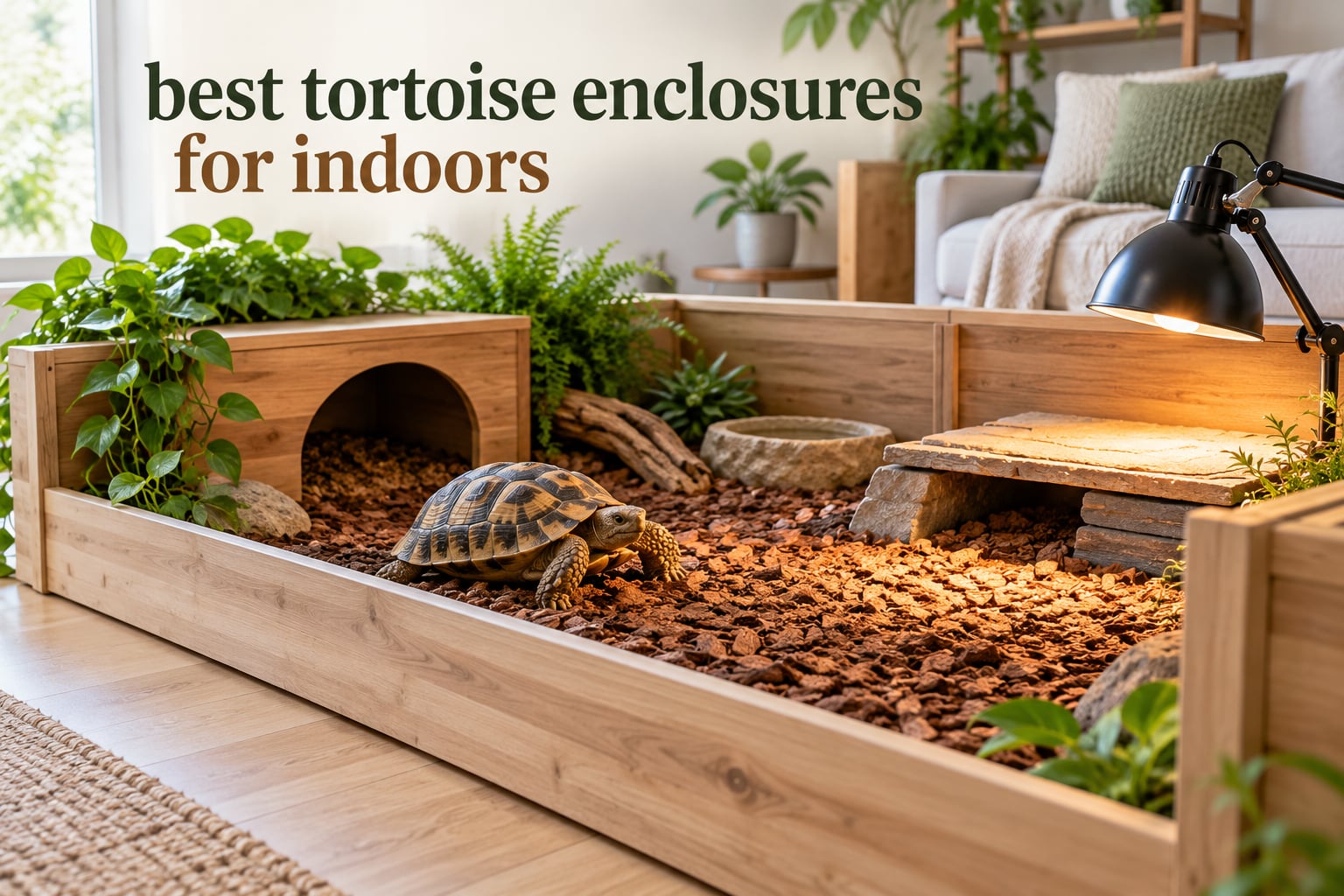
Choosing an indoor tortoise enclosure is the single decision that most affects whether a captive tortoise stays healthy. Too small a floor area, an all-glass tank, or a shallow layer of substrate will show up months later as pacing stress, soft shell, or respiratory trouble. This roundup covers 12 enclosures that are actually sold for indoor use, with the dimensions, materials and honest drawbacks for each one.
We deliberately left out aquatic turtle tanks with built-in filters and water pumps. They show up constantly in tortoise roundups, and they are the wrong animal entirely. Everything here is terrestrial housing, from open screen cages to composite habitats to two-room wooden houses.
If you are still working out the hardware around the enclosure itself, our best reptile enclosures guide covers the lamps, thermometers and monitoring gear that pair with these picks.
Table of Contents
What Is the Best Indoor Tortoise Enclosure?
The best indoor tortoise enclosure overall is the New Age Pet ECOFLEX 48 Mojave. Its composite panels hold heat and humidity far better than glass, the 46 inch interior floor gives a hatchling real walking room, and the mesh top with vented sides keeps air moving. For a smaller budget, the Zoo Med ReptiBreeze screen cage is the strongest starter option.
Top 3 Indoor Tortoise Enclosures in 2026
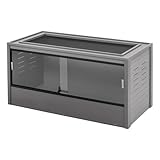
New Age Pet ECOFLEX 48 Mojave
- Composite panels hold heat and humidity
- 46 inch interior floor
- Sliding lockable front doors
- 10 year warranty

Zoo Med ReptiBreeze Screen Cage
- Front and bottom doors
- Light anodized aluminum build
- Assembles in 15-20 minutes

All 12 Indoor Tortoise Enclosures at a Glance
All 12 enclosures below are terrestrial tortoise housing. Dimensions are exterior unless the listing says otherwise, and every model here is sold for indoor placement.
| Product | Specifications | Action |
|---|---|---|
| New Age Pet ECOFLEX 48 Mojave |
|
Check Latest Price |
| Zoo Med ReptiBreeze Large Screen Cage |
|
Check Latest Price |
| GEGURI Wooden Tortoise House |
|
Check Latest Price |
 Aivituvin Tortoise Habitat AIR70 Aivituvin Tortoise Habitat AIR70 |
|
Check Latest Price |
 PetsCosset Tortoise Habitat PetsCosset Tortoise Habitat |
|
Check Latest Price |
 Penn-Plax Tortoise Palace REPTH1 Penn-Plax Tortoise Palace REPTH1 |
|
Check Latest Price |
 PawHut Habitat with Shelf Storage PawHut Habitat with Shelf Storage |
|
Check Latest Price |
 Magazoopet Large Tortoise Enclosure Magazoopet Large Tortoise Enclosure |
|
Check Latest Price |
 ZENTAVO 3-Room Tortoise Habitat ZENTAVO 3-Room Tortoise Habitat |
|
Check Latest Price |
 VEVOR Cedar Tortoise Habitat VEVOR Cedar Tortoise Habitat |
|
Check Latest Price |
 PawHut Habitat with Two Hide Boxes PawHut Habitat with Two Hide Boxes |
|
Check Latest Price |
 PawHut 2-Layer Tortoise Enclosure PawHut 2-Layer Tortoise Enclosure |
|
Check Latest Price |
1. New Age Pet ECOFLEX 48 Mojave – Best Composite Enclosure for Holding Heat
New Age Pet® ECOFLEX® 48″ Mojave Reptile Enclosure, Large, Grey
Composite panels
46.46 x 22.32 x 21.26 in interior
Mesh top, vented sides
10 year warranty
Pros
- Holds heat and humidity better than glass
- 20-30 minute build
- Lockable sliding front doors
- Light for a 48 inch habitat
- 10 year warranty
Cons
- Redesign shrank the front viewing window
- Interior height now under 22 inches
- Screen top is bare for heat-loving species
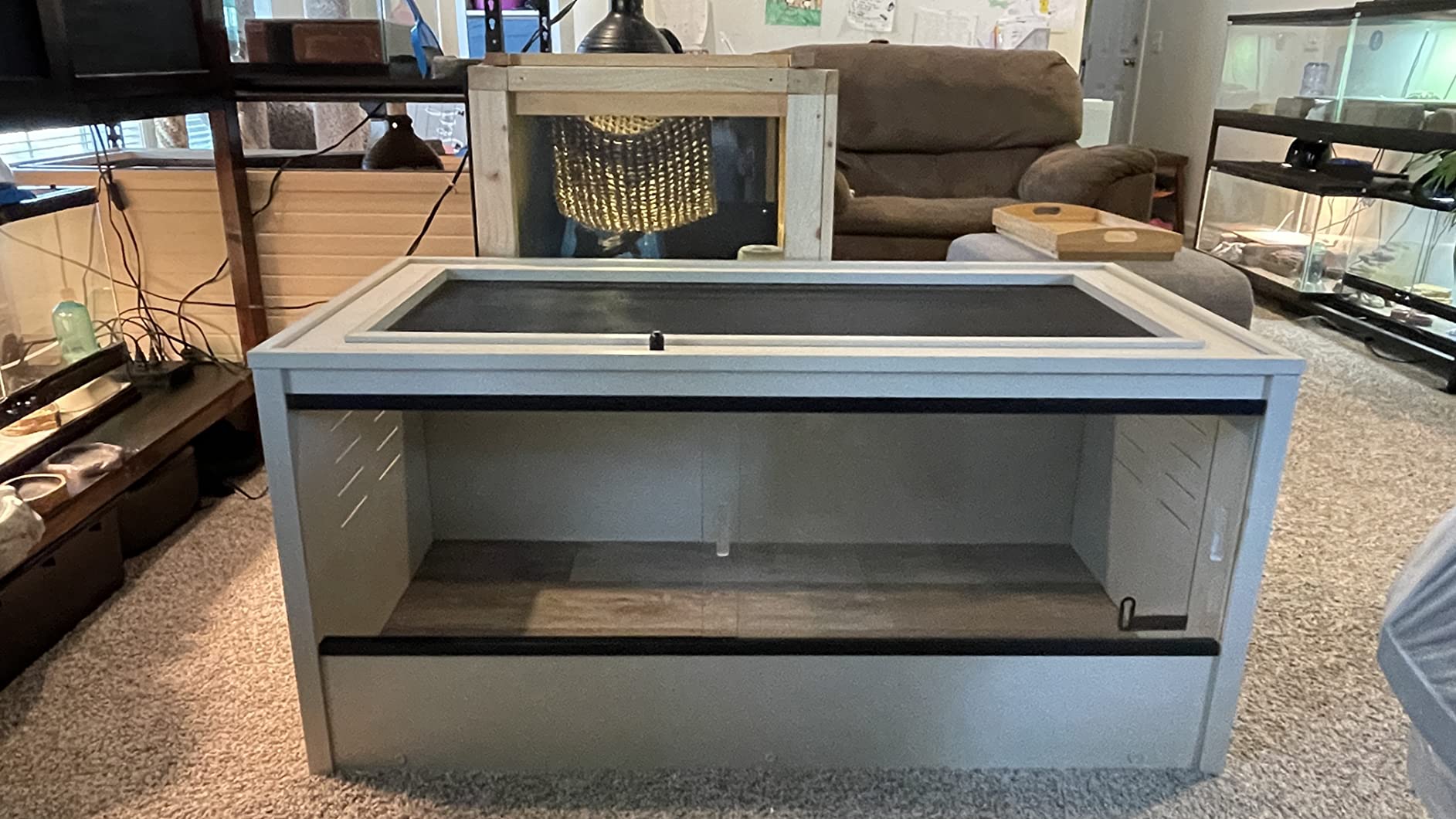
This is the enclosure we keep coming back to after comparing every option on the list. The interior measures 46.46 by 22.32 by 21.26 inches, which is a genuine 4 by 2 footprint rather than a starter box, and the composite panels slow heat loss in a way thin plastic never will.
Assembly took us about half an hour with basic tools, and the hardware came in the box. Sliding front doors with a lock make feeding and spot cleaning simple without pulling the whole top off.
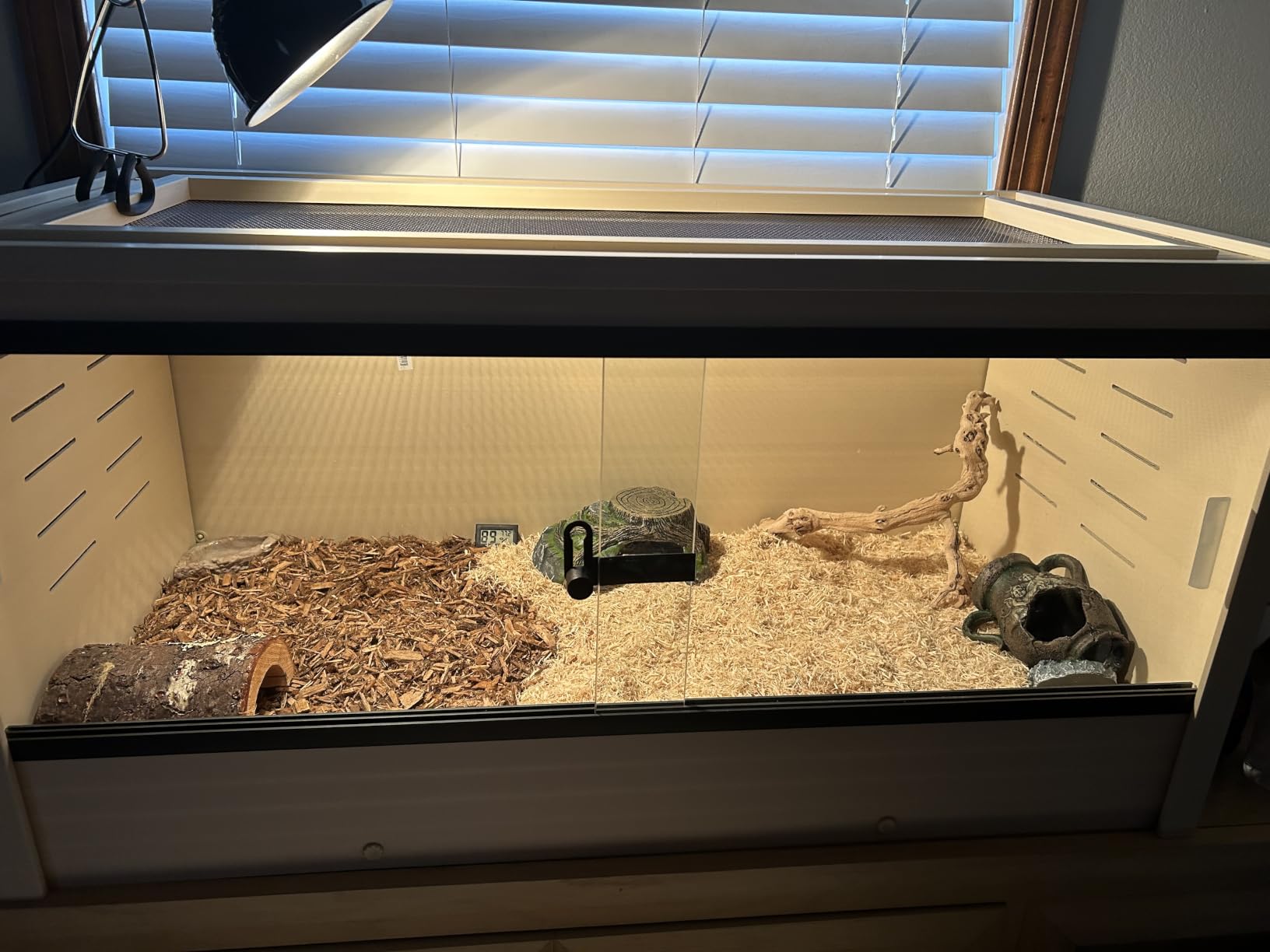
The most common owner note is that you should run a bead of aquarium silicone along the seams before adding substrate, particularly if you plan to keep live feeders. Owners with a cold room also cover the mesh top, since bare screen gives up heat quickly.
The redesign is the one complaint worth knowing about. The front glass viewing area shrank, and the height dropped by more than an inch, so this is no longer a true 4 by 2 by 2 interior. If you need that extra inch of headroom for a sulcata, look at the larger options further down.
Who the ECOFLEX 48 Works For
This suits hatchlings and juveniles of Russian, Hermann and Greek tortoises, and it works as winter indoor housing for an outdoor-kept adult. The 10 year manufacturer warranty also means it can be handed to the next animal in the house rather than binned.
Pair it with a 4 inch layer of substrate and a hide box placed opposite the basking lamp. The mesh top takes a lamp on a stand, and the vented side panels keep air moving even with a humid redfoot setup inside.
Who Should Skip the ECOFLEX 48
Skip it if your adult tortoise needs more floor space than 4 by 2 feet, or if you want a full side wall of glass for viewing. Those needs point toward a larger custom build rather than another shelf enclosure.
Also inspect the panels on arrival. Several owners report dings, dents or a bent screen top from shipping, and a few bought a replacement unit outright.
2. Zoo Med ReptiBreeze Large Screen Cage – Best Budget Starter Screen Cage
Zoo Med ReptiBreeze Open Air Screen Cage, Large, 18 x 18 x 36-Inches
18 x 18 x 36 inches
Anodized aluminum screen
Front and bottom doors
3.44 lb
Pros
- Light and easy to clean
- Front and bottom doors
- 15-20 minute build with one screwdriver
- Weighs just 3.44 pounds
Cons
- Narrow 18 inch footprint
- Screen tears if pushed
- Open base lets substrate spill
- No mounting points for fixtures
This cage has been on the market since 2009 and still turns up in nearly every beginner thread we read. The 18 by 18 by 36 inch frame gives you vertical space that most flat habitats cannot, and it weighs just 3.44 pounds so one person can move it.
The bottom door is the feature people forget. You can strip out old substrate through the base without dismantling the whole cage, which makes spot changes a two-minute job.
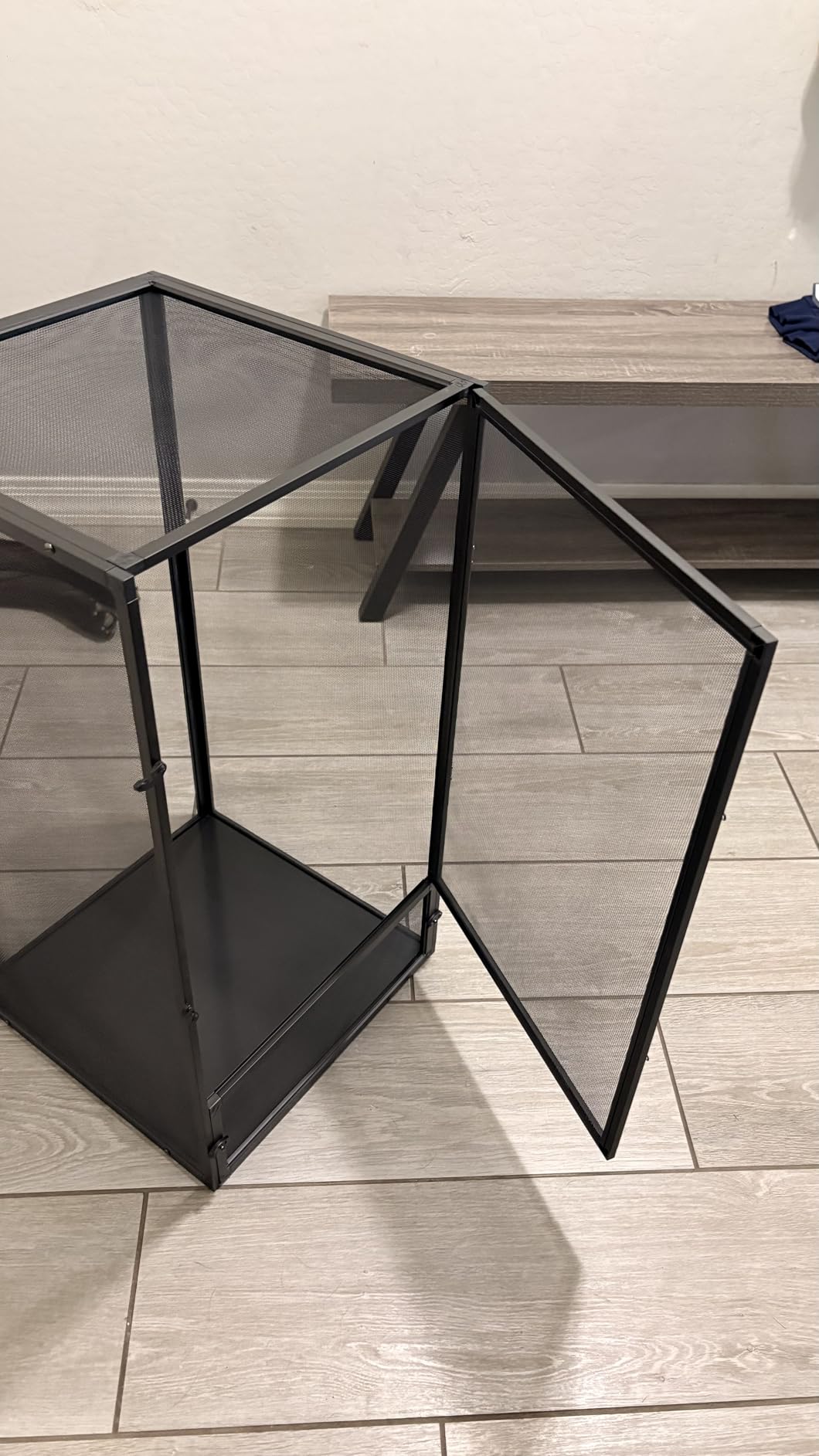
Be realistic about what an open screen cage is. It is a ventilated wire frame with no solid walls, so it cannot hold humidity, and there is no built-in surface to mount a lamp on, which means fixtures get zip-tied to the mesh. Owners of heat-loving species end up insulating panels themselves.
The other recurring theme is screen durability. The aluminum is sturdy in normal use, but reviewers report tears when a tortoise pushes against it or when décor is clipped on too tightly.
Where the ReptiBreeze Fits Best
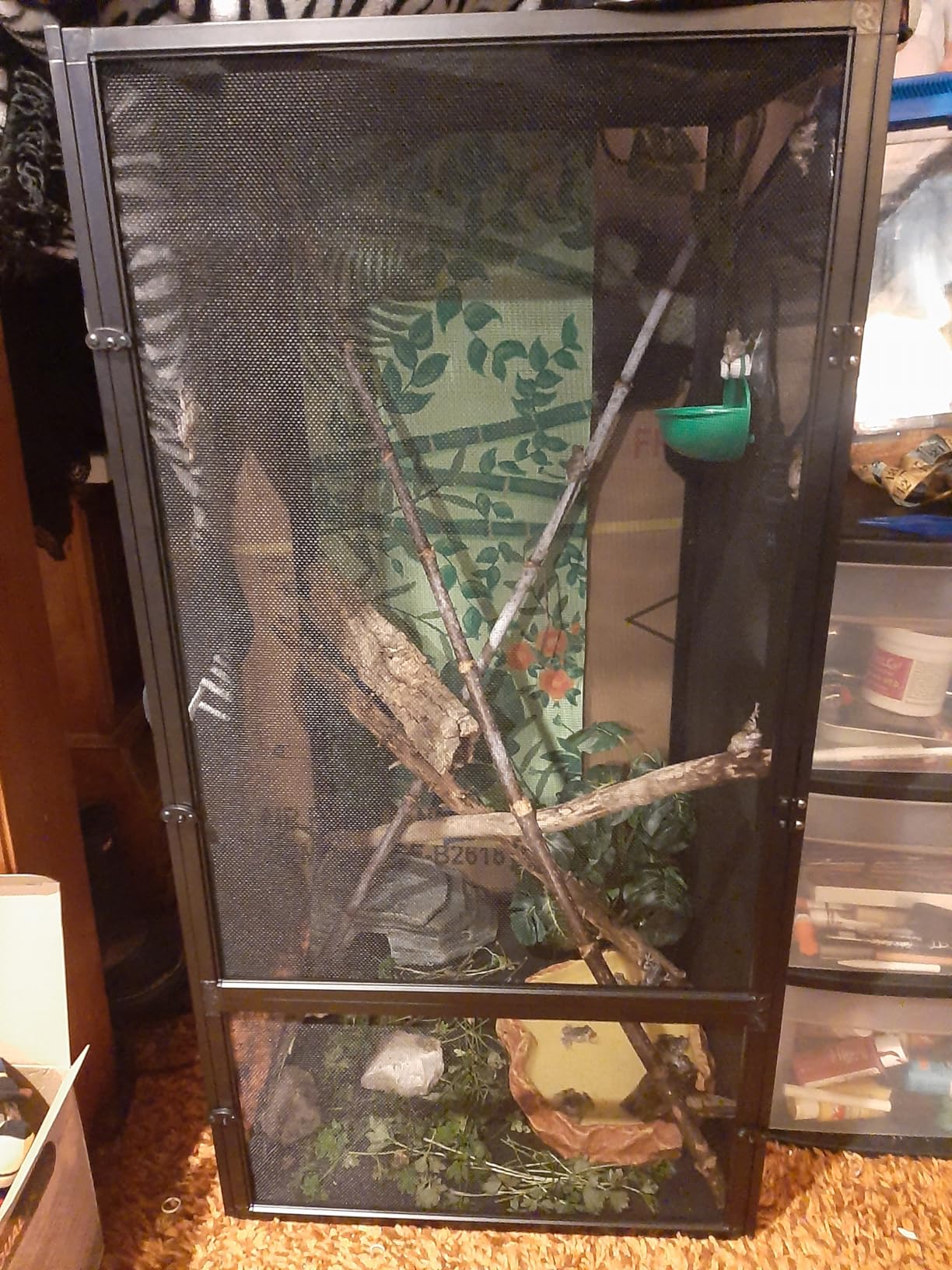
It works well as a quarantine or hospital setup, a temporary home for a hatchling, or an arboreal species habitat where airflow matters more than humidity. A 4 inch substrate layer will not stay put, so expect a ground layer and a feeding area instead.
It is also an easy way to learn where your heat and light fixtures will land before you commit to a heavier enclosure.
Who Should Skip the ReptiBreeze
Skip it for an adult Russian, redfoot or sulcata. The 18 by 18 inch floor is well under the 4 by 8 foot standard that experienced keepers repeat, and vertical height does not substitute for walking surface.
Also skip it if you keep a redfoot or other tropical species, since the open screen makes a stable humidity target difficult to hit.
3. GEGURI Wooden Tortoise House – Best Two-Room Layout for First-Time Keepers
GEGURI Tortoise Habitat Indoor & Outdoor, Wooden Tortoise House with Detachable Legs, Reptile Cage for Small Animals
38 x 24 x 32 inches with legs
Solid fir wood
Two rooms
Pull-out tray
Pros
- Two-room layout gives a real sleeping space
- Detachable legs work on floor or table
- Removable tray speeds cleaning
- Three-sided viewing windows
Cons
- Corner gaps leak substrate
- Humidity is hard to hold
- Unsealed joints
The two-room design is the reason this one appeals to beginners. One side is a private sleeping area, the other is a viewing and activity space, and the animal gets a real choice instead of one open box.
Detachable legs mean the same unit works on the floor, on a table, or outside on a warm patio. At 38 by 24 by 32 inches including legs, it fits a small apartment corner without dominating the room.
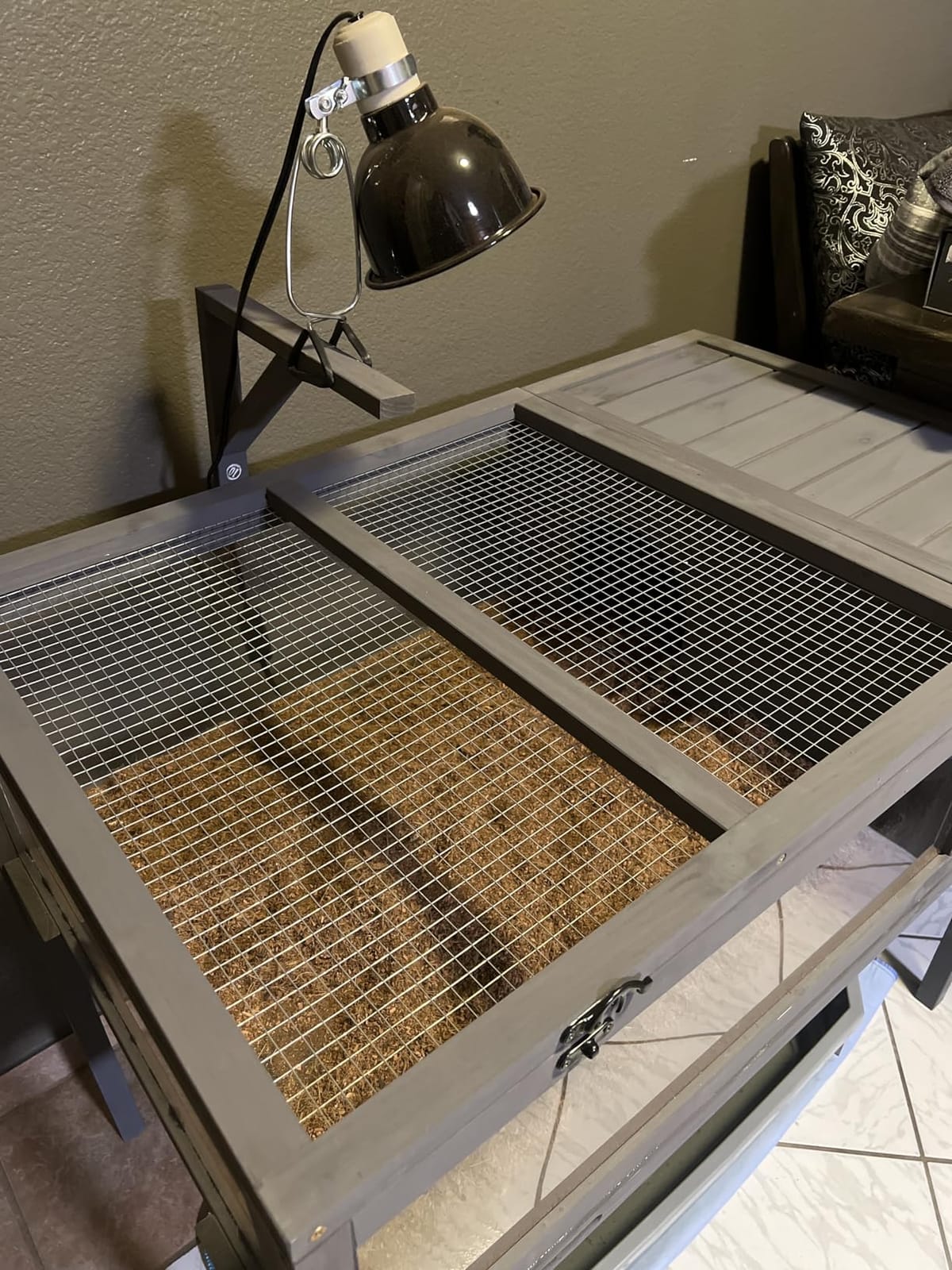
The build quality is where the reviews get blunt. Multiple buyers report gaps at the corners and wall joints where loose substrate falls through, and the open seams make humidity retention difficult indoors.
Many owners end up treating this as a warm-weather outdoor house instead of a sealed indoor habitat. If humidity control is part of your plan, run a bead of silicone along the joints first.
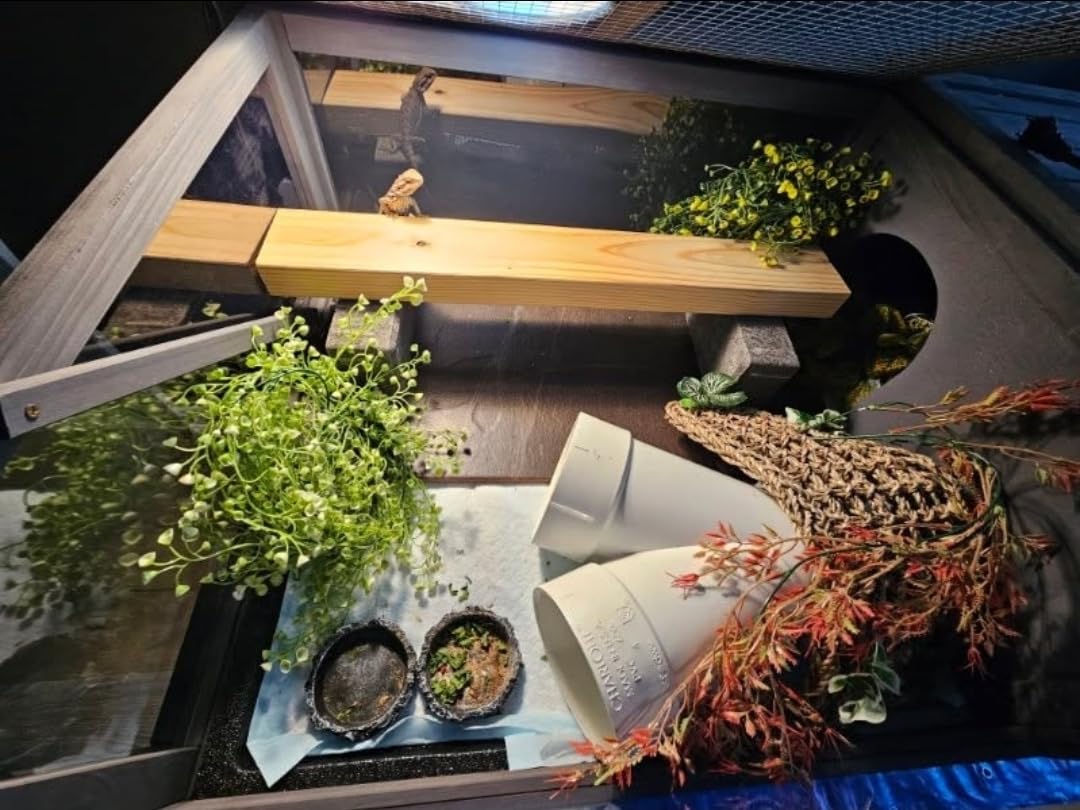
What Works With the GEGURI House
It handles juvenile Russian, Hermann and Greek tortoises well, and the pull-out tray makes daily cleaning straightforward. Add a hide box and a water dish in the sleeping room and a basking platform under the lamp in the viewing room.
The three-sided windows are genuinely useful for monitoring activity without opening anything, and the all-surrounding bottom catches spills.
Where It Falls Short
It is not a sealed chamber, so a tropical redfoot setup will struggle in a dry room. It also sits at the low end of floor space for anything past a year or two of growth.
Owners who need humidity control indoors should pick a composite habitat instead of trying to seal wood seams with sealant after the fact.
4. Aivituvin Tortoise Habitat AIR70 – Best for a Built-In Adjustable Lamp Holder
Aivituvin Tortoise Habitat Turtle Enclosure, Wooden Tortoise House Reptile Cage for Small Animals Indoor-Outdoor, Adjustable Lamp Holder Included
39.4 x 22.5 x 31.5 inches
Lamp holder 11-31 inch
360 degree rotation
Moisture-proof finish
Pros
- Lamp holder adjusts across a wide height range
- 360 degree rotation moves the basking spot
- Removable legs for table or floor use
- Acrylic window allows easy observation
Cons
- Wood seams leak humidity
- Acrylic panel scratches when cleaned
- Longer assembly than most
The lamp holder is the stand-out feature. It adjusts from about 11 to 31 inches in height and spans roughly 13 to 21.1 inches in width, and it rotates through 360 degrees, so you can move the basking zone from one room to the other without taking the fixture down.
That matters more than it sounds. A gradient that you can dial in is the difference between a basking spot and a uniformly warm box, and most wooden houses force you to move the animal instead.
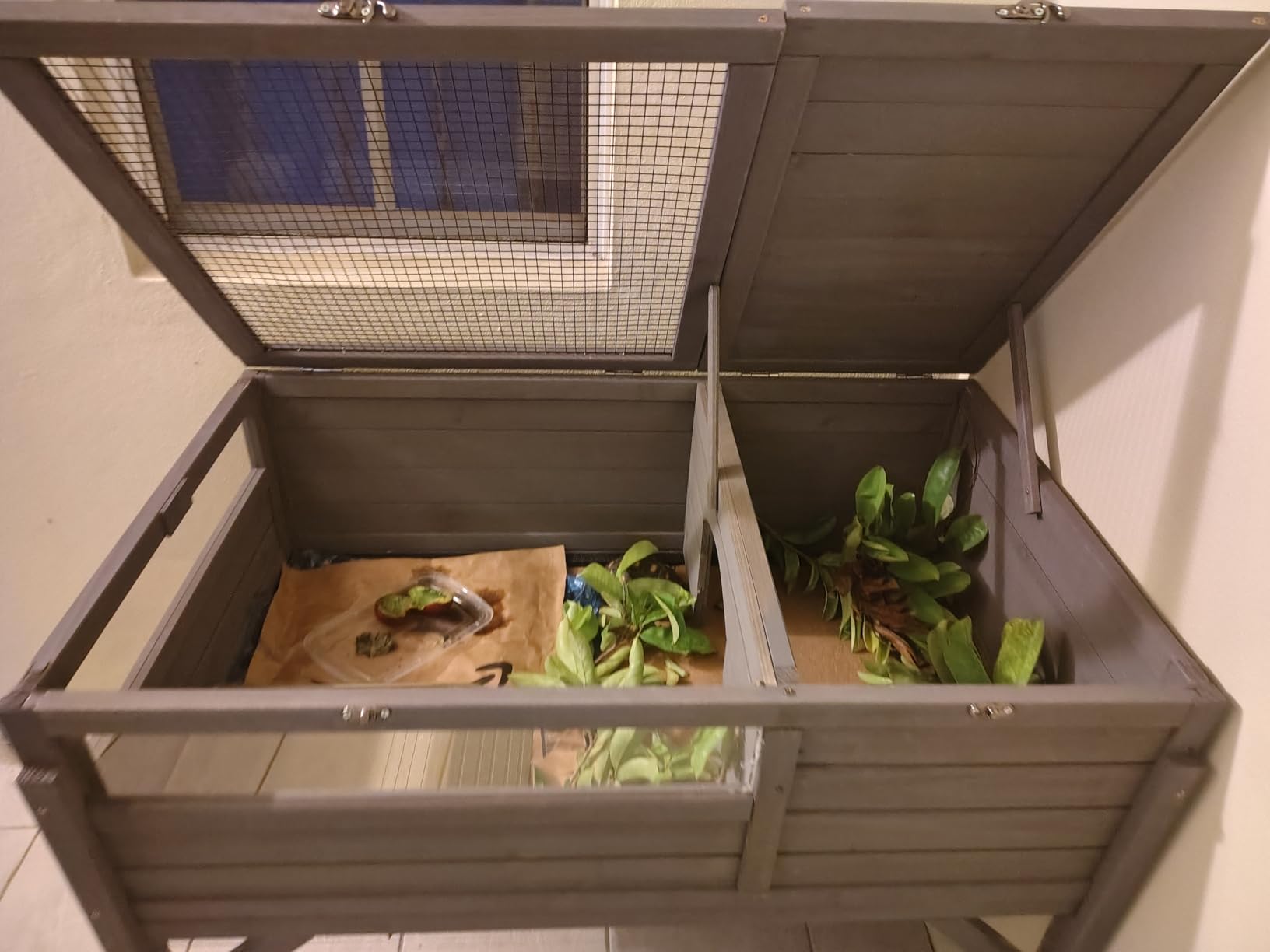
The two-bedroom layout pairs an activity area with a weatherproof hiding area, and the roof opens freely for handling. Removable legs let you shift between a table setup and floor placement as the animal grows.
Buyers add sealant before indoor use, because the wood seams leave gaps that make humidity hard to control. The acrylic viewing window also scratches easily during cleaning, so a soft cloth matters.
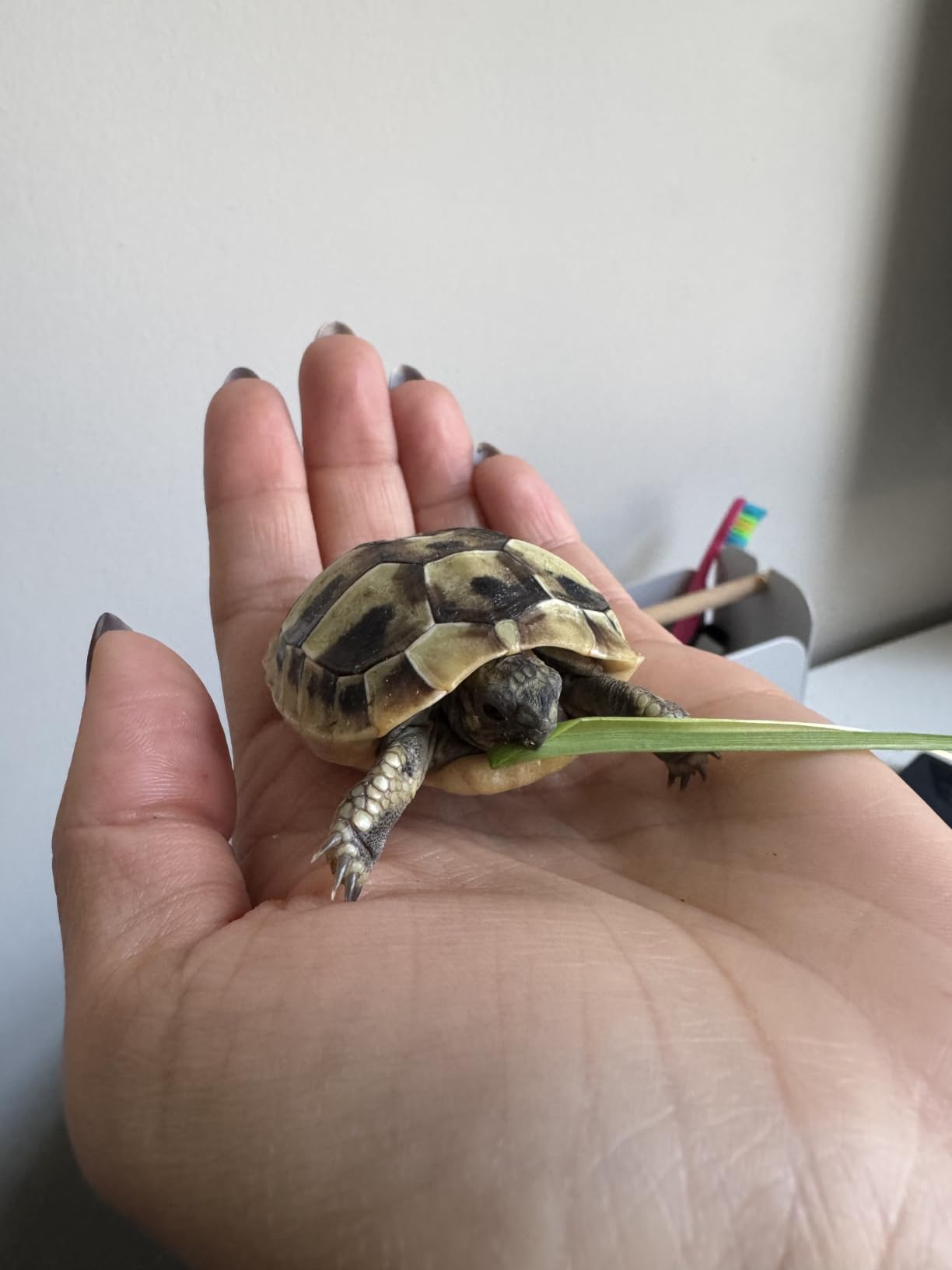
Who This Habitat Fits
It suits juveniles of most common indoor species, and the adjustable lighting makes it a good fit for dry temperate setups that need a hot basking zone. The moisture-proof finish also lets you move the same unit outside in summer.
Expect a longer build than the flat-pack plastic options. Reviewers describe it as more involved than a quick-setup habitat, so set aside a proper session.
When to Choose Something Else
Skip it if humidity is a strict requirement you cannot manage with sealant, and skip it if you want a fully sealed chamber with no gaps at all.
It also carries more weight than most wooden houses in this category, so check the route to its final spot before assembly.
5. PetsCosset Tortoise Habitat – Best Low-Cost Two-Room House
PetsCosset Tortoise Habitat with Detachable Legs, Wooden Indoor & Outdoor Turtle Enclosure, Two-Room Reptile House, Large Observation Windows, Removable Pull-Out Tray, for Tortoises
37.2 x 22.8 x 32.3 inches
Three acrylic windows
Two pull-out trays
Detachable legs
Pros
- Labeled panels make solo assembly around 30 minutes
- Soft wood resists cracking
- Two removable trays
- Light enough to move around
- Good size for the money
Cons
- Wire top too thin for a heat lamp
- Trays sit loose and undersized
- Uneven panel cuts leave cracks
- Windows stop short of the base
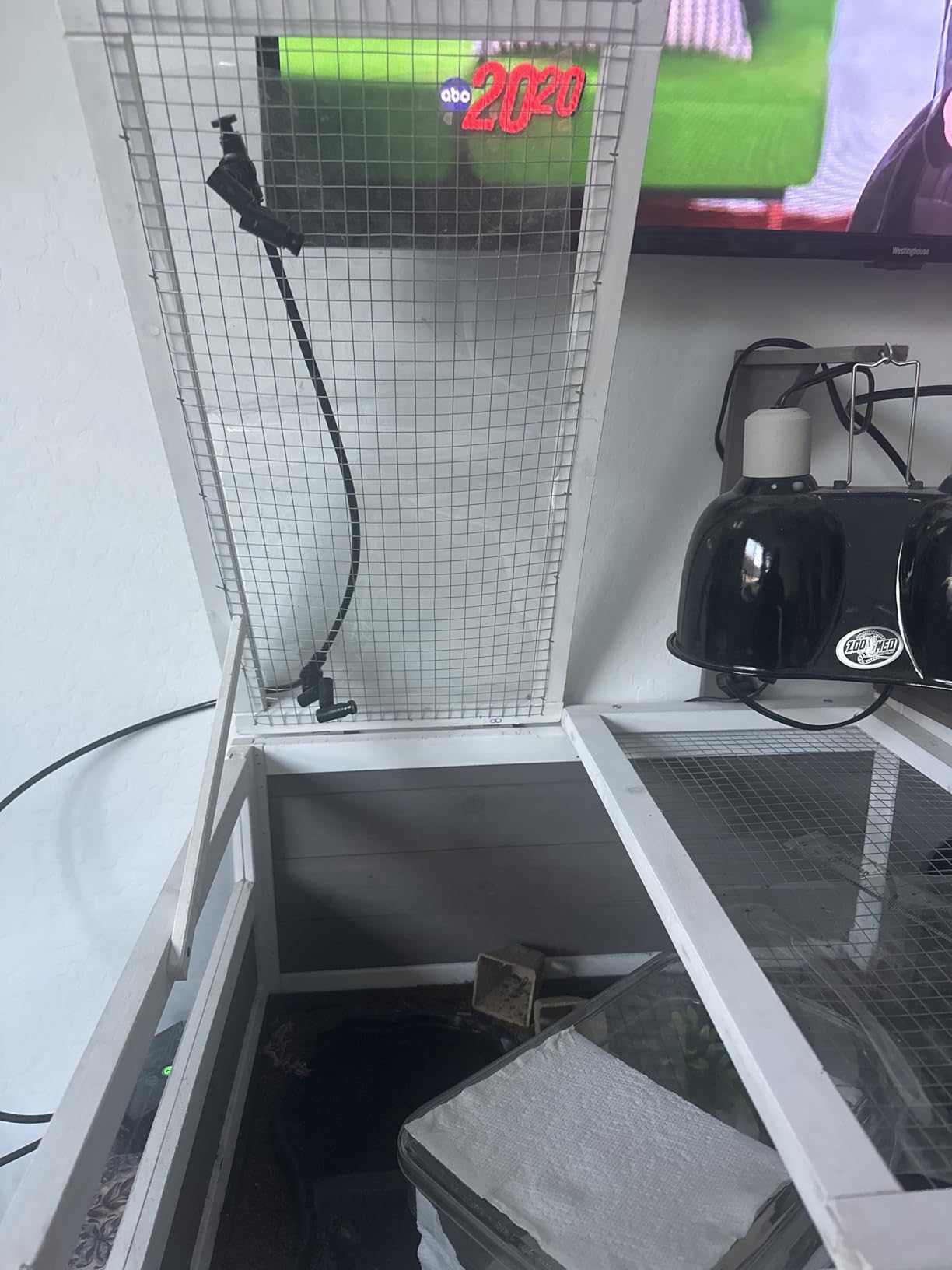
The panel numbers and clearly labelled pieces make solo assembly unusually friendly. Panels are numbered on the wood itself, and owners report around 30 minutes from box to finished habitat.
Three size variants run from 37.2 by 22.8 by 32.3 inches up to 40.4 by 22.8 by 34.2 inches, so you can pick to fit your space rather than the other way around.
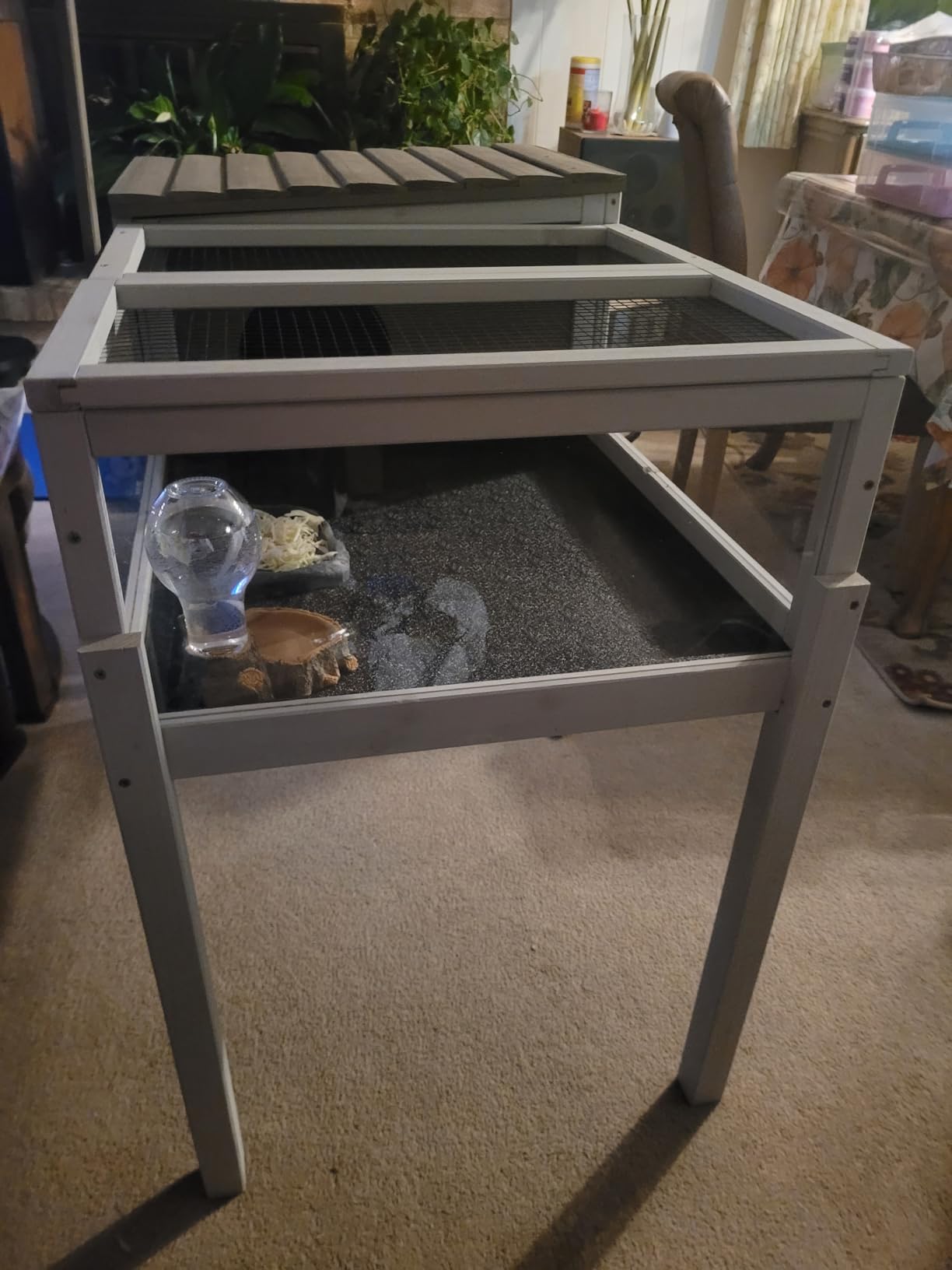
Two caveats stand out for indoor use. The thin top wire mesh cannot hold a heat lamp, so a separate stand is required, and the trays sit loosely on their ledges and are undersized enough to leave about an inch of gap against the interior walls.
Unevenly cut panels are the other recurring complaint. They stop the tray sitting flush, which is what lets substrate fall through the cracks and humidity escape.
Where the PetsCosset House Works
It is a good fit for a first tortoise, a hatchling setup, or a quarantine space, and the removable legs mean it can live on a table until the animal outgrows it. Wheels on the base also make it easy for families to reposition.
The listing covers Russian, Hermann, Greek, marginated, red-footed and sulcata tortoises alongside small reptiles, so the frame itself is not the limitation.
When to Look Elsewhere
Skip it if you want a sealed indoor chamber, since the gaps work against humidity retention. Skip it if you want a built-in lamp mount, and think twice if a larger adult is the goal.
If humidity control is your top priority, spend the difference on a composite habitat rather than sealing this one yourself.
6. Penn-Plax Tortoise Palace REPTH1 – Best Large Glass Footprint for a Living Room
Penn-Plax Large (48″ x 30″) Tortoise Palace with Wire Top, Black Frame, Glass Terrarium, and Lamp Mount – Beautiful Turtle Cage Designed for The Modern Home with Room for Growth (REPTH1)
48 x 30 x 12 inches
Glass panels
Side hideaway with lockable top
Rear lamp mount
Pros
- Very wide 48 by 30 inch floor
- Side compartment doubles as a hideaway
- Windowsill detail reduces glass contact
- Rear lamp mount for basking
Cons
- 72.45 lb and hard to move
- Only 12 inches of interior height
- Wire top over the main area
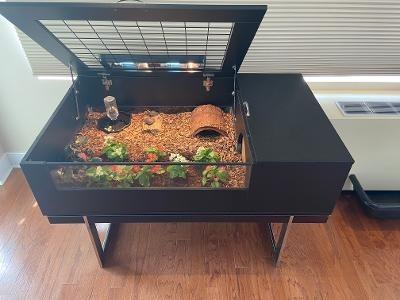
This is the only glass enclosure on the list, and it pairs a 48 by 30 inch floor with a black frame and clean lines that do not read as a reptile cage. That matters if it is going in a front room.
The windowsill detail along the front is a thoughtful touch. It gives the tortoise a physical barrier at glass level, which reduces the pacing and rubbing that transparent walls tend to provoke.
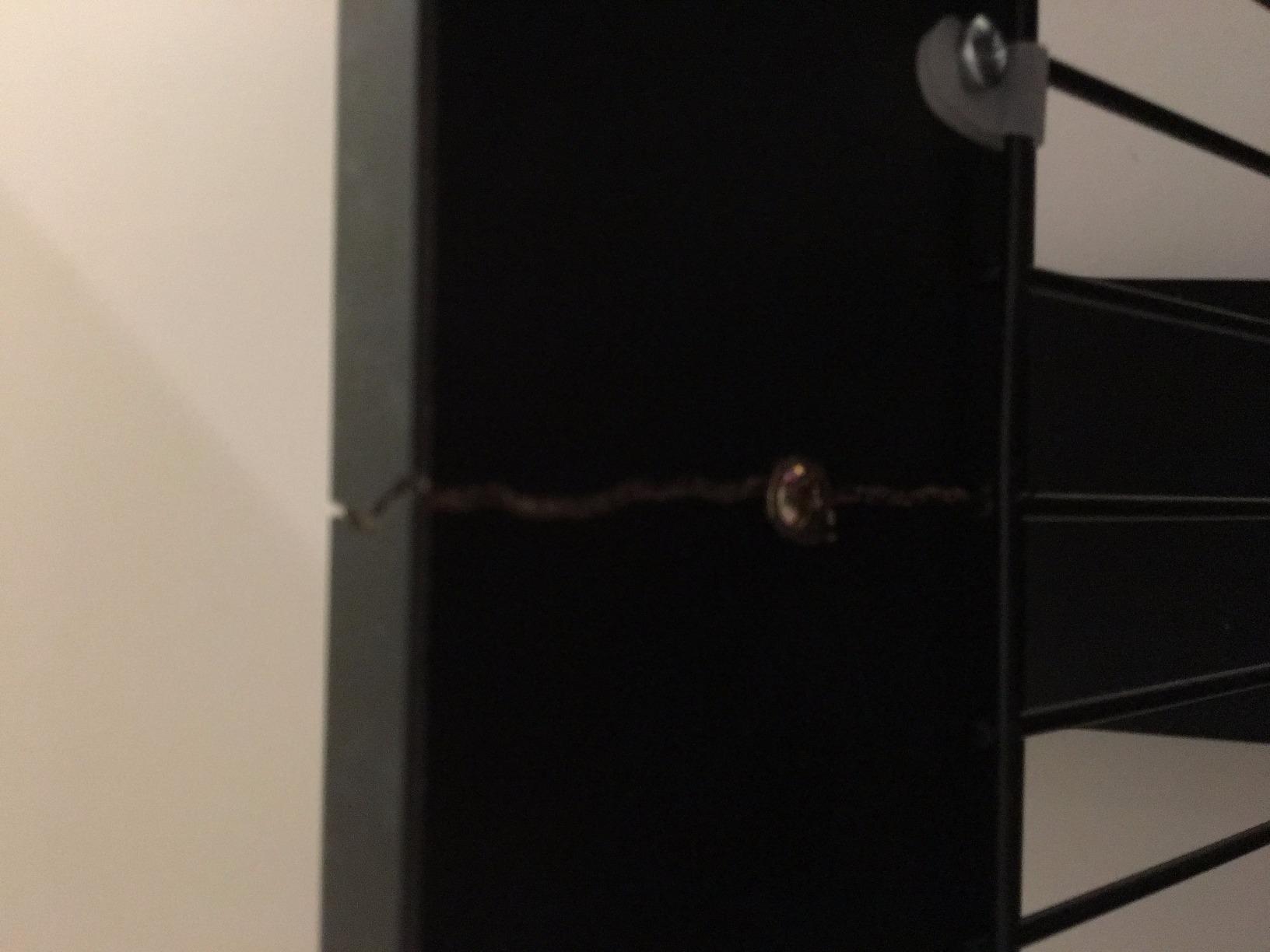
The side compartment works as a sleeping area or hideaway and has its own lockable top, so you can open the main section without exposing the animal. An adjustable rear mount holds a basking lamp, though the lamp itself is not included.
Height is the limitation. At 12 inches, the interior suits small and medium tortoises, and a large adult may feel cramped even with that much floor space.
Who This Palace Suits
It suits keepers who want one animal visible in a shared living space and who are willing to manage slow heat loss. The rear lamp mount and wire top make a gradient straightforward to set up.
For cold rooms, be aware that thin glass gives up heat quickly, so budget for a ceramic heat emitter on a thermostat rather than a single lamp.
Who Should Skip It
Skip it if you move the enclosure often. At 72.45 pounds, moving it without help is a real injury risk, and the glass panels are awkward to grip.
Skip it for a sulcata or other large species that needs vertical clearance, and skip it if your tortoise is known to pace at glass despite the windowsill detail.
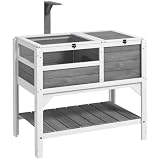
7. PawHut Habitat with Shelf Storage – Best for Small Rooms and Built-In Storage
PawHut Tortoise Habitat with Shelf Storage, Tortoise Enclosure with Weather Protection, Reptile Gift Accessory, Reptile Enclosure with Tray, Light Support Frame, Light Gray
33 x 20 x 40.5 inches
32 inch storage shelf
Hide box and basking grating
Mesh wire screen top
Pros
- Shelf folds storage into the footprint
- Two-room layout with a built-in hide box
- Openable lid for quick access
- Observation windows on both sides
Cons
- Unsealed wood limits humidity
- Steel grating is uncomfortable bare
- Light gray finish stains near water
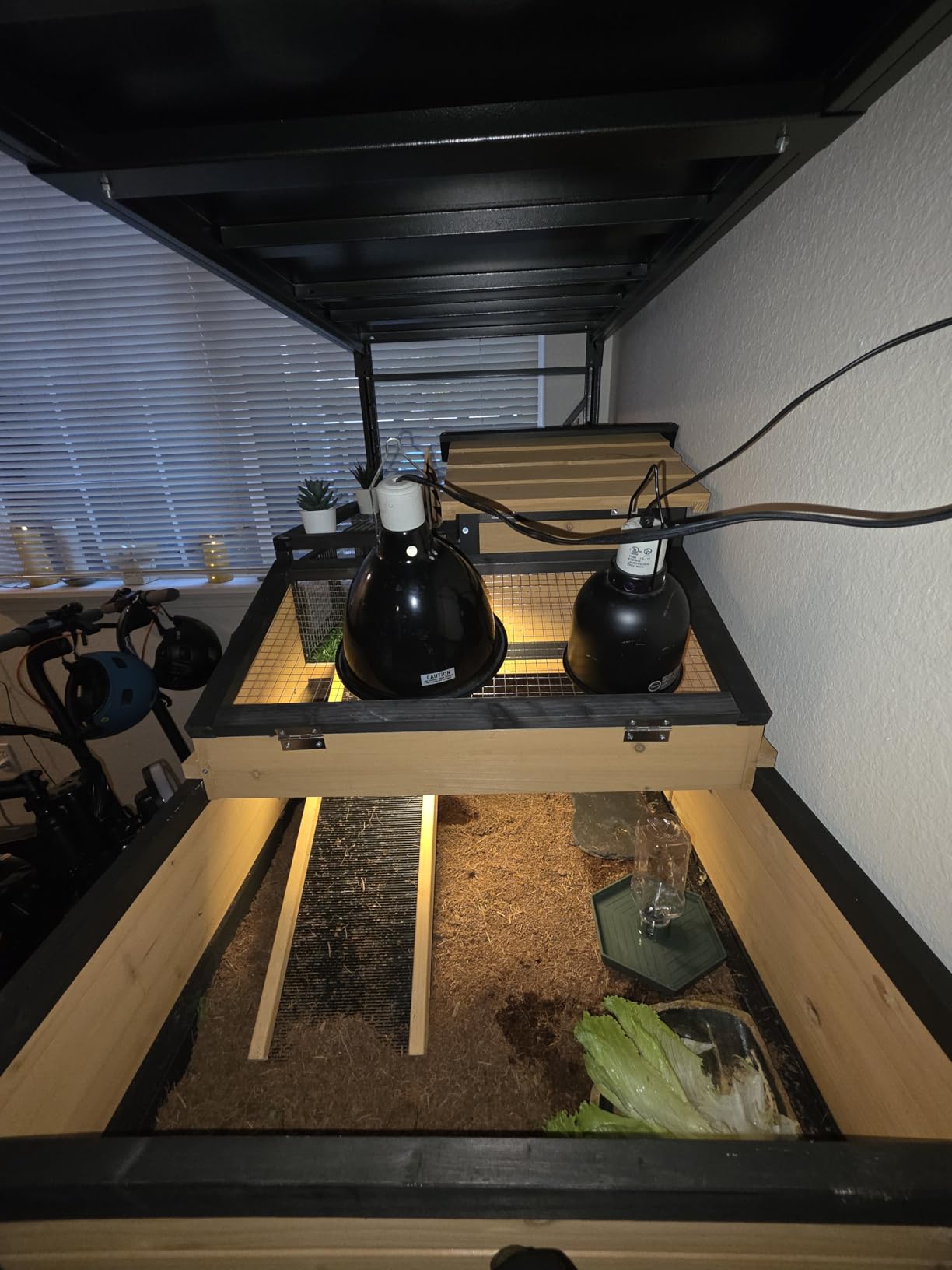
The built-in shelf is the whole idea here. A 32 by 19 inch shelf sits under the habitat, so your heat emitter, UVB lamp, thermostat and substrate all live in the footprint of the enclosure instead of beside it on another piece of furniture.
That makes it a practical option in a small apartment. The 33 by 20 inch base and mesh top keep the vertical profile compact, and the openable lid gives fast access to the animal.
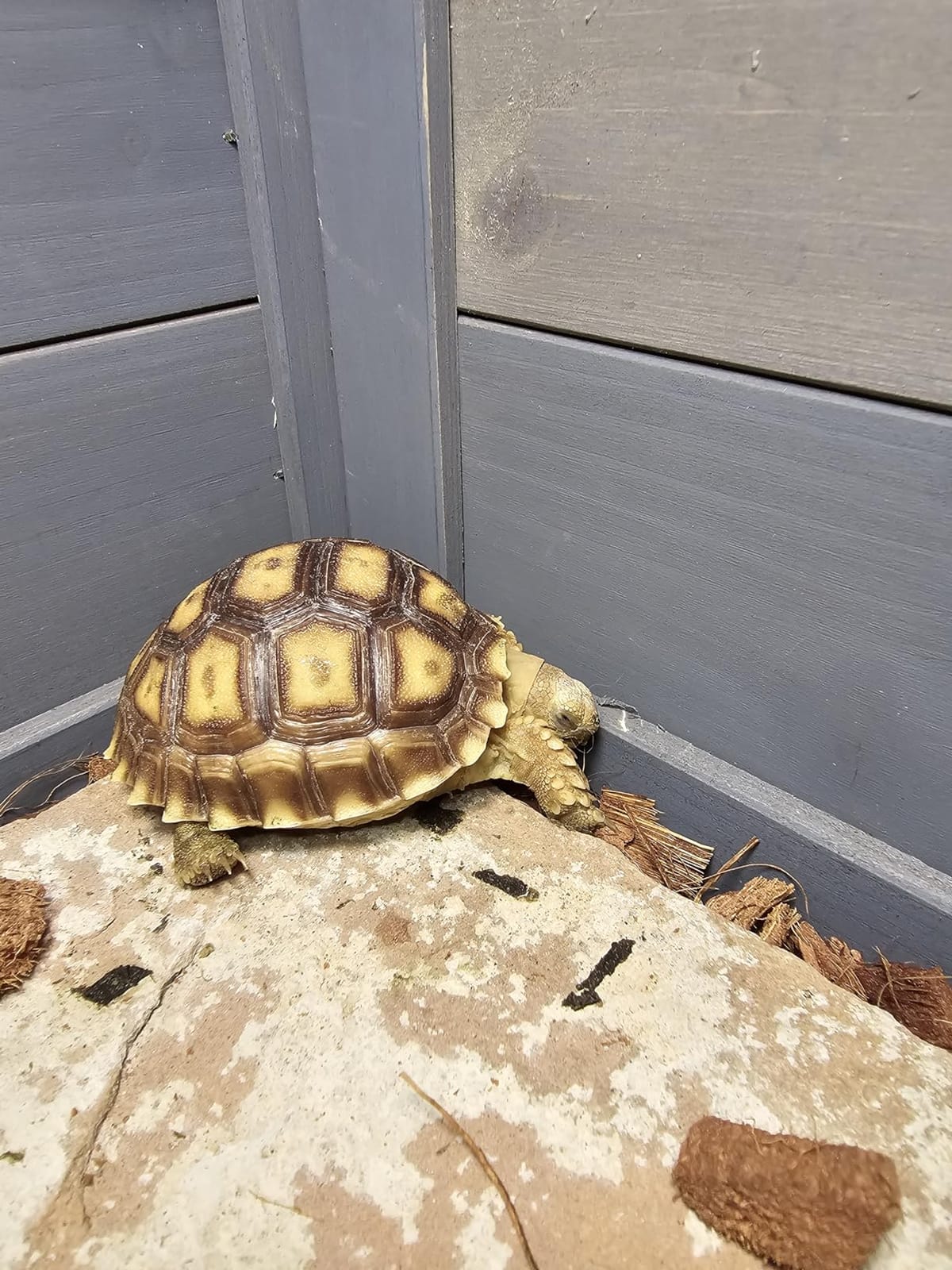
The two-room layout has a 12.5 by 17.25 by 12.5 inch hide box on one side and a matching steel-grating basking area on the other. The grating needs substrate laid over it, because bare steel is uncomfortable underfoot.
For indoor use the unsealed wood is the real limitation. Owners report that humidity retention is weak, and the light gray finish shows staining around the water and waste areas.
Who This Shelf Habitat Is For
It fits a juvenile Russian, Hermann or Greek tortoise, and it doubles as a patio setup in warm weather. The under-shelf storage keeps the whole system looking tidy in a living room.
Place a hide box in the shaded room and a basking platform over the grating, then run your gradient across the two halves.
Where It Falls Short
At 33 inches long, the floor area is short for anything approaching adult size, and the unsealed construction rules it out for tropical species that need high humidity.
If you plan to keep the animal here for more than a year or two, budget for a move to a longer habitat rather than treating this as a permanent home.
8. Magazoopet Large Tortoise Enclosure – Highest Rated, With the Widest Lamp Adjustment
Large Tortoise Enclosure with Lamp Stand, Wooden & Plastic Turtle Habitat
40.3 x 22.8 x 34.2 inches
Five lamp positions
Height 30.5-38.4 inch
Fir wood and plastic
Pros
- Highest rating in the group at 4.4
- Five horizontal lamp positions plus height adjustment
- Dual-zone lounging and activity areas
- Assembly around 40 minutes
- Slide-out tray
Cons
- Some wood pieces crack in assembly
- Painted numbers will not come off
- Initial wood smell needs airing out
This is the best-rated enclosure we reviewed, at 4.4 out of 5, and owners single out the spacious dual-zone design and the lighting control.
The lamp holder offers five horizontal positions between 14.6 and 22.4 inches and height adjustment from 30.5 to 38.4 inches. On a 40.3 by 22.8 by 34.2 inch frame, that range lets you place a basking spot over one zone while keeping the other cooler.
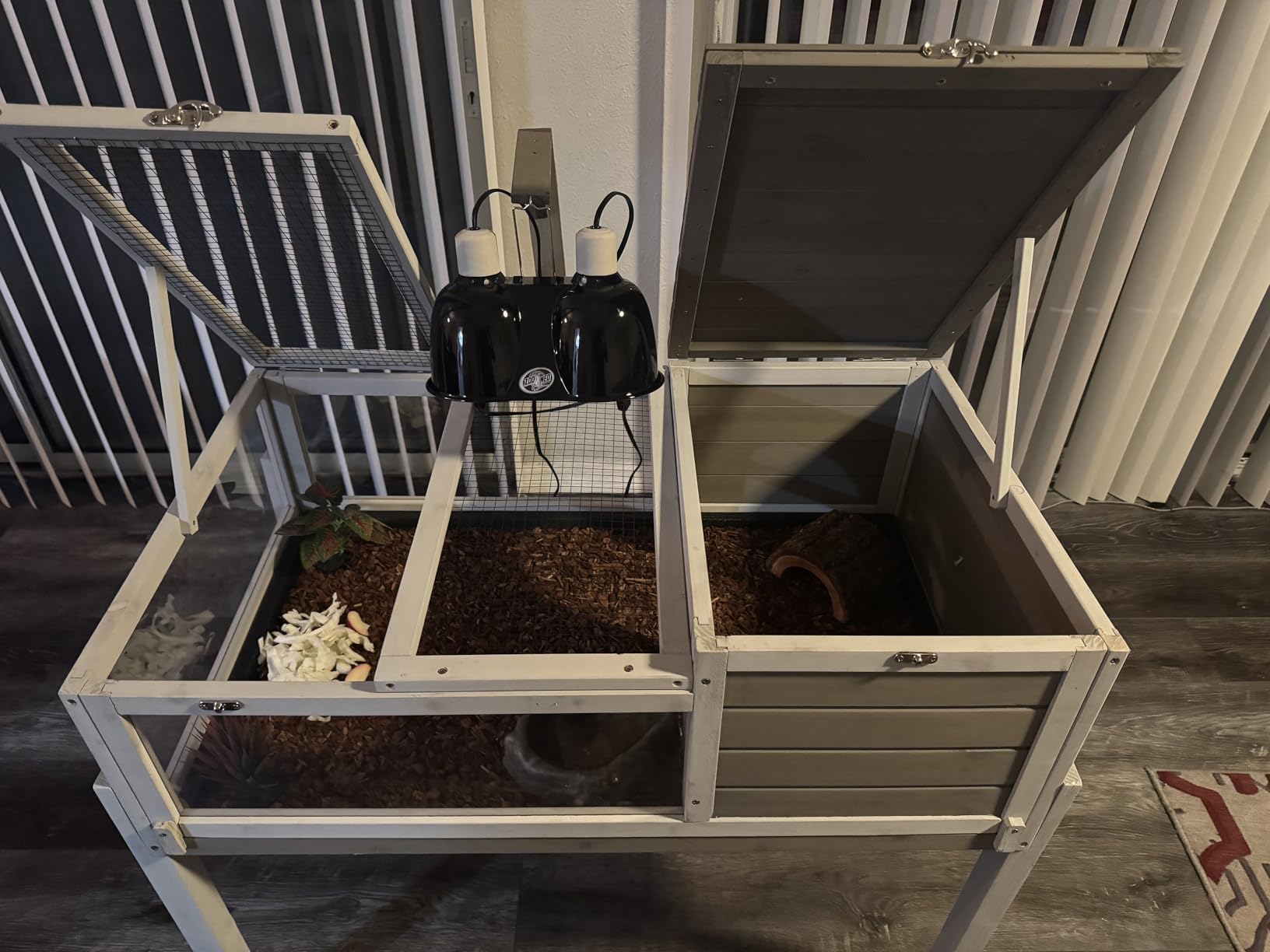
Owners generally find assembly straightforward, roughly 40 minutes, though the instructions are described as vague enough that you will lean on the pictures. Fir wood with reinforced plastic edges keeps the structure rigid.
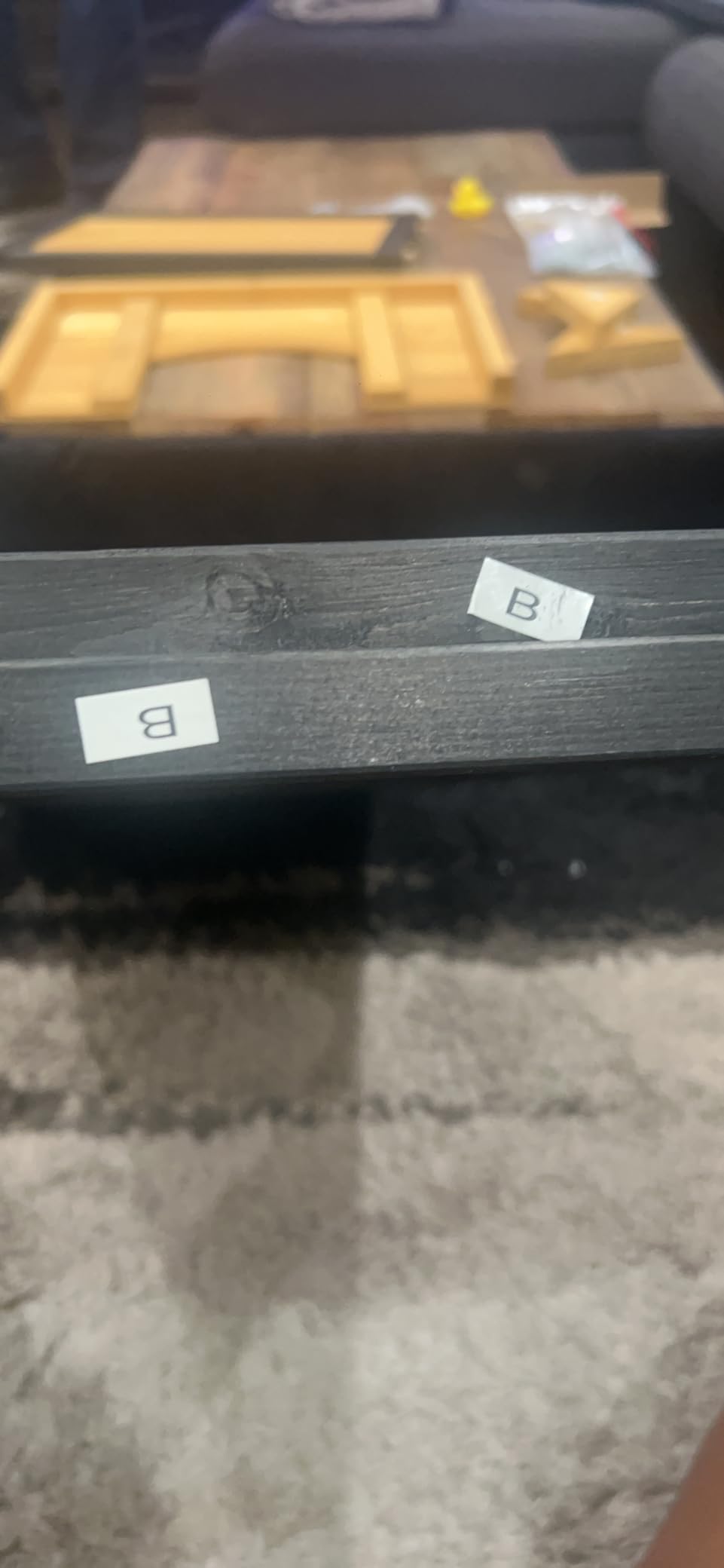
Minor quality issues come up repeatedly. Some wood pieces crack during assembly, the blue painted part numbers do not come off the finish, and the initial wood smell needs a few days of airing out.
Who This Enclosure Suits
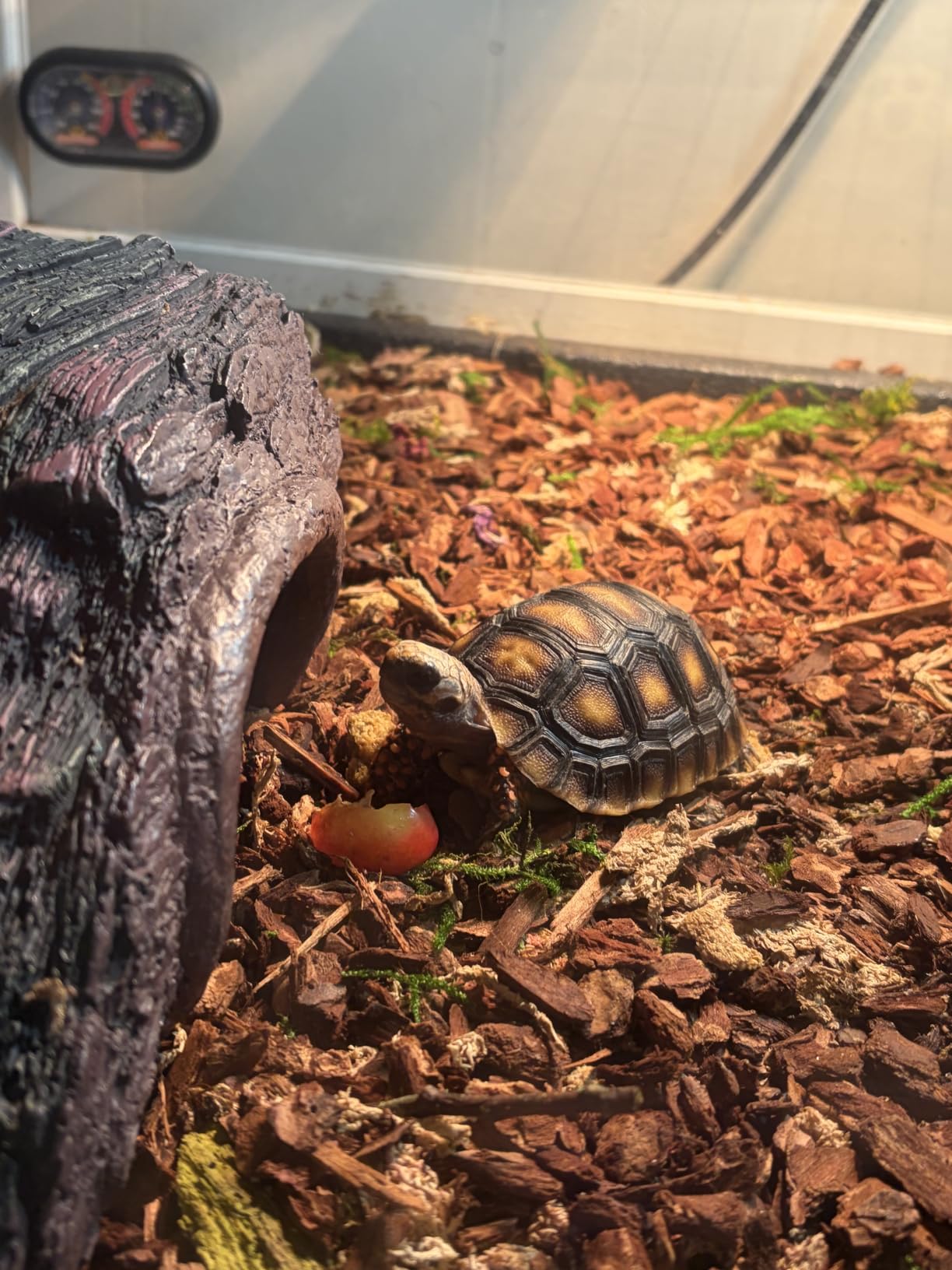
It suits dry temperate species kept indoors, including juvenile Russians and Hermanns, and it works well for a keeper who wants to fine-tune a gradient rather than just aim a lamp into a corner.
The slide-out tray keeps cleaning quick, and the clear acrylic window makes it easy to check the animal without opening the habitat.
Who Should Look Elsewhere
Skip it if you need a sealed chamber. Wood construction will not hold a tropical humidity range, and the gaps in the joints make that worse.
Also skip it if you are sensitive to strong smells, since the new-wood odour needs airing before the animal goes in.
9. ZENTAVO 3-Room Tortoise Habitat – Best Multi-Level Enrichment Layout
3-Room Large Tortoise Habitat with Pull-Out Tray, Wooden Tortoise Enclosure Indoor & Outdoor with Ramp, Grass Mat, Openable Roof, Luxurious Reptile Enclosure for Small Animals, Yellow
44 x 25.6 x 24 inches
Three rooms and two levels
Ramp and balcony
Openable roof
Pros
- Longest wooden footprint in the group at 44 inches
- Three rooms give a real choice of spaces
- Water-resistant paint suits indoor-outdoor use
- Includes ramp and grass mat
Cons
- Open balcony mesh leaves humidity low
- 32 lb unit is heavy to move
- Assembly has some mislabeled parts
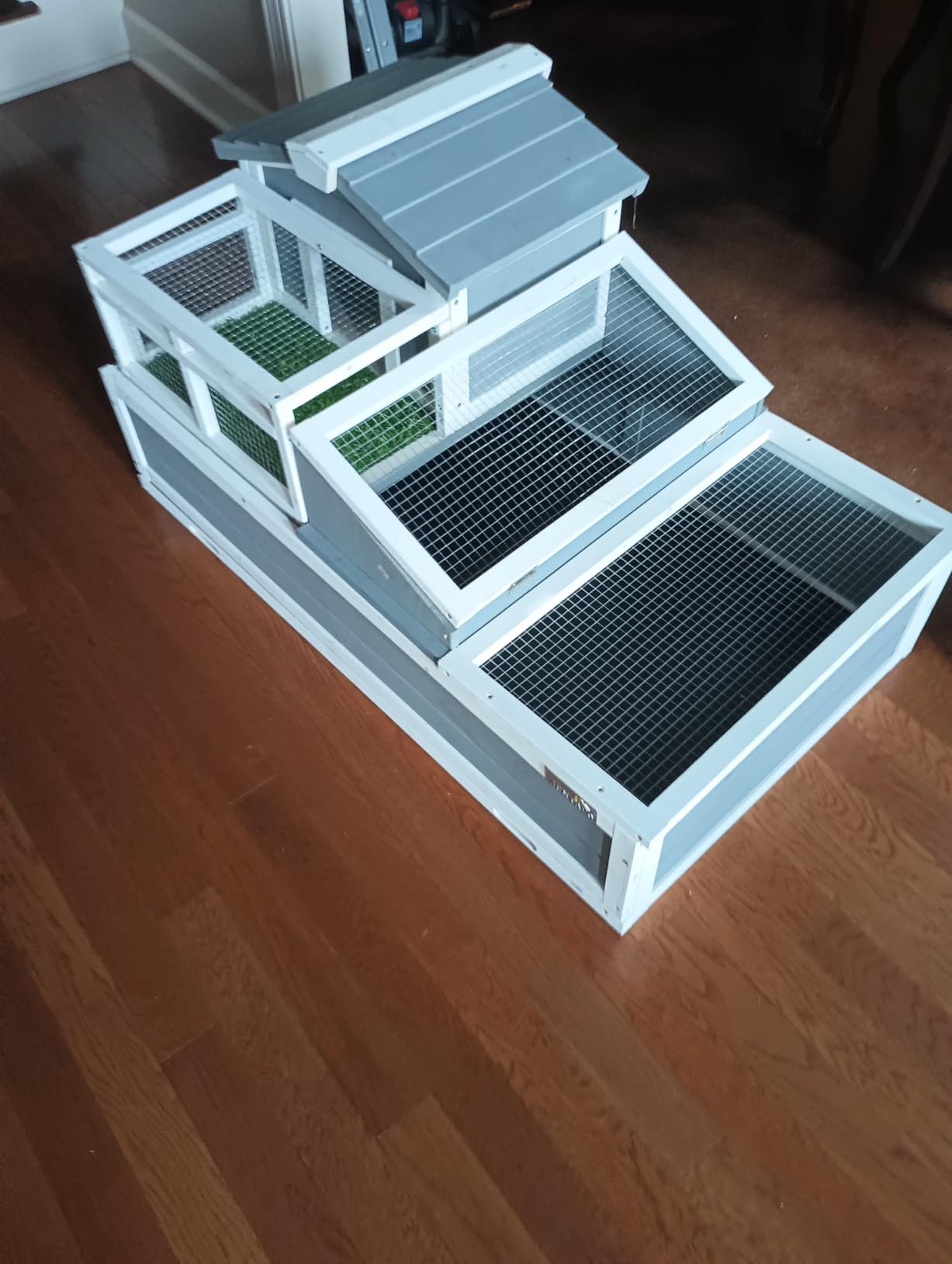
Most enclosures here are two rooms side by side. This one is a genuine three-room, two-level layout with a sleeping area, an upper balcony and a run box connected by a ramp, so the animal can climb rather than pace a flat floor.
At 44 by 25.6 by 24 inches it has one of the longer wooden footprints in the group, and the water-resistant outdoor paint means the same unit can spend part of the year outside.
The included grass mat gives immediate texture, and the metal mesh on the balcony provides airflow and a sunny spot. An openable roof means you can reach the animal without dismantling panels.
The mesh balcony is also the compromise. Uncovered mesh will not hold humidity, so tropical species are a poor match despite the size.
What This Layout Does Well
It suits juvenile Russian, Hermann and Greek tortoises and any dry temperate species that benefits from vertical variation. The pull-out tray simplifies cleaning under the ramp and balcony.
Pre-drilled holes make assembly more forgiving than flat-pack wood usually is, and the parts are painted to shed moisture.
Where It Falls Short
Skip it for redfoots or any species needing 70 to 80 percent humidity, and note that the open mesh balcony works against that goal.
At 32 pounds it is not a unit you reposition casually, so decide on the final spot before you start building.
10. VEVOR Cedar Tortoise Habitat – Best for Patio and Outdoor Transition
VEVOR Tortoise Habitat, Cedar Wooden Tortoise House Indoor & Outdoor, Tortoise Enclosure with Light Stand, Reptile Enclosure Small Animal Cage with Stand Legs for Gecko, Lizard, Snake
33 x 19.7 x 32.5 inches
Cedar wood frame
Light stand included
Storage shelf on leg frame
Pros
- Light stand and leg shelf included
- Cedar gives a pleasant natural smell
- Assembly around 40 minutes
- Two-room layout with a mesh window
Cons
- Cedar is a respiratory concern for some tortoises
- Wood splits reported during assembly
- Bottom tray can bow under substrate
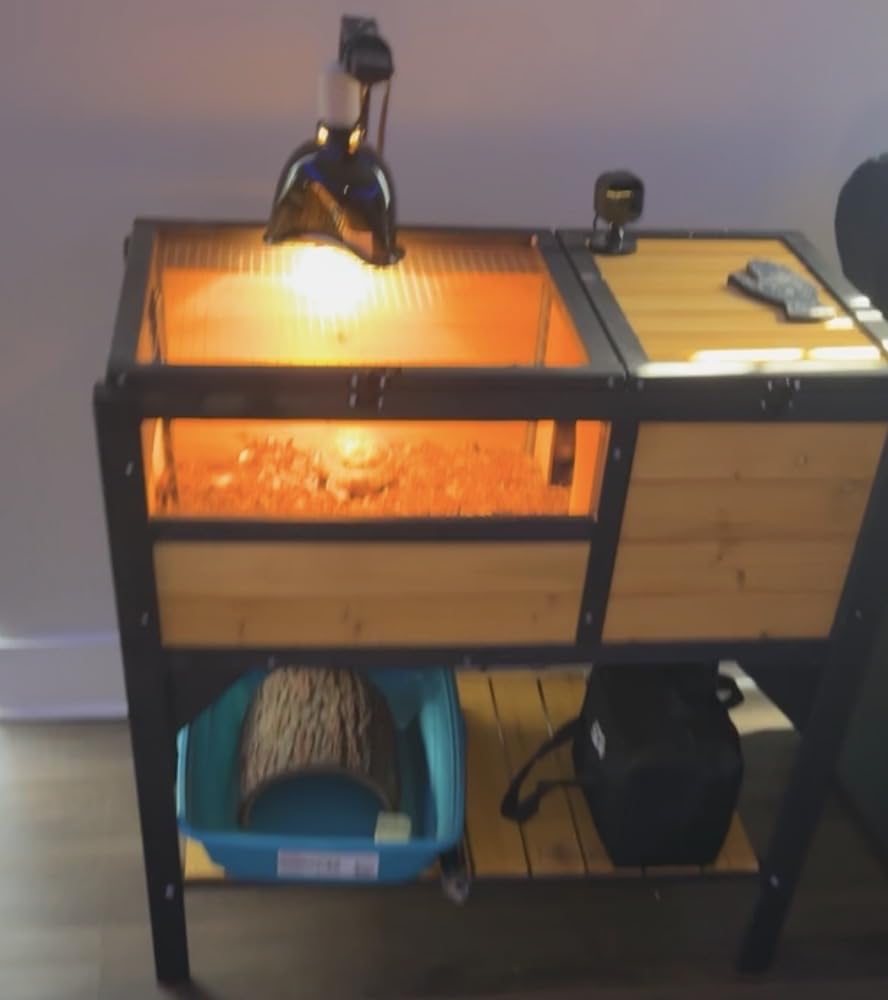
The included light stand and the heavy-duty shelf on the leg frame are what set this one apart from cheaper wooden houses. At 33 by 19.7 by 32.5 inches it is compact, and the shelf keeps supplies off the floor.
Owners consistently call assembly easy, around 40 minutes, and like the two-room split with a mesh window for ventilation. Variants are offered with legs, with caster legs, or as a basic habitat.
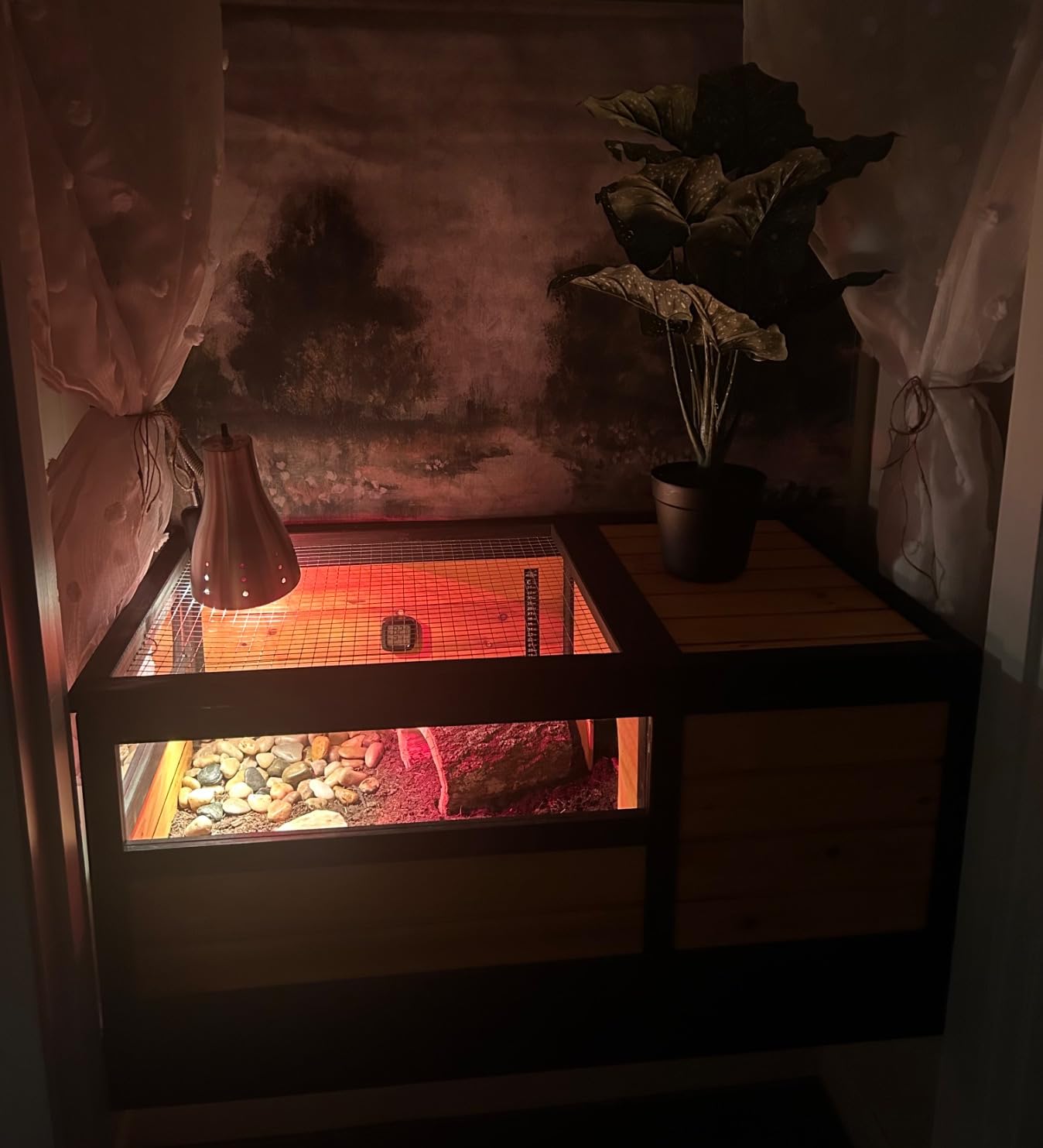
The material is the issue to think through carefully. Several reviewers warn that cedar can cause respiratory issues in tortoises, and that is a risk worth avoiding for an animal that lives in the enclosure year round.
There are also reports of wood splitting during assembly, a bottom tray that bows when loaded with substrate, and instructions that are difficult to follow.
Who This Habitat Works For
It fits a hatchling or juvenile on a patio or balcony, where the light stand and open mesh suit outdoor-style keeping. The caster leg variant makes it practical to move between sun and shade.
If you plan to use it indoors only, the material question is hard to ignore. Many experienced keepers avoid aromatic softwoods in closed rooms.
Who Should Skip It
Skip it for a tropical or humidity-dependent species, and skip it for any keeper who is not comfortable with the cedar respiratory concern.
Also consider a different option if the animal will be large, since a 33 inch floor is a transitional size rather than an adult one.
11. PawHut Habitat with Two Hide Boxes – Best Multi-Animal or Multi-Hide Layout
PawHut Tortoise Habitat with Adjustable Lamp Holder, Attached Tray Yellow
48 x 22.2 x 36.6 inches
Two hide boxes with divider panel
Attached leak-proof tray
Bottom shelf
Pros
- Long 48 inch length
- Removable divider lets you separate animals or zones
- Attached tray reduces leaks
- Observation window and openable top
- Bottom storage shelf
Cons
- Meaningful share of 1 star reviews
- 36 lb unit
- Assembly required
Two hide boxes with a removable divider is the feature that makes this distinct. You can run one tortoise, house two with a visible separator, or use the divider to create a warm zone and a cool zone inside the same 48 inch frame.
The attached plastic tray means water and substrate stay on the tray rather than reaching the shelf below, and there is a bottom shelf for food and supply storage.
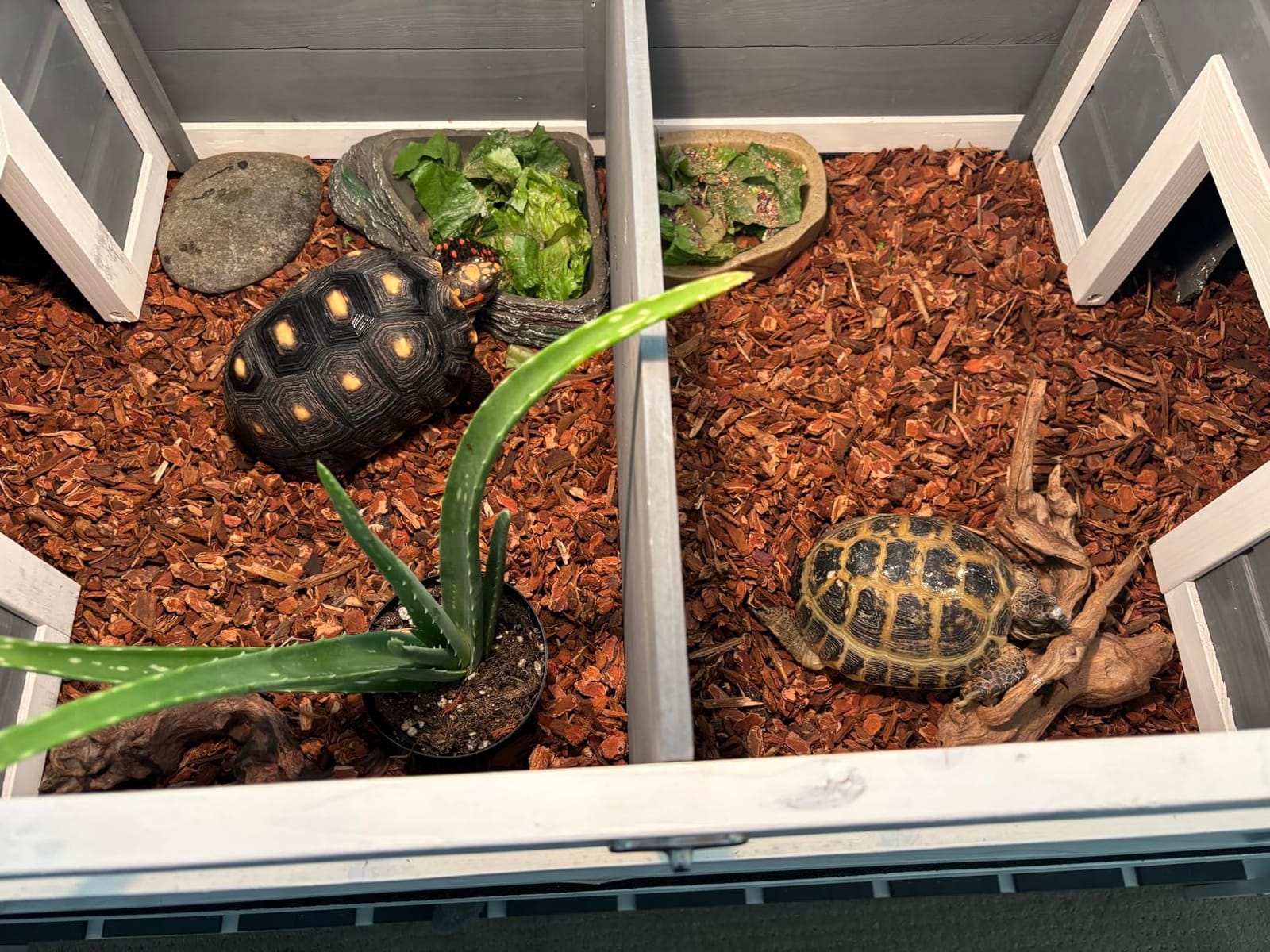
Its 48 inch length leaves more room for a warm side and a cool side than the shorter wooden houses here, which is what lets the divider do real work.
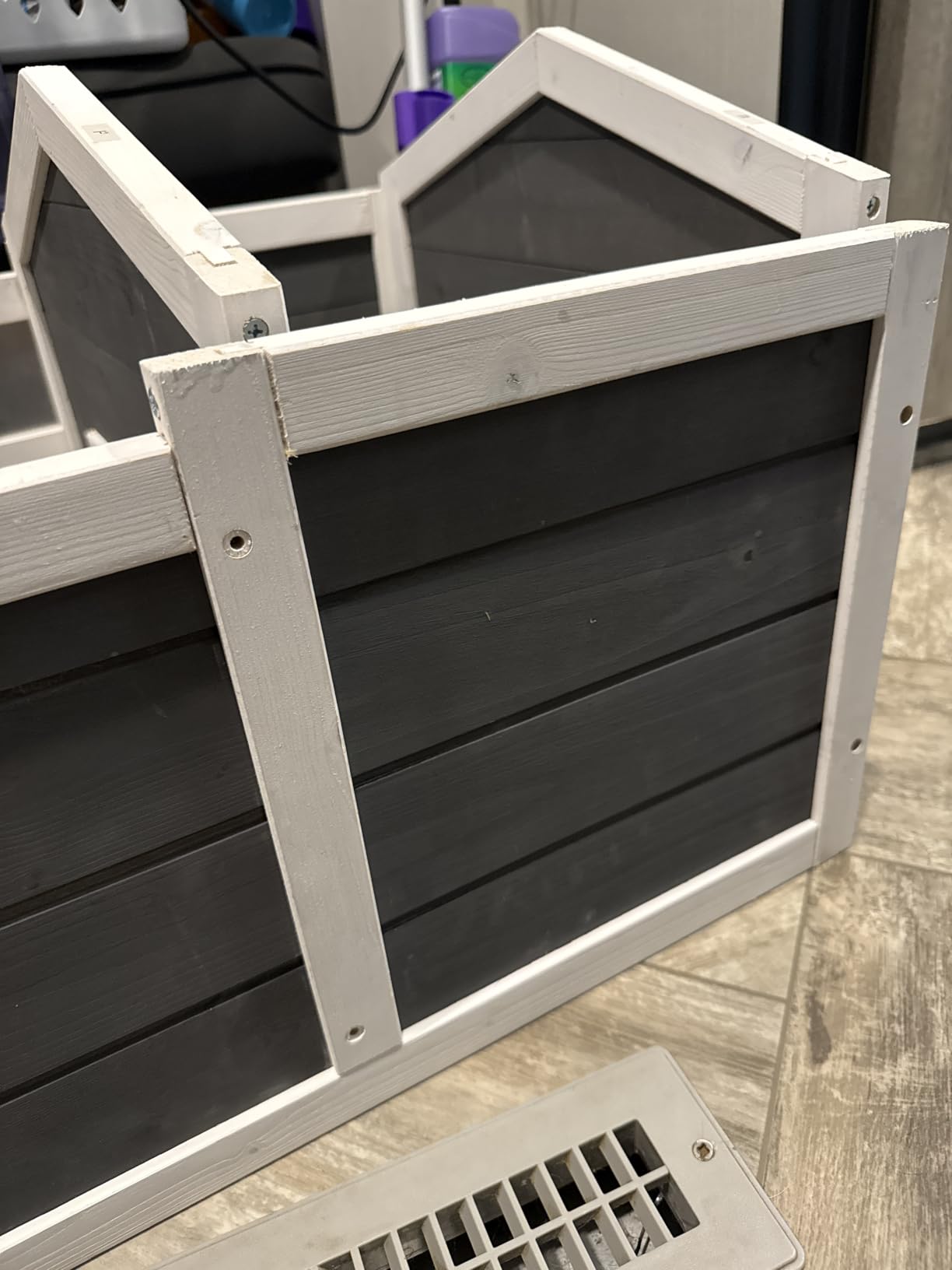
Reviewers are more divided on quality than on design. A noticeable share of 1 star reviews points to finish and assembly issues, so inspect the unit carefully on arrival and tighten every joint.
Where This Layout Helps
It suits a keeper with two juveniles who need visual separation without buying two enclosures, and it works for a single animal that simply benefits from more than one place to hide.
The adjustable lamp holder lets you warm one box more than the other, which is useful when the two animals have different thermal needs.
Who Should Skip It
Skip it if you need a sealed chamber or a reliable tropical humidity range. The open top and the gap at the divider work against both.
Skip it if you are not prepared to do a careful joints check after assembly, given the volume of critical feedback on finish.
12. PawHut 2-Layer Tortoise Enclosure – Best for Juveniles Needing Two Levels
PawHut Tortoise Habitat with Adjustable Lamp Holder, 2 Layer Tortoise Enclosure with Storage Shelf, Removable Main House, Fixed Tray, Openable Lid, Gray
40.2 x 22 x 40.9 inches
Removable main house
Attached leak-proof tray
Bottom storage shelf
Pros
- Removable main house lifts out for cleaning
- Dual-level layout with a run box
- Attached tray prevents leakage
- Openable top and clear window
- Bottom shelf for supplies
Cons
- Open top makes humidity control difficult
- Some parts mislabeled in instructions
- No tools included
The removable main house is the reason this one earns its place. The upper section lifts out entirely so you can clean underneath, which is the part that stays damp in every wooden habitat on this list.
Below it sits a run box, and the whole thing sits on a bottom storage shelf. At 40.2 by 22 by 40.9 inches without the lamp holder, the footprint is generous for a juvenile.
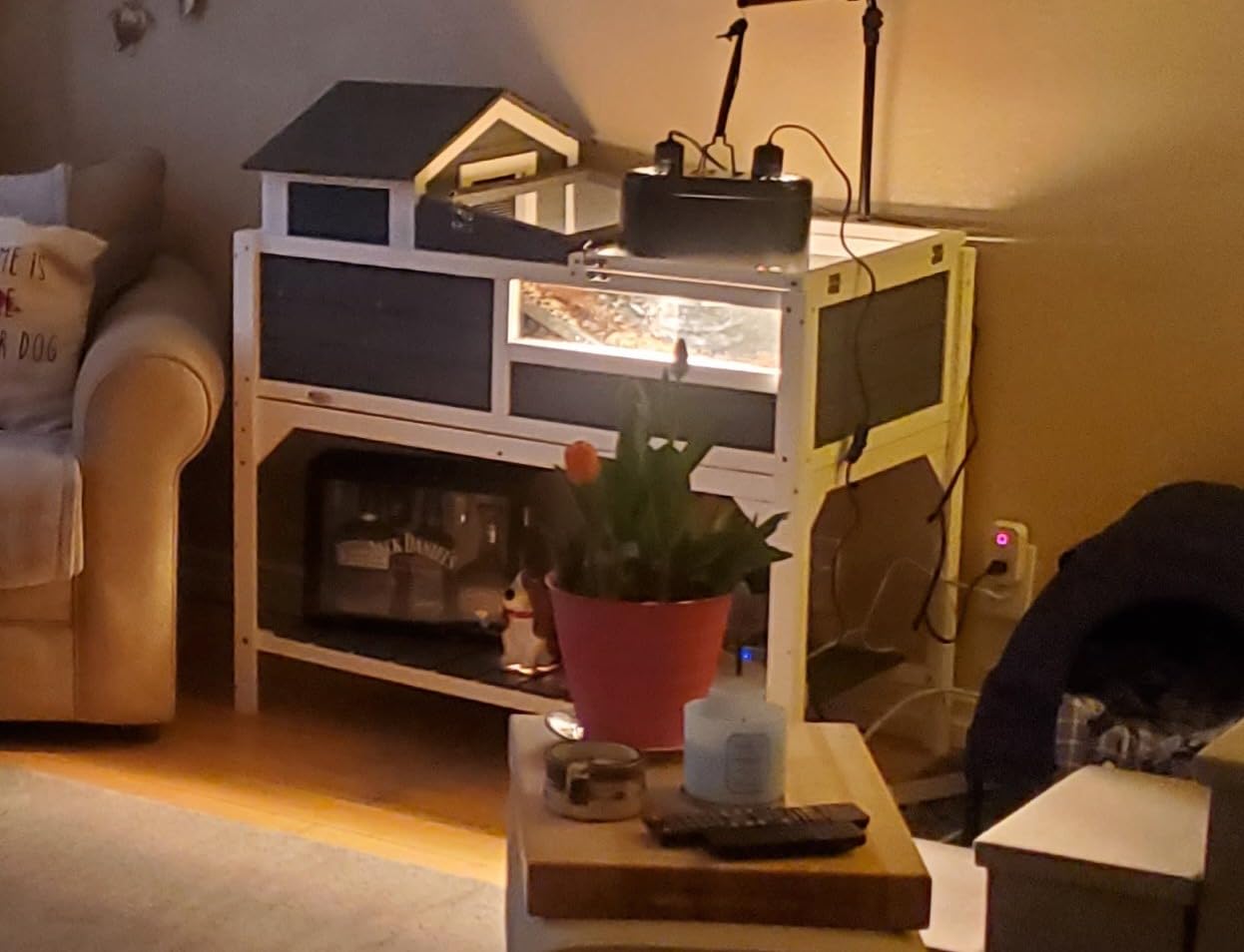
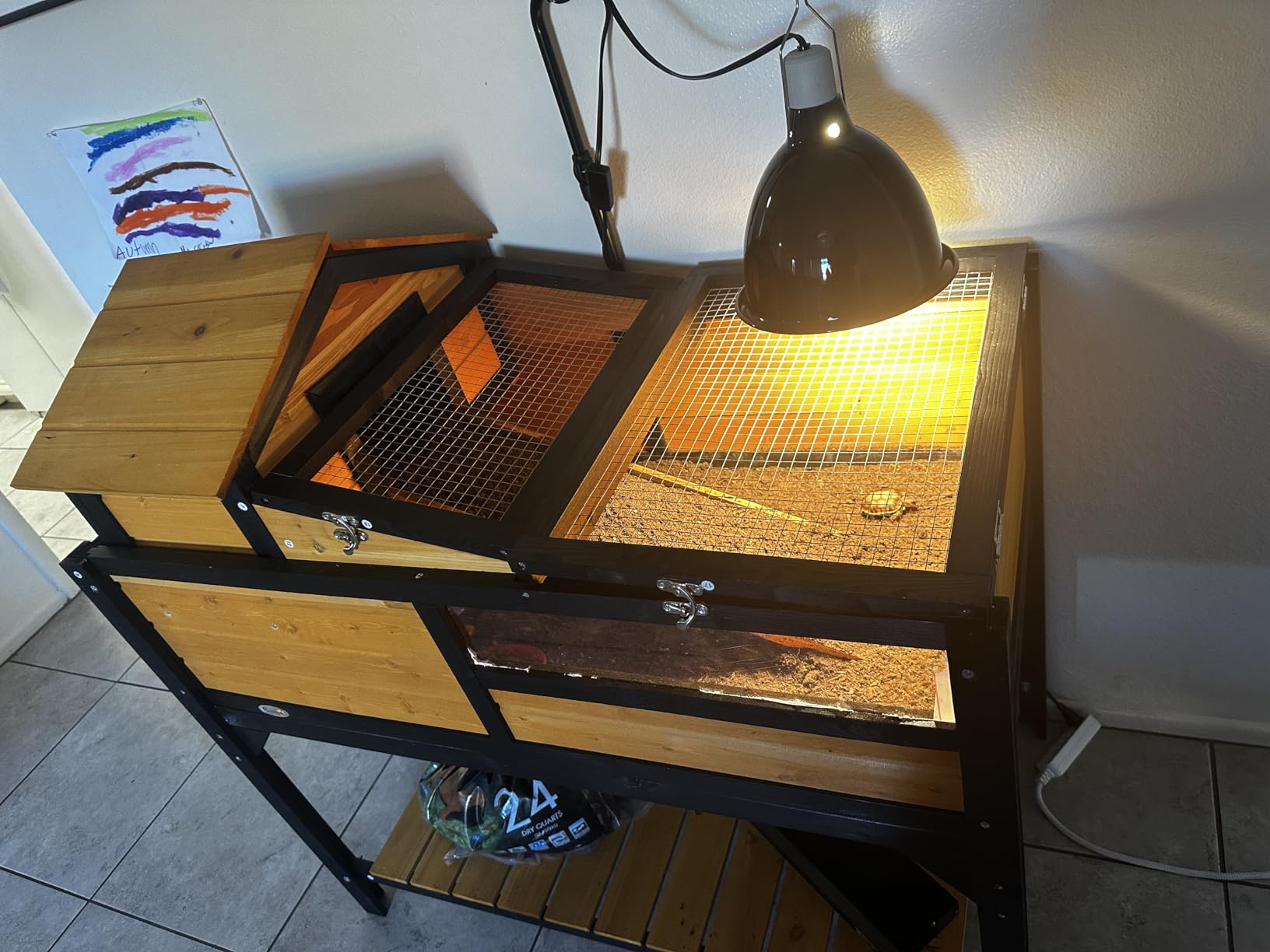
Reviewers like the attached plastic tray, the adjustable lamp holder and the openable top for interaction. Packaging is solid and parts tend to arrive intact, which is more than can be said for several rivals.
The open top is the drawback. A reviewer specifically flagged that humidity control is difficult, and some parts arrive mislabeled in the instructions while no tools are included for assembly.
Who This Two-Layer Enclosure Fits
It suits a baby or juvenile tortoise that needs vertical interest but will not stay small forever. The run box below the main house gives a shaded, cooler area to retreat to.
Gray and yellow variants are offered, and the openable top makes daily interaction straightforward without reaching through a door.
Who Should Skip It
Skip it for a tropical species, since the open top works directly against a stable humidity target. Skip it if you are in a hurry to assemble it, because owners report 45 to 90 minutes with mislabeled parts.
For a redfoot or a juvenile that will grow fast, the two-hide-box model offers a better use of the same length.
How to Choose an Indoor Tortoise Enclosure
Floor space beats height, every time. The standard experienced keepers repeat is 4 by 8 feet of walking surface for an adult, and the enclosures on this list are mostly appropriate for hatchlings and juveniles. A 4 by 2 foot habitat is a starting point, not a destination.
Plan your substrate depth next. Around 4 inches of fine-grade orchid bark, or a coco coir and bark pairing, is the usual recommendation, and a 24 quart bag is a practical minimum for a 4 by 2 foot enclosure. Buy potting media, not potting mix, and check that wood pieces are chemically untreated.
Build a gradient rather than a uniform temperature. A ceramic heat emitter on a thermostat with a fixed basking zone gives a hot end and a cool end in the same enclosure, and digital thermometers at both ends are the only way to confirm it. Add a hide at the warm end and another at the cool end so the animal can choose.
Check the top and the seams. Escape-resistant lids and continuous seal lines matter more than any decorative feature, and that is the failure point on most of the wooden houses here. Seams can be run with aquarium silicone before substrate goes in.
Think about where the cords go. A top-opening habitat means you either run cords through grommets and clamps along a wall, or mount fixtures on an external stand. Our reptile enclosure guide covers lamp and monitoring setups that solve this.
Enclosure Type Comparison
Composite habitats like the ECOFLEX 48 are the best all-round choice. They are waterproof, they hold heat and humidity, and they can be sealed, but they are heavy and you cannot easily change the footprint.
Wooden houses are the most common and the least sealed. They are attractive, they are easy to clean with a tray, and they double for outdoor use, but corner gaps leak substrate and humidity unless you add sealant.
Screen cages give the best airflow and the least insulation. They are light, cheap and easy to move, but nothing holds in a tropical range, and you will need a separate lamp stand.
Glass terrariums look the best in a living room and insulate the worst. Glass also invites pacing, so opaque lower wall borders matter. The Penn-Plax design addresses this with a windowsill detail, and it is the reason glass appears on this list at all.
The principle behind all of these is the closed chamber: enough solid surface area that the tortoise can regulate its own microclimate by burrowing into substrate, backed by a thermostat rather than a lamp on a timer. A portable greenhouse or grow tent follows the same logic and can move outdoors later, which is why experienced keepers treat one as a 2 to 3 year solution for a hatchling.
Frequently Asked Questions
How big should an indoor tortoise enclosure be?
An adult tortoise needs at least 4 by 8 feet of continuous walking surface, and 4 by 2 feet is a realistic hatchling to juvenile size. Height does not replace footprint, because tortoises walk rather than climb. Add floor space for every additional animal, and plan the upgrade before you buy rather than after the animal outgrows the first habitat.
Can a tortoise live in a glass tank?
A glass terrarium can work short term, but glass gives up heat quickly and invites pacing because tortoises walk against transparent walls without understanding the barrier. Add an opaque border along the lower walls and a windowsill detail at glass level, and use a thermostat rather than a bare lamp. Most experienced keepers prefer composite or wooden housing for an animal kept indoors year round.
Do tortoises need UVB light indoors?
Yes, indoor tortoises still need UVB to metabolise calcium and prevent soft shell and pyramiding. UVB does not pass through glass or mesh, so it has to enter through a screened or open top. Mount the lamp at the distance specified for the bulb, pair it with a ceramic heat emitter on a thermostat, and recheck the bulb on a schedule because output drops before the bulb visibly fails.
What substrate is best for an indoor tortoise?
Around 4 inches of fine-grade orchid bark, or a coco coir and orchid bark pairing, works well for most species and lets a tortoise burrow to regulate its own humidity. Buy potting media rather than potting mix, and avoid pine or cedar shavings. A 24 quart bag is a practical minimum for a 4 by 2 foot enclosure, and keepers report local plant nurseries selling large bags more cheaply than pet stores.
What is the most common cause of tortoise death in captivity?
Setup failure is the most common avoidable cause. An enclosure that is too small, a temperature gradient that never gets checked, missing UVB, or a shallow substrate layer all show up as pyramiding, soft shell, egg binding or respiratory illness. A thermostat, thermometers at both ends of the enclosure and a hide the animal can burrow into prevent most of it.
Final Recommendation
The New Age Pet ECOFLEX 48 Mojave is the indoor tortoise enclosure to beat in 2026. It is the only pick here with a sealed composite build, a 4 by 2 foot interior and a 10 year warranty together, and the whole thing assembles in one evening.
Start there if you can. If money is tight, the Zoo Med ReptiBreeze gets you a working setup you can learn on, and you move up to something larger once the animal reaches juvenile size. Our reptile enclosure hardware guide covers the lamps, thermostat and thermometers to pair with whichever habitat you choose.