
I have sat in countless classrooms where the energy flatlined after the first fifteen minutes. Students slouch. Eyes drift to the window. Engagement dies a slow death while the teacher pushes through the lesson plan. If you have felt this frustration, you are not alone. But there is a proven approach that transforms this scenario: gamification in the classroom.
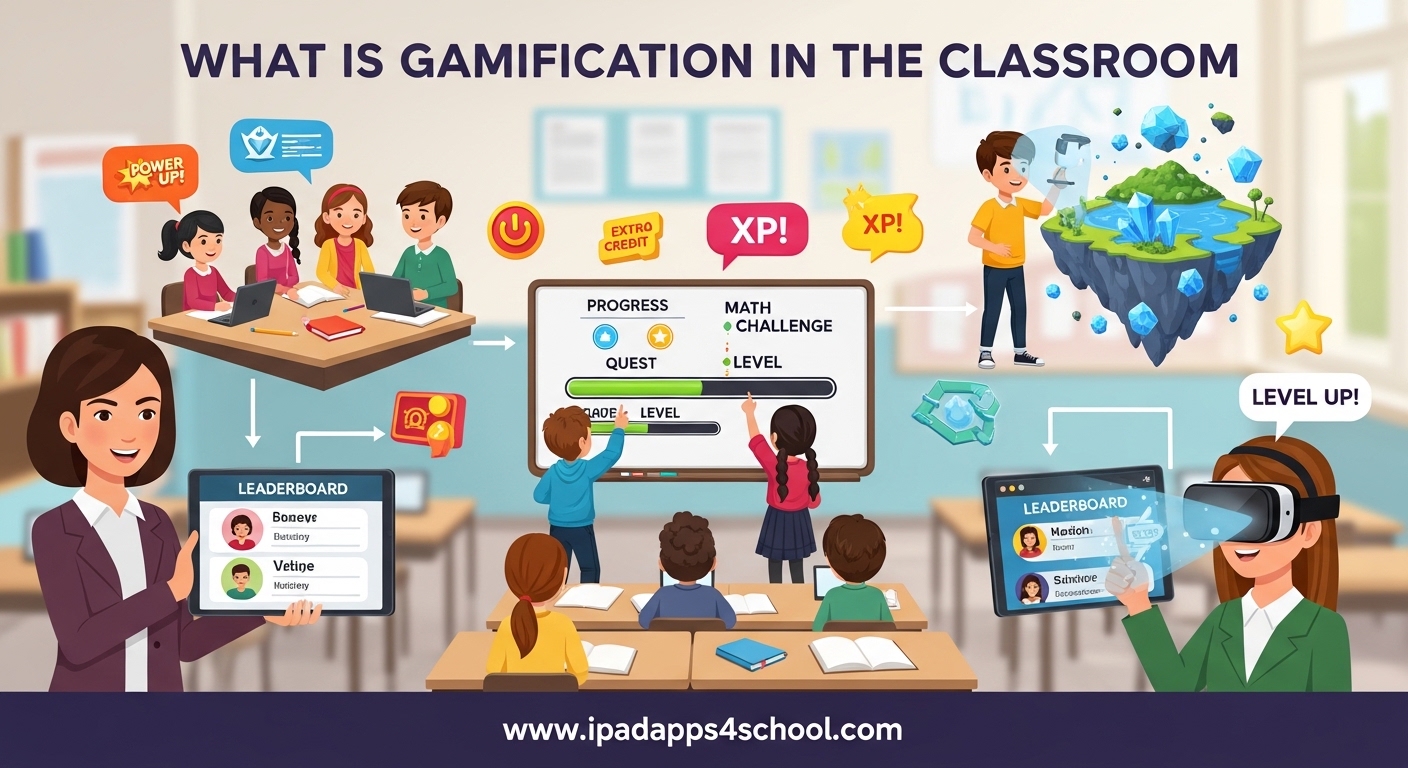
Gamification in the classroom is the practice of strategically adding game elements to learning activities to boost student motivation and engagement. It does not mean turning every lesson into a video game. Instead, it borrows the psychological hooks that make games addictive and applies them to education. Points, badges, leaderboards, and progress bars become tools for learning rather than distractions from it.
In this guide, I will walk you through everything you need to know about classroom gamification in 2026. We will explore what it actually means, why it works on a psychological level, the different types you can implement, and exactly how to get started even if you have never gamified a lesson before.
Table of Contents
What Is Gamification in the Classroom?
Gamification in the classroom is the integration of game mechanics into educational activities to increase student participation and motivation. Think about what keeps players glued to video games for hours. It is not just the graphics. It is the feeling of progress, the immediate feedback, the sense of achievement, and the social connection. Gamification brings those same elements into learning.
Let me break this down in simple words. Gamification is when you add points for completing homework, award badges for mastering skills, display leaderboards for friendly competition, or create quests that guide students through learning objectives. The subject matter stays the same. Math is still math. History is still history. But the wrapper around the content becomes more engaging.
There is a critical distinction I need to make here. Gamification is not the same as game-based learning. We will dig deeper into this difference later, but for now, remember this: gamification uses game elements in non-game contexts, while game-based learning uses actual games to teach content. Both work, but they serve different purposes.
How Gamification Works: The Psychology Behind It
Understanding why gamification works requires looking at what happens in our brains when we play games. When students achieve a goal in a gamified classroom, whether that is earning points or unlocking a badge, their brains release dopamine. This neurochemical reward creates a positive association with learning. Students start wanting to engage because the experience feels good.
This taps into both intrinsic and extrinsic motivation. Extrinsic motivation comes from external rewards like points and badges. Intrinsic motivation comes from the internal satisfaction of mastery and progress. The best gamified classrooms balance both. You might start students with extrinsic rewards, but the goal is always to help them develop intrinsic motivation for learning itself.
Gamification also supports growth mindset development. When failure becomes part of a game mechanic, students stop fearing it. They see a low score not as permanent defeat but as feedback to try a different strategy. This reframing is powerful. A student who will not attempt a math problem for fear of being wrong might eagerly retry a quest that requires the same skills.
The Four Core Types of Gamification
When teachers ask what are the four types of gamification, they often get confused by overlapping terminology. Let me clarify the main categories you will encounter in education.
Structural gamification wraps game elements around existing content without changing the curriculum. You teach the same lessons but add a points system, badges, and leaderboards as a layer on top. This is the easiest entry point for most teachers because it requires minimal curriculum redesign.
Content gamification integrates game mechanics directly into the learning material itself. Instead of a worksheet about ancient Egypt, students embark on an archaeological quest. The content and the game structure become inseparable. This requires more planning but often produces deeper engagement.
Assessment gamification transforms testing and evaluation into game-like experiences. Traditional quizzes become boss battles where students face challenging questions to progress. Formative assessments happen through instant feedback systems that feel like leveling up rather than being graded.
Social gamification leverages collaboration and competition between students. Team challenges, guild systems, and collaborative quests turn learning into a shared adventure. This type works especially well for building classroom community and developing social skills alongside academic ones.
Game Elements Explained
Now let me walk you through the specific game elements you can deploy in your classroom. Understanding each component helps you choose the right mix for your teaching context.
Points and XP
Points, or experience points (XP), are the fundamental currency of gamification. Students earn points for completing assignments, participating in discussions, helping classmates, or demonstrating growth. The key is making point earning transparent and consistent. Students should always know exactly what actions generate points.
I recommend starting with a simple point system before adding complexity. Award 10 points for completed homework, 5 points for class participation, 20 points for quiz performance. Once students understand the system, you can introduce multipliers for streaks or bonus challenges.
Badges and Achievements
Badges represent mastery and accomplishment. Unlike points which accumulate continuously, badges mark specific achievements. A student might earn a Collaboration Badge for excellent teamwork, a Persistence Badge for improving a low score, or a Creativity Badge for an innovative project approach.
Badges work best when they recognize behaviors you want to encourage, not just academic performance. This helps balance your gamification so that struggling students can still earn recognition for effort, improvement, and positive learning habits.
Leaderboards
Leaderboards add a competitive element by publicly displaying student rankings. However, this requires careful implementation based on forum insights I have gathered. Many teachers report that traditional leaderboards demotivate lower-performing students who always see themselves at the bottom.
The solution is progressive leaderboards that reset periodically or focus on different metrics. Consider weekly leaderboards for improvement rather than total points. Or create multiple leaderboards so every student can excel at something. Some teachers use anonymous leaderboards showing only usernames to reduce social pressure.
Levels and Progress Bars
Levels and progress bars visualize learning advancement. Students can see exactly how close they are to the next milestone. This creates anticipation and motivates continued effort. A student 20 XP away from Level 5 will likely complete one more assignment to get there.
Design your level system with achievable early wins. The first few levels should come quickly to hook students into the system. Then gradually increase the XP requirements for higher levels. This mirrors how video games design their difficulty curves.
Quests and Challenges
Quests frame learning activities as missions with narrative context. Instead of a reading assignment, students receive a quest to decode ancient manuscripts. Rather than a science lab, they conduct experiments to solve a mystery. The content stays rigorous, but the framing adds engagement.
Challenges work similarly but often have competitive or time-limited elements. A challenge might ask students to solve as many math problems as possible in five minutes or collaborate to build the strongest bridge from limited materials. Both quests and challenges transform routine work into adventure.
Benefits of Gamification for Students
After reviewing research and talking with teachers who have implemented these systems, I have identified the key benefits that make gamification worth the effort in 2026.
Increased Engagement
The most immediate benefit is higher student engagement. When learning feels like play, students pay attention longer and participate more actively. Teachers consistently report that gamified lessons see fewer off-task behaviors and more eager participation. Students actually want to start the activity rather than watching the clock.
Improved Motivation
Gamification creates multiple pathways to success. Traditional grading often leaves struggling students feeling hopeless after one bad test. Gamified classrooms offer many ways to earn points and recognition. A student who bombs a quiz might still earn points for completing practice problems, showing improvement, or helping a peer.
This keeps motivation alive across the achievement spectrum. High performers stay challenged by competitive elements. Struggling students stay engaged through achievable micro-rewards.
Better Collaboration
Well-designed gamification includes team elements that foster cooperation. When students work together on guild challenges or team quests, they develop communication and collaboration skills. The social aspect of gaming translates naturally to classroom community building.
Many teachers report that gamification helps shy students participate more. The game context reduces social anxiety. It is easier to volunteer when framed as accepting a quest rather than answering a teacher’s question.
Instant Feedback
Games provide immediate feedback on every action. Students know instantly if their answer was correct or if their strategy worked. This rapid feedback loop accelerates learning because students can adjust immediately rather than waiting days for graded papers to return.
Digital gamification tools on iPads excel at this. Apps can provide instant scoring, adaptive difficulty, and personalized hints based on student responses. The feedback is both faster and more targeted than traditional assessment methods.
Student Agency and Self-Directed Learning
Perhaps the most valuable long-term benefit is increased student agency. Gamification gives students choices about which quests to pursue, which badges to target, and how to allocate their points. This autonomy develops self-directed learning skills that serve students throughout their education.
Students in gamified classrooms learn to set personal goals, monitor their own progress, and adjust their strategies when needed. These metacognitive skills transfer far beyond any single game or classroom activity.
Gamification vs Game-Based Learning: What is the Difference?
This distinction confuses many teachers. Let me clarify once and for all because understanding the difference helps you choose the right approach for your goals.
Gamification in the classroom adds game elements to existing educational activities. You are still teaching your regular curriculum, but you have added points, badges, or competition. The learning content itself is not a game.
Game-based learning uses actual games as the primary learning tool. Students might play Minecraft Education Edition to learn about architecture, use DragonBox to master algebra, or engage with historical simulation games to understand ancient civilizations. The game itself delivers the educational content.
Both approaches work. Gamification is easier to implement because you do not need special software or game design skills. You can gamify tomorrow with a points chart and some badges. Game-based learning requires more preparation, technology access, and often budget for game licenses.
Many effective classrooms combine both approaches. They use gamification for daily motivation and game-based learning for specific units where immersive simulation adds value.
How to Gamify Your Classroom: A Teacher’s Roadmap
If you are new to gamification, the implementation process can feel overwhelming. I have broken this down into manageable steps based on feedback from teachers who successfully made the transition.
Step 1: Start Small
Do not try to gamify your entire curriculum at once. Pick one unit, one subject, or even one activity type to begin. Maybe you start by gamifying vocabulary practice or math fact review. Test the waters before diving in.
Many teachers report success starting with low-tech options. A simple points chart on the whiteboard, paper badges you hand out, or a classroom leaderboard drawn on poster paper requires zero technology but still delivers engagement benefits.
Step 2: Define Your Game Elements
Choose which game mechanics you will use. I recommend starting with just points and one additional element like badges or a simple leaderboard. You can always add complexity later. Students need time to learn the system too.
Be explicit about how students earn points. Write the rules clearly and post them. Transparency builds trust. Students should never feel that points are awarded arbitrarily or unfairly.
Step 3: Choose Your Tools
For iPad-enabled classrooms, several apps make gamification easier. Here are teacher-tested options that align with our site focus on iPad apps for school:
Classcraft turns your entire classroom into a role-playing game. Students create avatars, join teams, and earn points for positive behaviors. It includes parent communication features and works well for whole-class gamification.
Kahoot and Quizizz provide competitive quiz experiences perfect for review sessions. Students answer questions on their iPads while competing for the top spot on the live leaderboard.
Gimkit and Blooket have become favorites among teachers for gamified review games. Students earn virtual currency for correct answers and can use it to power up their gameplay.
ClassDojo works well for elementary classrooms, tracking points for specific behaviors and allowing instant feedback to students and parents.
Step 4: Address Competition Concerns
Based on forum discussions, this is where many gamification efforts stumble. Students can become overly competitive or demotivated by leaderboards.
Solve this by emphasizing personal progress over beating others. Celebrate improvement as much as total achievement. Create team challenges where success requires collaboration. And always provide ways for struggling students to earn recognition.
If you notice students focusing only on rewards rather than learning, adjust your system. Make badges harder to earn. Require demonstration of understanding before points are awarded. The game serves the learning, never the reverse.
Step 5: Iterate and Improve
Your first gamification attempt will not be perfect. Gather student feedback. Watch what motivates your specific group. Some classes love fierce competition. Others prefer collaborative quests. Adapt your approach based on what works for your students.
Teachers who stick with gamification report that the third or fourth iteration of their system works much better than the first. Give yourself permission to learn and adjust.
FAQ
What are examples of gamification in the classroom?
Examples include point systems for completed homework, badge collections for mastered skills, leaderboards for quiz scores, progress bars showing advancement through units, and quest-based assignments with narrative framing. Many teachers use apps like Kahoot for competitive review games, Classcraft for RPG-style classroom management, or simple low-tech systems like paper badges and whiteboard leaderboards.
What is gamification in simple words?
Gamification means adding game elements like points, badges, and competitions to regular learning activities. It makes schoolwork feel more like playing a game while keeping the same educational content. Students earn rewards for completing assignments, helping classmates, and showing improvement.
What are the four types of gamification?
The four main types are: 1) Structural gamification which adds game elements around existing content, 2) Content gamification which integrates game mechanics directly into learning materials, 3) Assessment gamification which transforms testing into game-like experiences, and 4) Social gamification which leverages collaboration and team competition.
What is a real life example of gamification?
A real classroom example is a language arts teacher who creates a reading quest where students earn XP for each book completed, unlock badges for different genres, and compete on a monthly leaderboard for most pages read. Another example is a math teacher who frames unit tests as boss battles that students must prepare for by completing practice quest assignments.
Conclusion
Gamification in the classroom is more than a trendy buzzword. It is a research-backed approach that taps into natural human psychology to increase motivation, engagement, and learning outcomes. By understanding what gamification truly means, how it works psychologically, and how to implement it effectively, you can transform your teaching practice.
The key is starting small and iterating. You do not need expensive apps or complex systems to begin. A simple points chart and some creative framing of your next assignment is enough to test whether gamification works for your students.
In 2026, with iPads increasingly present in classrooms, teachers have more tools than ever to implement engaging gamified learning experiences. Whether you choose high-tech apps like Classcraft and Gimkit or stick with low-tech paper badges and whiteboard leaderboards, the principles remain the same. Make learning engaging. Give students agency. Provide instant feedback. And watch engagement soar.