
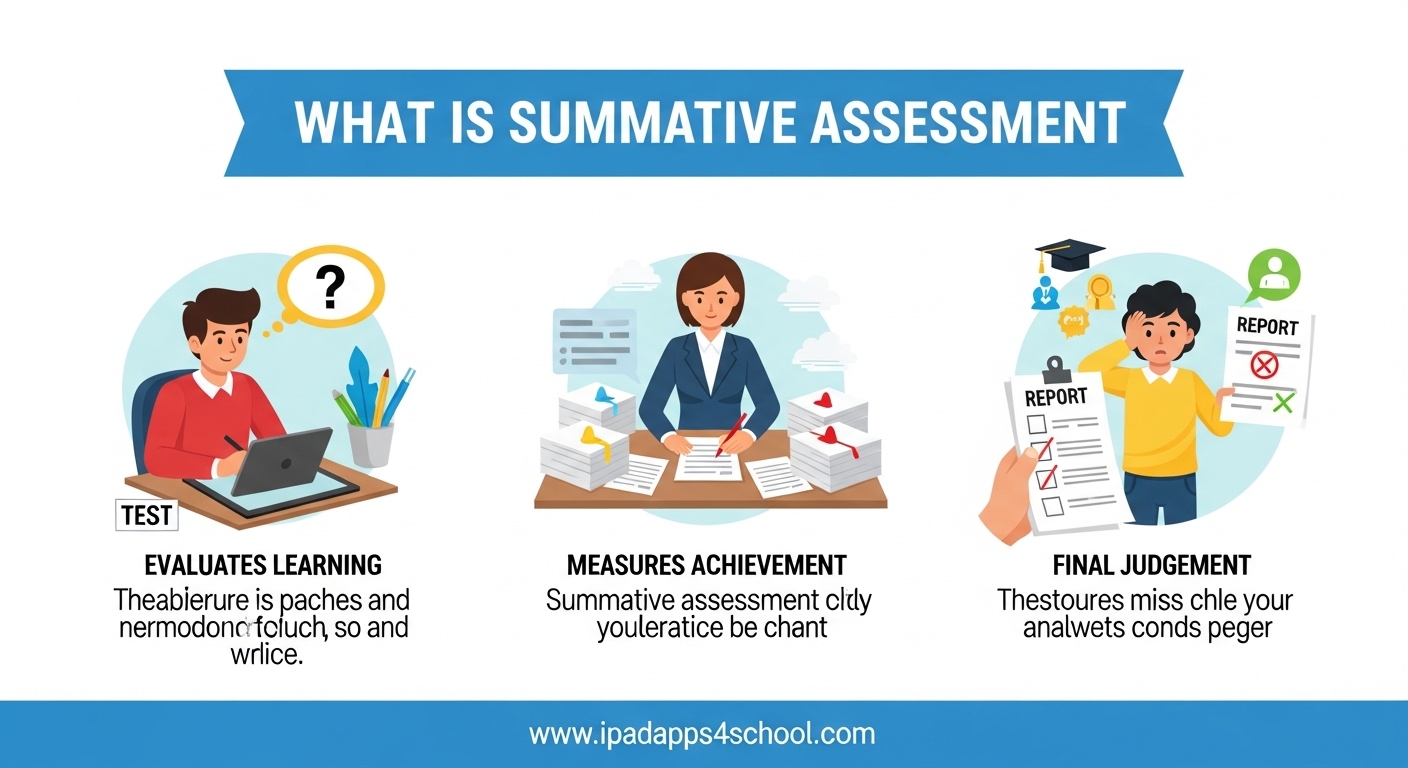
The goal of summative assessment is to evaluate student learning at the end of an instructional unit by comparing it against some standard or benchmark. Unlike formative assessments that happen during learning, summative assessments occur after instruction is complete.
Understanding the difference between these two assessment types can transform how you design your curriculum and gradebook. This guide will walk you through everything you need to know about summative assessment, from practical examples to technology tools that make implementation easier.
Table of Contents
What Is Summative Assessment?
Summative assessment is often called “assessment of learning” because it measures what students have learned at a specific point in time. These assessments are typically high stakes, meaning they carry significant weight in the final grade.
Here are the key characteristics that define summative assessment:
- Occurs at the end of an instructional unit, course, or program
- Compares student performance against standards or benchmarks
- Results in a grade or score that contributes to final evaluation
- Provides limited opportunity for feedback during the learning process
- Measures cumulative knowledge and skills
Teachers use summative assessments to determine whether students have met learning objectives. The results help assign grades, certify competency, and evaluate the effectiveness of educational programs.
Summative Assessment vs Formative Assessment
Understanding the distinction between summative and formative assessment helps educators choose the right tool for the right moment. While both evaluate student learning, they serve different purposes in the instructional cycle.
Formative assessment monitors student learning during instruction. It provides ongoing feedback that teachers can use to improve their teaching and students can use to improve their learning. These are typically low stakes and may not even be graded.
Summative assessment, on the other hand, evaluates learning at the end. It is high stakes and results in grades that appear on report cards and transcripts.
| Characteristic | Formative Assessment | Summative Assessment |
|---|---|---|
| Timing | During instruction | End of instruction |
| Purpose | Monitor learning, provide feedback | Evaluate learning against standards |
| Stakes | Low stakes or no stakes | High stakes |
| Feedback | Ongoing and immediate | Limited, often after completion |
| Grading | Usually ungraded or minimal weight | Significant grade weight |
| Examples | Exit tickets, quizzes, observations | Final exams, projects, portfolios |
Both assessment types play essential roles in effective teaching. Smart educators balance formative checks throughout units with well-designed summative assessments at the end.
Examples of Summative Assessments
Seeing concrete examples helps clarify what summative assessment looks like in practice. Teachers on education forums report using a variety of formats depending on their subject area and grade level.
Here are common summative assessment examples used in classrooms today:
- Final examinations at the end of a semester or year
- Midterm exams that cover half the course content
- Research papers or term papers
- Final projects that synthesize multiple concepts
- Portfolios showcasing student work over time
- Standardized tests required by districts or states
- Performance presentations or recitals
- Science fair projects with formal judging
- Capstone projects for graduating seniors
- Culminating presentations using the CER (Claim-Evidence-Reasoning) framework
Many teachers blend traditional tests with project-based assessments. One high school history teacher shared that they use a mix of 20-25 multiple choice questions plus fill-in-the-blank sections for unit tests, while also assigning research papers as summative work.
The key is choosing assessment formats that genuinely measure whether students have met your learning objectives.
Types of Summative Assessments
Summative assessments generally fall into four main categories. Each type serves different purposes and works better for certain subjects or skills.
1. Examinations
Traditional tests with multiple choice, short answer, essay, or problem-solving questions. These work well for measuring factual knowledge and analytical skills in subjects like math, science, and history.
2. Presentations
Oral or multimedia presentations where students demonstrate understanding by explaining concepts to an audience. Common in language arts, foreign languages, and the performing arts.
3. Projects
Extended assignments that require students to apply multiple skills and concepts to create something new. Science experiments, engineering designs, and research projects fit here.
4. Portfolios
Collections of student work gathered over time that demonstrate growth and mastery. Art portfolios, writing portfolios, and digital ePortfolios are popular examples.
Selecting the right type depends on what you want to measure. Factual recall might suit an exam, while creative synthesis might call for a project or portfolio.
Designing Effective Rubrics for Summative Assessment
Rubrics provide the grading guide that makes summative assessment transparent and consistent. A well-designed rubric clarifies performance criteria so students understand exactly what success looks like.
Effective rubrics include these components:
- Clear performance criteria aligned with learning objectives
- A rating scale that distinguishes levels of quality
- Specific descriptors for what work looks like at each level
- Transparency so students can access rubrics before starting
Here is a simple rubric structure for a research paper:
| Criterion | Excellent (4) | Proficient (3) | Developing (2) | Beginning (1) |
|---|---|---|---|---|
| Thesis Statement | Clear, specific, arguable | Clear but less specific | Vague or overly broad | Missing or unclear |
| Evidence Use | Relevant, cited properly, synthesized | Relevant and cited | Some relevance, weak citations | Limited or no evidence |
| Organization | Logical flow, strong transitions | Clear organization | Some organization issues | Confusing structure |
| Conventions | Few or no errors | Minor errors only | Some distracting errors | Many errors impede reading |
Teachers in online forums consistently praise rubrics that students can see before beginning work. This transparency reduces anxiety and helps students self-assess during the creation process.
Technology Tools for Summative Assessment
Digital tools have transformed how teachers administer summative assessments. For educators using iPads in the classroom, several apps streamline the process of creating, delivering, and grading these high-stakes evaluations.
Digital assessment platforms allow teachers to create question banks, randomize questions to prevent cheating, and auto-grade multiple choice sections. This saves hours of grading time while maintaining assessment security.
Portfolio apps and digital notebook tools help students compile their best work into shareable collections. These work especially well for project-based and performance-based summative assessments.
For written summative assessments, tools that support in-class, solo completion help ensure you are measuring individual student understanding. Many teachers report challenges with students using AI or internet resources inappropriately on take-home summative work.
When selecting technology for summative assessment, prioritize tools that provide clear data exports for your gradebook and maintain student privacy compliance required by your district.
Best Practices for Effective Summative Assessment
Drawing from classroom teachers and educational research, these practices help make summative assessment more effective and less stressful for everyone involved.
Balance your gradebook thoughtfully. Many teachers struggle to fit enough summative grades into short terms. Aim for a mix that accurately reflects student learning without overwhelming either students or yourself with grading.
Provide meaningful feedback. Written feedback on summative tests is valued by students but time-intensive for teachers. Consider audio feedback tools or focused comment banks to make this manageable.
Keep assessments in-class when possible. Administering summative assessments during class time gives you better data about what students actually know versus what they can look up.
Align assessments tightly with learning objectives. Every summative assessment should directly measure the standards you taught. Avoid testing content that was not covered or skills that were not practiced.
Use rubrics consistently. Apply the same standards to all students and provide rubrics in advance. This builds trust and helps students understand expectations.
Frequently Asked Questions
What is the meaning of summative assessment?
Summative assessment is the evaluation of student learning at the end of an instructional unit by comparing it against a standard or benchmark. It measures what students have learned after instruction is complete and typically results in a grade.
What is the difference between formative and summative assessment?
Formative assessment occurs during instruction to monitor learning and provide ongoing feedback, while summative assessment happens at the end to evaluate learning against standards. Formative is low stakes with minimal grading; summative is high stakes and contributes significantly to final grades.
What is an example of a summative assessment?
Common examples include final exams, midterm tests, research papers, final projects, portfolios, standardized tests, and culminating presentations. A final research paper in English class or an end-of-unit science test are both summative assessments.
What is the meaning of summative assessment test?
A summative assessment test is a formal evaluation administered at the end of instruction to measure student mastery of learning objectives. These tests are high stakes and produce scores or grades that represent student achievement.
Conclusion
Summative assessment remains essential for evaluating student learning and determining grades. When designed well, these assessments provide accurate measures of what students have mastered at the end of instruction.
The key is balancing summative assessments with formative checks throughout your units. Use clear rubrics, align assessments with learning objectives, and consider technology tools that streamline the process. Apply these principles and your summative assessments will give you the reliable data you need to evaluate student success.