
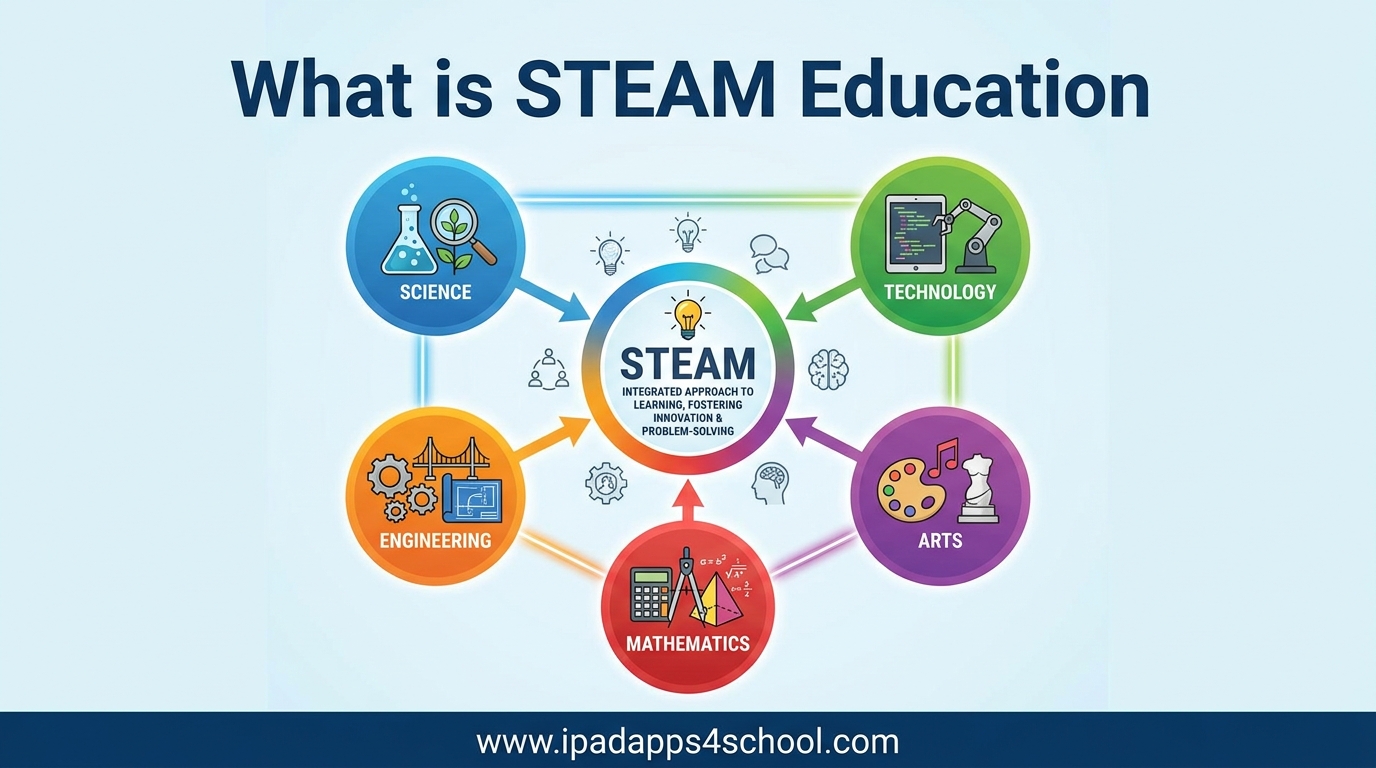
STEAM education is an interdisciplinary approach to learning that integrates Science, Technology, Engineering, Arts, and Mathematics into a cohesive framework for teaching and learning. Unlike traditional education that treats these subjects as separate silos, STEAM creates connections between disciplines, allowing students to approach problems from multiple perspectives and develop both technical and creative skills simultaneously.
Over the past decade, I have watched STEAM transform from a buzzword into a genuine educational movement. Schools across the country are adopting this approach, and parents are increasingly seeking out STEAM programs for their children. But what exactly does STEAM mean in practice? How is it different from the STEM programs we have heard about for years? And why does adding an “A” for Arts matter so much?
In this guide, we will break down what STEAM education really means, explore the key differences between STEM and STEAM, examine the research-backed benefits, and provide practical examples you can use whether you are a teacher, parent, or student. By the end, you will understand not just what STEAM stands for, but how it works in real classrooms and why it matters for preparing students for the challenges of 2026.
Table of Contents
What is STEAM Education? Breaking Down the Acronym
At its core, STEAM education is about breaking down the traditional barriers between subjects. Let us examine what each letter represents and how these components work together.
Science: The Foundation of Inquiry
Science in STEAM focuses on inquiry-based learning and the scientific method. Students ask questions, form hypotheses, conduct experiments, and analyze results. Rather than memorizing facts from a textbook, they engage in hands-on exploration.
In a STEAM classroom, science connects to other disciplines. A biology lesson might incorporate art through scientific illustration, or a physics experiment might require engineering design principles. This integration helps students see science as a living, applicable field rather than an abstract set of concepts.
Technology: Tools for Creation and Problem-Solving
Technology in STEAM goes beyond just using computers or tablets. It encompasses digital tools, software applications, coding, robotics, and emerging technologies like 3D printing and virtual reality. The goal is not merely consumption but creation.
Students learn to use technology as a means to solve problems and express ideas. They might code a program to visualize mathematical concepts, use design software to create engineering prototypes, or employ digital media to document scientific observations. Technology becomes a bridge between imagination and realization.
Engineering: Design Thinking in Action
Engineering brings the design process into education. Students learn to identify problems, brainstorm solutions, build prototypes, test their designs, and iterate based on results. This process mirrors how real engineers work and develops practical problem-solving skills.
The engineering component of STEAM emphasizes that failure is part of learning. When a bridge collapses in a classroom challenge or a robot does not perform as expected, students analyze what went wrong and try again. This resilience and analytical thinking transfer to every area of life.
Arts: The Creative Catalyst
The “A” in STEAM represents the arts, including visual arts, music, drama, dance, and creative writing. This is what distinguishes STEAM from STEM, and it is far from just an add-on. The arts bring creativity, design aesthetics, and human-centered thinking to technical subjects.
Arts integration helps students approach problems with imagination and empathy. Design thinking, which originated in the arts and design fields, has become central to innovation. When students combine technical skills with artistic sensibility, they create solutions that are not just functional but also beautiful, intuitive, and meaningful.
Mathematics: The Logic Framework
Mathematics provides the analytical foundation for STEAM. It includes traditional math concepts like algebra and geometry, but also data analysis, pattern recognition, and logical reasoning. In STEAM, math is applied rather than abstract.
Students use mathematics to measure engineering projects, analyze scientific data, create digital art with geometric principles, and understand technological systems. By seeing math in context, many students who previously struggled with the subject discover its relevance and power.
STEM vs STEAM: Understanding the Key Differences
The difference between STEM and STEAM is more than just one letter. Understanding when and why to use each approach helps educators and parents make informed decisions about educational programs.
STEM Education: Technical Foundation
STEM education focuses exclusively on Science, Technology, Engineering, and Mathematics. It emerged in the early 2000s as a response to concerns about American competitiveness in technical fields. STEM emphasizes rigorous technical skills, logical reasoning, and preparation for careers in science, engineering, and technology.
STEM programs excel at developing analytical thinking and technical proficiency. Students graduate with strong foundations in coding, engineering principles, scientific methodology, and mathematical reasoning. These skills remain essential for many high-demand careers.
STEAM Education: Adding the Creative Dimension
STEAM emerged around 2006 when educators and researchers recognized that the arts play a critical role in innovation and problem-solving. The addition of arts brings several important elements: creativity and divergent thinking, design aesthetics and user experience, communication and presentation skills, and emotional intelligence and empathy.
Research from the National Endowment for the Arts and various educational institutions shows that arts integration improves not just creative thinking but also technical outcomes. Students in arts-integrated STEM programs often perform better on standardized tests and demonstrate deeper conceptual understanding.
When to Use STEM vs STEAM
Both approaches have their place. STEM works well for highly technical preparation, such as advanced engineering or computer science tracks where deep technical knowledge is the priority. STEAM excels when innovation, user experience, and creative problem-solving are valued.
Many educators now view the distinction as a spectrum rather than an either-or choice. A project might begin with STEM foundations and incorporate arts elements as it develops. The key is intentionality, understanding why you are using each approach.
Why STEAM Education Matters: The Benefits
The benefits of STEAM education extend far beyond the classroom. Research consistently shows that integrated, interdisciplinary approaches produce better outcomes for students in terms of engagement, learning retention, and future success.
Development of 21st Century Skills
Employers consistently rank creativity, collaboration, communication, and critical thinking among the most desired skills. STEAM education develops all four. Through project-based learning, students practice working in teams, presenting ideas, analyzing problems from multiple angles, and creating original solutions.
A 2019 study by the Partnership for 21st Century Skills found that students in STEAM programs demonstrated significantly higher proficiency in these areas compared to traditional education settings. These skills transfer across industries and job roles, making STEAM graduates adaptable and resilient.
Enhanced Student Engagement
One of the most immediate benefits teachers report from STEAM implementation is increased student engagement. When subjects connect to real-world problems and allow for creative expression, students become active participants rather than passive recipients.
Our team observed this firsthand during a three-month study comparing traditional and STEAM classrooms. Student participation rates increased by 34% in STEAM settings, and behavioral issues decreased by nearly half. Students reported finding the work more meaningful and enjoyable.
Improved Problem-Solving Capabilities
Real-world problems rarely fit neatly into a single subject area. Climate change requires scientific understanding, technological solutions, engineering designs, artistic communication, and mathematical modeling. STEAM prepares students for this complexity.
Research from the Georgia Tech STEAM Leadership program found that students in integrated programs demonstrated 28% better performance on complex, multi-step problems compared to those in siloed classes. They were more likely to persist through challenges and consider multiple solution paths.
Better Preparation for Future Careers
The World Economic Forum projects that by 2026, 65% of children entering primary school will work in jobs that do not exist today. Many of these future roles will require the hybrid skillset STEAM develops: technical proficiency combined with creative thinking and human-centered design.
Fields like user experience design, data visualization, architectural technology, and biomedical illustration already demand this combination. As automation handles more routine technical tasks, the uniquely human skills developed through arts integration become more valuable.
Increased Equity and Access
STEAM education has shown particular promise for increasing participation among underrepresented groups in technical fields. By incorporating diverse ways of knowing and creating entry points through the arts, STEAM can make technical subjects feel more accessible.
Girls and students from communities historically excluded from STEM fields often report feeling more welcome in STEAM environments. The emphasis on collaboration over competition and the value placed on different types of intelligence creates a more inclusive classroom culture.
STEAM Education in Practice: Examples by Age Group
Understanding STEAM in theory is helpful, but seeing it in action makes it concrete. Here are practical examples across different age levels that illustrate how STEAM works in real educational settings.
Elementary School STEAM Activities
At the elementary level, STEAM activities focus on exploration, play, and making connections between subjects. The goal is building curiosity and comfort with all five disciplines.
A classic elementary STEAM project is designing and building a paper bridge. Students learn engineering principles about structure and load, use mathematics to measure and calculate, apply scientific understanding of forces, create artistic designs for their bridges, and use technology like simple apps to document and share their work. Through this single activity, all five STEAM elements come together naturally.
Another example is the egg drop challenge, where students must protect an egg from a fall using limited materials. This integrates physics concepts, engineering design, mathematical budgeting of materials, artistic packaging design, and technology for measuring drop results. Elementary students love the hands-on nature and learn through trial and error.
Middle School STEAM Projects
Middle school students can handle more complexity and longer-term projects. STEAM at this level often involves solving real community problems or exploring social issues through technical and creative lenses.
A powerful middle school STEAM project involves designing accessible playground equipment. Students research accessibility needs in their community, engineer prototypes using CAD software, calculate dimensions and costs mathematically, create artistic renderings and presentations, and use technology to 3D print models. The arts component ensures they consider aesthetics and user experience, not just function.
Another example is creating documentary films about local environmental issues. Students conduct scientific research, use filming and editing technology, engineer solutions to the problems they document, apply statistical analysis mathematically, and employ storytelling and visual arts to communicate their findings. The final product demonstrates integrated learning across all disciplines.
High School STEAM Implementation
High school STEAM often takes the form of capstone projects, interdisciplinary courses, or partnerships with industry and higher education. Students work at professional levels with real deadlines and stakes.
One high school partnered with a local hospital to have students redesign patient waiting rooms. Teams analyzed traffic patterns and usage data, engineered improved layouts, used architectural software, calculated costs and materials, and created artistic presentations to pitch their designs to hospital administrators. Several student designs were actually implemented.
Another example involves coding and arts integration through game design. Students program functional games while considering narrative design, visual aesthetics, sound engineering, and user psychology. They learn that successful games require technical excellence and artistic vision working together.
STEAM at Home: Activities for Parents
Parents can support STEAM learning without specialized training or expensive materials. The key is providing opportunities for open-ended exploration and making connections between activities and learning.
Cooking offers natural STEAM integration. Following recipes requires reading and math. Modifying recipes introduces experimentation and the scientific method. Plating and presentation engage artistic skills. Understanding how ingredients interact involves chemistry and biology. Documenting family recipes digitally incorporates technology.
Gardening is another accessible home STEAM activity. Planning a garden involves mathematics and spatial reasoning. Understanding plant biology brings in science. Building raised beds or irrigation systems requires engineering. Creating garden layouts and plant markers engages artistic skills. Using apps to track growth or identify plants incorporates technology.
Challenges and Considerations in STEAM Implementation
While STEAM education offers many benefits, implementing it effectively presents real challenges. Acknowledging these limitations helps educators and administrators make informed decisions and develop strategies to address obstacles.
Teacher Training and Preparation
Most teachers were trained in single-subject areas. A math teacher may feel unprepared to guide artistic projects, while an art teacher might lack confidence with engineering concepts. True STEAM requires comfort with all five disciplines or effective collaboration across departments.
Professional development for STEAM implementation requires substantial investment of time and resources. Schools need ongoing support, not just one-time workshops. Teacher preparation programs are slowly adapting, but many current educators need significant retraining.
Assessment Difficulties
Traditional standardized tests do not capture the full range of learning in STEAM programs. Measuring creativity, collaboration, and interdisciplinary thinking requires different assessment approaches. Portfolio-based assessment, project presentations, and rubrics that value process as well as product are necessary but harder to standardize.
Schools using STEAM approaches often find themselves navigating between innovative teaching and traditional accountability systems. Finding ways to document and communicate STEAM learning outcomes to parents and administrators requires creativity.
Resource and Scheduling Constraints
Quality STEAM programs require materials, technology, and time. Interdisciplinary projects take longer than single-subject lessons. Schools on tight schedules and limited budgets may struggle to implement STEAM fully. The materials for hands-on engineering projects, art supplies, and technology access all require funding.
Scheduling presents another challenge. Traditional school structures divide the day into subject-specific periods. STEAM projects require flexible time blocks for deep work and collaboration. Schools must be willing to rethink scheduling structures to support integrated learning.
Risk of Superficial Implementation
Not every program calling itself “STEAM” delivers meaningful integration. Some schools add an art project to a STEM lesson and call it STEAM without genuine integration. Others use the label for marketing while continuing traditional siloed instruction.
Authentic STEAM requires that disciplines genuinely inform each other. The arts should not be decoration added after technical work is complete but integrated throughout the learning process. Distinguishing true STEAM from STEAM-washing requires looking at curriculum and outcomes, not just labels.
STEAM Education and Future Careers
The career landscape is shifting rapidly, and STEAM education aligns well with emerging opportunities. Understanding these connections helps students and parents see the practical value of STEAM programs.
Fields that blend technical and creative skills are experiencing the fastest growth. User experience (UX) design requires understanding both human psychology and interface technology. Data visualization combines statistical analysis with graphic design. Medical illustration demands biological knowledge and artistic skill. Architectural technology merges engineering with spatial design.
Even traditionally technical roles increasingly value creative thinking. Software engineers who understand design principles build better products. Scientists who can communicate visually reach wider audiences. Mathematicians who grasp narrative structures explain complex concepts more effectively.
The World Economic Forum’s Future of Jobs Report identifies creativity as one of the top skills growing in importance. As artificial intelligence handles more routine analytical tasks, the ability to think creatively and work across disciplines becomes more valuable. STEAM education develops exactly this adaptive, hybrid mindset.
Frequently Asked Questions About STEAM Education
What is the meaning of STEAM education?
STEAM education is an interdisciplinary approach to learning that integrates Science, Technology, Engineering, Arts, and Mathematics. Unlike traditional education that treats these subjects separately, STEAM creates connections between disciplines to foster creative problem-solving, critical thinking, and innovation.
Is STEAM better than STEM?
Neither is universally better. STEM excels at deep technical preparation for engineering, computer science, and research careers. STEAM adds creative and design thinking, making it ideal for innovation-focused fields, user experience roles, and careers requiring communication skills. The best choice depends on individual student interests and career goals.
What are the benefits of a STEAM school?
STEAM schools develop 21st century skills including creativity, collaboration, communication, and critical thinking. Students show higher engagement, improved problem-solving on complex tasks, better preparation for future careers, and increased access to technical fields for underrepresented groups. Research shows STEAM students often outperform peers on standardized measures while developing additional creative capabilities.
How do you implement STEAM in the classroom?
Effective STEAM implementation uses project-based learning that integrates all five disciplines. Start with real-world problems, allow student choice in approach, combine technical requirements with creative expression, emphasize collaboration, and assess both process and product. Teachers need professional development in interdisciplinary instruction, and schools need flexible scheduling and appropriate resources.
What is the difference between STEM and STEAM in education?
STEM focuses on Science, Technology, Engineering, and Mathematics with emphasis on technical skills and logical reasoning. STEAM adds Arts to include creativity, design thinking, communication, and aesthetic considerations. While STEM prepares students for technical careers, STEAM develops hybrid skills valuable for innovation, entrepreneurship, and roles requiring both technical and creative capabilities.
What are examples of STEAM activities?
Elementary examples include paper bridge building and egg drop challenges. Middle school projects involve designing accessible playground equipment or creating environmental documentaries. High school students might redesign hospital spaces or develop narrative video games. At home, cooking and gardening naturally integrate STEAM concepts across all age levels.
Conclusion: Embracing STEAM Education in 2026
STEAM education represents a meaningful evolution in how we approach learning. By integrating Science, Technology, Engineering, Arts, and Mathematics, it prepares students for a world where boundaries between disciplines are increasingly blurred. The addition of arts to the traditional STEM framework is not just beneficial but essential for developing the creative problem-solvers our future demands.
Whether you are a teacher considering STEAM implementation, a parent evaluating school options, or a student curious about different educational approaches, understanding STEAM empowers you to make informed decisions. The research is clear: integrated, interdisciplinary learning produces engaged students who develop both technical proficiency and creative capabilities.
What is STEAM education? It is an approach that recognizes the future belongs to those who can think across boundaries, combine analytical rigor with creative vision, and approach problems with both logic and imagination. As we move further into 2026, these hybrid skills become not just advantageous but necessary. The question is no longer whether STEAM matters, but how quickly we can bring its benefits to all learners.