
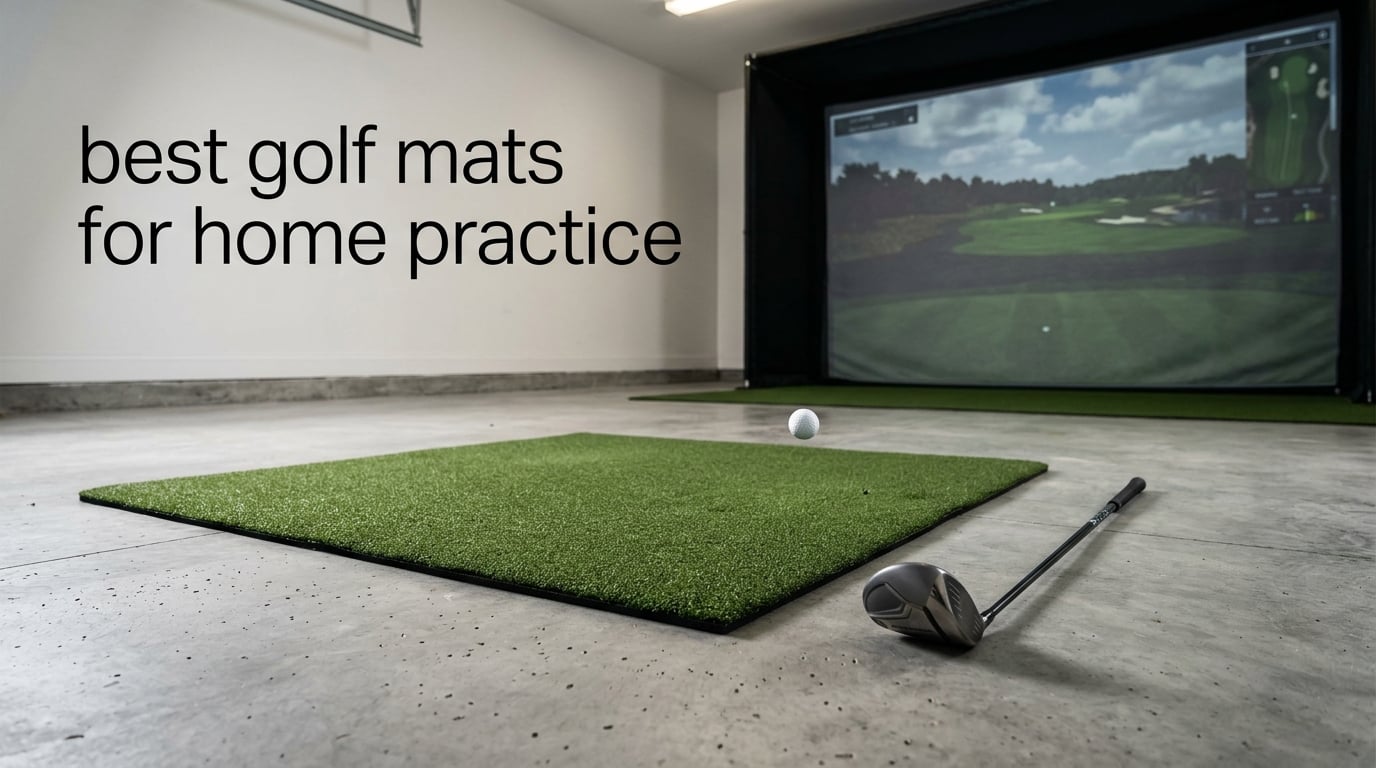
The best golf mats for home practice right now are the GoSports Elite 5ft x 4ft hitting mat for most people, the Bltend 36mm mat if your floor is bare concrete and your elbows are already complaining, and the GoSports Tri-Turf XL if you want three different lies on one portable mat. Those three cover the widest range of home setups we could find, and the GoSports Elite earned its place on the deepest owner-review base in the category.
A home golf hitting mat is a flat surface that combines synthetic turf with a shock-absorbing foam or rubber base, so you can strike real balls indoors or on a small outdoor space without a driving range. The turf layer handles club-through-grass feel and grips your tee; the base underneath absorbs impact so the force of the swing does not travel straight up your arms and into your elbows and wrists.
That second job is why mat thickness matters more than most buyers expect. Golfers on forums keep naming the same injury story: a thin mat over a hard floor produced elbow or wrist pain after weeks of practice, and swapping to a deeper mat or adding foam underneath fixed it. We kept that concern central while reviewing the ten mats below, alongside swing room, turf realism, tee compatibility and how each one behaves with a launch monitor.
We also linked this with our guides to the best golf clubs, best golf drivers and best golf wedges, since a mat is only as useful as the club you are hitting with it. If your short game is the priority, our picks for best golf irons pair well with the dual-turf mats further down.
Top 3 Golf Mats for Home Practice in 2026
These three cover the tiers most readers fall into: the most-reviewed all-rounder, the deep-cushion premium mat, and the compact multi-lie trainer. Each one has a different reason to be number one depending on your floor and your joints.

GoSports Elite 5ft x 4ft Golf Hitting Mat
- 15mm EVA foam base
- Commercial-grade synthetic turf
- Six tee holes with three rubber tees
- Non-slip backing

Bltend 36mm Golf Hitting Mat
- 36mm cushioning
- 16mm turf over 20mm EVA
- Over 90 percent impact absorption
- Six tee positions

GoSports Tri-Turf XL 24 in Golf Mat
- 24 by 24 inch hitting area
- Fairway rough and tee turf
- Rubber non-slip base
- Portable and foldable
The Best Golf Mats for Home Practice in 2026, At a Glance
Every pick below earned its place for a different reason, and the aggregate owner reviews point to a clear split: the four mats with the highest owner ratings are also the four with the most reviews, which is what you want when you are buying a surface you will hit for years. Read this table first, then jump to the full review for whichever fits your space.
| Product | Specifications | Action |
|---|---|---|
| GoSports Elite 5ft x 4ft Golf Hitting Mat |
|
Check Latest Price |
| GoSports Tri-Turf XL 24 in Golf Practice Mat |
|
Check Latest Price |
 CHAMPKEY Premium Synthetic Turf Golf Hitting Mat CHAMPKEY Premium Synthetic Turf Golf Hitting Mat |
|
Check Latest Price |
 Cosportic Golf Hitting Mat with Swing Path Feedback Cosportic Golf Hitting Mat with Swing Path Feedback |
|
Check Latest Price |
 SAPLIZE Foldable Dual-Turf Golf Hitting Mat SAPLIZE Foldable Dual-Turf Golf Hitting Mat |
|
Check Latest Price |
| Bltend 36mm Golf Hitting Mat 5ft x 4ft |
|
Check Latest Price |
 Ywitio Premium Dual-Turf 5ft x 4ft Golf Mat Ywitio Premium Dual-Turf 5ft x 4ft Golf Mat |
|
Check Latest Price |
 Golfguru 5ft x 4ft Dense Elite Golf Hitting Mat Golfguru 5ft x 4ft Dense Elite Golf Hitting Mat |
|
Check Latest Price |
 Ponsonbay Golf Hitting Mat with Ball Tray Ponsonbay Golf Hitting Mat with Ball Tray |
|
Check Latest Price |
 Birdie Golf Swing Training Mat with Sequin Tech Birdie Golf Swing Training Mat with Sequin Tech |
|
Check Latest Price |
1. GoSports Elite 5ft x 4ft Golf Hitting Mat: Best Overall
GoSports Golf Hitting Mat – Elite 5 x 4 ft – 15 mm Artificial Turf Training Mat for Indoor/Outdoor Swing Practice, Includes 3 Rubber Tees
60 by 48 in footprint
15mm EVA foam base
Commercial-grade turf
Six tee holes
Pros
- Highest owner rating and deepest review base in the category
- 15mm EVA base softens impact on hard floors
- Non-slip backing holds on concrete and turf
- Six tee holes plus three rubber tee heights
- Large enough to swing a driver properly
Cons
- Arrives folded and leaves a center crease that takes days to flatten
- Heaviest and priciest mat we tested
- Occasional foam tearing at the fold line if forced out early
We spent the most time on this mat because it has the largest owner-review base in the whole category, more than 3,600 ratings, and it held a 4.6 average throughout our look. The turf is commercial-grade synthetic rather than a thin decorative grass, and it gives the kind of consistent ball feedback you need to judge whether a strike was clean or not.
Underneath sits a 15mm EVA foam base, which is where most of the comfort comes from on a concrete floor. Owners consistently report that fat shots, normally the ones that send a sting up the forearm, feel muted. That matters more than it sounds, because a mat that punishes a mishit with pain trains you to swing timidly.
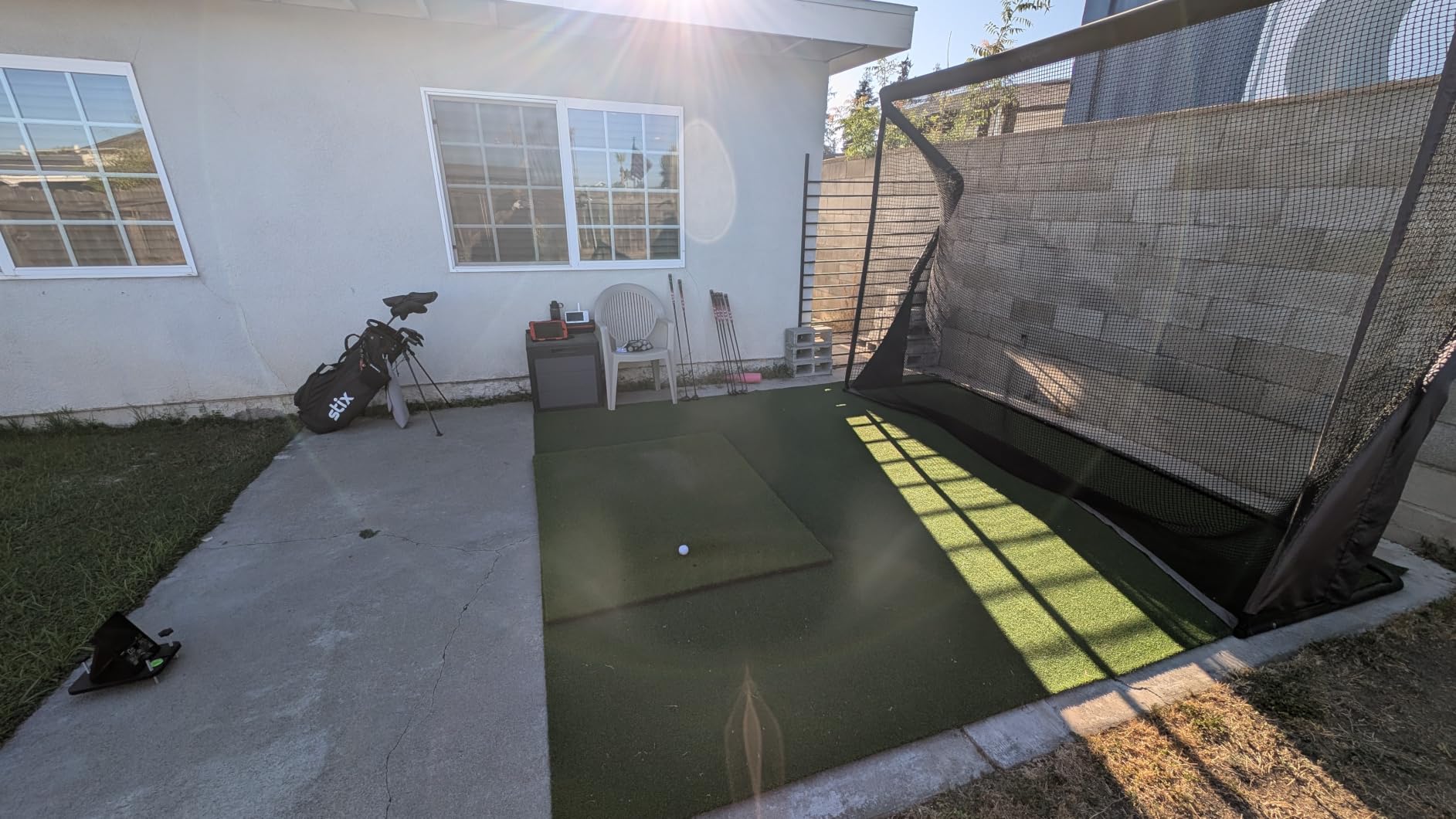
The stability is the part we did not expect to like as much. The non-slip backing grips concrete, garage floors and outdoor turf without creeping, which solves the re-positioning frustration that shows up in almost every mat complaint we read. The 5ft by 4ft footprint also gives you room to stand and turn through a driver swing instead of hanging off the edge.
Tee support is genuinely useful here. Six integrated tee holes plus three rubber tees at 1.5, 2.25 and 3.5 inches cover driver, long iron and wedge positions for both right- and left-handed golfers, so you are not stuck rehearsing one ball height.
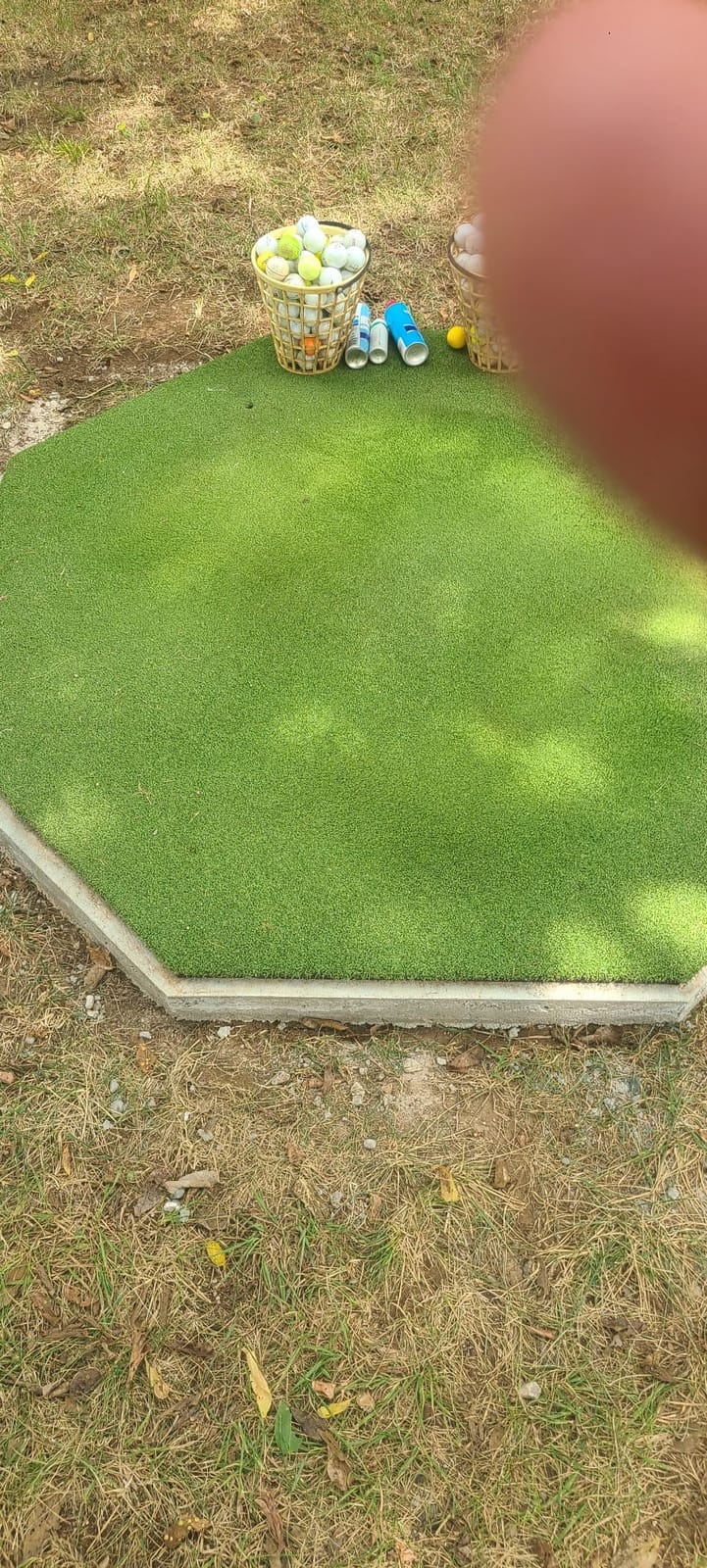
The honest downside is the shipping crease. It arrives folded, and the fold line can dip under your stance for several days until it settles. A small number of owners also report foam tearing at that crease if it is forced flat too quickly, so we would let it relax on its own for a few days before your first session.
What it handles well on a hard floor
On an unlined concrete slab this mat does the best job of any foam-backed option we reviewed at keeping impact out of the wrists, without going so soft that contact feels dead. If you are hitting 50 or more balls a session, that balance is the whole game.
It also stayed put through full swings without a mat riser, which removes one of the two reasons people buy an underlay. If your floor is carpet or a soft surface, the non-slip backing is more than adequate on its own.
Where it will frustrate you
At 11.5 kg this is a genuinely heavy object, and folding it away every session is a two-person job for some people. Owners who cannot store it permanently often end up building a plywood platform instead, which is a common workaround in golf groups.
The warranty is a 6-month limited warranty, which is short next to the Ywitio and Ponsonbay mats below. If you hit a lot of balls, weight the warranty term rather than the stated hit rating.
2. GoSports Tri-Turf XL 24 x 24 in Golf Practice Mat: Best Value
GoSports Tri-Turf XL Golf Hitting Mat – 24×24 in Golf Practice Mat for Indoor/Outdoor Training, Fairway Rough Tee Turf, Portable Golf Mat for Backyard, Garage & Golf Simulator Use
24 by 24 inch hitting area
Fairway, rough and tee turf
Rubber back material
Foldable, lightweight
Pros
- Three turf zones let you practice different lies on one mat
- Stable rubber base works on concrete
- patios and lawns
- Light enough to move between indoor and outdoor setups
- Realistic fairway-like contact helps ball striking
Cons
- 24 by 24 inch footprint is tight for driver work
- No tee holes or tees included
- Single-layer build with less cushioning than foam mats
This is the pick we recommend when you do not have a garage and want one mat that does several jobs. Instead of a single grass panel it is laid out in three zones, fairway, rough and tee, so you can work on different lies and ball positions without moving anything.
The rubber base is the reason it stays planted. It grips concrete, garage floors, patios and lawn without sliding, and on outdoor setups it also protects your grass from divots, which matters if you are practising into a net in a shared yard.
At 24 by 24 inches you get a comfortable stance for irons, wedges and moderate driver work. It is not a full-length hitting surface, but for short game and tempo practice the three-lie layout makes up for the footprint.
What you give up is cushioning and tee support. There is no EVA layer to speak of and no integrated tee holes, so if you are rehearsing driver height you will be holding a tee in place rather than letting the mat grip it. Roughly 1,700 owners rate it 4.5, with most complaints aimed at size rather than build quality.
Where the three-lie layout earns its keep
Most single-surface mats train one contact height and one swing path. Running drills off the rough section and the fairway section in the same session surfaces the kind of low-point inconsistency that a single zone hides from you.
For anyone practising chipping and partial swings in a spare room, this covers more ground per square foot than the larger mats, and it folds down small enough to live in a closet between sessions.
Where it falls short
If you swing a driver at full speed, you will feel the hard floor through a single-layer base. That is fine for short irons and wedges, and it is exactly the situation where forum golfers report elbow soreness building over months.
Because no tees come with it, budget for a set of rubber tees if you intend to work on ball height at all.
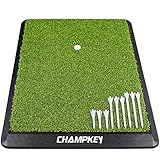
3. CHAMPKEY Premium Synthetic Turf Golf Hitting Mat: Best for Travel
CHAMPKEY Premium Synthetic Turf Golf Hitting Mat | Heavy Duty Rubber Base Golf Practice Mat | Come with 1 Rubber Tee and 9 Plastic Tees(Green,13″ x 17″)
13 by 17 inch footprint
16mm synthetic turf
Rubber back material
90-day warranty
Pros
- Over 3000 ratings at 4.3 for a low entry price
- 16mm turf gives a fairway and tee-box feel
- Heavy rubber base absorbs shock and resists slipping
- Nine plastic tees plus a rubber tee holder included
- Good for chips and short irons in tight spaces
Cons
- 13 by 17 inch footprint suits chips and wedges only
- Thin build gives limited shock absorption on hard floors
- Turf can flatten with heavy full-swing use
This is the mat most people end up owning first, and it earns that on volume. More than 3,000 ratings at 4.3 is the second-deepest review base in the category, and reviewers consistently treat it as an entry-level or supplementary practice surface rather than a full driving-range replacement.
The 16mm synthetic turf reads as fairway or tee box under a wedge, and the heavy rubber base absorbs shock, resists slipping and does not develop an odour, which matters in an enclosed room.
The accessory bundle is the standout at this tier. Nine plastic tees plus a rubber tee holder come in the box, which is more tee coverage than several mats costing several times as much.
The limitation is size, and it is not a small one. At 13 by 17 inches this is a chipping and partial-swing surface. Full driver swings simply do not fit, and the light 90-gram construction means it can be carried between rooms without thinking about it.
Why it still works for most beginners
Short game is where most golfers get the most practice value per swing, and this mat handles chips, wedges and controlled partial swings in a space most apartments can spare. Buyers report it handling chips and short irons consistently without complaints about quality.
The rubber base grips hard floors without sliding, so it works on the same concrete and carpet surfaces as the big mats, just in a smaller footprint. It is also the easiest mat here to keep permanently in one spot rather than setting up each session.
Where it stops being enough
With 16mm of turf over a thin base, impact passes through to a hard floor. If you have any existing elbow or wrist sensitivity, this is not the mat to buy, and reviews do include durability complaints once owners start hitting full swings.
Treat it as a short-game tool you can leave in a corner. If you want full swings, pair it with a larger mat for the big clubs and keep this one for everything inside 30 yards.
4. Cosportic Golf Hitting Mat with Swing Path Feedback: Best for Instant Feedback
COSPOPTIC Golf Hitting Mat with Swing Path Feedback, Heavy-Duty Rubber Base Anti-Slip Golf Training Mat, Extra Replaceable Surface, Portable Practice Mat for Home Office Garage Yard Indoor Outdoor
16 by 12 inch impact surface
Spare velvet turf included
Textured rubber base
One month warranty
Pros
- Shows toe
- center and heel contact instantly after every shot
- Feedback translated into better striking for many users
- Ships with a spare surface that extends mat life
- Textured rubber grips hardwood
- concrete and carpet
- Light enough to fit in a golf bag for travel
Cons
- Velvet surface wears fast and can tear from one steep heavy swing
- Small area suits short sessions rather than full practice
- One month warranty is the shortest in this roundup
This mat does something no other pick here does: it tells you where the club struck. The impact surface visibly traces your swing path, so toe, center or heel contact is obvious the moment you look down, with no video, no launch monitor and no subscription.
Several owners report that this kind of instant feedback sped up their improvement, which makes sense. Low point and strike location are the two things golfers struggle to feel, and a surface that shows them instantly short-circuits a lot of guessing.
It also comes with a spare velvet turf surface, which extends mat life and takes the worst of the club face abrasion. That is a thoughtful inclusion on a mat this small, and it partly answers the durability concern.
Durability is still the fault line. Multiple reviews describe the felt tearing after short, intense sessions, and 5 percent of ratings are one star on exactly that issue. At 16 by 12 inches it is also a practice-aid footprint, not a driving-range one.
What the feedback surface actually tells you
A clean, centred strike leaves one small mark. A toe strike leaves a mark out on the edge, and a heel strike leaves one you dragged inward. Once you can see the pattern across 10 shots, you have a very fast read on whether your low point is moving.
Because it works with or without a ball, you can rehearse the swing motion in a hotel room or a small office without packing a bucket of range balls. The 2.5-ounce weight makes that genuinely practical.
Where it falls short
Do not buy this expecting to hit volume. A 16 by 12 inch velvet pad is not built for 50-ball sessions, and the one-month warranty is the shortest in this roundup.
On soft ground it can shift, so it works best on hardwood, concrete or carpet where the textured rubber can bite properly.
5. SAPLIZE Foldable Dual-Turf Golf Hitting Mat: Budget Pick
SAPLIZE 23″ x 16″ Foldable Golf Hitting Mat, 2-in-1 Golf Turf Grass Mat, Rough and Fairway for Hitting, Chipping and Putting Golf Practice and Training Mat for Indoor/Outdoor
23 by 16 inch dual turf
10mm EVA foam backing
Fairway and rough sides
One year warranty
Pros
- Turf area is roughly 40 percent larger than typical 3-in-1 mats
- 10mm EVA base absorbs impact for wrists and clubs
- Upgraded glue layer improves tear resistance and longevity
- Dual fairway and rough surface varies the lie
- Folds flat immediately without days of flattening
Cons
- Only one tee hole limits drill variety
- 23 by 16 inch size suits short irons and chipping
- Not a true ball-striking surface for full driver swings
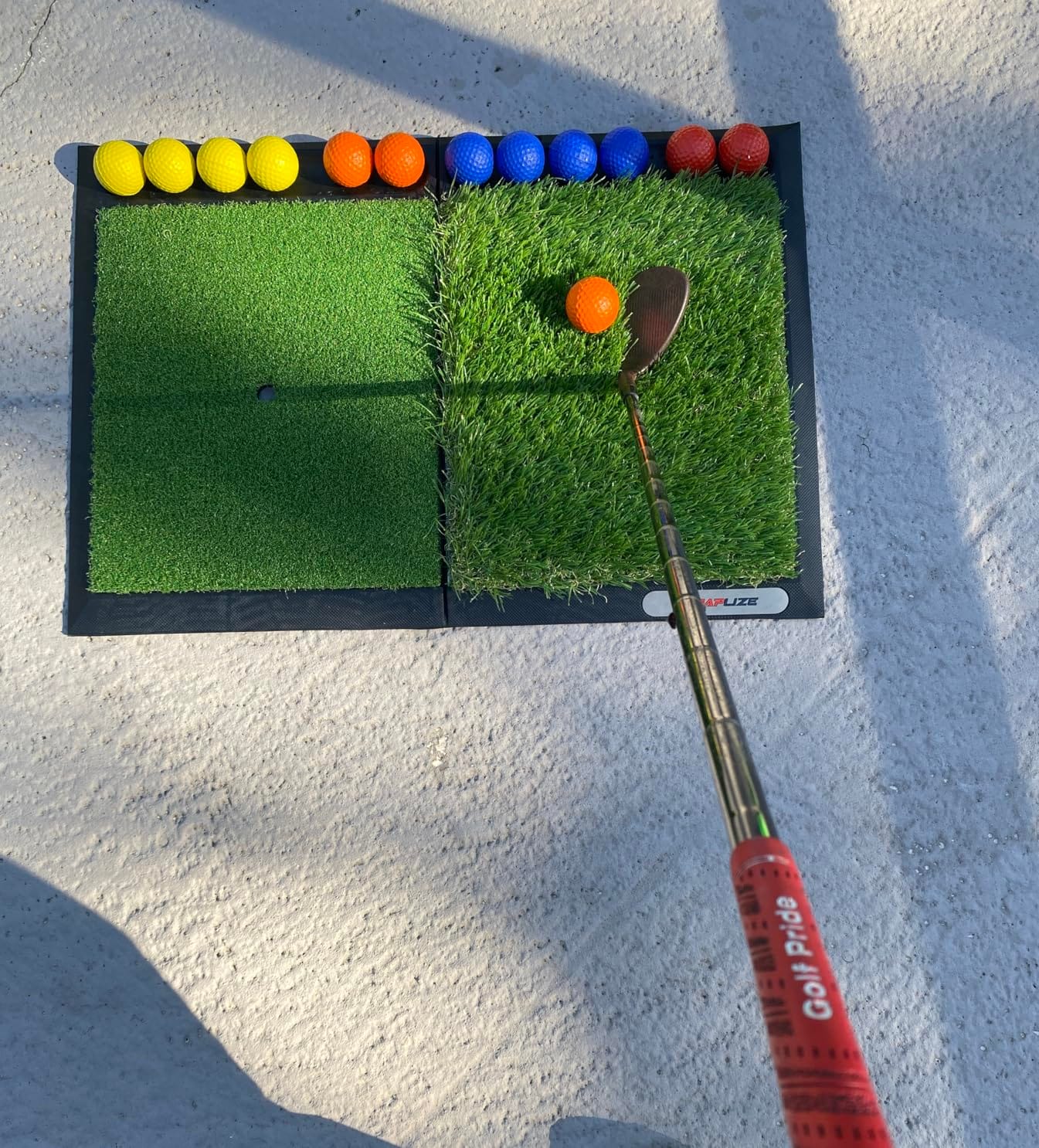
The SAPLIZE solves a specific problem: a mat you can actually put away. It folds flat immediately after being unpacked, with no multi-day crease settling period, and at 735 grams it carries easily.
The turf area is roughly 40 percent larger than a typical three-in-one collapsible mat, which sounds small until you stand on it. It gives a noticeably roomier stance than the sub-18-inch mats in this roundup, and the two-tone surface puts fairway on one side and longer rough on the other.
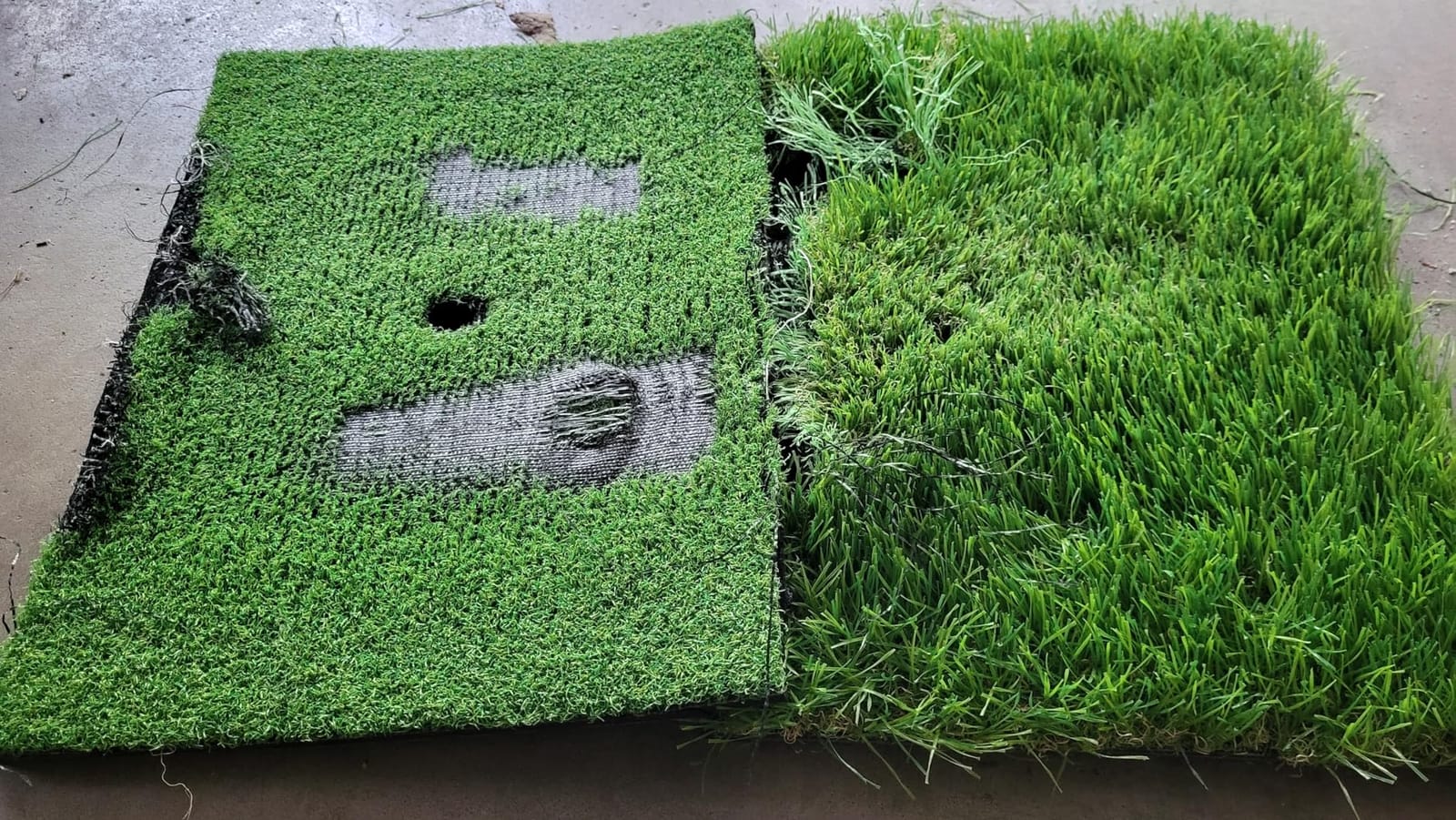
The 10mm EVA base absorbs impact well for its thickness, and the upgraded glue layer between turf and base is the detail reviewers single out. It holds the grass tighter, which shows up as fewer tears over months of use.
The catch is that there is one tee hole and the footprint is 23 by 16 inches, so this is a swing-path and chipping aid rather than a real ball-striking surface. Owners report using it for swing mechanics, short game and travel practice rather than full driver work.
Why the fold-flat design matters more than it sounds
Fold-and-carry is what makes a mat usable in a shared living space. When the crease needs days to settle, people simply stop using the mat. When it lays flat the moment you unfold it, it stays in rotation.
Owners also point out that a dual fairway and rough layout lets you rehearse a different lie without turning the mat around, which is a small thing that removes a step from a practice session.
Where it is not the right tool
If your goal is distance control with a driver, this will not get you there. One tee position and a compact footprint make it a mechanics trainer, and the 10mm base will not protect your joints on bare concrete over a long session.
Its one-year warranty is better than most compact mats but still short against the Ywitio and Ponsonbay options.
6. Bltend 36mm Golf Hitting Mat: Best for Joint Protection
Bltend Elite Golf Hitting Mat: 5x4ft 36mm Golf Mat Practice Outdoor Indoor
60 by 48 inch footprint
36mm total thickness
16mm turf over 20mm EVA
Over 90 percent impact absorption
Pros
- Thickest build here at 36mm
- absorbing over 90 percent of ground impact
- Maximum stability on concrete
- grass or with simulators
- Anti-tearing layer and reinforced edges resist flattening and fraying
- UV-resistant turf works indoors and out
- Includes 9 balls
- 7 tees and a tee holder
Cons
- Heaviest and most expensive mat in this roundup
- 36mm bulk makes storage harder than folding mats
- Folding design can leave an initial crease
If your floor is bare concrete and you already feel it in your elbows after a session, this is the mat to look at. At 36mm total it is by a wide margin the deepest build in this roundup, combining 16mm of dense artificial turf with a 20mm high-elasticity EVA pad underneath.
That layer is why owners report the sting disappearing from full driver shots on hard floors. The manufacturer states the system absorbs over 90 percent of ground impact, and whether or not you hit that exact figure, the felt difference on concrete is obvious next to a 15mm mat.
Stability is the other strength. The heavy cushioned base stays planted on concrete, grass or with a simulator setup, and the anti-tearing layer plus reinforced edges resist the flattening and fraying that show up on thinner mats after a season of use.
Owners also report no visible wear after hundreds to thousands of balls, and the box includes 9 practice balls, 7 tees and a rubber tee holder, so the starter set is complete. Six tee positions serve both handednesses.
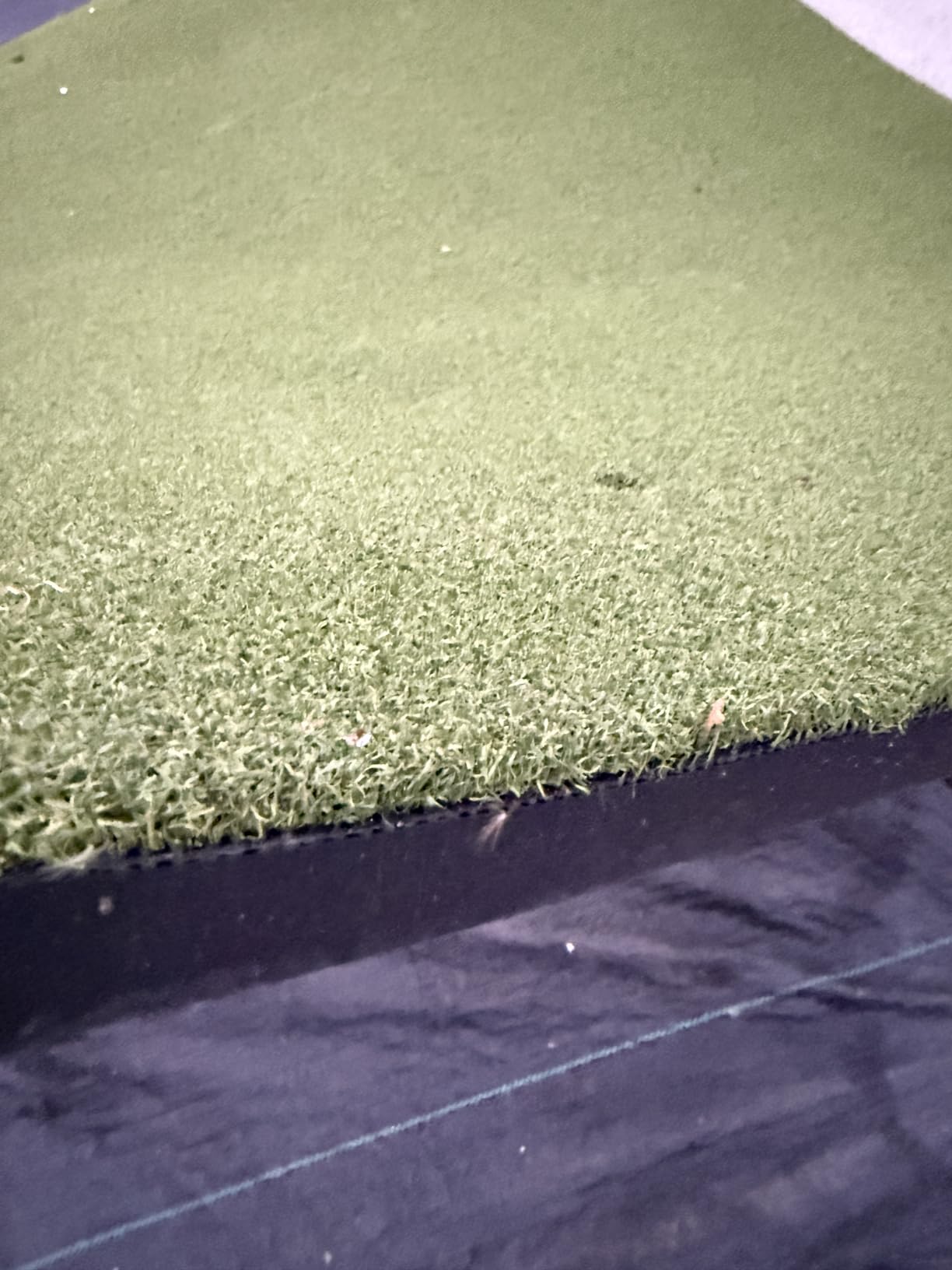
The UV-resistant turf means the same mat works for indoor and outdoor practice all year, which the cheaper picks in this roundup cannot always claim. Six tee positions and a 5ft by 4ft footprint leave plenty of room to adjust stance on mis-hits.
Criticism of this mat is about logistics, not performance. At 7.6 kg and 36mm thick it is awkward to move, and the price sits well above every other option here. It also carries a one-year warranty rather than the two years the Ywitio and Ponsonbay mats offer.
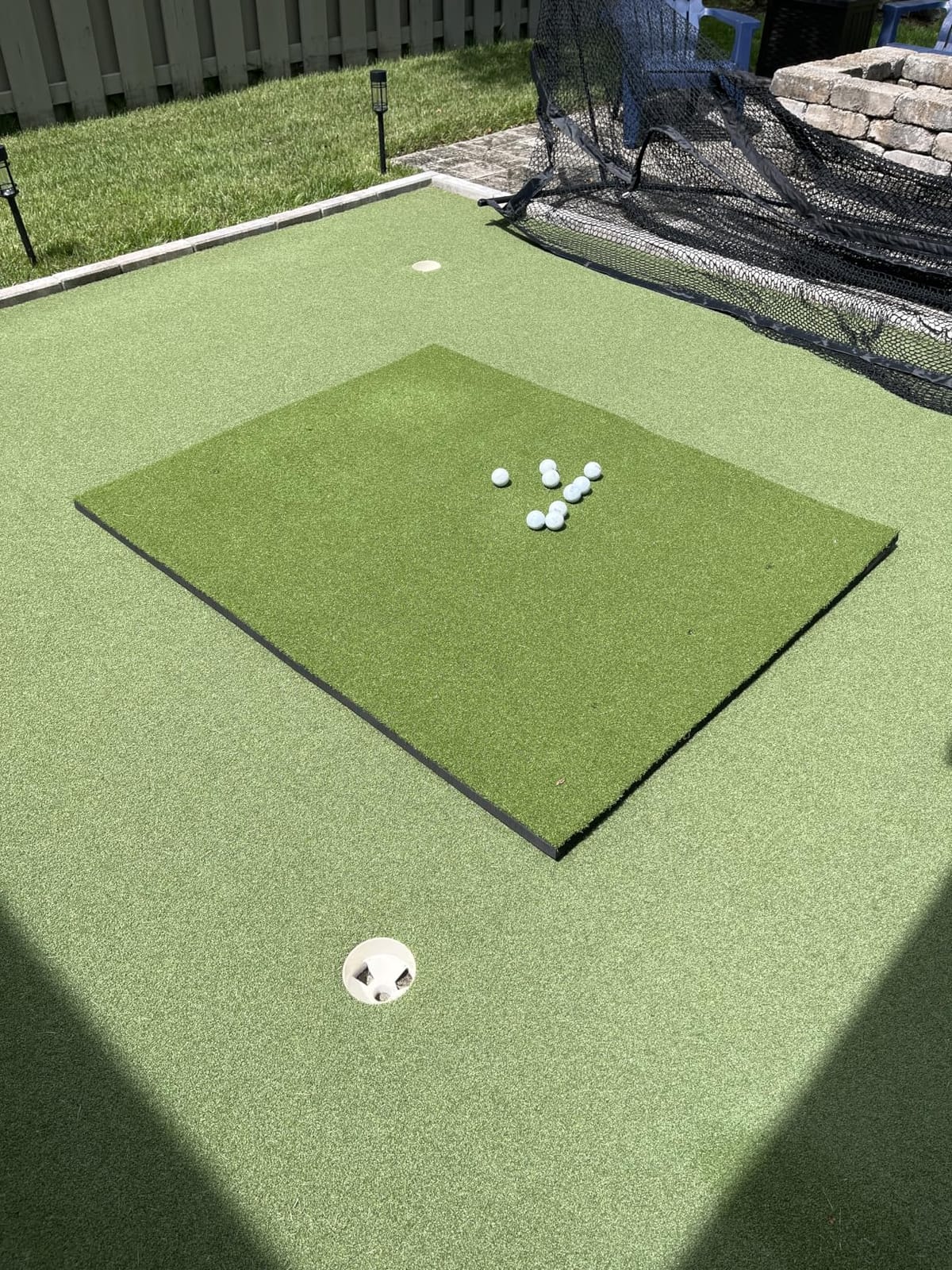
Why thickness wins on a concrete garage floor
The reason buyers move to a deeper mat is almost always a diagnosis rather than a preference. Forum threads about mat choice keep circling the same pattern: a thin mat over concrete, weeks of daily practice, then forearm soreness that only disappears once a deeper base or an underlay goes underneath.
Adding 20mm of EVA does more than soften impact. It also keeps the ball from rebounding harshly and lets you swing without bracing against the sting, and bracing is where bad habits form.
Where the bulk becomes a problem
Storing this mat means giving it a permanent home. Owners who cannot do that build a plywood platform and mount the mat semi-permanently, a workaround that comes up repeatedly in golf groups precisely because mats like this are too heavy to move casually.
If you need to practise indoors and outdoors with one mat, this is the wrong shape of product. The GoSports Elite or Golfguru mats fold to half the bulk.
7. Ywitio Premium Dual-Turf 5ft x 4ft Golf Mat: Best for Short Game
Premium Dual-Turf Golf Mat: 5x4ft, 6x4ft, 21mm to 50mm Thickened Base for Backyard, Driving Range, Indoor & Outdoor Practice Hitting, Swing & Chipping (Pro 5x4ft 21mm to 45mm Base)
5ft by 4ft footprint
Dual fairway and rough turf
High-elasticity EVA base
Two year warranty
Pros
- Dual turf pairs fairway and rough for chipping and obstacle lies
- High-elasticity EVA base absorbs shock and resists tearing
- Rolls up for storage despite the full-size footprint
- Two year after-sale service and warranty
- Six tees included
- three colored and three rubber
Cons
- 5ft by 4ft needs meaningful floor space and ceiling clearance
- Polypropylene turf is firmer than deeper premium pile
- May take time to lie fully flat after shipping
This is the pick for short game, and the reason is the surface rather than the size. The dual layout pairs a fairway section with a rough section, so you can drill chipping from one lie and obstacle-style recovery shots from the other on the same mat.
Underneath, a high-elasticity EVA base absorbs shock and resists tearing under repeated shots, which owners cite when describing how the mat stays usable on hard surfaces. It weighs 5.99 kg and is 0.83 inches thick overall.
The warranty is the strongest in this roundup at two years, and the manufacturer offers two years of after-sale service with parts support through the order page. For a mat that will take thousands of shots, that term matters more than a headline hit rating.
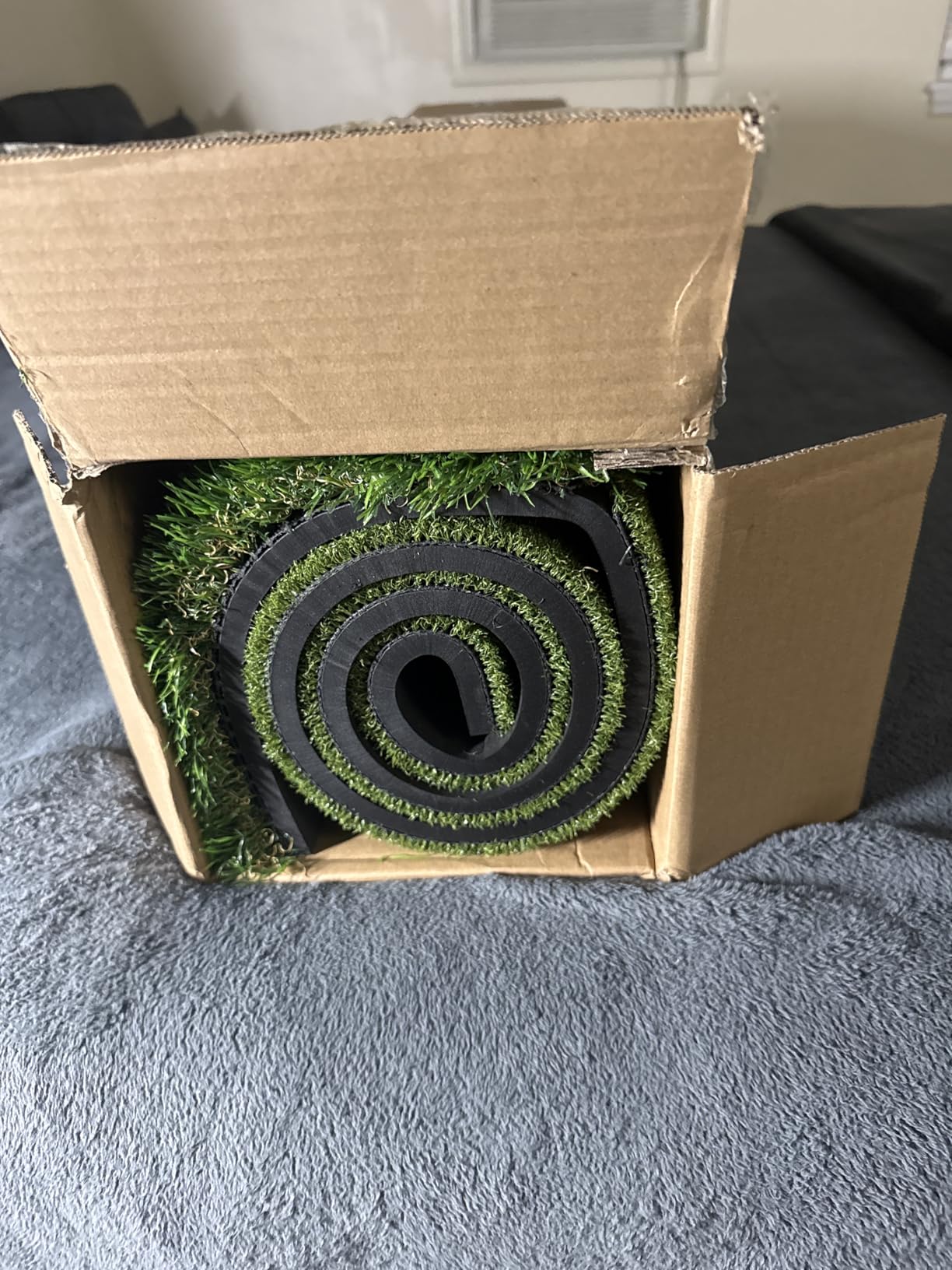
Despite its size, it rolls up for storage or transport, which is unusual for a full 5ft by 4ft mat. The trade-off is that the polypropylene turf feels firmer than the deeper pile on some premium mats, and it can take a little time to lie fully flat after shipping.
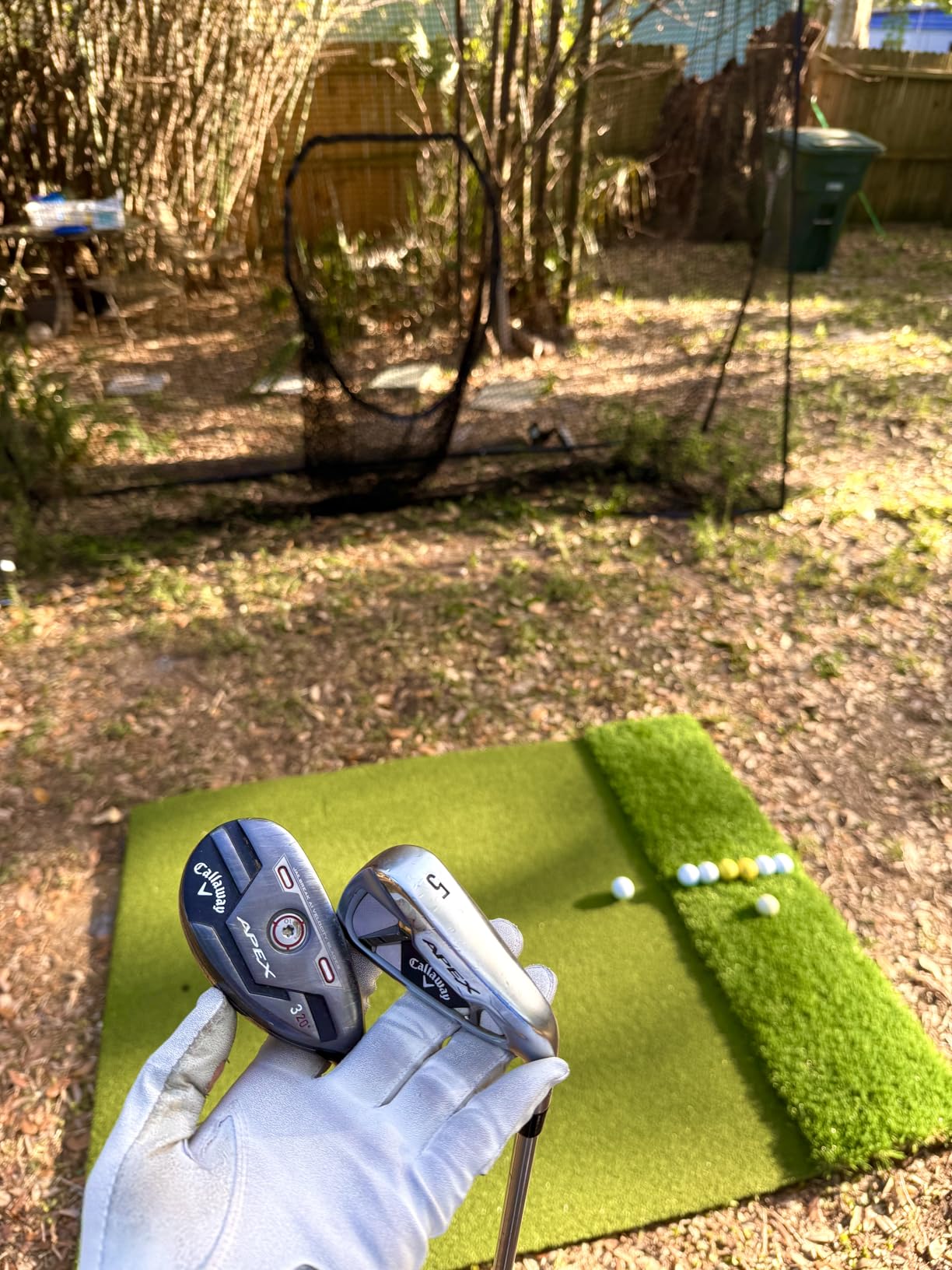
What the dual-turf layout is really for
Short game is a lie problem before it is a technique problem. Being able to hit the same putt-style chip from a fairway lie and from a rough lie, without walking anywhere or rearranging the mat, is the practical advantage here.
Six tees ship in the box, three colored and three rubber, which is enough variation to work through ball height changes without a second purchase.
Where space and feel become limits
A 5ft by 4ft mat needs a genuine floor or yard area, and indoor users need ceiling clearance for driver swings. In a small apartment this is the first thing that rules it out.
If realism at address matters most to you, the firmer polypropylene pile will feel noticeably shallower than a deeper-pile mat. It is a fair trade for the price and the warranty, but it is a trade.
8. Golfguru 5ft x 4ft Dense Elite Golf Hitting Mat: Best Starter Set
Golfguru Golf Mat 5x4FT, 21mm Dense Elite Turf with 10 Balls & 9 Tees
5ft by 4ft footprint
21mm build, 16mm turf over 5mm EVA
5mm PVC non-slip base
One year warranty
Pros
- 21mm total build balances cushioning with realistic strike feel
- Integrated anti-tearing layer built for thousands of swings
- 5mm PVC non-slip foam base is stable on garage floors and patios
- Six tee holes serve both handednesses
- Best bundled set in the category with 10 balls and 9 tees
Cons
- Thinner than the 36mm and 45mm premium mats
- so less joint protection on hard concrete
- Folding design can leave a center crease that takes days to settle
- 5ft by 4ft is bulky for apartments and small garages
Golfguru is the value answer to the GoSports Elite, and the accessory bundle is the reason. The box includes 10 PU golf balls, 4 tees, 3 step-down tees and 2 rubber tees, which is the most complete starter set in this roundup by a distance.
Construction is 21mm total, 16mm of commercial-grade turf over a 5mm EVA pad. That is thinner than the Bltend and the thicker premium options, so it sits closer to the GoSports Elite in feel while costing less.
The base is 5mm of PVC non-slip foam rubber, which owners say holds well on garage floors and patios. An integrated anti-tearing layer improves strength and durability, and reviewers report use continuing past the one-year warranty mark.
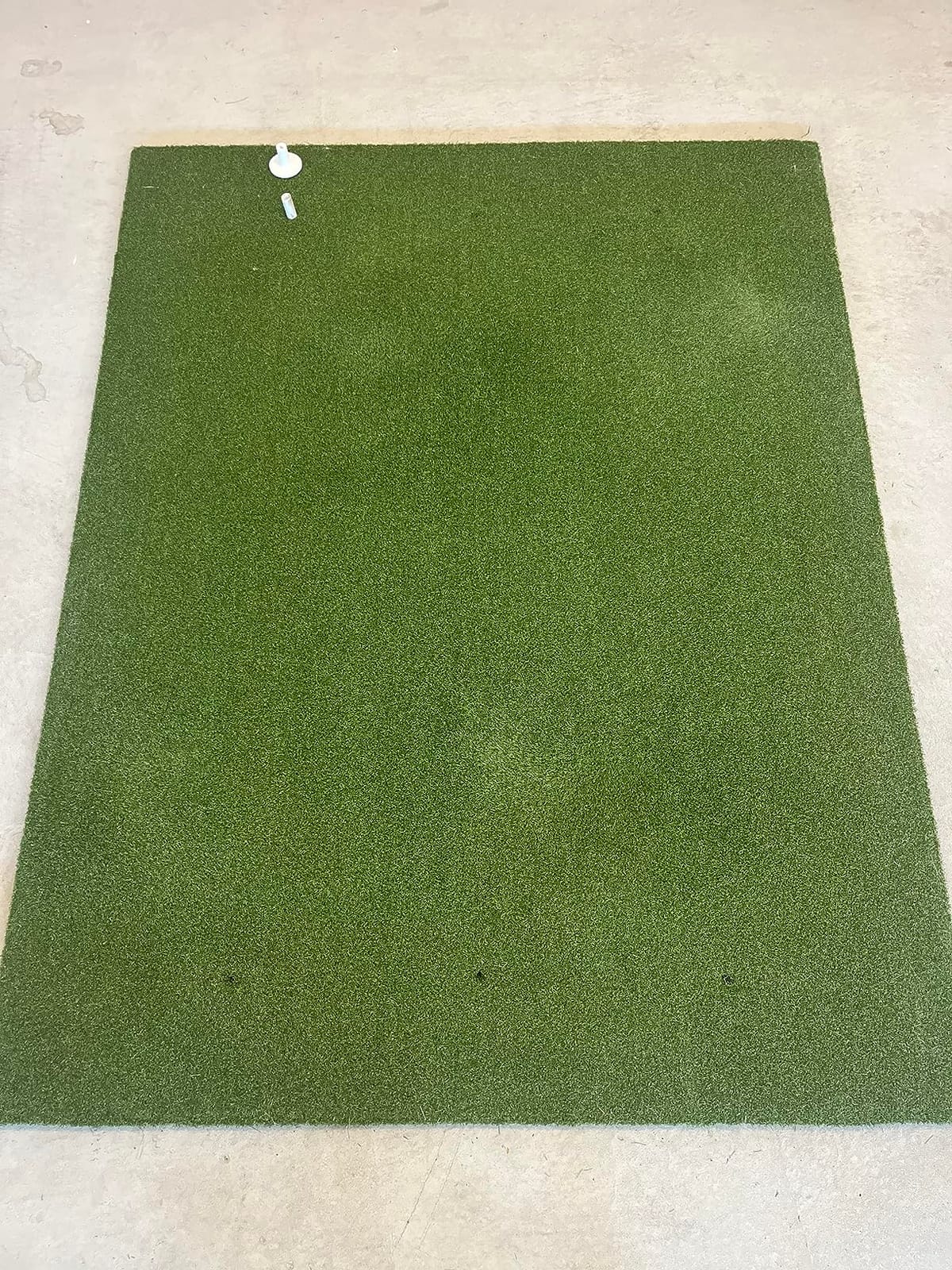
Around 640 owners rate it 4.5 with 75 percent five-star ratings, and complaints are minor and clustered around crease memory after shipping and overall thickness. The 5ft by 4ft footprint is genuinely bulky for small rooms, so measure first.
Why the bundled set changes the maths
Add up what a first-time buyer would otherwise purchase separately, and the set pays for itself before you ever hit a ball. Ten balls and nine tees cover driver, iron and wedge heights immediately, with step-down tees for the awkward in-between positions that beginners need most.
For families or juniors sharing one mat, having enough tees and balls for several people stops practice sessions turning into a queue.
Where the 5mm base shows its limit
On bare concrete, a 5mm EVA layer is thin. If you already have joint sensitivity, this is the mat to skip and the Bltend to buy instead. The 21mm build is comfortable for moderate volume but not built for daily hundred-ball sessions on hard floors.
Expect the same folding crease as the GoSports Elite, so give it a few days before judging the surface flatness.
9. Ponsonbay Golf Hitting Mat with Integrated Ball Tray: Best for Ball Workflow
Ponsonbay Integrated Golf Hitting Mat with Ball Tray, Thickening Golf Mats Practice Outdoor & Indoor Artificial Turf Matt with 3 Tees 5 ft x 4 ft 1.02 in Thick
5ft by 4ft rollable mat
Tray for 100 balls
EVA base to 1.22 in
Three tee positions
Pros
- Built-in tray holds up to 100 balls beside the hitting area
- Thickened EVA base options absorb heavy impact for wrists and joints
- Three tee positions with rubber tees at 2.4
- 2.8 and 3.1 in
- Rolls up for storage between garage
- basement and backyard
- Two year warranty with fast replacement support
Cons
- Takes time to lay completely flat after unrolling
- Ball tray feels cheap even though it works
- Not slip-resistant on grass or dirt and creeps after full swings
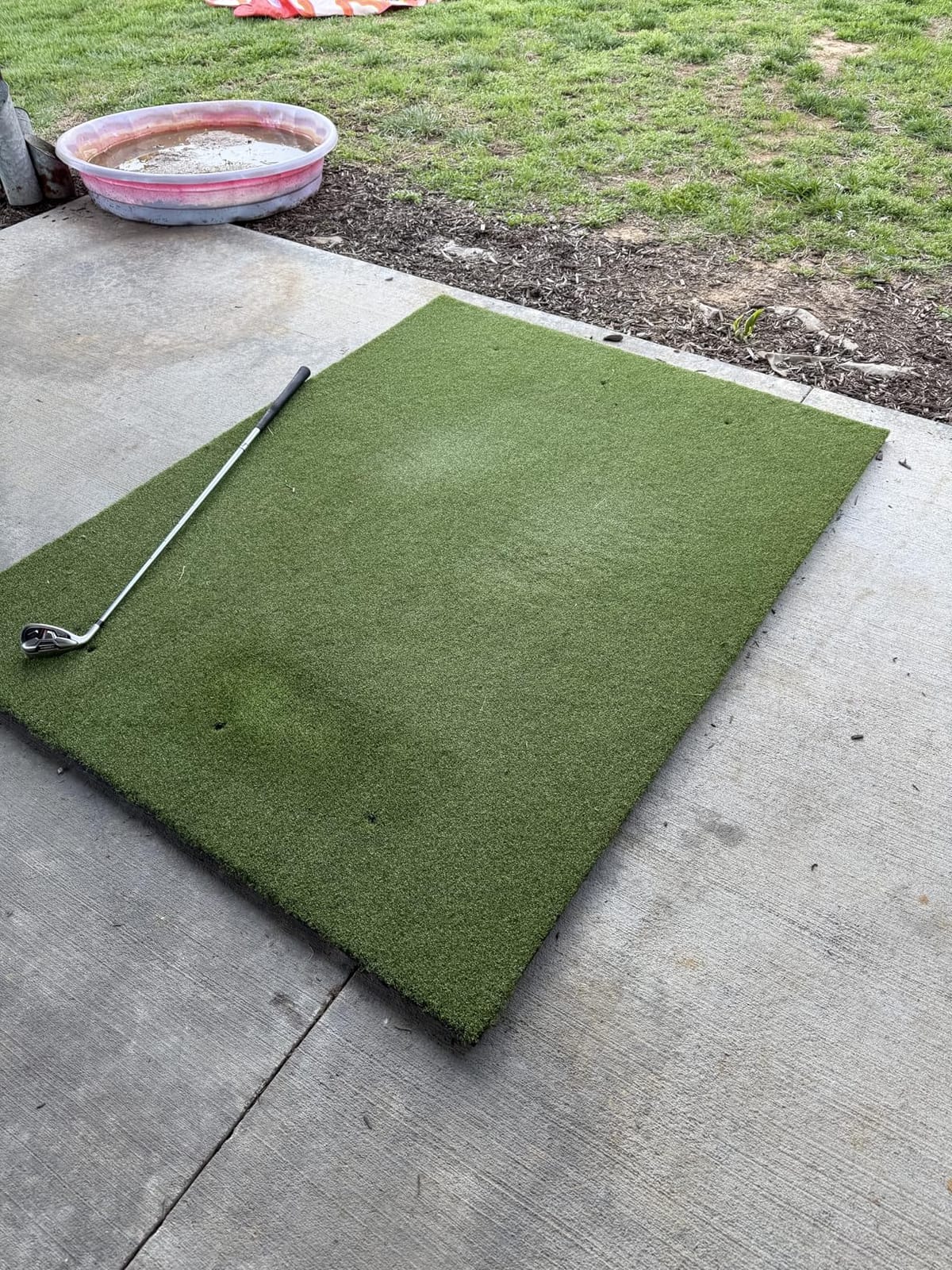
The ball tray is the feature reviewers talk about most, and the reason is rhythm rather than convenience. Holding up to 100 balls right next to the hitting area removes the repeated bending that breaks your setup between shots, and owners report the practice session flows noticeably better as a result.
Cushioning is the second strength. The high-density EVA base comes in thickness options from 0.39 to 0.59 inches, with heavier options up to 1.22 inches, so you can choose based on how hard your floor is rather than settling for whatever ships.
Three tee positions come with rubber tees at 2.4, 2.8 and 3.1 inches, which covers most skill levels, and the two-year warranty is tied to genuine replacement support. One owner put 2,000 iron shots on it without arm pain, and another credits fast replacement after the tee-hole area tore.
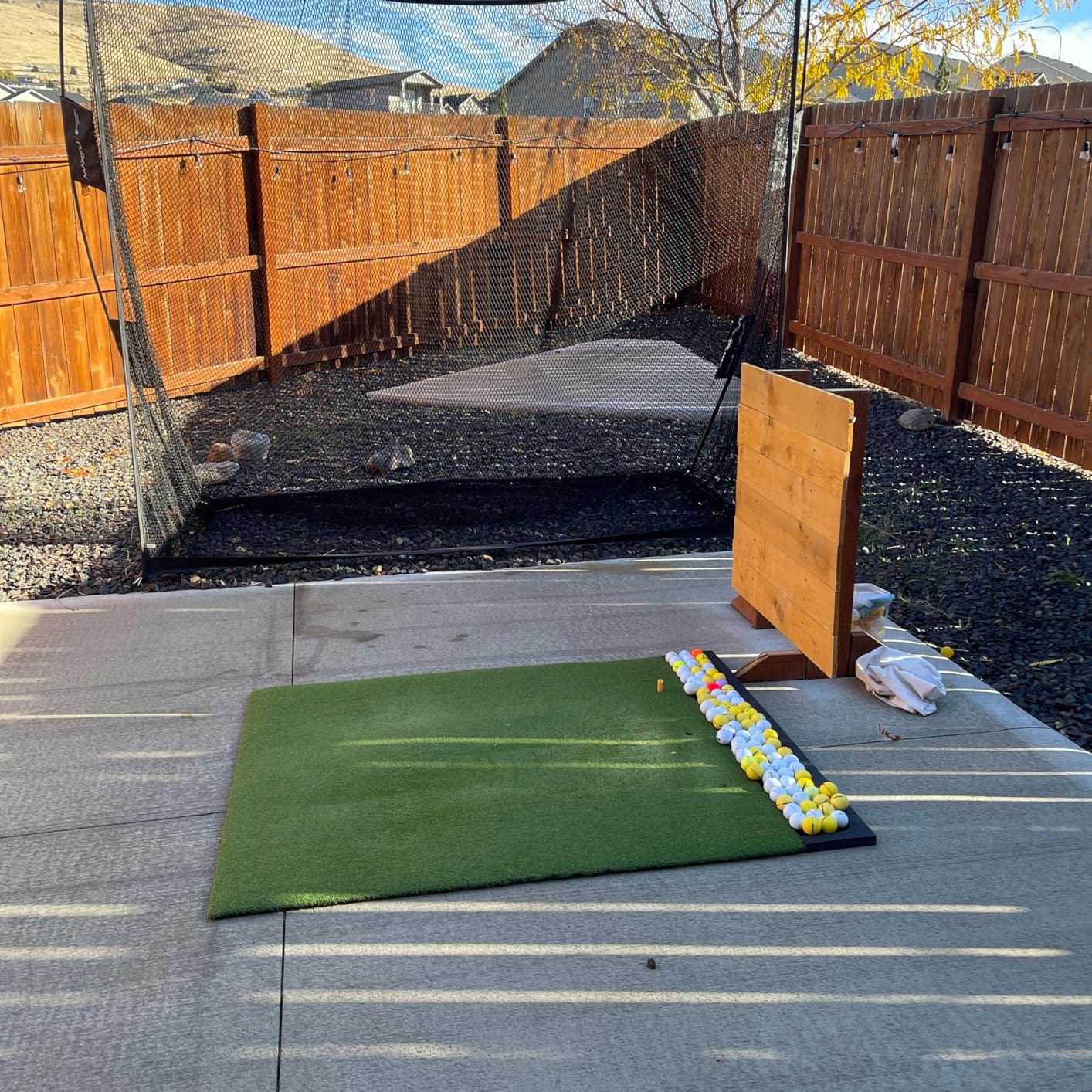
The honest weaknesses are specific. The mat takes time to lay completely flat after unrolling, the tray itself feels cheap even though it functions, and it is not slip-resistant on grass or dirt, where it creeps after a few full swings. Tee positions are laid out primarily for right-handed golfers.
Turf also deforms somewhat under very heavy, repeated use, so if you hit several hundred balls a session every day, check the thickness option you order.
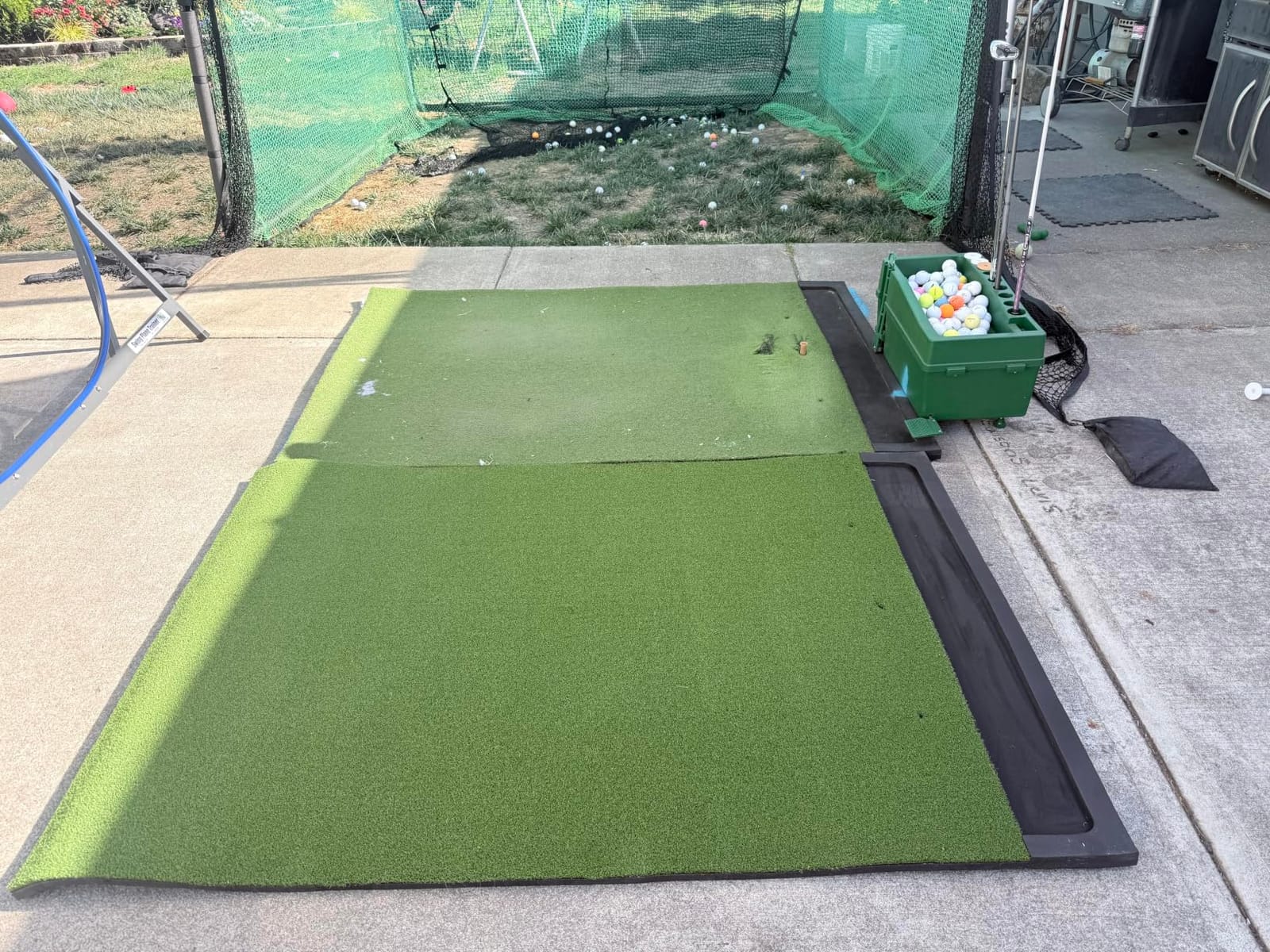
Why a ball tray changes practice volume
The most common reason sessions end early is not fatigue, it is logistics. A bucket in the corner means bending, standing up, resetting, and by the time you have hit again your tempo and focus have both drifted.
Keeping 100 balls at hip height removes that step entirely, which is why this mat shows up in reviews written by high-volume golfers rather than occasional ones.
Where it is the wrong choice
If you are a left-handed golfer, the tee layout works against you here. This is the only mat in the roundup where reviewers specifically flag handedness as a layout limitation rather than a feature.
For outdoor backyard use on soil or grass, expect creep and re-positioning. The roll-up design is genuinely convenient, but the slow flattening after unrolling is a real cost for someone practising outside twice a week.
10. Birdie Golf Swing Training Mat with Sequin Feedback: Best for On-Court Work
Birdie Golf Swing Training Mat – Sequin Tech, Analyzes Swing Path, Portable
19.25 by 12.32 inch pad
Sequin feedback surface
PVC backing, 2.2 pounds
Foldable design
Pros
- Sequin surface changes green to white on impact
- showing divot location and strike point
- Feedback accuracy verified against impact tape
- Works with or without a ball indoors or on the course
- Carry handle and foldable storage
- Cheaper than a lesson for beginners working on low point
Cons
- Shifts with each swing and needs repositioning
- Sequin pad and rubber edge tear under sustained high-compression practice
- No replacement strike pad offered at this price
This mat gives instant feedback through a different mechanism than the Cosportic. The sequin surface shifts from green to white where the club strikes, so you see the divot location and strike point at a glance, and reviewers who checked it against impact tape say the marks match club face contact precisely.
It works with or without a ball, which is the feature that makes it genuinely different from everything else here. You can carry it to the course with a handle, hit a few rehearsals before a round, and work on low point without setting up a full station.
At 19.25 by 12.32 inches it is bigger than the Cosportic pad but still small, and at 2.2 pounds it is one of the few mats here heavy enough to feel planted while staying genuinely portable.
Durability is the split in reviews. The sequin pad, the rubber handle and the front edge can all give way under sustained or high-compression practice, and the mat shifts with each swing because there are no spikes or stake holes. Distribution reflects that, with 62 percent five-star and a notable 8 percent one-star share.
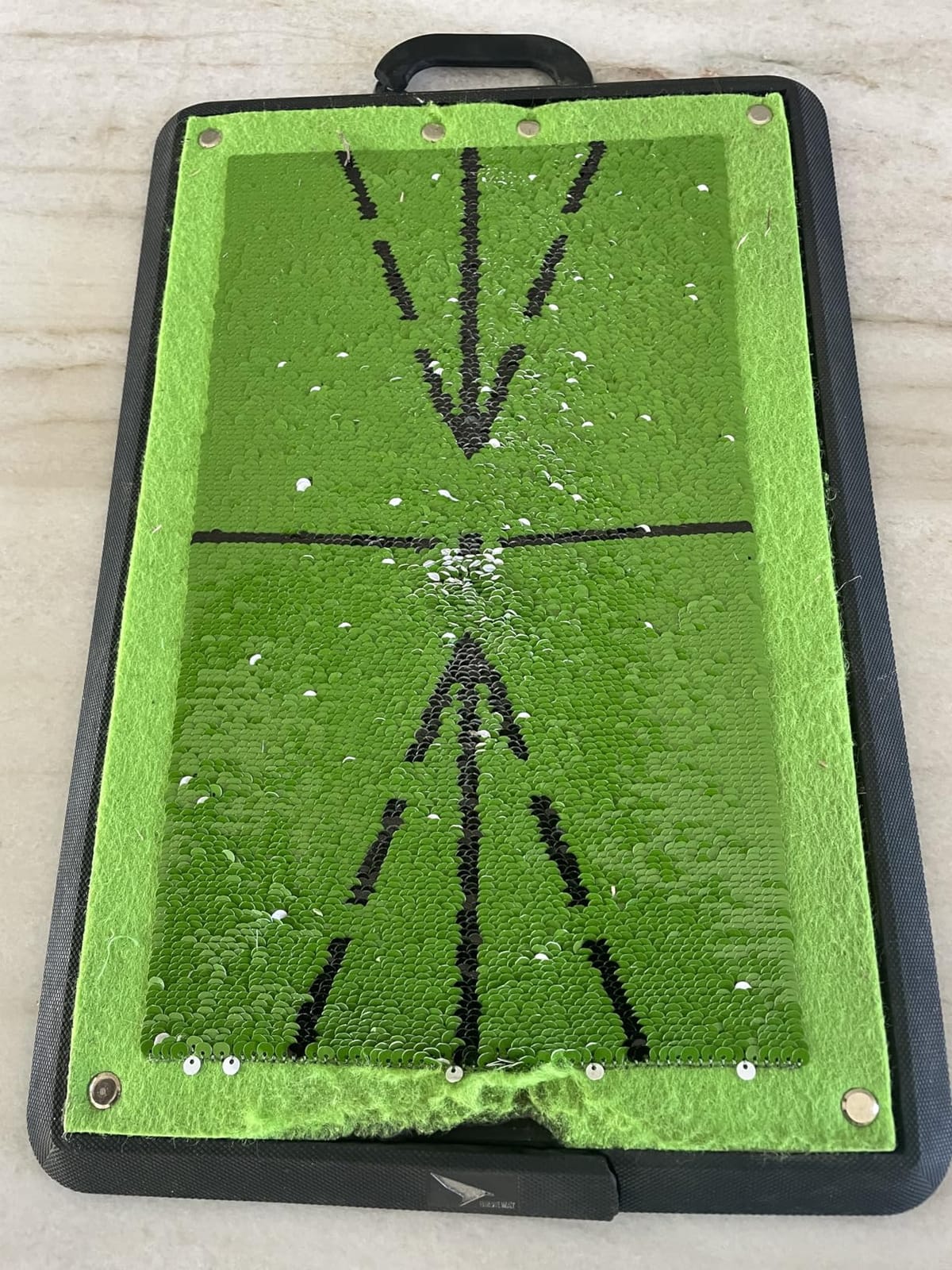
When a portable feedback mat beats a big station
Most golfers do not need 100 shots of feedback. They need to know where on the clubface they are making contact, and they need to know that before they start hitting balls at full speed.
A sequin mat gives you exactly that, takes about ten seconds to unfold, and does not need a ball, a net or a clear floor. For a beginner working on low point, owners say it is cheaper than a lesson and faster than waiting on video.
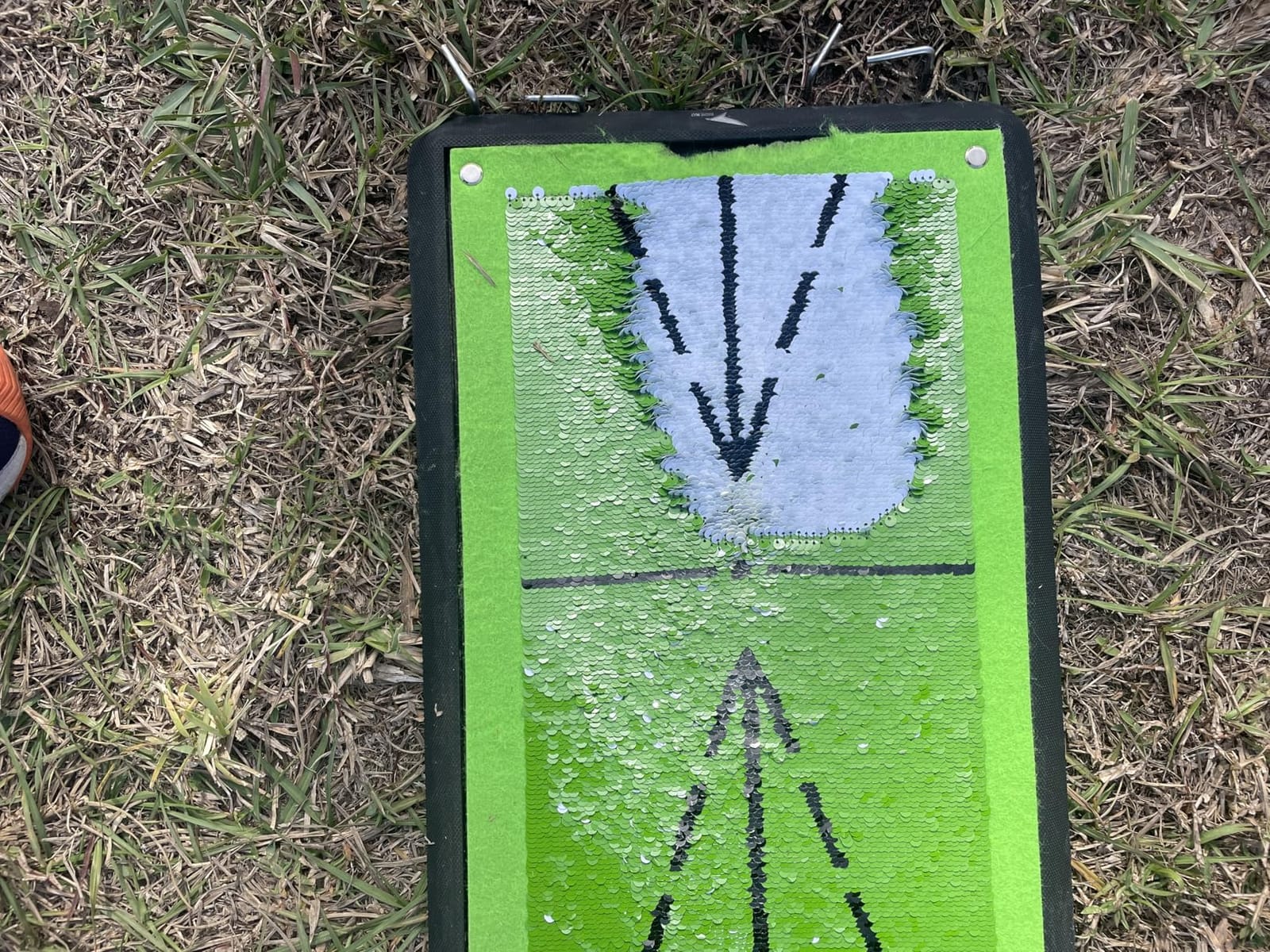
Where it stops working
One hundred percent compression swings and steep descending blows will ruin the sequin pad, and there is no replacement pad at this price. If your practice style is hard and repetitive, the money is better spent on a turf mat that will last.
Expect to reposition it between shots, particularly on grass, and give the new feedback system a few sessions before deciding whether it is helping.
How to Choose a Golf Mat for Home Practice
Five decisions separate a mat that works for years from one that ends up in a closet. Work through them in order, because each one narrows the field cheaply.
1. Measure your space and pick the right size
A 5ft by 4ft mat is the practical minimum for a full swing, because it leaves enough room for clubhead travel and follow-through without you hanging off the edge. Anything under about 24 inches square is a short-game and swing-path tool, not a driving-range surface.
Measure the room rather than the mat. You need standing room in front of the mat, a full swing arc behind it, and ceiling clearance for a driver indoors. Many indoor setups fail because the ceiling is too low, not because the mat is too small.
2. Judge turf realism by pile and feedback
Commercial-grade synthetic turf with a 16mm pile is the standard for ball striking and is what most of the picks here use. Deeper premium pile feels better under an iron but costs more and is not necessary for most home practice.
More useful than feel is whether the surface penalises a fat shot. A mat that gives no feedback for mishits trains confidence you have not earned, which is the most common criticism of the cheapest pads in this roundup.
3. Treat base material as the joint-protection decision
EVA foam is the standard base, and 15mm is a practical floor for practice on a hard floor. Below that, impact transfers to your wrists and elbows; above 20mm you are buying genuine cushioning rather than token padding.
Rubber bases are firmer and better for outdoor use on soil and grass. The trade is comfort, so a rubber-based mat on concrete is the combination we would avoid if you have any joint history.
4. Confirm tee insertion before you buy
If you plan to rehearse driver or long-iron height, the mat needs integrated tee holes or it needs to grip a real wooden tee. Several of the compact mats here have no tee holes at all, which quietly rules them out of driver practice.
Six tee holes with three rubber tee heights is the setup we look for, since it covers driver, iron and wedge positions without re-plugging anything.
5. Read durability claims properly
Hit counts are marketing numbers that assume a single contact type. A more honest measure is mat thickness, turf pile depth, the presence of an anti-tearing layer, and the warranty term, because that is what a manufacturer will actually stand behind.
Warranty terms here run from one month on the Cosportic mat to two years on the Ywitio and Ponsonbay models. The GoSports mats carry a 6-month limited warranty. Where you have a choice, the longer term is the more useful signal.
Hard Floors, Joints and Launch Monitors: What Most Buyers Miss
Three topics come up constantly in forums and are barely addressed by editorial roundups. They are also the three that most affect whether your mat is a long-term tool or an expensive mistake.
Hard subfloor mitigation
Concrete plus a thin mat is the combination behind most joint complaints. Golfers consistently report adding foam tiles or a horse-stall mat underneath their existing mat as a cheap fix, and that solution works well enough that several owners say it removed pain before they replaced the mat itself.
So check the floor before you buy. On carpet or lawn, every mat here works. On bare concrete, either buy the deepest mat you can justify or plan to add an underlay. Doing both is not overkill if you are hitting daily.
Joint health and realistic versus forgiving
Elbow, wrist and tendonitis complaints are the single most repeated concern across every golf forum we read. The pattern is consistent: a thin or dead-feeling mat over a hard floor, weeks of daily practice, then forearm pain that only stops when the surface changes.
Forgiving and realistic are not the same goal. A surface that punishes fat shots keeps you honest but transmits more shock. A surface that absorbs everything protects joints but lets you swing badly without knowing. The mats reviewed here split into those two groups deliberately, and our joint-friendly picks trade a little feedback for a lot of cushioning.
Launch monitors and simulators
Most home practice happens with a launch monitor, and mat choice changes the readings. A hard, bouncy surface sends the ball into the monitor at a different height and spin rate than a deep, damped one, so keep the mat consistent between sessions if you are tracking numbers over time.
Size matters here more than anywhere else. Simulator bays and hitting strips require room in front of the mat for the monitor, and a 5ft by 4ft surface is what most builds are sized around. If you already own a mat and want better data without replacing it, swapping in a premium hitting strip is a common upgrade path among owners, though none of the mats we reviewed are strips themselves.
Apartments, noise and small spaces
In a shared living space, noise is a real constraint. Thin mats and hard floors produce a sharp, high-volume strike that carries through a room, while a 36mm build like the Bltend absorbs a meaningful share of it. Foam balls and a lower swing speed are the other half of that fix.
Below about 24 inches square you are limited to chipping and partial swings, which is exactly what the CHAMPKEY, SAPLIZE and Cosportic mats are built for. For ceiling clearance, test your driver swing indoors before committing to a full-size mat.
Frequently Asked Questions
What is the best golf mat for home practice?
The GoSports Elite 5ft x 4ft hitting mat is the best all-round choice for home practice, because it pairs the deepest owner-review base in the category with a 15mm EVA foam base that softens impact on hard floors. Pick the Bltend 36mm mat instead if bare concrete and joint comfort are your priority.
What size golf mat do I need for a full swing?
A 5ft by 4ft mat is the practical minimum for a full swing, because it leaves room for clubhead travel and follow-through without you standing off the edge. Mats around 24 by 24 inches are short-game and swing-path tools only. You also need ceiling clearance for a driver indoors.
Are golf practice mats worth it?
A mat is worth it if you hit balls regularly and have no range access, because it keeps a swing sharp and lets you rehearse ball height and contact without travel. It cannot replace range work for distance control, so treat it as a maintenance and mechanics tool rather than a full substitute.
Do golf mats hurt your elbows?
A thin mat over a hard floor can, and this is the most repeated complaint across golf forums. The usual pattern is weeks of daily practice followed by forearm soreness that stops when the surface changes. Buying 15mm or more of EVA foam, or adding foam tiles or a horse-stall mat underneath, is the standard fix.
What size golf mat do I need and how do I pick one for a garage?
For a concrete garage floor, prioritise base thickness over turf quality. A 5ft by 4ft footprint gives swing room, 15mm or more of EVA foam absorbs impact, and a non-slip backing stops the mat creeping mid-swing. If your floor is bare concrete, either buy a 20mm-plus base or plan to add an underlay.
The Best Golf Mats for Home Practice: Final Verdict
The GoSports Elite 5ft by 4ft mat is the pick we would buy, because it holds the deepest owner-review base in the category and its 15mm EVA base handles a hard floor without going soft and dead. For concrete garages and sensitive elbows, the Bltend 36mm mat buys real cushioning at the cost of bulk.
Below that, the Ponsonbay tray mat solves high-volume workflow, the Ywitio dual-turf mat handles short game with the longest warranty here, and the CHAMPKEY and SAPLIZE mats cover small-space and travel practice. Whatever you choose, measure your floor and check your ceiling height before ordering.
We kept updating this list through 2026, and we would revisit it the moment any of these mats changes its base construction or warranty length.