
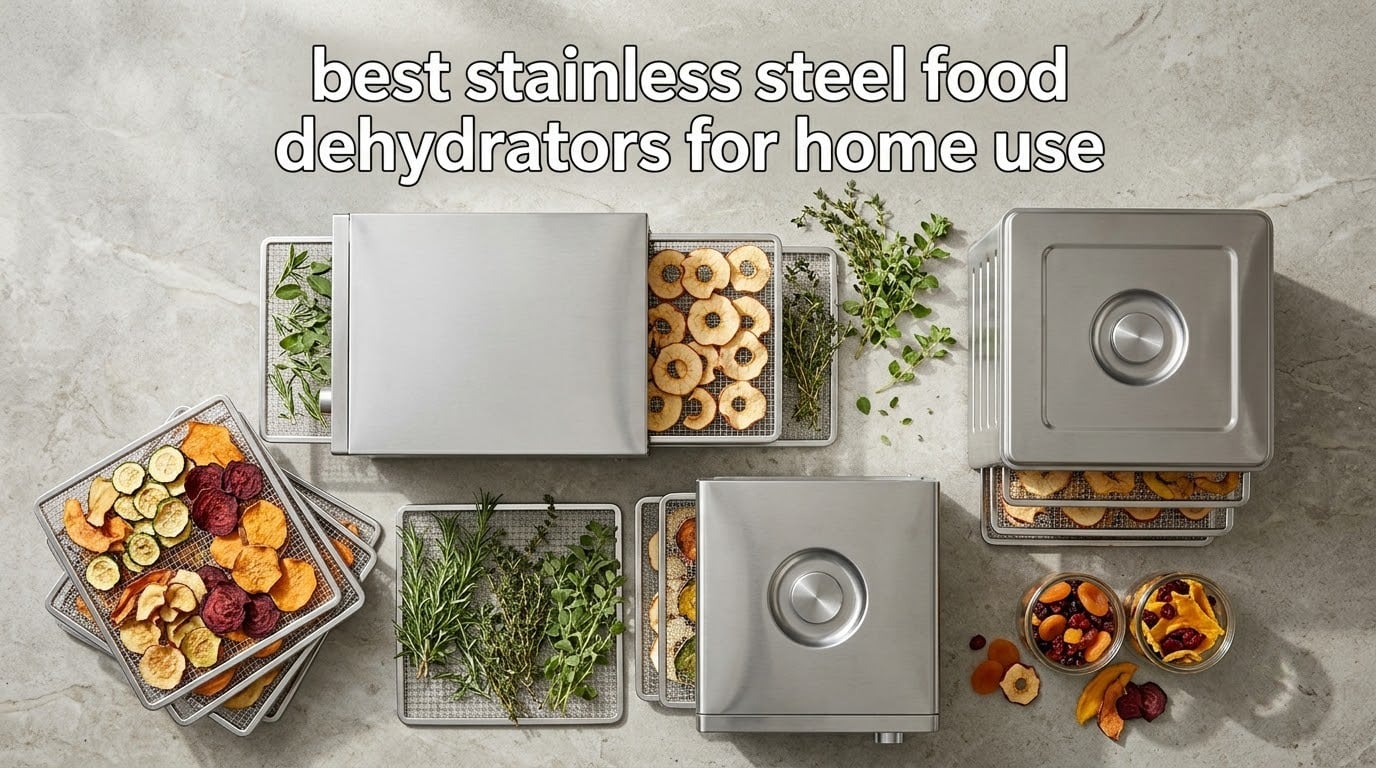
A dehydrator earns its counter space the first time you run it overnight. Ten hours of low, steady heat does something a kitchen oven cannot: it pulls water out of food slowly enough that the flavor, the enzymes and most of the nutrients survive the trip. That is the whole promise of the best stainless steel food dehydrators for home use, and it is why these appliances end up running for weeks at a time in a lot of kitchens.
We spent time with ten stainless steel models, reading the specifications, the review histories and the failure patterns, then sorting them by the things that actually change a batch: how much food fits, whether the fan sits at the back or the bottom, how high the thermostat goes, and whether the trays survive a season of sticky fruit leather. All ten units here have stainless steel food-contact trays, and most have a stainless body as well, though two do not and we say so plainly below.
We also went past the usual jerky-versus-fruit framing, because the questions that come up most in dehydrating communities are about spice powders, yogurt, tempeh and dog treats. Those all need specific temperature behaviour, and they are covered in the food guide and in the notes on each model. If your interest is meat specifically, our jerky dehydrator guide covers slicing thickness and marinade timing in more detail.
Table of Contents
Top 3 Stainless Steel Food Dehydrators of the Moment

Cosori 6-Tray 6.5 ft2 Dehydrator
- Six stainless steel trays
- 6.5 ft2 drying area
- 600W
- 95-165F
- 48-hour timer

Magic Mill 10 XL-Tray 700W Dehydrator
- Ten extra-large trays
- 700W rear fan
- 95-167F
- keep-warm for 24 hours

Magic Mill Pro 7-Tray 176F Dehydrator
- Full stainless interior and exterior
- 600W rear fan
- 95-176F
- ETL listed
The Cosori CP267-FD takes the top slot because it is the most reviewed dehydrator in this group by a wide margin, and the reasons behind those reviews are the reasons that matter: a rear fan that dries every tray without manual rotation, a brushless motor that stays under 48 dB, and six dishwasher-safe steel trays in a body that will not flex when you slide a full load in.
The Magic Mill MFD-7100 takes the bulk slot. Ten extra-large trays and a 700W element mean a full load of vegetable chips or a weekend of beef jerky happens in one cycle rather than three. The Magic Mill Pro MFD-7700 is the value pick: full stainless inside and out, a 176F ceiling, and an ETL listing, in a body roughly a foot wide.
All 10 Stainless Steel Dehydrators Compared Side by Side
| Product | Specifications | Action |
|---|---|---|
| Cosori 6-Tray 6.5 ft2 Dehydrator |
|
Check Latest Price |
 Magic Mill 5-Tray 240W Dehydrator Magic Mill 5-Tray 240W Dehydrator |
|
Check Latest Price |
| Magic Mill 10 XL-Tray 700W Dehydrator |
|
Check Latest Price |
| Magic Mill Pro 7-Tray 176F Dehydrator |
|
Check Latest Price |
 Cosori P501 5-Tray Compact Dehydrator Cosori P501 5-Tray Compact Dehydrator |
|
Check Latest Price |
 Cosori 10-Tray 16.2 ft2 Dehydrator Cosori 10-Tray 16.2 ft2 Dehydrator |
|
Check Latest Price |
 OLIXIS 8-Tray 185F Dehydrator OLIXIS 8-Tray 185F Dehydrator |
|
Check Latest Price |
 PSIIDAN 8-Tray 650W Dehydrator PSIIDAN 8-Tray 650W Dehydrator |
|
Check Latest Price |
 Elite Gourmet 5-Tray 194F Dehydrator Elite Gourmet 5-Tray 194F Dehydrator |
|
Check Latest Price |
 Elite Gourmet 4-Tray Compact Dehydrator Elite Gourmet 4-Tray Compact Dehydrator |
|
Check Latest Price |
1. Cosori Food Dehydrator with 6 Stainless Steel Trays – The Even-Drying All-Rounder
Cosori Food Dehydrator, 6 Stainless Steel Trays with 6.5 ft² Drying Space
6 steel trays, 6.5 ft2 area, 600W, 95-165F, 48-hour timer, 2-year warranty
Pros
- Rear fan dries all six trays evenly with no rotation
- Brushless motor stays under 48 dB
- Dishwasher-safe steel trays plus mesh screen and fruit roll sheet
- 95-165F control in one-degree steps
- Most reviews of any model here
Cons
- Six trays is modest for bulk preserving
- Mesh screen and fruit roll sheet are not metal
This is the dehydrator we would put in an apartment with one person making jerky every weekend and a jar of dried herbs on the counter. The 600W brushless motor drives a rear-mounted fan across a 6.5 square foot deck, which is the layout that removes the single most annoying chore in this hobby: turning trays over at the three-hour mark because the back one dried faster than the front one.
Control runs from 95F to 165F in one-degree increments, with a 48-hour timer. That range covers dried herbs, fruit leather, vegetable chips, yogurt proofing and beef or poultry jerky, and the one-degree steps matter more than they sound once you are repeating a batch that came out exactly right last week.
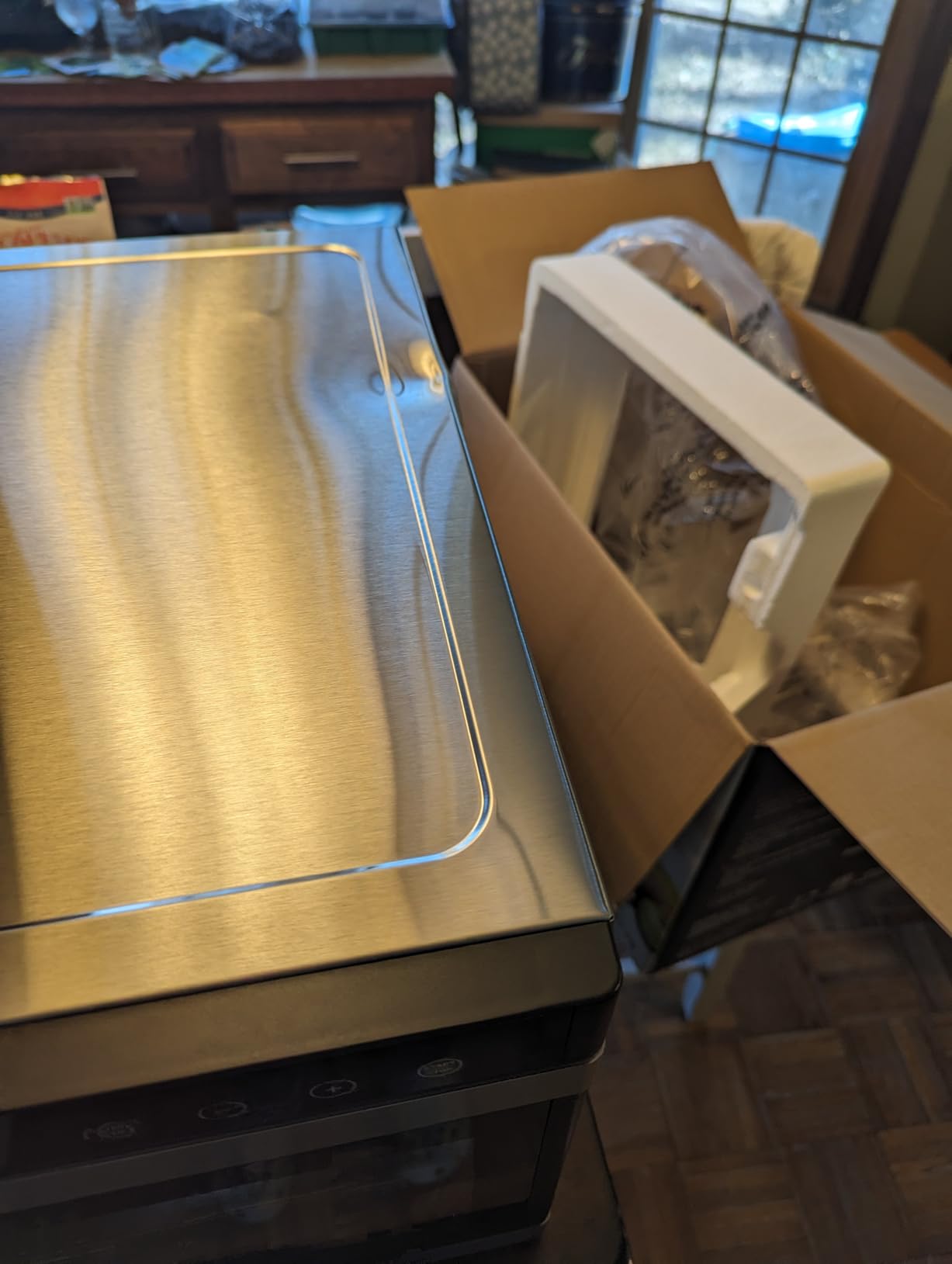
Reviews of this model keep returning to the same three things: even drying, quiet running, and trays that come out of the dishwasher rather than the sink. The five-star share sits at 86%, which is high for a category full of near-identical boxes, and the sales rank in Kitchen and Dining reflects how much of this market runs on this one unit.
Two things work against it. Six trays is not many if you have a garden that hands you forty pounds of zucchini in September, and the included mesh screen and fruit roll sheet are plastic rather than metal, which slightly undercuts an all-stainless promise for anyone focused on metal contact surfaces.
Who should buy the Cosori CP267-FD
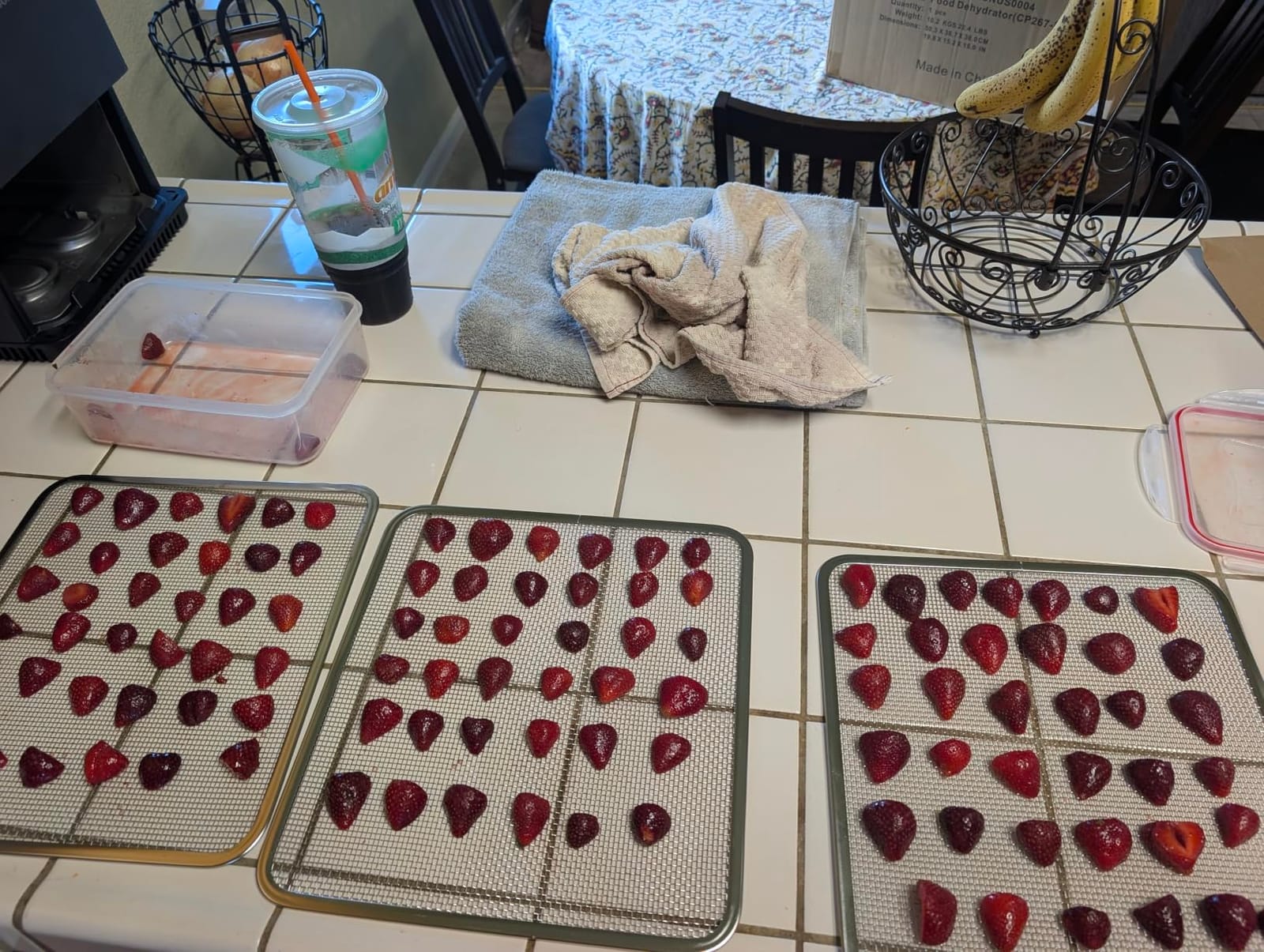
Buy this one if you want to set a temperature, walk away, and come back to evenly dried food with no tray rotation. It suits households dehydrating a few trays a week: weekend jerky, a tray of apple chips, herbs drying in the oven of the dehydrator while dinner cooks.
It also suits anyone sharing a wall with someone sensitive to noise. Under 48 dB with no rattling plastic body is what makes an overnight cycle practical in a bedroom-adjacent space, and the two-year manufacturer warranty is the longest we see here alongside the Cosori models.
Who should look elsewhere
If you are preserving a serious seasonal harvest, six trays becomes the bottleneck rather than the feature. The 16.2 square foot Cosori model handles far more per cycle, though it also asks for a lot more counter space and carries the unit at 35.8 pounds.
If you make powders regularly, note the 165F ceiling. It is plenty for meat and fruit, but a higher thermostat gives you more headroom for vegetable work. The Magic Mill Pro and the Elite Gourmet five-tray model both reach past that.
2. Magic Mill 5 Stackable Stainless Steel Trays – The Compact Starter
Magic Mill Food Dehydrator Machine | 5 Stackable Stainless Steel Trays, 48H Digital Adjustable Timer & Temperature Control Upto 167° Electric Dryer & Preserver for Jerky, Fruit, Dog Treats & Much More
5 adjustable steel trays, 240W, 95-167F, 48-hour timer, dishwasher-safe trays
Pros
- Smallest footprint in the group at 8.5 x 11.8 x 11 inch
- Trays raise from 0.6 to 1.1 inch spacing for thick cuts
- Dishwasher-safe and detachable
- Simple touch panel for temperature and timer
Cons
- 240W is the lowest power here so batches run long
- BPA-free plastic body with a steel base
This is the model to start on if your dehydrating plans involve a tray of herbs, some strawberries and a monthly batch of dog treats rather than a season of preserving. At 8.5 by 11.8 by 11 inches it takes up about the counter space of a coffee maker, and at 2.75 kg it is easy to move to a shelf when the job is done.
The tray design is the part worth paying attention to. The five food-grade stainless steel trays normally sit at 0.6 inch spacing, and each can be raised to 1.1 inch. That means a single machine handles both thin apple chips and thick-cut vegetable slabs without you buying a second appliance or stacking things unevenly.
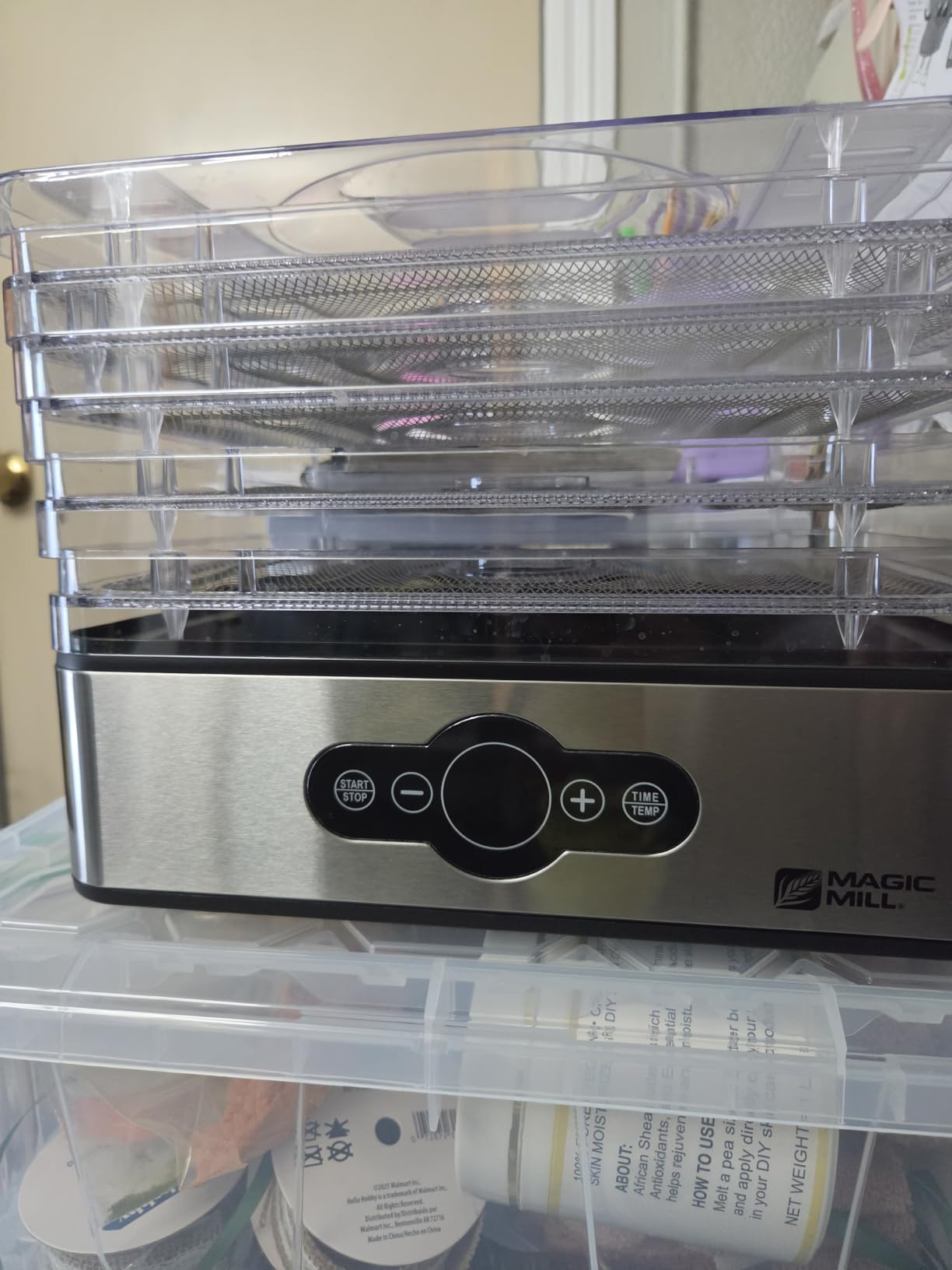
The 240W element is the compromise. It holds temperature from 95F to 167F and runs to 48 hours on the timer, but full loads take noticeably longer than they do in a 600W or 1000W body. Owners who describe the drying speed as modest are describing the physics of the wattage, not a fault.
The body is BPA-free plastic with a stainless steel base, not full stainless steel. That is a fair trade for the footprint and the weight, but if you are buying specifically for a stainless interior, this is not the unit.
What this Magic Mill MFD-5000 is good for
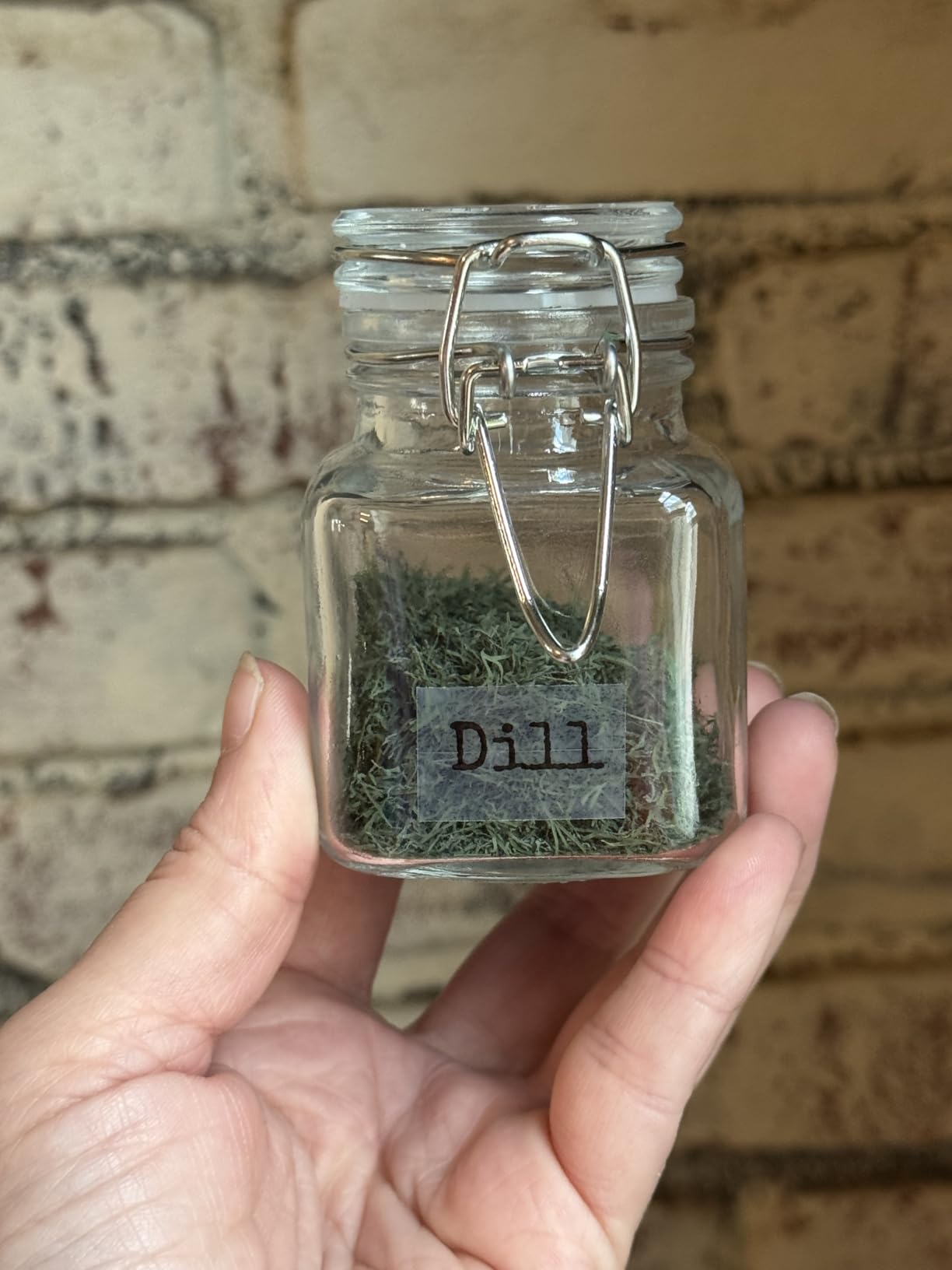
This suits a first dehydrator, a small kitchen, or a second machine for a job the big unit cannot do quickly. Powders and herbs are good fits: low-temperature work, small volume, no need for a large fan to push air through a heavy load.
It also works well as a dehydrator for fruit roll-ups and dog treats in modest quantities, where the raised tray spacing keeps thicker pieces from touching. The detachable dishwasher-safe trays make cleanup after sticky fruit work far less of a chore than it sounds.
Where it will disappoint you
If you dry meat regularly, the 240W motor is the limit. A full tray of beef strips that takes eight hours here can take closer to four in a 600W body, and heat loss matters more when the machine is small and the chamber is warm.
The stainless steel case is the other soft spot in the promise. A BPA-free plastic shell is easier to scrub but it will not survive being dropped off a shelf the way a full steel cabinet does, and it is not the aesthetic most people mean when they search for a stainless steel dehydrator.
3. Magic Mill Premium 10 XL-Tray 700W Dehydrator – Built for Heavy Batches
Magic Mill Premium Food Dehydrator Machine (10 Extra-Large Stainless Steel Trays) 700W Dryer for Beef Jerky, Fruits, Vegetables, Dog Treats, 48 Hour Digital Timer – 95°-167° Temperature Control
10 XL steel trays, 700W, 95-167F, 48-hour timer, 24-hour keep-warm
Pros
- Ten extra-large trays take serious batch volumes
- 700W element with rear fan for even drying
- Keep-warm holds finished food for 24 hours
- Automatic shutoff and overheat protection
- Dishwasher-safe trays and liner
Cons
- At 20.5 lb it needs real counter space
- 167F ceiling is lower than some newer models
When one dehydrator has to do the work of three, tray count matters more than any other number on the box. Ten extra-large stainless steel trays give you a full load of jerky, a full load of fruit and a full load of vegetables without babysitting three sequential cycles that each take most of a day.
The 700W element and rear-mounted fan handle the volume. Reviews of this model focus on even drying across the full stack with no tray rotation, and the transparent door means you can check progress without opening the chamber and letting warm moist air escape.
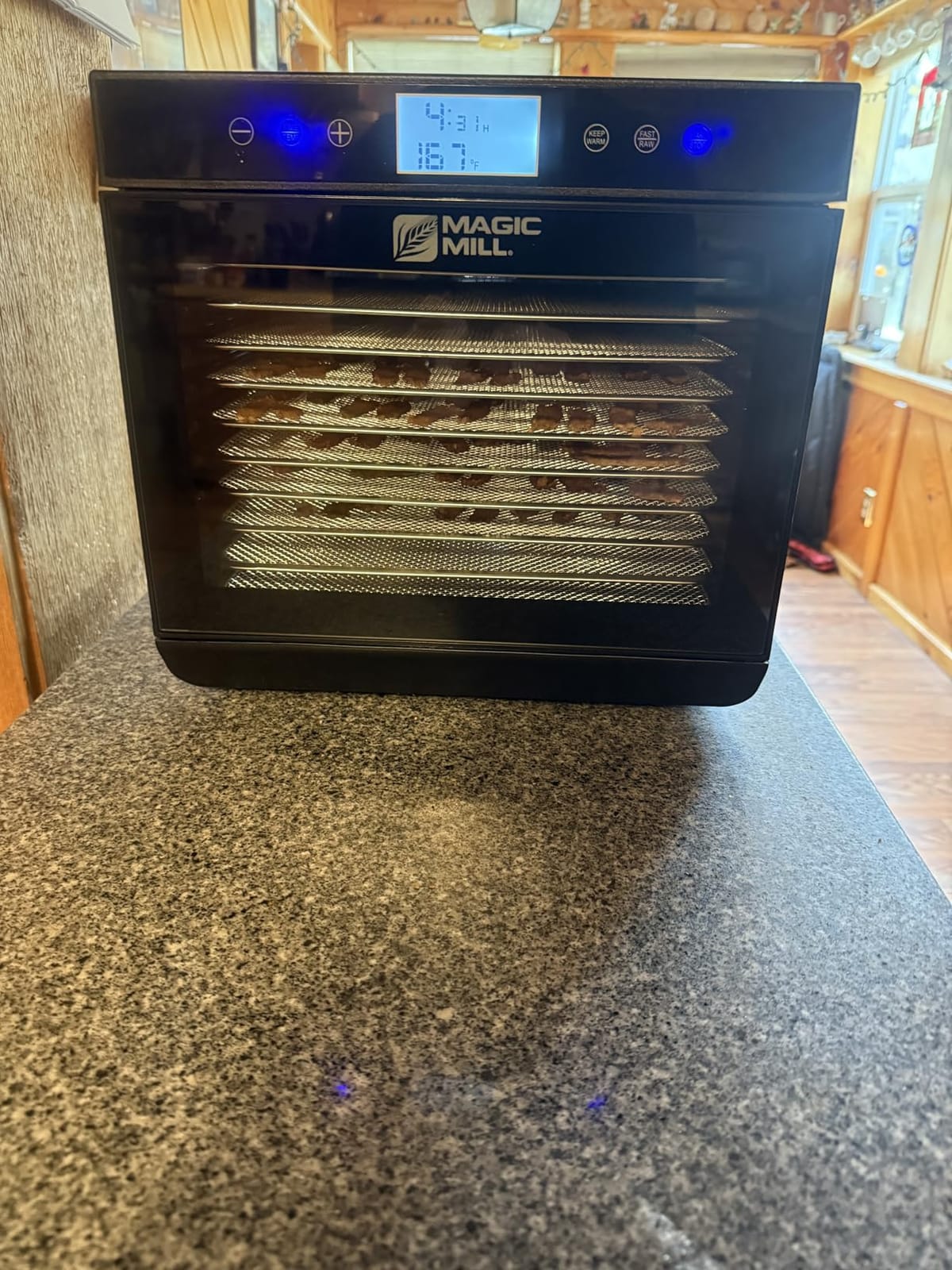
The keep-warm function is the sleeper feature. Once a cycle ends it holds temperature for up to 24 hours, which matters more than it sounds: it means you can finish a batch before bed, load the next one in the morning, and not have dried food sitting out overnight waiting for you to wake up.
Automatic shutoff and overheat protection are both present, and the trays and liner go in the dishwasher. The one-year limited warranty is shorter than the two years on the Cosori models, which is worth factoring in if you expect five years of use.
Where the 10-tray Magic Mill earns its space
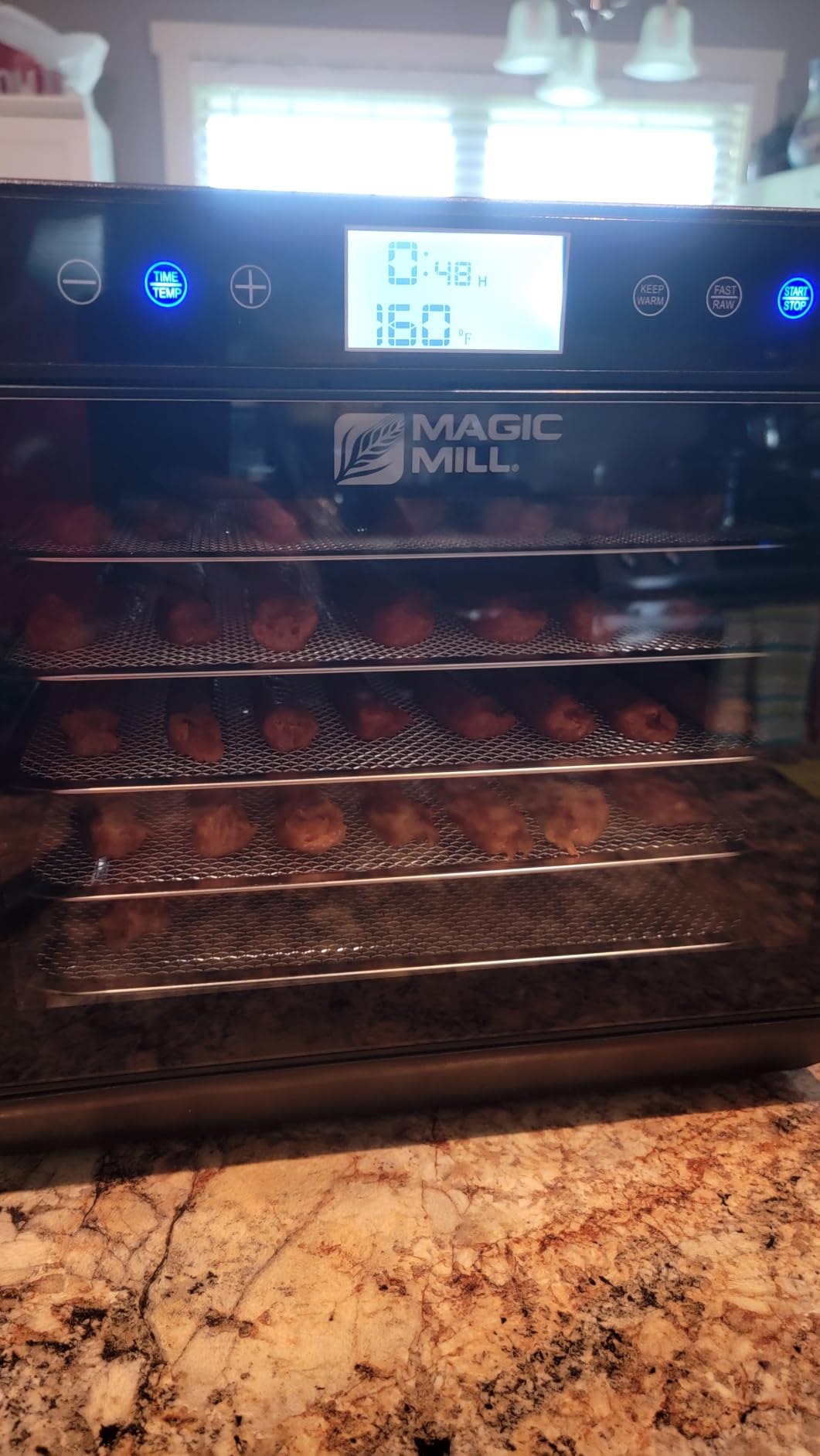
This is the right pick for a household that dehydrates most days, or for a gardener who processes produce in volume. Jerky makers who run multi-pound batches report consistent results, and the extra-large tray footprint means fewer, larger loads rather than more small ones.
It is also a strong choice for anyone preserving for a year or more. A keep-warm function and automatic shutoff are genuinely useful for long preservation schedules, and the dishwasher-safe liner keeps cleanup manageable after tomato-heavy batches.
What you give up for the capacity
At 20.5 pounds and 18 by 13 by 14 inches, this is a large object that lives on a counter. Dehydrating communities flag the same issue with any high-capacity box: it is easy to love the capacity and resent the footprint within a month.
The 167F maximum also caps how far you can push dense vegetable work and some powder projects. And the 700W element, while strong, is not the same as the 1000W in the largest Cosori model, so very heavy loads still take most of a cycle.
4. Magic Mill Pro 7 Full-Size Stainless Steel Trays – Full Metal With a 176F Ceiling
Magic Mill Pro Food Dehydrator Machine | Powerful 600W Rear Fan Even-Drying System | 7 Full-Size Stainless Steel Trays | 95°-176° Temperature Control, 48H Timer, Keep Warm + Auto Shutoff | ETL Listed
7 full-size steel trays, 600W, 95-176F in 1F steps, keep-warm, ETL listed
Pros
- Stainless exterior and interior with no plastic walls
- Roughly a foot wide but still holds seven trays
- 176F ceiling in one-degree increments
- Runs 24 hours or more straight
- ETL listed
Cons
- Start and stop button is sensitive and easy to bump
- Seven trays hold less than 10-tray models
- Needs a drip tray at the bottom
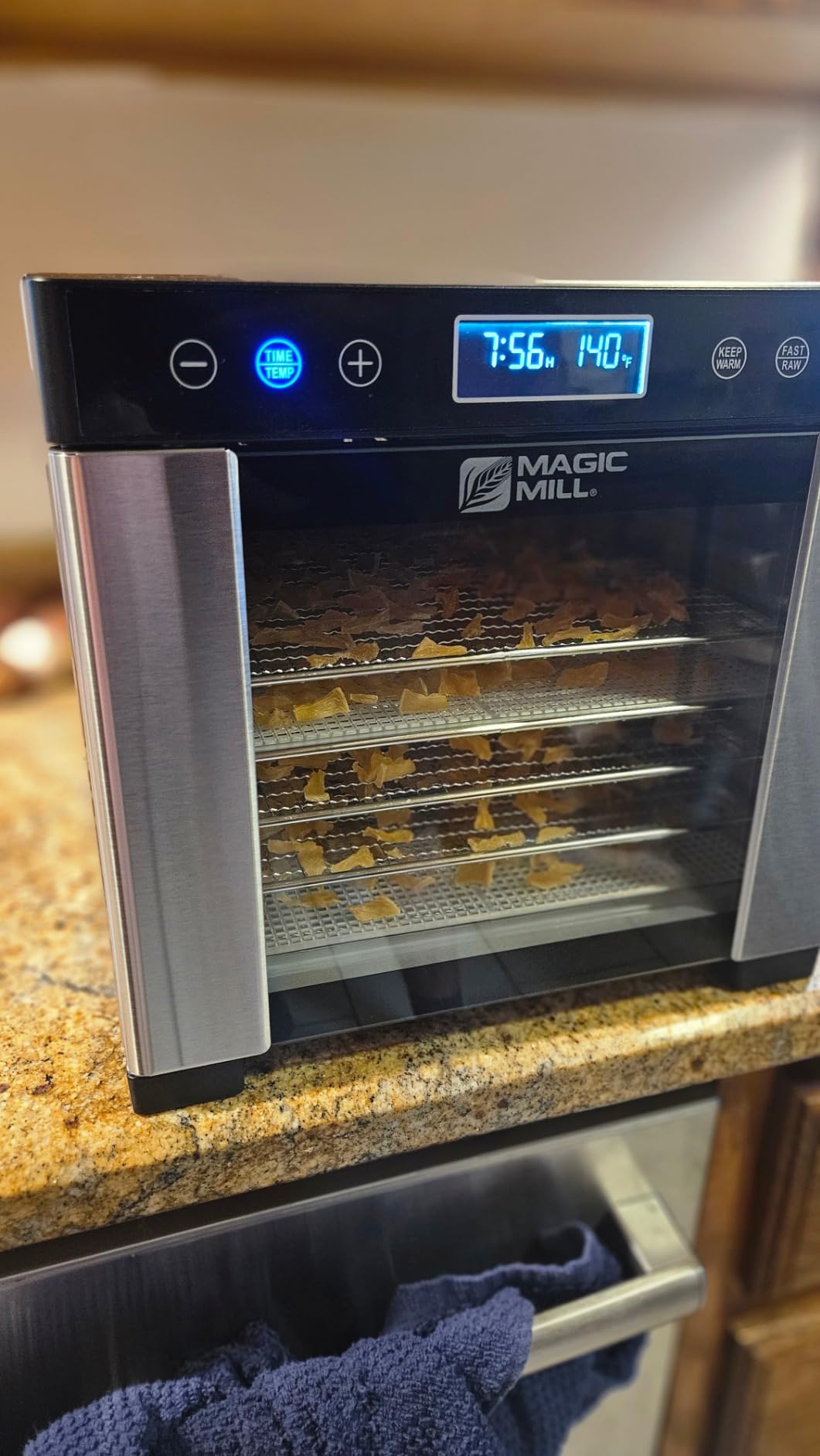
This is the one to buy if stainless steel means the whole cabinet to you. The Magic Mill Pro MFD-7700 has a stainless exterior, a stainless interior and 100 percent stainless steel trays, with no plastic walls for food aroma to latch onto. For anyone who has dealt with a plastic-bodied unit that never quite loses a stale onion smell, that difference is the point of the machine.
It is also unusually well specified for its size. Temperature runs to 176F in one-degree increments, the 48-hour timer steps in 30-minute intervals, and a keep-warm mode holds at 95F for up to 24 hours. The rear-mounted fan and rear heat placement mean the bottom tray is not a hot spot, so you do not rotate anything mid-cycle.
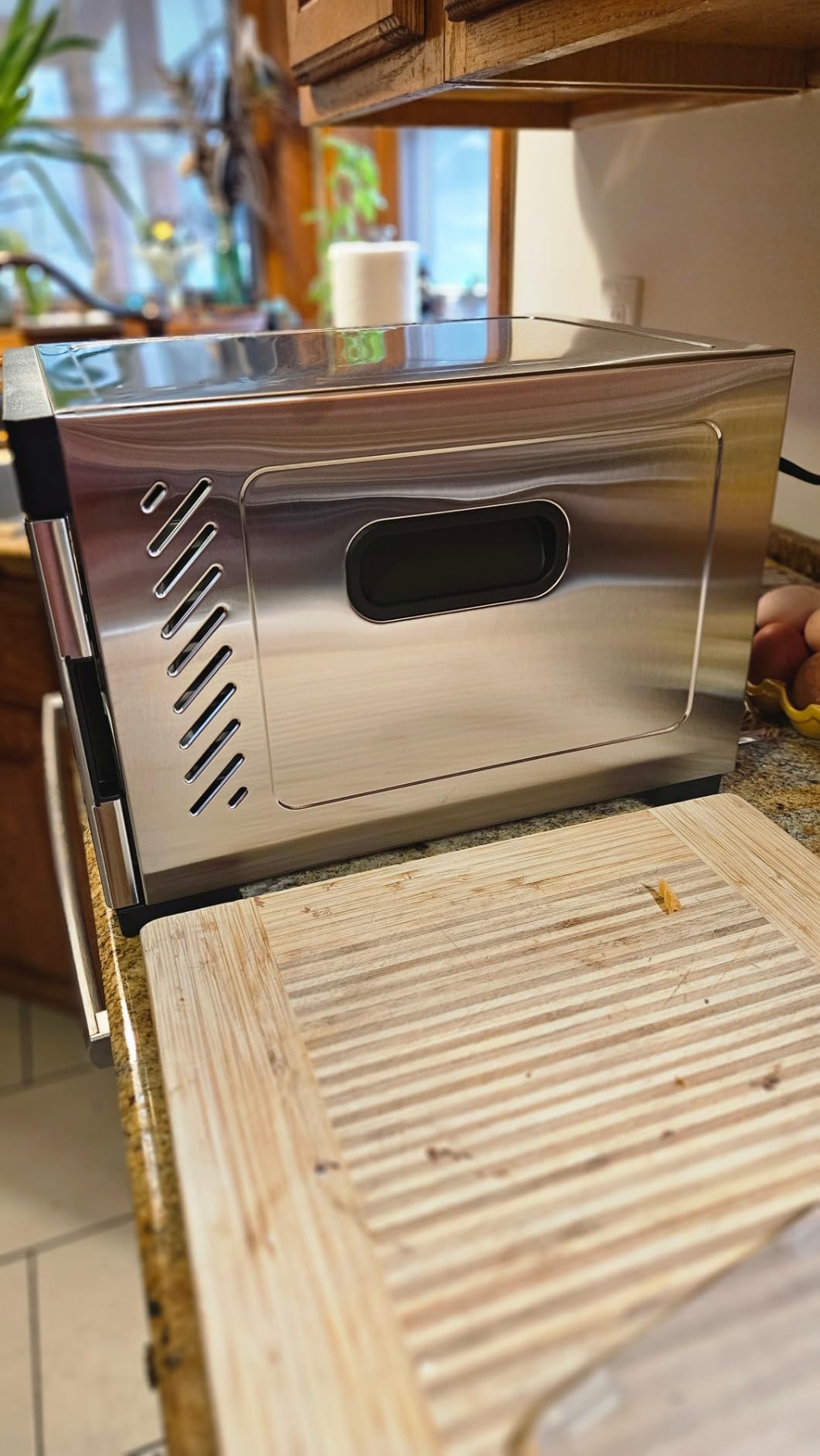
Reviews describe the fan as near-silent and report runs beyond 24 hours without trouble, and one owner notes it runs on an RV 50 amp circuit without tripping. The 600W rear-fan system handles about five pounds of jerky evenly, which is more than most people expect from a box this narrow.
At 15.5 by 11.3 by 10.8 inches it holds seven full-size trays in roughly a foot of width. The complaints that recur are about the sensitive start and stop button, which is easy to bump and can halt a cycle, and the fact that seven trays hold less than the 10-tray models.
What the MFD-7700 does better than bigger boxes
It hits the sweet spot between capacity and footprint. A narrow body means it fits a standard counter run rather than eating a whole work surface, and the full stainless interior handles sticky fruit and strong-smelling foods without holding onto them.
The 176F ceiling gives it more range than the 165F and 167F models here, which matters for dense vegetables and for anyone who wants more control at the hot end. Two mesh screens and a fruit roll and drip tray are included, which covers most of the accessory needs you would otherwise buy separately.
Where it falls short
The start and stop button is the most reported annoyance, and it is worth knowing before an overnight run. A bumped button can stop a cycle on a full load of meat, so check it before you leave the room.
Seven trays is a middle number rather than a generous one. If your peak season involves processing more than one full load a day, the ten-tray models will finish sooner. And because the chamber is tight, a drip tray at the bottom catches anything that falls, which the package partially but not fully covers.
5. Cosori P501 5-Tray Stainless Steel Dehydrator – The Compact Multi-Use Pick
Cosori Food Dehydrator, 5 Stainless Steel Trays, 3.1 ft² Drying Space
5 steel trays, 3.1 ft2, 480W, 95-176F, four presets, 2-year warranty
Pros
- Compact at 13.9 x 11.3 x 8.9 inch
- 176F maximum for safer jerky work
- Four presets for jerky fruit vegetables and yogurt
- Rear fan dries evenly with no rotation
- Two-year manufacturer warranty
Cons
- Mesh screen and fruit roll sheet are plastic
- Small tray area for large batches
- Stainless finish smudges easily
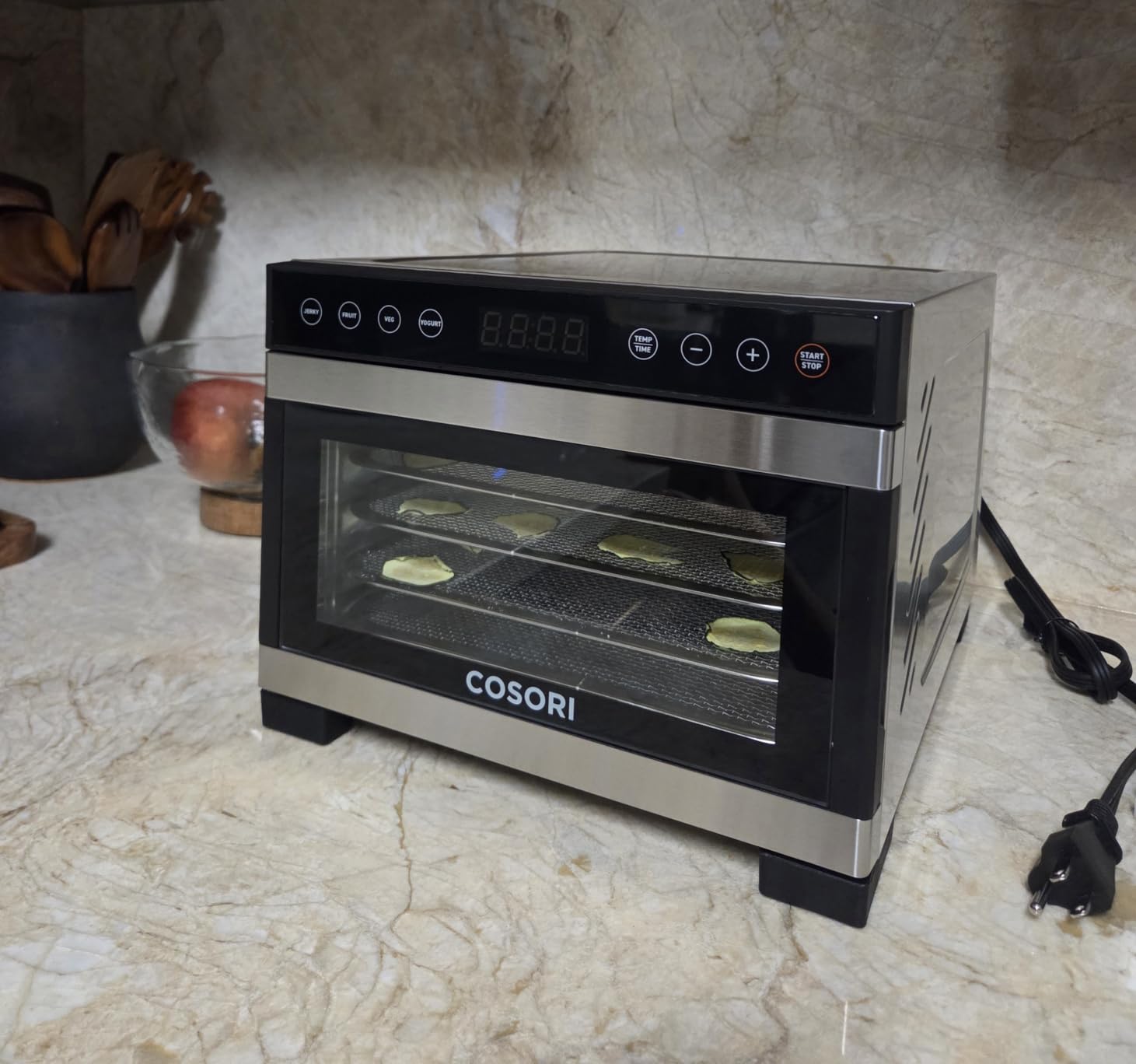
The P501 answers a question most roundups skip: what if the problem is counter space, not drying power. At 13.9 by 11.3 by 8.9 inches and 10.8 pounds, it is smaller than a mini oven, yet it still fills all five stainless steel trays across 3.1 square feet.
It also has the feature home cooks want most and competitors rarely offer at this size: four presets for jerky, fruit, vegetables and yogurt, each of which you can still override with manual time and temperature. The yogurt preset is what makes this useful beyond snacks, and it also handles bread proofing and tempeh at controlled low heat.
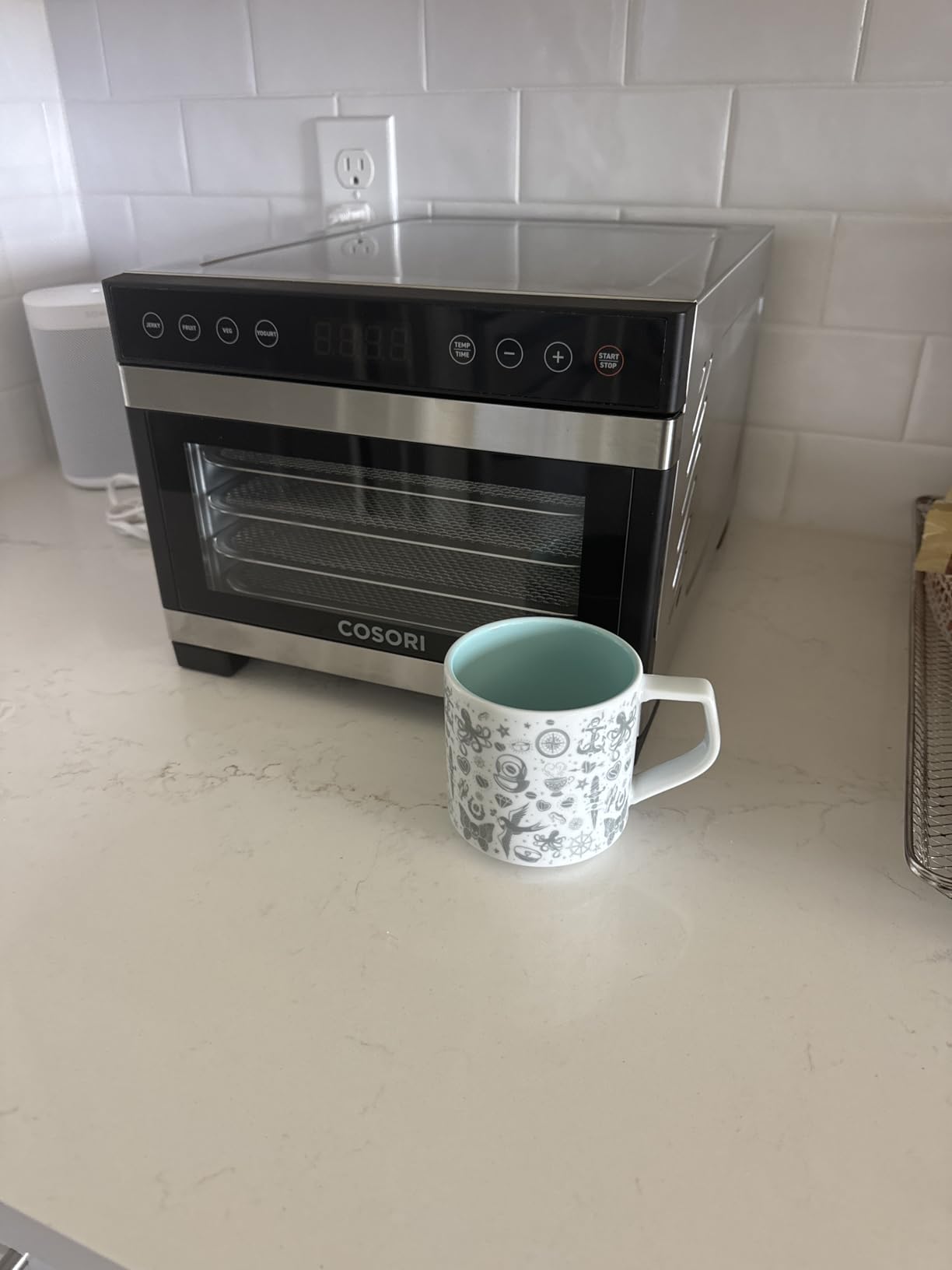
Temperature reaches 176F in one-degree increments, which reaches the safe drying mark for meat that many home preservers look for, and the 48-hour timer stops when the time is up. Owners report accurate, quiet operation that ends right on the timer rather than running long.
The included recipe book lists times, temperatures and expected end texture, which sounds minor until you have dried your first batch of pineapple and had no idea what leathery should feel like. The rear fan handles airflow, so no tray rotation is needed.
Where the Cosori P501 fits best
This suits small kitchens, apartment living and anyone who wants yogurt, tempeh and proofing as well as dried fruit. The four presets make it the most flexible machine here for mixed use, since one button covers a food type you would otherwise have to look up every time.
It is a sensible first dehydrator for a household that dries a few trays a week. The two-year manufacturer warranty matches the strongest here, and the compact size means it stores easily when you are not using it.
What to know before you commit
The mesh screen and fruit roll sheet included in the box are plastic, not metal. The trays are stainless steel, but the accessories are not, and that matters if you are drying tomato or onion and care about plastic contact surfaces.
Heat can also escape at the door hinge, and dehydrating meat fills a room with a strong aroma for the duration. The stainless finish also shows fingerprints easily, which is cosmetic but annoying on a visible counter. Outside the United States you will need a step-down converter for the 110V plug.
6. Cosori 10-Tray 16.2 Square Foot Dehydrator – The Maximum Capacity Option
Cosori Food Dehydrator, 10 Stainless Steel Trays with 16.2 ft² Drying Space
10 trays at 11.6 x 11 inch, 16.2 ft2, 1000W, 95-165F, 2-year warranty
Pros
- Largest drying area here at 16.2 square feet
- 1000W element dries faster than smaller Cosori units
- Food-grade 304 stainless steel trays
- Rear fan gives even results with no rotation
- Two-year manufacturer warranty
Cons
- Heaviest unit at 35.8 lb with the biggest footprint
- 165F ceiling is below some models
- Higher one-star share of 7% among the Cosori models
Ten trays at 11.6 by 11 inches each adds up to 16.2 square feet of drying space, which is more than double the mid-size units here. If you process a garden harvest, run a small food business from your kitchen, or simply do not want to run three cycles to finish a weekend, this is the ceiling in this group.
The 1000W heating element is the most powerful we looked at, and it is the reason a full load here finishes faster than the same load in smaller Cosori bodies. Temperature control runs 95F to 165F in one-degree steps, with a 48-hour timer in 30-minute intervals.
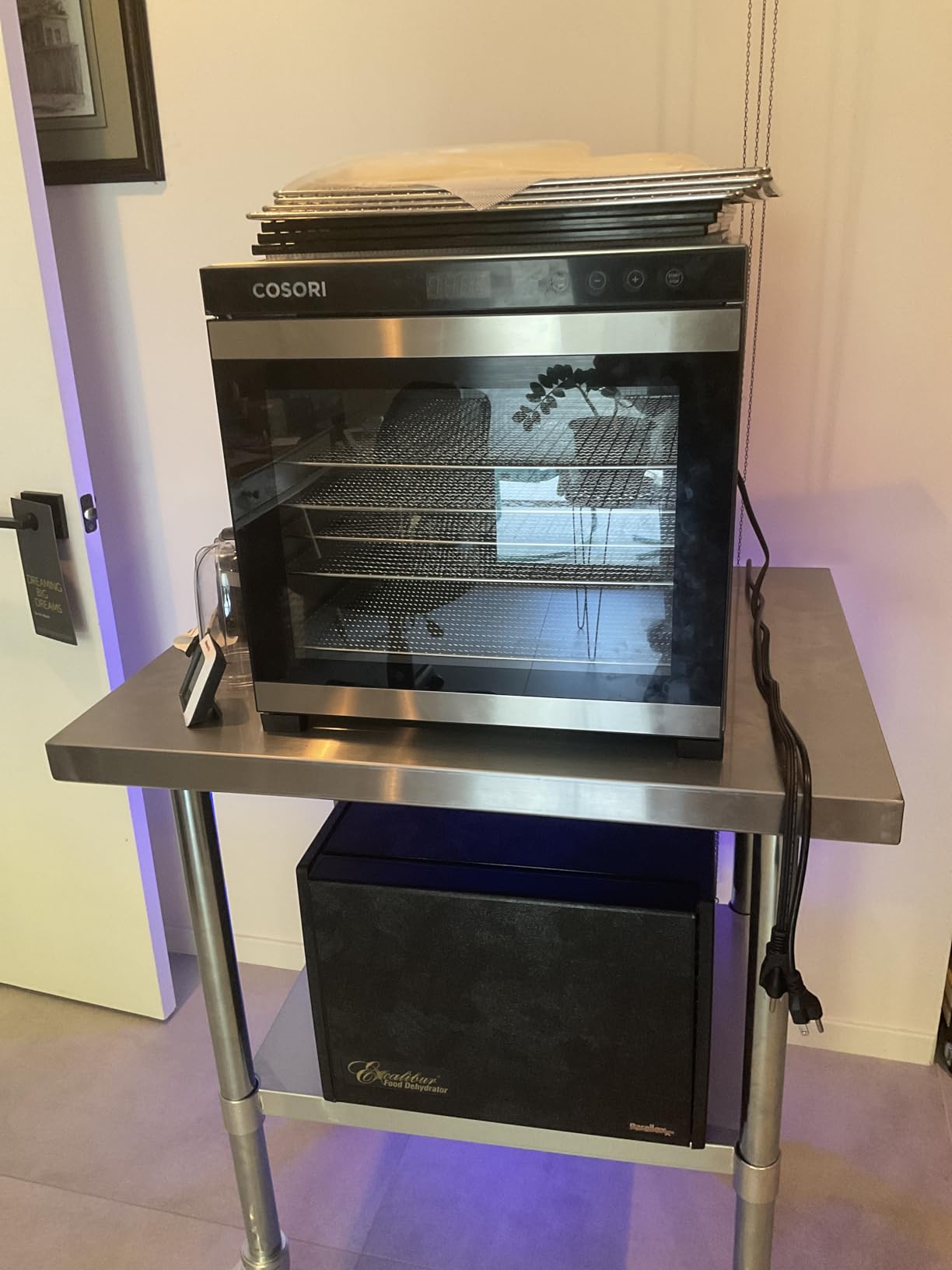
Trays are food-grade 304 stainless steel with BPA-free accessories, and the rear fan keeps drying even across the whole stack. The 165F ceiling is deliberate on this model, capped at the level generally treated as safe for jerky, which is a sensible design choice rather than a shortfall for most home use.
About 700 reviews average 4.4 stars, and the 7 percent one-star share is the second highest among the Cosori models, pointing to a small tail of complaints about size and durability. The dimensions are 21.3 by 16.9 by 16.4 inches and the weight is 35.8 pounds, so plan the counter before the purchase.
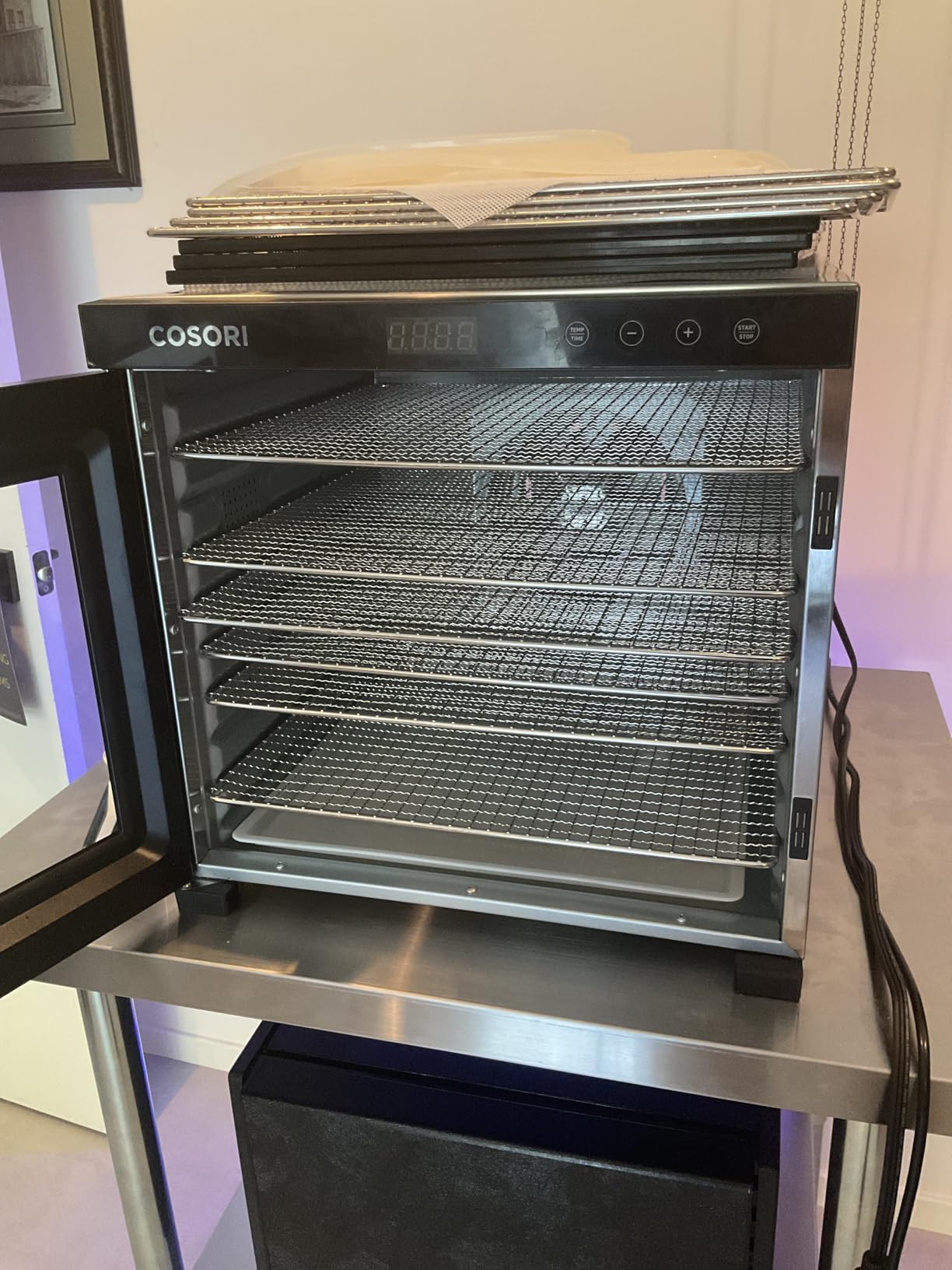
Who this large Cosori model actually suits
Serious preservers. A single cycle can cover an entire weekend of vegetable chips, fruit leather or a large batch of jerky, and the 304 stainless trays take acidic foods like tomato and fruit without staining or warping.
It is also the right call for anyone who wants a fixed appliance rather than a seasonal one. If you plan to dehydrate most days, the large drying area and the 1000W element pay for the footprint in saved cycles and electricity per finished pound.
What gives you pause
The size and weight are the real considerations. At 35.8 pounds, moving it needs two hands and a clear path, and a 16 by 21 inch footprint claims a permanent counter position. Small kitchens should be honest about that before ordering.
The 165F ceiling also rules out the higher-temperature work that the 176F and 185F models can do, and the elevated one-star share suggests some owners have had durability or noise issues. If the largest possible batch is not your goal, a 7-tray body gives up very little capacity for a lot less space.
7. OLIXIS 8-Tray 185F Dehydrator – The Widest Temperature Range
OLIXIS Food Dehydrator Machine, 500W Jerky Dehydrators with 8 Stainless Steel Large Trays, 185°F Temperature Control & 24H Timer Food Dryer for Fruit Meat Herb Dog Treats, Silver
8 steel trays, 8.2 ft2, 500W, 85-185F, 24-hour timer, under 45dB
Pros
- Wide 85-185F temperature range
- Eight large trays at 11.7 x 12.6 inch
- 3.3 lb per tray capacity
- Under 45dB with a built-in interior light
- Overheat protection
Cons
- Thinnest review base here at about 120 reviews
- 500W on eight large trays means long cycles
- Only a user manual is listed in the box
The OLIXIS is interesting because of its temperature floor and ceiling. It goes down to 85F, which is fine for slow herb drying and gentle work, and up to 185F, which gives it more headroom at the hot end than any other model in this group apart from the Elite Gourmet five-tray unit.
Eight large stainless steel trays measure 11.7 by 12.6 inches each, adding up to 8.2 square feet, and each tray is rated for 3.3 pounds. That per-tray figure is one of the higher load ratings here, so a single tray of beef or poultry is realistic rather than aspirational.
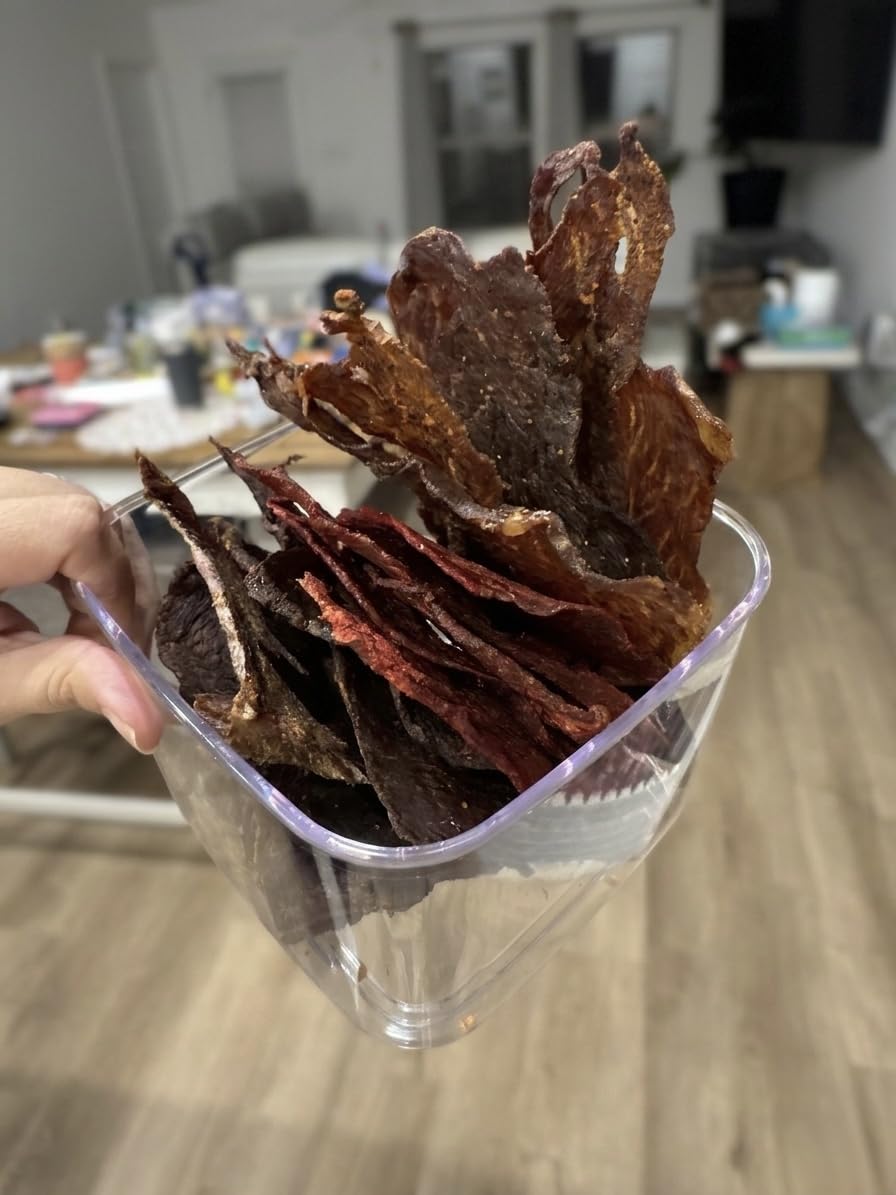
It runs under 45 dB, quieter than most, and has a built-in interior light so you can check a batch without opening the door and losing heat. Horizontal airflow with a rear drying fan handles distribution, and overheat protection is standard.
The honest caveat is the review base. Roughly 120 reviews at 4.5 stars with 72 percent five-star is a young listing, so the long-term durability picture is not established the way it is for the models with tens of thousands of reviews. The 500W element on eight large trays also means full loads take time.
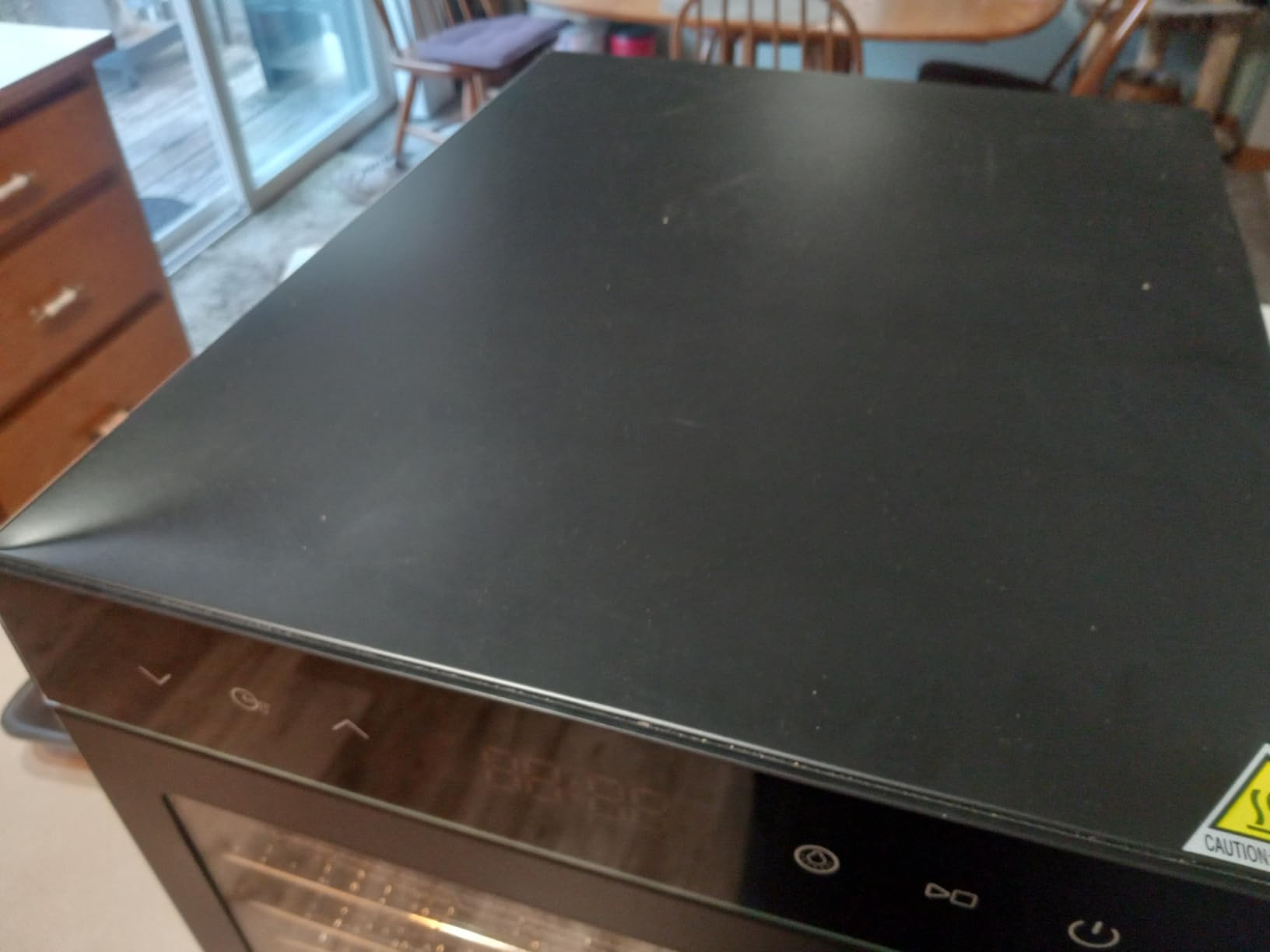
Where the OLIXIS earns a place
Switching between herbs and meat. Most home dehydrators force a compromise between a low enough temperature for delicate herbs and a high enough temperature for poultry. The 85F to 185F range covers both ends of what home food preserving actually asks for.
The per-tray load rating and tray size also make it a good fit for dog treat makers working with chicken or other poultry, where a higher heat and a heavier tray load matter. The interior light and low noise make long unattended runs easier to manage.
Where caution is warranted
The thin review history is the main thing. A 4.5 average over roughly 120 reviews tells you current owners are happy, not how the motor and seals look in five years, and long-term durability reports are exactly what forum buyers ask about most.
The wattage to tray-area ratio works against it. Eight large trays on a 500W element is more surface than the power comfortably drives, so a full load runs long. And only a user manual is listed in the box, so you will be buying mesh screens or fruit roll trays separately.
8. PSIIDAN 8-Tray 650W Dehydrator – The Highest Rated Compact Design
Food Dehydrator Machine, Powerful Food Dryer with 8 Stainless Steel Trays, Adjustable Temperature up to 167°F & 48-Hour Timer for Jerky, Fruits, Herbs – Includes Mesh Tray, Drip Tray & Recipe Guide
8 steel trays, 650W, up to 167F, 48-hour timer, interior light, auto shutoff
Pros
- 4.8 average rating with 88 percent five-star
- 650W dries quickly and evenly
- Compact 13 x 13.3 x 12 inch body holds eight shelves
- Dual-layer insulation keeps the exterior cool
- Mesh tray and drip tray included
Cons
- Body is ABS plastic with steel trays
- 167F ceiling is below the 176-185F models
- Review base is only about 115
The PSIIDAN posts the highest average rating in this group at 4.8, with 88 percent five-star ratings, though that average rests on roughly 115 reviews rather than tens of thousands. The eight stainless steel trays and 650W motor in a body measuring 13 by 13.3 by 12 inches is an unusual combination of capacity and footprint.
Dual-layer insulation is the feature to know about. Owners report the exterior staying cool during extended runs, which matters if the machine lives on a counter near other appliances or if you are running overnight in a warm room, where heat loss slows drying.
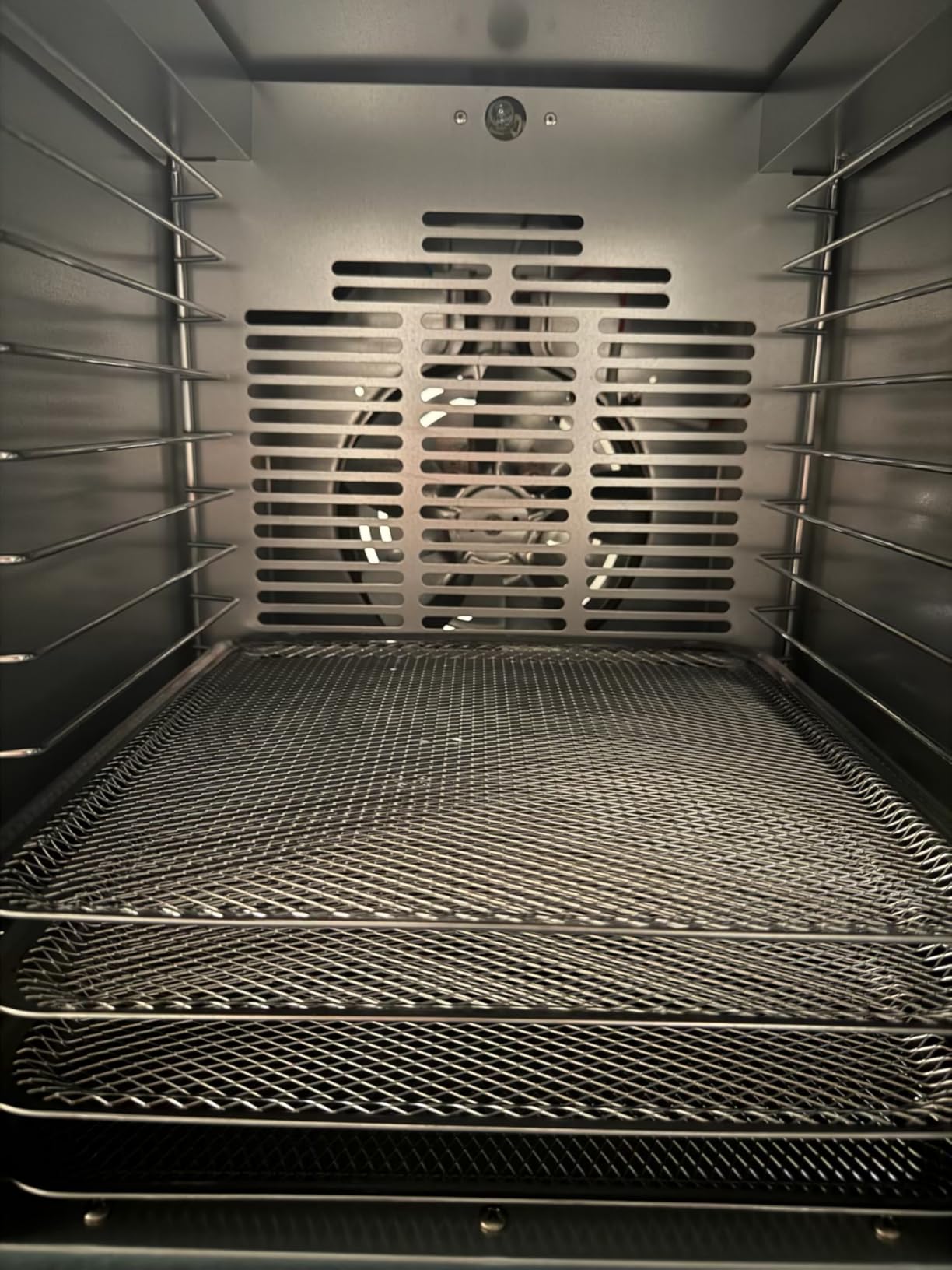
Temperature adjusts to 167F and the timer runs to 48 hours, with a built-in interior viewing light and automatic shutoff so a cycle ends without you needing to unplug anything. A mesh tray for nuts and seeds and a drip tray for fruit roll-ups come in the box, along with a recipe guide.
Long-time jerky makers describe drying as quick and even, and the motor as ultra-quiet. One owner flagged that it runs noticeably warm, which is worth keeping in mind for placement. The body is ABS plastic with stainless steel trays rather than a full metal cabinet.
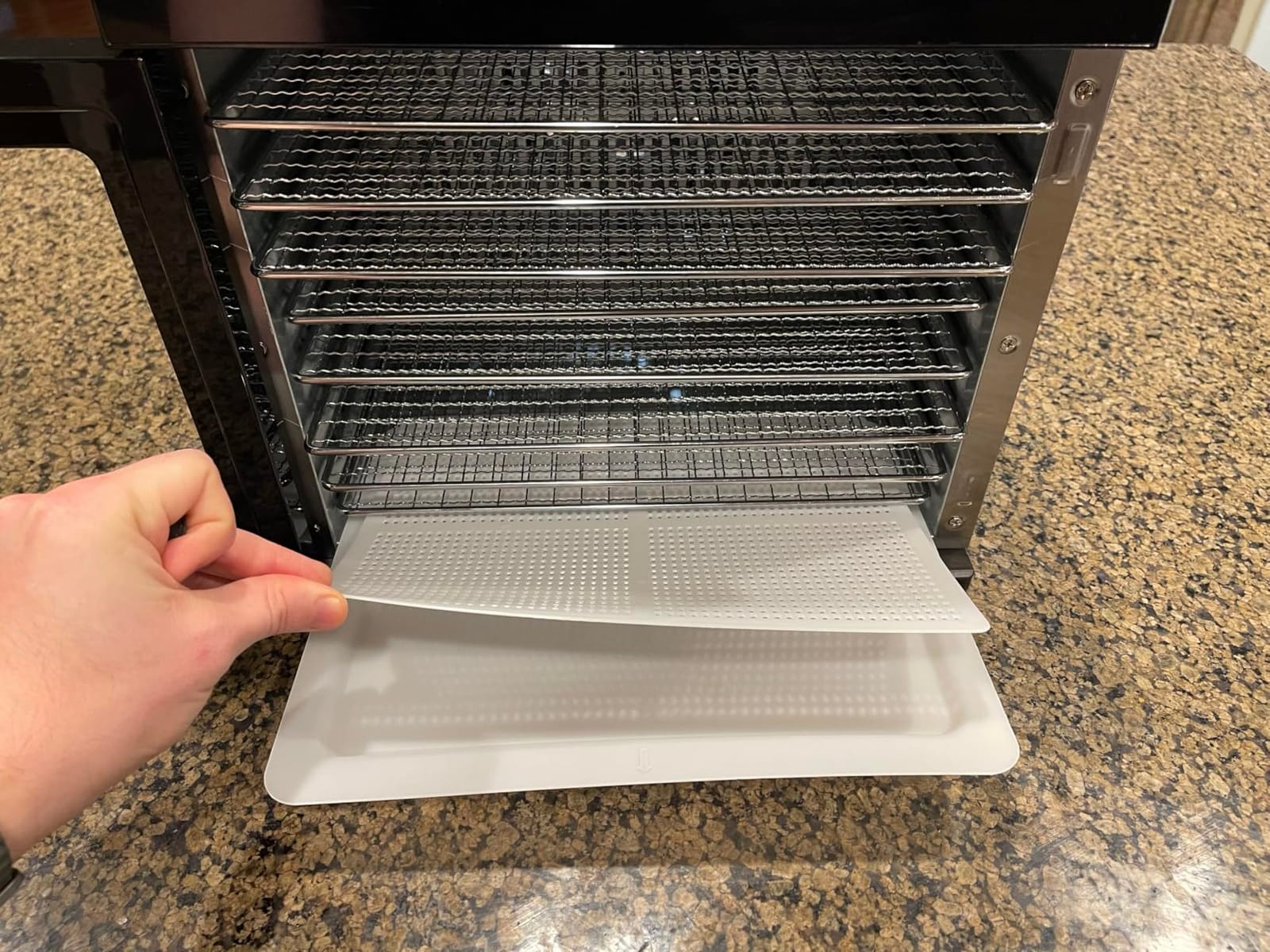
Why buyers like the PSIIDAN
It gets eight metal shelves into roughly a foot of counter space, which almost nothing else here manages. In an apartment kitchen that is the difference between a dehydrator you use and one that lives folded in a cupboard.
The accessory package is complete for a first project: a mesh tray for small items, a drip tray for fruit work, and a recipe guide. The interior light and auto shutoff cover the two things people most often complain about missing on compact machines.
What to weigh first
Two reviews of a five-star product can go wrong in a month. A brand with a short track record and a low category ranking carries more risk than a model with tens of thousands of reviews, so this one suits a buyer who is comfortable with that.
The 167F ceiling is below the Magic Mill Pro, the Cosori P501 and the OLIXIS, and the plastic cabinet means it is not a full stainless build. If your plans center on heavy meat loads at high temperature or a metal interior, this is not the machine.
9. Elite Gourmet 5-Tray 194F Digital Dehydrator – The First-Time Buyer Machine
Elite Gourmet 5-Tray Digital Food Dehydrator, Stainless Steel, Keep Warm
5 mesh steel trays, 480W, 95-194F, 48-hour timer, interior light, keep-warm
Pros
- Digital temperature and timer in a very compact body
- 194F ceiling is the highest here
- Mesh trays handle berries nuts and herbs without fall-through
- Interior light and keep-warm are rare in this class
- Dishwasher-friendly trays
Cons
- Trays are small at 9.2 x 7.1 inch
- 480W means slower drying on full loads
- Some owners report a louder or rattlier fan
At 10.4 by 11.3 by 7.8 inches the Elite Gourmet EFD809D is about microwave sized, which makes it the easiest machine here to find a permanent home for. Five stainless steel mesh trays at 9.2 by 7.1 inches hold berries, nuts, herbs and small vegetable chips without pieces falling through the gaps.
The controls are more capable than the size suggests. Temperature runs from 95F to 194F, which is the highest ceiling in this group, with a timer up to 48 hours, plus a built-in interior light and a keep-warm setting. Both of those extras are unusual in a machine this compact.
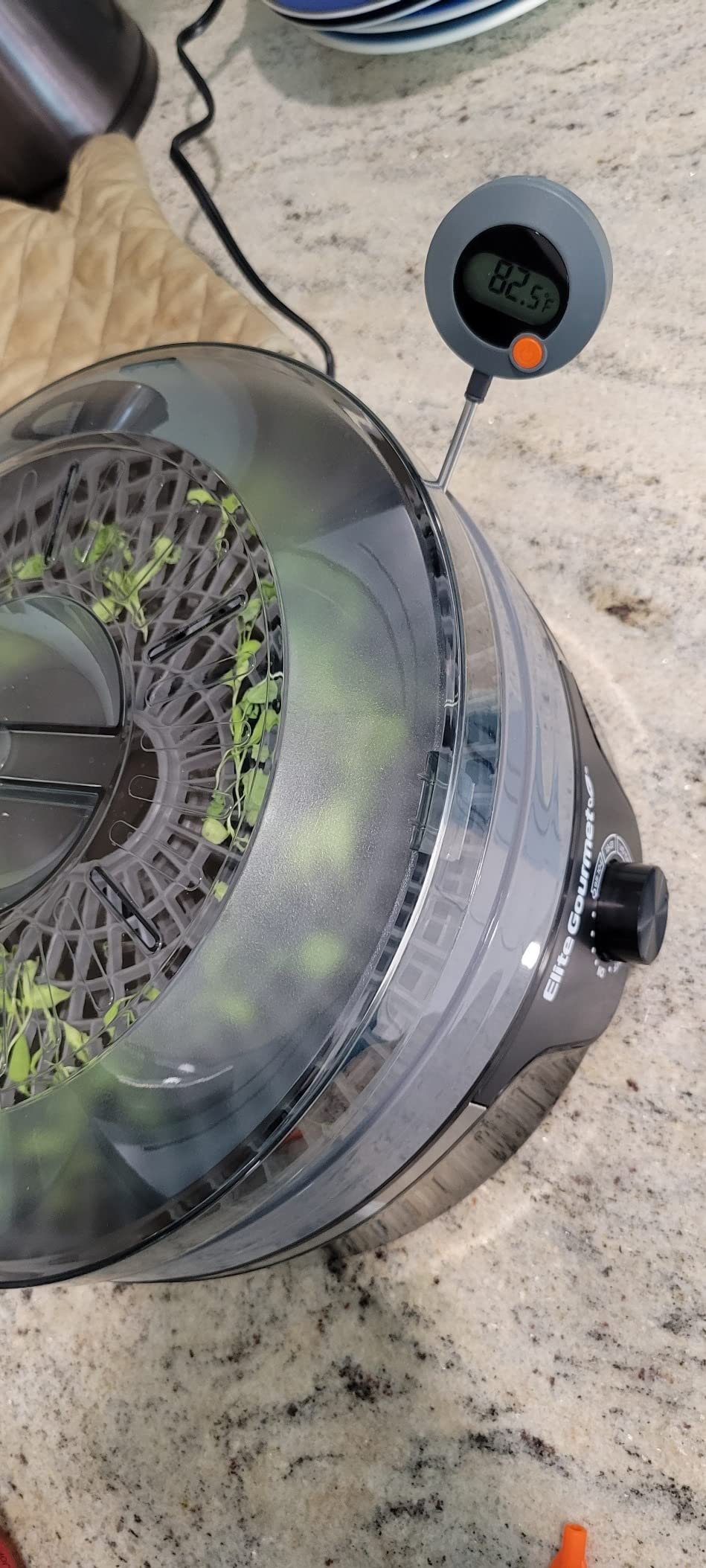
About 1,940 reviews average 4.4 stars with a 70 percent five-star share. Owners making jerky and vegetable chips report good results, and the digital control plus the light make it forgiving for a beginner who does not yet know how long strawberry chips should take.
The recurring complaint is capacity. Several reviewers call the tray size too small for family quantities, and the 480W element means some report banana batches running past the times in the booklet. A few also describe the fan as louder or rattlier than expected.
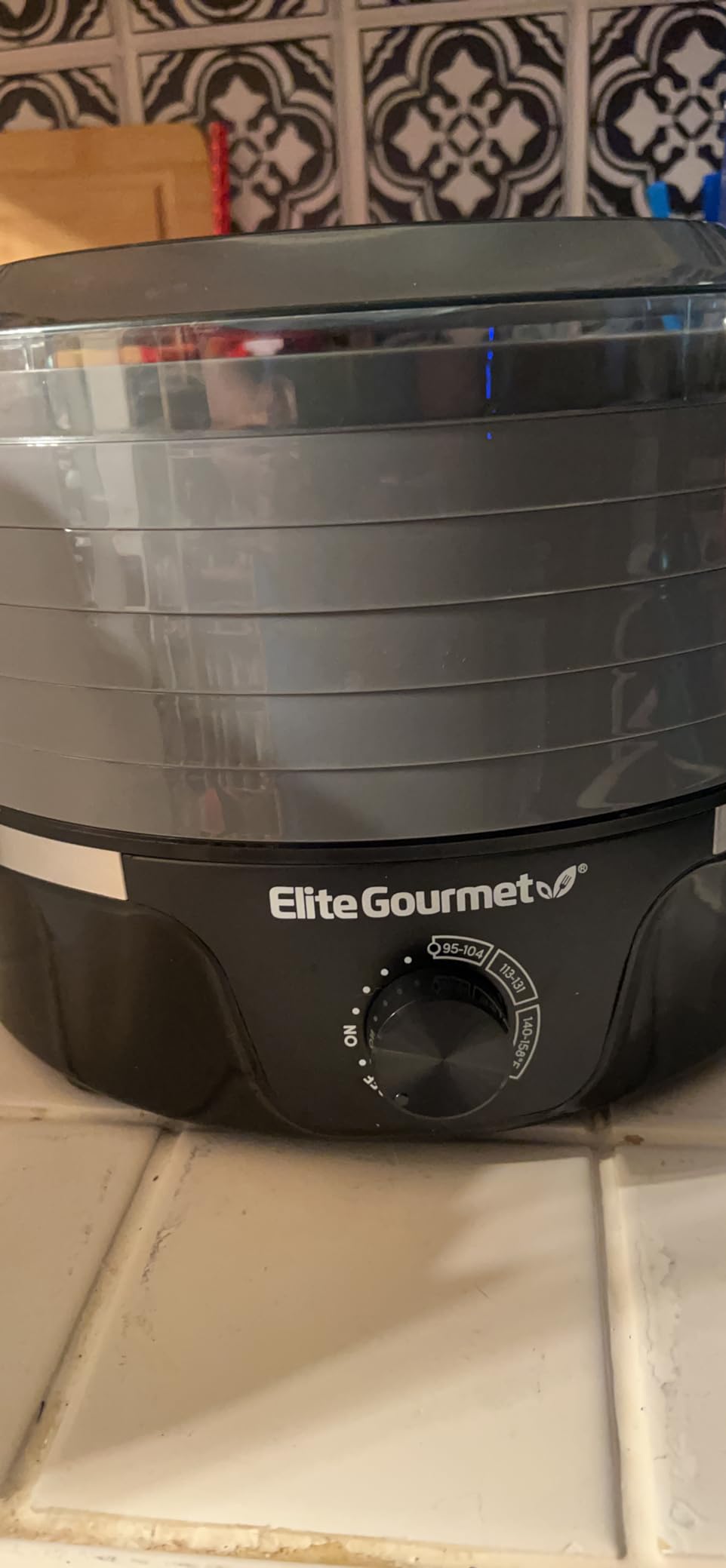
What makes this a good first dehydrator
It teaches you the craft without asking for a large commitment. Small batches dry faster, the interior light lets you learn what done looks like, and the digital temperature control means you can record the setting that worked and repeat it exactly.
The mesh trays are the quiet strength. Small round items like blueberries, raspberries and sliced strawberries sit securely rather than dropping onto the heating element, and the fruit roll tray and recipe booklet remove the two most common first-project problems.
When the small trays become a problem
If you are feeding a family or working through a harvest, 9.2 by 7.1 inch trays will be the first thing that frustrates you. You will run more cycles to cover the same volume, and each cycle costs you a full day.
The 480W element compounds that. Owners who report banana batches overrunning the book times are not doing anything wrong; they are simply loading a small tray area into a modest heater. And if noise matters in your space, test this one before settling, since some owners describe the fan as rattly.
10. Elite Gourmet 4-Tray Adjustable Temperature Dehydrator – The Smallest Useful Machine
Elite Gourmet Food Dehydrator, Stainless Steel Trays, Adjustable Temp
4 steel trays, 350W, 95-158F, 24-hour timer, ETL listed, dishwasher-safe
Pros
- Very small 11.5 x 10 x 8 inch footprint that stores easily
- Rectangular removable trays clean far more easily than round ones
- ETL listed at 350W and 120V
- Runs 24 hours or more and signals when time is up
Cons
- Only four trays for a personal batch size
- 158F ceiling is below the safe jerky mark
- Body is plastic rather than stainless steel
The smallest useful dehydrator here, and the one most likely to live in a cupboard between uses. At 11.5 by 10 by 8 inches with four removable stainless steel trays, it handles herbs, fruit rolls, trail mix, granola, mushrooms and pet treats without occupying real estate.
What it does well is accuracy. Owners have checked the temperature against a calibrated probe thermometer up to the 158F maximum and found it honest, which matters more for drying than any other spec once you start keeping seeds or herbs for storage. Horizontal airflow and a bottom-mounted fan handle distribution.
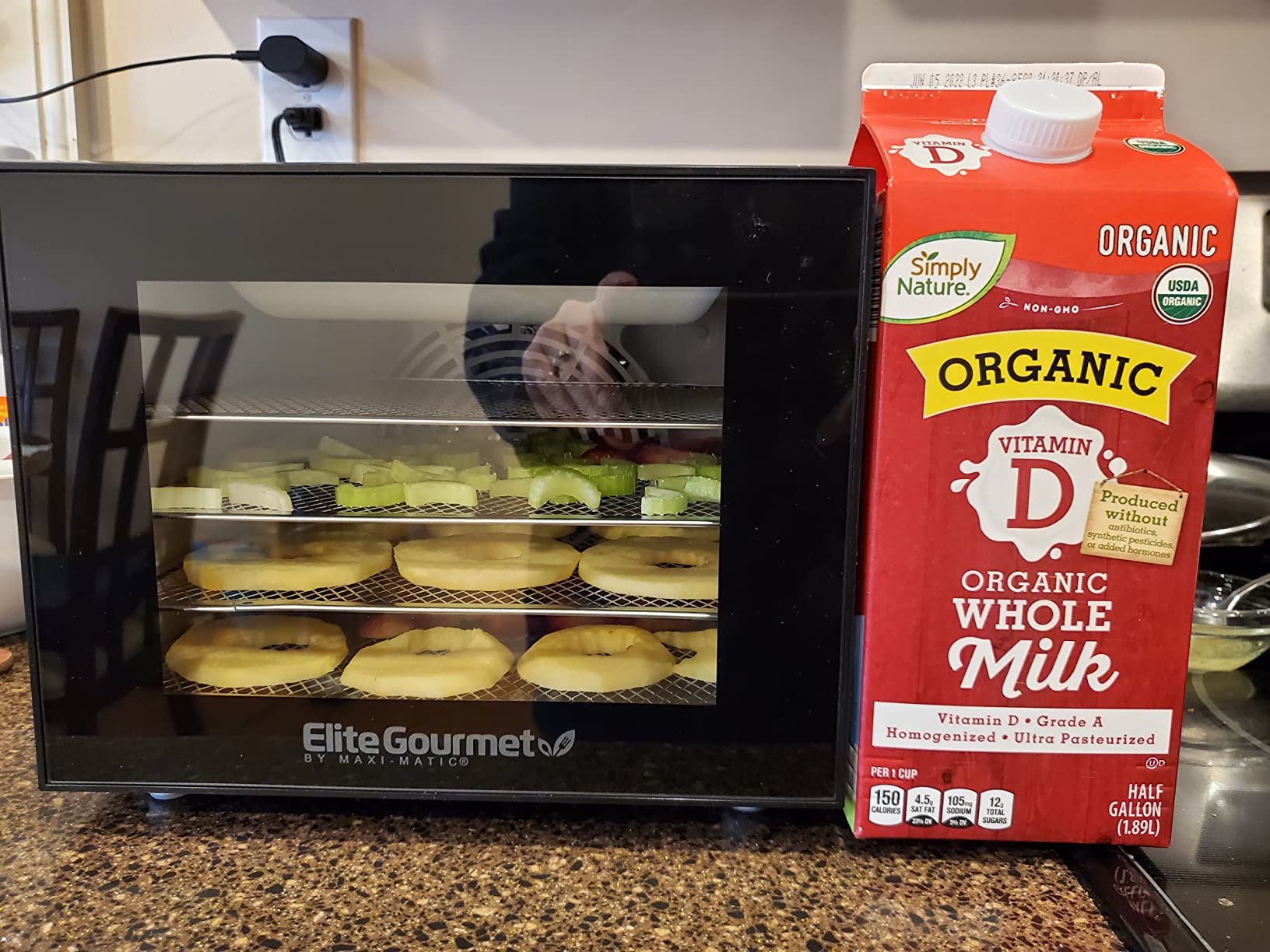
The transparent trays let you watch progress without opening the lid, and the rectangular removable trays and lid go in the dishwasher. That rectangular shape is not a small detail: round trays with a center hole trap residue in a way these do not.
The limits are clear. Four trays is a personal-batch machine, the 158F ceiling is below the temperature most jerky makers want, and the body is plastic rather than stainless steel. Some owners report drying more slowly than the specified time and temperature.

Where the four-tray Elite Gourmet works
Herbs, fruit rolls and dog treats in small quantities. If you dry a few bunches of herbs and make fruit leather for the kids twice a summer, this handles it, and it stores away the rest of the year in a fraction of the space a larger body needs.
It is ETL listed at 350W and 120V, runs 24 hours or more continuously without trouble, and signals when the timer ends. Accurate, verified temperature behaviour is a genuine strength here rather than a spec-sheet claim.
Why it will not do meat the way you want
A 158F ceiling rules out safe jerky drying for most people, and that is the single most common reason people buy a dehydrator. If meat is on the list, this is the wrong machine regardless of how tidy it looks.
Four trays also means very small loads, and 350W on that little chamber means slow cycles. Buyers who want a small stainless steel dehydrator that still handles meat should step up to the five-tray Magic Mill or the compact Cosori P501, both of which reach 167F and above.
What Temperature to Set for Each Food
Getting the temperature right matters more than the machine you choose. The thermostat range on a given model is not the same as the food-safe target, and a dehydrator that runs accurately at 125F is worth more than one that reaches 190F but drifts.
Dried herbs go in at the low end, 95F to 115F, because the aim is slow moisture removal with the essential oils intact. High heat drives those compounds off and leaves you with green-coloured hay. Check stems for brittleness rather than watching the clock.
Fruits and vegetables sit in a middle band, typically 125F to 135F. Fruit leather works at the lower end of that, while vegetable chips and fruit slices hold their colour better with a little more heat. Rotate trays only if your model needs it; the rear-fan units in this group do not.
Meat needs the top of the range. Beef and poultry jerky generally call for 160F to 165F, which is why models that top out at 158F or 165F give you less margin than those reaching 176F to 185F. Any model below about 160F is a poor choice for meat drying.
Powders are a low-temperature project that most roundups skip. Run dried mushrooms, onions, garlic or herbs to full dryness, then pulse them in a blender to make mushroom powder, onion powder, garlic powder or bouillon. Staying between 95F and 115F preserves the aromatics, and a machine with a tight low-end range does this better than a wide one with poor control.
Dog treats follow the meat rules. Poultry-based treats for livers and hearts need 160F or above, which is exactly where the auto shutoff and overheat protection features earn their keep on long unattended cycles.
Yogurt, tempeh and bread proofing use the bottom of the range, held steady for hours at a time. Only a few models here, such as the Cosori P501 with its dedicated presets, make this a one-button job. On the others you are managing a narrow low band by hand.
How to Choose a Stainless Steel Dehydrator
Airflow direction is the first decision. A rear-mounted fan pushes air horizontally across every tray, which is why you never rotate them. A bottom or top fan sends air vertically through a stack, so the trays nearest the element dry faster and you have to swap them mid-cycle.
Most of the good models here use horizontal airflow, and that is the single biggest quality difference in this category. It costs you nothing extra at purchase and it removes an entire step from every batch.
Tray material is a second-tier decision for the trays themselves and a first-tier one for the body. Stainless steel trays are the reason this roundup exists: they do not warp, they take heat, they survive sticky fruit and they go in the dishwasher. The body matters more than most buyers expect, because plastic walls hold odour and the interior of a dehydrator is a warm, damp environment.
Two models here have plastic bodies with stainless trays. Both are good machines, but neither is what someone searching for an all-stainless dehydrator is looking for. Check the construction description, not just the tray material.
Wattage sets how fast you get through a load. The models here run from 240W up to 1000W, and the difference shows up directly in cycle length. A small wattage in a small body is fine; a small wattage in a large body means long cycles and perishable food sitting in a warm chamber.
Tray count and drying area should be matched to your volume. Under ten pounds of produce a year, five trays is plenty. A garden that hands you a harvest every week wants ten trays and a large square foot area. The step from 5 to 7 trays costs little space; the step from 7 to 10 costs a lot.
Temperature ceiling decides what you can make. Anything you want to dry for meat should reach at least 160F, and 176F to 185F gives you real margin. A model topping out at 158F is a herb and fruit machine, and it is honest about that.
Timer and safety features matter for long cycles. A 48-hour timer with automatic shutoff and overheat protection is the baseline for overnight runs. Keep-warm functions, which hold a finished batch at a low temperature, are a genuine convenience when you are not ready to package.
Cleaning is decided by tray shape. Removable rectangular stainless trays that go in the dishwasher are the easiest to live with, and a drip tray or fruit roll sheet in the box saves you a purchase. Dense mesh trays are better for berries and small items but take longer to scrub.
Noise and heat deserve a check if you share a space. Two models here publish figures, at under 48 dB and under 45 dB, which are quiet enough for overnight running. Insulated bodies keep the exterior cooler during long cycles. A model that runs warm needs more clearance on the counter.
Warranty runs one to two years in this group, and the two-year manufacturer warranties on the Cosori models are the longest. Longer is better for a machine you expect to run hundreds of cycles a year.
Running cost is easy to estimate. Take the wattage, divide by 1000, and multiply by the hours you run, then multiply by your utility rate. A 600W machine running ten hours draws 6 kilowatt-hours; a 1000W machine running ten hours draws 10. Higher wattage finishes faster, so compare cost per finished batch rather than cost per hour.
Frequently Asked Questions
What is the best food dehydrator for home use?
The Cosori CP267-FD is the best food dehydrator for most home kitchens in our testing. It dries six stainless steel trays across 6.5 square feet with a rear-mounted fan, so no tray rotation is needed, and the brushless motor stays under 48 dB overnight. For heavy batch volume, the Magic Mill MFD-7100 adds ten extra-large trays and a 700W element, and for a fully stainless cabinet the Magic Mill Pro MFD-7700 reaches 176F in a narrow body.
Which brand of food dehydrator is considered the best?
Among the stainless steel models we compared, Cosori and Magic Mill dominate on review volume and consistency, and Elite Gourmet covers the compact and low-cost end. Cosori units lead on sales rank in Kitchen and Dining and carry two-year manufacturer warranties. Magic Mill covers the widest range of capacities, from a five-tray 240W starter to a ten-tray 700W bulk machine and a fully stainless 176F model. Pick by capacity and top temperature rather than brand alone.
What is the best food dehydrator for value for money?
The Magic Mill Pro MFD-7700 is our best value pick. It has a stainless steel exterior and interior with no plastic walls, seven full-size stainless steel trays, a 600W rear-fan system and a 176F ceiling with one-degree control, and it carries an ETL safety listing. It runs more than 24 hours straight according to owners and is narrow enough for a normal counter run. Its main drawbacks are a sensitive start and stop button and fewer trays than the ten-tray models.
What is the best-rated stainless steel dehydrator?
The PSIIDAN 8-tray model posts the highest average rating at 4.8 stars with 88 percent five-star ratings, but that average rests on roughly 115 reviews. Among models with an established track record, the Cosori CP267-FD rates 4.7 across more than 21,000 reviews and the Magic Mill Pro rates 4.7 across roughly 2,000. A high average on a small sample is less meaningful than a slightly lower average across tens of thousands of owners.
Is horizontal airflow worth the extra cost?
Horizontal airflow is worth more than almost any other feature in this category, and it is rarely a premium add-on. A rear-mounted fan pushes air across every tray at the same time, so you never rotate them halfway through a batch. Vertical airflow units with a bottom or top fan dry the tray nearest the heater first and require manual swapping. Most of the stainless steel models we compared use horizontal airflow, and it is the reason even drying is not a concern with them.
Can you leave a food dehydrator running overnight?
Yes, as long as the machine has automatic shutoff and overheat protection, and you give it clearance on the counter. Most of the models here include both, and the 48-hour timers on several are designed for exactly this. Check the temperature and timer before you leave a room, avoid stacking anything against the vents, and expect a warm kitchen and a noticeable food aroma, particularly when drying meat. A model that runs cool to the touch, such as one with dual-layer insulation, is the safest choice in a warm room.
Does a food dehydrator use a lot of electricity?
Less than most people expect. The models here draw between 240W and 1000W, so a 600W machine running ten hours uses 6 kilowatt-hours. Multiply by your utility rate for the cost of one cycle. A higher-wattage machine uses more per hour but finishes a batch in less time, so the fairest comparison is cost per finished batch rather than cost per hour.
The Stainless Steel Dehydrator Worth Buying in 2026
The best stainless steel food dehydrators for home use are not all the same machine, and the right one depends on volume and on how high you need the temperature to go. Six to seven stainless steel trays with a rear-mounted fan, a one-degree thermostat reaching at least 165F and a dishwasher-safe tray set covers almost every home kitchen.
Our pick is the Cosori CP267-FD, with the most reviews in this group and the quietest, most even drying. Go bigger with the Magic Mill MFD-7100 if you process a harvest, smaller and cheaper with the five-tray Magic Mill starter, and full-metal with the Magic Mill Pro MFD-7700 if a stainless interior is the point. Our meat slicer guide covers the prep side of a jerky batch if you need the cutting step sorted first.
Whichever you pick, run it on a weekend afternoon so you can check the trays, and use the temperature guide above rather than the time in a recipe that was written for a different machine.