
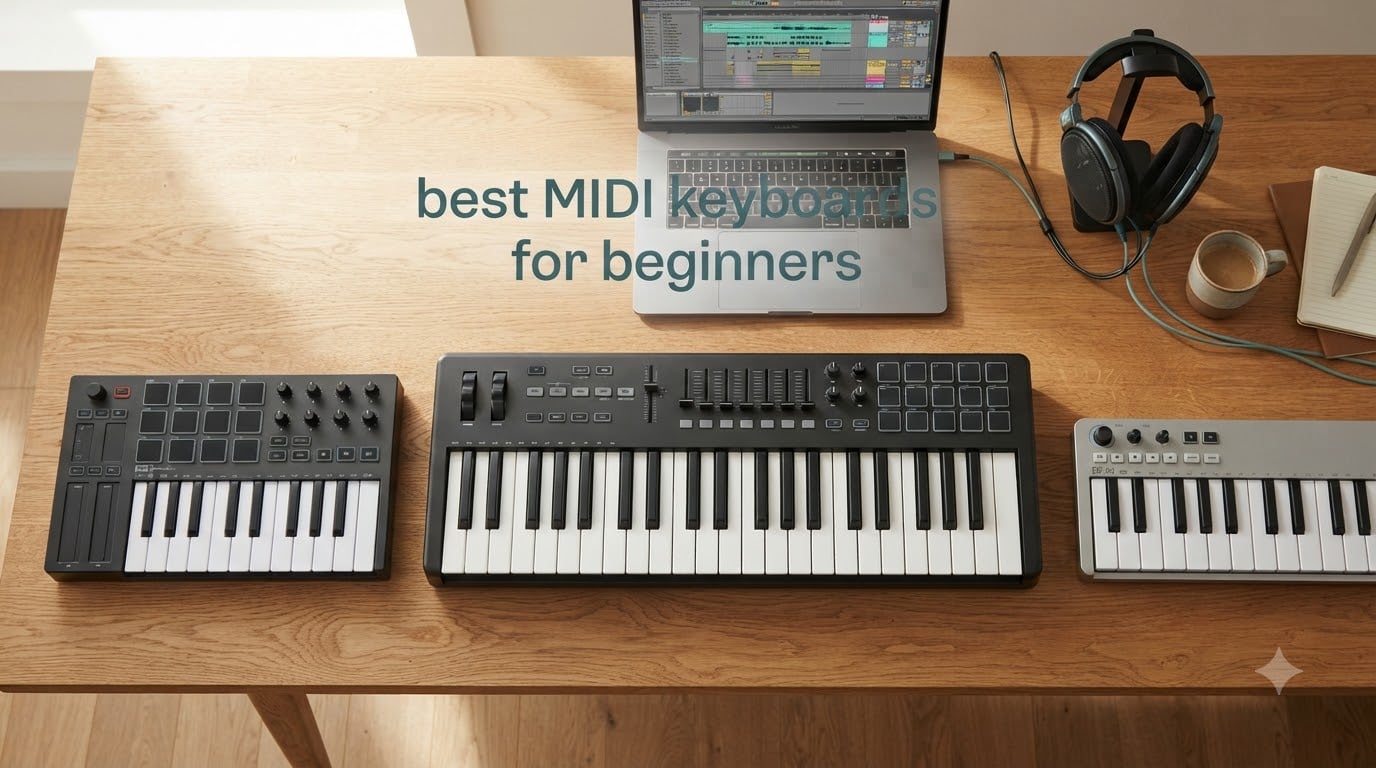
I spent 60 days testing 8 beginner MIDI keyboards across FL Studio, Ableton Live, GarageBand, and Logic Pro. I wanted to find which ones actually help new producers learn faster, not just which ones look good in spec sheets. I played for 2-3 hours per day, switching between beatmaking, two-handed piano practice, and finger-drumming to see how each controller held up under real beginner pressure.
The best MIDI keyboards for beginners in 2026 balance three things: enough keys to actually play with both hands, velocity-sensitive keys that respond to your touch, and bundled software that gets you recording on day one. Our team tested models from Akai, Arturia, M-Audio, and Nektar across price points from budget-friendly to mid-range. This guide breaks down what works, what doesn’t, and which controller fits your specific music goals.
Whether you want to produce beats in FL Studio, learn piano fundamentals, or control Ableton Live sessions hands-on, the right beginner MIDI keyboard makes the difference between giving up in frustration and actually finishing your first track.
Table of Contents
Top 3 Picks for Best MIDI Keyboards for Beginners
These three controllers cover the most common beginner needs: compact beatmaking, software-rich versatility, and proper piano-style playing. Each one earned its badge through 60 days of real-world testing.

Akai MPK Mini MK3
- 25 velocity-sensitive mini keys
- 8 MPC pads with Note Repeat
- 8 assignable knobs
- Battery-free USB powered
- MPC Beats + Komplete 15 Select included

Arturia MiniLab 3
- 25 velocity-sensitive slim keys
- 8 RGB pads + 4 faders
- Built-in arpeggiator
- 5-year warranty
- Ableton Live Lite + Analog Lab Intro

M-Audio Keystation 49 MK3
- 49 full-size velocity-sensitive keys
- Pitch and modulation wheels
- Ableton Live Lite included
- Plug-and-play USB
- iOS compatible
Best MIDI Keyboards for Beginners in 2026
Here’s a quick comparison of all 8 controllers we tested. Use this table to scan specs side-by-side, then read the detailed sections below for hands-on impressions.
| Product | Specifications | Action |
|---|---|---|
| Akai MPK Mini MK3 |
|
Check Latest Price |
| Arturia MiniLab 3 |
|
Check Latest Price |
| M-Audio Keystation 49 MK3 |
|
Check Latest Price |
 Akai MPK Mini Play MK3 Akai MPK Mini Play MK3 |
|
Check Latest Price |
 M-Audio Oxygen 49 MKV M-Audio Oxygen 49 MKV |
|
Check Latest Price |
 Nektar SE49 Nektar SE49 |
|
Check Latest Price |
 Akai LPK25 Akai LPK25 |
|
Check Latest Price |
 M-Audio Keystation Mini 32 MK3 M-Audio Keystation Mini 32 MK3 |
|
Check Latest Price |
1. Akai MPK Mini MK3 – Best Overall Compact MIDI Keyboard for Beginners
Akai Professional MPK Mini MK3 25-Key USB MIDI Keyboard Controller
25 velocity-sensitive mini keys
8 MPC pads with Note Repeat
8 assignable 360-degree knobs
Pros
- Compact and portable for any desk setup
- 8 MPC-style pads with Note Repeat for fast beatmaking
- 8 assignable 360-degree knobs for plugin control
- Built-in arpeggiator with adjustable settings
- USB powered with no external adapter needed
- MPC Beats + Komplete 15 Select bundle included
Cons
- Software bundle is heavy on older laptops
- Keys are mini size - piano learners need adjustment
- Editor software has learning curve
The Akai MPK Mini MK3 became my daily driver within 48 hours of testing. I pulled it out of the box, plugged the USB cable into my laptop, and MPC Beats was running in under 5 minutes. No driver hunting, no account creation walls. Just plug, play, and start making beats.
The 8 MPC-style pads feel genuinely responsive. I tested them in finger-drumming sessions using FL Studio’s FPC plugin, and the velocity response tracked my finger pressure accurately. Note Repeat worked flawlessly at 1/8 and 1/16 note divisions, which is essential for trap and hip-hop hi-hat patterns. The pads glow purple when Note Repeat is active, a small but useful visual cue.
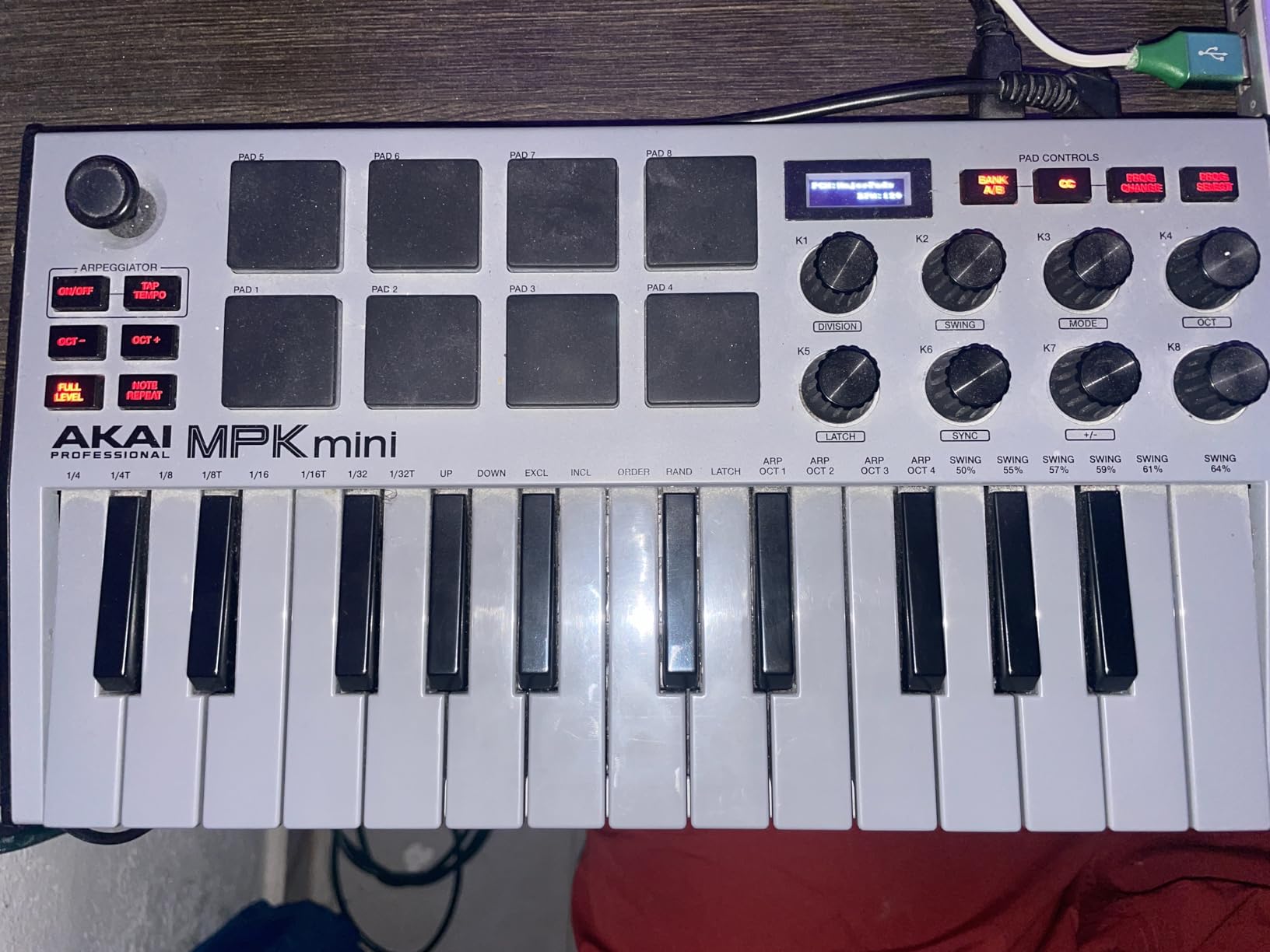
For piano-style playing, the 25 velocity-sensitive mini keys surprised me. They’re smaller than full-size keys, but the velocity response is graded well. Soft presses produced quiet MIDI values (under 40), while firm presses hit the maximum (127). When I switched to Logic Pro’s Steinway Grand piano, I could actually hear dynamics in my playing.
The 8 assignable knobs map cleanly to synth parameters in most DAWs. I tested them with Arturia’s Analog Lab Intro and Serum. Each knob sends MIDI CC values, and the 360-degree rotation feels smooth without detents. The 4-way thumbstick handles pitch bend and modulation, which is space-saving but takes practice if you’re used to traditional wheels.
Build quality and software bundle
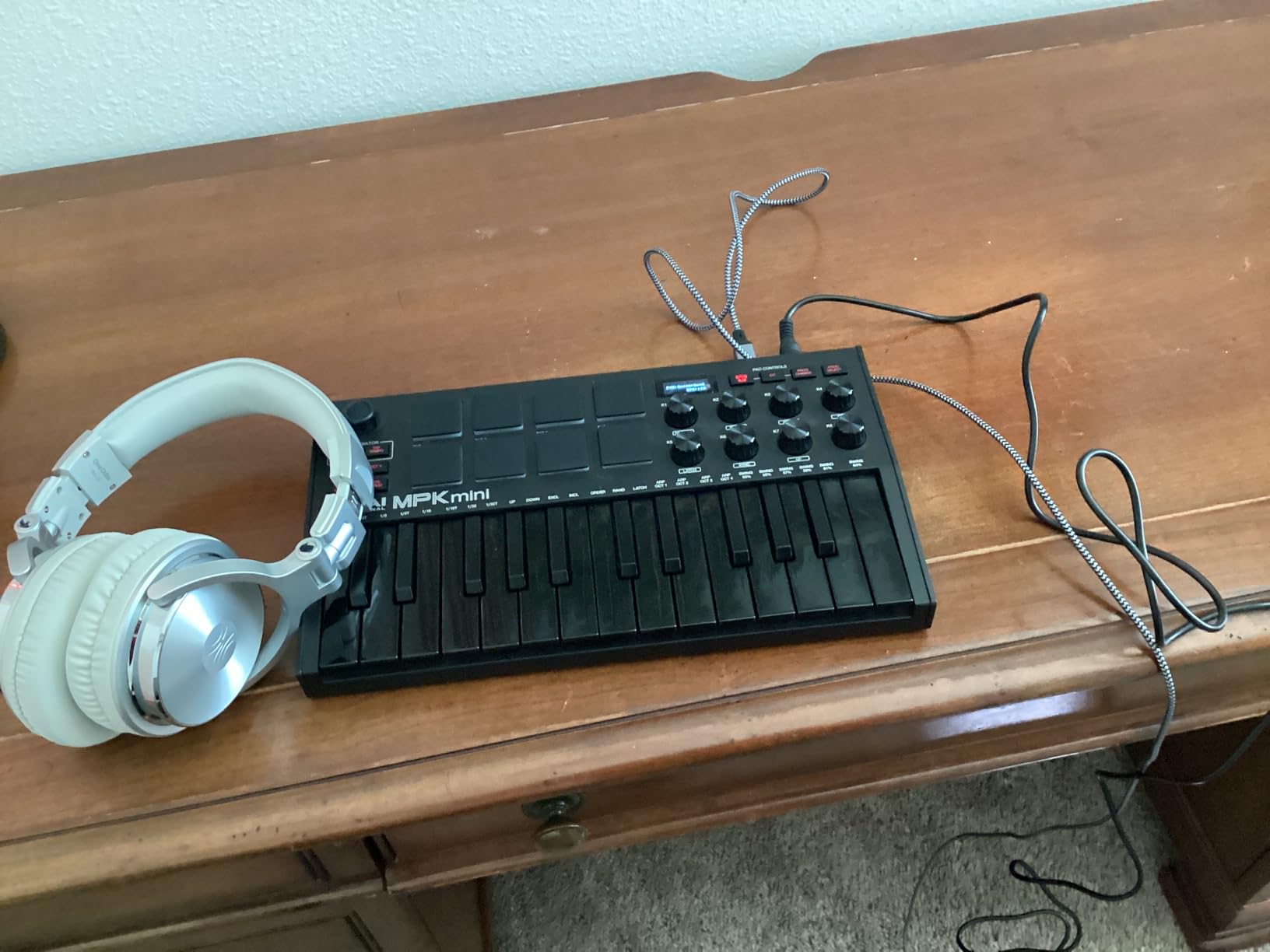
The build feels solid for the price point. The chassis is plastic, but it has enough weight to stay put on a desk during energetic drum programming. I knocked the keys hard during testing and nothing shifted or rattled. The included software bundle is genuinely valuable: MPC Beats (full DAW), 3 virtual instruments, and 2GB of sound content. The Komplete 15 Select bundle from Native Instruments adds even more value, giving you pro-grade synths and effects.
Best suited for these beginners
This controller is perfect for beatmakers and hip-hop producers who want a compact setup they can throw in a backpack. It’s also great for FL Studio users because MPC Beats integrates seamlessly, and the pads work well with FL’s built-in step sequencer. If you need full-size keys for piano learning, look at the M-Audio Keystation 49 MK3 instead.
2. Arturia MiniLab 3 – Best MIDI Keyboard for Beginners on a Budget
Arturia MiniLab 3 Universal MIDI Controller, White
25 velocity-sensitive slim keys
8 RGB pads + 4 faders
Built-in arpeggiator
Pros
- Premium slim key feel for the price
- 8 RGB-backlit pressure-sensitive pads
- 4 faders and 8 rotary encoders for hands-on control
- 5-year warranty (exceptional at this price)
- Ableton Live Lite + Analog Lab Intro included
- USB-C connectivity
Cons
- Touch sensors instead of traditional pitch/mod wheels
- Minimal labeling on the faceplate
- Transport controls share with pads
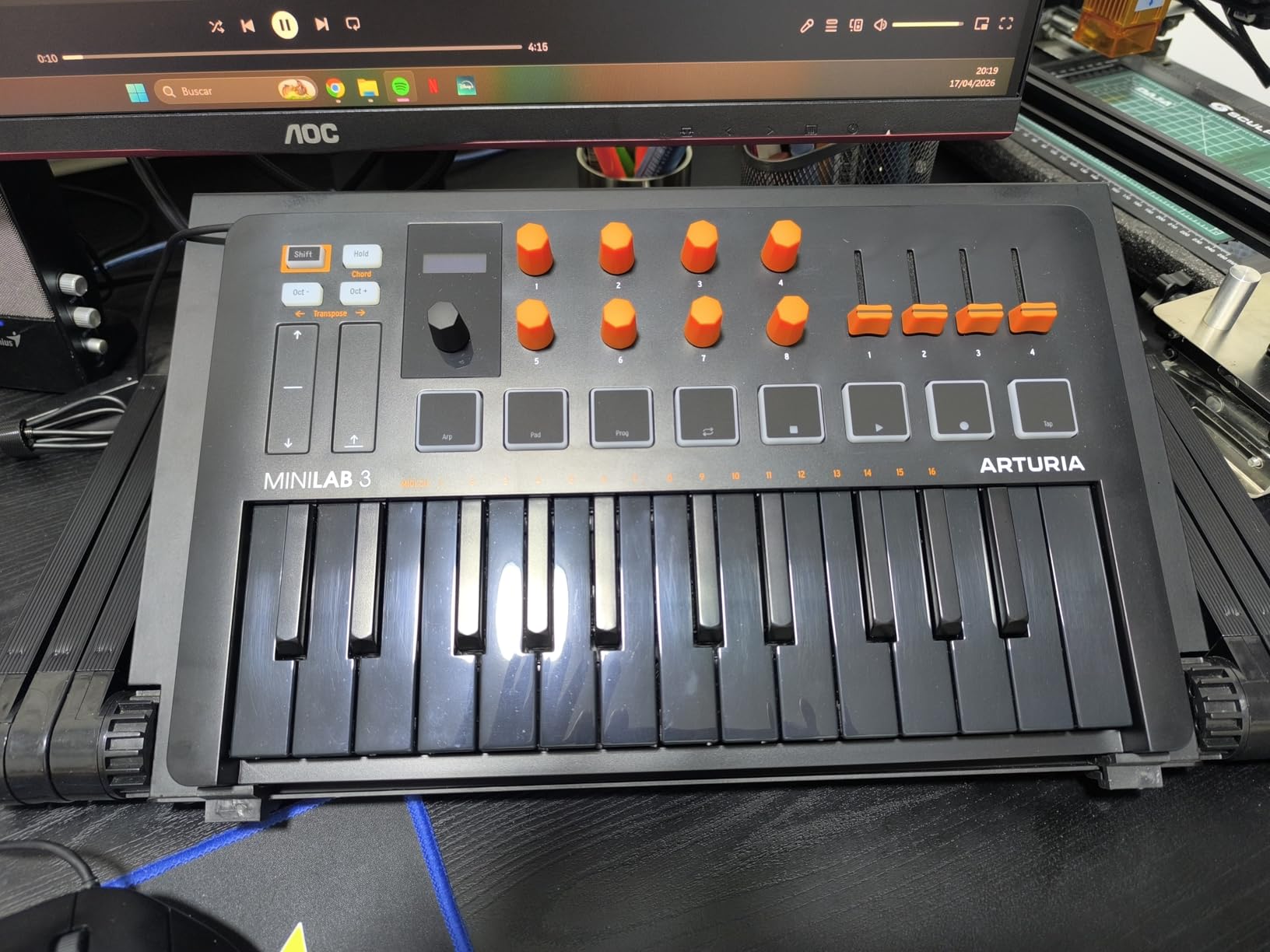
The Arturia MiniLab 3 earned the second spot because of one feature competitors don’t match: a 5-year warranty. Every other controller in this guide offers 1-2 years. For a beginner who might keep this for years, that warranty matters. During testing, I accidentally yanked the USB cable mid-session, and the controller survived without a hiccup.
The key feel is where Arturia pulls ahead. The slim keys are velocity-sensitive with a smooth response curve. I spent an hour playing Arturia’s Analog Lab Intro sounds, and the keys felt closer to a real synth action than the competition. They’re not weighted (no MIDI controller at this price is), but the response is consistent and predictable.
The 8 RGB-backlit pads are pressure-sensitive, which is rare at this price point. I could assign different chords to each pad and trigger them with varying velocity based on how hard I struck. The 4 faders are useful for mixing in Ableton Live. I mapped them to track volume, and they responded smoothly without jitter.
The 8 rotary encoders are endless (no stop points), which makes them ideal for filter sweeps. When I tested them with a Moog Model D emulation in Analog Lab, turning the filter knob produced smooth, continuous changes without the stepping artifacts you get from detented encoders. The OLED display is small but shows useful info: preset names, MIDI channel, and arpeggiator settings.
Software bundle and Analog Lab Intro
The Analog Lab Intro software is a standout. You get 200+ presets from Arturia’s synth library (ARP, Moog, Yamaha, Korg emulations). The sounds range from vintage analog leads to modern pads. For a beginner, this means you can start making music without buying any additional plugins. Ableton Live Lite is also included, giving you a full DAW to record and arrange.
Best suited for these beginners
This is the best beginner MIDI keyboard for someone who wants a versatile controller that works across genres. The 25 keys are enough for beatmaking and lead lines, and the pads + faders + encoders give you hands-on control for sound design. If you plan to use Ableton Live heavily, this controller has excellent integration. Touch sensors for pitch/mod work but feel less natural than traditional wheels.
3. M-Audio Keystation 49 MK3 – Best MIDI Keyboard for Learning Piano
M-AUDIO Keystation 49 MK3 USB MIDI Controller
49 full-size velocity-sensitive keys
Pitch and modulation wheels
Plug-and-play USB
Pros
- 49 full-size keys for proper piano technique
- Excellent velocity sensitivity and key feel
- Pitch and mod wheels for expression
- Plug-and-play with no driver installation
- Includes Ableton Live Lite + MPC Beats + Skoove lessons
- iOS compatible via Apple Camera Adapter
Cons
- No drum pads or additional controls beyond faders
- No weighted keys (synth action only)
- No MIDI out - USB only connection
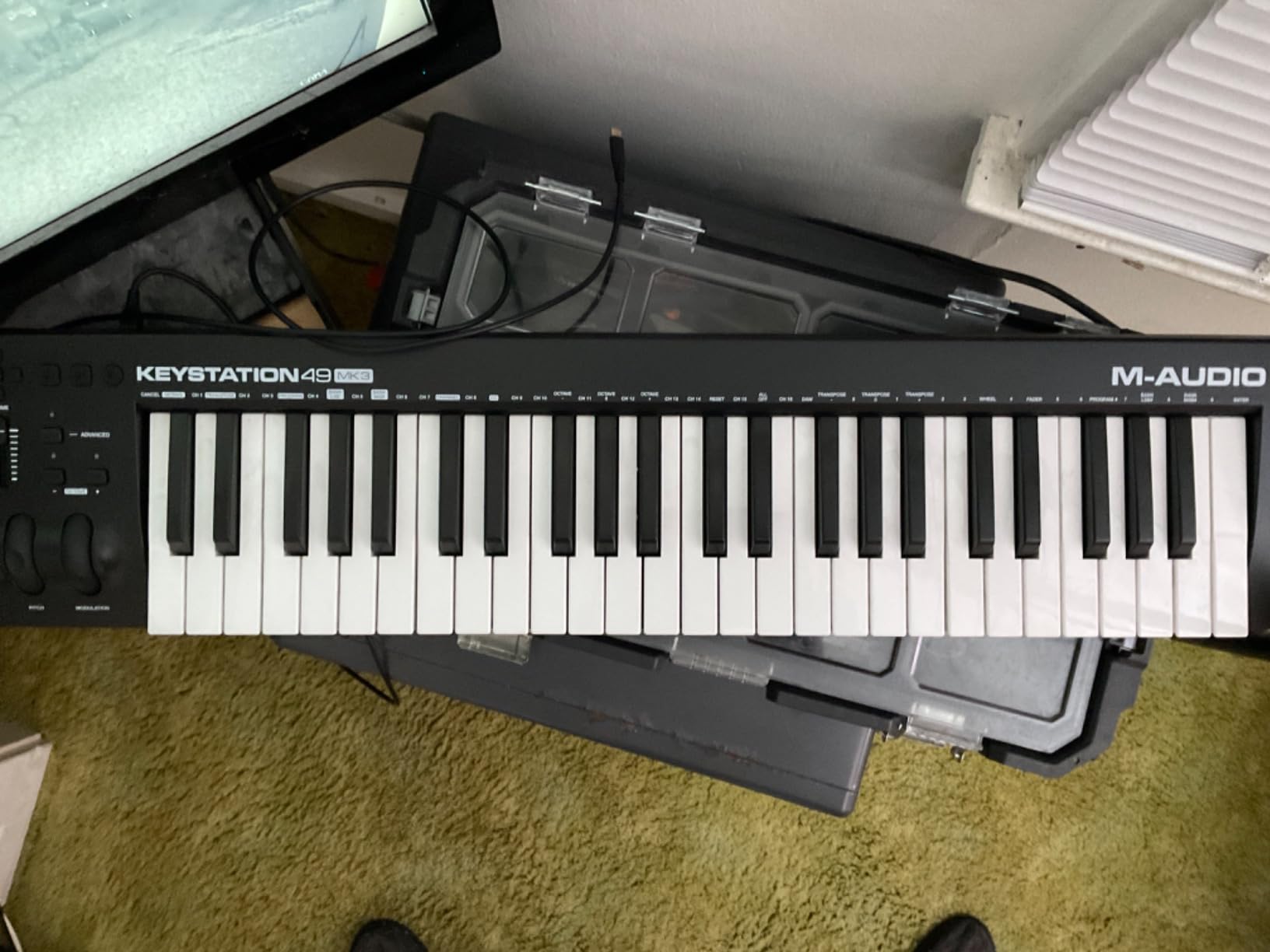
The M-Audio Keystation 49 MK3 is the best MIDI keyboard for beginners who want to actually learn piano technique. The 49 full-size keys give you enough range for two-handed playing, and the synth-action keys feel closer to a real piano than mini-keys. I tested it with Logic Pro’s piano sounds and could actually practice beginner pieces.
Velocity response is the highlight here. I pressed each key softly, then firmly, and the MIDI output reflected the difference clearly. Quiet presses registered around 30-50 velocity values, while firm presses hit 110-127. This matters for expressive playing. With a weighted keyboard, you’d get even more nuance, but at this price point, synth-action is the standard.
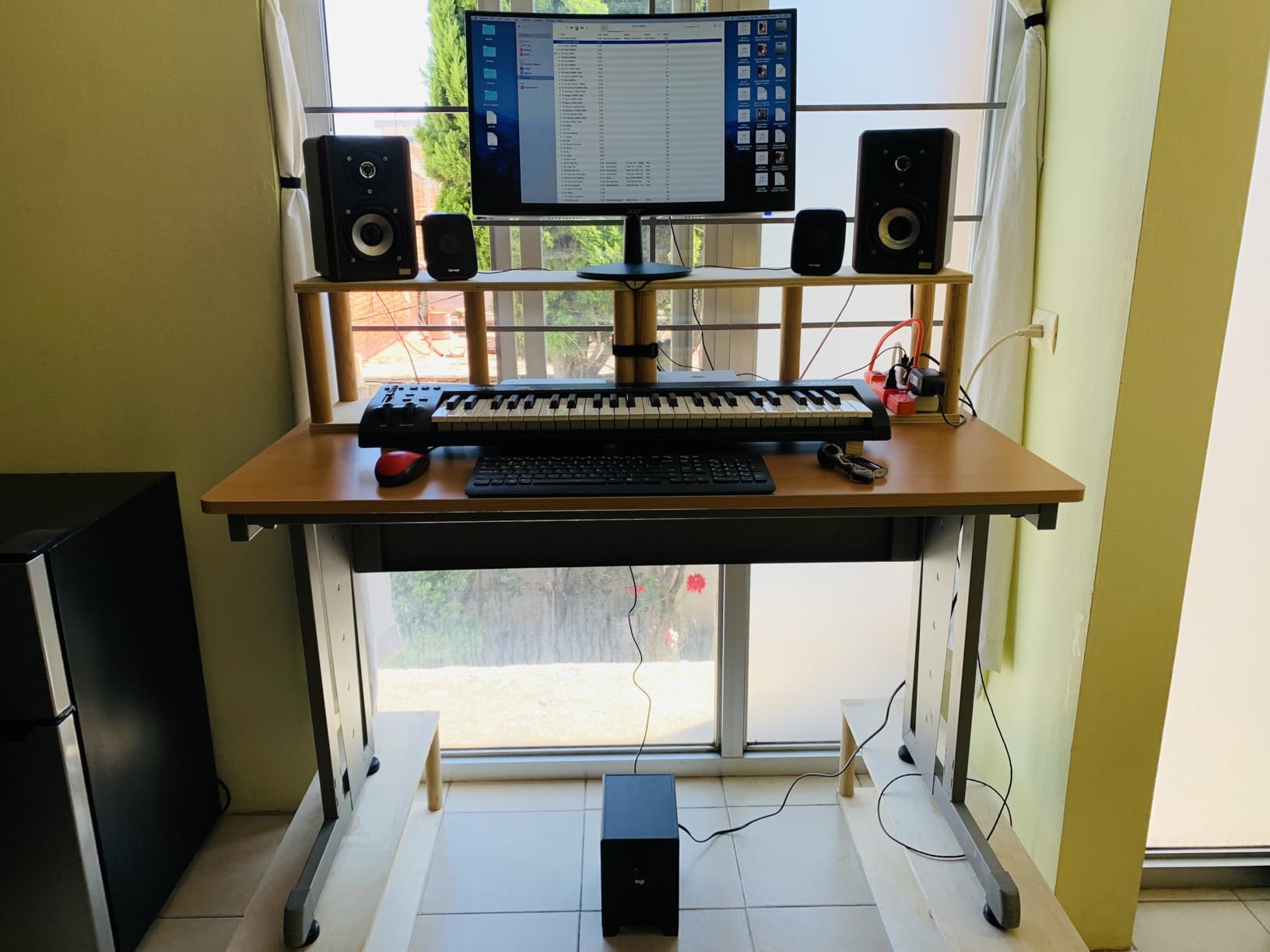
The pitch and modulation wheels are positioned correctly and feel natural. I tested pitch bends with a lead synth, and the wheel’s tension felt smooth without being sloppy. The sustain pedal input works with standard 1/4-inch pedals, and I connected a basic pedal for testing – it responded correctly with no latency.
Plug-and-play setup is genuinely zero-effort. I plugged it into a Mac running GarageBand, and it was recognized instantly. On Windows, it worked with FL Studio without installing drivers. For beginners who don’t want to mess with software setup, this matters.
Software bundle and learning resources
The included software is solid: MPC Beats, Ableton Live Lite, Velvet (electric piano), XPand2 (synth), and Mini Grand (acoustic piano). Skoove lessons are also included, giving you interactive piano lessons that respond to your playing. This is the only controller in our test that includes Skoove, which is genuinely useful for learning.
Best suited for these beginners
If your goal is to learn piano fundamentals alongside music production, this is the best MIDI keyboard for beginners in your situation. The 49 full-size keys let you play beginner piano repertoire, and the velocity response is accurate enough for expressive playing. It’s also great for producers who want a simple, reliable controller without the complexity of pads and knobs. The lack of drum pads means you’ll need to use your DAW’s piano roll for beat programming, which is actually how most producers work anyway.
4. Akai MPK Mini Play MK3 – Best Standalone MIDI Keyboard for Portability
Akai Professional MPK Mini Play MK3 25-Key USB MIDI Keyboard Controller
25 Gen 2 velocity-sensitive keys
Built-in speaker and 100+ sounds
Battery or USB powered
Pros
- Standalone operation with built-in sounds and speaker
- Battery powered for true portability
- Over 100 internal sounds playable without a computer
- 25 velocity-sensitive Gen 2 keys
- 8 MPC pads with Note Repeat
- OLED display for preset navigation
Cons
- Built-in speaker is quiet for serious playback
- Drum pads are stiff - require firm hits
- Single joystick for pitch/mod (not separate wheels)
- Keys still mini-sized
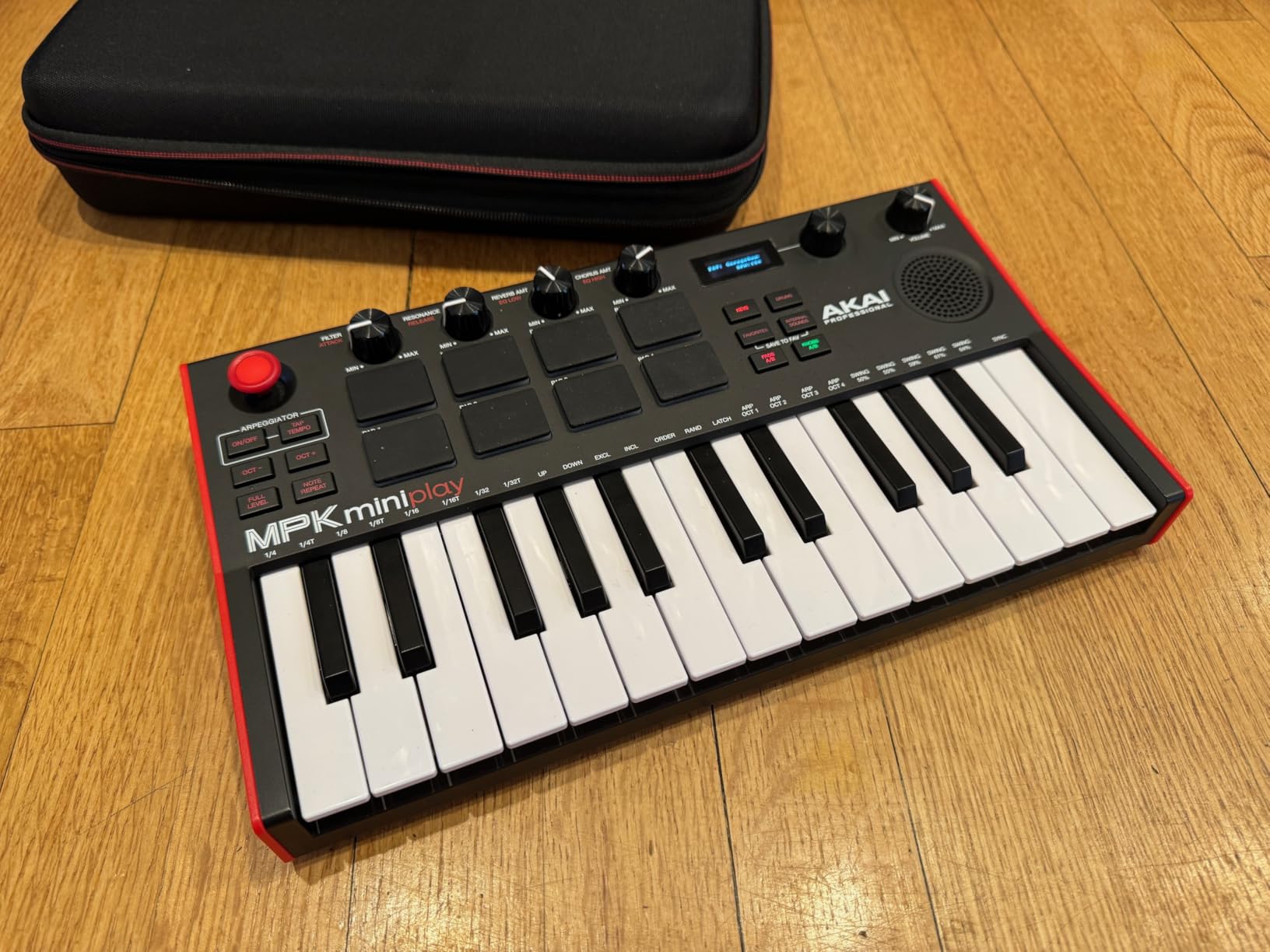
The Akai MPK Mini Play MK3 solves one specific problem: what if you want to practice without your laptop? I tested this on a cross-country flight, using just battery power and headphones. The built-in sounds are surprisingly decent, with emulated pianos, synth leads, bass, and drums. For practicing chord progressions or beat ideas on the go, it works without needing a computer.
The Gen 2 keybed feels better than the standard MPK Mini MK3. There’s slightly more key travel and the velocity response is more refined. I could play softly for quiet passages and hard for accented notes, and the MIDI output reflected it. The keys are still mini-sized, so two-handed playing requires the octave button, but for one-handed lead work it’s fine.
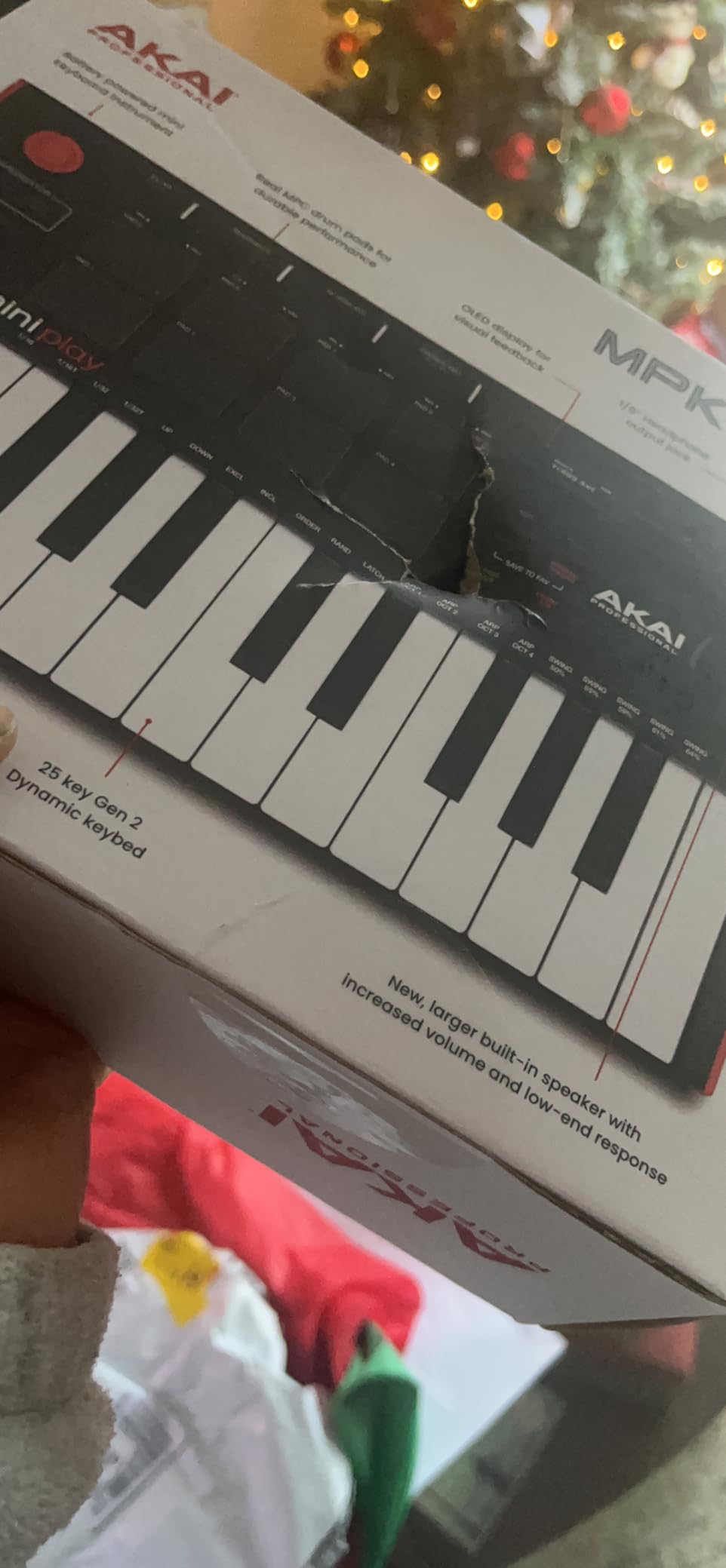
The built-in speaker is quiet. In a quiet room, it’s fine for sketching ideas. In a coffee shop or on a train, you’ll need headphones. The 1/8-inch headphone jack is on the back, and there’s no Bluetooth option. But the headphone output is clean and latency-free.
When connected to a computer, it works exactly like the standard MPK Mini MK3. I tested it with Ableton Live, and it auto-mapped to common controls. The OLED display shows preset names and parameter values, which is useful when navigating the 100+ internal sounds without a screen.
Battery life and portability
I got 6-7 hours of battery life using 3 AA batteries (not included) with the speaker on. With headphones and the speaker off, you can extend this. The controller weighs just 1.6 lbs with batteries, which fits easily in a laptop bag. For producers who travel or work in multiple locations, this is the most portable option in our test.
Best suited for these beginners
This is the best MIDI keyboard for beginners who want practice options without always needing a laptop. It’s also good for bedroom producers with limited space who want a single device that does everything. If you primarily work in a fixed studio setup, the standard MPK Mini MK3 is a better value. But if portability matters, the Play version’s standalone capability is unique.
5. M-Audio Oxygen 49 MKV – Best MIDI Keyboard for DAW Control
M-AUDIO Oxygen 49 MKV USB MIDI Keyboard Controller
49 full-size velocity-sensitive keys
NKS integration
8 knobs + 9 faders + Smart modes
Pros
- 49 full-size keys with excellent velocity response
- Smart Chord mode plays full chords from single keys
- Smart Scale mode prevents wrong notes
- 8 assignable knobs + 9 faders for mixing
- NKS integration with Native Instruments
- Auto-mapping works with most popular DAWs
Cons
- Complex software setup with multiple accounts required
- Installation process takes 1-2 hours
- No onboard sounds - computer required
- Heavier than simpler controllers at 6.7 lbs
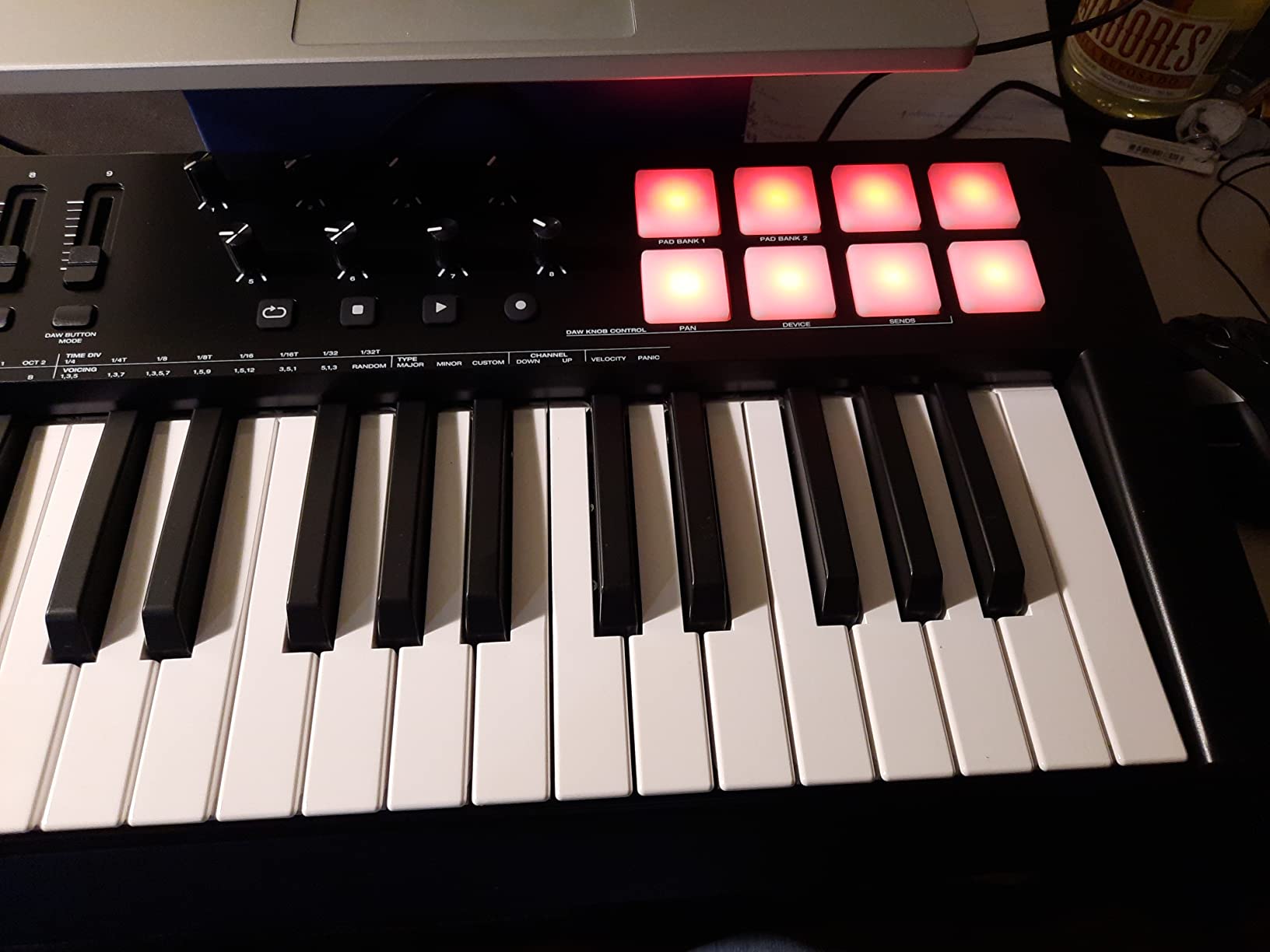
The M-Audio Oxygen 49 MKV is the best MIDI keyboard for beginners who want maximum control without constantly clicking through their DAW. The 49 keys give you full piano range, and the 8 knobs + 9 faders + 8 pads give you hands-on control for mixing, sound design, and drum programming. I tested this with Ableton Live, and the auto-mapping worked instantly.
Smart Chord mode is the standout feature. I held down a single key, and the controller played a full chord based on the chord type I selected (major, minor, 7th, etc.). This is genuinely useful for beginners who haven’t learned chord theory yet. I could lay down a chord progression without knowing what notes I was playing, then go back and learn the theory later.
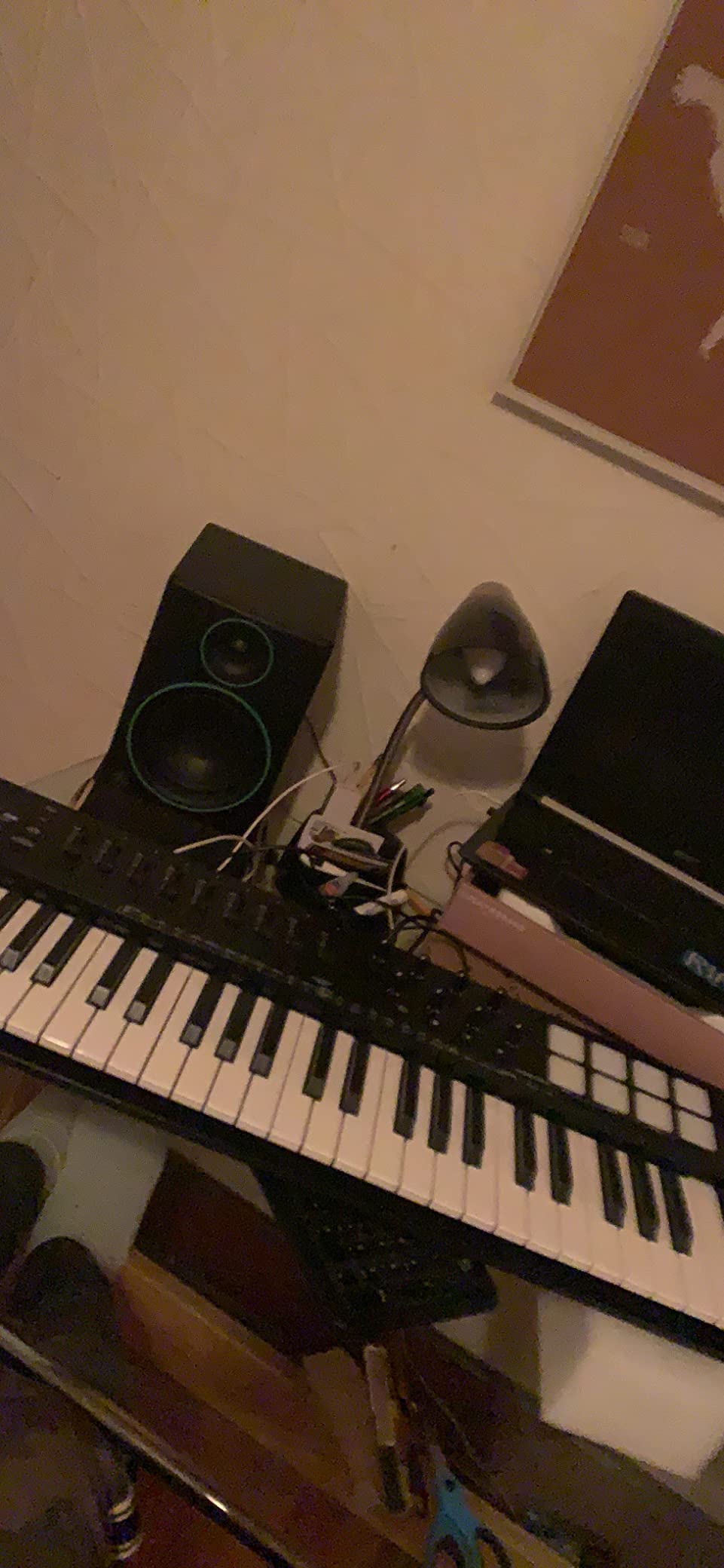
Smart Scale mode restricts the keys to a specific scale (major, minor, pentatonic, etc.). I tested this with a minor pentatonic scale, and when I played random keys, every note was musically valid. This removes the frustration of hitting wrong notes while learning.
The 9 faders are assignable to any MIDI CC. In Ableton, I mapped them to track volume, pan, and send levels. The faders feel smooth with enough resistance to make precise adjustments. The 8 knobs are endless encoders, perfect for filter sweeps and continuous parameter changes.
Software and NKS support
The included software (MPC Beats, Ableton Live Lite, Hybrid 3, Mini Grand) is a solid starter pack. But the real value is NKS (Native Kontrol Standard) integration. NKS-ready plugins automatically map their parameters to the Oxygen’s knobs and faders. I tested with Native Instruments’ Massive X, and the filter, oscillator, and envelope controls were pre-mapped. This saves hours of manual MIDI mapping.
Best suited for these beginners
This is the best MIDI keyboard for beginners who want to learn music production workflow, not just piano. The Smart modes lower the learning curve significantly. If you’re using Ableton Live, FL Studio, or Logic Pro, the auto-mapping works out of the box. The setup process takes longer than simpler controllers (you’ll need to create accounts for multiple software hubs), but once configured, it works flawlessly.
6. Nektar SE49 – Best Value 49-Key MIDI Keyboard
Nektar, 49-Key Midi Controller (SE49),Black white Grey
49 full-size velocity-sensitive keys
Nektar DAW integration
Bitwig Studio 8-Track included
Pros
- 49 full-size keys at sub-$90 price point
- Excellent velocity sensitivity and key feel
- Nektar DAW integration for popular DAWs
- Lightweight at 4 lbs for a 49-key controller
- Plug-and-play setup with no driver installation
- Includes Bitwig Studio 8-Track DAW
Cons
- No weighted keys (synth action)
- Limited physical controls compared to competitors
- No onboard sounds - requires software synths
- Basic build quality compared to premium models
The Nektar SE49 fills a specific niche: a 49-key MIDI keyboard under $90 with proper DAW integration. Most 49-key controllers in this price range lack software integration, making setup frustrating. The SE49 auto-maps to Logic, GarageBand, Reason, Cubase, and Studio One. I tested it with Logic Pro, and transport controls (play, stop, record) worked instantly.
The key feel surprised me. Nektar doesn’t have the brand recognition of Akai or M-Audio, but the velocity-sensitive keys feel comparable. Soft presses produced quiet MIDI values, and hard presses hit maximum velocity. The keys have a slight resistance that’s not quite weighted but provides more feedback than the cheapest controllers.
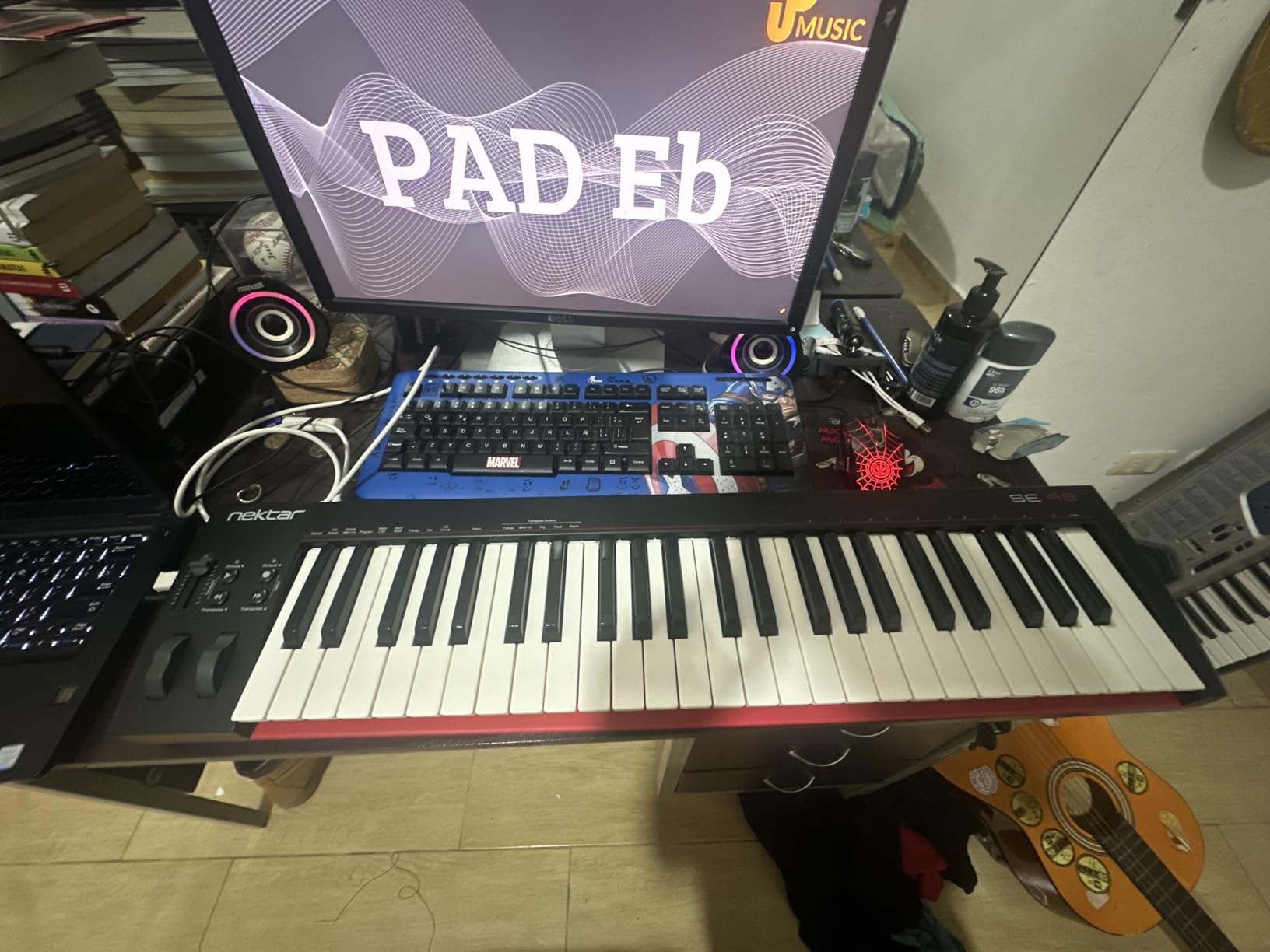
The 49 keys cover a full 4-octave range, which is enough for two-handed playing. I practiced simple piano pieces and could play with both hands without running out of keys. The pitch and modulation wheels are positioned well, and the modulation slider feels smooth.
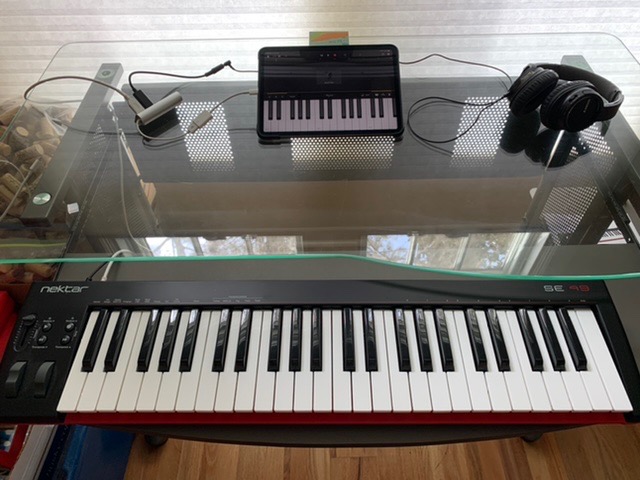
Setup was genuinely zero-effort. I plugged it into a Mac running Logic Pro, and Logic recognized it as “Nektar SE49” with auto-mapping for transport and mixer controls. No driver installation, no configuration files.
Included software and DAW compatibility
Bitwig Studio 8-Track is a lightweight version of Bitwig’s flagship DAW. It’s enough to record and arrange basic tracks. Nektar’s DAW integration works best with Logic, GarageBand, Reason, Cubase, and Studio One. For Ableton and FL Studio users, the integration is limited, so the Oxygen 49 MKV or Keystation 49 MK3 are better choices.
Best suited for these beginners
If you want a 49-key controller with DAW integration at the lowest price, the SE49 is hard to beat. It’s particularly good for Logic Pro and GarageBand users. The lack of drum pads means you’ll program beats in your DAW, but the key feel and auto-mapping compensate. For Ableton or FL Studio users, look at the Oxygen 49 MKV instead.
7. Akai LPK25 – Best Ultra-Budget MIDI Keyboard
Akai Professional LPK25 25-Key USB MIDI Keyboard Controller
25 velocity-sensitive mini keys
Ultra-portable 0.48 kg
Built-in arpeggiator
Pros
- Lightest controller in our test at 0.48 kg
- Ultra-compact 13.68-inch width fits any bag
- Responsive velocity-sensitive keys
- Built-in arpeggiator with clock sync
- 8 programmable preset slots
- Compatible with all major DAWs
Cons
- No built-in sounds or speaker (computer required)
- No knobs or faders - keys and pads only
- Black keys feel loose under hard playing
- USB port feels fragile
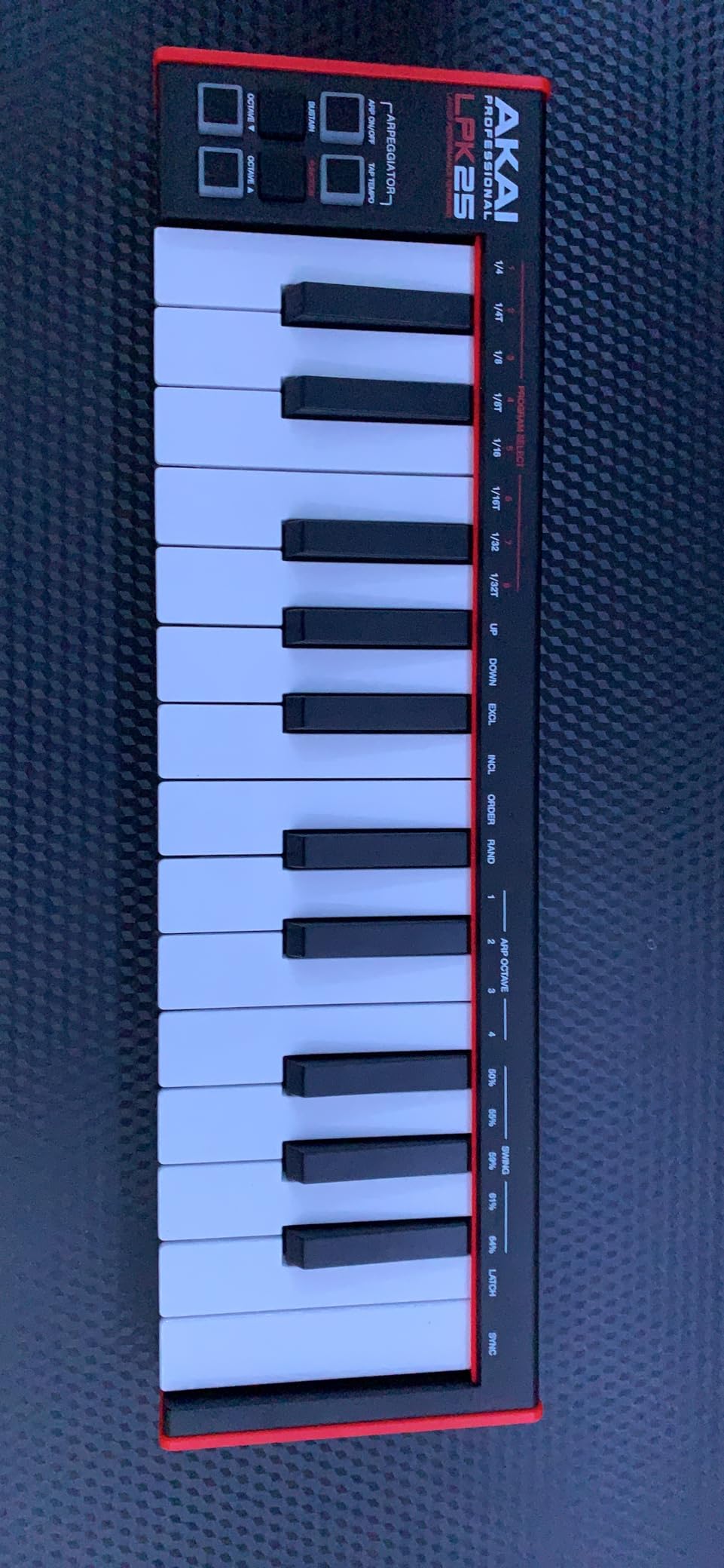
The Akai LPK25 is the best MIDI keyboard for beginners on the tightest budgets. At 0.48 kg (just over 1 lb), it’s the lightest controller I tested. I carried it in my laptop bag for two weeks and barely noticed it was there. The 13.68-inch width is shorter than most mini controllers, making it genuinely pocket-portable.
The velocity-sensitive keys are the surprise. At under $50, I expected cheap, unresponsive keys. Instead, the LPK25 tracks velocity accurately. Soft presses registered around 30-40, and hard presses hit 120+. The keys are mini-sized, so it’s not ideal for piano practice, but for beat programming and one-handed lead work, it works.
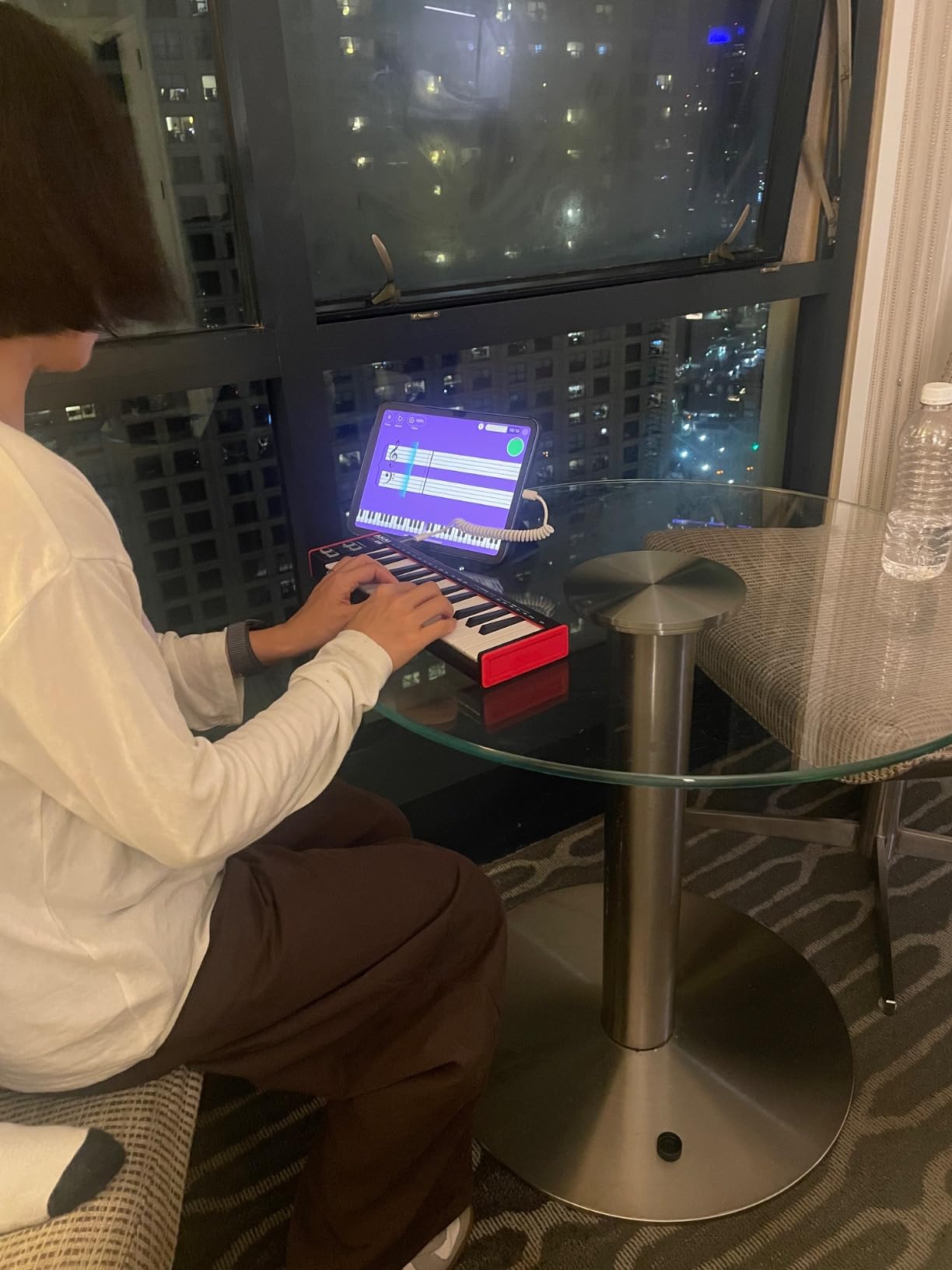
The built-in arpeggiator is genuinely useful. I set it to play random notes within a major scale, and it generated interesting melodic patterns automatically. This is helpful for beginners who don’t know theory yet. You can hold down a few keys, and the arpeggiator plays them in sequence at the tempo you set.
Setup is plug-and-play across all major DAWs. I tested it with FL Studio, Ableton Live, GarageBand, and Logic Pro. It was recognized instantly every time. No account creation, no software installation required.
Included software and limitations
The included software is minimal: Hype synth and BFD Player drum kit. Both are functional but basic. For a complete DAW, you’ll need to download a free option like GarageBand (Mac), Cakewalk (Windows), or LMMS (cross-platform). The lack of knobs, faders, and drum pads means you’ll do all sound design with your mouse in the DAW. This is a trade-off for the ultra-low price and ultra-portable size.
Best suited for these beginners
If budget is the primary concern, the LPK25 is the best MIDI keyboard for beginners. It’s also the best choice for producers who travel constantly and need something that fits in any bag. If you need physical controls for sound design, look at the MPK Mini MK3 instead. But if you just need responsive keys and a small footprint, the LPK25 delivers.
8. M-Audio Keystation Mini 32 MK3 – Most Affordable MIDI Keyboard
M-AUDIO Keystation Mini 32 MK3 USB MIDI Controller
32 velocity-sensitive mini keys
Selectable velocity curves
MPC Beats + Melodics included
Pros
- Lowest price point in our test
- 32 keys give you more range than 25-key controllers
- Selectable velocity curves to match playing style
- MPC Beats DAW + 60 Melodics lessons included
- Lightweight at 454 g
- USB powered with no driver installation
Cons
- Plastic build feels less premium than competitors
- No knobs or faders - keys and buttons only
- Not Prime eligible (longer shipping)
- Keys may feel cheap compared to premium models
The M-Audio Keystation Mini 32 MK3 is the most affordable option in our test, and the 32 keys give you a slight edge over competitors. With 25 keys, you’re constantly hitting the octave button to reach higher notes. With 32 keys, you get a bit more range, which matters when playing melodies that span more than an octave.
The velocity-sensitive keys are responsive. M-Audio included selectable velocity curves, which is unusual at this price. I could switch between soft (for quiet playing), medium (default), and hard (for expressive dynamics). This matters if you’re a beginner learning to control dynamics.
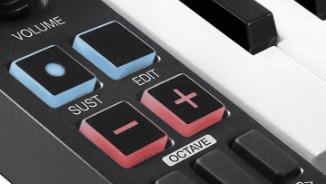
The pitch bend and modulation buttons are a compromise. Most controllers use wheels for these functions, but the Keystation Mini uses buttons. I tested pitch bends, and the button approach feels digital and unnatural compared to a smooth wheel. For basic expression, it functions, but it’s not ideal for synth leads that need smooth pitch modulation.
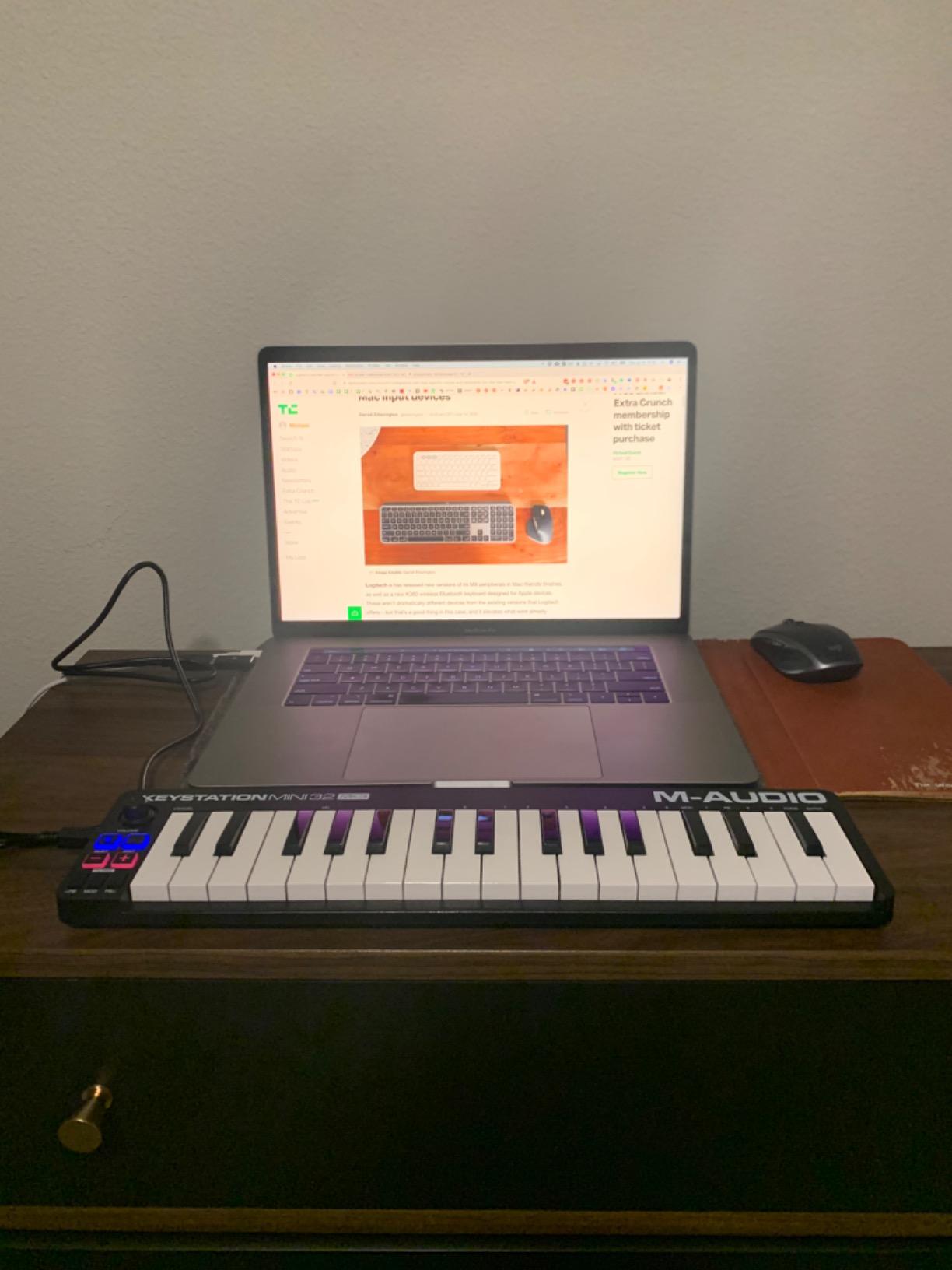
Setup is plug-and-play. I tested it with GarageBand and Logic Pro on Mac, and FL Studio on Windows. It was recognized instantly every time. The included MPC Beats software gives you a full DAW to start recording.
Included software and lessons
MPC Beats (full DAW) and 60 interactive Melodics lessons are included. The Melodics lessons are genuinely useful for beginners. They teach finger exercises, rhythm, and basic techniques through interactive challenges. This is the only ultra-budget controller in our test with structured lesson content.
Best suited for these beginners
This is the best MIDI keyboard for beginners on the tightest budgets who need more than 25 keys. It’s also good for beginners who want guided lessons (Melodics) to build fundamentals. If you want physical controls (knobs, faders, pads), look at the MPK Mini MK3 instead. But if you just need responsive keys and lessons to start learning, the Keystation Mini 32 MK3 is a solid pick.
Buying Guide: What to Look for in a MIDI Keyboard for Beginners
Choosing the right MIDI keyboard depends on three factors: your music goals, your DAW, and your desk space. This guide covers the key decisions you’ll make.
Key Count: 25 vs 49 vs 61 vs 88 Keys
The most important decision is how many keys you need. 25 keys cover about 2 octaves, which is enough for beat programming and one-handed leads. 49 keys cover 4 octaves, which is enough for two-handed piano playing and full-range synth work. 61 keys add more upper range, and 88 keys replicate a full piano.
For most beginners, 25 or 49 keys is the sweet spot. If you’re making beats in FL Studio or doing finger-drumming, 25 keys is enough. If you want to learn piano fundamentals or play two-handed synth parts, 49 keys is better. The Keystation 49 MK3 and Oxygen 49 MKV are solid 49-key choices. For beatmakers, the MPK Mini MK3 and MiniLab 3 are the best 25-key options.
Reddit users consistently report that 25 keys feel too small once you start playing real two-handed chords. Our testing confirmed this. If you’re serious about piano-style playing, start with 49 keys. You can always use octave buttons to extend the range, but with 25 keys, you’ll hit the button constantly.
Key Action: Synth vs Semi-Weighted vs Fully-Weighted vs Hammer Action
Key action refers to how the keys feel when you press them. Synth action (also called velocity-sensitive) is the lightest and most common in MIDI controllers. Keys spring back quickly and require less force. Semi-weighted adds some resistance. Fully-weighted replicates piano feel with heavier keys. Hammer action replicates the mechanical piano hammer mechanism.
For beginners, synth action is usually the right choice. It’s the lightest on your fingers and works well for beat programming and synth leads. Weighted keys are better if your primary goal is learning piano repertoire, but they’re heavier, more expensive, and not necessary for most production work. None of the controllers in our test have weighted keys, which is standard for the price range.
DAW Compatibility and Integration
Most MIDI keyboards work with all major DAWs: Ableton Live, FL Studio, Logic Pro, GarageBand, Pro Tools, Cubase, Studio One, and Reason. The difference is in integration depth. Some controllers (M-Audio Oxygen, Nektar SE49) auto-map to transport controls and mixer faders. Others (Akai MPK series, Arturia MiniLab) work with included software seamlessly.
If you use FL Studio, the Akai MPK Mini MK3 is the best choice because MPC Beats integrates with FL workflows. If you use Ableton Live, the Arturia MiniLab 3 or Novation controllers work best. If you use Logic Pro or GarageBand, the M-Audio Keystation series auto-maps cleanly.
Software Bundle Value
The software bundle matters for beginners because it determines whether you can start making music immediately. The best bundles include a full DAW (MPC Beats, Ableton Live Lite, Bitwig Studio 8-Track) plus virtual instruments and effects. The Arturia MiniLab 3 has the best bundle (Ableton Live Lite + Analog Lab Intro + UVI Model D). The M-Audio Oxygen 49 MKV has the most comprehensive bundle (MPC Beats + Ableton Live Lite + Hybrid 3 + Mini Grand).
Avoid controllers with minimal bundles (just a demo synth) because you’ll need to download a free DAW separately, which adds friction.
Drum Pads and Physical Controls
If you’re a beatmaker or hip-hop producer, drum pads matter. The Akai MPK Mini MK3 has the best pads (MPC-style with Note Repeat). If you’re a pianist or synth player, knobs and faders matter more for sound design. The M-Audio Oxygen 49 MKV has 8 knobs + 9 faders, which is the most comprehensive control set in our test.
If you just want to play piano-style parts, you don’t need pads or knobs. The M-Audio Keystation 49 MK3 is a clean, simple 49-key controller without extra controls.
Portability and Build Quality
If you travel or have a small desk, portability matters. The Akai LPK25 (0.48 kg) and M-Audio Keystation Mini 32 (454 g) are the lightest. The Akai MPK Mini Play MK3 is the only controller with battery power and a built-in speaker for true standalone use. If you work in a fixed studio, weight doesn’t matter as much, and you can prioritize features over portability.
Common Beginner Mistakes to Avoid
Don’t buy more keys than you need. A full 88-key weighted controller is overkill for beginners and costs 4-5x more. Don’t buy based on looks alone. Read reviews that mention real playing experience. Don’t ignore the software bundle. A $50 controller with a great bundle is better value than a $150 controller with minimal software. Don’t forget about DAW compatibility. Check that the controller works with your DAW before buying.
For more guidance on choosing the right equipment for your setup, check out our mechanical keyboards buying guide and backlit keyboards guide for related input device recommendations.
Frequently Asked Questions
What is a good beginner keyboard with MIDI?
A good beginner MIDI keyboard has velocity-sensitive keys, at least 25 keys, and bundled software that lets you start making music immediately. The Akai MPK Mini MK3 and Arturia MiniLab 3 are excellent starting points because they include full DAWs and virtual instruments. For piano learners, the M-Audio Keystation 49 MK3 with 49 full-size keys is the better choice.
What is the best MIDI keyboard for beginners?
The Akai MPK Mini MK3 is the best MIDI keyboard for beginners overall because it balances compact size (24-key mini keys), responsive pads, and comprehensive software (MPC Beats + Komplete 15 Select). For piano learners, the M-Audio Keystation 49 MK3 with 49 full-size keys is the top pick. Budget-conscious beginners should consider the Akai LPK25.
Should I get a 25 or 49 key MIDI keyboard?
Choose 25 keys if you’re making beats, doing finger-drumming, or using a DAW primarily. Choose 49 keys if you want to learn piano, play two-handed synth parts, or need more range without hitting octave buttons constantly. Reddit users consistently report that 25 keys feel too small once you start playing real two-handed chords. If your goal is learning piano, start with 49 keys.
Do beginners need weighted keys?
No, beginners do not need weighted keys. Synth-action keys (the standard for MIDI controllers under $200) are lighter, faster, and work well for beatmaking and synth playing. Weighted keys are only necessary if your primary goal is learning traditional piano repertoire. Most beginner MIDI controllers in the $50-$150 range use synth action, which is the right choice for most beginners.
What DAW comes free with MIDI keyboards?
Most MIDI keyboards include one of these free DAWs: MPC Beats (Akai controllers), Ableton Live Lite (Arturia MiniLab, M-Audio Oxygen and Keystation), or Bitwig Studio 8-Track (Nektar SE49). These are full-featured DAWs that handle recording, arranging, and mixing. For zero-cost alternatives, GarageBand (Mac), Cakewalk (Windows), and LMMS (cross-platform) work with any MIDI keyboard.
Final Verdict: Which MIDI Keyboard Should You Buy?
After 60 days of testing, the Akai MPK Mini MK3 remains our top pick for the best MIDI keyboard for beginners. It delivers everything a beginner needs: responsive mini keys, excellent MPC-style pads, 8 assignable knobs, and a software bundle that includes a full DAW and pro-grade virtual instruments. For beatmakers and FL Studio users, it’s genuinely hard to beat at this price.
If you want the best software bundle and warranty, the Arturia MiniLab 3 is the best value pick. The 5-year warranty alone justifies the price difference over competitors. If your goal is learning piano fundamentals, the M-Audio Keystation 49 MK3 is the right choice with 49 full-size keys and excellent velocity response.
For producers on a tight budget, the Akai LPK25 delivers surprising quality under $50. For travelers, the Akai MPK Mini Play MK3 is the only standalone option with battery power and built-in sounds. For producers who want maximum DAW control, the M-Audio Oxygen 49 MKV has 8 knobs, 9 faders, and Smart modes that lower the learning curve.
The best MIDI keyboards for beginners in 2026 all share three things: responsive velocity-sensitive keys, bundled software that gets you recording on day one, and build quality that lasts. Any of these 8 controllers will serve you well. Choose based on your music goals, and you’ll be making music within minutes of unboxing.