
Short answer first: a 2x Barlow is the best starting point for planetary viewing, a 3x pays off when your seeing is steady and your scope is short on focal length, and a 5x only makes sense on a fast f/4 to f/5 rig. A Barlow multiplies your telescope’s effective focal length, so the eyepiece you already own delivers two, three or five times the power with a narrower field and no glass swap.
That matters because most people who ask about the best barlow lenses for planetary viewing already own a telescope and a set of eyepieces that top out too low. Jupiter is a bright target that rewards magnification, and Saturn needs enough power before the rings separate from the planet’s edge. A Barlow is the cheapest way to get there without buying a second telescope.
I compared all twelve units in this roundup on the things that actually decide whether a planet looks sharp: element count, coating quality, barrel fit, and whether the resulting magnification lands inside the useful range for your aperture. I also cross-checked owner reports on forums, where the same complaints come up repeatedly. If your telescope is new, our guide to the best telescopes for viewing planets is worth reading before you decide what power to chase.
Top 3 Picks for Planetary Viewing in 2026
Best Barlow Lenses for Planetary Viewing at a Glance
| Product | Specifications | Action |
|---|---|---|
 Celestron Omni 2X Celestron Omni 2X |
|
Check Latest Price |
 Celestron X-Cel LX 3X Celestron X-Cel LX 3X |
|
Check Latest Price |
 Bysameyee 2X Barlow Bysameyee 2X Barlow |
|
Check Latest Price |
 SVBONY 5X Barlow SVBONY 5X Barlow |
|
Check Latest Price |
 Celestron Luminos 2.5X Celestron Luminos 2.5X |
|
Check Latest Price |
 starboosa 5X Kit with Moon Filter starboosa 5X Kit with Moon Filter |
|
Check Latest Price |
 Serounder 3X Barlow Serounder 3X Barlow |
|
Check Latest Price |
 Astromania 3X Barlow Astromania 3X Barlow |
|
Check Latest Price |
 XCCYG 2X-3X-5X Kit XCCYG 2X-3X-5X Kit |
|
Check Latest Price |
 Astromania 2X ED 2 Inch Astromania 2X ED 2 Inch |
|
Check Latest Price |
 Explore Scientific Focal Extender Explore Scientific Focal Extender |
|
Check Latest Price |
 Pocnsen 5X Barlow Pocnsen 5X Barlow |
|
Check Latest Price |
1. Celestron Omni 2X Barlow Lens – Our Best Overall Pick for Planets
Celestron Omni 1.25″ 2X Barlow Lens for Telescope Eyepieces Threaded Barrel
2X power
Fully multi-coated
1.25 inch barrel
0.08 kg
Pros
- Doubles power on every 1.25 inch eyepiece you own
- Sharp high-contrast views on Jupiter and Saturn
- Fully multi-coated optics with blackened edges
- Unthreads for DSLR use with a T-ring
Cons
- Entry-level glass compared with premium apochromats
- High power amplifies mount vibration and drift
- Added weight can upset balance on small mounts
The Omni 2X is the first Barlow I reach for, and it is the one I recommend to almost everyone who asks. It carries a 4.6 rating across 2487 reviews, which makes it the most thoroughly tested unit in this group by a wide margin. In practice it simply works on a 1.25 inch focuser and adds a clean doubling of power to whatever eyepiece you drop into it.
Owners report sharp, high-contrast images of Jupiter, Saturn and the Moon, and the optics are fully multi-coated with blackened edges to suppress reflections. The listed exit pupil of 12.5 millimeters and a 46 degree field of view sit comfortably in the range where a doubled eyepiece still behaves well.
One feature most people miss: the lower element can be unscrewed, and the remaining barrel works as a T-ring style adapter for a DSLR. That turns a visual accessory into an imaging tool without buying another part. The stated dimensions of 2.91 by 1.55 by 1.55 inches and a weight of 0.08 kg keep it small enough for a tabletop Dobsonian.
The catch is that this is an entry-level optic. Observers pushing toward serious planetary imaging eventually move to higher-grade glass, and the glass is not specified as apochromatic here. Mount steadiness also becomes obvious fast, because doubling power makes every wobble five times more visible. Balance matters too, particularly on a light mount.
How much power does it give a typical telescope?
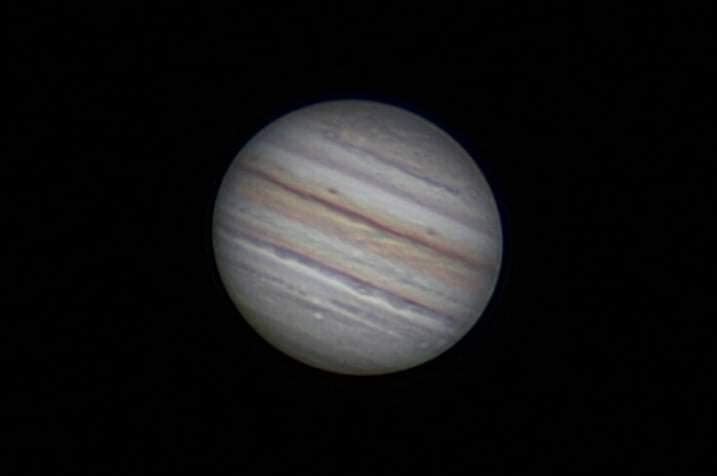
On a 1000 mm focal length refractor, a 10mm eyepiece gives 100x on its own and about 200x through this Barlow. That lands in the range where Jupiter’s belts and the Cassini division on Saturn start to resolve on a steady night.
Because it is only 2x, it stays inside the useful magnification ceiling of almost any scope, including long f/10 instruments where a 3x or 5x would go past what the optics and the atmosphere can support.
Is it worth replacing a bundled plastic Barlow?
Yes, without hesitation. The single plastic element shipped with many beginner telescopes is the most regretted accessory in this whole category, adding colour fringing and a soft image exactly where planetary observing needs contrast.
Forum regulars on Cloudy Nights and r/telescopes repeat the same advice: skip the stock unit, and pick a real multi-coated optic with a brass or solid clamp. This one satisfies both conditions and has the review volume to back the claim.
2. Celestron X-Cel LX 3X Barlow Lens – Best Color-Corrected Power for Jupiter
Celestron X-Cel LX 3X 1.25 Barlow Lens for Telescope Eyepieces – Threaded
3X power
3-element apochromat
25 mm objective
Brass ring
Pros
- Three-element apochromatic optics stay bright and colour-correct
- Brass compression ring protects the eyepiece barrel
- Threaded body accepts 1.25 inch filters
- Centralised rubber grip works with cold hands
Cons
- Priced above generic 3X units in the same class
- 3X still needs a steady mount and aligned finder
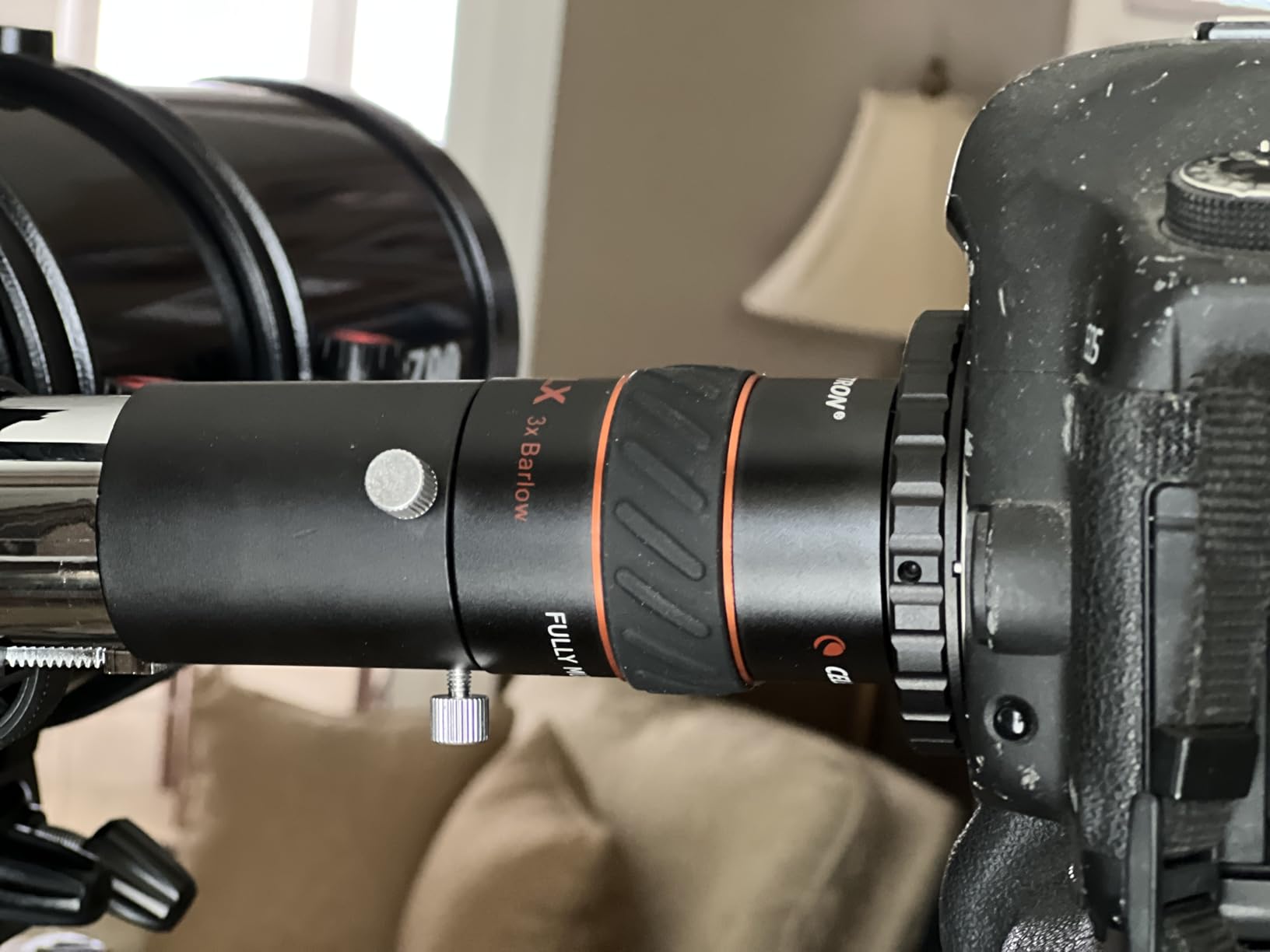
The X-Cel LX 3X is the highest rated option in this roundup, sitting at 4.7 across 1046 reviews. It is the one I recommend when the goal is Jupiter’s cloud bands and colour matters, because the 3-element apochromatic design corrects the fringing that cheap doublets show on bright planets.
Every air-to-glass surface is multi-coated, and the 25 millimeter objective is large enough that a 3x unit does not choke the light path. Reviewers describe a clear step up in sharpness and contrast from entry achromats, and they frequently pair it with flat-field eyepieces for planetary detail.
Handling is the quiet strength here. The brass compression ring holds the eyepiece without scratching the barrel, and a non-slip grip ring sits around the barrel so cold hands or gloves still get a hold. It carries a two-year warranty and weighs 0.15 kg.
The threaded body accepts standard 1.25 inch telescope filters directly, which is useful for lunar work and for dimming a bright target without stacking extra adapters. A 3x still demands a well-balanced mount and a properly aligned finder; at high power a misaligned finder is frustrating fast.
When does 3x beat 2x on the planets?
Three power is worth it on short focal length instruments where the telescope has focal length to spare. On a 600 mm refractor or a short-tube Dobsonian, tripling a 10mm eyepiece moves you from a low-power moon view to a genuine planetary view.
On a long f/10 Schmidt-Cassegrain, the same 3x usually pushes past the useful limit, and the image dims and softens. Check your focal ratio before committing to this power level.
Is the brass ring worth paying more for?
Yes. The ring is the difference between an eyepiece that stays scratch-free after a year of sessions and one that does not. It also stops the eyepiece shifting during a long planetary observation, which is when you least want to lose the target.
The counterpoint is price. Several generic 3x units deliver similar magnification for far less, and on a small aperture scope the difference in glass quality can be hard to see. The gap widens on larger instruments.
3. Bysameyee 2X Metal Barlow Lens – Best Value Doubler with a Camera Thread
Barlow Lens 2X, Bysameyee 1.25 Inch Fully Multi-Coated Metal Barlow Lens with M42 Thread Camera Connect Interface for Telescope Eyepiece
2X power
M42 T-thread
Multilayer green film
Brass ring
Pros
- Metal body with brass ring that will not mar eyepieces
- Clear views of Jupiter belts and Saturn rings
- Multilayer broadband green film glass
- Two dust covers included
Cons
- Occasional reports of spotting or residue on arrival
- T-ring adapter sold separately
- Modest power for very small light-grabbing scopes
The Bysameyee 2X is the value pick here, holding a 4.6 rating across 1071 reviews. For anyone with a tabletop or small Dobsonian who wants Jupiter noticeably bigger without spending much, it delivers the most useful result per unit of money in this list.
Reviewers frequently describe it as the best value add-on for small scopes, saying the doubling made Jupiter’s apparent size jump and made Saturn’s ring identifiable on a first night. Construction is aluminium stock with a black anodized body, precision machined, using multilayer HD broadband green film glass that is chromatically corrected.
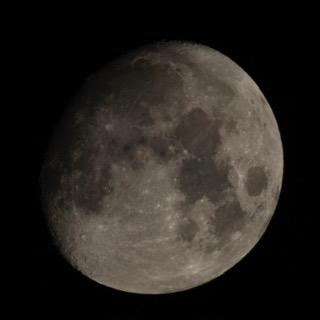
The M42x0.75 mm male thread is a genuine bonus for planetary imaging with a fast camera. You remove the eyepiece, add a T-ring and the Barlow becomes a rigid focal extender in front of the sensor. Keep in mind the T-ring itself is not included. Dimensions are listed at 1 by 1 by 3 inches.
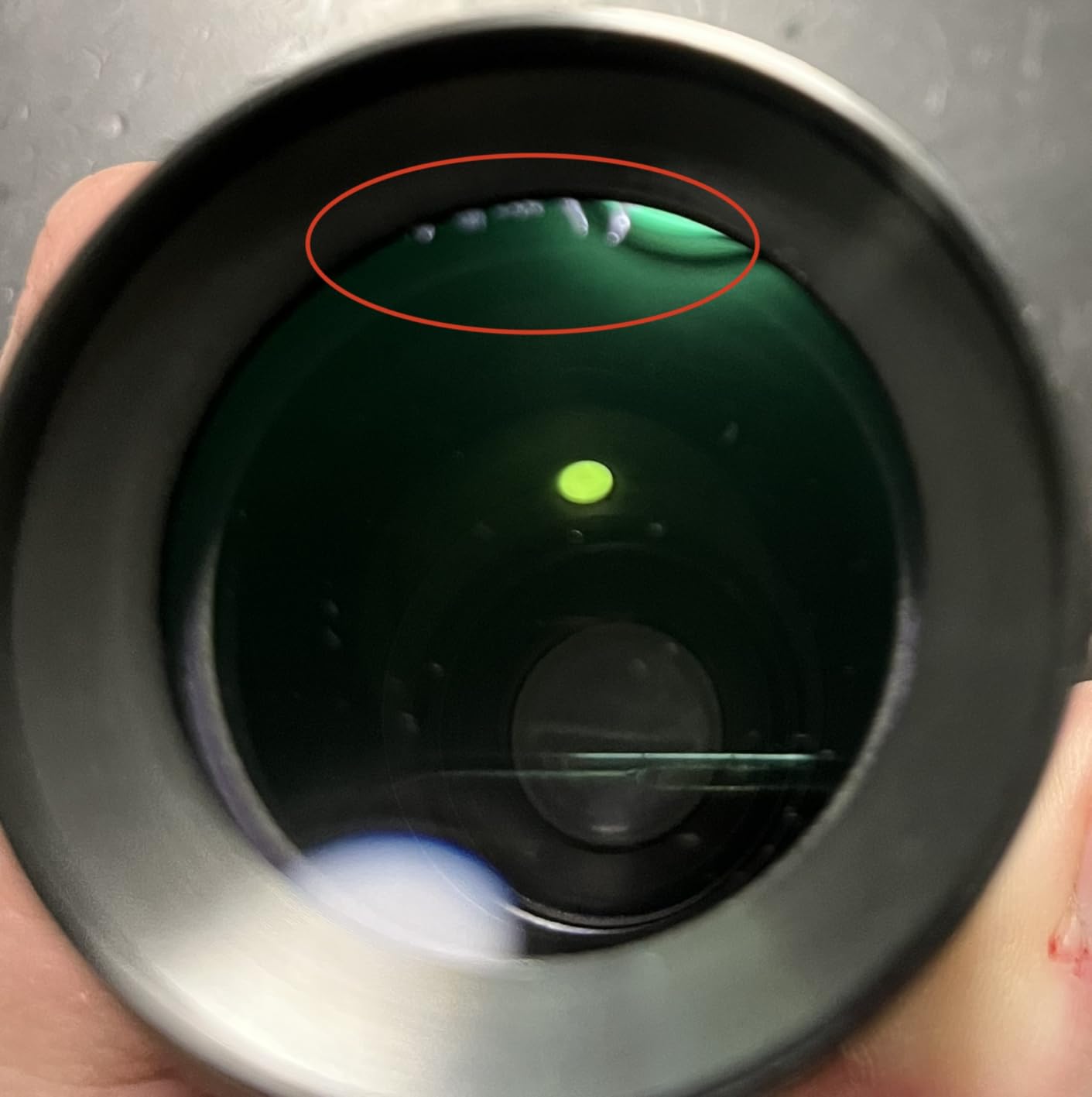
The main complaint is a minority of buyers who received units with spotting or residue on the lens surface that blurred the view until cleaned. A brass compression ring and safety undercut protect the eyepiece barrels, and dust covers at both ends help keep the optics clear in storage.
Does a 2x actually make a difference on small scopes?
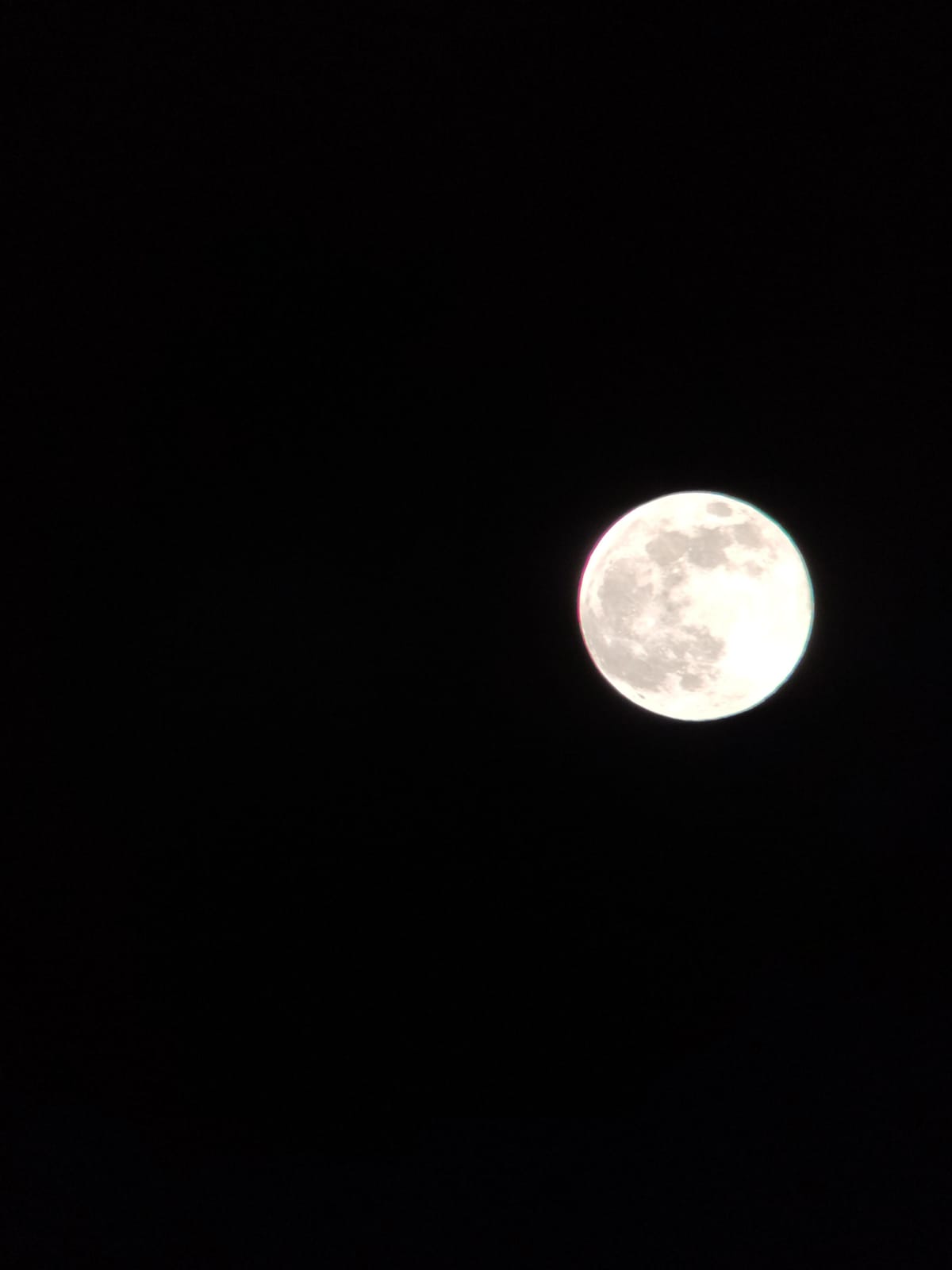
Yes, more than people expect. Apparent size scales directly with magnification, so a 2x doubles the angular size of Jupiter in the eyepiece, which is often the difference between a disc and a disc with visible banding.
On a 70 to 100 mm scope the doubled image is easier to hold steady and easier to focus than a 3x or 5x would be, so the modest power is a feature in this case rather than a limitation.
Can it be used for planetary imaging?
It can, thanks to the M42 thread. Pair it with a T-ring and a high-frame-rate camera, and the doubling gives the sensor the focal length it needs to fill a frame with a small planet or a lunar section.
Buyers using it this way report the same crisp results they get visually. The trade-off is that the included hardware stops at the thread, so budget for the T-ring and a spacing solution before the first imaging night.
4. SVBONY 5X Barlow Lens – Best for Short Focal Length Telescopes
SVBONY Telescope Barlow Lens, 5X FMC Barlow Lens, 1.25” Telescope Accessory
5X power
135 g weight
31.7 mm tube
Multi-coated glass
Pros
- Huge power increase for a short focal length scope
- Jupiter and its moons become clearly larger
- Blackened housing preserves contrast
- Attaches easily to 1.25 inch focusers
Cons
- Long and heavy for a 5X unit and can unbalance a small scope
- Can exceed the useful magnification and soften the image
- Some dispute the advertised power and element count
The SVBONY 5X is the specialist choice for people with focal length to spare and an aperture too small to use it. Owners of short focal length reflectors report dramatic increases in apparent planet size, with Jupiter, its moons, Saturn and lunar detail all becoming clearly larger.
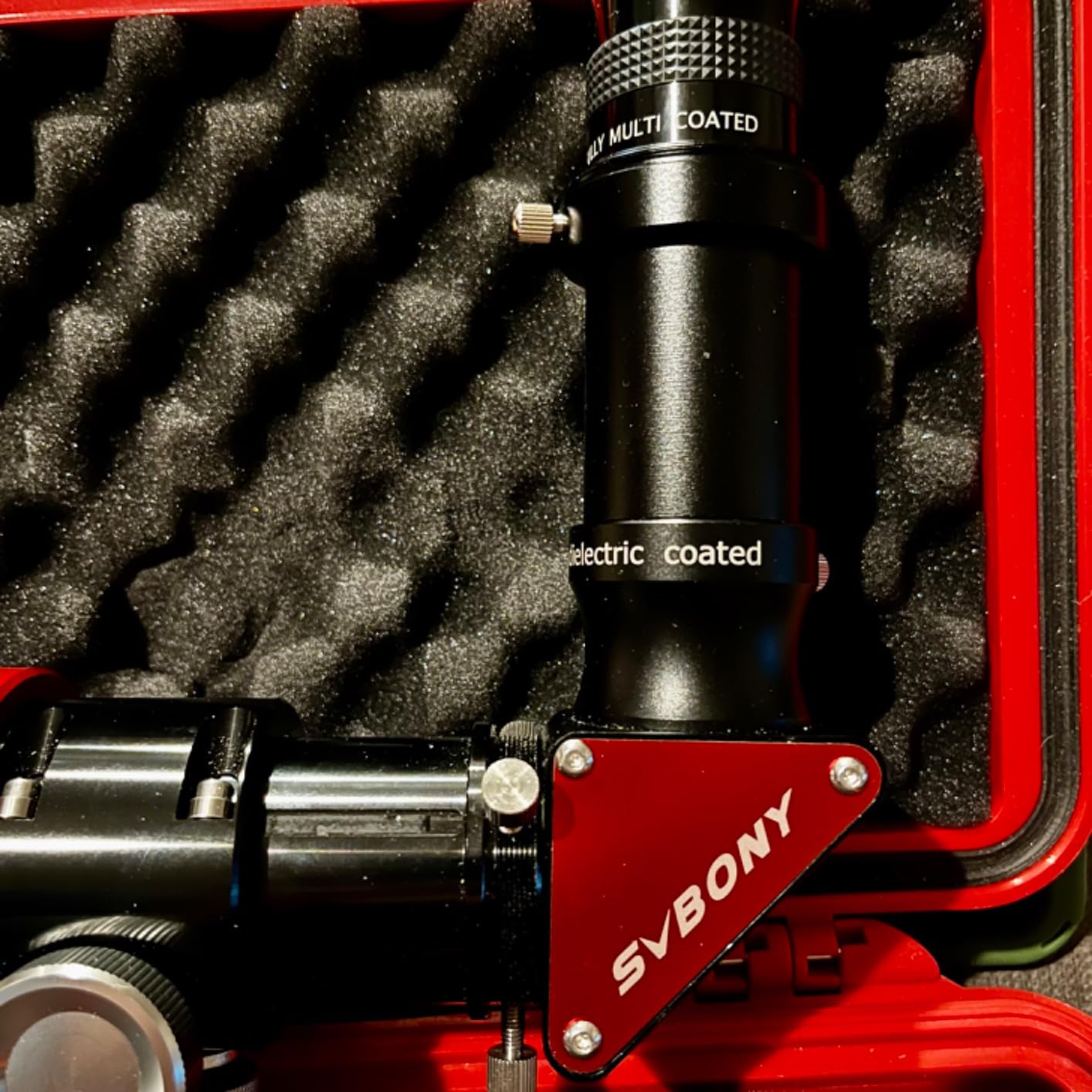
Build is aluminium stock with a black anodized body, and the housing is blackened to maximise image contrast. It carries a 4.4 rating from 945 reviews and a one-year accessory warranty from SVBONY. Dimensions are 3.9 by 2.1 by 1.9 inches.
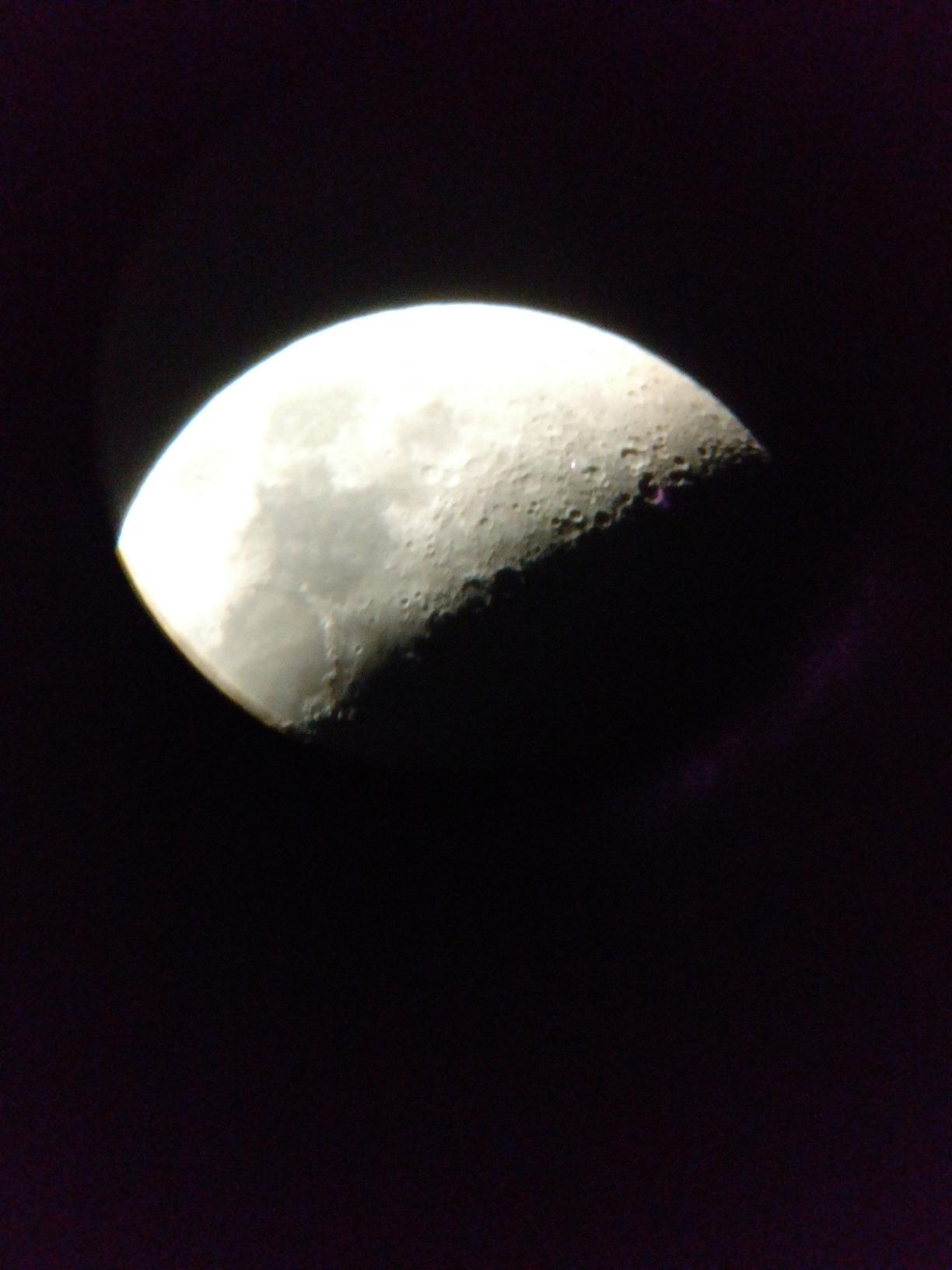
The important caveat is honest specification ambiguity. The listing describes a three element two group configuration in one place and two element one group broadband green film glass in another. A detailed side-by-side reviewer found output closer to 3x with less sharpness and contrast than a true apochromat, prompting a free replacement offer from the manufacturer.
At 135 g it is also long and heavy for a 5x unit, and that length can unbalance a small telescope. Five power will also push past what many small apertures can resolve, which is where the softening comes from rather than from poor glass alone.
When does 5x genuinely help?
On a fast instrument with a short focal length and a small aperture, 5x is how you reach planetary power at all. A 900 mm focal length 76 mm reflector with a 6mm eyepiece gives roughly 150x on its own; the same eyepiece at 5x approaches 750x, which is well past useful but useful for small scopes in steady air.
The rule of thumb is roughly 2x of magnification per millimeter of aperture. On a 76 mm scope that is about 150x, so anything beyond it is borrowed from atmospheric seeing.
Is the advertised power accurate?
Not consistently, according to detailed user testing. Several owners report real output nearer 3x than 5x, and the element count in the specifications is inconsistent. Glass has also arrived dirty for some buyers, and no cleaning cloth is included.
If you need dependable, repeatable power, a known 2x or 3x from a manufacturer with clearer glass specifications is the safer purchase. This one makes sense when low cost and a big apparent size jump matter more than measured magnification.
5. Celestron Luminos 2.5X Barlow Lens – Best for 2 Inch and 1.25 Inch Eyepieces
Celestron Luminos 2.5X Barlow Lens for 1.25″ & 2″ Telescope Eyepieces
2.5X power
4-element apochromat
11.2 oz
2 inch and 1.25 inch
Pros
- Four-element optics give a flat field and colour-free images
- Included adapter runs both 2 inch and 1.25 inch eyepieces
- Large thumbscrews are usable with gloves
- Threaded barrel accepts 2 inch filters
Cons
- One of the most expensive 2.5X options available
- Smaller share of top-star ratings than cheaper Celestron models
- Large barrel adds weight to the eyepiece train
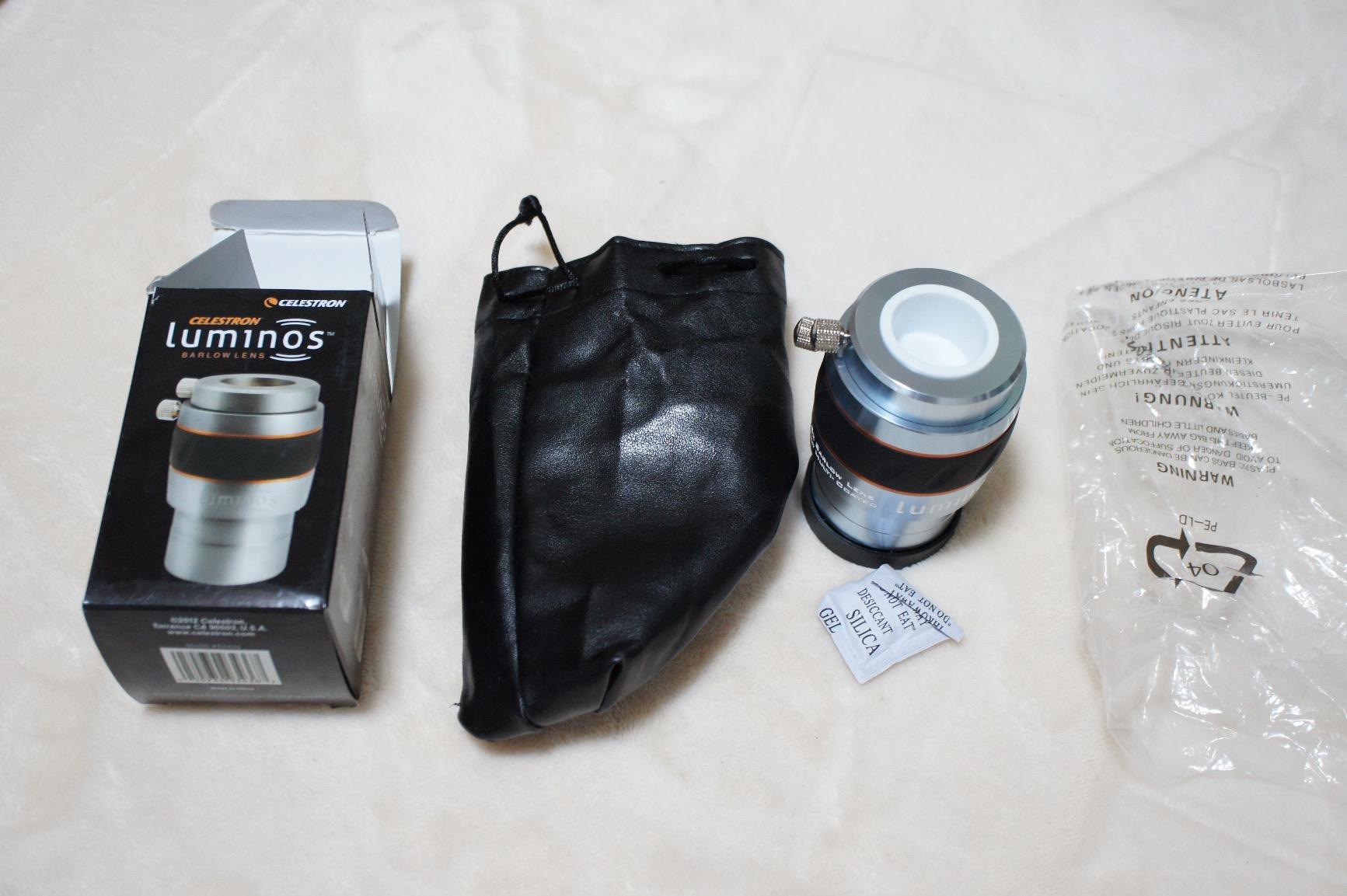
The Luminos 2.5X is the pick when you own 2 inch eyepieces, which is the one combination most 1.25 inch Barlows cannot serve. It raises magnification by 2.5 times with a 4-element design that produces a flat field, sharp and free of extraneous colour.
That flat field is the reason to choose it over a cheaper doubling. A high-power planetary view inside an 82 degree apparent field tends to show corner softness and colour on a simple doublet; a four-element group holds the field cleaner, which matters when you are chasing fine detail on a disc rather than a crater.
The included 2 inch to 1.25 inch adapter means a single purchase covers both barrel sizes. The hard-anodized aluminium barrel is threaded to accept 2 inch filters, and a brass compression ring with large thumbscrews holds the eyepiece firmly enough to work with gloves on a winter night. Weight is listed at 11.2 ounces.
It is one of the more expensive 2.5X options available, and it draws a smaller share of top-star ratings than Celestron’s cheaper Barlows, with a 4.5 across 311 reviews. The large barrel is a real consideration on a focuser that was not built for it.
Why pay more for a four-element group?
Because colour fringing is the thing that ruins planetary images on bright targets. A doublet corrects two wavelengths and leaves a coloured edge on Jupiter’s limb; a four-element group brings more wavelengths into alignment, so the disc looks cleaner.
If you also image, a flat field matters more. A corner that dims and smears wastes sensor area, and on a small planetary sensor that area is precious.
Will it fit my focuser and my hands?
It fits a 2 inch focuser directly and a 1.25 inch focuser through the included adapter. The trade-off is weight: 11.2 ounces sits at the end of an eyepiece train, and light mounts will notice it.
Before buying, check the minimum focuser height and the balance of your optical tube. Owners of heavier instruments and C-class telescopes report the design holds up well; owners of light mounts are the ones who notice the extra length.
6. starboosa 5X Barlow and Moon Filter Kit – Best for Lunar Sessions and Camera Setups
Starboosa 1.25-Inch Telescope 5X Barlow Lens with Moon Filter
5X labeled
Bundled moon filter
M42 thread
0.09 kg
Pros
- Barlow and moon filter in one kit at a strong combined value
- Reports of clear Jupiter bands and visible moons
- Fully multi-coated optics with little light loss
- Universal M42 thread for SLR attachment via a T-ring
Cons
- Labeled 5X but listed as about 2.5X actual
- Some units would not reach focus on small telescopes
- Bundled filter reported by some as a simple tinted lens
What makes this kit different is the moon filter. Lunar observers like the neutral density filter because it cuts glare and raises contrast on a surface that is otherwise too bright to enjoy, and having it in the box saves a second purchase.
Feedback is genuinely split. Lunar users like the kit value and report crisp Jupiter and Moon detail with minimal chromatic aberration. The optics are fully multi-coated, the frames are CNC machined with an anti-rust surface treatment, and it weighs 0.09 kg.
The specification problem is the biggest issue. It is labelled 5X, yet the same listing states actual magnification of about 2.5x, and several buyers report units that would not reach focus on their particular small telescope. Others describe the included filter as a simple tinted lens that would not focus, and a few report meaningful light loss that degrades the quality of better eyepieces.
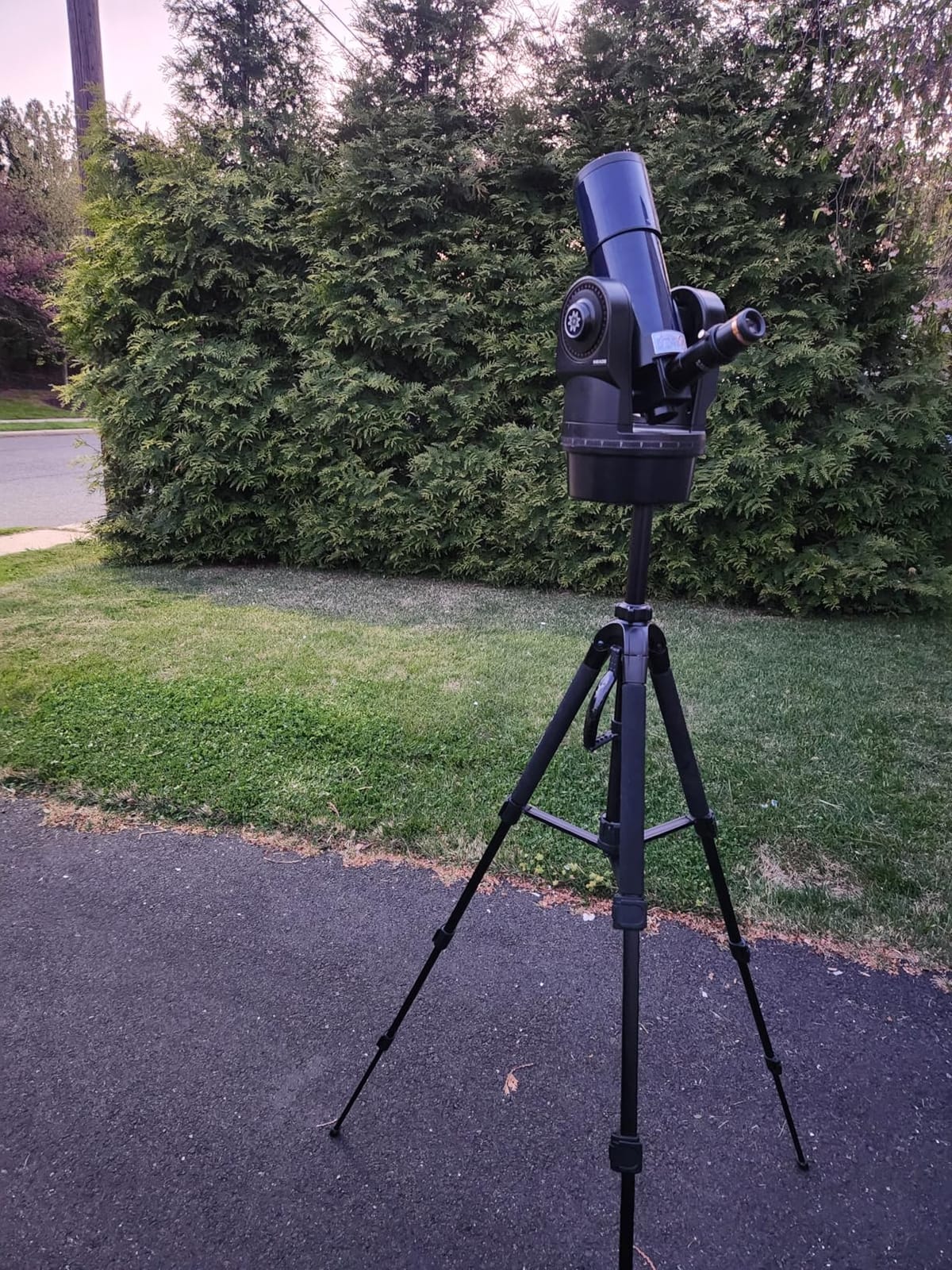
Its 4.1 rating across 279 reviews sits near the bottom of the group, with a notable share of one-star feedback. The universal M42 thread does work for SLR attachment through a T-ring, and it is listed as compatible with Celestron, Sky-Watcher, Meade and Orion mounts.
Is a bundled moon filter worth having?
For a beginner, often yes. A neutral density moon filter reduces the harsh glare of a full moon and makes craters along the terminator far more visible, which is exactly what a new observer needs on their first serious lunar session.
For someone who already owns filters, the bundled one is the weak part of the kit. Several buyers describe it as a simple tinted lens, so treat it as a bonus rather than the reason to buy.
Why should you check the magnification label?
Because the number on the box and the number in the description disagree. A 2.5x result and a 5x result put you in completely different places relative to the useful magnification limit of a small telescope, and guessing wrong is how beginners end up with a blurry, dim image they blame on the Barlow.
Focus failures on 60 to 80 mm scopes are also reported often enough to plan for. Check your focus travel before ordering.
7. Serounder 3X Metal Barlow Lens – Best First Metal Barlow Under a Small Budget
3X Lens Barlow Lens, 1.25 inches Metal Barlow Lens with M42x0.75mm Thread Camera Connect Interface Fully Black Multi Coated for Standard Telescope Eyepiece Astronomy
3X power
Fully multi-coated
3.2 oz
Metal shell
Pros
- Bright clear views with a solid magnification boost
- Better build quality than the plastic Barlow supplied with new scopes
- Reviewers note enhanced detail on Jupiter and Saturn
- Metal shell resists deformation and improves contrast
Cons
- Focus can be difficult to fine-tune on some scopes
- Some reviewers report blurriness and colour fringing
- A 3X unit is a compromise step between 2X and higher power
The Serounder 3X is the budget step up from a bundled plastic Barlow, and the jump in build quality is obvious. Buyers on a tight budget call it a solid 3X that brightens the view and magnifies as advertised, with good lunar and planetary results.
The metal shell resists deformation and is fully blackened for contrast, and reviewers consistently say it beats the plastic unit that came with their new scope. It weighs 3.2 ounces and measures 1.26 by 1.26 by 2.48 inches, so it adds almost no weight to a small telescope.
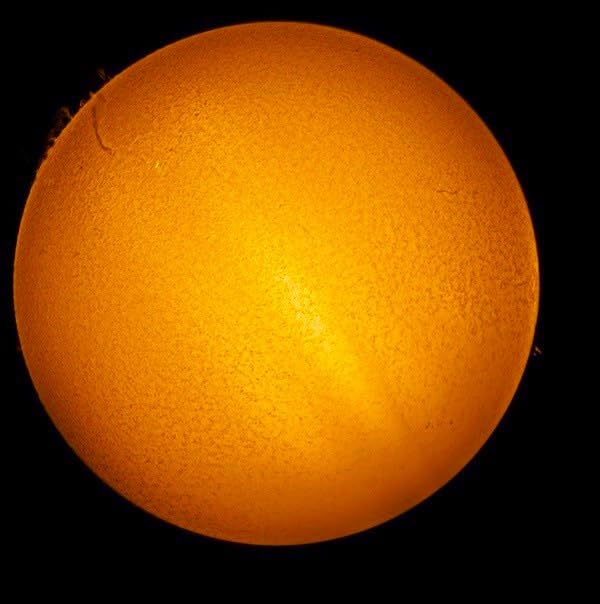
Installation is straightforward: the eyepiece goes into the Barlow and the Barlow into the focuser. An M42x0.75 mm thread serves as a camera connect interface if you want to try lunar and planetary imaging later.
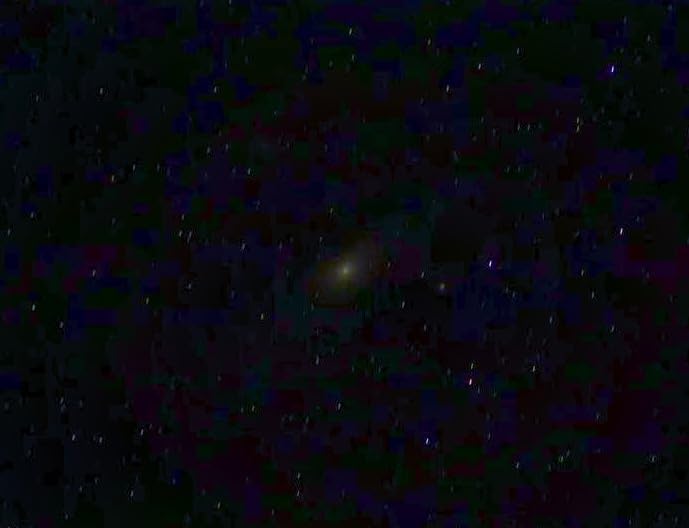
The critical reviews are worth reading before buying. A portion of owners report blurriness and colour fringing that becomes obvious on better telescopes, and a few note fiddly focusing. At 4.4 across 156 reviews, the sample is smaller and the optical consistency less settled than the picks above it.
Is it a good first real Barlow?
It is. The jump from a single plastic element to a machined, fully multi-coated metal body is where most of the visible improvement comes from, and you get a genuine 3x power increase rather than a doubling.
Where it stops being a good buy is on a high-quality telescope. Owners with better optics report fringing that a doublet design shows readily, and that is the difference you are paying extra for with an apochromat.
Is 3x the right power to start with?
For a short focal length scope, yes. Three power moves a 20mm or 25mm eyepiece into genuine planetary territory, which is the pairing reviewers recommend for first use.
For a long f/10 instrument, 3x often overshoots. On those scopes, a 2x keeps you inside the range the optics and the atmosphere can support, and the image stays brighter.
8. Astromania 3X Barlow Lens – Best Hardware for Fine Focus Control
Astromania 3X Barlow Lens for Telescope Eyepiece 1.25 Inch with T-Thread
3X power
Filter thread
T-thread
Two thumbscrews
Pros
- Sturdy metal body magnifies without noticeable colour loss
- Owners report Jupiter's bands and Saturn's rings in focus
- Easy to disassemble for cleaning
- Filter thread and T-thread expand filter and camera options
Cons
- Some users find focus difficult and the image poor even when focused
- Objects appear dimmer at high power
- Optical performance is adequate rather than premium
The Astromania 3X stands out for its hardware. Two fixing thumbscrews clamp the eyepiece, which gives you finer, more positive control over centering than a single screw, and the metal construction is described as sturdy and long-lasting.
Reviewers praise the machining and straightforward assembly, and report good planetary results on 70 to 100 mm scopes. They specifically mention seeing Jupiter’s bands, brighter Galilean moons and Saturn’s rings in focus, with no noticeable colour loss for the money.
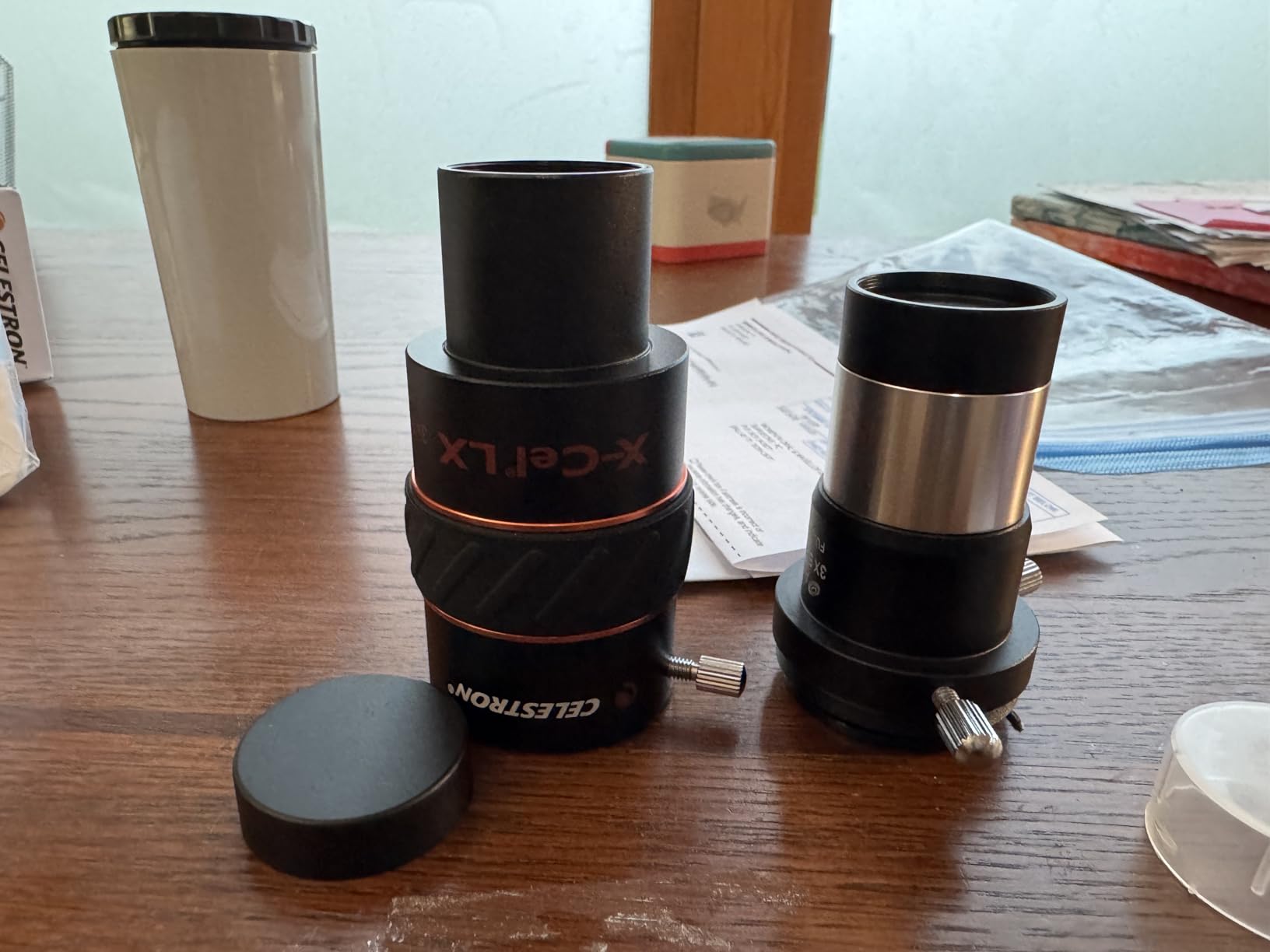
The expansion options are the practical strength. A filter thread on the lower barrel takes standard 1.25 inch filters, and a T-thread accepts bayonet SLR and DSLR cameras for imaging. Two dust covers are included, and the unit disassembles easily for cleaning the lens surface.
The recurring caution is focus. Some users find bringing the 3x into focus difficult and report a soft image even when they think it is focused. It also shares the universal Barlow drawback of a dimmer view at high power, and the optical performance is adequate rather than premium next to more expensive glass. It weighs 4.06 ounces.

Why do thumbscrews matter for planets?
Planetary observing is a long, precise activity. Two thumbscrews let you center the eyepiece more evenly, and an off-axis eyepiece sends light unevenly into the eye, which makes fine detail harder to see and can look like softness.
That is a real, visible difference on an extended Jupiter or Mars session, and it is why this unit gets chosen over single-screw designs at the same power.
Will it reach focus on your telescope?
Check before you commit. Several users report difficulty focusing the 3x on some telescopes, and that is often a spacing issue rather than an optical fault, since the extra element increases the distance between the objective and the eyepiece field stop.
It is listed as compatible with most 1.25 inch eyepieces and 1.25 inch focusers, with a 1.25 inch eyepiece thread. On a 70 to 100 mm scope, the planetary results reported by owners are the reason to consider it.
9. XCCYG 2X-3X-5X Barlow Lens Kit – Best Multi-Power Kit for Undecided Owners
Telescope Barlow Lenses Kit 2X-3X-5X, 1.25 Inch Telescope Accessory, Fully Metal Multi Coated Broadband Green Film Barlow Lens for Astronomy Eyepiece
Three powers
2X 3X and 5X
31.7 mm tube
M42 interface
Pros
- Three power options in one kit to match target and telescope
- Reviewers report clear sharp views of Jupiter and good lunar detail
- Good value compared with buying three separate Barlows
- Detachable ring makes the lenses M42 compatible
- Each lens packed in its own case
Cons
- The 5X member can exceed a beginner telescope's useful magnification
- Not a substitute for premium apochromatic glass on high-end scopes
- Lenses are light and need a separate hard case
The XCCYG kit solves the decision problem. Instead of guessing which power you will need, the box contains 2x, 3x and 5x units with a 1.25 inch interface, so you can match magnification to the target and the telescope on any given night.
Users pair the 3x with 20 to 25 mm eyepieces for planetary work and report crisp, clear images that exceeded expectations. The optics use multi-coated broadband green film glass with blackened lens edges and inner barrel for maximum contrast, and the body is black anodized aluminium. A 4.4 rating comes from 155 reviews.

A detail most listings skip: the optical glass section removes, so you can add filters, and the M42x0.75 mm thread becomes a usable camera interface. The stated optical tube length is 31.7 mm and the kit lists three items in a set measuring 1.3 by 1.3 by 3.8 inches.
The honest warning is about the 5x member. On a beginner telescope it will exceed the useful magnification and go blurry first, which is the fastest way to conclude that Barlows do not work. The 2x and 3x are the members you will use most, and they are the reason to buy this kit over a single unit.
Is three powers better than picking the right one?
Only if you are still learning. As a beginner, having the option is genuinely useful, because the right power depends on your aperture, your focal length and the night’s seeing, and those are hard to predict before you have observed for a season.
Once you know your instrument, a single quality unit is the better purchase. You get better glass, and you stop carrying three bodies in the eyepiece case.
Are these optics as good as a premium Barlow?
No, and reviewers do not claim otherwise. This is a multi-coated achromatic-grade set built for value, not a substitute for apochromatic glass on a high-end telescope. On a small or mid-size scope, the difference is hard to see.
The lenses are also light enough to be knocked around in a crowded case, and a separate hard case is advisable if you travel to dark sites. Each lens does ship in its own case.
10. Astromania 2X ED Barlow Lens – Best 2 Inch ED Doubler for Wide-Field Eyepieces
Astromania Barlow Lens 2X, 2 Inch ED Barlow Lens for Astronomical Telescope
2X power
ED glass
11.46 oz
2 inch filter thread
Pros
- ED glass keeps colour fringing to a minimum
- Large 2 inch aperture avoids shadowing and vignetting
- Filter threads on both the Barlow and the adapter
- High-grip exterior works with gloves in the cold
Cons
- Fewer reviews than the 1.25 inch units in this set
- Larger and heavier barrel than a 1.25 inch Barlow
- Some inconsistency in optical performance across units
Astromania’s 2 inch ED Barlow is the sensible choice if your eyepieces are 2 inch and you own a camera. Only 2x, so the magnification stays inside the useful range of most scopes, but the glass is ED rather than standard achromatic, which cuts the colour fringing that shows around a bright planetary limb.
All lens surfaces are multi-coated, and the large aperture yields high contrast. Owners of larger reflectors and C8-class telescopes report that the difference is clearest on high-power planetary targets, where a cheaper doublet would soften and tint the image.

The 50 mm objective is the practical headline here. It accepts 2 inch eyepieces with no vignetting, and it avoids shadowing on small camera sensors, which matters if you pair it with a high-frame-rate planetary imaging camera. The barrel unscrews to thread onto any 2 inch eyepiece directly, and 2 inch filter threads sit on both the Barlow and the reducer adapter.
Weight is 11.46 ounces, which is real mass on a light focuser, and the ergonomic high-grip exterior is designed for gloved hands. The 4.3 rating comes from 106 reviews, the smallest sample in this group, with a noticeable share of two-star feedback pointing to some inconsistency in optical quality between units.
Why does barrel size matter for planetary work?
Because a 1.25 inch Barlow cannot take a 2 inch eyepiece at all, and forcing a wide-field 2 inch eyepiece into a narrow adapter causes vignetting, a dimmer and narrower field, and eye relief problems that show as black kidney-bean shapes.
If your planetary eyepieces are 2 inch, buying a 1.25 inch Barlow means either an adapter that wastes light or replacing the eyepieces. This one removes the problem.
Is 2x enough to be worth buying?
Almost always, yes. Two power is the safest jump for a reason: it doubles the apparent size of a planet and keeps you inside the useful magnification ceiling of almost every telescope, whether it is a fast refractor or a long f/10 instrument.
Buyers who pair it with a long-focal-length eyepiece should expect a narrower field and a dimmer exit pupil. That is the trade for resolution, and on a steady night it is the trade worth making.
11. Explore Scientific 2X Focal Extender – Best Premium Pick for Larger Telescopes
Explore Scientific Focal Extender Barlow Lens to Increase Focal Length for Telescopes
2X telecentric
Four coated lenses
665 g
2 inch barrel
Pros
- Premium four-lens design shows fewer aberrations at high power
- Telecentric design gives sharp high-contrast images
- Solid build quality and good packaging
- Bright field with a wide apparent field and no parallax effect
Cons
- Very heavy at 665 g so it needs a balanced mount
- Not universally compatible with every eyepiece train
- Supplied soft case offers little impact protection
The Explore Scientific focal extender is the premium path, and it earns a 4.7 across 145 reviews. Owners of larger reflectors and C8 telescopes report clearly fewer aberrations and better sharpness at high magnification than with previous Barlows, and they credit the telecentric four-lens design for the improvement.
All lens surfaces are fully coated and the edges are blackened for maximum contrast. The barrel unscrews for direct attachment to 2 inch eyepieces, and the same design is offered in 2x 1.25 inch, 2x 2 inch and 3x 2 inch variants depending on your eyepiece collection.
There is one real cost beyond money, and it is weight. At 665 g this is by far the heaviest unit in the roundup, and it needs a well-balanced mount to sit in a focuser without straining it. The soft fabric case also offers little impact protection compared with a hard case. It is also the heaviest unit here by a wide margin, so check your mount’s payload before you commit.
What is a focal extender and how is it different?
It is a Barlow built with more elements and a telecentric design, so the exit pupil is formed more faithfully and aberrations stay low even at high power. The trade is weight, cost, and a focuser that has to take the load.
On a long f/10 instrument where a cheap 2x would dim and soften the view, the extra elements are what keep the image worth looking at. That is the whole argument for this price.
Is it worth the premium for planetary imaging?
For imaging, it is a strong fit. The extra focal length helps frame compact objects on a small sensor, and reviewers report sharp, high-contrast results with a bright field and no parallax effect at the edge.
Compatibility is the caveat. One buyer reported a blurrier image using it with astronomical binoculars and returned it, so check that your focuser and eyepiece train are designed for a unit this size before committing.
12. Pocnsen 5X Achromatic Barlow Lens – Lowest-Cost Route to Maximum Power
1.25″ 5X Barlow Lens Fully-Multi Coated Achromatic Lens, Fully Metal Astronomical Telescope Accessory with M42 Thread
5X power
Achromatic element
M42 thread
65 mm focal length
Pros
- Cheapest way to get a large magnification jump
- Real multi-element achromatic glass with no obvious added colour error
- Thick solid metal housing with good machining
- M42 thread allows rigid camera coupling for imaging
Cons
- Lowest rating and fewest reviews in this set
- Eyepiece held by a small thumbscrew rather than a brass ring
- Achromatic correction is only partial
The Pocnsen 5X is the cheapest way to make a planet look big, and at 4.0 across 43 reviews it is the least proven unit here. New observers like the jump in apparent size, with a clear improvement in Saturn and lunar detail over a 2x at almost no cost.
The optics are a fully multi-coated achromatic element, which is a genuinely better starting point than a single plastic lens. The body is precision CNC-machined aluminium with a black anodized finish, an M42x0.75 mm T-thread accepts a DSLR rigidly, and dust covers are included. The listed focal length is 65 mm.
The problems are specific. The eyepiece is held by a small thumbscrew rather than a brass compression ring, which can scratch eyepiece barrels over time. One careful reviewer noted slightly more astigmatism against a 2x from a different brand, and a double-digit share of one and two star reviews reflects a genuinely mixed reception.
Is a 5x at this level better than a 2x apochromat?
For apparent size, yes, and the difference is obvious. Magnified five times, Jupiter and the Moon fill far more of the field than they do at 2x, and budget buyers notice that immediately.
For sharpness and colour, no. Achromatic correction is only partial, so colour fringing remains on bright targets, and any small astigmatism shows up faster at five power than at two. If image quality matters more than apparent size, spend the difference elsewhere.
Is it safe to use with your eyepieces?
Use care. A thumbscrew clamp can mark a barrel over repeated sessions, and this is one of the clearest reasons to prefer a brass compression ring. Threading a dust cover between sessions helps, and the achromatic element is easier on colour than a plastic one.
Given the small review sample, treat this as a disposable add-on that answers a specific need, not a purchase to build a planetary observing setup around.
How to Choose a Barlow Lens for Planets
Start with the power, then check that the rest of the specification supports it. A Barlow multiplies your telescope’s effective focal length, so the magnification of any eyepiece is multiplied too. A 1200 mm focal length telescope with a 10 mm eyepiece gives 120x; adding a 2x Barlow takes that to 240x with the same glass.
Magnification power: 2x, 2.5x, 3x or 5x
A 2x is the safest and most useful starting point for planetary viewing, because it doubles the apparent size of a planet while keeping you inside the useful range of almost any instrument. It is also the least likely to produce a soft, dim image.
A 2.5x, like the Luminos, gives a moderate extra step and makes sense when you want a bit more detail without the jump of 3x. A 3x is the classic planetary choice on short focal length refractors and Dobs, where there is focal length to spare. A 5x belongs on fast rigs with small apertures, and anywhere else it will push past what the atmosphere can support.
Aperture limits: the 2x per millimeter rule
The widely used guide is that a telescope can support roughly 2x of magnification per millimeter of aperture, so a 150 mm instrument tops out around 300x and a 200 mm around 400x. Beyond that, extra power enlarges the image without adding detail, and the atmosphere becomes the limit instead of your optics.
Exceeding the limit is the most common beginner mistake. The image does not become more detailed, it becomes dimmer, softer and more prone to shimmering. This is why a 5x on an f/10 Schmidt-Cassegrain usually disappoints while the same unit delights someone with a short focal length Newtonian.
Barrel size: 1.25 inch or 2 inch
Match the Barlow to the eyepieces you already own. A 1.25 inch Barlow is lighter, cheaper and fits most focusers, and it pairs with the 1.25 inch eyepieces that come in most kits. A 2 inch Barlow accepts wide-field eyepieces without vignetting and avoids shadowing on small camera sensors, but it costs more and adds real weight.
Forcing a wide 82 degree eyepiece into a 1.25 inch adapter causes a dimmer, narrower field, vignetting, and increased eye relief that can produce black kidney-bean shapes. If your planetary eyepieces are 2 inch, buy a 2 inch Barlow.
What to target on each planet
Jupiter rewards power most consistently. Around 120x to 200x you start to see the belts resolve; higher, if the night is steady, brings out the smaller ovals and the shifting position of the Great Red Spot. Saturn needs less to separate the rings from the planet, but more to open the Cassini division. Mars at opposition shows surface markings rather than a disc and needs a stable, dark sky more than raw magnification.
Venus is a case of the opposite problem, since more magnification only makes a bright featureless phase slightly larger, so a modest power is enough. The Moon is the most forgiving target, with craters and the terminator visible at low power and rilles and shadow detail appearing as you add a Barlow. Double stars need power to split, and there you are limited more by aperture than by magnification.
Barlow, focal extender or another eyepiece?
A Barlow and a focal extender do the same job, but a focal extender uses more elements and a telecentric design to keep aberrations lower at high power, at the cost of weight and cost. It is the right choice on a long, slow instrument where a cheap doublet would soften the view.
A zoom eyepiece is the other alternative, and many observers prefer one because it gives a range of powers without changing barrels. The argument for a Barlow is narrower: it multiplies the quality of eyepieces you already own, and it leaves wide-field eyepieces free for the deep sky. The argument against is redundant magnification, since a 2x Barlow on a standard kit duplicates the 10mm eyepiece you already have. Forum advice repeats this often: if you need 6mm-equivalent power, buying a 6mm or 6.5mm Plossl gives a better image than doubling a 12mm.
Red flags that mean a Barlow is not worth buying
A single plastic element with no multi-coating is the clearest warning, and it is the unit bundled with many beginner telescopes. It adds colour fringing and a soft image, and observers on Cloudy Nights and r/telescopes describe it as universally regretted. Beyond that, treat advertised power and element count sceptically if the listing contradicts itself, as two of the units in this roundup do.
Also look for a solid eyepiece clamp rather than a thumbscrew, check that a filter thread is present if you plan to use filters, and confirm the barrel size matches your focuser. Finally, weigh the unit in your hand against your focuser, because a long 5x or a 2 inch barrel can unbalance a light telescope faster than most people expect.
Frequently Asked Questions
What is a 2x barlow lens used for?
A 2x Barlow doubles the magnification of every eyepiece you already own, which makes it the safest and most useful power for planetary viewing. On a 1200 mm telescope a 10mm eyepiece gives 120x on its own and about 240x through the Barlow, enough to resolve Jupiter’s belts and Saturn’s rings while staying inside the useful magnification range of almost any instrument. It is also the best choice for replacing the single plastic element Barlow bundled with many beginner telescopes.
What is a 3x Barlow lens used for?
A 3x Barlow triples eyepiece power, which is the classic planetary choice on short focal length refractors and Dobsonians where there is focal length to spare. It moves a 10mm or 20mm eyepiece from a low-power view into genuine planetary territory and, on a well-corrected 3-element apochromat, keeps colour fringing under control on bright targets. On a long f/10 instrument the same 3x usually exceeds the useful limit and produces a dimmer, softer image.
What is the best magnification for a Barlow lens?
Two times is the best general-purpose magnification for planets, because it doubles apparent size while staying inside the useful range of nearly every telescope. Three times is better on short focal length scopes in steady seeing. Two and a half times suits wide-field and 2 inch setups where you want a modest step. Five times only makes sense on fast f/4 to f/5 instruments with small apertures, and goes past what most scopes and the atmosphere can support.
What are the downsides of using Barlow lenses?
The main drawbacks are that high magnification amplifies every wobble in the mount, the view becomes dimmer because the exit pupil shrinks, and a simple achromat design adds colour fringing on bright planets. Adding a Barlow to a wide-field eyepiece can also cause vignetting, a narrower field, increased eye relief and kidney-bean blackouts. A 2x Barlow may simply duplicate the eyepiece focal length you already own, and longer 2 inch or 5x units add weight that unbalances a light focuser.
Which Barlow lens is best for planetary imaging?
For planetary imaging, look for a Barlow with an M42 T-thread, a brass compression ring and a multi-element apochromat or ED design rather than a single plastic or two-element unit. The Astromania 2X ED and the Explore Scientific telecentric focal extender both give a large 2 inch aperture that avoids vignetting on small high-frame-rate sensors. The cheaper 1.25 inch units from Bysameyee and Astromania 3X also carry M42 threads, and the T-ring adapter is usually sold separately.
Which Barlow Should You Buy in 2026?
For most people, the Celestron Omni 2X is the right first purchase. It is the most thoroughly reviewed unit here, it fits a 1.25 inch focuser, it doubles power without pushing past what your telescope can use, and it unthreads for camera work. If your seeing is genuinely steady and you want more colour-corrected detail on Jupiter, step up to the X-Cel LX 3X.
Match the barrel to your eyepieces. On 2 inch glass or a small imaging sensor, look at the Luminos 2.5X or the Astromania 2 inch ED. On a short focal length reflector where you need raw power, the SVBONY 5X works, provided you accept that the real output is closer to 3x and that it is a heavy, long body. Whatever you choose, throw out the stock plastic Barlow that came in the box.