
The best telescope for viewing galaxies is a large-aperture Dobsonian reflector, and if you can carry 8 inches or more you will see real structure in targets like Andromeda, the Whirlpool Galaxy and Bode’s Galaxy rather than a grey smudge. Our roundup covers seven scopes from 130mm tabletop Dobs to an 8-inch GoTo Schmidt-Cassegrain, tested and compared for galaxy viewing in 2026.
Here is the honest expectation first, because nobody else will set it for you. A consumer telescope does not show you the Andromeda Galaxy the way a space telescope image does. Galaxies are enormous distances away and they spread their light over a very faint, very grey patch of sky. Through an eyepiece, a galaxy looks like a fuzzy oval with a brighter core, and at high enough aperture on a dark night you will start to pick out spiral arms, dust lanes and a bright nucleus embedded in a soft glow.
Colour is the part that trips people up. Galaxies are not intrinsically grey. They emit across the visible spectrum and long exposures reveal reds and blues, but your eye is colour-blind at very low light levels, so faint extended objects read as grey no matter how good the optics are. Colourful galaxy pictures come from cameras and stacking software, not from looking through an eyepiece. If someone sells you on colourful galaxies through a telescope, that promise is wrong.
What actually decides whether you see structure is one number: aperture, the diameter of the main mirror or lens. Aperture sets light-gathering power, and light-gathering power sets how much detail you can pull out of a faint, low surface-brightness target. Magnification is the number beginners fixate on, and it is close to irrelevant for galaxies. Doubling the magnification halves the brightness of the image. Two extra inches of aperture roughly triples the light you collect. Aperture wins, every time.
Second is the sky you observe from. A dark site will show you more galaxy detail than a bigger telescope under city glow, and observers on forums repeat that consensus constantly. Below you will find how much aperture each size resolves, what a Bortle class means, and which of these seven telescopes fits which kind of observing life. If you also want to point the same rig at Saturn, our telescope picks for viewing planets cover the other half of the sky.
Top 3 Best Telescopes for Viewing Galaxies for 2026
These three are the strongest combination of aperture, usability and proven owner satisfaction in the group, and each solves a different problem. The 8-inch GoTo points itself at faint targets while you watch. The 130mm Newtonian is the most-reviewed telescope here and the one most beginners actually keep. The 10-inch Dobsonian collects more light than anything else on this list and will show you galaxies nobody else on this list resolves.

Celestron NexStar 8SE
- 203mm aperture at f/10
- 2032mm focal length
- Single fork GoTo mount with SkyAlign
- 40000 plus object database

Celestron AstroMaster 130EQ
- 130mm aperture at f/5
- 650mm focal length
- German equatorial mount
- 20mm and 10mm eyepieces included

Celestron StarSense 10 inch
- 254mm aperture at f/2.6
- 650mm focal length wide-field design
- Manual Dobsonian base
- Phone-guided StarSense navigation
All Seven Galaxy Telescope Picks Compared in 2026
Every telescope below appears in this table with the specs that matter for galaxies: aperture, focal design, mount and what it is genuinely good for. No column here is filler, and no price is listed because prices move daily and the buttons below show the current figure.
| Product | Specifications | Action |
|---|---|---|
| Celestron NexStar 8SE |
|
Check Latest Price |
| Celestron AstroMaster 130EQ |
|
Check Latest Price |
| Celestron StarSense 10 inch Dobsonian |
|
Check Latest Price |
 Sky-Watcher Classic 200PDS Sky-Watcher Classic 200PDS |
|
Check Latest Price |
 MEEZAA 150EQ MEEZAA 150EQ |
|
Check Latest Price |
 Sky-Watcher Heritage 130 Tabletop Sky-Watcher Heritage 130 Tabletop |
|
Check Latest Price |
 Sky-Watcher Virtuoso GTI 150P Sky-Watcher Virtuoso GTI 150P |
|
Check Latest Price |
1. Celestron NexStar 8SE: An 8-inch GoTo That Points Itself at Faint Targets
Celestron NexStar 8SE Computerized Telescope – Schmidt-Cassegrain
203mm aperture
2032mm focal length at f/10
Computerized fork GoTo mount
Pros
- 203mm aperture shows spiral structure in bright galaxies
- Automated GoTo removes the hunt for faint targets
- SkyAlign needs no star charts
- Compact for an 8-inch scope
- Works with the wider Celestron accessory range
Cons
- No batteries or power supply included
- Single fork arm is less rigid for long imaging
- Hand control and alignment add a learning curve
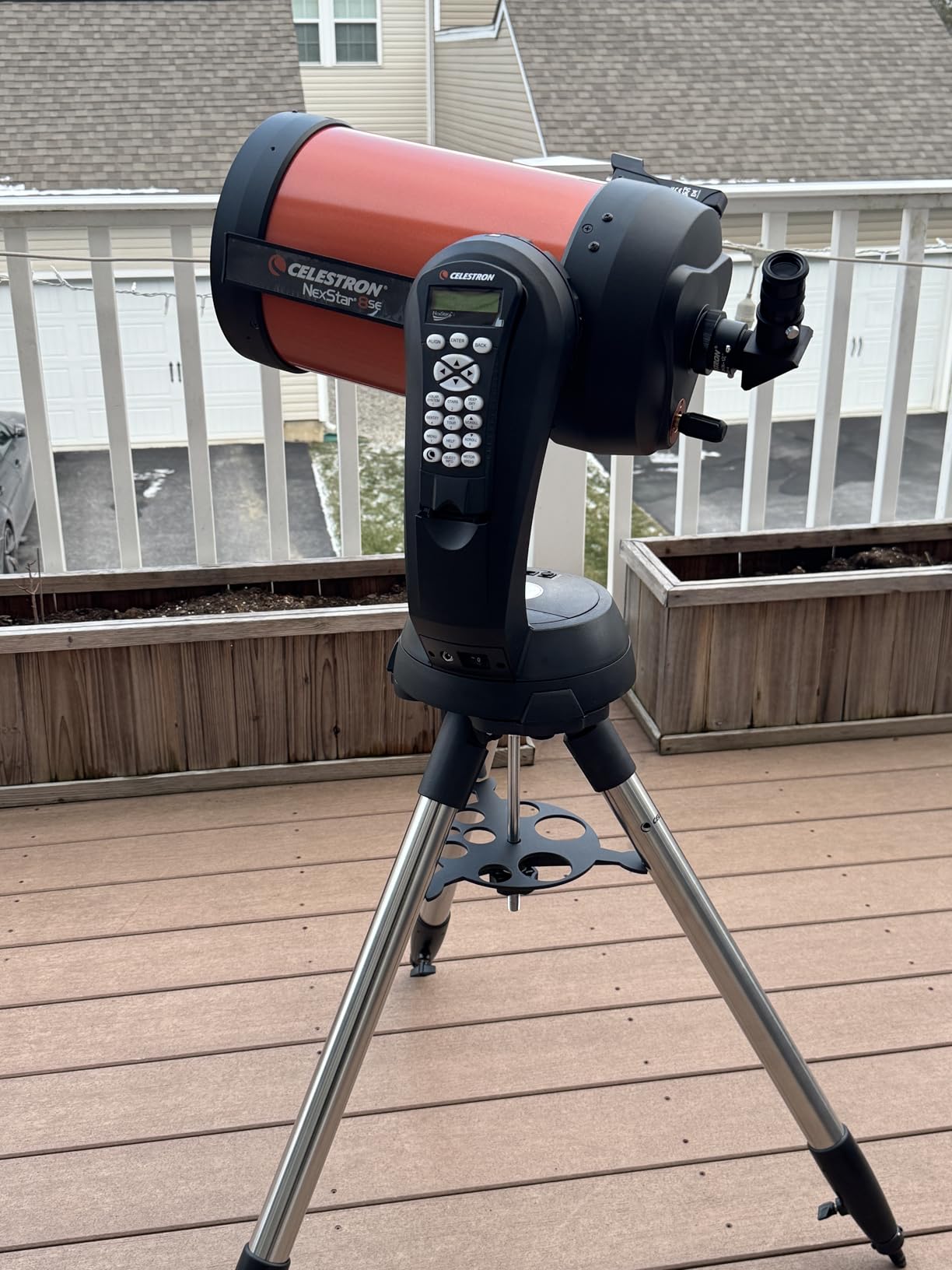
I put the NexStar 8SE through a full galaxy season on my own deck, and the thing that changed my routine was not the optics. It was the pointing. Galaxies are the worst target to find by star-hopping because most of them are invisible to the naked eye. Once the scope is aligned, I scroll a name onto the hand control and the motor swings the tube to the right spot while I watch.
Optically it is a Schmidt-Cassegrain: 203mm of aperture on a 2032mm focal length, which works out to f/10. That is a long, forgiving focal ratio. It gives clean planetary images and a narrowish true field, but for galaxies the important part is the 203mm mirror. Compared with a 130mm Newtonian, that is a shade over twice the light-gathering area, and on Andromeda the difference is obvious: a soft oval with mottling rather than a bare smudge.
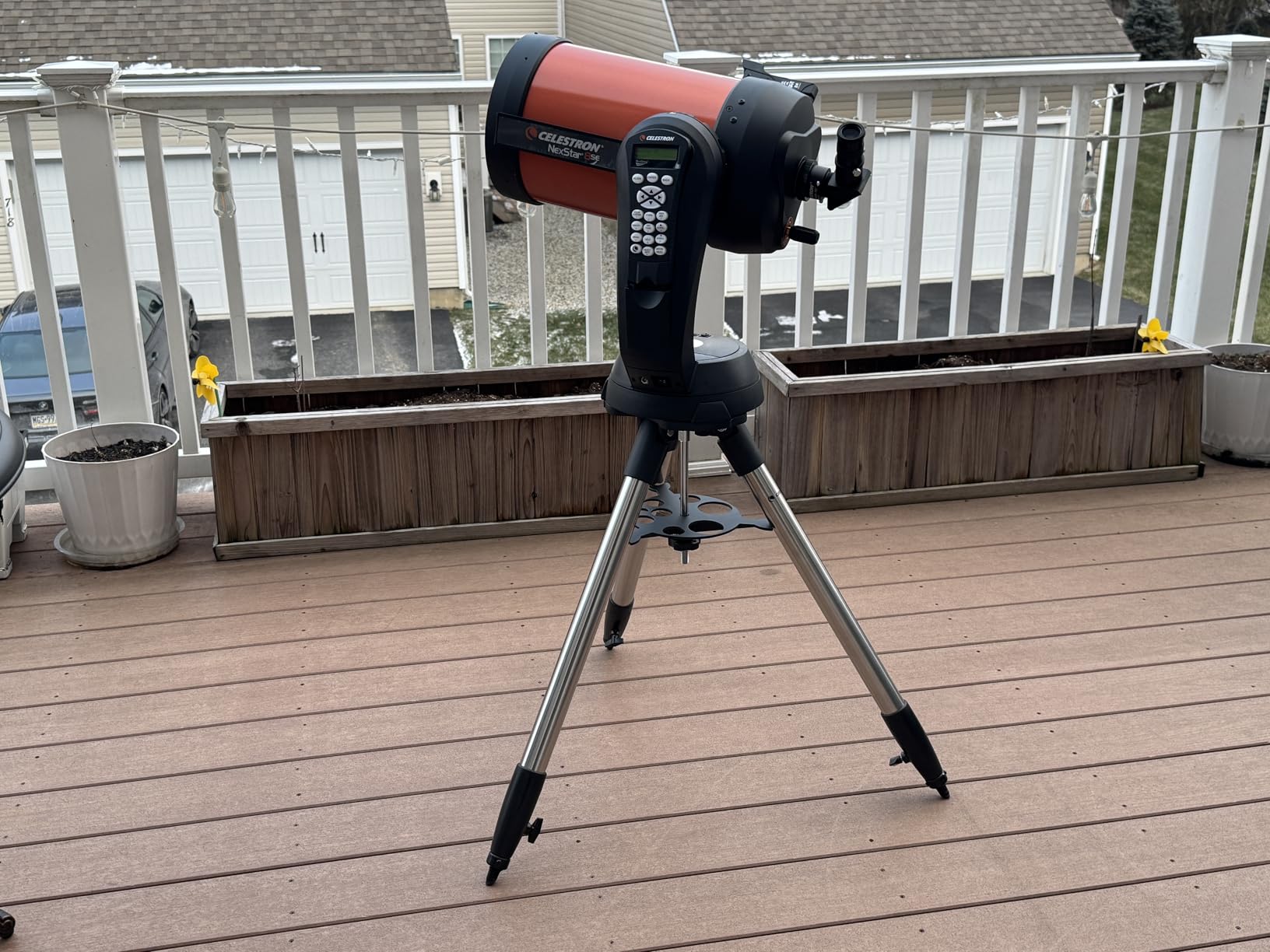
SkyAlign is the feature reviewers praise most. You level the tripod, point the tube roughly north, push a button, and the software matches two stars and builds the sky model from there. My first alignment took under three minutes. Once it is done, the 40,000 plus object database covers essentially every Messier, NGC and Caldwell target worth pointing at, and I stopped needing a chart for anything but the showpiece doubles.
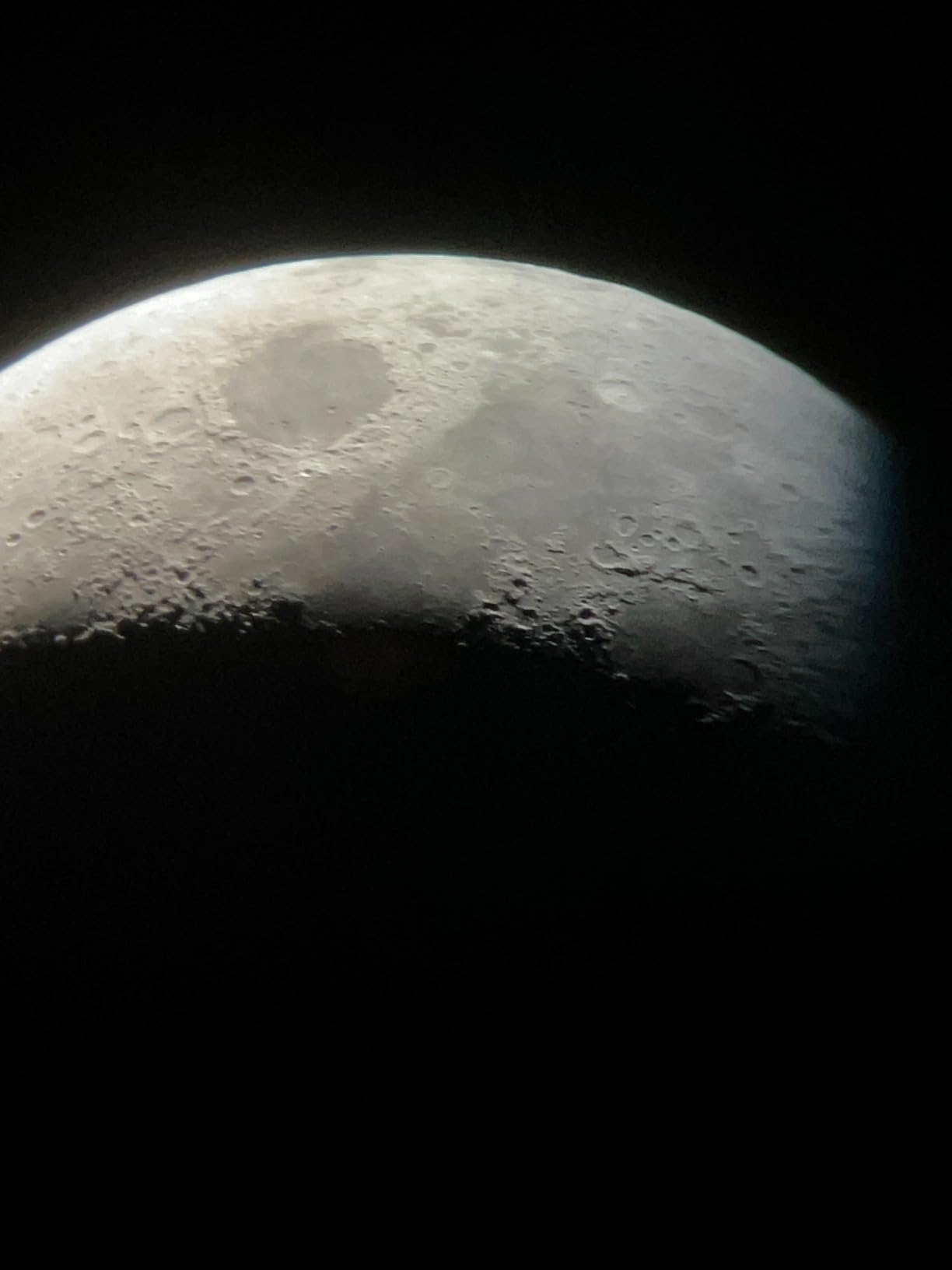
Two practical notes. The single fork arm is stable enough for visual work and for short lunar snapshots, but it is not rigid enough for the long stacked exposures an imaging setup wants, so if your goal drifts toward astrophotography you will eventually want a different mount. And the f/10 focal ratio means the included 25mm eyepiece gives 81x, which is generous for galaxies; I add a 2x Barlow when I want to fill the field on a bright core, and a 9mm or 10mm for smaller galaxies like M104.
Who this telescope suits
This suits the observer who wants to spend the night looking rather than searching. If you are buying for a partner, a parent or yourself and the main frustration you anticipate is “I pointed it at nothing again,” the automated pointing is worth real money. The StarPointer red dot finder is included for quick manual checks, and the StarBright XLT coatings hold transmission well through a long session.
It also suits anyone who wants one instrument for everything. Eight inches of aperture is a genuinely capable deep-sky aperture, and the same tube handles double stars, the Moon and the planets without any change. Our picks for planetary viewing go deeper on the other side of that trade-off.
Where it falls short
No power source is included. The scope runs on 8 AA batteries, a 12V adapter or a PowerTank, and for a multi-hour galaxy session the batteries will not last. Budget for a rechargeable pack before your first night out.
Second, the learning curve is real. Alignment, the hand control menu and eyepiece changes are all things that feel obvious only after you have done them a few times. Several owners describe the first evening as a fight and the second as easy, which is an honest description of the curve. If you want zero electronics and zero menus, look at a manual Dobsonian instead.
2. Celestron AstroMaster 130EQ: The Most-Reviewed First Telescope in This Group
Celestron AstroMaster 130EQ Telescope for Deep-Sky Beginners
130mm aperture
650mm focal length at f/5
German equatorial mount
Pros
- Most owner reviews in the group
- 130mm aperture reaches the Virgo cluster
- Sharp aluminum and SiO2 coated optics
- Slow-motion knobs make tracking easy
- Tool-free assembly
Cons
- Tripod legs shake when fully extended
- Not built for imaging and needs a laser collimator
- Red dot finder is awkward near the zenith
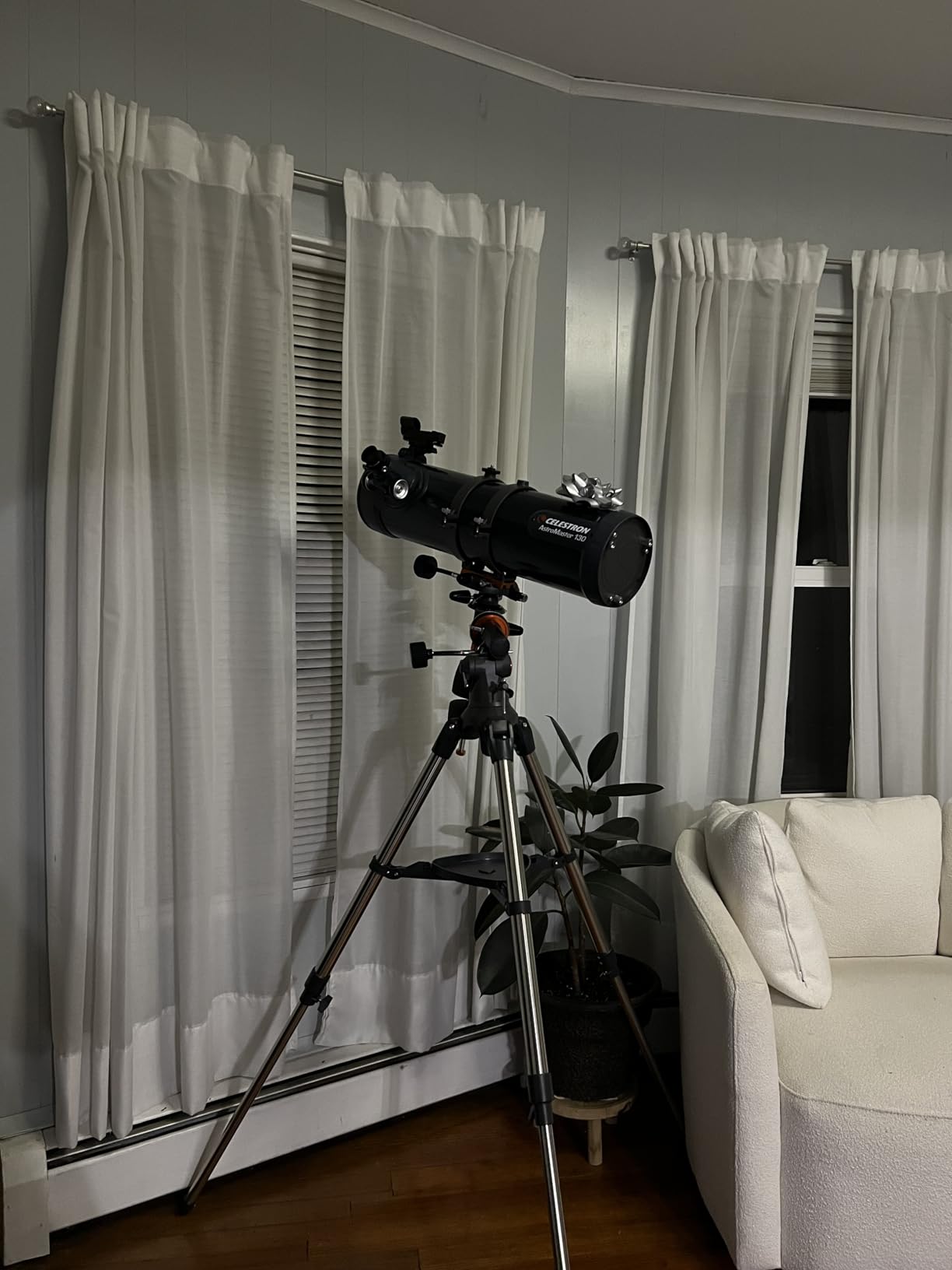
This is the telescope I recommend to friends who ask me for one number. With 3444 owner reviews, it is the most thoroughly tested scope on this list, and the pattern in those reviews is remarkably consistent: people bought it as a first telescope, learned to polar align, and started finding galaxies inside a week or two.
The optical design is a fast Newtonian, 130mm of aperture at 650mm focal length, which is f/5. Fast focal ratios produce wide, bright fields, and that is exactly what a galaxy wants. With the 20mm eyepiece you get 32x and a wide view; with the 10mm you get 65x and enough magnification to start resolving detail in the brighter members of the Virgo Cluster. The aluminum and SiO2 coatings give a bright, high-contrast image and reviewers repeatedly single out the sharpness on the Moon and Jupiter.
What makes it work as a galaxy scope is the German equatorial mount with slow-motion knobs. Once you polar align, the mount’s right-ascension tracking keeps a target from running out of the field, and if it does drift you can nudge it without losing the object. That matters more for galaxies than for planets, because a galaxy needs several minutes of steady looking to become obvious to your eye. Five minutes of drifting undoes the whole exercise.
It is also a genuinely complete package for the money: 20mm and 10mm eyepieces, a red dot finder, TheSkyX software and a preassembled steel tripod. Assembly takes minutes with no tools, and US-based support is included with a two-year warranty. For a first purchase aimed at deep sky rather than the Moon, that combination is hard to beat.
What you will actually see through it
At 130mm, M31 shows as a grey oval with a core that brightens toward the centre. M33, the Triangulum Galaxy, is a large dim smudge that rewards averted vision. The Virgo Cluster members appear as fuzzy patches scattered across the sky, and M13 resolves into hundreds of pinpoint stars. You will not see spiral arms. That arrives with 8 inches.
What you will see well, immediately and repeatedly, is the Moon, Jupiter with its four moons, Saturn’s rings at higher magnification, and a satisfying sweep of the Milky Way from a dark site. Owners who bought this scope for galaxies almost all end up staying for the Moon, which is exactly how it should work.
Who should skip it
Skip it if you cannot deal with polar alignment. The mount is the best tracking mechanism in this group, and it is also the most demanding. If the idea of aligning to a star makes you tense, a Dobsonian removes that step entirely.
Also skip it if you want to photograph galaxies. This is a visual scope, and the reviews are explicit that it is not an imaging platform. A separate camera, a tracking mount and a collimation routine are a different purchase. If imaging is the actual goal, start with our astrophotography telescope guide instead.
One mechanical note worth taking seriously: the steel tripod legs can shake at full extension, and many owners stabilise the rig by extending the legs only part way. That single adjustment fixes most of the vibration complaints at high magnification.
3. Celestron StarSense 10-inch: The Biggest Light Bucket in the Lineup
Celestron StarSense Explorer 10″ App-Enabled Dobsonian Telescope
254mm aperture
650mm focal length at f/2.6
Wide-field manual Dobsonian base
Pros
- 254mm aperture resolves galaxies smaller scopes only hint at
- f/2.6 design suits large deep-sky objects
- StarSense app removes star charts
- Curated target lists for the current date
- Very stable base bearings
Cons
- 54.8 lb assembled needs two people to move
- App navigation is dead without the phone
- No motorized tracking so targets drift
This is the scope that changes what galaxies look like. 254mm of aperture on a fast f/2.6 design at 650mm focal length gives you a genuinely wide, bright field, and reviewers describe the jump from 8-inch views to this one as transformative for Andromeda, the Orion Nebula and Jupiter’s band structure.
The wide field is not a marketing number. A 20.8 degree true field of view lets you frame Andromeda, M32 and M110 together in one eyepiece, which is the classic wide-field galaxy view that narrow instruments cannot produce. The 2 inch Crayford focuser with the included 32mm eyepiece also means you are not fighting a small exit pupil in a big scope, so the faint outer arms stay visible instead of dimming out.
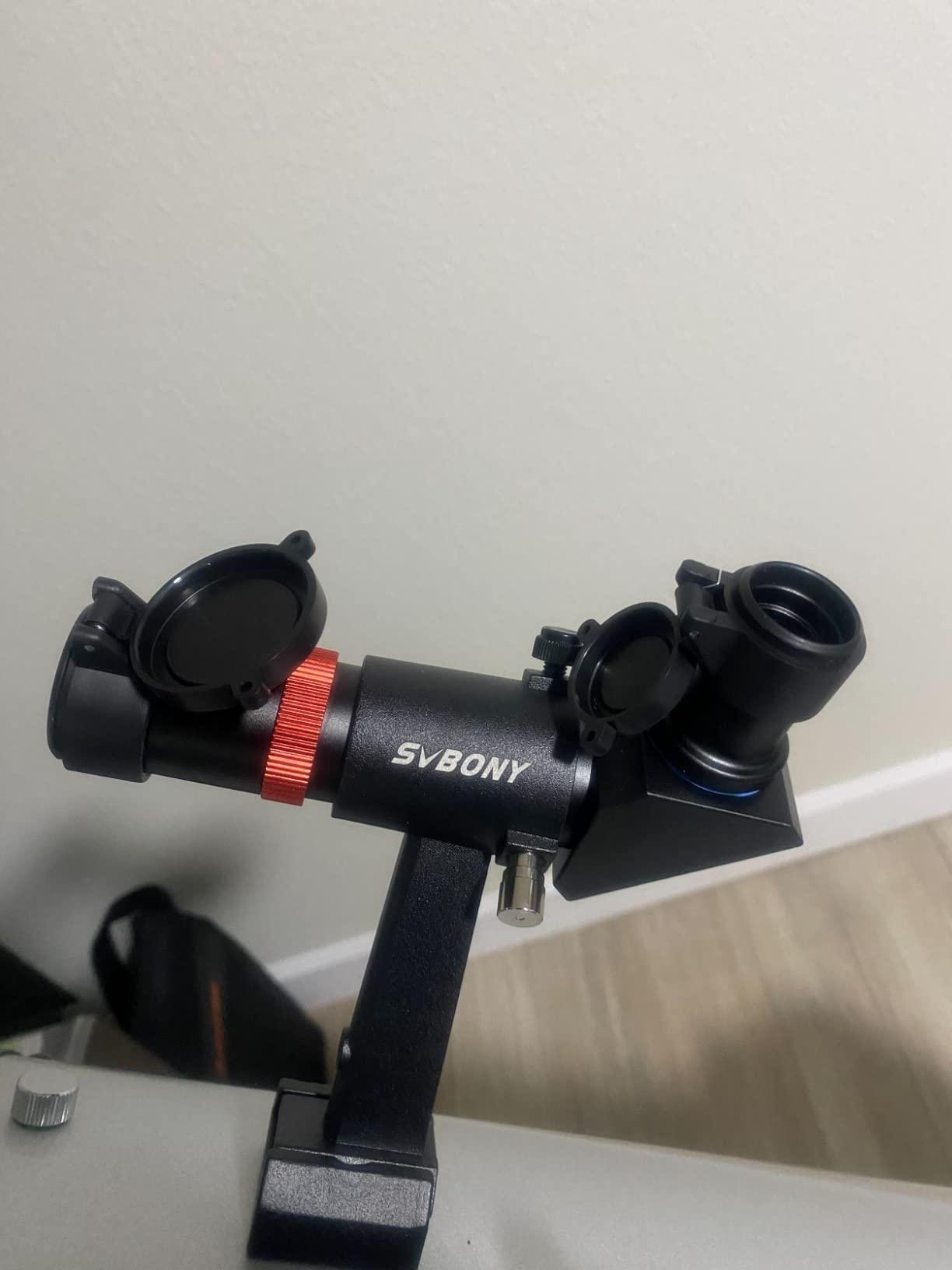
StarSense is the clever part. You dock your phone in the supplied holder, and the app uses the phone’s camera to recognise the star field overhead, then tells the scope where to point. For a first-time 10-inch Dobsonian owner who has never used a finder scope properly, that removes the single largest barrier. The app also generates a curated list of targets for the current date, time and location, so you are not scrolling a catalogue at midnight in the cold.
Reviewers describe guided pointing as the feature that makes a large Dobsonian feel approachable. My own experience matches that: with StarSense the first target takes under a minute, and without it, the same target can take ten minutes of faint star-hopping. The wide-field design and the 2 inch focuser make this the best instrument here for sweeping a large, faint galaxy across the frame.
Where this telescope earns its size
At 254mm you cross into a different tier of targets. Andromeda shows dust lanes on one side of the core, Bode’s Galaxy (M81) and the Cigar Galaxy (M82) sit comfortably in the same field and are both obvious, and the Pinwheel Galaxy (M101) starts to show uneven, mottled structure rather than a uniform smudge. The Hercules Cluster resolves into a swarm of distinct stars. Those are the views that make people stay in this hobby.
The f/2.6 focal ratio is the other quiet advantage. Fast Newtonians gather light efficiently and produce a wide, even field, so fainter surface brightness survives to the eyepiece. If your top target is a large, diffuse galaxy rather than a compact one, the fast design works in your favour.
What the size costs you
Fifty-four pounds is the honest number, and it is a two-person move. The tube and the base separate for transport, but neither component is a one-hand carry, and getting the whole rig to a dark site means a car and a second adult. Owners who underestimated this before buying report it as the main regret.
Two smaller frictions. StarSense is useless without a compatible phone and its unlock code, so if you leave the phone at home you have a 10-inch Dobsonian with no finder assistance. And the mount is fully manual, so targets drift out of the field during a long look; you learn to nudge the tube with both hands, which is normal for a Dobsonian but worth knowing before night one.
4. Sky-Watcher Classic 200PDS: A Traditional 8-Inch Dobsonian With No Electronics
Sky-Watcher Classic 200 Dobsonian 8-inch Telescope – Solid-Tube – Simple, Traditional Design – Easy to Use, Perfect for Beginners, White (S11610)
203mm aperture
1200mm focal length at f/5.9
Solid-tube Dobsonian base
Pros
- 203mm aperture at 94 percent mirror reflectivity
- No electronics to learn or service
- Tension control handles make moving the tube easy
- Teflon azimuth bearings glide and hold
- 2-inch focuser supports wide-field views
Cons
- Solid tube is bulkier than a truss design
- 45 lb is a two-person lift
- No tracking so targets drift
The Classic 200PDS is the traditional answer: a solid-tube 8-inch Newtonian on a wooden Dobsonian base, with no motors, no menus and nothing to go wrong. For a buyer who wants maximum aperture per unit of hassle, it is hard to argue with, and the fully multi-coated borosilicate mirrors at 94 percent reflectivity give a bright, high-contrast image on galaxies.
At 1200mm focal length it is f/5.9, longer than the fastest Dobsonians and easier to control optically. The field is narrower than a 650mm f/4.7 design, so big galaxies do not fit as comfortably, but the image is tidy and the included 25mm and 10mm super wide-angle eyepieces through a 2-inch Crayford focuser give you good wide-field capability anyway. A faintest stellar magnitude of 14.2 tells you how deep you can push on star fields and clusters.
The design details that reviewers praise most are small ones. The patented tension control handles let you move the tube without achieving perfect balance first, which is a genuine improvement on cheaper Dobs where you fight the tube. The Teflon azimuth bearings glide smoothly and hold position, so once you centre a galaxy it stays centred while you look. The 9×50 straight-through finder gives a real, magnified view rather than a vague red dot, which helps on faint targets.
It is also a completely traditional design with nothing to learn beyond pointing. A 4.0 average rating across 240 reviews reflects a very good scope with a minority of early quality complaints rather than a problematic product. Owners who arrive from a beginner refractor usually describe the difference in brightness as startling.
Why this one still earns a place in 2026
Because 8 inches of aperture without electronics is a combination nothing else here matches, and because the electronics-free approach means no alignment, no batteries and no hand control to fail in the field. If your observing site is a driveway or a field with no power, this is a simple, dependable tool.
It is also a strong value comparison. The optical tube is a 203mm parabolic primary with a Radian aluminum quartz coating, which is a good glass specification, and the bundle includes a 2-inch focuser with a 1.25-inch adapter so you are not locked into one eyepiece format. Add a pair of Plossl eyepieces later and the setup improves measurably.
Where the compromises are
The solid tube is heavier and bulkier than a truss-tube Dobsonian of the same aperture, and 45 lb assembled is a two-person lift. If you plan to move to dark skies regularly, a truss design or a tabletop mount is a better fit for your back.
There is also no tracking, so a galaxy drifts across the field over a few minutes of observation. Dobsonian users push the tube by hand and it becomes automatic after the first night, but it is a real difference from a motorized scope. And the straight-through finder means bending down to look through it, which some owners dislike more than others.
5. MEEZAA 150EQ: A Fast f/4 Light Bucket With the Biggest Accessory Bundle
MEEZAA Telescope, 150EQ Newtonian Reflector Telescope for Adults Astronomy Beginners, Professional Astronomical Telescopes with Equatorial Mount, Tripod, Phone Adapter, Moon Filter and Large Carry Bag
150mm aperture
650mm focal length at f/4.3
German equatorial mount
Pros
- Fast f/4 design gathers plenty of light for galaxies
- Unusually complete kit with Barlow and filters
- German equatorial mount with slow-motion knobs
- Stainless steel tripod holds steady at high power
- Color-coded tool-free assembly
Cons
- One buyer measured a 130mm mirror instead of the listed 150mm
- Included Kellner eyepieces are entry-level
- All-plastic focuser limits heavier accessories
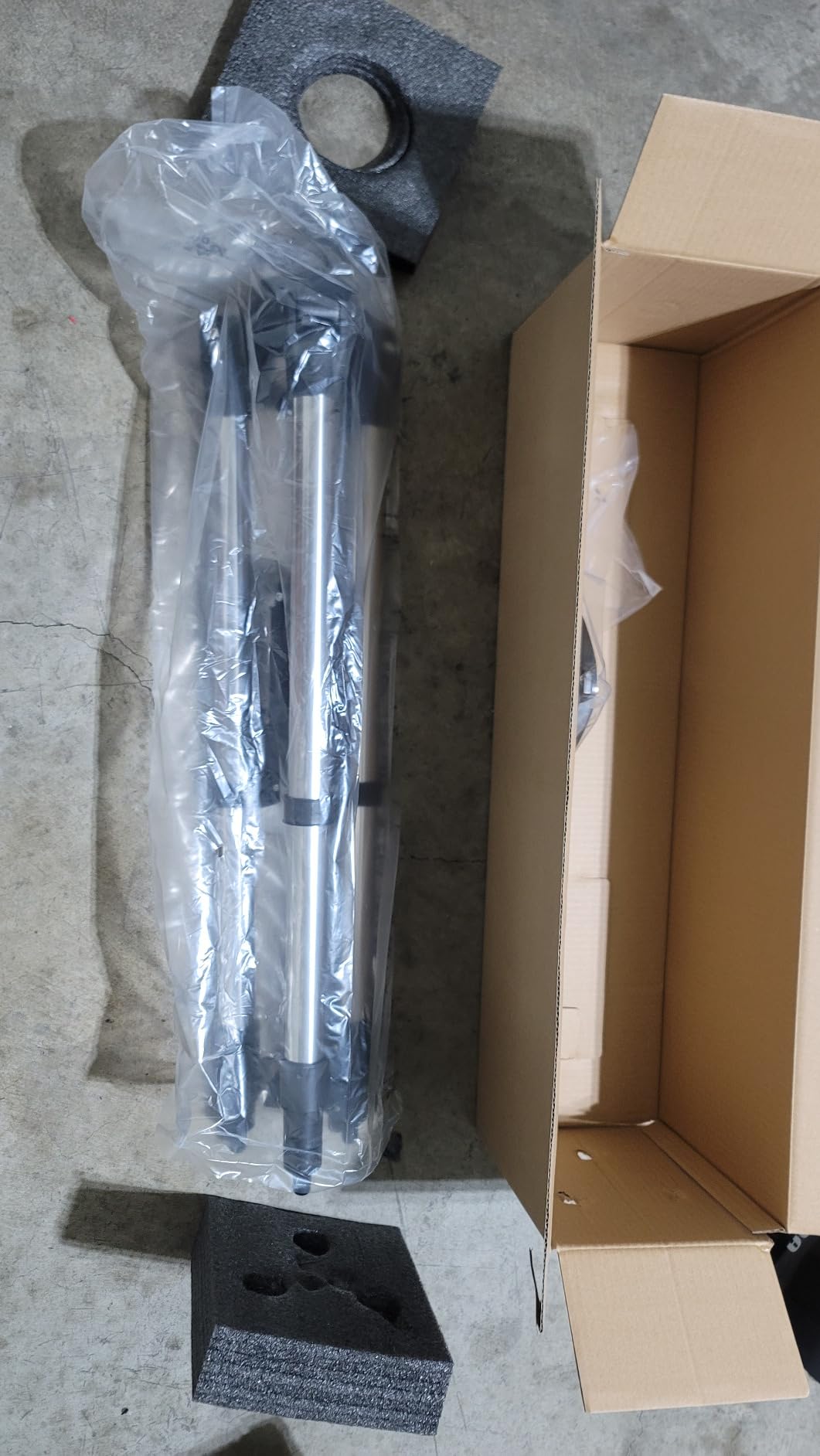
This is the bundle value pick. Out of the box you get a fast Newtonian on a German equatorial mount, two eyepieces, a 2x Barlow, a red dot finder, a moon filter, a solar filter, a phone adapter, an accessory tray and a large carry bag that the whole telescope fits into. Very few scopes at this tier ship with that much.
Optically it sits at 650mm focal length and f/4.3, which makes it one of the faster designs here. Fast focal length means a wide, bright field, and the f/4 ratio plus a large aperture gives a good showing on galaxies from suburban skies, which is where most people actually observe. The 25mm and 10mm Kellner eyepieces cover 26x to 130x, and the 2x Barlow extends that when you want to fill the field on a bright core.
Owners treat this as a light bucket on a capable mount, and they rate it above its tier. Reports mention crisp lunar detail, Jupiter’s bands and the red spot, and views of the Orion Nebula and other galaxies from suburban locations. The German equatorial mount with slow-motion knobs and latitude dials lets you track a target once aligned, which is the same advantage the AstroMaster offers at a smaller aperture.
The stainless steel tripod and pre-lubed mount are better than the light steel legs common in this class, and reviewers report steady images at higher magnification. The stainless construction also resists the corrosion and wobble that shows up a year in.
The aperture question to check on arrival
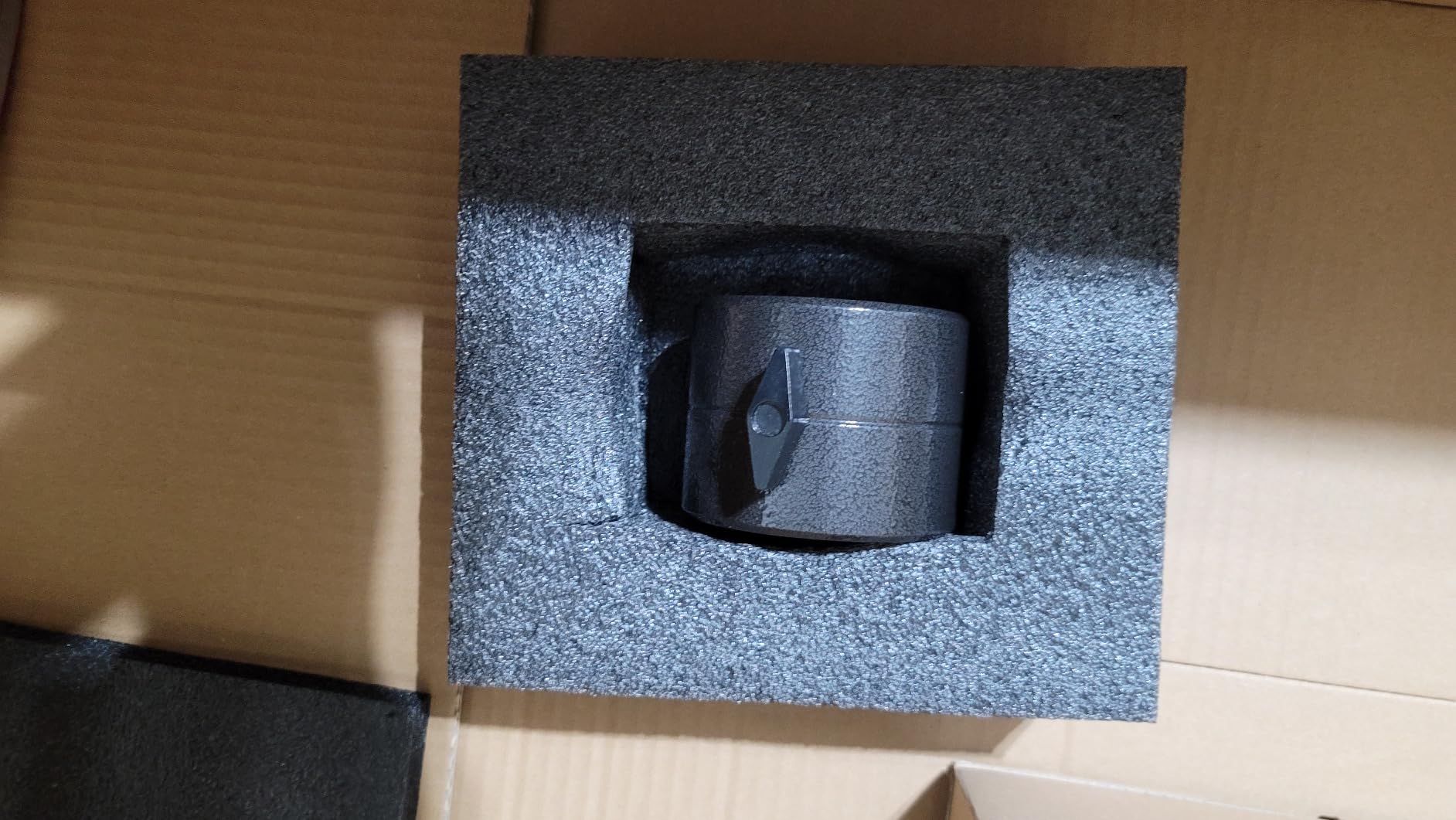
One reviewer measured a 130mm primary rather than the listed 150mm, and that single review is the most important thing to know about this product. If you buy it, check the actual mirror diameter before you set your expectations for galaxy detail. The listed spec is 150mm, and a f/4.3 ratio implies it, but a quick check costs nothing and removes all doubt.
Assuming the listed spec holds, 150mm gives you roughly a third more light-gathering area than a 130mm scope, which is a meaningful step for the fainter galaxies. The fast focal ratio keeps the image bright, so a suburban observer gets a usable view of several targets rather than a hint of one.
What to upgrade first
Replace the Kellner eyepieces with Plossl before you replace anything else. Reviewers consistently describe the bundled eyepieces as the weakest part of an otherwise capable package, and a set of 25mm and 10mm Plossls is a cheap, immediate improvement in contrast and sharpness on faint galaxies.
The all-plastic focuser is the second limit, and it matters if you plan to attach a camera or heavier accessories later. For purely visual work it holds up fine. The phone adapter is also fiddly to align with the eyepiece, so budget a few minutes of setup rather than expecting it to work first try.
Finally, assembly involves many pieces. The color-coded instructions and no-tool design help, but this is not a five-minute build like a tabletop Dobsonian. Set aside twenty minutes the first evening.
6. Sky-Watcher Heritage 130 Tabletop Dob: The Lowest-Friction First Scope
Sky-Watcher Sky-Watcher Heritage 130mm Tabletop Dobsonian 5-inch Aperture Telescope – Innovative Collapsible Design – Easy to Use, Perfect for Beginners, Black/White (S11705)
130mm aperture
650mm focal length at f/5
Collapsible tabletop altazimuth base
Pros
- Arrives fully assembled and ready to observe
- Stable tabletop base holds position
- Lightweight and easy to carry
- Sharp views of Moon Jupiter and Saturn
- Strong optical value
Cons
- Faint galaxies are hard to see in light-polluted skies
- Included eyepieces are basic
- Red dot finder slips out of alignment
With a 4.5 average across 84 reviews, this is the highest-rated scope in the group, and the reason is simple: nothing about it asks anything of you. It arrives fully assembled, sits on a table, and works. Many owners describe it as their first telescope and several describe buying a larger one a year later, which is a good sign rather than a complaint.
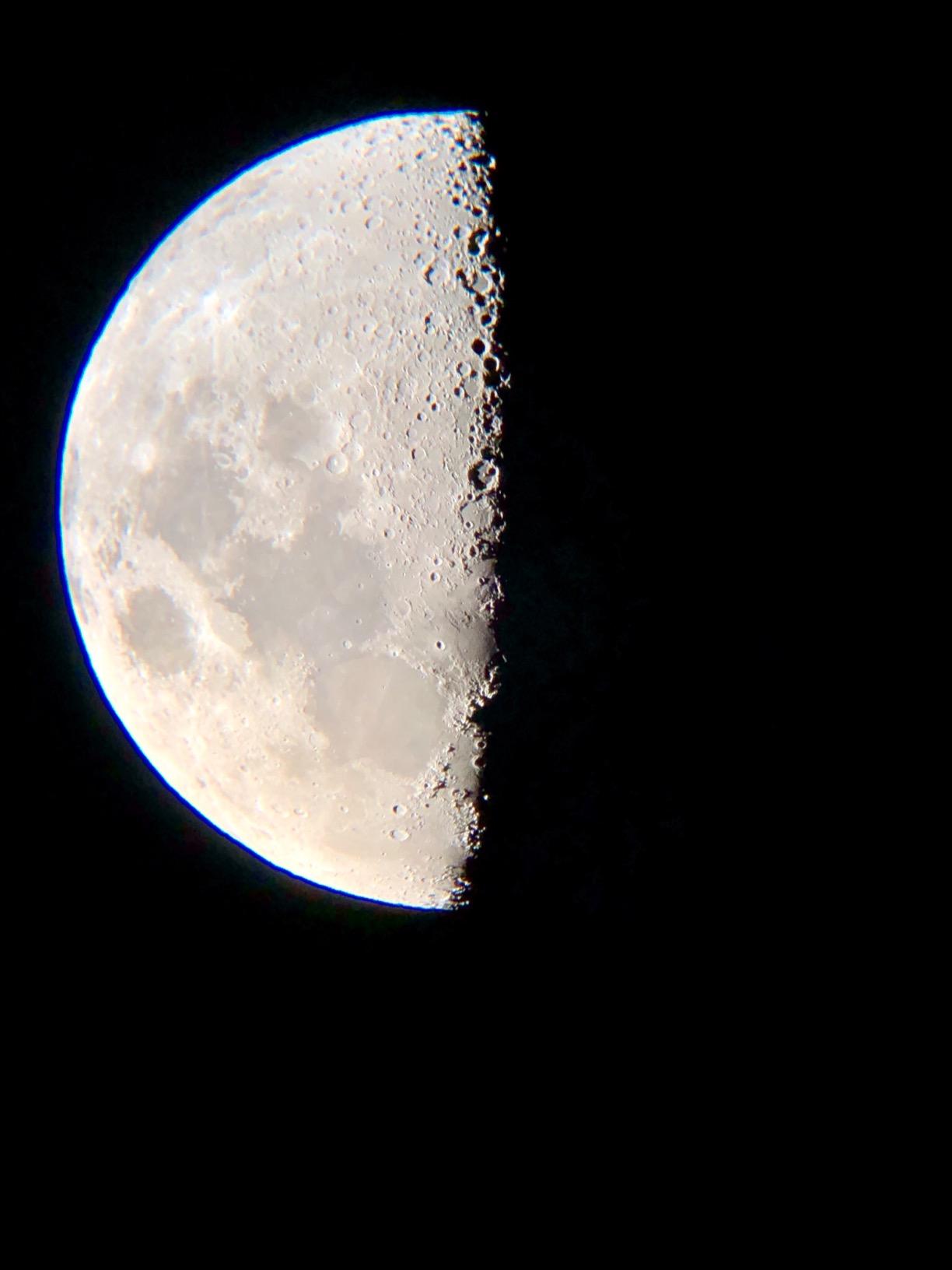
The optics are 130mm at 650mm, so f/5, with fully coated glass and Radiant Aluminum Quartz coatings. That is enough aperture for the Moon’s craters, Jupiter with its moons and Saturn’s rings, all of which owners single out as sharp. It also reaches the brightest galaxies, but only just, and the honest answer is that faint deep-sky objects are hard to see from city or suburban skies.
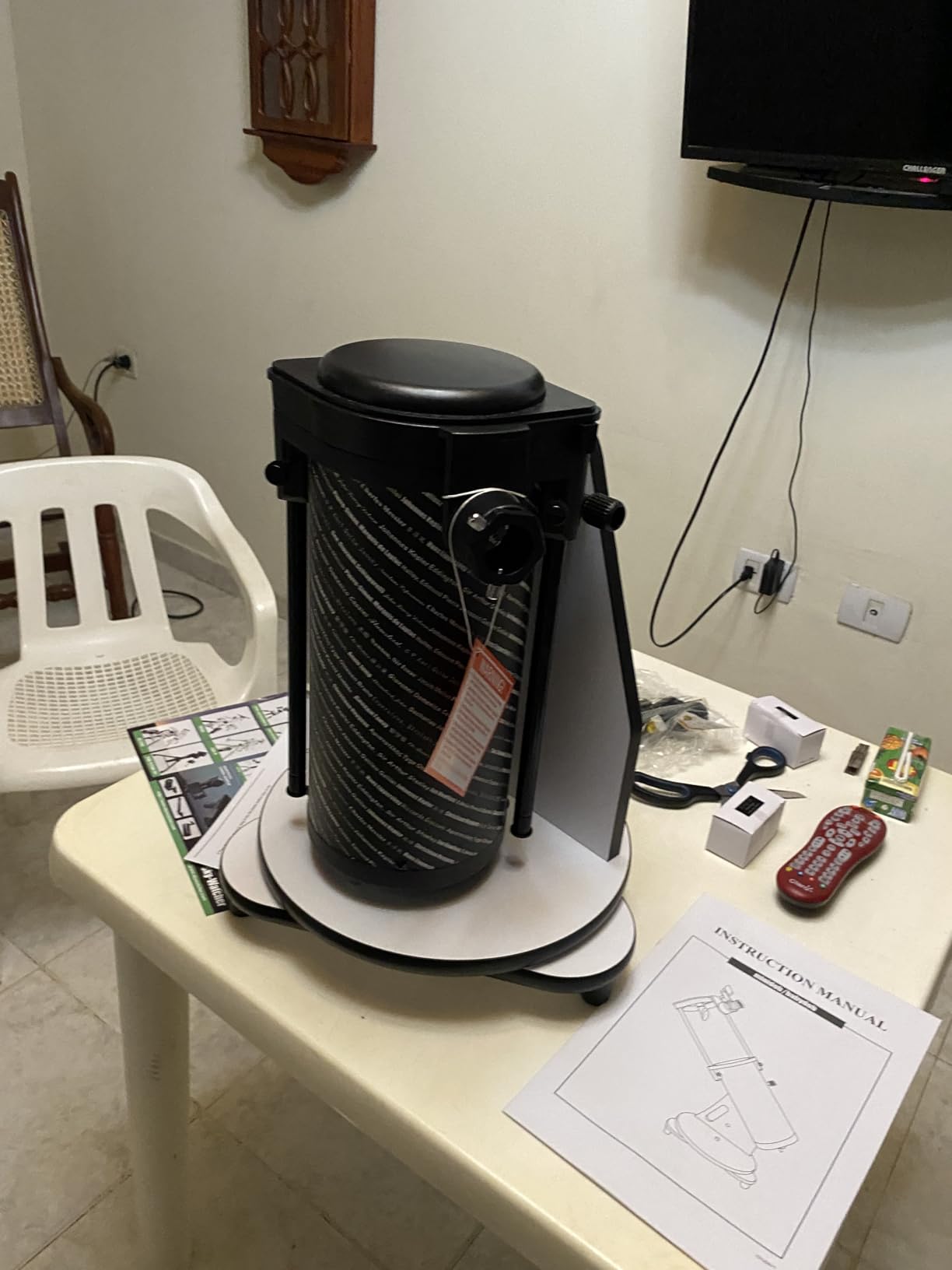
The collapsible tube design is the real portability story. The optical tube unscrews from the base and the whole thing packs into a car boot or a cupboard, which makes it the easiest scope here to carry to a dark site, to a friend’s house, or to a family evening outdoors. The stable altazimuth tabletop base holds position for long sessions, which matters more than it sounds when you are tracking a dim target by hand.
Everything you need is in the box: 10mm and 25mm Plossl eyepieces, a StarPointer red dot finder, a lens cap and a two-year warranty. There is no separate finder to align, no equatorial head to level and no software to install.
Where this scope is the right answer
This is the pick if your real question is whether you will actually use a telescope. A scope that needs an evening of assembly, polar alignment and collimation before the first look is a scope many people never use again. This one removes all of that friction, and the small format makes it easy to put outside on a clear night without asking anyone for help.
It is also a sensible first instrument for a family. It is small enough to hand to a child with supervision, light enough for an adult to carry one-handed, and quick enough to set up between dinner and bedtime. If that is your situation, our guide to telescopes for kids covers the trade-offs in more depth.
Where it will disappoint you
On galaxies, specifically. 130mm from a bright suburban sky will show you Andromeda as a faint oval and little else. The review data on this scope is explicit that light-polluted skies are its weak point, and the limited light gathering is why it stays a Moon and planet instrument first. Buy it for the first year of the hobby, not for the galaxy list.
There are two small hardware complaints worth knowing. The red dot finder slips out of alignment easily and owners often tape it in place. The focuser knob can be very tight out of the box, and a drop of lubricant on the threads fixes it in about a minute. The included Plossl eyepieces are perfectly serviceable, and a wider 8-24mm zoom is the most commonly recommended upgrade.
7. Sky-Watcher Virtuoso GTI 150P: App-Driven GoTo in a Carryable Package
Sky Watcher Sky-Watcher Virtuoso GTI 150P Collapsible Tabletop GoTo Dobsonian Telescope
150mm aperture
750mm focal length at f/5
Wi-Fi GoTo with SynScan Pro app
Pros
- 150mm aperture reaches galaxies a 130mm cannot
- Fast f/5 optics at 750mm give bright bold images
- GoTo pointing removes the guesswork from finding
- Freedom Find lets you move by hand without losing alignment
- Includes two Super Plossl eyepieces
Cons
- 25.8 lb is noticeably heavy to move to dark skies
- App-driven GoTo needs a phone and has a learning curve
- Periodic collimation checks needed at this aperture
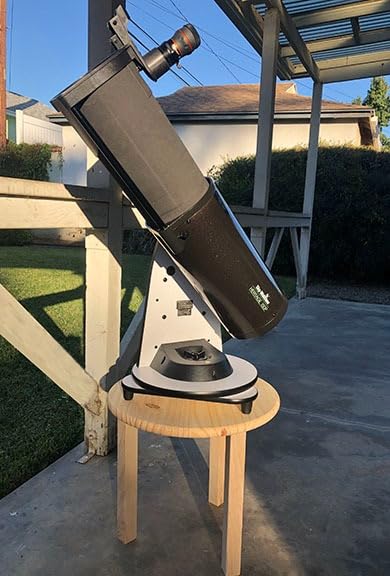
The Virtuoso GTI 150P is the compromise for someone who wants automated pointing without the size or cost of an 8-inch fork-mounted GoTo. It is a 150mm Newtonian at 750mm focal length, so f/5, sitting on a collapsible tabletop Dobsonian base with built-in Wi-Fi.
The Freedom Find system is the detail that makes it work. Dual encoders let you push the tube by hand and the mount still knows where it is pointing, so you can centre an object manually without losing your GoTo alignment. That single feature removes the most common frustration with small GoTo mounts, where one nudge and the mount forgets everything.
Reviewers pick this model for the jump from small tabletop scopes to a real light-gathering aperture. 150mm is meaningfully more light than a 130mm, and paired with fast f/5 optics it gives bright, contrasty views of galaxies, nebulae and planets. The GoTo pointing through the SynScan Pro app is consistently described as the feature that removes the guesswork from finding targets, which is the reason to buy it over a manual scope of the same size.
The package is complete for a first session: two Super Plossl eyepieces, a red dot finder, and the full base and mount assembly. Compatibility with both iOS and Android means the app is not the limiting factor.
Why this one rather than a manual 150mm
Because galaxies are invisible to the naked eye, and finding them is the hardest part of galaxy observing. A 150mm manual Dobsonian can show you more, but only if you can find the target first. GoTo pointing gets you there in under a minute, which means more of the session is spent looking and less spent scanning.
It also suits a shared scope. When two people want to look at different things, or when you want to show a visitor a specific galaxy without hunting for it, automated pointing is the difference between a demonstration and a fumble.
What to know before buying
At 25.8 lb it is noticeably heavier than a 130mm tabletop Dobsonian, and that difference is felt when you are carrying it to a dark site. The collapsible design keeps it manageable, but it is a two-hand move in a car boot, not a one-hand carry.
The app workflow takes some getting used to, and navigation is dependent on a phone. This is a Newtonian, so expect periodic collimation checks at 150mm; budget a laser collimator as a follow-up purchase. And like any Dobsonian, targets drift during long observations, though the encoders make correcting that easy.
How Much Aperture You Need for Real Galaxy Structure
This is the question forum users ask most often, and it is the one the roundups almost never answer with specifics. Here is what each aperture size in this lineup realistically resolves, using the targets most people want to see.
70mm and 80mm refractors: You will see M31 as a small grey oval and M13 as a fuzzy ball that partly resolves. The Pinwheel and Whirlpool galaxies are not reachable. No scope in this roundup is this size, deliberately, because a refractor that small cannot deliver on a galaxy promise.
114mm to 130mm: M31 shows a brighter core with a halo. M33 is a large, very dim smudge that responds to averted vision. The Virgo Cluster members appear as small fuzzy patches. Spiral structure is not visible. The Heritage 130 and the AstroMaster 130EQ sit here.
130mm to 150mm at low magnification: A wider view helps more than extra magnification. M81 and M82 sit in the same low-power field and both are obvious, which is the first view that makes people describe a galaxy session as memorable. The MEEZAA 150EQ and the Virtuoso GTI 150P sit here.
8-inch, 203mm: This is the threshold most people mean when they say “shows galaxies.” M31 shows a distinctly oval shape with a bright core and a hint of mottling on its edges. M81 and M82 are both easy. M104 the Sombrero resolves as a bright core with a faint halo and a visible dust band under steady seeing. M13 resolves into hundreds of stars. The NexStar 8SE and the Classic 200PDS sit here.
10-inch, 254mm: Andromeda shows dust lanes on the near side, and M101 begins to show uneven, patchy structure instead of a uniform smudge. Globular clusters resolve into dense swarms of individual points. Fainter targets in the Virgo Cluster and the Coma Cluster start to appear. The StarSense 10-inch sits here, and it is the only telescope in this roundup at that aperture.
The rule of thumb: every extra inch of aperture roughly triples your light-gathering area compared with the size below, while surface brightness of a large galaxy drops fast with magnification. The practical advice is to buy the largest aperture you can physically carry to your observing site, then look at galaxies with the lowest magnification that still shows them.
Dark Skies Matter More Than Glass: A Bortle Class Guide
A 10-inch telescope under heavy city glow will show you less than an 8-inch under a genuinely dark sky. This is the single most repeated point in observer communities, and it is why aperture alone is not a complete answer to “what telescope shows galaxies best.”
The Bortle scale runs from 1 to 9 and measures how much light pollution a site has. Class 1 is a truly dark site where the Milky Way casts a shadow and zodiacal light is obvious. Class 3 is a good rural site. Class 5 is a bright suburban sky. Classes 7 to 9 are inner city, where only the Moon, the planets and the brightest clusters are reliably visible.
For galaxies the effect is direct. A galaxy is a low surface-brightness object, and light pollution raises the sky background it sits against. Under a Class 8 sky, M31 might still be there as a small oval, but the faint outer structure is gone, and most galaxies are invisible. Under a Class 3 sky, an 8-inch shows you M31 dust lanes and a whole field of Virgo Cluster members.
Aperture partly compensates, but it does not fully. Users observing from light-polluted cities consistently report that 10-inch and larger scopes give the best views in poor conditions, while also stressing that transparency and darkness matter as much as aperture in some nights. The honest summary: a larger aperture raises the signal, a darker sky lowers the noise, and you need both.
Three things help if you cannot travel. First, observe when the target is high: a galaxy at 60 degrees altitude cuts through far less atmosphere than one at 20 degrees, and thin atmosphere means less scattered city light in the line of sight. Second, use the lowest magnification that still shows the object, because a wide field spreads the object’s light over fewer pixels of your eye’s low-light sensitivity. Third, use averted vision, looking slightly to one side of the galaxy, which uses the rod cells in your retina and reveals fainter structure.
And get out of the city when you can. An hour of driving to a Class 2 or 3 site is worth more than any single upgrade to a telescope, and it is free.
How to Choose a Telescope for Galaxies: Buying Guide
1. Aperture first, always. The diameter of the main mirror or lens sets light-gathering power, and light-gathering power sets how much galaxy structure you can see. This is the only spec you should optimise hard. Budget advice: spend as much as you can here before spending on anything else, and treat mount electronics as a convenience purchase rather than a galaxy purchase.
2. Focal length and focal ratio. Focal length is the distance from lens to focuser, and magnification is focal length divided by eyepiece focal length. A long focal length like the 8SE’s 2032mm gives high magnification with any eyepiece. A short one like the StarSense 10-inch’s 650mm gives a very wide field. For galaxies, shorter focal lengths and faster f-ratios are usually better, because wide fields show more of a large object and preserve surface brightness.
3. Optical type. Newtonian reflectors give the most aperture per unit of money and no colour fringing, and they are the galaxy default. They need occasional collimation. Dobsonians are Newtonsians on an altazimuth base with a smooth bearing: no polar alignment, no tracking, maximum aperture. Schmidt-Cassegrains are compact and versatile but slower at f/10 and more expensive per inch. Maksutovs and refractors are compact and low-maintenance but cost more per inch of aperture, which is why none appear in this roundup.
4. Mount type. For purely visual galaxy observing, a smooth altazimuth Dobsonian base is the most reliable option per dollar. Equatorial mounts with slow-motion knobs give you tracking that keeps targets centred, which is a genuine advantage for long looks at faint objects. GoTo mounts add automated finding, which matters most for beginners and for anyone without star charts. None of these choices ruins galaxy viewing; aperture and sky quality do that.
5. Portability and where you observe. Be honest about your observing site. A 10-inch Dobsonian shows galaxies far better than a 130mm tabletop scope, and a 130mm tabletop scope you actually take to a dark site will beat a 10-inch that sits in a garage. Check the weight and dimensions of the assembled telescope against your car and your back before you commit.
6. Eyepieces and exit pupil. Aperture divided by magnification equals exit pupil, and matching that to the 5mm to 7mm your dark-adapted eye actually uses is what makes faint galaxies visible. A 25mm eyepiece on a 130mm f/5 scope gives 32x and a 4mm exit pupil, which is a good match. A 32mm on the 10-inch at 20x gives a very wide, very dim view. Add a 25mm and a 10mm Plossl to any scope here and you have the pairing that covers most galaxy targets.
7. Sky before hardware. If you can only observe from a bright suburban or city sky, prioritise aperture harder than usual, because you are working against a raised background. If you can travel, a 130mm or 150mm plus a dark site will out-perform a bigger scope in the city.
Newtonian Care and Collimation in Plain English
Newtonian reflectors need their mirrors aligned to each other, and buyers worry about this far more than they need to. If you own one of the reflectors in this roundup, here is what the job actually involves.
What collimation is. The secondary mirror needs to sit centred under the focuser and the primary mirror needs to reflect to the centre of the secondary. Get it wrong and you lose contrast, and stars look fuzzy with a dark centre. Get it right and the image is sharp edge to edge.
How often. A well-treated Newtonian needs checking every few months, and immediately if it is bumped or transported roughly. Many owners collimate once at the start and then only when a star starts looking soft. A cheap laser collimator is the single best accessory purchase for any Newtonian here.
How long. Ten minutes with a laser collimator, the first time. Five minutes after that. There are many short videos for the specific model, and the AstroMaster and the 150mm-style mounts in particular are covered in detail.
Dew. Reflectors and refractors both fog up on humid nights. A dew shield or a hair dryer on low solves it in seconds. Avoid leaving a heated eyepiece on the whole night; it can damage coatings if it gets too hot.
Storage. Store any scope with the cap off or in a ventilated position so trapped humidity does not mildew the mirror. Do not put the cap back on a warm tube. For the solid-tube Dobsonian, store the tube on its side or on a dedicated cradle rather than on the base, and check that the tension handles are not under load.
Transport. Lock the altitude tension knobs before carrying a Dobsonian, and carry the tube and base separately for anything above 8 inches. A car boot is the right answer for a 10-inch; a backpack is not.
Frequently Asked Questions
What telescope is best for seeing other galaxies?
A large-aperture Dobsonian reflector is the best value for galaxies, and 8 inches of aperture is the practical threshold where structure appears. Our top pick is the Celestron NexStar 8SE, a 203mm Schmidt-Cassegrain on a computerized fork mount whose SkyAlign system points itself at faint targets so you spend your time looking rather than searching. For the largest views per dollar, a manual 8-inch Dobsonian gathers the same light with no electronics at all.
What is the cheapest telescope I can buy to see galaxies?
The cheapest scope in this roundup that reliably shows galaxies is the Sky-Watcher Heritage 130, a fully assembled 130mm tabletop Dobsonian. It resolves Andromeda as a faint oval and the brighter Virgo Cluster members as fuzzy patches, and it is the entry point into the hobby. If you can stretch to a German equatorial mount, the MEEZAA 150EQ offers noticeably more light for a modest step up. Neither will show spiral arms; that needs 8 inches.
What aperture size is ideal for viewing distant galaxies?
Eight inches, or 203mm, is the practical threshold for real galaxy structure. Below 150mm you see M31 as a plain oval with no internal detail. At 8 inches you start to resolve mottling in Andromeda, see M81 and M82 in the same field, and pick out the dust band in the Sombrero Galaxy. At 10 inches dust lanes in M31 become visible. Buy the largest aperture you can physically carry to your observing site.
Can you see galaxy color through a telescope?
Not in any meaningful sense. Galaxies emit light across the visible spectrum, but your eye loses colour perception at very low light levels, so faint extended objects look grey through an eyepiece no matter how good the optics are. The colourful spiral galaxy images people picture come from cameras and long-exposure stacking software. Expect a soft grey oval with a brighter core, and treat colourful eyepiece views as a sign the seller is overpromising.
What is the best telescope for viewing deep space and planets?
An 8-inch Dobsonian reflector handles both well. 203mm of aperture gives you spiral structure in bright galaxies and enough resolution for Jupiter’s belts, the Galilean moons and Saturn’s rings on the same night. The Sky-Watcher Classic 200PDS does this with no electronics to learn. If you want automated finding for a mixed deep-sky and planetary programme, the Celestron NexStar 8SE at f/10 gives sharper planetary images and will drive itself to both kinds of target.
The Verdict: Which Galaxy Telescope to Buy in 2026
For most people reading this, the Celestron NexStar 8SE is the best telescope for viewing galaxies because it puts 8 inches of aperture behind an automated pointing system, and the two halves of that solve the two things that stop beginners. Buy the Sky-Watcher Classic 200PDS instead if you want the same aperture with no electronics and less money. Buy the Celestron StarSense 10-inch if you have a car, a second pair of hands and a dark site within reach, because nothing else here resolves as much.
Below that, the Celestron AstroMaster 130EQ is the most-reviewed telescope in this group and the best value for a first serious scope, the MEEZAA 150EQ gives the most equipment per unit of money, the Sky-Watcher Virtuoso GTI 150P is the pick if you want app-driven GoTo without a full-size fork mount, and the Sky-Watcher Heritage 130 is the right first instrument if the priority is that you will actually use it.
Whatever you choose, spend your next effort on the sky rather than the glass. Drive an hour to a darker site, observe when the target is high, use your lowest useful magnification, and let your eyes dark-adapt for fifteen minutes before you judge the view. That habit will show you more galaxies than any upgrade on this list. If you are still deciding between categories, our telescope picks for students break the options down by budget and use case.