
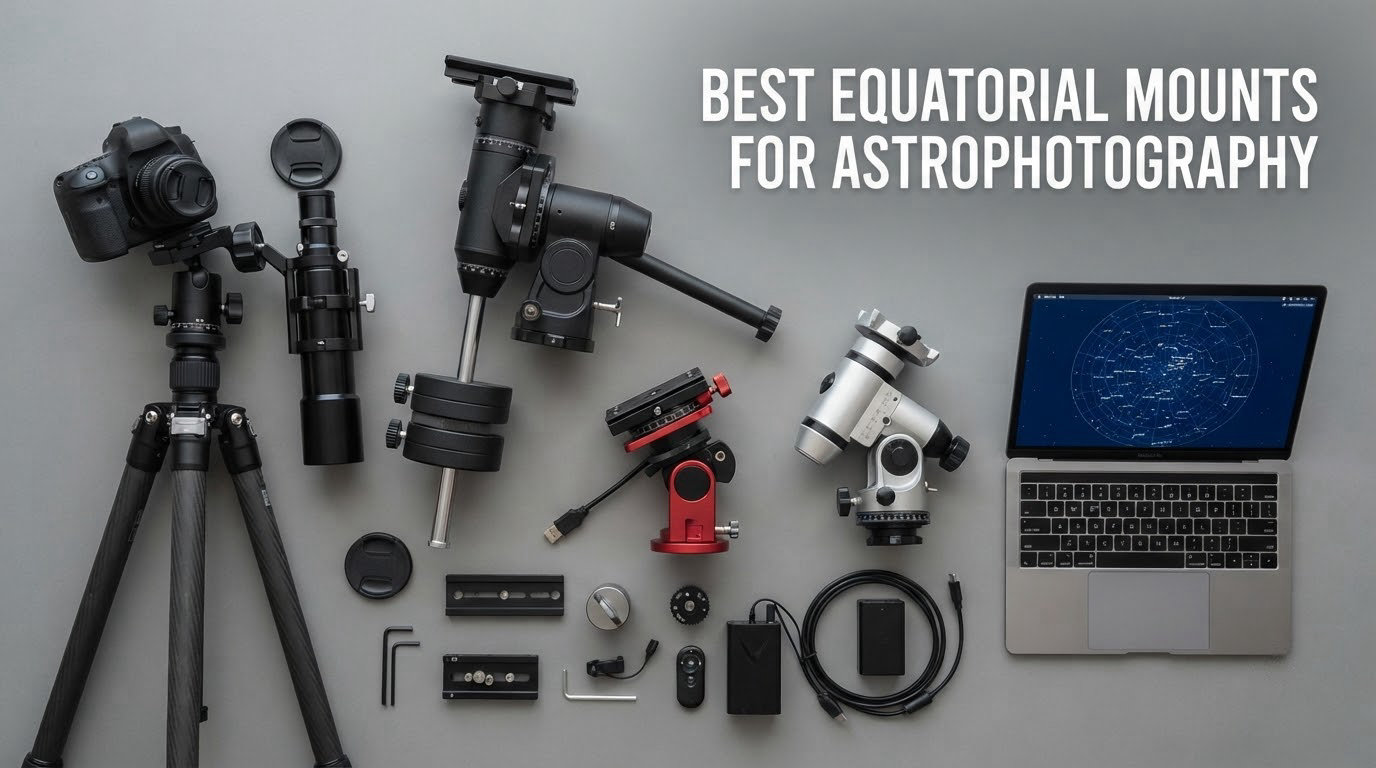
The best equatorial mount for astrophotography is the one whose payload comfortably exceeds your imaging train and whose weight you can still carry to a dark site. After comparing nine motorized equatorial mounts side by side, the Sky-Watcher Star Adventurer 2i Pro Pack takes our top slot for wide-field work, the iOptron SkyGuider Pro is the strongest all-round tracker at 4.5 stars, and the Celestron Advanced VX is the German equatorial workhorse most people graduate to.
That is the honest answer, but it hides a decision most buyers get wrong. People ask which mount is best when the real question is which class of mount their optical tube deserves, because an 80mm refractor, an 8-inch Newtonian and a 200mm telephoto lens have almost nothing in common in terms of payload, guiding demands and how long you can hold the frame still.
So this guide covers all nine of them, from pocket trackers you can carry up a flight of stairs to a 108-pound observatory head. We looked at payload headroom, drive type, alignment aids, weight, power options and how each one behaves under third-party guiding software. Every number below comes from the manufacturer specification and from what owners report after real imaging sessions.
New to the hobby and still choosing an optical tube? Our telescope picks for astrophotography break down the tube options that pair well with each mount tier here.
Top 3 Best Equatorial Mounts for Astrophotography In 2026

Sky-Watcher Star Adventurer 2i Pro
- 7 lb portable tracker
- Built-in Wi-Fi with SAM Console app
- Deluxe equatorial base with polar alignment scope
- Autoguider port included

iOptron SkyGuider Pro
- All-metal body at 2.2 lb
- 11 lb payload when balanced
- AccuAlign illuminated polar scope
- Up to 20 hours internal battery

Celestron Advanced VX
- 30 lb payload
- 2-inch stainless steel tripod legs
- All-Star polar alignment and PPEC
- Latitude range of 7 to 77 degrees
The Star Adventurer 2i Pro has the largest owner base of anything in this guide, and the reasons are not subtle: it weighs 7 pounds, it has a built-in polar alignment scope in the deluxe equatorial base, and it tracks a camera with a short lens to pinpoint stars without autoguiding. The SkyGuider Pro earns its badge on build quality, with an all-metal body where most competitors use plastic, plus a rechargeable battery that covers a full night. The Advanced VX is the choice when you have outgrown a camera and need a real German equatorial head with 30 pounds of payload.
All Nine Equatorial Mounts Side by Side in 2026
| Product | Specifications | Action |
|---|---|---|
| Sky-Watcher Star Adventurer 2i Pro Pack |
|
Check Latest Price |
| iOptron SkyGuider Pro |
|
Check Latest Price |
| Celestron Advanced VX |
|
Check Latest Price |
 Sky-Watcher Star Adventurer GTi Kit Sky-Watcher Star Adventurer GTi Kit |
|
Check Latest Price |
 Sky-Watcher EQ6-R Sky-Watcher EQ6-R |
|
Check Latest Price |
 Celestron CG-4 Manual Celestron CG-4 Manual |
|
Check Latest Price |
 Explore Scientific iEXOS-100-2 Explore Scientific iEXOS-100-2 |
|
Check Latest Price |
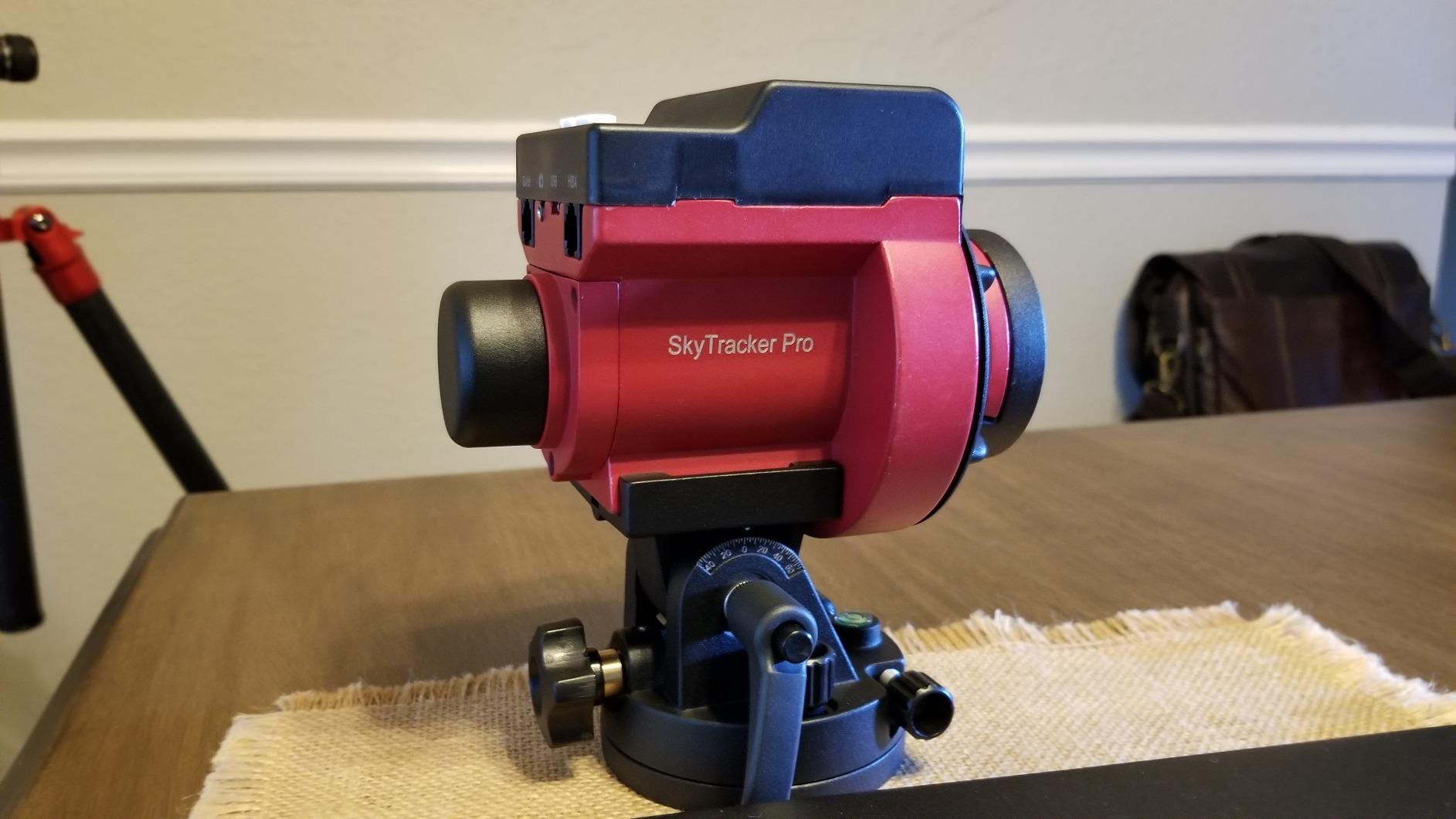
 iOptron SkyTracker Pro iOptron SkyTracker Pro |
|
Check Latest Price |
 Celestron CGX Celestron CGX |
|
Check Latest Price |
Read that table by payload column, not by brand. The first four entries here carry between 3 and 11 lb of capacity and are really camera trackers. The last four accept imaging telescopes. If your total load sits above 15 pounds, the tracker half of this list is already out of the conversation.
How We Picked and Scored These Mounts
Budget astro hardware accumulates, and the review counts we worked from range from 20 to 609. A thin review base is a real trust gap, so we weighted owner reports from the largest samples most heavily and flagged the low-volume picks explicitly.
We scored each mount on six things. Payload headroom against your likely load, since the community rule is to stay at 50 to 60 percent of rated capacity. Tracking quality as reported under guiding, which covers periodic error and backlash. Alignment aids, because an illuminated polar scope saves twenty minutes a night. Total weight, including the tripod, because a mount you cannot lift is a mount you will stop using. Software support, specifically whether it plays nicely with PHD2, NINA and ASCOM rather than only the bundled app. And build quality, where metal construction consistently beats plastic at the same price.
Two products in this list scored below par and are included with that stated plainly, because a mount roundup that hides the weak entries is just an advertisement.
1. Sky-Watcher Star Adventurer 2i Pro Pack: Best Overall for Wide-Field Imaging
Sky-Watcher Star Adventurer 2i Pro Pack (S20512)
7 lb item weight
Polar alignment scope in deluxe base
Wi-Fi SAM Console app
Autoguider port
Pros
- Light enough to carry to a dark site in one hand
- Deluxe base includes a polar alignment scope
- Built-in Wi-Fi for phone control
- Autoguider port for when you outgrow unguided
Cons
- Needs a sturdy tripod rated well above the mount weight
- External polar illuminator is awkward to fit
- Plastic SNAP connector and battery cover feel flimsy
Our top pick has been in the hands of more imagers than anything else here. The 2i Pro Pack weighs 7 pounds as listed, folds into 13.9 by 9.6 by 6.3 inches, and runs on lithium metal batteries that are included. Owners report roughly 40 hours of runtime on one set of cells, which means a full night of shooting without a power bank.
Tracking holds pinpoint stars with lenses up to about 300 to 400mm, which covers a 24mm wide lens, a 50mm, and most short refractors with a camera. The deluxe equatorial base carries a polar alignment scope, and Wi-Fi control through the Sky-Watcher SAM Console app pairs quickly and stays connected. There is an autoguider port when you want to stretch sub-exposure length.
The weakness is the tripod question. This mount does not include one, and the small plastic SNAP connector and battery cover are the parts most likely to fail. Budget for a properly rated photographic tripod and a decent ball head, and this becomes a genuinely complete wide-field rig.
What Focal Lengths It Handles Without Guiding
Owners consistently report clean frames with wide and moderate lenses and no guide camera at all. Past roughly 400mm, you will want the autoguider port and a guide scope in the mix. That boundary is where the Star Adventurer stops being a casual setup and starts being a real imaging rig.
The Wi-Fi app control is also worth understanding before you buy. It is stable and easy to pair, and it handles tracking rates and exposure control well, but the feature set is basic compared with a wired hand controller. Owners who need fine slewing end up driving the mount with third-party software instead.
Where It Falls Short
The external polar illuminator is the most common complaint. Fitting it after a camera is attached on the dovetail is fiddly, and the alignment procedure takes practice before it becomes automatic. Rare units have also reported erratic drive motor behaviour straight out of the box, so testing a full tracking run in daylight before a night shoot is worth ten minutes of your time.
2. iOptron SkyGuider Pro: Best Metal-Built Portable Tracker
iOptron SkyGuider Pro Camera Mount Full Package
2.2 lb metal body
11 lb balanced payload
Illuminated AccuAlign scope
Pros
- All-metal body resists vibration
- Night-long internal battery
- Illuminated AccuAlign polar scope
- Compact enough for a camera bag
Cons
- 5 kg payload caps your optical tube choices
- Azimuth adjust only plus or minus 5 degrees
- Sold without a ball head or tripod
The SkyGuider Pro is the pick for anyone who wants a tracker that feels solid rather than plasticky. The mount body is all metal and weighs 2.2 pounds, which is why it tracks so cleanly relative to its size. When balanced, it handles up to 11 pounds, which is double what most trackers in this class can take.
The integrated AccuAlign polar scope is dark-field illuminated, so alignment works at the pole without washing out faint stars. Latitude adjustment runs from -30 to 65 degrees, covering most of the inhabited world, and the internal rechargeable battery gives up to 20 hours of operation at 20 degrees Celsius. That is an entire session without external power.
This is also the mount many long-time imagers name first. One owner with two years of imaging reported reaching for it over heavier options, and the 4.5 star average across 196 reviews backs that up. The 78 percent five-star share is the highest in this guide.
Why the Metal Body Matters in Practice
Vibration is what softens star edges and defeats stacking, and a metal chassis resists it far better than the glass-filled plastic used in comparable trackers. Reviewers repeatedly single this out as the reason tracking is stable. Combined with 11 pounds of payload, it also accepts a small refractor and a guide scope, not just a camera body.
The altitude wheel is smooth and the illuminated reticle is genuinely usable at the pole, so alignment is quick even on a first attempt. Latitude range of -30 to 65 degrees means it works from southern latitudes through the temperate band without modification.
Where It Falls Short
Two limits decide this mount for you. The payload figure of 5 kg rules out anything heavier, so a fast Newtonian or a long refractor is out. The azimuth adjustment of only plus or minus 5 degrees is tight enough that some tripods need improvisation to bring the scope over the pole. Budget for a separate ball head, because the package does not include one.
3. Celestron Advanced VX: Best Value German Equatorial Mount
Celestron Advanced VX Computerized German Equatorial Mount – 30lb Payload
30 lb payload
2-inch stainless steel tripod legs
47 lb total kit weight
All-Star polar alignment
Pros
- Rock-solid German equatorial construction
- 30 lb payload suits mid-size imaging tubes
- NexStar+ hand control with 40000+ objects
- Works for both visual and imaging
Cons
- Roughly 47 to 50 lb makes it awkward to move
- Latitude range is 7 to 77 degrees
- Serious imaging needs a separate guide camera
The Advanced VX is the classic step-up mount for people who have outgrown a camera tracker and want a telescope on the other end. It carries 30 pounds of payload, has 2-inch stainless steel tripod legs, and accepts CG-5, CGE-style and Vixen format dovetails, which covers almost every refractor and Newtonian on the market.
Alignment is handled by All-Star Polar Alignment through Celestron PWI software, alongside SkyAlign and PPEC. The NexStar+ hand controller carries a database of more than 40,000 objects with sidereal, solar and lunar tracking rates and both north and south hemisphere modes.
Community consensus has long treated this mount as the entry-level German equatorial for more serious work, and our research backs that up.
It is also the only mount here that serves visual observing just as well as imaging, which matters if you are not purely an imager. That dual role is why it keeps showing up as a recommended first serious rig.
What You Can Hang On It
With 30 pounds rated, a mid-size refractor, an 8-inch-class imaging Newtonian or a camera with a medium telephoto all fit with headroom. Staying at 50 to 60 percent of capacity, which is the working rule, puts you at 15 to 18 pounds of imaging train. Latitude adjustment from 7 to 77 degrees covers every observing site in North America and most of Europe.
Owners report the tripod is the reason the mount feels stable, not the head alone. Stainless steel legs and a spreader under 26 inches of deck give a much quieter platform than the lightweight aluminium tripods that ship with cheaper mounts.
Where It Falls Short
Weight is the honest drawback. The kit weight is listed at 50 pounds, and owners cite 47 to 50 pounds in practice, so this is a two-person carry at best. Guiding and tracking improvements also require a separate guide camera for serious imaging, and the latitude range is narrower than some competing heads. If you plan to move to a dark site often, look at a lighter GEM or a harmonic head instead.
4. Sky-Watcher Star Adventurer GTi Kit: Best for a Complete GoTo Travel Rig
Sky Watcher Sky-Watcher Star Adventurer GTI Mount Kit with Counterweight, CW bar, Tripod, and Pier Extension – Full GoTo EQ Tracking Mount for Portable and Lightweight Astrophotography
Full GoTo head with counterweight
5 lb counterweight included
Tripod and pier extension
Built-in illuminated polar scope
Pros
- Everything needed arrives in one box
- Counterweight bar adds real capacity
- Built-in illuminated polar scope
- Wi-Fi control removes the hand controller
Cons
- Heaviest option in the tracker class
- GoTo accuracy still needs careful alignment
- App control less responsive for fine guiding
The GTi kit is the one to buy if you want GoTo pointing without assembling a mount head, tripod and counterweight from three boxes. You get the head, a tripod with pier extension, a counterweight bar and a 5 pound weight, all in one package. The built-in illuminated polar scope and built-in Wi-Fi mean no hand controller is needed.
That counterweight bar matters more than it looks. It lifts this kit above the basic Star Adventurer class in payload, so a small refractor becomes possible where a camera-only tracker would have failed. The pier extension raises the head to a comfortable height on the included tripod, which keeps the polar axis usable at low latitudes.
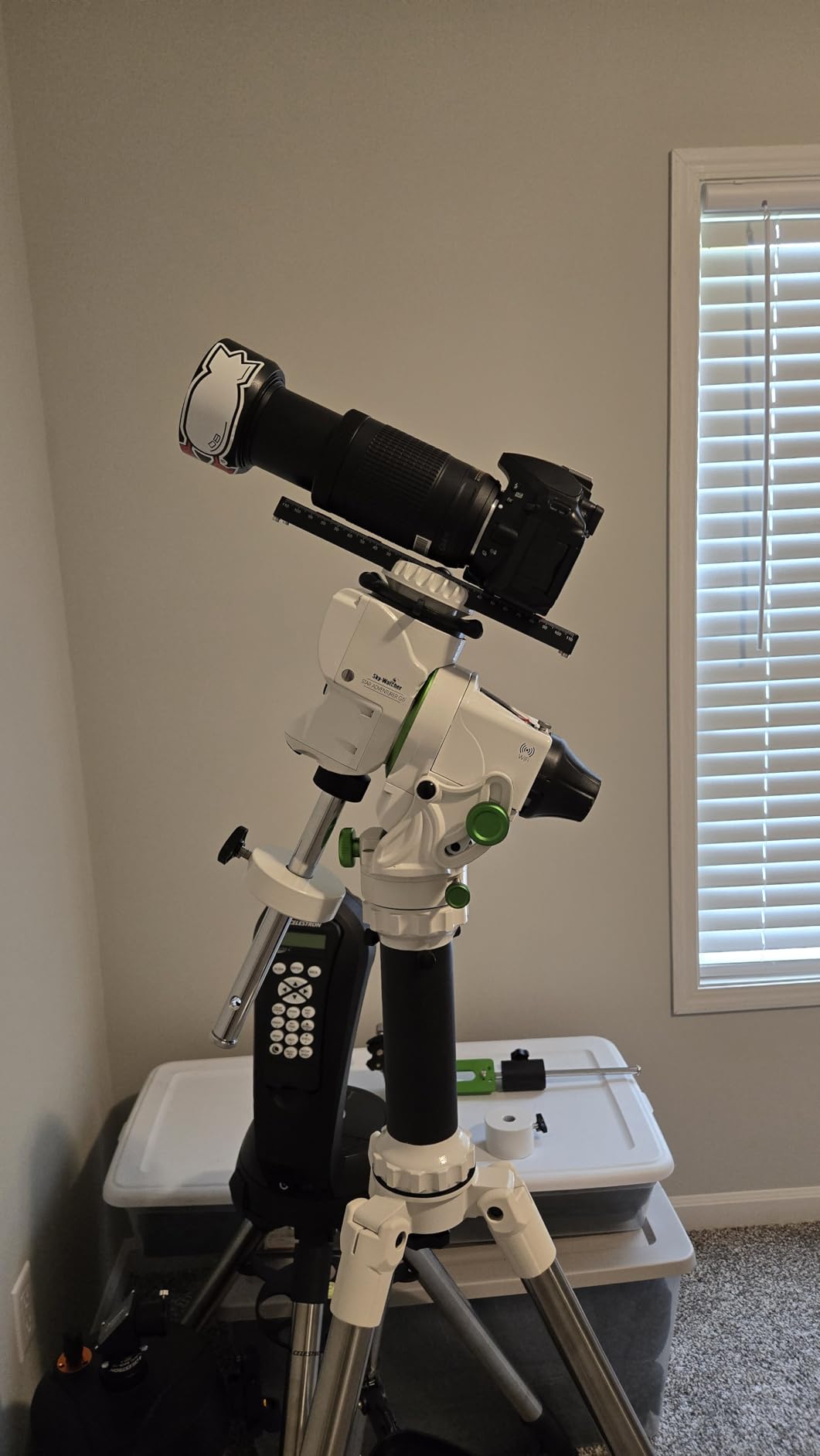
At 26 pounds total, it is no longer the carry-everything-while-hiking option, but it splits neatly into tripod, head and bar, and the head alone is manageable in a car.
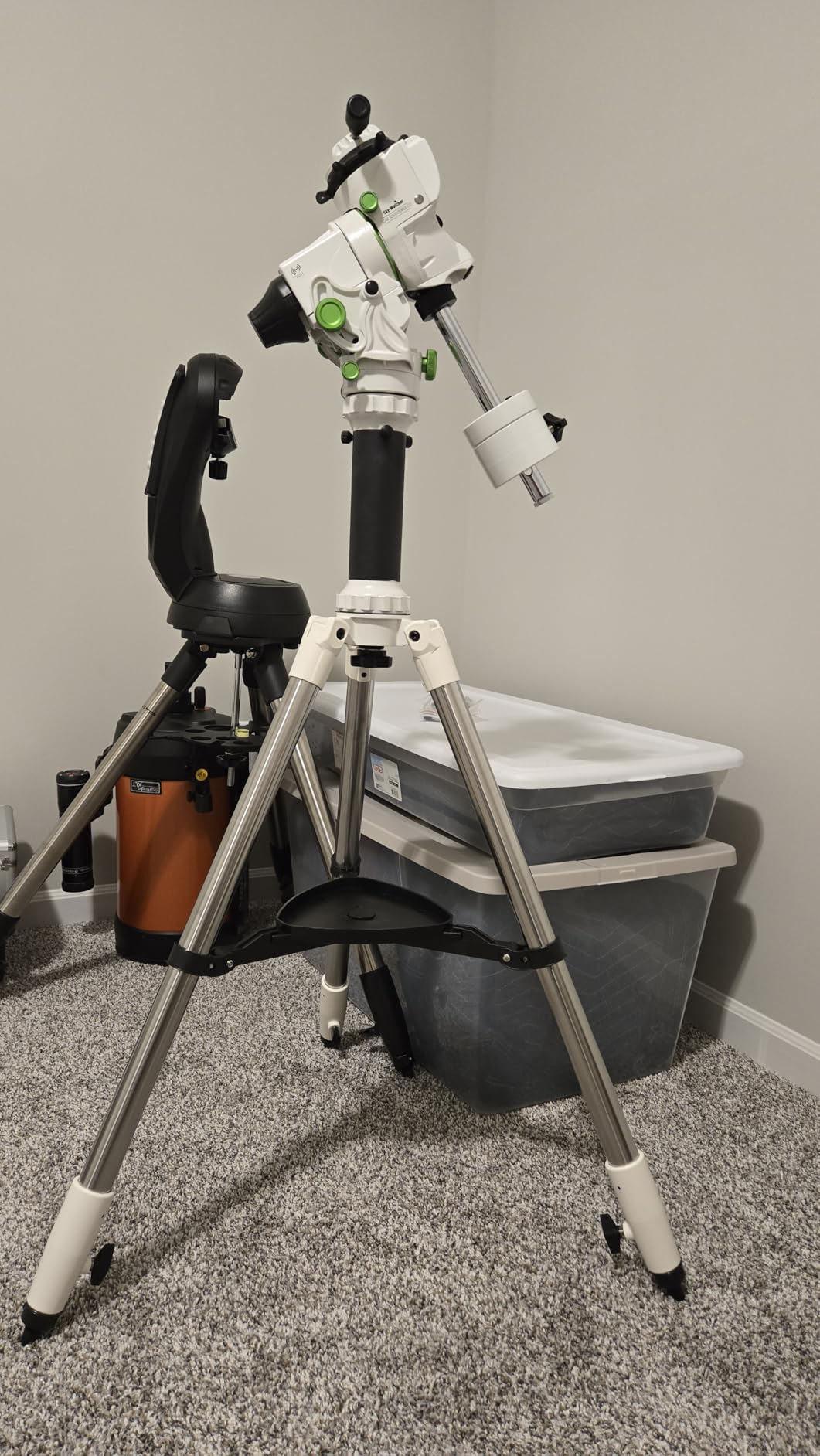
When GoTo Pointing Actually Pays Off
GoTo is worth it when you are imaging with a narrow field of view and do not want to hunt targets manually, or when a polar scope is blocked by a balcony wall. It is also useful for beginners who have not yet learned to star-hop. Owners like that the Wi-Fi app removes the hand controller from the kit entirely, simplifying the packing list.
Maximum shutter speed is listed at 30 seconds, matching the rest of the tracker tier, and multiple tracking rates are available for wide-field and landscape-style work. The two-year warranty is also the longest in the portable group.
Where It Falls Short
GoTo accuracy is entirely dependent on how well you align the polar axis, and the kit’s own reviews note that sloppy alignment shows up immediately as pointing errors. App-based control is also less responsive than a wired controller when you need fine guiding corrections. And at 26 pounds it is no longer the lightest thing you can carry up an observing site, which is the number one deal breaker for many imagers.
5. Sky-Watcher EQ6-R: Best for Long Focal Length and 8-Inch Telescopes
Sky-Watcher EQ6-R – Fully Computerized GoTo German Equatorial Telescope Mount – Belt-driven, Motorized, Computerized Hand Controller with 42,900+ Celestial Object Database
44 lb payload
Belt-driven stepper motors
PPEC encoder
Built-in illuminated polar finder
Pros
- Very low periodic error from the belt drive
- 44 lb payload handles 8-inch class tubes
- Sub-arcsecond guiding with a guide camera
- Built-in illuminated polar finder and carry handle
Cons
- Extremely heavy to move
- Needs 13 volts or more or it stalls
- Factory grease causes stiction until tuned
- Hand controller screen can fail in cold
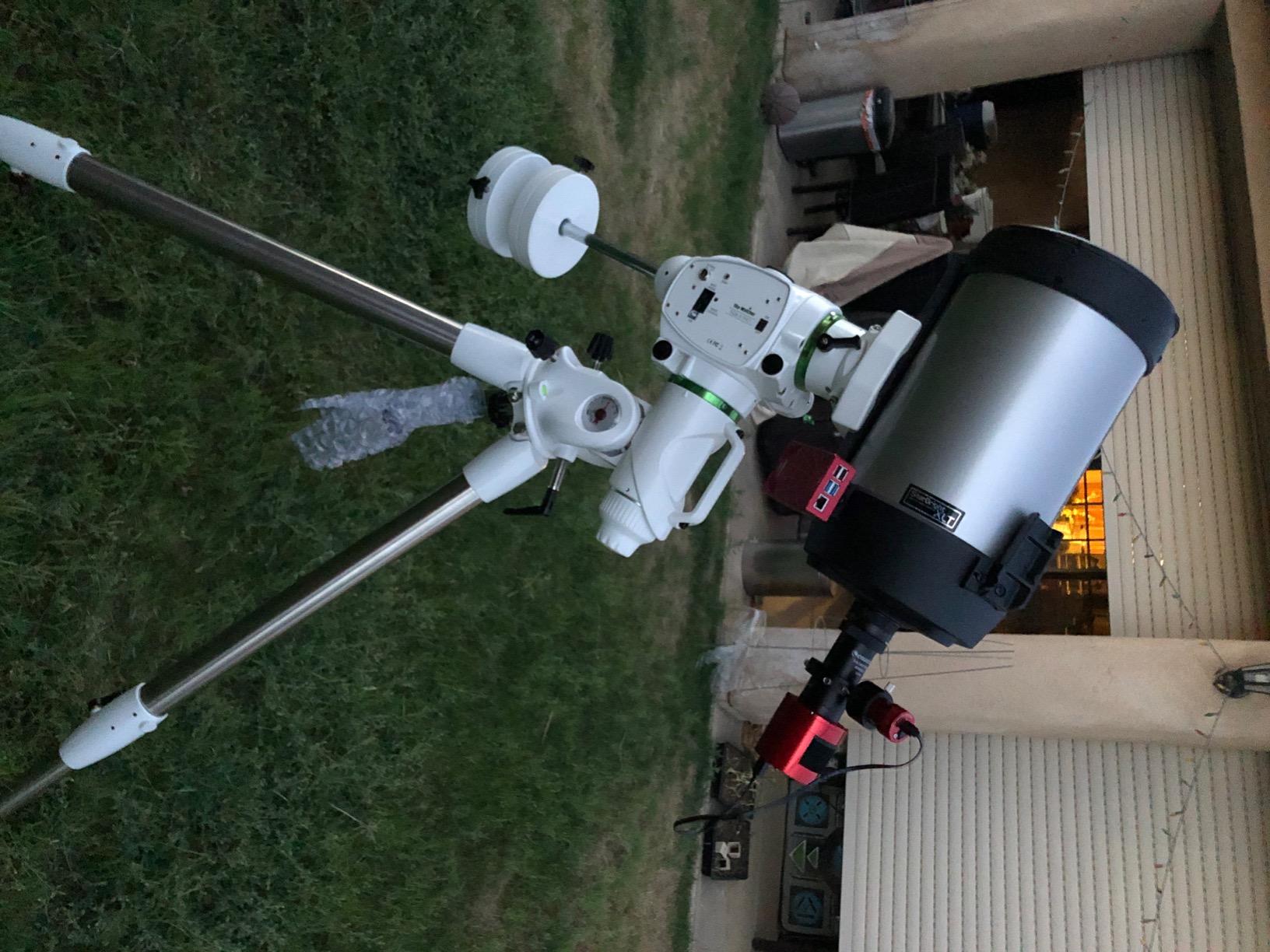
The EQ6-R is the mount that changes your imaging ceiling. Forty-four pounds of payload covers an 8-inch-class imaging telescope with a guide camera and camera, and the belt-driven stepper motors produce periodic error low enough that owners report sub-arcsecond guiding with a properly aligned polar axis. A built-in PPEC encoder handles part of the correction automatically, and the SynScan hand controller carries more than 42,000 objects.
It is widely regarded as the best value serious GoTo equatorial in its class, and the reviews support that: 78 percent five-star, with only 4 percent at four stars. The remaining complaints are almost entirely about logistics rather than imaging quality.
Belt-drive also means near-silent slewing, which matters more than it sounds when you are working next to a sleeping house or a campsite. The built-in carry handle helps, though it is a hand on a 44-pound item rather than a real solution.
Why Periodic Error Decides Long Focal Length Work
At 44 pounds of rated capacity this head accepts focal lengths where tracking error becomes visible as elongated stars rather than faint smudges. Belt-driven gearing reduces the repeating tracking wobble that worm gear mounts produce, and the PPEC encoder corrects a large part of what remains. That combination is why this mount shows up so often as the recommendation for a serious first rig around the thousand-dollar class, and beyond.
Community experience also covers the practical side of running it long-term. A 12 volt supply drawing at least 4 amps keeps it from stalling mid-slew, and reviewers who hypertuned the axes report noticeably smoother motion in cold weather.
Where It Falls Short
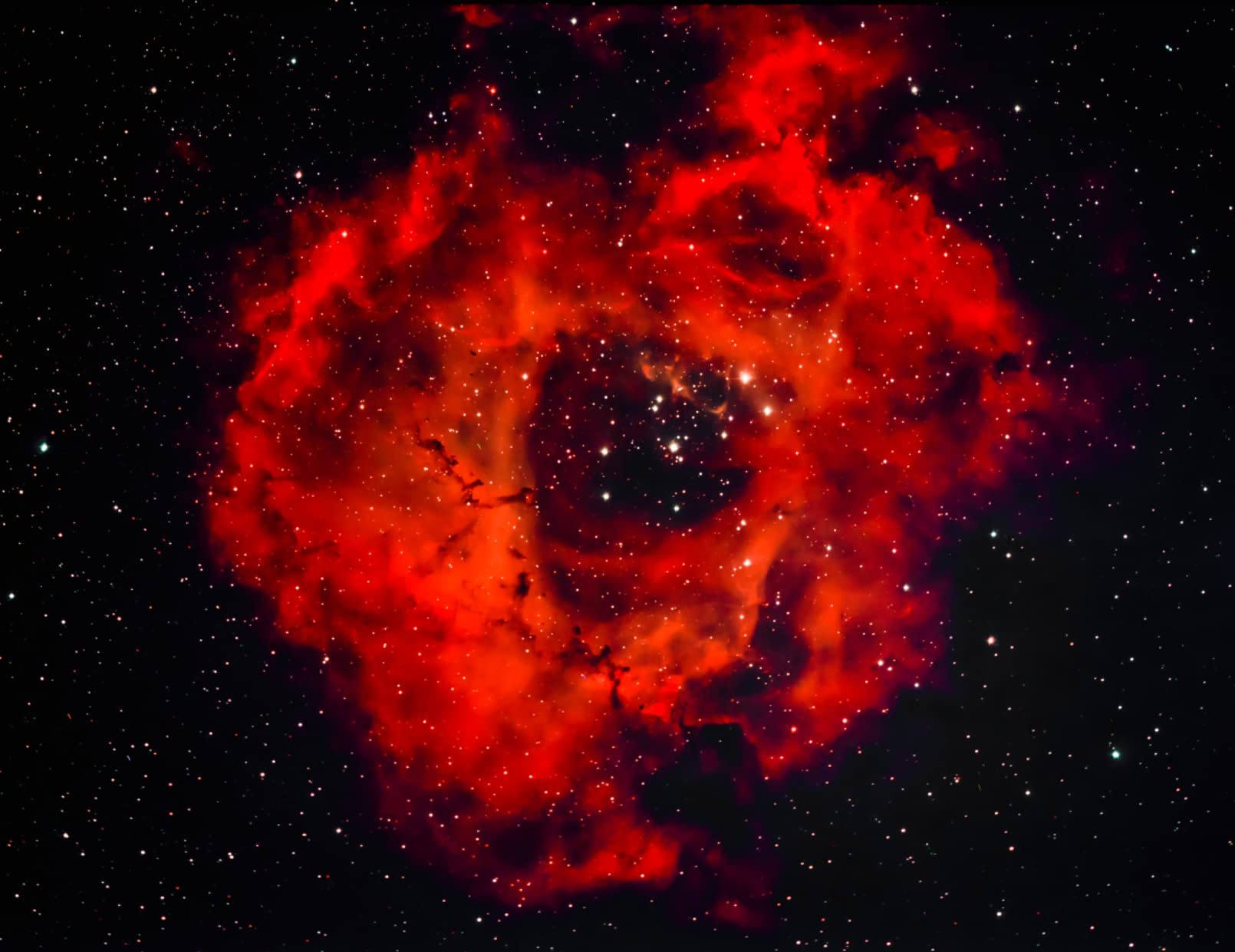
The weight is the whole problem. Assembled, owners report well over 75 pounds, which means it stays where you put it. If you want to chase clear skies to a mountain site, this is the wrong mount. It also needs a genuinely high-voltage supply, and factory grease can leave the axes stiff until the mount is broken in or tuned. The hand controller display has been reported as unreliable in very cold conditions.
6. Celestron CG-4 Manual Mount: Best for Visual Use and Budget GEM Entry
Celestron CG-4 Manual German Equatorial Mount with Steel Tripod
20 lb payload
Manual slow-motion controls
1.75-inch steel tripod legs
Accepts a motor drive later
Pros
- Smooth slow-motion controls on both axes
- 20 lb payload is generous for a manual head
- Sturdy stainless steel tripod
- Simple and quick to assemble
Cons
- No GoTo or computerized tracking as standard
- Long exposures need careful manual control
- Heavier than a portable tracker
The CG-4 is a 20-pound payload German equatorial head that needs no batteries, no motors and no software. Both axes have smooth manual slow-motion controls, and the stainless steel tripod has 1.75-inch diameter legs with a height range of 33 to 47 inches. Owners consistently rate it 4.5 stars across 93 reviews for exactly one reason: it simply works.
For visual observing it is excellent, and it accepts a motor drive later if you want tracking. Members have reported the Celestron CG-5 in the same family producing fine Milky Way images when new, which points to a lineage that has proven itself under load for decades.
This is the sensible first German equatorial for someone who wants to learn manual tracking and polar alignment before automating anything. It is also a common used buy, since the model has been in production for a very long time.
What You Give Up Without Motors
Tracking accuracy here is entirely manual, which means long exposures need continuous attention to the slow-motion knobs. That is fine for visual observing and frustrating for a full night of imaging. The honest use case is learning, visual work, or using it as a stable platform for a camera during the first few sessions.
Because the latitude adjuster is manual and the mount is designed around a counterweight shaft, converting it later is straightforward rather than a project. That upgrade path is a real part of the value: you learn the alignment workflow on a simple mechanism before the electronics arrive.
Where It Falls Short
No GoTo and no computerized tracking come as standard, so you point manually. It is also heavier than any tracker in this guide, which makes it a poor choice for portable work. For imaging specifically, it loses to every motorized option here once you pass the first few sessions.
7. Explore Scientific iEXOS-100-2 PMC-Eight: Best for Budget GoTo with Third-Party Control
iEXOS-100-2 PMC-Eight Equatorial Tracker System Tripod and Mount for Astrophotography with WiFi and Bluetooth Compatible
PMC-Eight controller with eight CPUs
Clutched dual-axis worm gears
Polar sight through RA axis
ExploreStars app control
Pros
- Quiet and stable for a small refractor plus camera
- Reports around 1.5 arcseconds autoguiding in some setups
- Board responds quickly under ASIAIR and PHD2
- Good value for a GoTo equatorial
Cons
- Bundled app is buggy on Android and Windows
- Needs eight C batteries and often a separate polar scope
- Very little azimuth adjustment
- Support responses are slow
This is the lowest-rated mount in the guide at 3.9 stars, and we are including it with that label because the split between the hardware and the software is so pronounced. The PMC-Eight controller runs eight independent CPUs, the dual-axis worm gears are clutched and belt-driven with quiet precision stepper motors, and owners report autoguiding around 1.5 arcseconds in some configurations. That is respectable imaging performance.
Owners also report that the board responds quickly and pairs well with ASIAIR and with PHD2 and Ekos, which is how most serious imagers drive it. The 57 percent five-star share and 13 percent one-star share tell you the same story from both ends: people love the mechanism and fight the interface.
The clutched RA and declination axes make balancing genuinely easy, and the polar alignment sight hole runs through the RA axis with altitude control, which is a real convenience when you have no polar scope.
Why Third-Party Software Fixes It
Almost every strong imaging report on this mount comes from driving it with external software rather than the bundled app. Once you accept that workflow, the mount is quiet, quick to respond and accurate enough for short refractors and small Newtonians with a camera. The stepped worm drive and clutches also make it forgiving during balancing changes mid-session.
Its support response times are the weak point. Owners report slow replies when units fail, so factor that into any purchase you intend to keep for years rather than one season.
Where It Falls Short
The ExploreStars app is the recurring complaint, with reports of flaky connectivity and broken star alignment on Android and Windows. Power comes from eight C batteries, and many owners find they need a separate polar scope for anything beyond a rough alignment. Azimuth adjustment is minimal without an optional adapter, which is a genuine problem at latitudes far from the design centre.
8. iOptron SkyTracker Pro: Best for Small Camera and Phone Setups
iOptron SkyTracker Pro Camera Mount with Polar Scope, Only
3 kg payload
Internal rechargeable battery
Dimmable polar scope LED
Folds to 115mm cube
Pros
- Quiet with no backlash reported
- Integrated battery needs no external power
- Alignment knobs make setup quick
- Compact 3.3 lb body with padded bag
Cons
- 3 kg payload means telephoto zooms need the counterweight kit
- Dovetail base is not Arca-Swiss compatible
- No ball head included
- Polar scope needs a clear view of Polaris
The SkyTracker Pro is the smallest complete tracking solution here, at 3.3 pounds and 115 by 115 by 95 millimeters folded, and it is rated for cameras as well as phones. The DC servo motor drive uses a 600 second worm period with four bearings, and owners report no backlash and clean multi-minute exposures with short lenses. The internal rechargeable battery reaches 80 percent charge in 5 hours over micro USB.
Alignment is the part owners praise most. There are many fine-tuning knobs and a dimmable LED in the polar scope, so getting a good polar alignment takes minutes rather than a session. Four tracking speeds are available, including half-celestial for blending sky and ground, plus solar and lunar rates.
It is the mount to buy if your imaging is a camera on a travel lens and you want something that fits in a daypack beside the rest of your kit.
Where the Payload Limit Bites
Three kilograms covers a mirrorless body with a short prime or a kit lens comfortably. Anything heavier, including most telephoto zooms, needs the optional counterweight kit, which changes the whole balance geometry. The dovetail base is not Arca-Swiss compatible either, so a small adapter plate is required for the head you probably already own.
Reviewers describe it as a big step up from the original SkyTracker, handling 4 to 5 minute exposures well with wide glass. Beyond that, drift becomes visible and you need guiding hardware the platform does not natively support well.
Where It Falls Short
The polar scope is hard to align without a clear line of sight to Polaris, which rules it out for balcony and city setups with obstructions. The listed maximum shutter speed of 30 seconds limits unattended landscape blending work. And a ball head is not included, so budget for that before the total cost makes sense.
9. Celestron CGX: Best for a Fixed Observatory Rig
Celestron CGX Computerized German Equatorial Mount & Tripod, 55lb Payload
55 lb payload
High-torque belt-drive servos
Internal cable management
40,000-object database
Pros
- Large payload headroom for big imaging trains
- Tracks flat through hours of guiding
- Internal cable routing keeps the setup tidy
- Works with plate-solved pointing models
Cons
- Very heavy at 108 lb so it stays put
- Optional polar scope can restrict declination range
- Some reports of RA drive failures
- Included tripod is less rigid than the CGX-L version
The CGX is the observatory tier. Fifty-five pounds of payload with high-torque belt-drive servos is enough for a large refractor or a heavy imaging Newtonian with a full complement of accessories, and long-term owners report it tracking flat through hours of guiding and 30-minute subframes. Internal cable management keeps a complex imaging train tidy, which is not a small luxury on a rig this size.
The NexStar+ hand controller carries a 40,000-object database with guided tours and custom object filters, and the mount works well with plate-solved pointing models and All-Star Polar Align. AC operation needs the 5 amp power supply.
We want to be straight about the evidence here. Twenty reviews is the thinnest sample in this guide, and 15 percent of those are one-star. The 4.2 average reflects a mount with an excellent reputation and a small, sometimes unhappy owner base.
What You Gain at This Payload Level
At 55 pounds, the constraint stops being the mount. A full imaging train with a large optical tube, off-axis guider, filter wheel and camera can sit at 50 to 60 percent of rating and still have room for a guide scope. That headroom is what lets you run long focal lengths and narrowband without a permanent fight with balance.
Flat tracking through 30-minute subs means fewer discarded frames and shorter total integration time for the same depth. Internal cabling also reduces the failure points that come with cable loops catching on the mount during a slew.
Where It Falls Short
At 108 pounds, this mount does not move. That is acceptable for a permanent pier and unacceptable for anything else. Some owners also report the optional polar scope restricting declination range and causing collisions, and a few have reported RA drive failures and controllers stuck on initializing. The included tripod is also less rigid than the CGX-L variant, so most serious setups end up on a pier.
What an Equatorial Mount Does and Why Alt-Az Fails
An equatorial mount aligns one axis with the Earth’s rotational axis, then turns that axis once per sidereal day. The sky stays fixed on your sensor, so stars become points instead of arcs, and you can stack hundreds of exposures into a single deep image. That single mechanical idea is the whole reason this category exists.
An alt-az mount, which is what most Dobsonian and Schmidt-Cassegrain setups use, tracks by turning in two directions at once. The field rotates around the frame centre even though the target stays centred, and that rotation cannot be cancelled by stacking or cropping. Forum discussion is blunt about this for imaging, which is exactly why anyone moving past visual observing switches to an equatorial head.
Is an equatorial mount the same as a star tracker? Not quite, although the two overlap. A star tracker is a single-axis device that rotates a camera at sidereal rate, with no declination axis and no GoTo pointing. An equatorial mount has a second axis, so it can hold any declination and slew to catalogued targets. In practice the trackers in this guide, the Star Adventurer 2i Pro, the SkyGuider Pro and the SkyTracker Pro, are equatorial platforms in spirit but restricted to wide fields.
Periodic error is the repeating tracking wobble produced by the gear train, measured in arcseconds, and it is the number that decides whether a mount needs autoguiding. A belt-driven head with a PPEC encoder corrects much of it automatically, while a basic worm drive may need continuous guiding with PHD2, NINA or ASIAIR. Aligning to a tolerance of under one arcminute is the difference between an hour of usable subs and an hour of thrown-away data.
How to Choose an Equatorial Mount Without Regretting It
Start with the payload, not the price. Add up your optical tube, camera, guide scope, focuser and cables, then divide by the rated capacity. The working rule is to stay at 50 to 60 percent, so a mount rated at 30 pounds is designed for a train of 15 to 18 pounds. Check that figure before anything else, because it eliminates most mistakes immediately.
Second, decide whether you will move the setup. A mount over 40 pounds that you cannot lift to a dark site will accumulate dust indoors. If portability matters, the tracker and lightweight tier dominates, and the cost is payload ceiling. If you have a pier or a permanent site, buy the heaviest head your budget allows, since weight translates directly into stiffness.
Third, look at the alignment aids. An illuminated polar scope is worth paying for, and software plate-solving alignment works even where Polaris is blocked by a wall or a tree. Both approaches end at the same place: an accurate polar axis, which is worth more than any other single feature on the list.
Fourth, confirm software support before you commit. Check that the mount accepts ASCOM or SynScan protocol control, and that it has been reported working with the guiding stack you intend to use. This is the decisive purchase factor for modern imagers, and it is the reason the Explore Scientific scores lowest here despite solid hardware.
Fifth, consider buying used. The HEQ5 Pro, the Advanced VX and the CG-5 all appear regularly as used purchases in forum threads, and the used market is a normal path rather than a compromise. When you inspect a used head, check the worm gear for wear and backlash, confirm the periodic error correction table still loads, look at the counterweight shaft for scoring, and verify that the hand controller and its cables are present.
Finally, plan the whole chain. Guiding needs a guide scope and a guide camera, and a narrowband filter wheel adds payload you must count. Dew management, cable routing and a stable tripod matter as much as the head, and all three weigh against your payload budget.
Frequently Asked Questions
What are the best equatorial mounts for astrophotography?
The Sky-Watcher Star Adventurer 2i Pro Pack is the best all-round choice for wide-field camera work, the iOptron SkyGuider Pro is the strongest portable tracker thanks to its all-metal body and 11 lb payload, and the Celestron Advanced VX is the best value German equatorial mount for imaging telescopes at 30 lb of capacity. For 8-inch class tubes at 44 lb, the Sky-Watcher EQ6-R is the step up.
Do you need an equatorial mount for astrophotography?
You need one for any exposure longer than about 30 seconds on a fixed camera or telescope. An alt-az mount introduces field rotation, which rotates stars within each frame and cannot be fixed by stacking or cropping. Equatorial tracking removes that rotation so stars stay as points across long subs.
How accurate are equatorial mounts?
Accuracy is described as periodic error in arcseconds, the repeating wobble of the gear train during a tracking run. Belt-driven heads such as the EQ6-R sit at the low end with owners reporting sub-arcsecond guiding after alignment, while basic worm drives need continuous autoguiding with PHD2, NINA or ASIAIR. Polar alignment accuracy dominates everything else.
Is an equatorial mount the same as a star tracker?
Not exactly. A star tracker is a single-axis device that rotates a camera at sidereal rate with no declination axis and no GoTo pointing, so it suits wide-field work only. An equatorial mount has two axes, holds any declination, slews to catalogued objects and can carry a telescope as well as a camera.
Which star tracker camera mount is best for astro photography?
The iOptron SkyGuider Pro is the best star tracker here, with an all-metal body, 11 lb of balanced payload, an illuminated AccuAlign polar scope and up to 20 hours of internal battery. The Sky-Watcher Star Adventurer GTi is the best GoTo option, and the iOptron SkyTracker Pro is the smallest and lightest for travel.
What is the 500 rule for astrophotography?
The 500 rule divides 500 by your full-frame equivalent focal length to get the longest exposure in seconds before stars trail noticeably, so a 50mm lens gives 10 seconds and a 200mm lens gives about 2.5 seconds. An equatorial mount sidesteps the rule because it tracks the sky, allowing multi-minute exposures instead.
The Best Equatorial Mount Verdict for 2026
The best equatorial mounts for astrophotography in 2026 come down to your load and your site. For wide-field camera work, the Sky-Watcher Star Adventurer 2i Pro Pack wins on proven reliability, portability and a 7-pound weight. For a metal-built tracker with room for a small refractor, the iOptron SkyGuider Pro is the strongest all-rounder. For anything heavier, the Celestron Advanced VX at 30 lb of payload is the best value, and the Sky-Watcher EQ6-R at 44 lb is where serious deep-sky imaging begins.
Check your total payload against the 50 to 60 percent rule, confirm the mount works with your guiding software, and buy the heaviest thing you can still carry to a dark sky. Start with the right mount class and the rest of the chain gets much easier.