
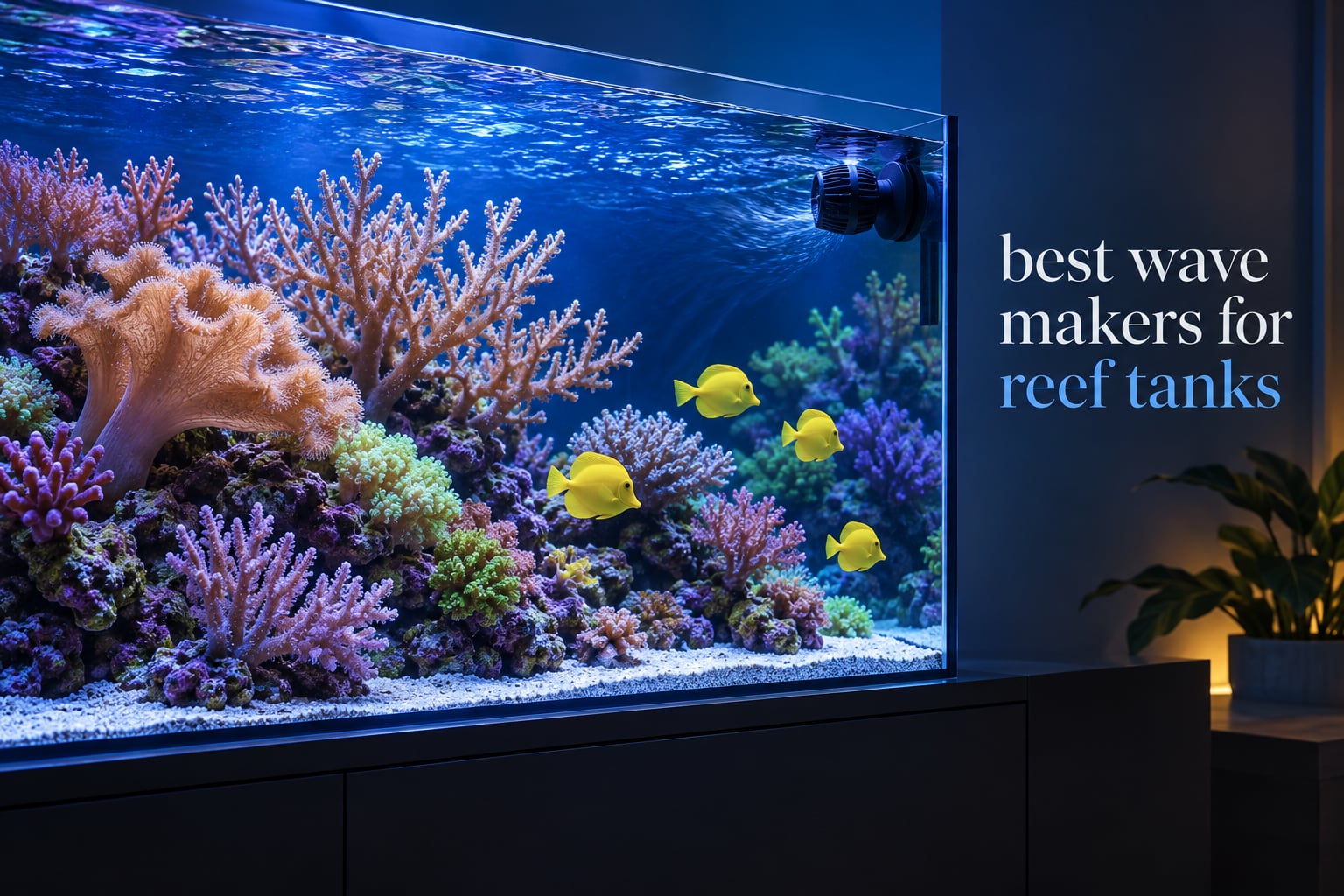
A reef tank without a wave maker is a reef tank with a slow problem. Corals need moving water for gas exchange, waste removal and detritus control, and a single return pump on its own leaves corners where nothing moves at all. If you have been searching for the best wave makers for reef tanks, you will have noticed the same thing we did: every brand claims huge flow, the numbers are not comparable, and the owner reviews contradict each other.
So we did the sorting for you. We compared eight current wave makers on published flow ratings, wattage, control method, tank-size fit and, just as importantly, the failure modes owners actually report. That last part matters more than any spec sheet. On this forum-led topic, documented problems such as weak magnets, impeller wear and app pairing failures decide the purchase far more often than headline gallons per hour.
How we picked: specs were compiled from manufacturer and retailer product pages in October 2026, and owner feedback was cross-checked against recurring themes on r/ReefTank, r/Aquariums, Reef2Reef, Nano-Reef and Saltwaterfish. Every flow figure below is a manufacturer maximum measured at a specific setting, not a typical daily output, and we explain what that means for sizing further down. We earn a commission from qualifying purchases at no extra cost to you, and it does not change the ranking.
One note on scope: this list covers marine and reef-oriented circulation pumps only. Freshwater-only setups wanting gentle surface agitation have a different shortlist.
Top 3 Picks for Reef Tanks in 2026
Quick Picks by Use Case in 2026
- Best overall for large tanks: Uniclife 3400 GPH Wave Maker – the most review volume of any pump here, a rotatable head and a 10-minute feeding pause on a clean 40W package.
- Best all-round buy: hygger 18W Cross Flow Wave Maker – crossflow geometry that clears dead spots, five modes and the widest intensity range in the set.
- Best value per unit of flow: Jebao SOW-8 Wave Maker – up to 2245 GPH from 23W with wireless master-slave pairing for two-pump setups.
- Best for a 40-gallon breeder: Jebao SLW-30 Wavemaker – 3434 GPH of headroom in a compact body, with random mode that owners credit for better polyp extension.
- Best gyre-style coverage: hygger 1850 GPH Gyre Wave Maker – a dual-outlet head that sweeps 270 degrees, built for 40 to 125 gallon tanks up to 31 inches long.
- Best app-controlled: Red Sea ReefWave 25 – five programmable patterns with forward, reverse and alternating flow, driven from the ReefBeat app.
- Best mode variety: hygger 50W Intelligent Wave Maker – six wave modes including tide and forward/reverse, plus a light sensor that drops to low flow after dark.
- Best low-profile crossflow: Jebao SCP-90 Crossflow Pump – a 2 by 1.5 by 11 inch body that disappears against the glass while still moving 2700 to 3300 GPH.
All 8 Wave Makers Side by Side in 2026
| Product | Specifications | Action |
|---|---|---|
| Uniclife 3400 GPH Wave Maker |
|
Check Latest Price |
 hygger 18W Cross Flow Wave Maker hygger 18W Cross Flow Wave Maker |
|
Check Latest Price |
| Jebao SOW-8 Wave Maker |
|
Check Latest Price |
 Jebao SLW-30 Wavemaker Jebao SLW-30 Wavemaker |
|
Check Latest Price |
 hygger 1850 GPH Gyre Wave Maker hygger 1850 GPH Gyre Wave Maker |
|
Check Latest Price |
 Red Sea ReefWave 25 Red Sea ReefWave 25 |
|
Check Latest Price |
 hygger 50W Intelligent Wave Maker hygger 50W Intelligent Wave Maker |
|
Check Latest Price |
 Jebao SCP-90 Crossflow Pump Jebao SCP-90 Crossflow Pump |
|
Check Latest Price |
1. Uniclife 3400 GPH Wave Maker – Best Overall for Large Tanks
Uniclife Aquarium Wave Maker for 120-300 Gallon Fish Tanks 3400 GPH Adjustable Circulation Pump with Controller and Strong Magnetic Suction Base Submersible Power Head for Fresh and Salty Water
3400 GPH max flow
40W DC 24V
120-300 gallon range
4 wave modes
10-minute feed pause
Pros
- Largest review base in the group at 845 ratings
- Strong magnetic base with rotatable head
- Four wave modes plus a dedicated feeding pause
- Quiet enough to be described as a soft ringing
Cons
- Oversized for tanks under 120 gallons
- Four basic modes with no app or frequency control
This is the pump we keep coming back to for anything in the 120 to 300 gallon range, largely because the 845 ratings behind it give us a far clearer picture of long-term behaviour than most of the alternatives here. Owners consistently single out two things: the magnetic base, which holds position well enough to reposition without fuss, and the head, which rotates to push flow from several angles off a single mount.
The 10-minute feeding pause is the feature we did not expect to use as much as we do. You hit the mode button, the pump stops, and it restarts on its own, which removes the mental load of remembering a feeding schedule. Four selectable wave modes cover the basics, and the 40W draw on 24V DC keeps running costs unremarkable for a pump of this output.
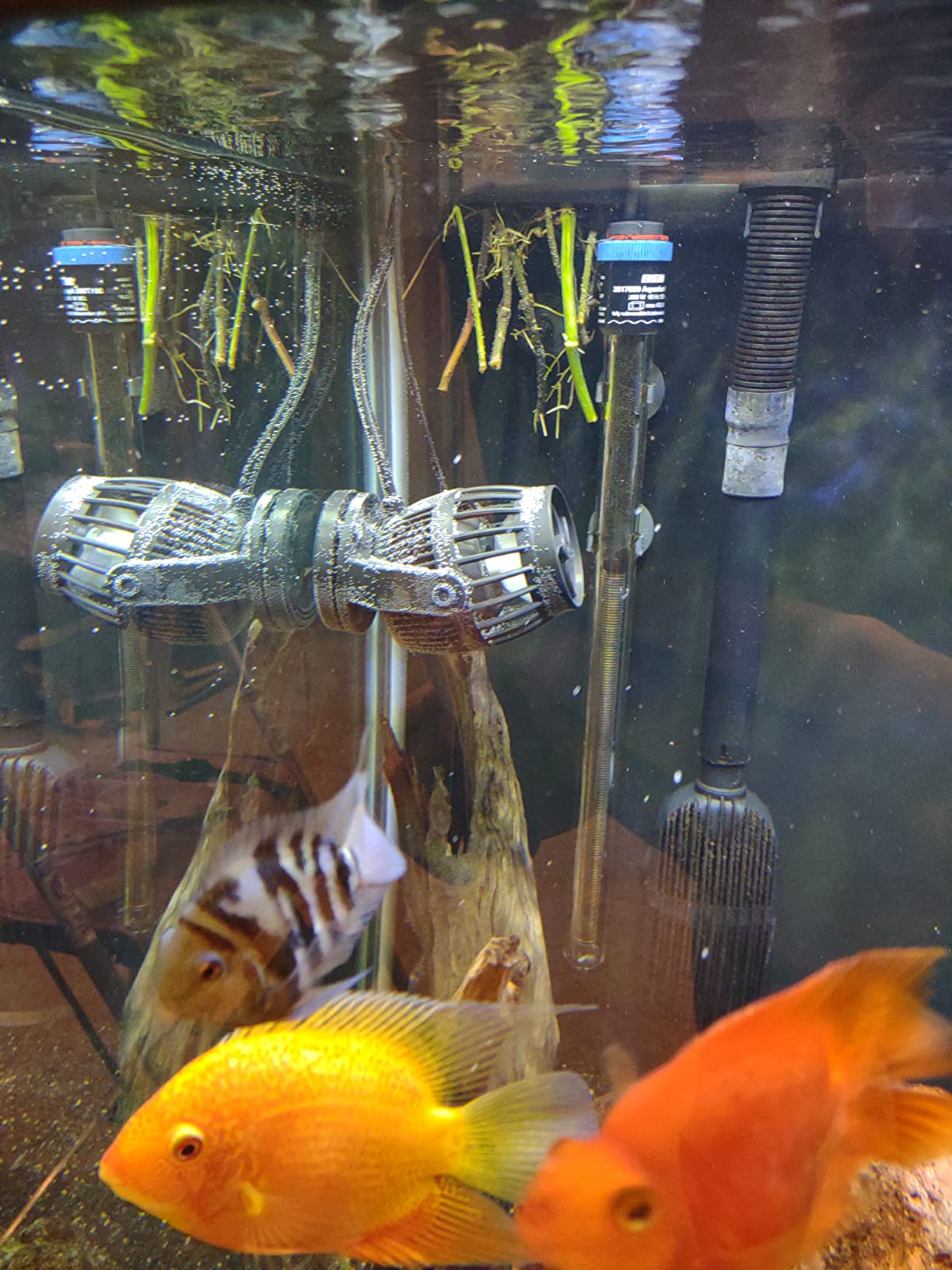
What the rating does not flatter is the fit. A 3400 GPH maximum is a lot of pump for a 60 gallon system, and a notable share of the one-star reviews are not about failure at all; they are about the pump being plainly too much for the tank it was put in. Buy this for the size it was designed for. If your reef is smaller, the tank-sizing guidance we use for other aquarium builds applies just as much to flow as to volume.
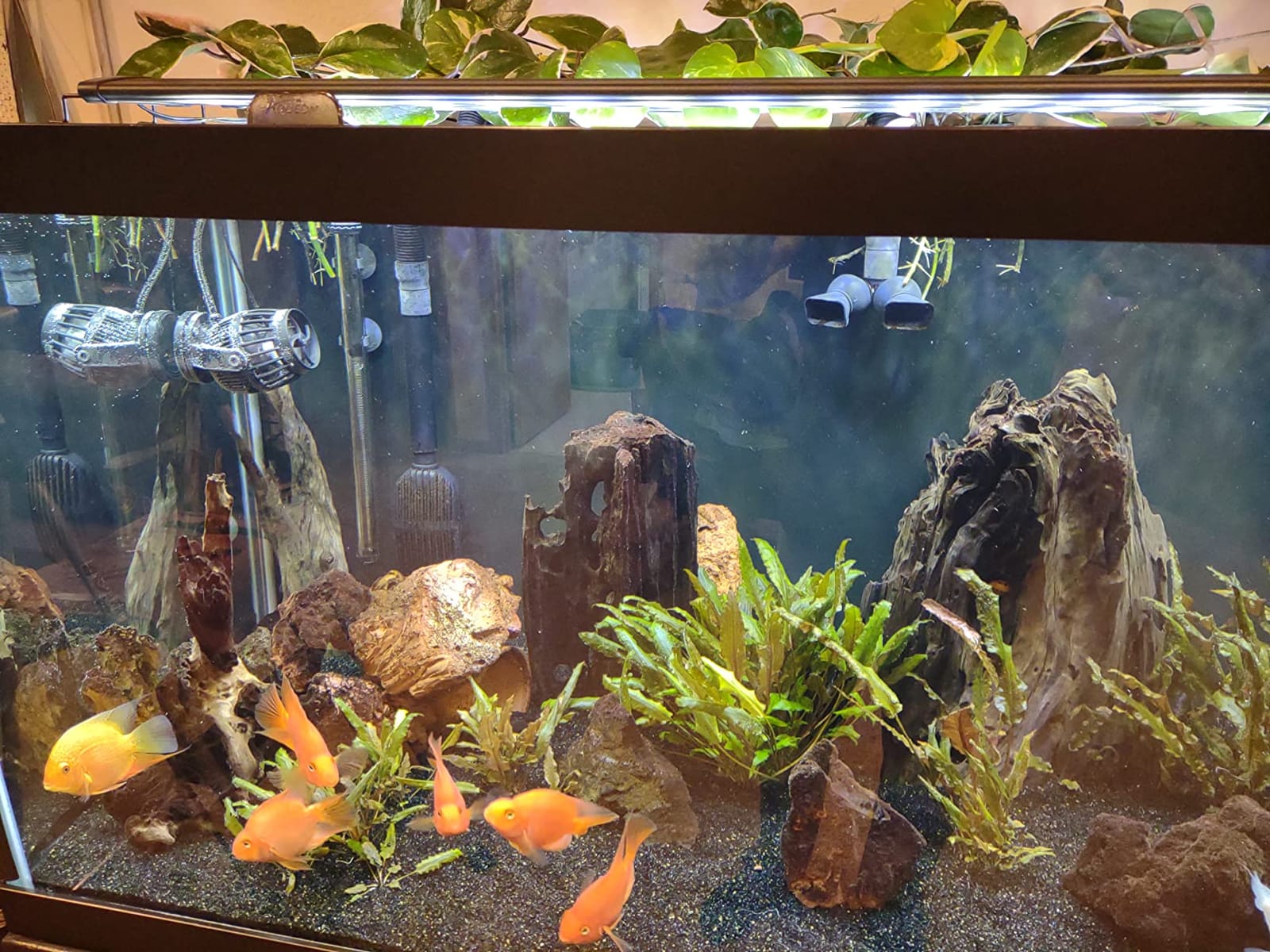
How much flow this pump actually delivers
The 3400 GPH figure is a measured maximum at full throttle, and in wave mode the pump spends most of its cycle below that. Reef keepers using random or pulse patterns see average output closer to a fraction of the headline number, which is exactly why we recommend sizing to the top of your target band rather than the bottom.
Where it fits in a reef build
This belongs on a long tank with heavy rockwork, where a single point of entry cannot clear the far corners. On a 40-gallon breeder it is more pump than the system needs, and on a nano it is simply the wrong tool. Buy it when the tank has genuine length to the wave pump and you need the mounting to disappear behind rockwork.
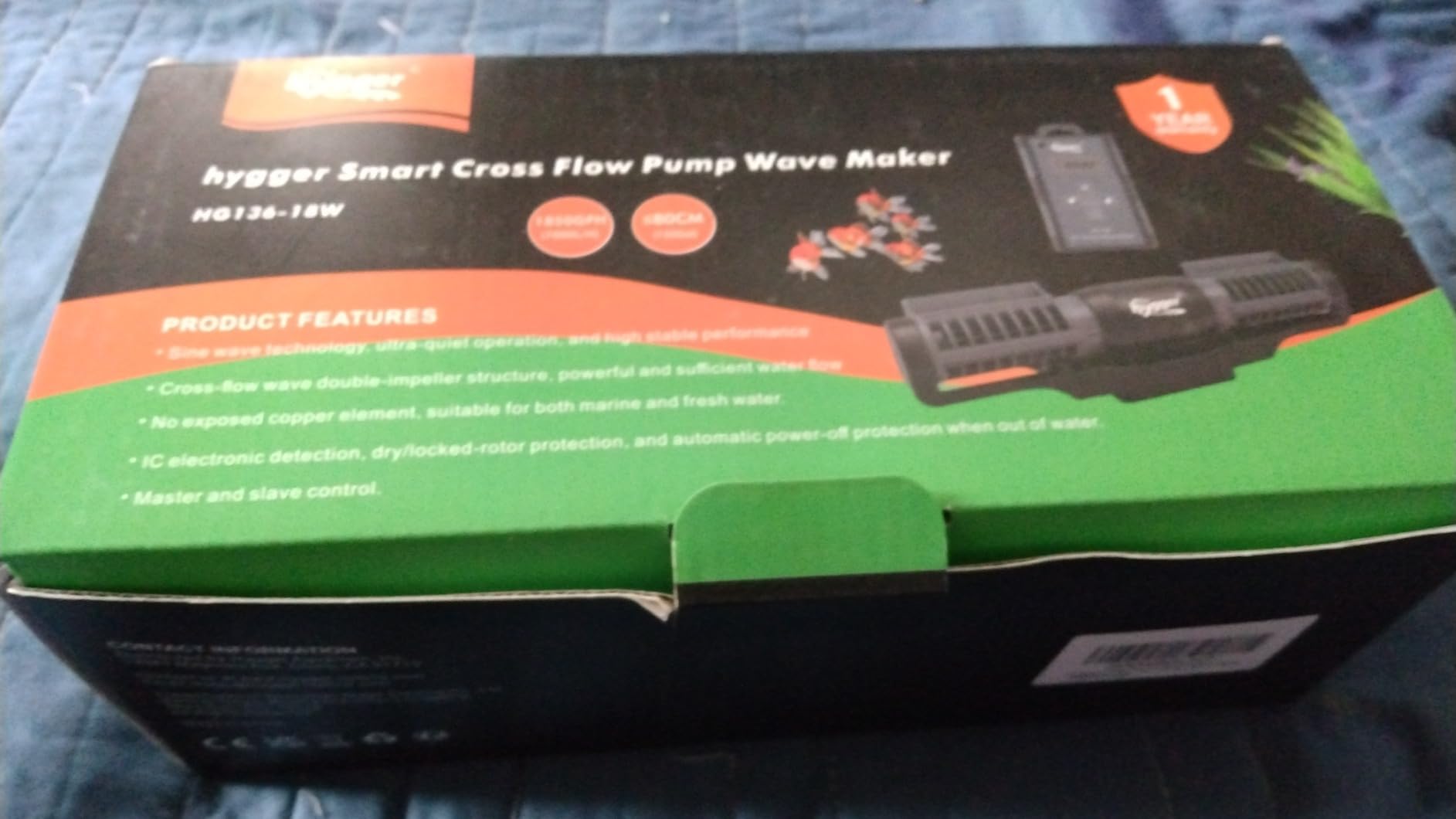
2. hygger 18W Cross Flow Wave Maker – The Top Rated All-Rounder
hygger Aquarium Wave Maker, 18W Adjustable Cross Flow Pump with LED Display Controller, Magnetic DC 24V Aquarium Powerhead for Freshwater and Marine Reef Aquariums Up to 135 Gallon
1850 GPH max
18W DC 24V
360 degree crossflow
5 wave modes
30-100 intensity steps
Pros
- Crossflow geometry gives even 360 degree circulation with few dead spots
- Thirty intensity levels and thirty frequency levels
- Feed pause with memory is easy to trigger
- Quiet on DC power at lower percentage settings
Cons
- Audible hum above roughly 50 percent power
- Occasional Er04 blockage error codes reported
At 4.5 stars across 401 ratings, this is the strongest combination of rating and review depth in the group, and the crossflow rotor is the reason. Rather than firing a cone of water in a straight line, the design circulates flow back around itself, which is what keeps dead spots from forming behind rockwork. Reef keepers running 65 to 90 gallon systems report even coverage from a single mount more often than not.
The control surface is unusually granular for the money. Five wave modes (pulse, sine, constant, random and cross flow) combine with 30 to 100 flow levels and 30 to 100 frequency levels, which means you can build a genuinely irregular pattern instead of watching the same three-second surge repeat all night. Feed mode, night mode and linkage mode are all on the LED display controller, and the magnetic base is rated for glass up to half an inch.
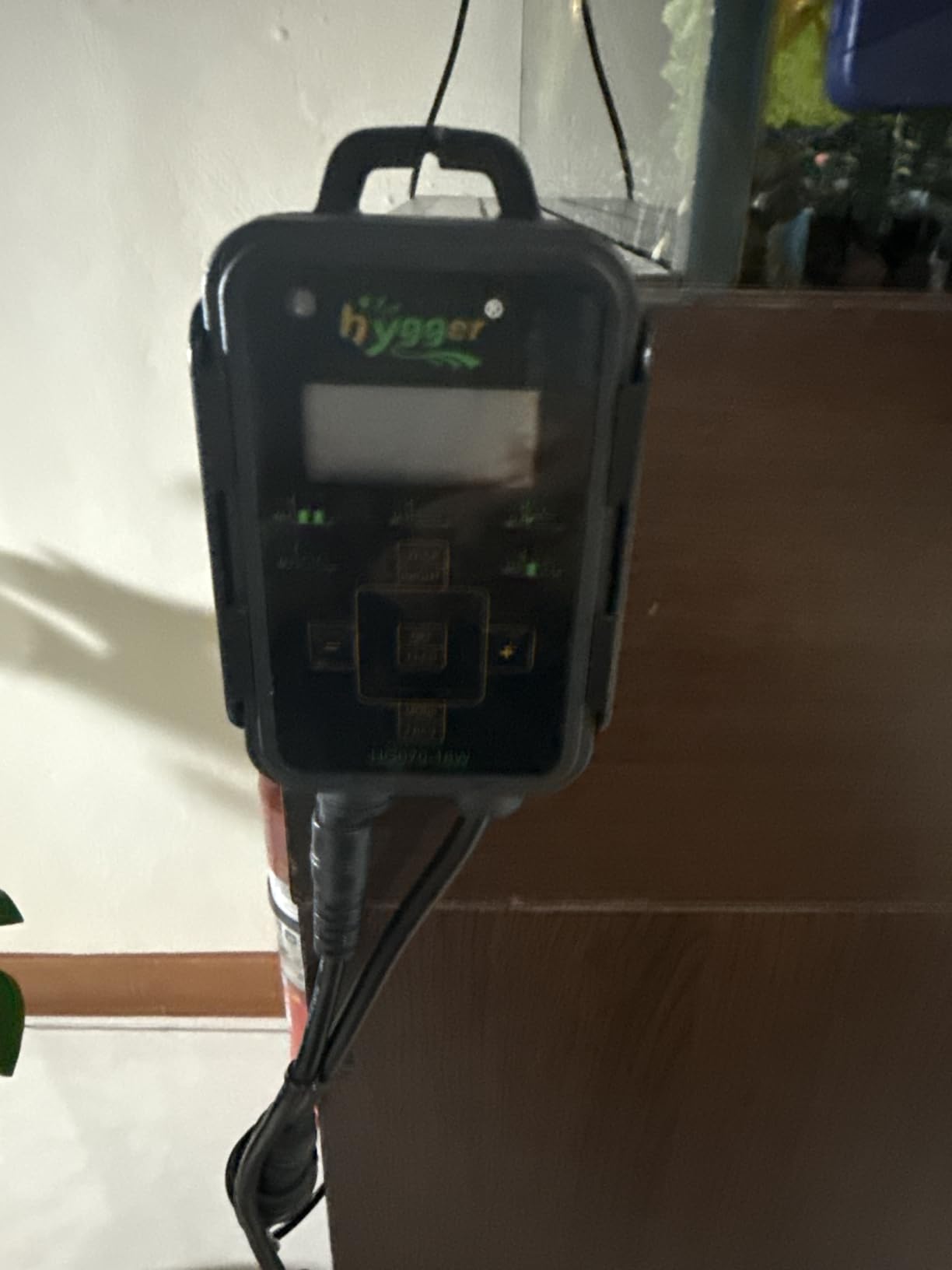
Two things temper the recommendation. The recurring caveat in reviews is a low hum that becomes noticeable above roughly 50 percent power in a very quiet room at night, and a small cluster of owners have hit Er04 pump blockage error codes on the controller. The dual-direction outlet is a genuine asset too: one side can be aimed up and the other down, which doubles its usefulness for lifting settled sand.
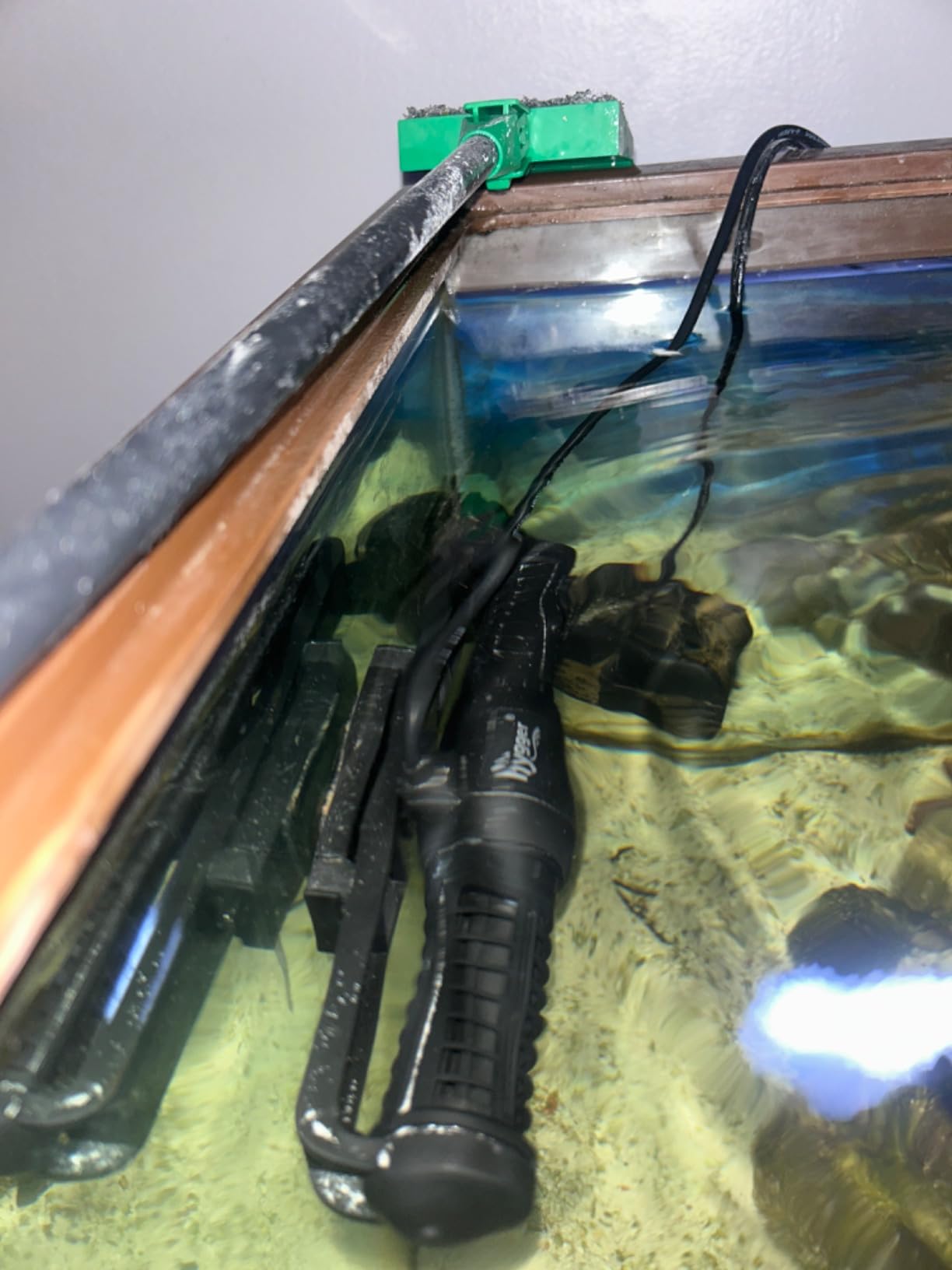
Is the noise a real problem
For most living rooms, no. The hum sits below conversation level at mid settings. If your tank shares a room with a bed or a home office, run it below 50 percent at night and use the built-in night mode to drop output further. A hum that changes pitch or volume while the pump is running is a different story, and that is usually a bearing or bushing issue rather than normal operation.
How it pairs with a second pump
Linkage mode lets two pumps share a pattern, and reef keepers routinely run a matched pair on opposing ends of a long tank. That is where the intensity steps pay off, because you can dial each pump to the same percentage and let the two gyres collide in the middle of the system rather than fighting each other along one wall.
3. Jebao SOW-8 Wave Maker – Best Value Per Gallon of Flow
Jebao SOW-8 Wave Maker Flow Pump with Controller for Marine Reef Aquarium
Up to 2245 GPH variable flow
23W on 24V DC
Sine wave drive
2.4G master-slave sync
Pros
- Sine wave drive keeps motor noise and vibration low
- Wireless master-slave sync for alternating tidal currents
- Good output matched to its power draw
- 360 degree ball joint external magnet mount
Cons
- SOW-8 ceiling is modest for larger tanks
- Some buyers report the magnet is weak on thicker glass
The SOW-8 delivers up to 2245 GPH from 23W, and the sine wave electronic motor drive is the reason it stays quiet while doing it. Where many budget pumps use a stepper that buzzes under load, this one ramps smoothly, which owners consistently describe as the quietest thing in the class. At 4.5 stars on 214 ratings, it holds the joint-highest average in this roundup.
Built-in 2.4G wireless master-slave synchronization is the feature that separates it from cheaper alternatives. Two of these can alternate tidal currents without any app, phone or additional controller, which is the single most common two-pump setup on forums. Wave patterns include classic pulse, sine wave surge, reef gyre random and constant flow, plus a night sensor and one-touch feed mode. The external magnet mount articulates through 360 degrees for precise aiming.
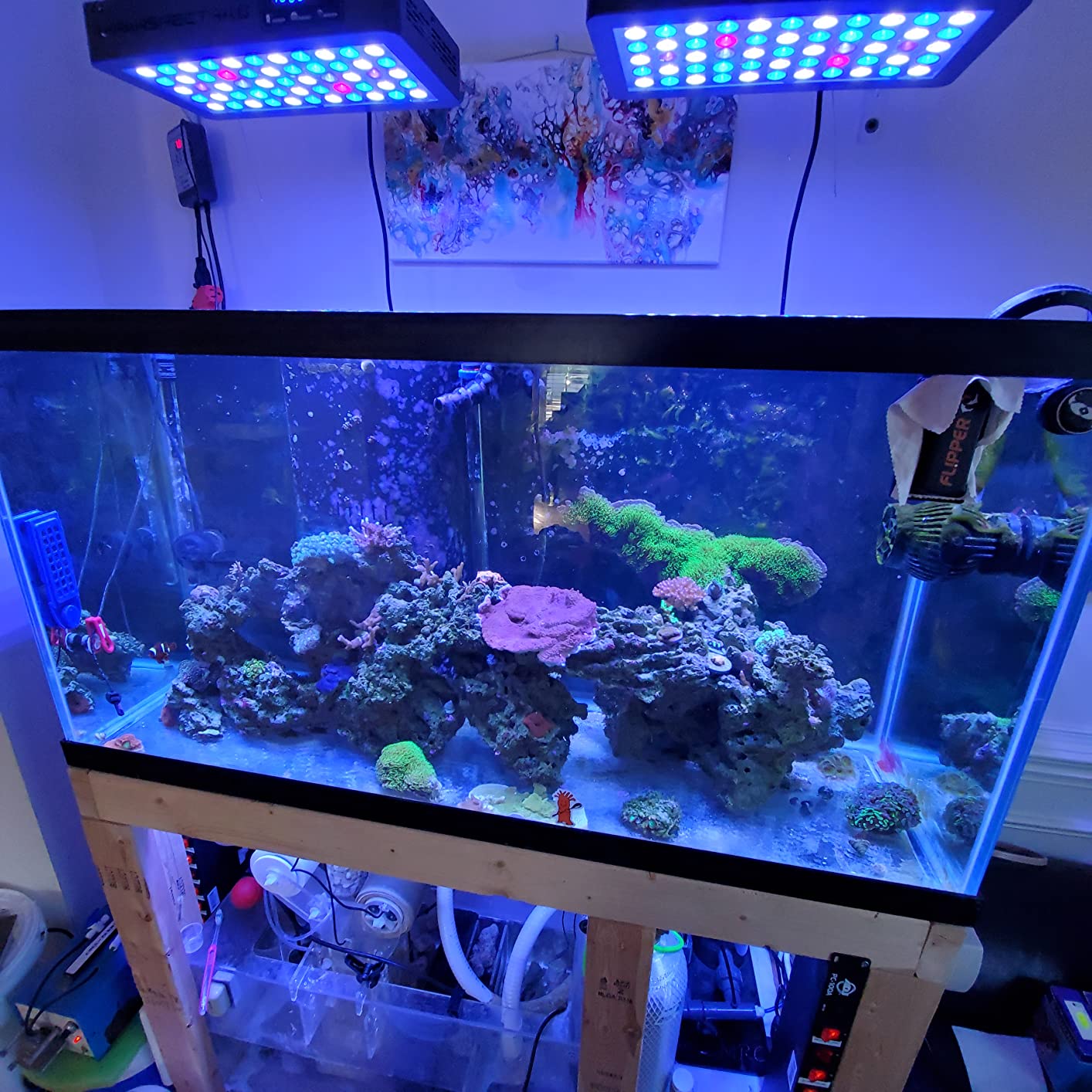
The honest limitation is headroom. At 2245 GPH this is a 20 to 60 gallon class pump, and the same range also includes the SOW-15 and SOW-20 for larger systems, so a 90 gallon tank would need a step up. Magnet strength on thicker glass is the other recurring complaint, so check your pane thickness before you commit.
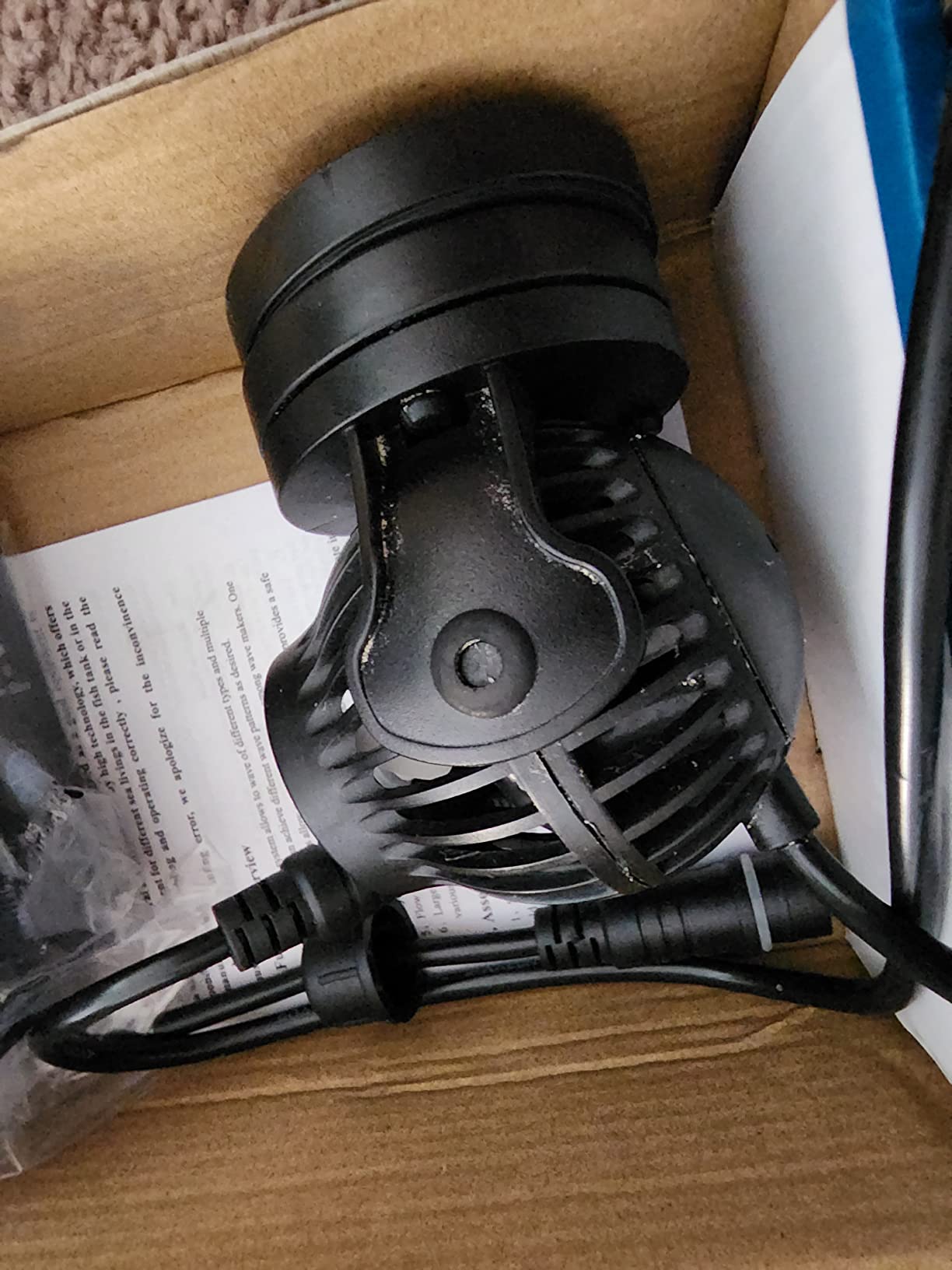
Why two of these beat one bigger pump
One pump always leaves a low-flow pocket directly behind its own mount. Two pumps aimed at each other from opposite ends of the tank create colliding gyres that keep the whole water column in motion, including the middle and the surface. Forum consensus on this question has not moved in years, and the wireless sync here makes it a two-minute job rather than a wiring project.
Where the wave modes matter
Reef gyre random is the mode most reef keepers settle on permanently. It varies output in an irregular pattern, which stops the coral from experiencing a repetitive laminar river. The night sensor drops output in darkness automatically, and the one-touch feed mode does the same job for feeding without touching a schedule.
4. Jebao SLW-30 Wavemaker – Best for 40-Gallon Breeders
Jebao SLW-30 Aquarium Wavemaker, 3,434 GPH
3434 GPH max at 30W
External drive controller
3D rotation adjustment
Ceramic shaft
Pros
- High flow in a compact 30W body
- Random mode credited with good SPS polyp extension
- Wide gentle flow rather than a narrow stream
- Pops out for cleaning while the magnet stays in place
Cons
- Supplied magnet is weak on 3/8 inch and 10-12mm glass
- Translated instructions are hard to follow
A 40-gallon breeder is the classic first serious reef, and the SLW-30 is the pump that size of tank has grown around. It pushes 3434 GPH from a 30W draw, which gives you real headroom above what a 40 gallon system actually needs, so you can dial the controller down and still have flow left in reserve. Multiple reviews single out random mode for producing noticeably better polyp extension on SPS corals.
Two engineering choices stand out. The external drive controller keeps all electronics out of the pump body, which is the design choice that most affects service life in wet environments. The wear-proof ceramic shaft resists the corrosion and biofilm buildup that quietly kills cheaper pumps. Three-dimensional rotation lets you redirect the output without moving the mount.
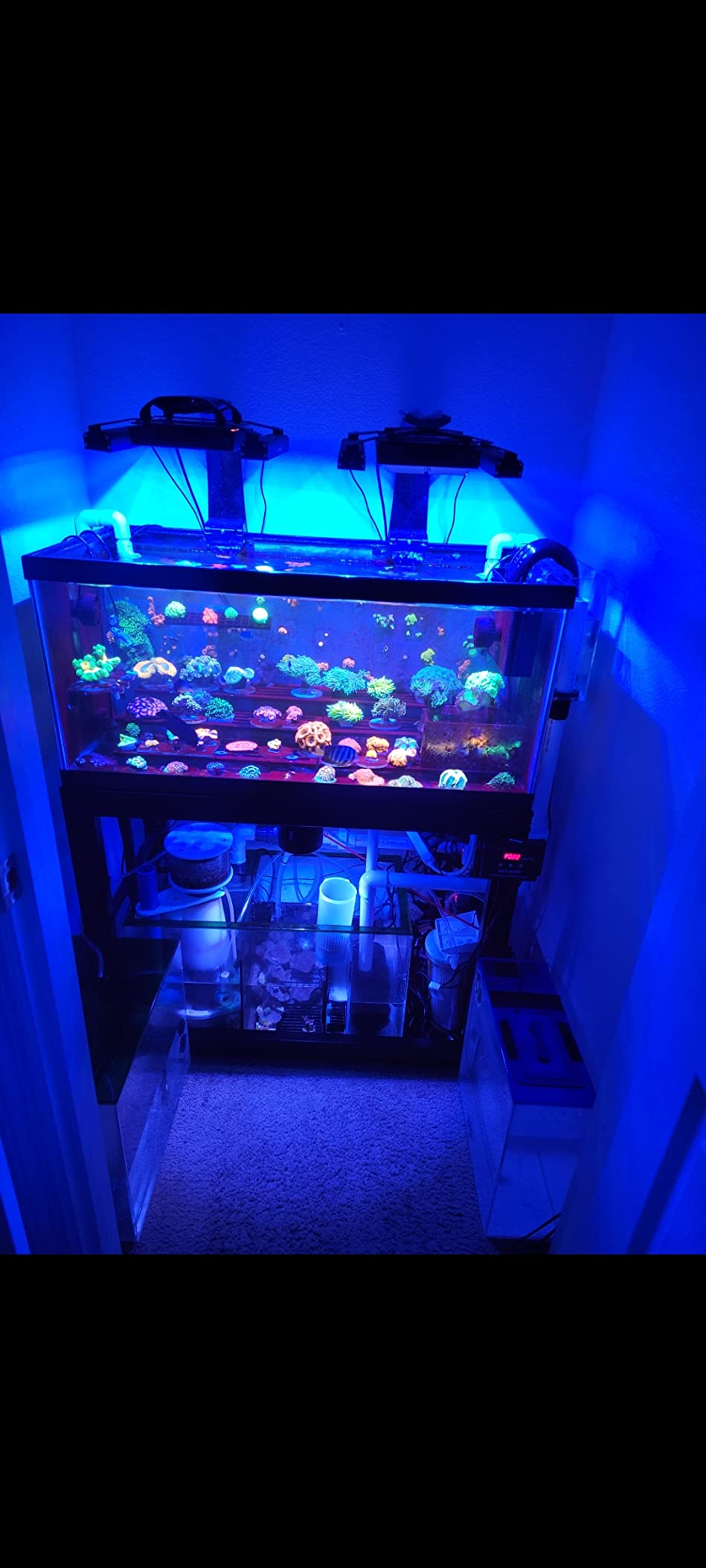
It also has a practical advantage owners like more than they expect: the pump lifts straight out of the water for cleaning while the magnetic plate stays in position, so your cleaning routine does not involve re-aiming anything. The older-style controller runs without a phone app and does not reset after a power cut, which some people prefer to app-dependent gear.
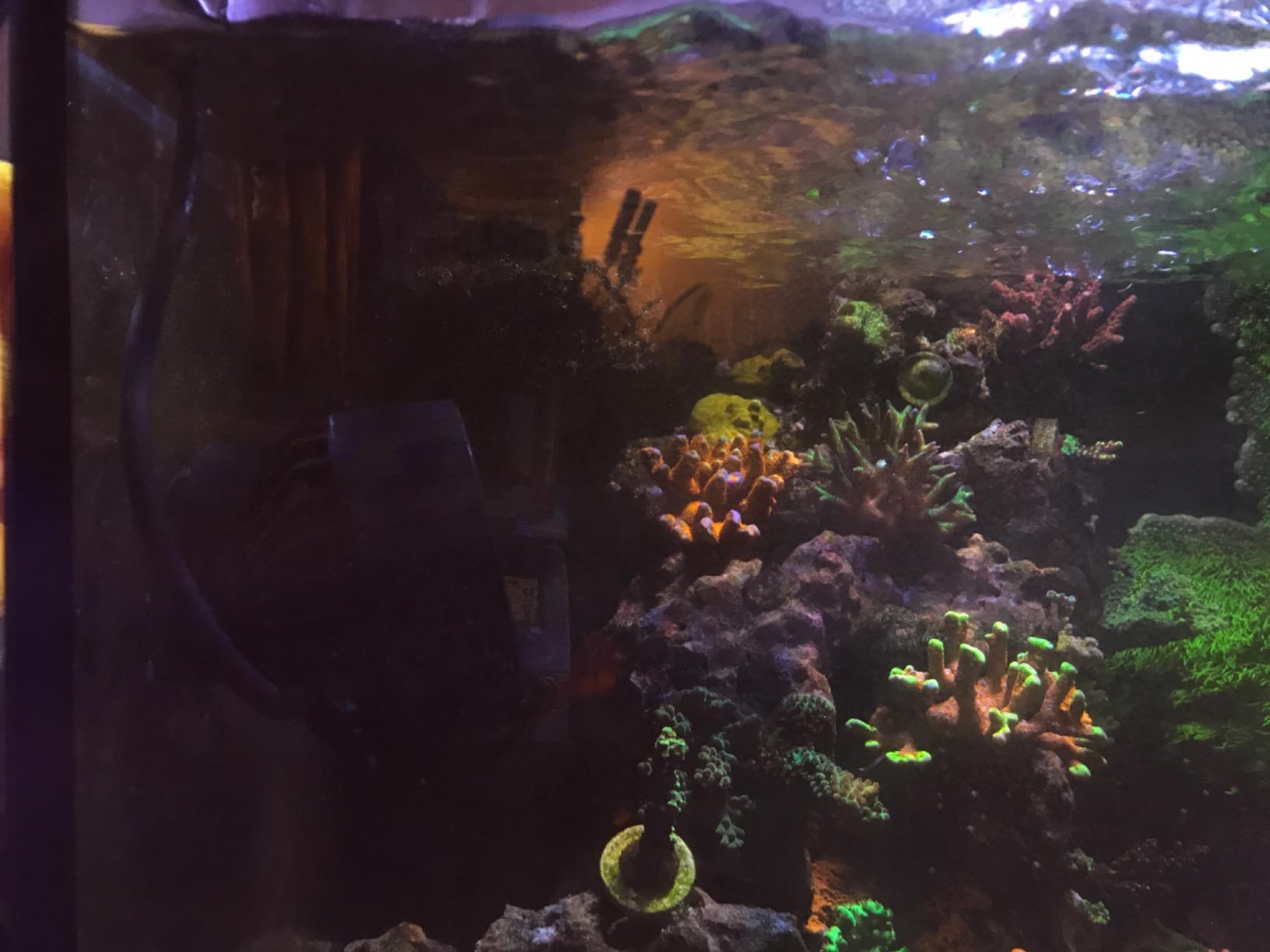
What to watch out for on this pump
Two issues come up repeatedly. The supplied magnet is reported as weak on 3/8 inch and 10 to 12mm glass, and owners on thicker panes add extra pads or a silicone shim. Debris or a broken part that jams the impeller produces a very loud noise on this model, which makes it unusually easy to diagnose by ear.
How it handles a mixed reef
The wide, gentle output suits mixed SPS and LPS systems better than a narrow jet would, and several owners run it lower than maximum specifically to keep softer corals comfortable. Wireless master-slave control means a second one can be added later if you expand, though on a 40 gallon most setups never need to.
5. hygger 1850 GPH Gyre Wave Maker – Best Gyre-Style Coverage
hygger Aquarium Gyre Wave Maker 1850GPH for 40-125 Gallon Fish Tank Cross-Flow Pump Adjustable Aquarium Water Circulation Powerhead 18W with Controller Magnetic Base
1850 GPH at 18W
270 degree dual-outlet head
Five wave modes
1 percent steps
Pros
- Covers long tanks well in the 75-120 gallon range
- Intensity adjustable in 1 percent steps with frequency control
- Long power cord gives more placement options
- Gyre pattern clears dead spots and lifts detritus
Cons
- Magnet can buzz and transmit vibration into the glass
- Minimum setting can still be too strong near 40 gallons
This is the gyre specialist in the group. The dual-pump head rotates through 270 degrees, which is what produces the wide, circling current that clears dead corners in a long tank. Owners running 75 to 120 gallon systems report strong coverage and good value against higher-priced dedicated gyre pumps, and the tank rating extends to 40 to 125 gallons on tanks up to 31 inches long.
Control is more granular than most rivals at this output. Five wave modes including a dedicated gyre pattern, intensity adjustable from 30 to 100 percent in one-percent increments, and separate frequency control let you tune the pattern rather than accepting a fixed surge. There is a ten-minute feeding pause, a night mode that auto-reduces speed when ambient light dims, and wireless linkage for synchronising multiple pumps. The controller also displays error codes, which helps when something does go wrong.
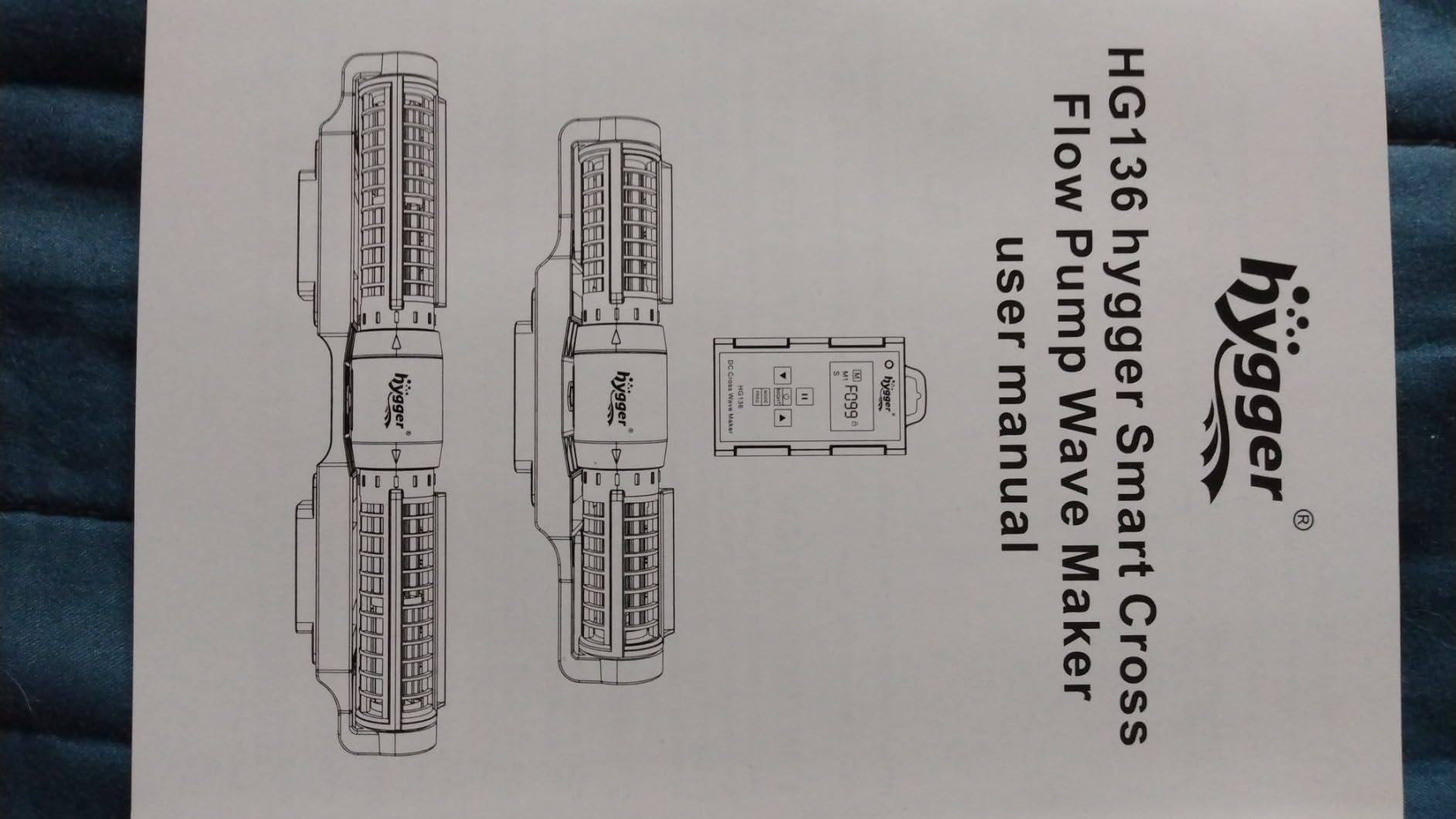
The dominant complaint in the reviews is sound, not performance. The magnet can buzz and pass vibration into the glass in a quiet room, and several buyers solved it by putting foam or a melamine sponge shim between the magnet and the pane. One reviewer reported a cracked aquarium, so a spacer is worth adding regardless of whether you hear anything.
What the extra intensity steps actually give you
One-percent steps matter more than they sound. The difference between 40 and 41 percent is the difference between a clean circulation loop and a sandstorm on a lightly stocked system, and coarse increments force you to choose between a wave that is too weak and a wave that is too strong. The frequency control compounds this, letting you shorten or lengthen the surge independent of its height.
Long tank or standard footprint
The 31 inch length rating is the honest limit here. On a standard 4 foot tank it covers ground well, but on anything deeper or longer the two-pump approach is stronger, and this pump supports wireless linkage for exactly that. Its long power cord also makes back-of-cabinet placement easier than most competing mounts.
6. Red Sea ReefWave 25 – Best App-Controlled Pump
Red Sea ReefWave 25 Gyre Aquarium Water Flow Wave Pump | ReefBeat App Controlled Customized for Aquarium Fish Tank for Saltwater Corals Reef Marine & Freshwater Aquariums
1960 GPH on 4-25 watts
5 programmable patterns
ReefBeat app control
9 inch low profile
Pros
- Slim low-profile design looks clean in a display tank
- Long-term owners report units still running after five years
- Forward
- reverse and alternating patterns in the app
- Quiet at low flow for mixed reefs
Cons
- Even at 10 percent flow it can be too strong near 30 gallons
- ReefBeat scheduling has no short on-off cycles within an hour
This is the only pump in the list that runs entirely from a phone app, through a dedicated Wi-Fi controller, and that changes what you can program. Five wave patterns are available with forward, reverse and alternating flow modes, so instead of one pump surging you can have two directions crossing in the same tank. The ReefBeat app also handles feeding pause as part of the schedule rather than as a button press.
The physical design is a genuine strength in a display aquarium. At 9 inches long and 1.6 inches tall it sits tight against the glass, and the 10 foot cable plus a recommended mounting distance of 1.5 to 4 feet from the glass gives you real freedom over placement. Output is 1960 GPH on 4 to 25 watts, and owners report quiet low-flow running suited to mixed reefs.
Durability is the standout report. One five-year owner describes units still running after that span of continuous use, which is a longer service life than most products in this roundup can document. The 4.4 average comes from a small base of 43 ratings, so treat it as a promising signal rather than a settled statistic.
Keep in mind the constraints to plan around, which are the ones reviewers raise most: the app will not schedule short on-off cycles inside a single hour, and even at 10 percent output the pump can overwhelm a tank around 30 gallons. There are no owner photo reviews on this listing yet, which reflects review volume rather than build quality. Mounting magnets are also reported as weak for the class, and a small number of owners describe pump head failures with slow support response. Flow output is modest next to what you get elsewhere in this list for the money, which is the honest trade for the app control and the five-year service reports.
Is an app better than a dial controller
App control wins when you want multi-pump coordination, long schedules and directional changes without getting wet. A physical dial controller wins when your controller network is unreliable or you would rather set it once and forget it. This pump is the one in the list most exposed to connectivity problems, and the fix is usually on your router rather than the pump.
Which tanks suit it
Mixed reefs, fish-only-with-some-corals systems, and display tanks where appearance counts. It is a poor fit for a nano or a lightly stocked 30 gallon, where even minimal output pushes sand around. The 45 model in the same range covers larger systems if you outgrow it.
7. hygger 50W Intelligent Wave Maker – Best Mode Variety
hygger Intelligent Wave Maker for Aquarium, Saltwater Freshwater Circulation Pump Adjustable 6 Waves/Night/Feed/Wireless Connection Mode, Magnetic Holder Display Controller Memory Function (50W)
50W power head
Six wave modes including tide
Light sensor night mode
10-minute feed timer
Pros
- Highest average rating in the set at 4.7 across 62 ratings
- Six wave modes give more variety than four-mode budget pumps
- Light sensor drops to low flow automatically in dim light
- Silicone sleeve dampens magnet noise and protects glass
Cons
- Shorter review history than the budget models
- Digital controller is basic next to app-controlled pumps
Six wave modes is more variety than anything else here. Constant, pulse, tide, random, quick and forward/reverse each produce a noticeably different movement pattern, and with adjustable wave length and flow rate on top, the same head covers everything from a calm mixed reef to a high-energy SPS system. At 4.7 stars it is the highest-rated pump in the roundup.
The light sensor night mode is the sleeper feature. It drops to first speed when the room dims, automatically, with no schedule to configure, and the feeding timer pauses the pump and restarts it after ten minutes. There is also low water level protection, which is cheap insurance if you top off and forget.
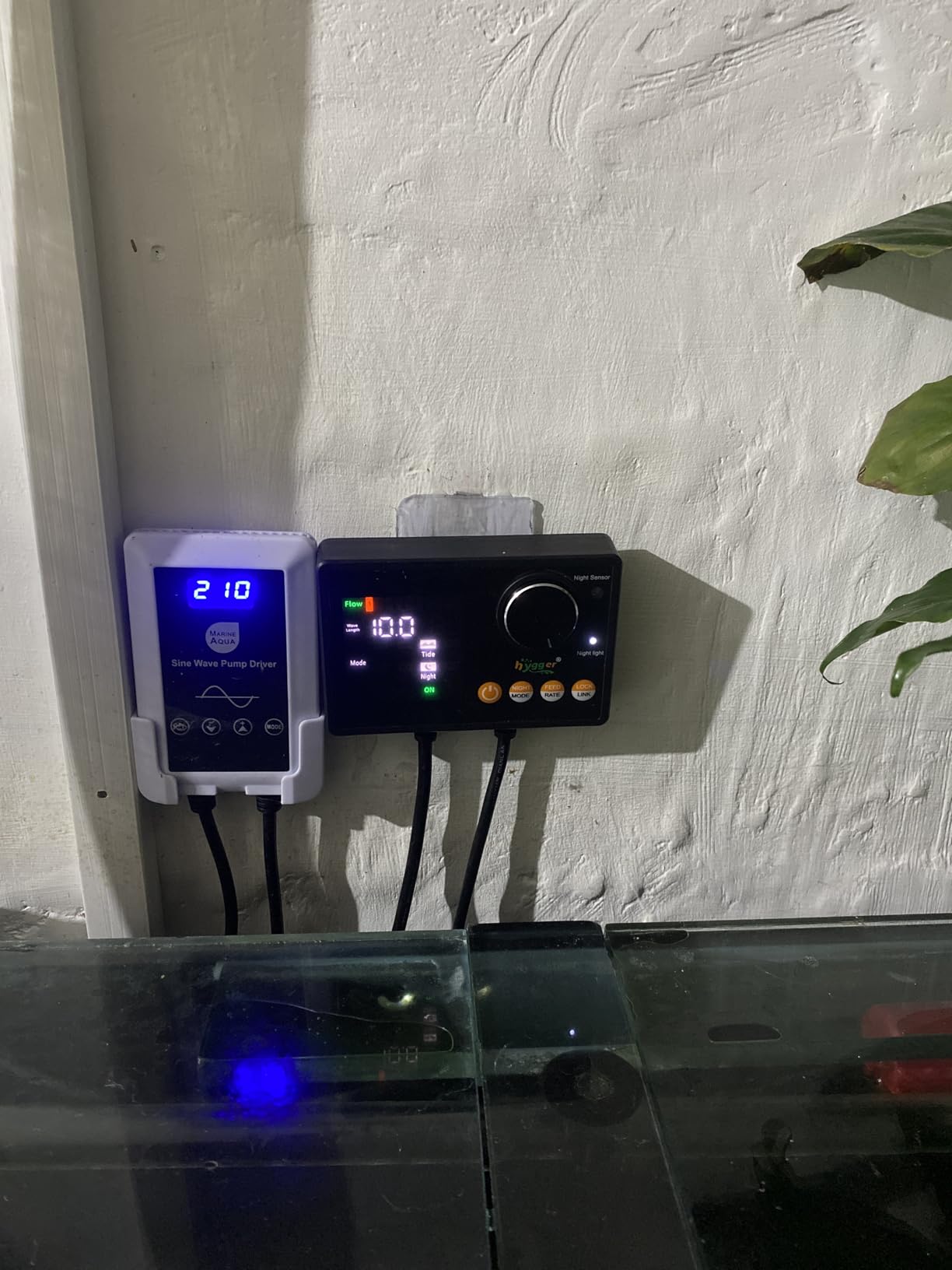
Physically, the wide dual-outlet head disperses flow more evenly and more gently than a narrow jet, which owners with softer corals appreciate. The magnetic holder has a silicone sleeve that damps noise and avoids scratching the glass, addressing the magnet buzz problem that appears elsewhere in this list. Wireless connection lets several heads share one master controller setting.
Should you buy a newer model with fewer reviews
This pump reached availability only recently, so 62 ratings is a young history compared with the 845 behind the Uniclife. The design decisions are all conservative and well documented, which is why we rate it highly, but you are accepting a shorter track record. If you want proven longevity above all else, the ReefWave 25 has owners reporting five years of continuous running.
How the silicone sleeve changes day-to-day use
It is a small part that removes an entire category of complaint. Magnet buzz is the most common negative theme across budget pumps on this topic, and a sleeve that absorbs the contact removes both the noise and the risk of scratching. It is the reason we would pair this pump with thin glass without adding a separate shim.
8. Jebao SCP-90 Crossflow Pump – Best Low-Profile Crossflow
Jebao SCP-90 Sine Cross Flow Pump Wave Maker with Controller
2700-3300 GPH crossflow
360 degree return flow
25W DC 24V
Low profile 11 inch body
Pros
- Crossflow pattern gives even flow with few dead spots
- Low profile body sits tight against the glass
- One pump has covered a 75 gallon upgrade for several owners
- Cost effective next to dedicated gyre pumps
Cons
- Some owners report a whining noise relative to dedicated gyre pumps
- Tanks longer than about 6 feet usually need two pumps
The SCP-90 is the long-standing budget crossflow option, and its signature is a body measuring 2 by 1.5 by 11 inches that runs flat against the glass. In a display tank that footprint is the whole point. Output of roughly 2700 to 3300 GPH of whole-tank crossflow comes from 25W on DC 24V, and the crossflow technology returns flow to the pump through 360 degrees to reduce dead spots.
It suits people stepping up from small powerheads. Several owners describe using a single one to upgrade a 75 gallon system on a low speed setting, which tells you the headroom is there. Reviewers also repeatedly describe the output as wide and gentle, the phrasing of approval we hear most often when people talk about whether their corals tolerate the flow.
The controller offers multiple wave types, and the pump runs from a 3-prong US plug, so there is no external power brick to hide. Being a well-known design, replacement parts and advice are easy to find, which matters if you are maintaining equipment yourself.
The length limit you should plan around
Owners are consistent on one boundary: on tanks longer than about six feet, one pump is not enough, and a second is normally required for adequate flow. Below that, a single SCP-90 on a low setting is a genuinely capable setup. It is a geometry limit, not a weakness, and it is the same reason gyre-style heads get stretched across long systems.
What the whining noise means
A mild whine relative to dedicated gyre pumps is the most common recurring note, and it sits alongside occasional impeller issues that required owners to open and reinstall the pump. A small share of owners report failure within a year or two. If you want the crossflow pattern and a quieter signature, the hygger 18W is the closer comparison.
Flow Shape Explained: Gyre vs Crossflow vs Cone Jet
Gallons per hour tells you how much water moves. It does not tell you how the water moves, and on a reef that second question matters as much as the first. Three flow shapes cover essentially every pump on this list, and understanding the difference prevents most disappointing purchases.
Cone jet is the classic powerhead shape: a focused stream fired in one direction. It is efficient at pushing water a long way and useless at filling a tank, because the far corners and the space directly behind the mount stay still. Powerheads on a single return flow fall into this category.
Crossflow circulates water back around the rotor rather than away from it, so the flow wraps through 360 degrees and passes through the same volume repeatedly. That repeated pass-through is what clears dead spots. The hygger 18W, the hygger gyre model and the Jebao SCP-90 are all crossflow designs.
Gyre-style sheet flow uses a long crossflow rotor to push a wide sheet of water down the length of the tank and back along the bottom, creating a full-tank rotation rather than a local loop. This is why gyre pumps get sought out for long tanks and heavy rockwork: a traditional powerhead cannot clear those corners, and a gyre does not care how long the tank is.
For a display aquarium full of LPS and softies, any of the three will work if you keep the intensity moderate. For an SPS-dominant system or a long tank with a rockwork ridge, gyre sheet flow earns its extra cost. For a nano, restraint matters more than shape.
Where to Place Your Wave Maker and Which Way to Aim It
Placement is the single most common question on this topic and the one least often answered well. Most disappointing wave makers are correctly sized and badly aimed.
- Start at one end, aim down the long axis. For gyre and crossflow pumps, mount high on the end wall or back corner and aim along the length of the tank so the flow has somewhere to travel. Aiming into a short wall wastes most of the output.
- Count your return pump as part of your flow. A 1000 GPH return already contributes circulation. Place the wave maker to complement it, usually opposing or crossing its output, rather than reinforcing it.
- Keep the outlet away from the substrate. Pointing a jet straight at the sand bed is the leading cause of sandstorms, the most repeated failure reported by nano keepers.
- Aim slightly down and across, not straight across. A downward angle of around 20 to 30 degrees circulates the water column and the lower third of the tank, while a level outlet tends to run along the surface only.
- Leave the pump’s own dead zone to the return flow. There will always be a low-flow pocket behind the mount. Do not try to eliminate it with the wave maker; route the return nozzle into it or accept it and rotate the mount occasionally.
- Check the glass before you tighten anything. Several owners across this list report a magnet cracking a pane. Use a silicone or foam shim on any glass above 3/8 inch and never overtighten.
- Re-aim after every major rockwork change. Rockwork redirects flow, and a layout that worked at day one can leave the far end stagnant after a rescape.
On cord routing, which is a genuine setup headache with submersible pumps: the cord has to get through the lid or over the rim regardless, and the cleanest route is a bulkhead-style gland in the rear corner of the lid. Failing that, run the cord behind the cabinet and leave enough slack that you can lift the pump out for cleaning without dragging the whole line.
One Big Pump or Two Smaller Ones
Two smaller pumps almost always beat one large pump of the same combined output. The physics is simple: two opposing gyres create colliding, chaotic, multi-directional flow, while one pump creates a single consistent rotation that leaves a quiet pocket behind its own mount.
There is a practical argument too. Two pumps of half the size each mean a failure takes out half your circulation rather than all of it, and cleaning can be done one at a time. Most of the pumps here support wireless master-slave linking, so a matched pair can be programmed to alternate surge without a phone or an external controller.
The exception is the nano, where two pumps may simply be too much equipment. On very small systems a single appropriately sized head on a random mode does the job, and the extra circulating hardware risks a sandstorm. On anything above 40 gallons, plan for two.
How to Choose a Wave Maker for Your Reef Tank
Work out your flow target first. Multiply your display volume by 20 to 40 to get your total hourly flow target, counting the return pump. A 40 gallon system therefore wants roughly 800 to 1600 GPH of total circulation, and a 125 gallon mixed reef wants 2500 to 5000 GPH. Then subtract what your return pump already delivers, and size the wave maker to the top of the remaining band rather than the bottom, because rated output is a maximum and you will rarely run there.
Understand what the GPH number means. Manufacturer flow ratings are measured at peak with a bare pump. Real output drops in wave mode, falls further as biofilm builds on the shaft and impeller, and declines with age. Treat the rating as a ceiling and plan around roughly half of it as your working average.
Map your tank to a size band. Under 20 gallons, restraint wins: a single low-output pump on random mode, and nothing aimed at the sand. From 20 to 40 gallons, the Jebao SOW-8 or the hygger 18W is the sweet spot, and most keepers run two. From 40 to 100 gallons, the Jebao SLW-30, the hygger gyre model or a pair of crossflow pumps fit well. Above 100 gallons, gyre sheet flow is worth the premium, and two pumps become the default rather than the option.
Choose cord-free or submersible on appearance and service. Cord-free designs keep the motor and cabling outside the glass, which looks cleaner in a display tank and keeps electronics dry. Submersible magnetic pumps are cheaper, easier to reposition, and simpler to service because the whole unit lifts out. Decide which of those two matters more to you before comparing specs.
Pick a dial controller or an app. Dial and digital controllers set patterns once and never fail. Apps add scheduling, multi-pump coordination and remote changes, at the cost of connectivity risk on a modern home network. Reef keepers running Apex, HYDROS or GHL equipment usually prefer the app so flow lives in the same interface as lighting.
Match power to coral type. SPS-dominant systems want the highest, most chaotic and most multi-directional flow in the tank. LPS and mixed reefs are happiest in the middle of the range. Soft coral and low-flow specimens sit at the bottom of the band, and forcing them to the top is how damaged tissue happens.
On placement of the wider equipment around the tank, our guides to choosing the right tank footprint and sizing an aquarium to its inhabitants cover the volume questions that determine your flow target before you ever reach a pump.
Wave Modes, Night Operation and Feeding Pauses
Most wave makers ship with mode names that mean little until you know what they do. Constant flow is a steady output, essentially a powerhead. Pulse is a repeating ramp, the classic surge. Sine and tide stretch that ramp into a longer, gentler cycle. Random, reef gyre and cross flow vary the output irregularly, which is what stops coral from settling into a single pattern. Forward and reverse alternate direction. Quick is a short, sharp burst for stirring the substrate.
For most mixed and SPS systems, random or gyre random at moderate intensity is the setting you will use most of the time. The regular modes are useful for short windows around a water change, when you want a consistent sweep rather than a chaotic one.
Nighttime. Turning the wave maker off at night is a common question, and the answer is that you do not need to, though many keepers do. Corals benefit from continued flow overnight, and a gentle night mode that reduces output when the room darkens is usually better than a full shutdown. Several pumps here include a light sensor that does this automatically. On nano tanks and shallow systems where the pump is louder than it is useful in a dark room, a night drop is worth setting.
Feeding. Every pump in this list handles feeding in one of two ways, a ten-minute feed pause on a button or a scheduled pause in the app. Either way, pausing during feeding prevents food from being pushed into the water column and keeps the corals from having to fight a current for their share. Do wave makers stress fish? Properly aimed and moderated flow does not. Sandstorms do, and so does a jet fired directly at a resting fish. The stress in a reef comes from sustained high-energy flow at close range in a cramped tank, not from having moving water.
Known Issues, Noise and a Cleaning Schedule
Magnet strength is the most common physical complaint across every brand here. Reported thresholds cluster around 3/8 inch and 10 to 12mm glass, above which owners add extra pads or a shim. Adding a silicone or foam spacer solves the buzz and reduces the risk of cracking a pane at the same time.
Noise is the second theme, and it is where gyre pumps differ most from smaller units. Maxspect and other manufacturers describe their pumps as near silent rather than silent, with audible hum appearing above roughly 40 to 50 percent power. That is normal for the class. What is not normal is a noise that changes with running time rather than with speed, which usually means a bushing or bearing wearing.
App-controlled pumps most often fail to connect because of the network, not the pump. The fix is a short sequence: confirm your home Wi-Fi is on the 2.4GHz band rather than 5GHz, put the phone and the controller on the same band, power-cycle the controller by unplugging it for thirty seconds, then pair again from close to the tank. Bluetooth-based controllers have the same problem when the phone roams between bands.
Cleaning schedule. Weekly, take each pump out and wipe the shaft and impeller. Monthly, pull the rotor and clean the bushing with a soft brush, and rinse the magnet. Community consensus is that routine cleaning is the single biggest factor in how long any of these pumps lasts, and the pumps with a dry-side or external-drive design simply have less to corrode. A pump that has never been cleaned is the one that fails, regardless of brand.
Frequently Asked Questions
What is the best wave maker for a reef tank?
For most reef tanks the Uniclife 3400 GPH model is the strongest all-round choice, with the most owner feedback of any pump here. Smaller systems should step down to the Jebao SOW-8 or hygger 18W, which suit 20 to 60 gallon tanks. Match the pump to display volume times 20 to 40, count your return pump, and prioritise random or gyre modes over straight constant flow.
How much flow does a reef tank actually need?
Multiply your display volume by 20 to 40 to get total hourly flow, including the return pump. A 40 gallon reef therefore wants roughly 800 to 1600 GPH of total circulation. Subtract what the return already moves, then size the wave maker to the top of the remaining range because rated output is a measured maximum and real wave-mode output is lower.
Where should I place my wave maker in my reef tank?
Mount high on an end wall or back corner and aim along the long axis so the flow has distance to travel. Keep the outlet away from the substrate to prevent sandstorms, angle it slightly downward to circulate the whole column, and route the return nozzle into the low-flow pocket behind the mount. Re-aim after any major rockwork change, since rockwork redirects flow.
Do wave makers stress out fish?
No, when flow is aimed correctly and kept at a moderate level. Moving water is normal and beneficial for a reef. What causes stress is a jet fired directly at a resting fish, or a pump powerful enough to lift sand and create a sandstorm. Aim across the tank rather than at a resting spot, use random modes, and keep intensity moderate on soft coral and shallow systems.
Should I turn my wave maker off at night?
You do not need to, and continued flow benefits corals overnight. Many keepers instead run a gentler night setting, and several pumps here include a light sensor that reduces output automatically when the room dims. On nano tanks and quiet rooms, a night drop or shutdown makes sense purely because of pump noise, not because of coral health.
Why do app-controlled wave makers keep failing to connect?
The usual cause is the network rather than the pump. App and Wi-Fi controllers commonly only support the 2.4GHz band, so a 5GHz home router will not pair. Put the phone and controller on the same 2.4GHz band, power-cycle the controller by unplugging it for thirty seconds, then pair again from close to the tank.
Is one wave maker enough or do I need two?
Above about 40 gallons, two smaller opposing pumps beat one larger pump. Colliding gyres create chaotic, multi-directional flow across the whole tank, and a single pump always leaves a quiet pocket behind its own mount. Two pumps also mean a failure takes out only half your circulation. Most pumps here support wireless master-slave linking, so a pair needs no extra controller.
Final Verdict
For the best wave makers for reef tanks in 2026, the Uniclife 3400 GPH model is the pick we would put in a large system: 845 ratings, a rotatable magnet mount, four wave modes and a ten-minute feeding pause, at 40W. Step down to the Jebao SOW-8 under 60 gallons, or the hygger 18W for its crossflow geometry and granular intensity control, and pair any of them rather than running one pump alone.
Whichever you pick, aim it along the long axis, keep it off the substrate, and clean the shaft and bushing every week. That last habit does more for service life than the model name does.