

Short answer: the Garmin Instinct 3 Solar is the best Garmin watch for hiking for most people, because it pairs multi-band GPS with SatIQ, a built-in flashlight, a barometric altimeter and a 3-axis compass in a 52 g case, and it carries a 4.6 rating across 818 reviews. If you want full-color topographic maps on your wrist, the fenix 8 47mm is the better hiking watch. If your trips run days without a charger, the Enduro 3 is the one to look at first.
I compared the current Garmin outdoor lineup model by model, weighing what actually matters on a trail: how long the battery lasts with GPS running, whether the watch holds a signal in tree cover, whether the screen is readable in glare, and how the case feels after twenty miles on your wrist. Every number quoted below comes from the manufacturer specifications and the aggregated owner reviews for that specific model.
Garmin makes the widest range of outdoor watches of any brand, which is both its strength and the source of most buyer confusion. The same watch name can hide a different case size, a different lens, a different display and a different battery life. So this roundup skips the marketing shorthand and names the exact configuration that earns each spot.
A few things to keep in mind as you read. A breadcrumb trail that records where you walked is not the same thing as a full-color topographic map you can route across, and both are completely different from carrying a dedicated handheld unit. If you need one of the companion items most hikers end up buying, start with our best headlamps for hiking guide and our best backpacks for thru-hiking picks.
Top 3 Garmin Picks for Hiking in 2026
The three watches below cover the majority of hiking situations. The Instinct 3 Solar handles everything from day hikes to multi-day treks on a breadcrumb trail, the fenix 8 adds true offline mapping, and the Enduro 3 is the endurance specialist.

Garmin Instinct 3 Solar 45mm
- Multi-band GPS with SatIQ
- Built-in LED flashlight
- 52 g fiber-reinforced polymer case
- 10 ATM and MIL-STD-810

Garmin fenix 8 47mm
- 1.4 inch AMOLED touchscreen
- Speaker and mic for wrist calls
- Multi-band GPS with SatIQ
- 40-meter water rating

Garmin Enduro 3 Solar
- Up to 320 hours GPS with solar
- Preloaded TopoActive maps
- 63 g titanium and sapphire build
- Built-in flashlight
All 10 Watches at a Glance in 2026
Every watch below was picked for a specific hiking scenario rather than for its place on a spec sheet. The table gives you the short version, and the numbered reviews that follow explain who each one actually suits.
| Product | Specifications | Action |
|---|---|---|
| Garmin Instinct 3 Solar 45mm |
|
Check Latest Price |
| Garmin fenix 8 47mm |
|
Check Latest Price |
 Garmin Instinct 2X Solar 50mm Garmin Instinct 2X Solar 50mm |
|
Check Latest Price |
 Garmin epix Pro Sapphire 51mm Garmin epix Pro Sapphire 51mm |
|
Check Latest Price |
 Garmin fenix 7X Pro Solar 51mm Garmin fenix 7X Pro Solar 51mm |
|
Check Latest Price |
| Garmin Enduro 3 51mm |
|
Check Latest Price |
 Garmin fenix 7X Sapphire Solar Garmin fenix 7X Sapphire Solar |
|
Check Latest Price |
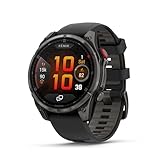 Garmin fenix 8 Pro 51mm Garmin fenix 8 Pro 51mm |
|
Check Latest Price |
 Garmin Enduro 2 Garmin Enduro 2 |
|
Check Latest Price |
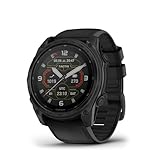 Garmin tactix 8 Solar 51mm Garmin tactix 8 Solar 51mm |
|
Check Latest Price |
1. Garmin Instinct 3 Solar 45mm Review – Best Overall Hiking Watch
Garmin Instinct® 3 Solar, Rugged GPS Smartwatch, 45mm, Black
0.9 inch monochrome MIP
Solar lens
52 g
10 ATM and MIL-STD-810
Pros
- Multi-band GPS with SatIQ holds signal in canyons and tree cover
- Built-in LED flashlight with variable intensity and strobe
- 52 g case stays comfortable on long days
- 28-day average battery with solar assist
- Metal-reinforced bezel on a fiber-reinforced polymer case
Cons
- Monochrome screen means no full-color topographic maps
- Button-driven menus take practice to master
- Small 0.9 inch display limits detailed map legibility
What makes the Instinct 3 Solar the best Garmin watch for hiking right now is the combination of things it refuses to leave out. Multi-band GPS with SatIQ sits alongside a 3-axis compass and barometric altimeter, so it tracks position, heading and elevation without needing your phone to agree. The 0.9 inch transflective memory-in-pixel screen is sunlight-visible rather than backlit, which means it stays readable at noon on an exposed ridge.
At 52 g this is one of the lighter full-size watches in the lineup, and on a 20-mile day that difference compounds. The case is fiber-reinforced polymer with a metal-reinforced bezel, rated to 10 ATM and tested to MIL-STD-810 for thermal and shock resistance. Rating data for this configuration sits at 4.6 across 818 reviews, with 83 percent of those ratings at five stars.
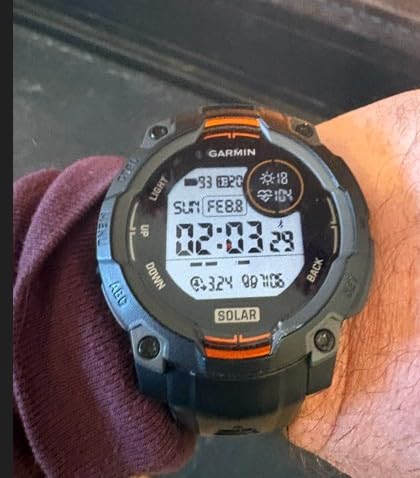
Owners almost always open with the battery. Garmin rates the average life at 28 days in smartwatch mode, and the solar lens extends that further with regular daylight exposure. The health suite covers wrist-based heart rate, sleep monitoring and Pulse Ox, and the watch also includes Garmin Pay, Connect IQ apps and incident detection with Assistance.
Storage is 128 MB, which is modest compared with the 32 GB you get on the mapping models. That is the trade you make: you give up music and detailed on-watch maps in exchange for a lighter case and a far longer battery between charges.
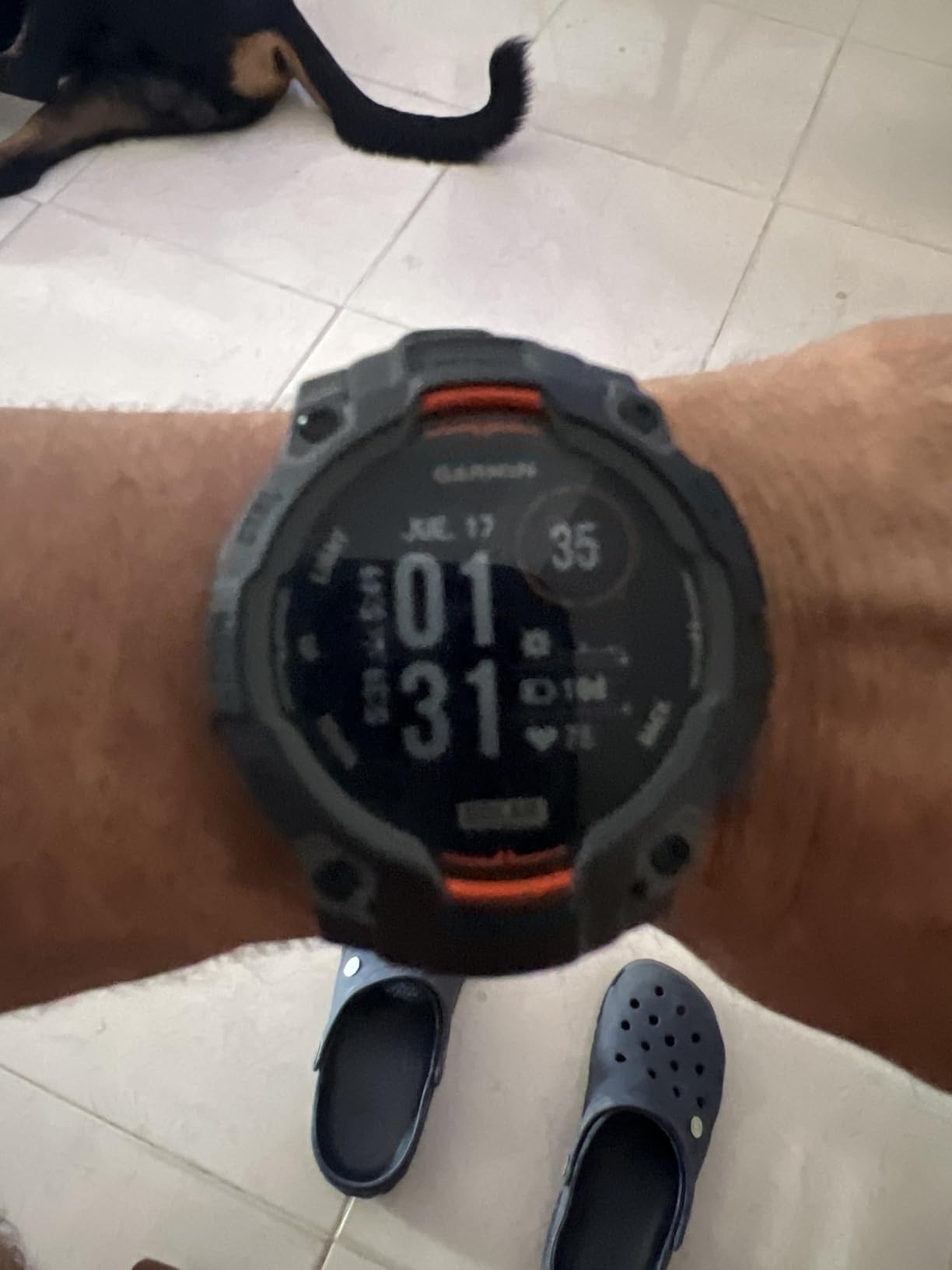
What you gain by picking the Instinct 3 Solar
The flashlight is the feature hikers mention first in the wild, and it is a real one. Variable intensity plus a strobe mode turns the watch into an emergency beacon when you are off-trail after dark, and it removes one more device from your pack. The SOS strobe mode is a genuine signaling tool if a night hike goes wrong.
SatIQ is the quiet advantage. It lets the watch use multiple satellite bands without draining the battery the way constant multi-band does, which is exactly what you want when you move in and out of heavy tree cover. Tracback-style breadcrumb navigation keeps a record of your route so you can walk it back.
Where it falls short for hiking
Navigation is the limit. You get a breadcrumb trail, a compass and elevation data, but not a full-color topographic map you can read contours on and route across unfamiliar terrain. If you regularly navigate unmaintained trails or need to see a valley layout at a glance, one of the mapping watches below fits the job better.
Navigation here is also button-driven, and reviewers report the menu depth takes a few weekends before it stops feeling slow. Wrist heart rate readings drift when you are walking uphill hard with a pack, which is a common Garmin complaint on this line and worth expecting.
2. Garmin fenix 8 47mm Review – Full-Color Offline Maps
Garmin fēnix® 8, 47mm, Black
1.4 inch AMOLED touchscreen
Stainless steel bezel
80 g
47 hours GPS
Pros
- Bright 1.4 inch AMOLED touchscreen rated at 1000 nit
- Built-in speaker and mic for on-wrist calls and phone assistant
- Multi-band GPS with SatIQ plus compass gyro and altimeter
- Dynamic round-trip routing for out-and-back days
- 40-meter rating with leakproof metal buttons and ECG app
Cons
- GPS mode battery is short for multi-day trekking
- Touchscreen is awkward with wet or gloved hands
- Heaviest of the everyday-sized options here at 80 g
The fenix 8 47mm is the Garmin watch for hikers who genuinely navigate rather than retrace steps. A 1.4 inch AMOLED touchscreen at 1000 nits shows full-color topographic detail, and dynamic round-trip routing will build a path back to a trailhead for you. The stainless steel bezel is 22 mm band width, and the case carries a 40-meter rating with leakproof metal buttons.
Battery is the honest weakness. Garmin rates 16 days in smartwatch mode and 47 hours in GPS mode, and 47 hours is real. Reviewers rank this configuration 4.6 out of 5 across 1195 reviews, with 85 percent five-star ratings, and the most common reservation in the aggregate reviews is exactly that GPS runtime.
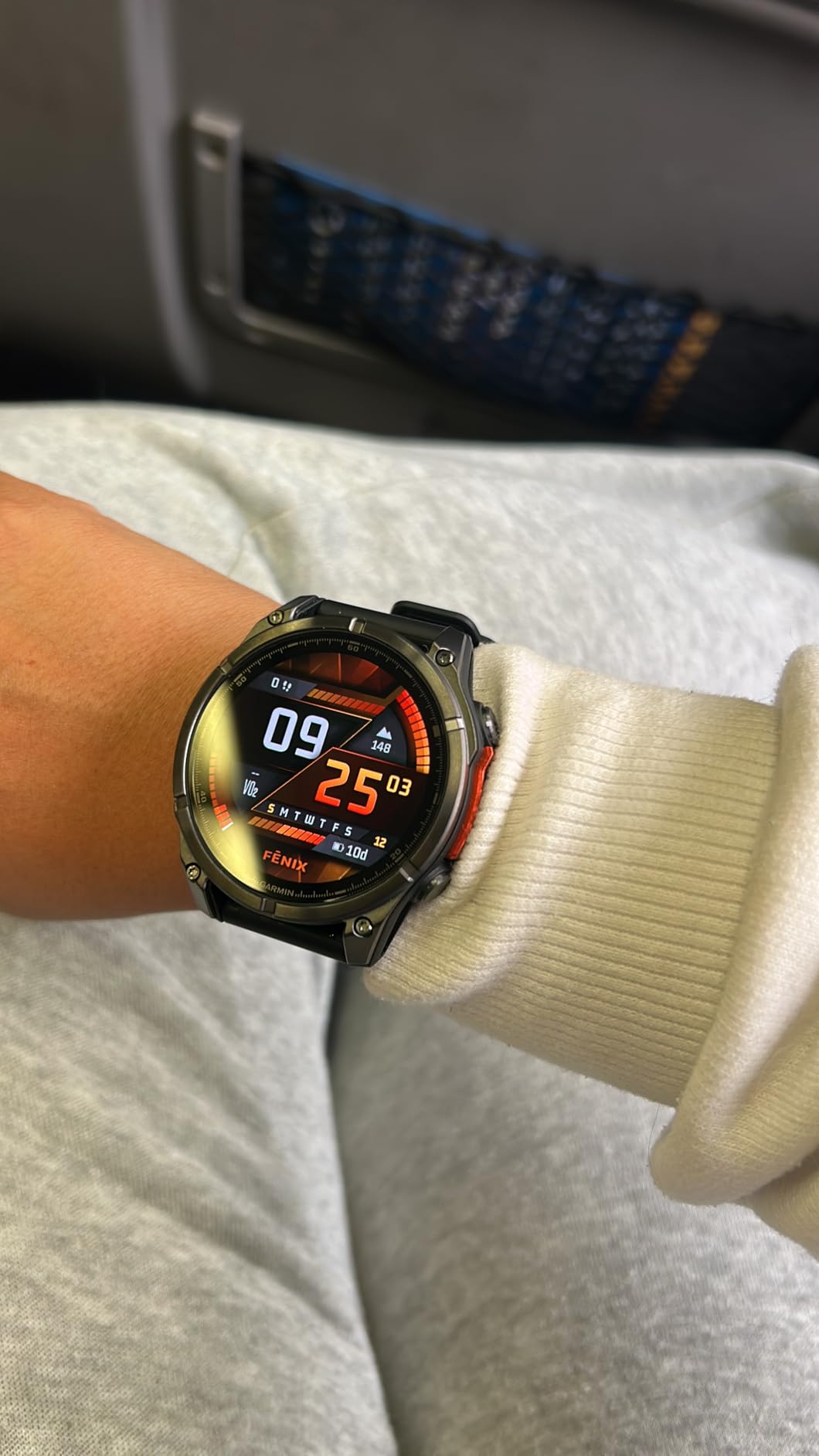
What the fenix 8 adds over an Instinct is a speaker and microphone. You can take calls on the wrist, talk to your phone assistant and use off-grid voice commands on the trail. Storage of 16 GB holds music, and there is an ECG app, Pulse Ox, respiration tracking and advanced sleep monitoring.
The sensor stack is complete for backcountry use: multi-band GPS with SatIQ, a 3-axis compass, a gyroscope and a barometric altimeter. That combination is what lets the watch tell you how far you climbed rather than just where you walked.
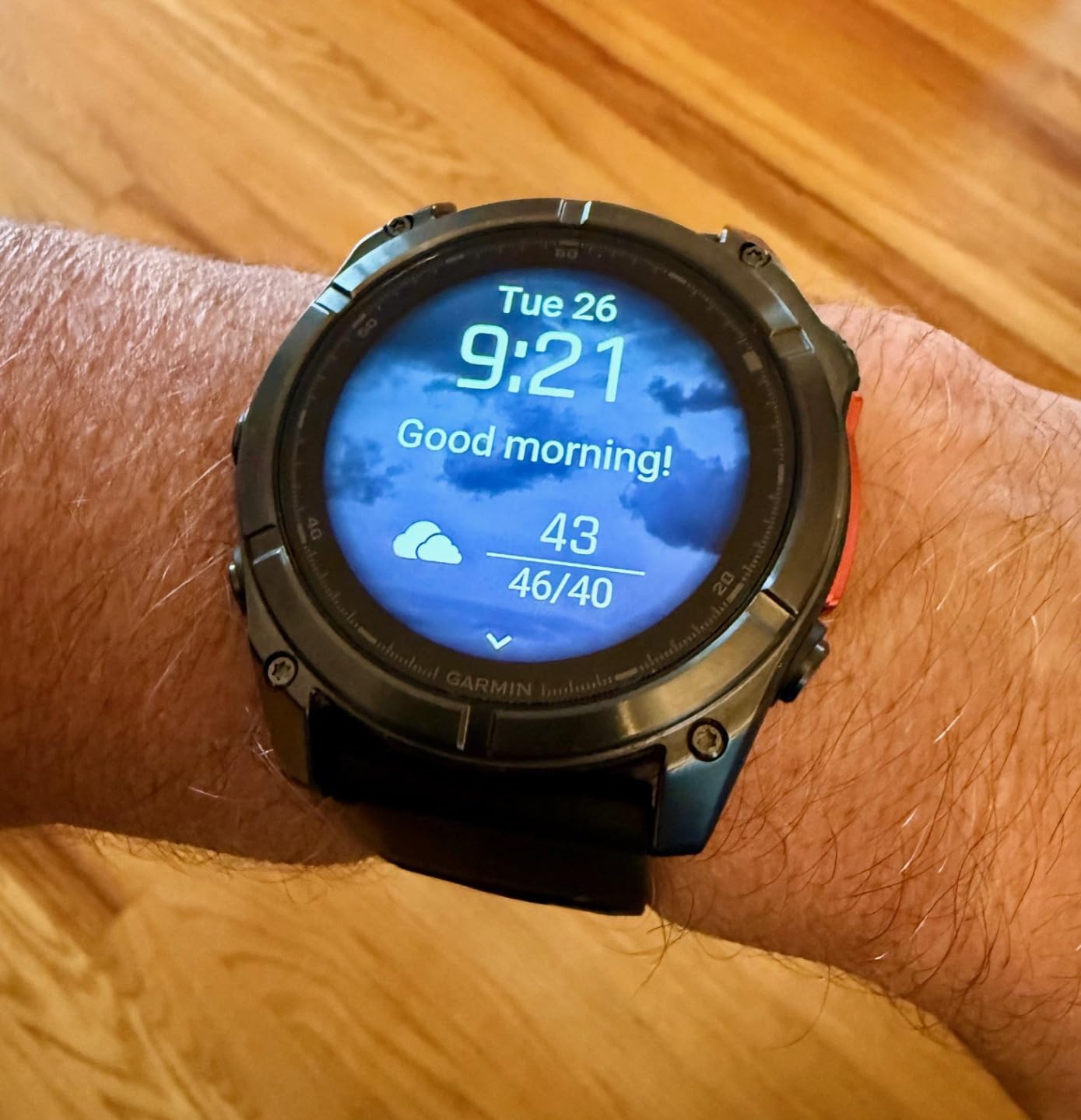
What you gain by picking the fenix 8
You gain a real map on your wrist, and that changes how you plan a route. Owners who moved up from a breadcrumb-only watch describe the difference as being able to see a ridge line and pick a line across it instead of guessing. A touchscreen is also far faster for scrolling through data than five buttons.
The speaker and mic genuinely matter for solo hikers. If you fall and cannot reach your phone, incident detection sends a notification, and having voice control nearby reduces the number of times you need to pull the phone out with cold hands.
Where it falls short for hiking
Two days without a charger is where this watch runs out of road. For a weekend in the backcountry, plan on carrying a small battery pack. It also means solar is not an option here, since the AMOLED panel has no solar lens in this configuration.
At 80 g it is noticeably heavier on the wrist than the Instinct line, and a wet or gloved touchscreen is a genuine usability problem during a rainy ascent. The 47 mm case also sits at the upper edge of what smaller wrists find comfortable.
3. Garmin Instinct 2X Solar Review – MIL-STD-810 Endurance
Garmin Instinct® 2X Solar, Rugged Outdoor Smartwatch, 50mm, Graphite
1.1 inch monochrome MIP
Solar Power Glass
67 g
50 mm case
Pros
- Owners report 29 to 40 days between charges
- Built to US military standard 810 for thermal shock and water
- LED flashlight with strobe and red night-vision modes
- Multi-band signal reception with Tracback and line-of-sight navigation
- Hand and heart rate HRV sleep respiration and Pulse Ox tracking
Cons
- 50 mm case feels bulky on smaller wrists
- No speaker or microphone for wrist calls
- Button menus are deep and take time to learn
The Instinct 2X Solar is the endurance pick of this group, and at 2197 reviews it also carries the largest owner base here. It is built to US military standard 810 for thermal, shock and water resistance, which is the single most reassuring spec for anyone who drops their watch into a creek or onto granite.
Runtime is the headline. Owners frequently report 29 to 40 days between charges, helped by the Solar Power Glass lens, which Garmin says delivers 50 percent more energy than the standard Instinct 2 solar and supports unlimited battery life in smartwatch mode with three hours of daily sunlight. The case is 50 by 50 by 14.5 mm and fits wrists from 145 to 228 mm.
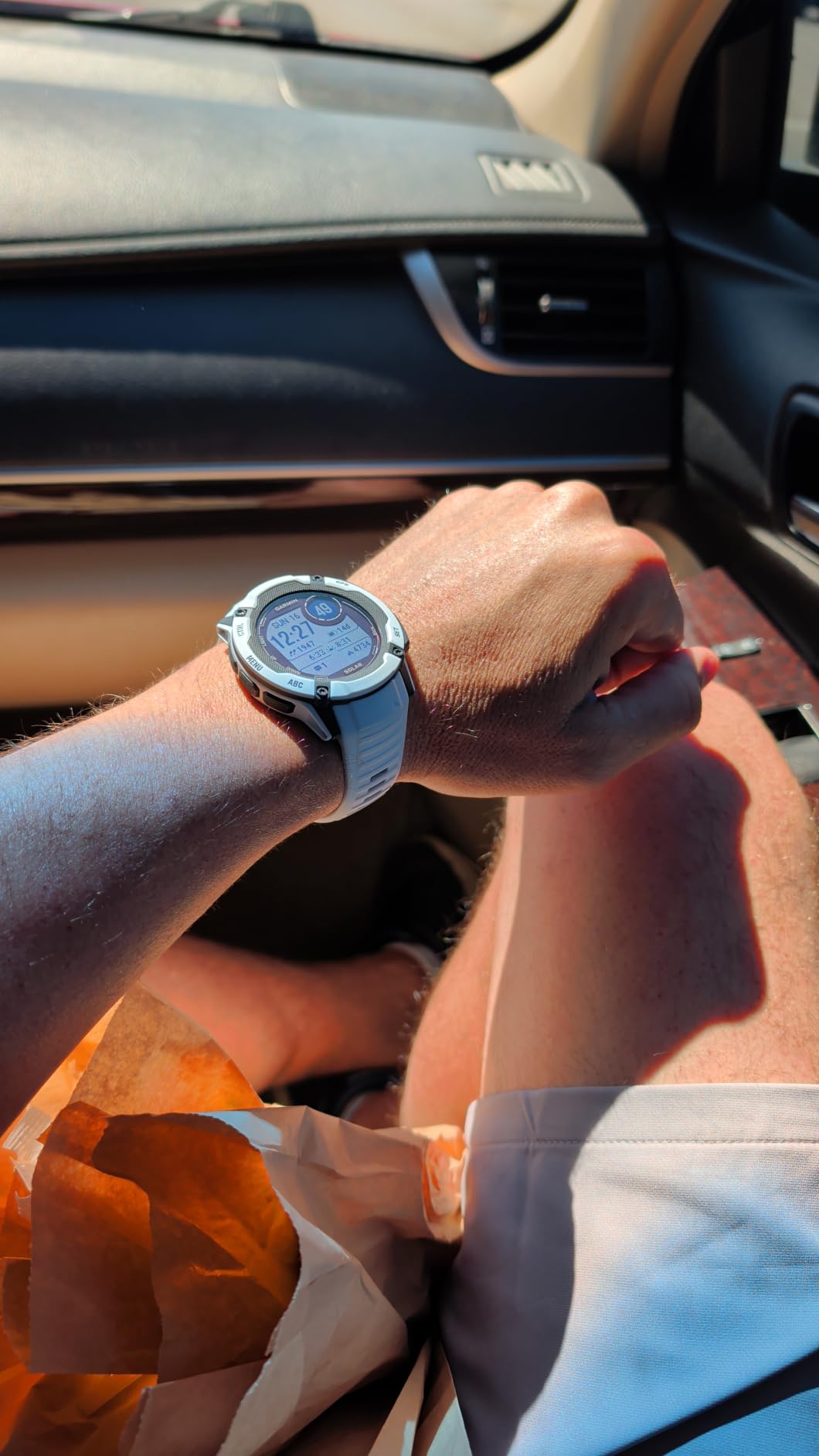
Navigation is more capable than the current Instinct 3 on one specific point. Tracback routing and line-of-sight navigation both appear in the technical details, and multi-band signal reception keeps the track clean under canopy. You still get a 3-axis compass and barometric altimeter, and there is an SOS strobe mode.
Training features cover the dual-use case well, with running, biking, swimming and strength apps plus VO2 max tracking and heart rate, HRV, sleep, respiration, Pulse Ox and stress monitoring. The band is 22 mm silicone, which is easy to swap for a spare.
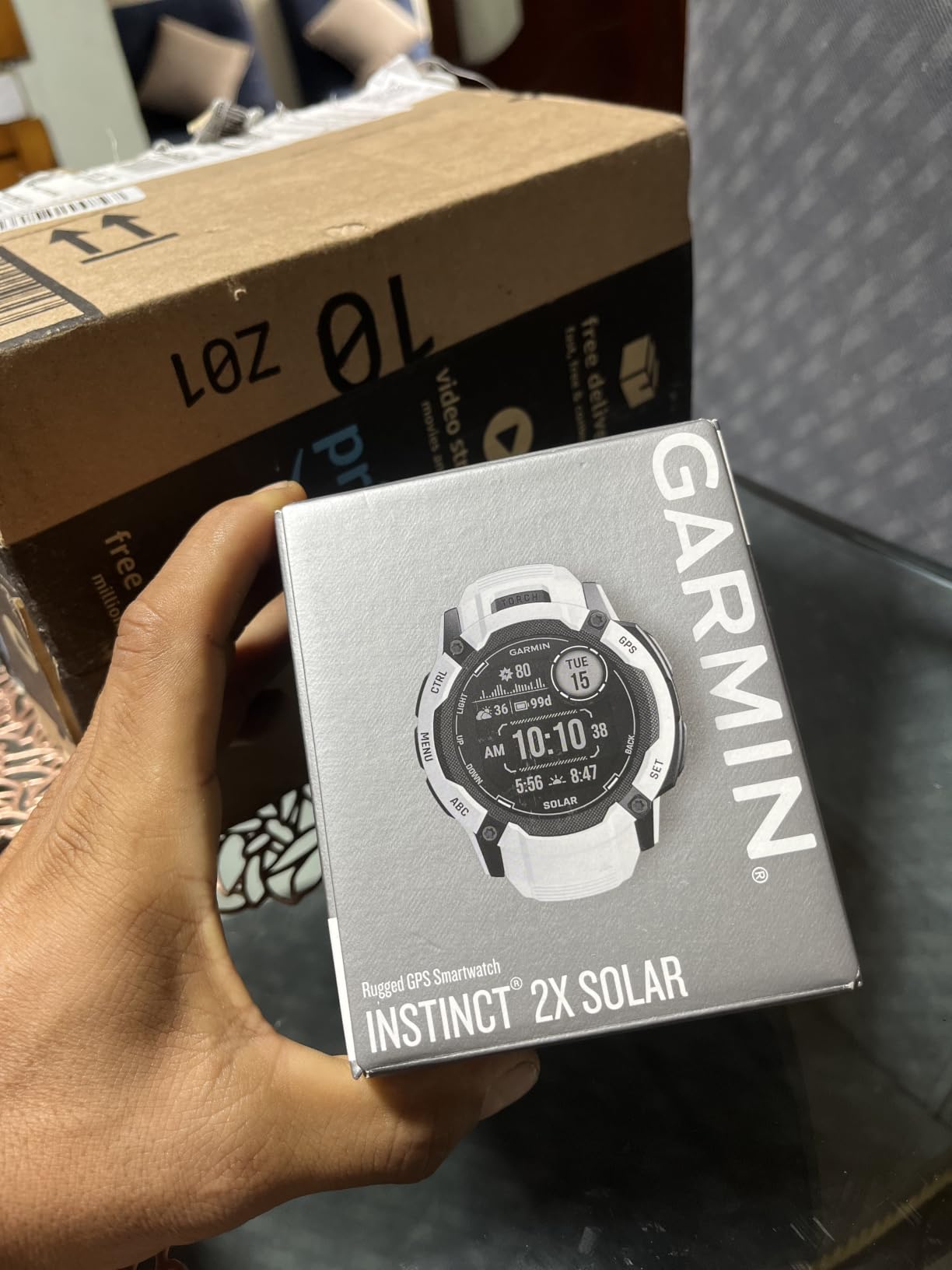
What you gain by picking the Instinct 2X Solar
You gain a watch you can genuinely forget about. For a week in the backcountry, a solar watch removes the battery anxiety that makes people carry a solar pack, and the flashlight covers the pre-dawn start and the walk out after dark.
At 67 g it is heavier than the Instinct 3 Solar but still far lighter than the titanium and sapphire models in this list. That balance of durability, size and runtime is why it remains a common recommendation among owners who have moved on to more expensive watches.
Where it falls short for hiking
The 1.1 inch monochrome display has no touch and no color, so detailed map viewing is limited and the only satellite systems listed are GPS itself. Reviewers also note the feature menus are deep and button-only, which costs you time on early outings.
There is no speaker or microphone, so no calls from the wrist and no voice assistant. On a 50 mm case, smaller wrists will feel the bulk, and Garmin rates wrist compatibility starting at 145 mm, which is above many women’s wrist measurements.
4. Garmin epix Pro Sapphire Review – AMOLED and Titanium
Garmin epix Pro (Gen 2) Sapphire, High Performance Smartwatch, 51mm, Black
1.4 inch AMOLED at 1200 nit
Sapphire lens
88 g
51 mm titanium
Pros
- Always-on AMOLED touchscreen readable in direct sun
- Sapphire lens and titanium bezel resist trail scratches
- Roughly 10 to 14 days of battery beats most AMOLED rivals
- Multi-band GPS with SatIQ and preloaded TopoActive maps
- Built-in LED flashlight with variable intensity and strobe
Cons
- 51 mm case overwhelms smaller wrists
- No speaker or microphone for calls or voice
- Default silicone band gets hot on long days
The epix Pro Sapphire is the most complete all-round hiking watch in this group if weight is not your main concern. A 1.4 inch always-on AMOLED touchscreen runs at 1200 nits, covered by a scratch-resistant sapphire lens inside a DLC titanium bezel, which is the best combination of toughness and screen quality here.
Battery breaks the usual AMOLED pattern. Owners report roughly 10 to 14 days in normal use, and Garmin lists camping and hiking among the supported sport types alongside expanded activity profiles for team sports. The rating for this configuration is 4.6 across 1469 reviews with 83 percent five-star, and reviewers call it the best all-round hiking smartwatch they have owned.
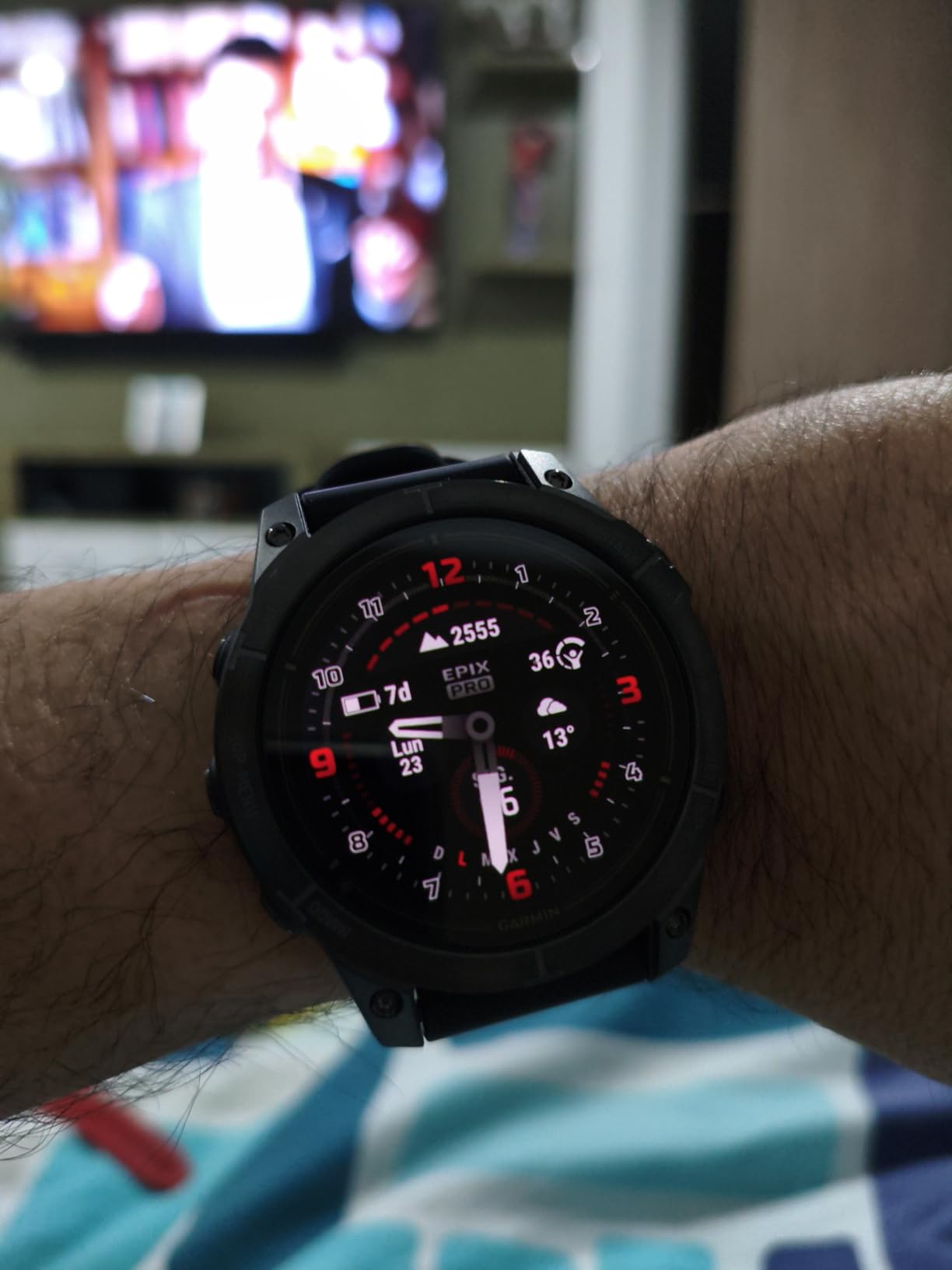
Mapping is present. Preloaded golf and ski resort maps plus TopoActive maps load on the watch, and Up Ahead prompts give you turn-by-turn warnings before corners you would otherwise miss. Storage is 32 GB, and memory holds music and full watch faces.
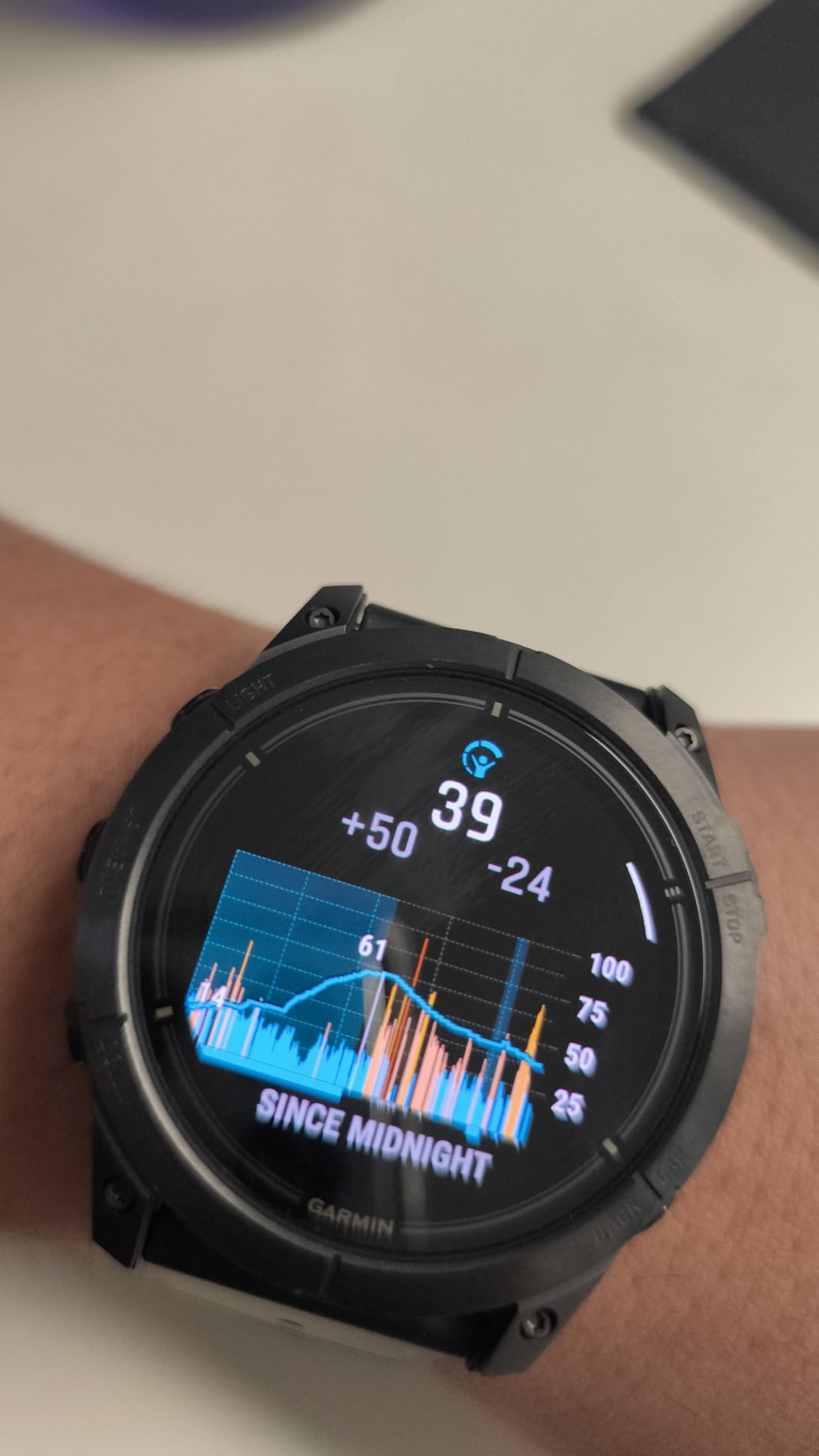
For training on steep trails, Hill Score and Endurance Score are genuinely useful rather than decorative, alongside training readiness, a morning report, wrist-based running power and advanced pacing modes. Multi-band reception with SatIQ handles the positioning, and HRV status, Pulse Ox and advanced sleep monitoring cover recovery.
What you gain by picking the epix Pro
You gain a screen you can read in full sun without shading it with your hand, and a lens that shrugs off rock rash. The 1200-nit panel stays legible on exposed ridgelines where a standard AMOLED turns to mush, and the always-on mode means you do not have wake the watch to check elevation.
Owners also single out the built-in LED flashlight as more useful than expected, which is a nice save on a watch this large. With 32 GB on board you can load music and leave the phone in the pack for a lot of the day.
Where it falls short for hiking
Size is the recurring complaint, and it is a real one. At 51 mm, 88 g, and a listed wrist range of 127 to 210 mm on the silicone band, this is a large watch on any wrist that is not thoroughly average. Reviewers frequently note the case looks bigger in person than the number suggests.
There is no microphone or speaker, so no voice assistant and no wrist calls. The default silicone band is reported as hot over long stretches, and premium watch faces are an extra purchase.
5. Garmin fenix 7X Pro Solar Review – Solar With a Big Touchscreen
Garmin fēnix 7X Pro Solar, Multisport GPS Smartwatch, Built-in Flashlight, Solar Charging Capability, Black
1.4 inch MIP touchscreen
Power Glass solar lens
96 g
37-day battery
Pros
- Solar Power Glass lens delivers roughly 37 days in smartwatch mode
- 1.4 inch touchscreen at 1000-nit sunlight visibility
- Multi-band GPS with SatIQ and preloaded TopoActive map downloads
- Hill Score and Endurance Score for trail training
- 24/7 HRV Pulse Ox and sleep monitoring
Cons
- 96 g case is the heaviest here except the Pro models
- MIP touchscreen lags versus AMOLED
- No speaker or microphone and an older chipset
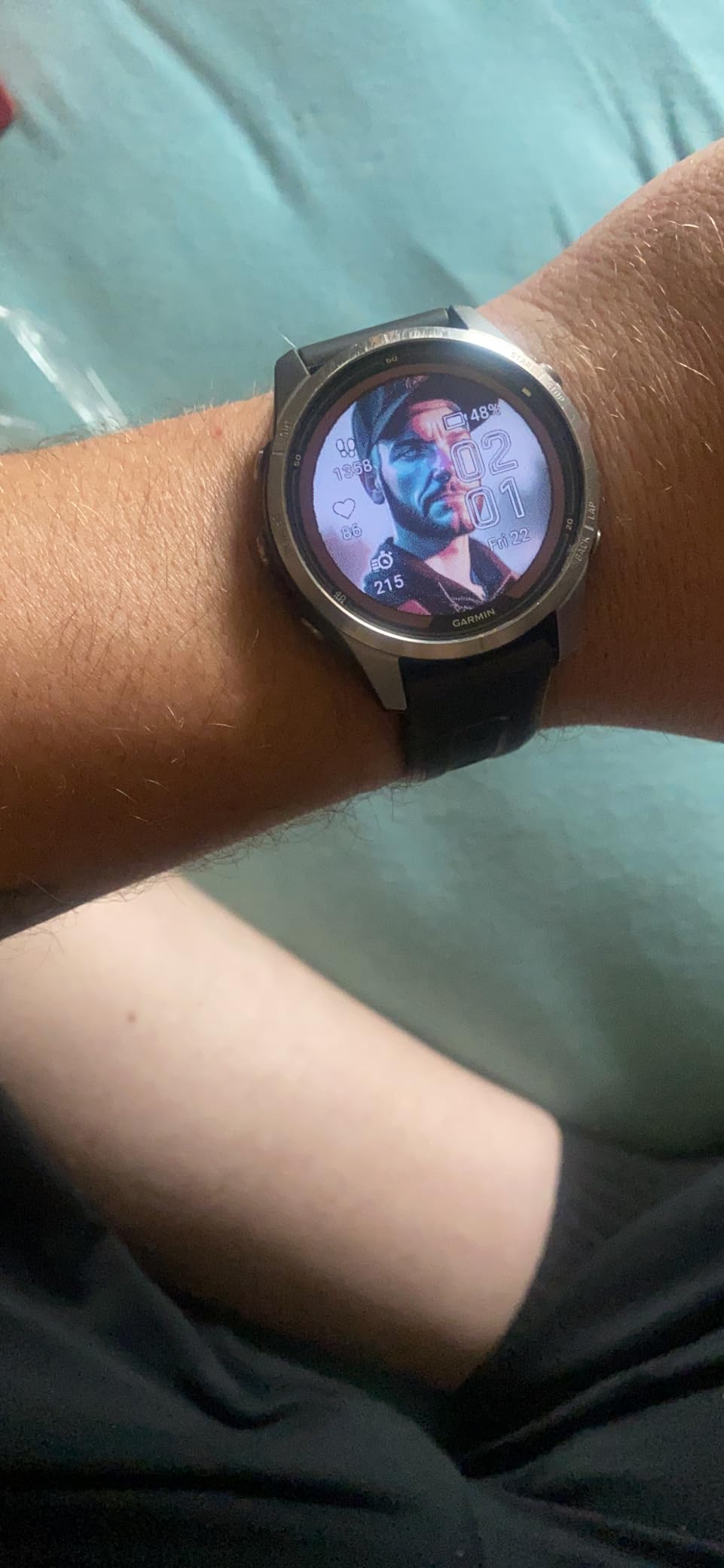
The fenix 7X Pro Solar solves a problem the newer AMOLED watches create: it gives you a large 1.4 inch touchscreen and still runs for weeks. The Power Glass solar charging lens is the reason, and Garmin rates 37 days in smartwatch mode. For a hiker who wants maps and long runtime in the same box, that combination is rare.
The case is a 51 mm fiber-reinforced polymer with a steel rear cover and a steel bezel, weighing 96 g. The transflective memory-in-pixel display is sunlight-visible and rated at 1000 nits with a 480 by 272 resolution, which is sharper than most MIP panels in this roundup.
Navigation is the 7X Pro’s strength. Multi-band GPS with SatIQ, preloaded golf and ski maps, downloadable TopoActive maps and Up Ahead turn-by-turn prompts all ship here, plus 32 GB of storage. The built-in LED flashlight has variable intensities and strobe modes for night movement.
Training metrics lean toward trail work, with Hill Score and Endurance Score, morning report, training readiness, wrist-based running power and advanced pacing modes. HRV status, Pulse Ox and advanced sleep monitoring round out the health stack, and there is a speaker-free design with no microphone.
What you gain by picking the fenix 7X Pro Solar
You gain solar endurance without giving up a touchscreen. Most mapping Garmin watches ask you to choose between battery life and screen quality, and this one splits the difference better than anything else at 51 mm. Owners favour the long runtime and the rugged steel-backed build.
Storage of 32 GB means real map downloads rather than breadcrumb traces, and the Up Ahead prompts are the kind of feature that only earns its keep once you have walked a unfamiliar ridge line with it.
Where it falls short for hiking
At 96 g, this is the second-heaviest watch in the roundup, and you feel it by hour ten. The MIP touchscreen also lags against AMOLED glass and needs more taps for the same job, which is exactly the complaint owners raise most often in reviews.
There is no speaker or microphone, so no calls or voice assistant, and the chipset is a generation behind the current fenix. It is also a 51 mm case, which rules it out for smaller wrists.
6. Garmin Enduro 3 Solar Review – 320 Hours of GPS
Garmin Enduro™ 3, Solar, 51 mm, Sapphire, Black UltraFit Nylon Strap
Up to 320 hours GPS with solar
63 g titanium
Sapphire lens
Preloaded TopoActive
Pros
- Up to 90 days in smartwatch mode and 320 hours in GPS mode with solar
- Light 63 g titanium case with sapphire lens for long hikes
- Preloaded TopoActive maps and dynamic round-trip routing
- Comfortable UltraFit nylon band for long-distance wear
- Built-in LED flashlight for after-dark navigation
Cons
- 280 by 280 screen is low resolution next to AMOLED models
- Solar gains depend on real daylight exposure
- UltraFit nylon band will not suit metal bracelet fans
The Enduro 3 is the reason to own a Garmin watch, and the numbers explain it without any interpretation. Up to 90 days in smartwatch mode and up to 320 hours in GPS mode with solar charging is the longest advertised GPS runtime of any watch covered here, by more than double the next closest.
It is also lighter than it should be. At 63 g with a titanium bezel and sapphire lens, it undercuts the 80 g fenix 8 and the 88 g epix Pro, which matters when a watch is on your arm for twenty hours a day. Storage is 32 GB and the included UltraFit nylon band is the most comfortable long-distance band in this group.
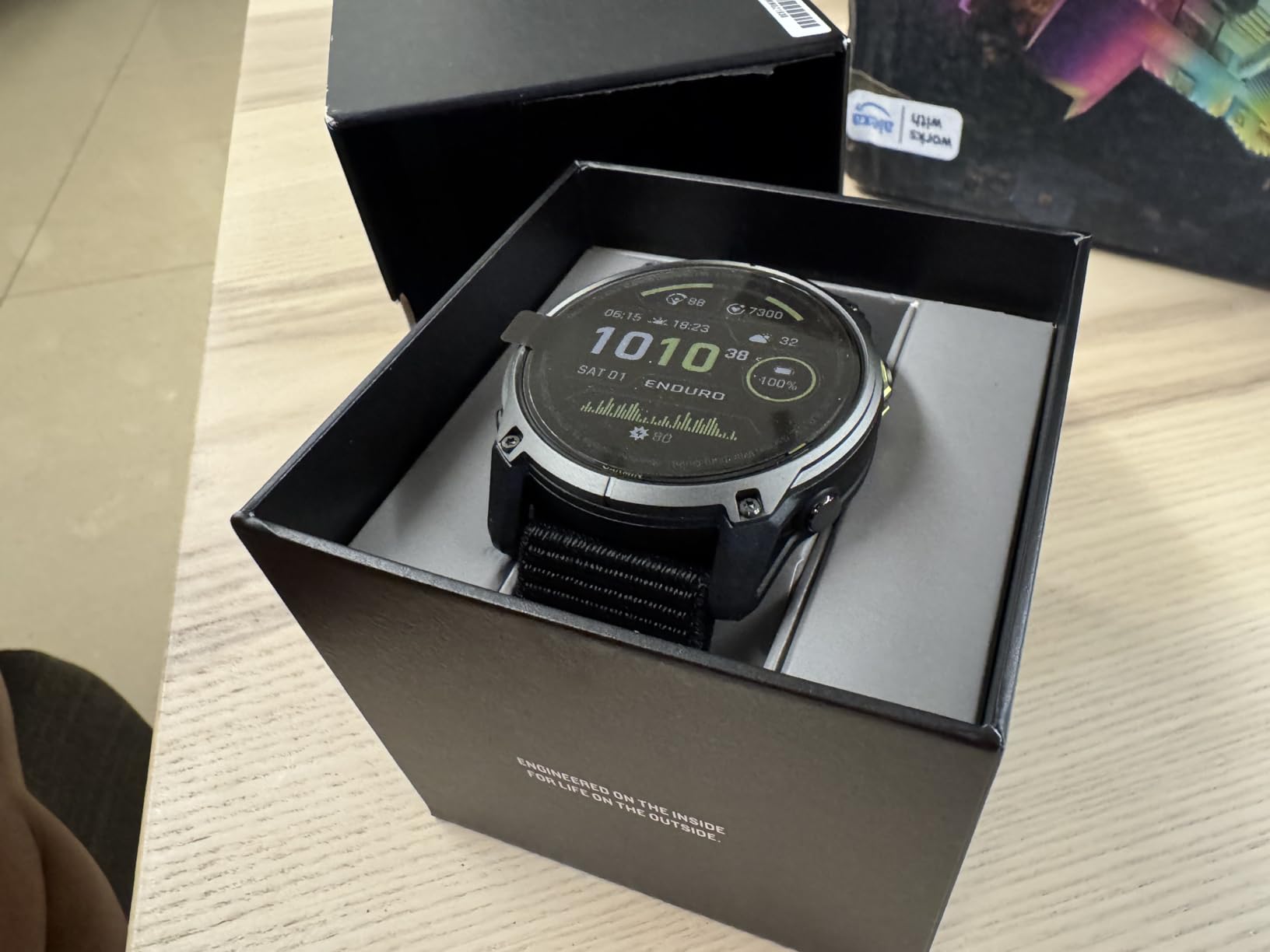
Navigation is the strongest argument for the premium here. Preloaded TopoActive maps are optimized for outdoor activities, and dynamic round-trip routing builds a course for a hike, run or bike ride and guides you back. Multi-band positioning lists GLONASS, GPS and Galileo, with a barometric altimeter and compass covering the essentials.
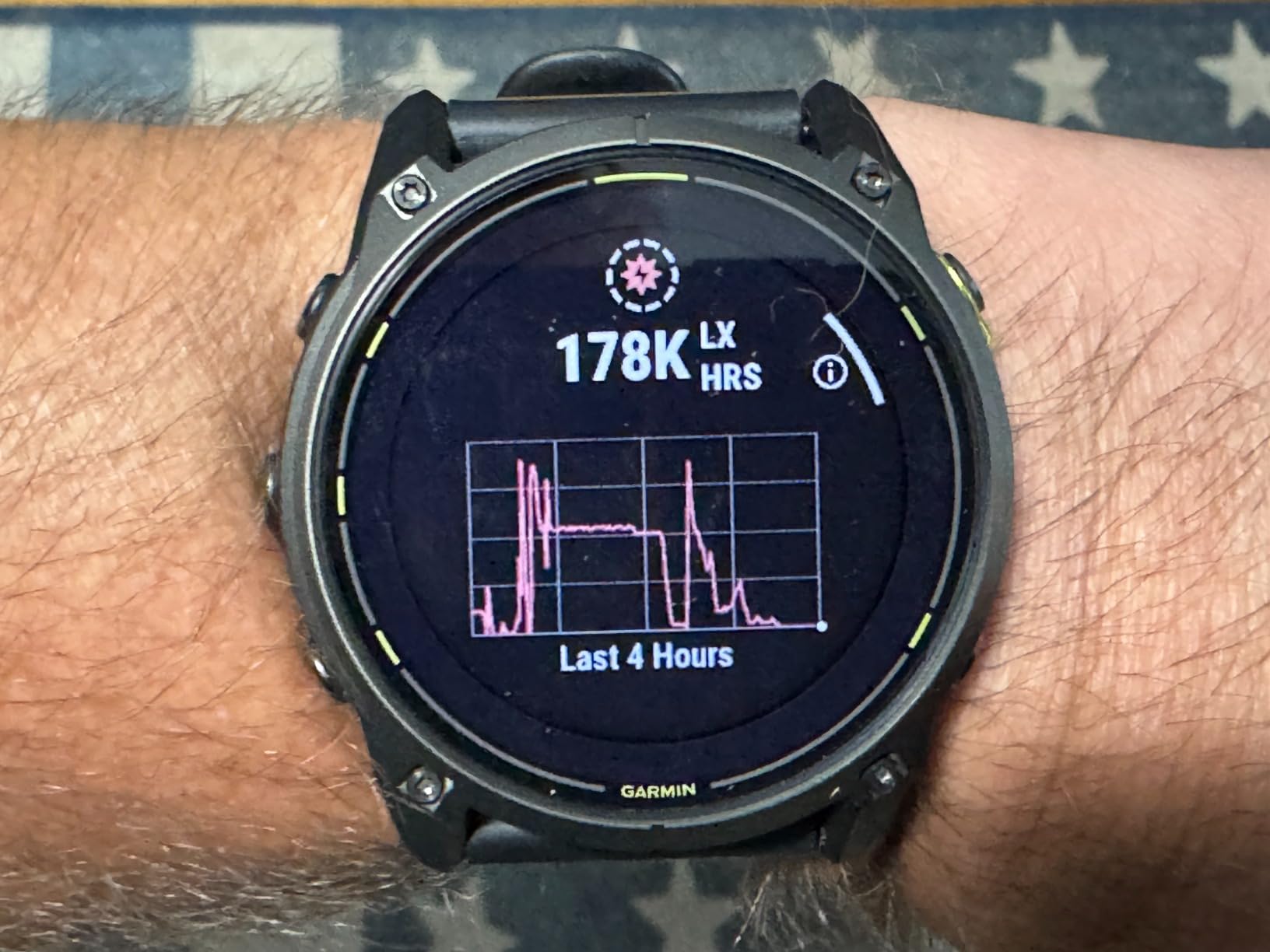
Training features are pointed at the ultra-endurance hiker, with real-time stamina tracking and sport-specific workouts for ultrarunners, cyclists and hikers, plus targeted strength training plans and performance metrics. Garmin rates 100-meter water resistance and a three-hour charge time.
What you gain by picking the Enduro 3
You gain the ability to walk away from a charger for two weeks. That is the whole argument, and it changes how you pack. Owners moving up from a Forerunner or a first-generation fenix describe the battery change as the single biggest upgrade in the switch.
You also gain a full-color topographic map without accepting an AMOLED battery penalty, because this is a 1.4 inch transflective display with an always-on mode. Reviewers rank it 4.6 across 286 reviews and consistently point to battery, weight and preloaded topo maps as the reasons they bought it.
Where it falls short for hiking
The 280 by 280 resolution is the reservation that shows up again and again. It is fine for reading a topo map at a glance, but contours and trail detail are noticeably coarser than the 454 by 454 panels on the newer AMOLED models.
Solar charging only works if you are genuinely in daylight for long stretches, and reviewers note that performance dips under heavy tree cover or on overcast stretches. The UltraFit nylon band is excellent for hiking and a poor fit if you want a metal bracelet, and this is a large 51 mm case at 63 g.
7. Garmin fenix 7X Sapphire Solar Review – Maps Over Wi-Fi
Garmin Fenix 7X Sapphire Solar, Larger Sized Adventure smartwatch, with Solar Charging Capabilities, Rugged Outdoor Watch with GPS, Touchscreen, Wellness Features, Black DLC Titanium with Black Band
1.4 inch OLED with Power Sapphire
On-watch Wi-Fi
122 hours GPS with solar
Pros
- Power Sapphire solar lens with 89 hours GPS and 122 hours with solar
- Built-in Wi-Fi downloads maps directly onto the watch
- Preloaded TopoActive maps plus golf and ski resort maps
- Multi-band GPS with GLONASS and Galileo
- 3-axis compass gyroscope and barometric altimeter
Cons
- 240 by 240 display looks dated beside newer AMOLED models
- Bulky 51 mm titanium case
- Older processor and software than the fenix 8 generation
The fenix 7X Sapphire Solar remains the most practical mapping watch in this roundup for a specific reason: built-in Wi-Fi. You connect the watch to a network at home or in a trailhead lot and download maps directly onto the watch, no phone, no desktop, no cable. Nothing else in this list does that at 16 GB of storage.
Battery supports the habit. Garmin rates up to 28 days in smartwatch mode, 37 with solar, 89 hours in GPS mode, and 122 hours in GPS mode with solar charging. The Power Sapphire lens combines a solar lens with scratch resistance, which is the combination you want on rock scrambles.
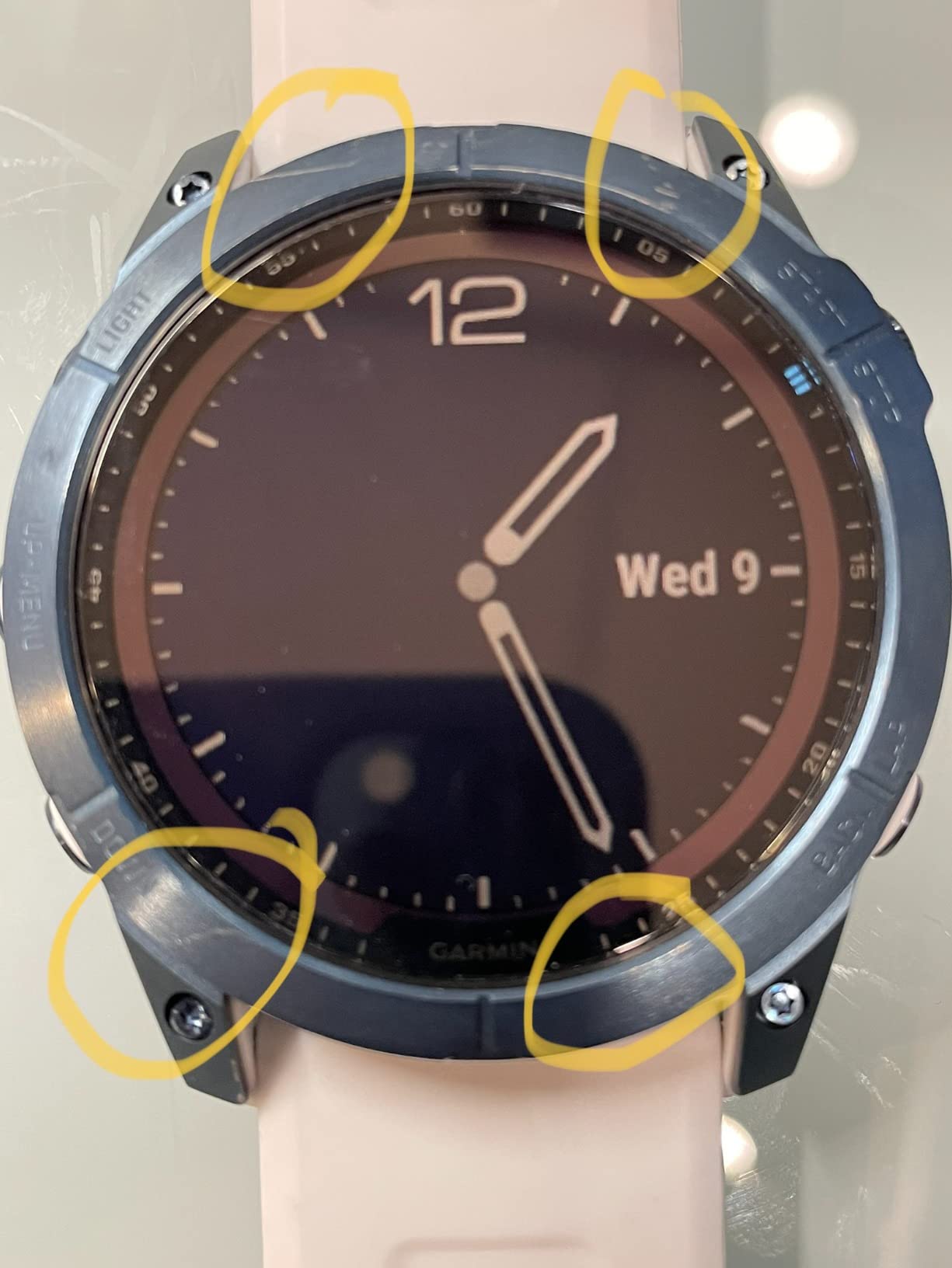
The rest of the feature set is full-fat: preloaded TopoActive maps plus golf and ski resort maps, multi-band frequency and multi-GNSS positioning across GLONASS, GPS and Galileo, a 3-axis compass, gyroscope and barometric altimeter, and a built-in LED flashlight. Smart notifications, music storage and Garmin Pay are all present.
Training runs deep with endurance and real-time stamina tracking, training status and more than 30 sport apps, alongside 24/7 heart rate, Pulse Ox, stress and enhanced sleep tracking. The band is 26 mm silicone, which is the standard width for large adventure cases.
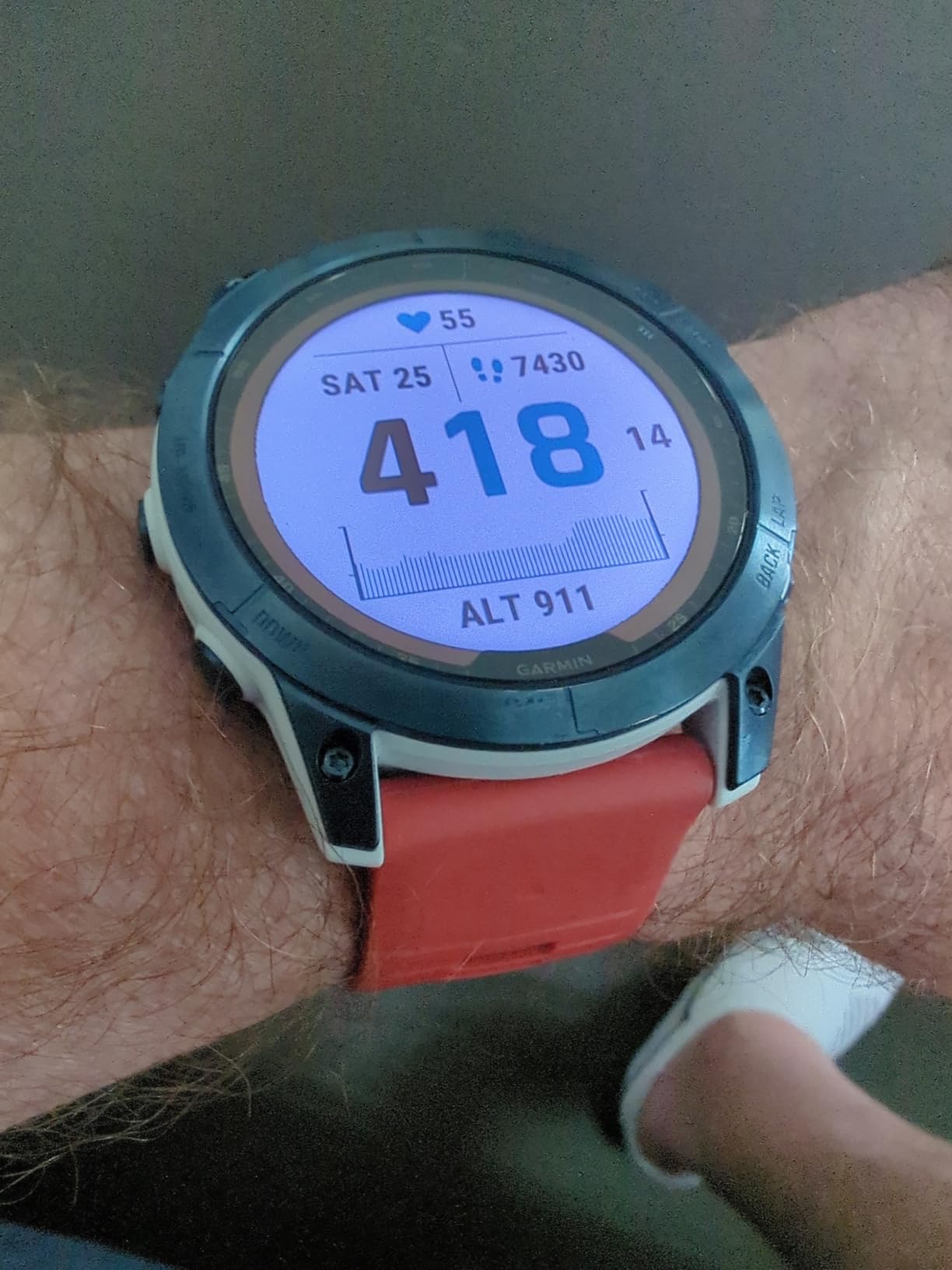
What you gain by picking the fenix 7X Sapphire Solar
You gain map independence at the trailhead. Owners who use the Wi-Fi download report never planning routes in a car park with a phone again, and having golf and ski resort maps preloaded is a small bonus for shoulder-season hiking above treeline.
Reviewers rate this configuration 4.6 across 678 reviews, and the aggregate view highlights battery endurance, the sapphire durability and the mapping as the reasons owners stay with it.
Where it falls short for hiking
The 240 by 240 OLED panel is the weak point. Owners consistently note it looks dated next to newer AMOLED screens, and the 26 mm band width on a 51 mm titanium case is a lot of watch on a smaller wrist.
Processor and software are a generation behind the fenix 8, and the touchscreen is less responsive than current models. There is no speaker or microphone either, so wrist calls and voice assistant are out of reach.
8. Garmin fenix 8 Pro Review – Built-in inReach Satellite SOS
Garmin fēnix® 8 Pro, 51mm, Sapphire, DLC Titanium, Black/Pebble Gray
Built-in inReach messaging
LTE connectivity
1.4 inch AMOLED
90 g titanium
Pros
- Built-in inReach two-way satellite messaging with interactive SOS
- LTE lets you make calls and messages without carrying your phone
- 1.4 inch AMOLED with sapphire lens and titanium bezel
- Preloaded TopoActive maps with relief shading
- ECG app HRV status and Pulse Ox on board
Cons
- Needs an active inReach or LTE subscription to be useful
- Battery drops sharply when LTE and satellite features are used
- 90 g titanium build is heavy on long hikes
The fenix 8 Pro is the only watch here with inReach satellite technology built into the case. Interactive SOS goes to the Garmin Response center, two-way satellite messaging lets you check in from a drainage with no cell coverage, and LTE connectivity handles voice calls, messages and LiveTrack location sharing. The on-device Garmin Messenger app handles location check-ins.
Everything else is flagship level. A 1.4 inch AMOLED touchscreen sits under a sapphire lens inside a titanium bezel, with preloaded TopoActive maps including relief shading, plus golf and ski maps, a built-in LED flashlight, a 40-meter rating with leakproof metal buttons, and 32 GB of storage for music and multisport profiles.
The health suite is the most complete in this roundup, with 24/7 heart rate, sleep, HRV status, an ECG app and Pulse Ox, alongside advanced training features, performance metrics and training plans. Garmin rates 27 days of battery in smartwatch mode, which assumes you are not using the radio.
Positioning lists GLONASS, GPS and Galileo, and the watch supports multi-band GPS with SatIQ. That is the sensor package you want on a route that crosses canyon, tree cover and open ridgeline in a single morning.
What you gain by picking the fenix 8 Pro
You gain a genuine emergency layer without carrying a separate satellite device. Owners who hike solo in remote terrain describe the inReach SOS and the ability to send a check-in message as the reason for the spend. LTE is a real bonus on routes that pass near populated valleys.
The bright AMOLED with sapphire and titanium is also the best-looking display pairing here, and the relief shading on the TopoActive maps makes terrain much easier to read than flat colour.
Where it falls short for hiking
The features are only useful with a subscription, and that is a recurring cost most hikers decide against. Reviewers are blunt that the satellite and cellular functions do nothing without an active plan.
Battery life drops sharply when the LTE and satellite hardware is switched on, and 90 g of titanium is heavy for a long hiking day. It also carries the lowest average rating in this group at 4.4 across 343 reviews, with 76 percent five-star and the highest one-star share of the set, which mostly reflects the cost and the subscription friction.
9. Garmin Enduro 2 Review – 2000-Nit Flashlight and Solar
Garmin Enduro™ 2 – Ultraperformance Watch
1.4 inch Power Sapphire at 2000 nit
46-day solar battery
70 g
NextFork guidance
Pros
- Highest average rating in the group at 4.7 out of 5
- Up to 46 days in smartwatch mode and 150 hours GPS with solar
- Superbright 2000-nit flashlight with strobe and red safety mode
- NextFork map guide shows distance to the next trail intersection
- Light 70 g titanium build with a comfortable UltraFit nylon band
Cons
- 240 by 240 MIP display is low resolution
- Older chipset and software than the Enduro 3 and fenix 8
- Solar gains depend on consistent daylight
The Enduro 2 holds the highest average rating in this roundup at 4.7 out of 5 across 292 reviews, with 87 percent five-star. It is also the most trail-specific Garmin in the list, because two features on it exist for exactly one situation: navigating in the dark.
The flashlight is rated at 2000 nits, which Garmin describes as twice as bright as the fenix 7X flashlight, and it includes strobe and a red safety light mode. The NextFork map guide shows the distance to the next trail intersection, so you can see a junction before you reach it instead of after.
Battery is close to the top of the group. Garmin rates up to 46 days in smartwatch mode and 150 hours in GPS mode with solar charging, and AutoSelect mode with SatIQ shifts between GPS modes to trade accuracy for runtime as your charge drops, which is a smart behaviour on a long trip with no resupply.
At 70 g with a titanium case, Power Sapphire lens and UltraFit nylon band, it is lighter than most mapping watches here. Preloaded TopoActive and ski maps are preloaded, and there is endurance and stamina tracking plus an adventure racing app, grade-adjusted pace and an automatic rest timer.
What you gain by picking the Enduro 2
You gain the strongest night-running and pre-dawn-start setup here. Owners single out the super bright flashlight with its red safety mode as the feature they did not expect to care about and now rely on, and the auto rest timer is useful on long climbs.
Grade-adjusted pace and the adventure racing app suit hikers who also run and bike, and the 46-day solar figure means a two-week trip needs no battery pack at all.
Where it falls short for hiking
The 240 by 240 MIP display is the same low-resolution compromise as the original Enduro, and owners list it as the main drawback alongside the older chipset and software compared with the Enduro 3 and fenix 8.
There is no touchscreen colour interface and no smartwatch calling. Solar performance drops without consistent daylight, and unlike the newer mapping models it lists GPS only in its satellite systems rather than multi-GNSS.
10. Garmin tactix 8 Solar Review – Tactical and Aviation
Garmin tactix® 8 Solar, Premium Tactical GPS Smartwatch, 51mm
1.4 inch solar AMOLED
48-day battery
95 g
Applied Ballistics solver
Pros
- Up to 48 days in smartwatch mode and 149 hours GPS with solar
- Aviation navigation suite with moving map NEXRAD weather and airport data
- Applied Ballistics solver plus rucking and jumpmaster activities
- Sapphire lens and titanium bezel with a 40-meter rating
- Multi-band GPS with SatIQ compass gyroscope and altimeter
Cons
- Most expensive watch covered here
- 95 g titanium build is heavy on long days
- Smallest review base in the group at 94 ratings
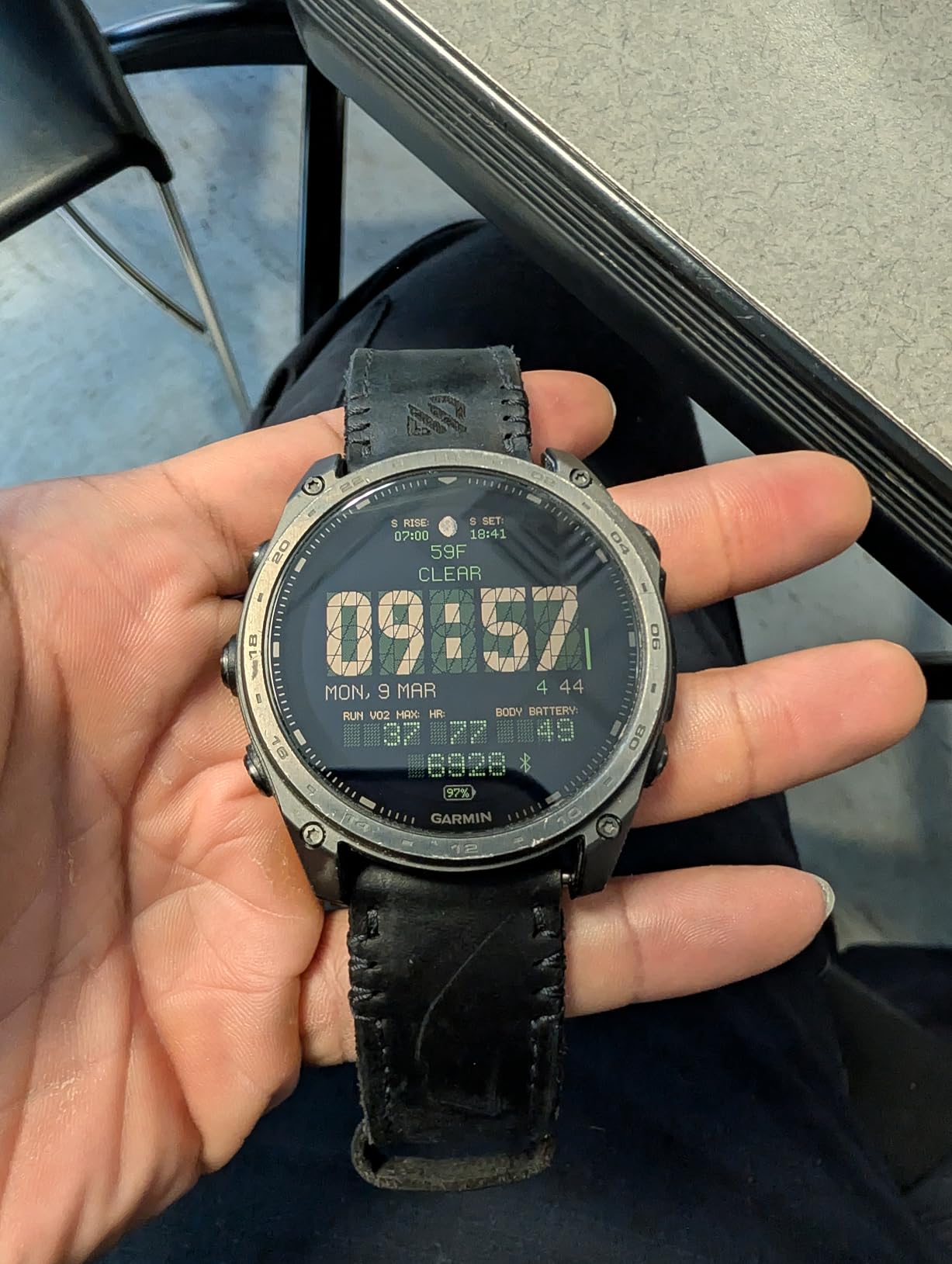
The tactix 8 answers the question hikers and buyers keep asking about the military side of Garmin. The tactix line descends from the GPS units issued to tactical users, and the current model carries a 1.4 inch solar-charged AMOLED display under a sapphire lens with a titanium bezel, rated to 40 meters.
It is now a genuinely capable hiking watch, not a novelty. It has multi-band GPS with SatIQ, a 3-axis compass, a gyroscope and a barometric altimeter, preloaded TopoActive maps with relief shading, golf and ski maps, a built-in LED flashlight, and Garmin rates up to 48 days in smartwatch mode and 149 hours in GPS mode with solar charging.
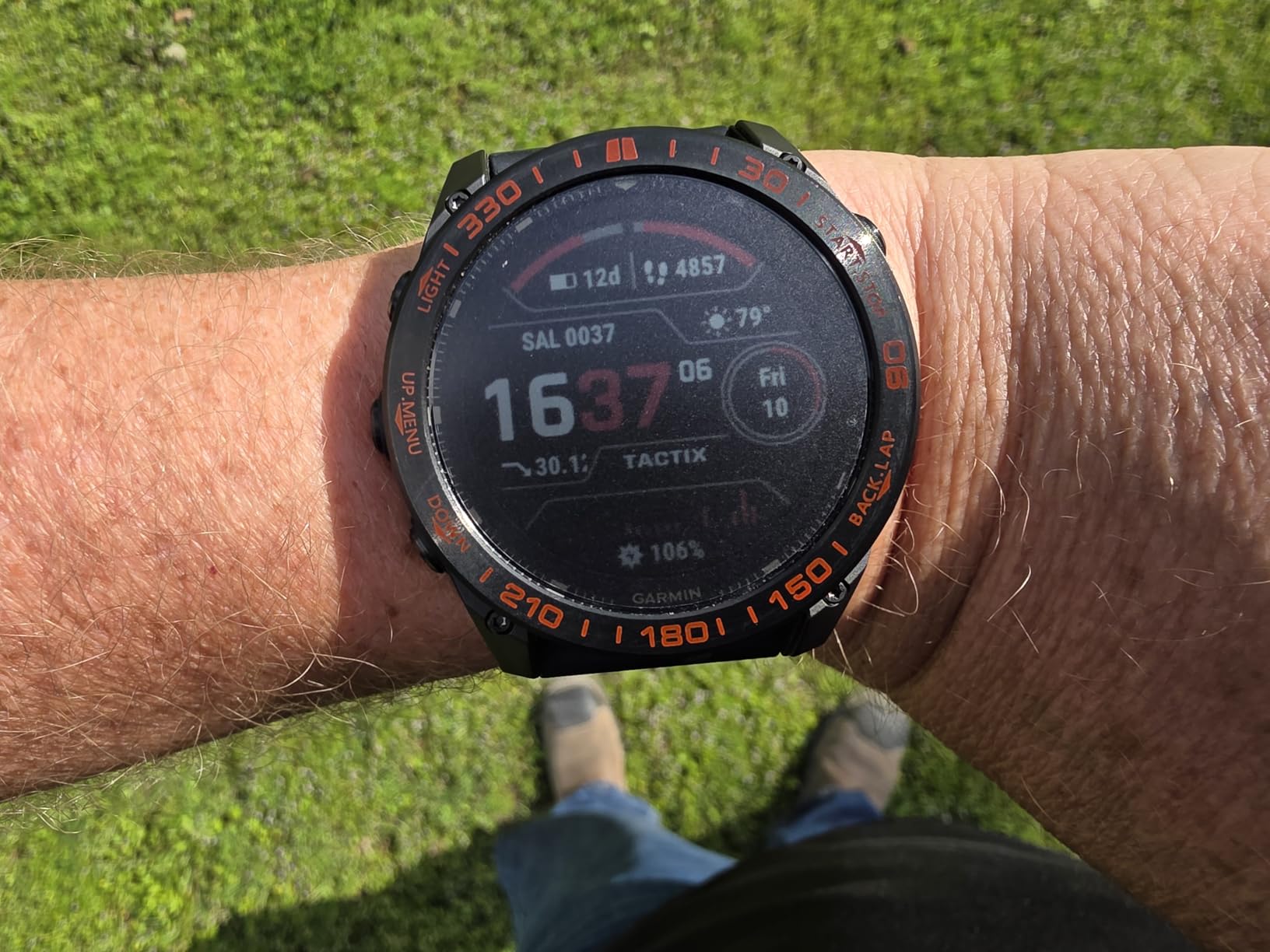
What makes it different is the specialisation. A rucking activity with a preloaded Applied Ballistics solver calculates holdover and windage for long-range shooting, managed through the Applied Ballistics Quantum mobile app. Stealth mode, a kill switch, night vision compatibility, jumpmaster, waypoint projection and dual-position GPS format fill out the tactical layer.
There is also full aviation navigation on the wrist, with a moving map, NEXRAD weather and airport information. Health features include an ECG app, Pulse Ox and advanced sleep monitoring.
What you gain by picking the tactix 8 Solar
You gain a durable, map-capable hiking watch with a sapphire lens and titanium bezel, plus a solar battery figure of 48 days that keeps pace with the Enduro line. The display is a proper AMOLED rather than the low-resolution MIP panel on the Enduro 2.
For anyone who also flies, the aviation suite is a genuine standalone feature. Search-and-rescue, range estimation and long-range ballistics tools are the reason this model exists, and they all work away from a phone.
Where it falls short for hiking
It is the most expensive watch in this roundup and the feature set is largely overkill for someone whose hiking is a weekend trail loop. The 95 g titanium build is heavy for long hiking days, sitting above the Enduro 3 by more than 30 g.
Its review base of 94 ratings is the smallest here, which means less long-term owner history to lean on. Owners also note that stealth mode and dual-position features can raise questions with airlines and venues, which is worth checking before travel.
How to Choose a Garmin Watch for Hiking
Most Garmin buying mistakes come from comparing screen size and features when the decision is really about trip type and wrist size. A watch that is perfect for a five-day backpacking route can be annoying on a two-hour evening walk, and a 51 mm case that feels fine in a shop can look absurd after August.
Start with the trip. A day hike on a trail you have walked before needs a compass, an altimeter, a reliable breadcrumb track and a comfortable fit, and nothing more. A multi-day trip on unmaintained routes needs a full-color topographic map and enough GPS battery to cover the whole route plus a margin. Overnight and alpine trips add barometric trend and storm-watch features to the list.
What the ABC sensors actually do
ABC stands for altimeter, barometer and compass, and these three sensors are what separate a hiking watch from a fitness tracker. The altimeter uses barometric pressure to estimate elevation change, the barometer tracks pressure trends so you can forecast a storm hours before it arrives, and the compass gives heading when you are moving too slowly for GPS to do it well.
On a scree slope, a compass is what stops you walking in circles. On a ridge at dawn, a pressure trend reading is what tells you to get off the exposed crest early. Every watch in this roundup has all three.
All of them also support Garmin Connect for syncing routes, and Connect IQ for extra apps and watch faces. If you route on paper maps and follow ridgelines, the ABC set matters more than the display.
GPS modes and battery life
Garmin advertises battery life in several modes, and only one of them reflects a real hike. Standard GPS mode is the headline number most people read, for example 320 hours on the Enduro 3 with solar or 47 hours on the fenix 8. All-satellite systems mode adds constellations and drains faster. Multi-band mode improves accuracy under canopy and drains faster again.
SatIQ is the feature that changes this calculus. It allows the watch to use multi-band positioning selectively, spending the extra power only when the signal conditions need it. On the Instinct 3 Solar and the fenix 8, that is the difference between a watch that tracks well all day and one that goes flat by dinner.
Budget for reality. Solar-assisted figures assume meaningful daylight exposure, and under dense canopy or heavy cloud the gain shrinks. Our editorial guidance is simple: if your trip runs past two days, buy solar or carry a battery pack.
Breadcrumb tracking vs full-color topo maps
Breadcrumb navigation records the path you walked and lets you retrace it. That is enough for a maintained trail, an out-and-back to a lake, and most day hiking. It is not enough when you need to see a drainage, pick a crossing, or route around a cliff band you cannot see past.
Full-color topographic mapping is what you want for unmaintained trails, alpine terrain, and anywhere you may need to bail out on an unplanned line. On those models, Up Ahead prompts warn you about upcoming turns and intersections, and elevation shading makes terrain readable at a glance.
In this roundup, the mapping watches are the fenix 8, the epix Pro, the fenix 7X Pro Solar, the fenix 7X Sapphire Solar, the fenix 8 Pro, the tactix 8, the Enduro 3 and the Enduro 2. The Instinct 3 Solar and the Instinct 2X Solar are breadcrumb-first.
MIP vs AMOLED in real trail conditions
A MIP transflective screen is lit by the sun rather than by the watch, which is why it stays readable in glare and runs for weeks. An AMOLED panel is far brighter and sharper, supports touch, and is what you want for reading contour lines, but it draws power constantly and dies faster in cold weather.
The Instinct 3 Solar, the Instinct 2X Solar and the Enduro 2 use the transflective approach. The fenix 8, the epix Pro, the fenix 8 Pro and the tactix 8 use AMOLED. The fenix 7X Pro Solar and the fenix 7X Sapphire Solar sit between the two, with transflective panels that add a solar lens.
One practical note: touchscreens are poor with wet hands and gloves, which is a condition hikers meet often. If you hike in rain or wear gloves above freezing, the button-driven Instinct models are genuinely easier to operate one-handed.
Solar charging: what the specs mean
Solar ratings assume a specific amount of daily sunlight, typically around three hours of direct exposure. That is realistic on an open ridgeline and unrealistic in a valley of old-growth forest. Solar therefore removes the low end of your battery anxiety on exposed routes rather than eliminating the need to charge.
The solar models here are the Instinct 3 Solar, the Instinct 2X Solar, the fenix 7X Pro Solar, the fenix 7X Sapphire Solar, the Enduro 3, the Enduro 2 and the tactix 8 Solar. Reviewers consistently note that solar gains depend on consistent daylight and that the effect shrinks under canopy.
If you mostly hike in forest, solar matters less than the base GPS figure. If you hike in high country with long exposed stretches, solar is close to a free upgrade.
Case size and wrist fit
This is the most common buyer regret and the easiest to get wrong. Wrist circumference, not screen size, is what decides whether a watch feels like a tool or a brick. The Instinct 3 Solar at 45 mm and 52 g is the most compact option in this roundup, and the epix Pro lists a wrist range starting at 127 mm on the silicone band.
The Instinct 2X Solar fits wrists from 145 to 228 mm, and the Enduro 3, epix Pro, fenix 8 Pro and tactix 8 all sit at 51 mm. If you measure under 165 mm around your wrist bone, try the 45 mm Instinct 3 Solar in person before committing to a 51 mm case. Owners of large cases repeatedly report the size looks bigger in person than the number implies.
Weight follows the same logic. The Enduro 3 at 63 g and the Instinct 2X Solar at 67 g are noticeably lighter than the fenix 8 Pro at 90 g, the epix Pro at 88 g and the tactix 8 at 95 g. Over a twenty-hour day that is a real difference in wrist fatigue.
Enduro 3 vs fenix 8 vs Instinct 3 Solar
These three come up more than any other combination in hiking searches, and they answer different questions. The Enduro 3 is for the trip where battery life is the deciding factor, giving up to 320 hours in GPS mode with solar at 63 g. The fenix 8 is for the trip where navigation quality is the deciding factor, giving a 1.4 inch AMOLED touchscreen, speaker and mic, and 47 hours of GPS at 80 g.
The Instinct 3 Solar is for the trip where weight and simplicity decide it, giving multi-band GPS with SatIQ, a flashlight, 28 days of average battery and 52 g, but no full-color mapping. If you need only one watch that handles hiking and trail running without slowing you down, it is the one.
Forum discussion on these three converges on the same point from several directions: the Enduro 3 covers what most hikers need from the fenix 8 without the dive features, and the Instinct 3 is repeatedly defended by owners who have since moved to more expensive models. That consensus shaped our ranking more than any spec sheet.
Two other comparisons come up often. Instinct 3 versus Instinct 2X is a choice between the newer 45 mm platform with a flashlight and multi-band GPS, and the older 50 mm platform with the largest review base and reported multi-week runtimes. Fenix 7X Sapphire Solar versus the fenix 8 is a choice between Wi-Fi map downloads and multi-week solar battery, or a brighter screen, wrist calls and a newer chipset.
If you are still torn, our best monoculars for hiking and best compact binoculars for hiking guides cover the spotting glass that pairs naturally with a long-range Garmin setup.
Frequently Asked Questions
Which Garmin watch is best for hiking trails?
The Garmin Instinct 3 Solar is the best all-round choice for hiking trails, with multi-band GPS and SatIQ, a barometric altimeter, a 3-axis compass, a built-in flashlight and 28 days of average battery in a 52 g case. Choose the Garmin fenix 8 if you want full-color topographic maps on your wrist, or the Garmin Enduro 3 if your trips run several days without a charger.
Which Garmin watch do Navy Seals use?
Garmin’s tactix line is the tactical branch of the same outdoor family and descends from the GPS units issued to military users. Current tactix models such as the tactix 8 Solar are fully hiking-capable, carrying multi-band GPS with SatIQ, a compass, gyroscope and barometric altimeter, preloaded TopoActive maps, a solar-charged AMOLED display and up to 48 days of smartwatch battery.
Which Garmin GPS device is best for hiking?
For most hikers a Garmin watch is the right device, because it combines position, heading and elevation data with health tracking and no separate handset to carry. Pick a breadcrumb model such as the Instinct 3 Solar for familiar trails, a mapping model such as the fenix 8 for unmaintained routes, and add a handheld unit only if you need larger screens, longer runtimes or a replaceable battery.
What is the best watch for hikers?
There is no single answer, because it depends on trip type. Day hikers on known trails are served by a lightweight solar watch such as the Instinct 3 Solar. Multi-day and off-trail hikers want full-color offline maps, which points to the fenix 8 or epix Pro. Alpine and ultra-endurance hikers usually want the Enduro 3 for its 320 hours of solar-assisted GPS runtime.
Do Garmin watches work without cell service on a hike?
Yes. Every watch in this roundup determines position from satellite signals and stores maps on the watch itself, so navigation keeps working with no cell coverage and no phone in range. The fenix 8 Pro goes further with built-in inReach satellite messaging and LTE, but those features require an active subscription.
The Garmin Hiking Watch Worth Buying in 2026
If you take one thing from this roundup, take this: the Garmin Instinct 3 Solar is the best Garmin watch for hiking overall. It holds a signal with multi-band GPS and SatIQ, carries the full ABC sensor set, weighs 52 g, and includes a flashlight that removes a device from your pack. At 4.6 across 818 reviews, it is also the pick with the most owner history behind it.
Step up to the fenix 8 47mm when navigation quality outweighs runtime, and to the Enduro 3 when your trips run days without a charger. The epix Pro and fenix 7X Pro Solar cover the large-screen mapping end, the Instinct 2X Solar covers maximum ruggedness, and the tactix 8 and fenix 8 Pro answer the satellite and tactical questions the usual roundups skip.
Check the case size against your wrist in person before you buy, and remember that the useful things on a hiking watch are the compass, the altimeter and the battery, not the display. Whatever you choose, tell someone your route before you go.