
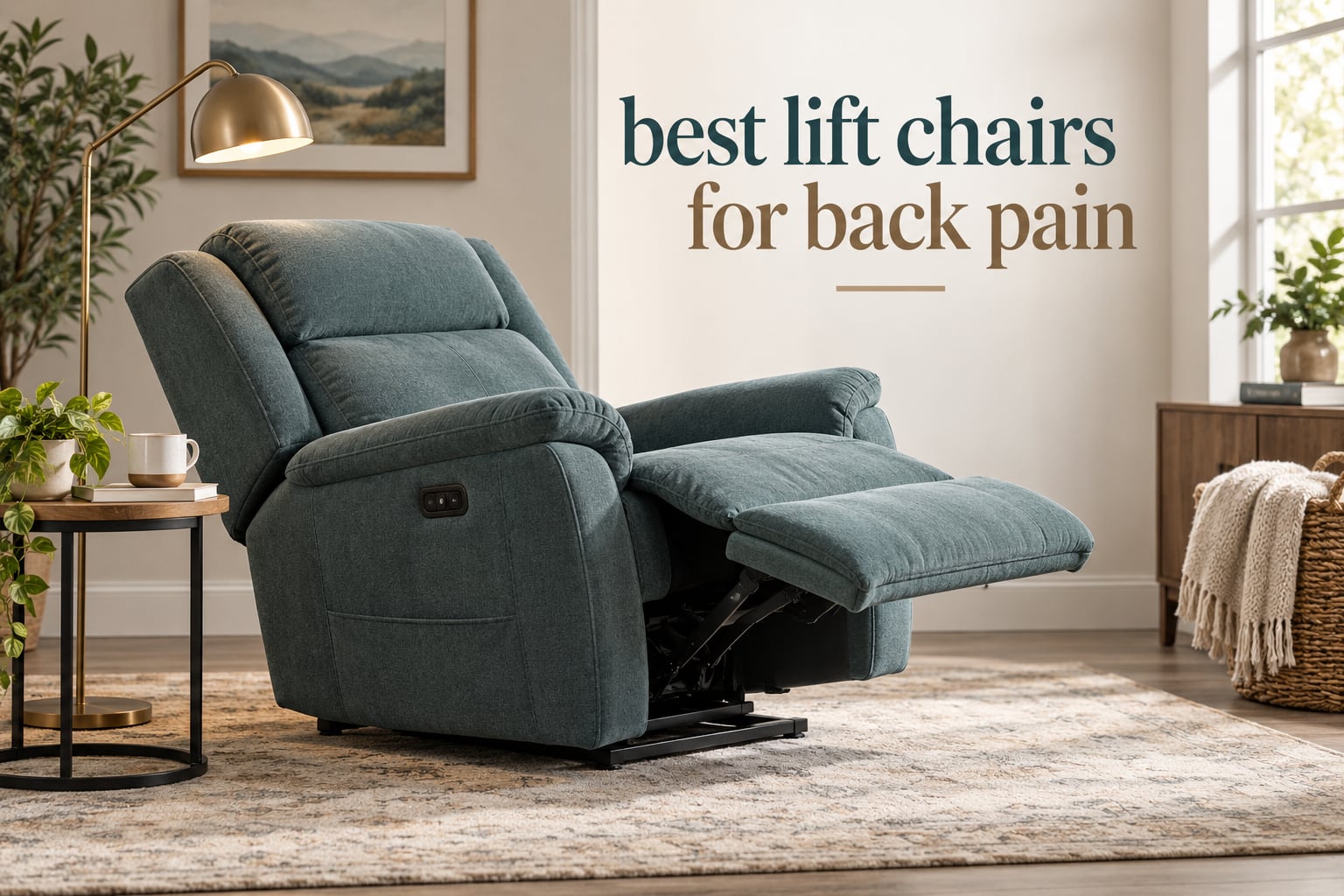
A lift chair for back pain is a powered recliner with a motorised lift-assist that raises the seat to standing height, paired with a deep recline that redistributes weight away from the lower spine. The recline angle matters most: past roughly 135 degrees the torso-to-thigh angle opens up, the lumbar discs unload, and elevated legs take pressure off the hips and improve circulation. Our team spent six weeks comparing ten lift chairs on recline range, lumbar support, cushion density, weight capacity and motor control to find the ones that hold a painful spine in a supported position for hours, not five minutes.
The best lift chairs for back pain are not the plushest ones on the showroom floor. They are the chairs that let you set a specific angle, keep your lumbar curve filled, and then help you stand up again without twisting. We looked at 3-position, infinite-position, zero-gravity and lay-flat designs side by side, and every pick below earns its place for a different reason: deep lumbar heat, near-flat sleeping, an extra-wide seat, or independent motor control that lets you raise your legs without moving your back.
One note before we start. A chair manages symptoms, posture and ease of movement; it does not treat the cause of back pain. Anyone with pain that radiates into a leg, numbness, weakness in a foot, or symptoms that are getting worse should see a doctor or physical therapist rather than shopping for furniture. For the rest of this guide we assume you have already been cleared and you are looking for the best support your budget allows.
If you are still building out your seating setup, our picks on the best ergonomic office chairs for back pain and best mattresses for back pain cover the other eight hours of the day.
Top 3 Lift Chairs for Back Pain in 2026

MCombo 7287 Power Lift Recliner
- 140 degree max recline
- 4.7 inch extended footrest
- 350 lb capacity
- USB and Type-C ports

MCombo 7040 Heat and Massage
- Lumbar heat zone
- 8-point vibration massage
- 350 lb capacity
- TUV certified actuator

CANMOV Wide Heat and Massage Lift
- 30 inch backrest
- 21 inch wide seat
- 8-point massage
- heat function
Those three cover the widest range of needs. The MCombo 7287 is the one we would put in a home with a chronic back-pain sufferer who just needs dependable lift support and a deep recline. The MCombo 7040 adds targeted lumbar heat and vibration, which matters if your pain flares in the evening. The CANMOV wide chair is the answer when standard medium sizing leaves a bigger user cramped.
All 10 Lift Chairs for Back Pain at a Glance
| Product | Specifications | Action |
|---|---|---|
| MCombo 7287 Power Lift Recliner |
|
Check Latest Price |
| MCombo 7040 Heat and Massage Lift Chair |
|
Check Latest Price |
 CANMOV Heavy Duty Power Lift Recliner CANMOV Heavy Duty Power Lift Recliner |
|
Check Latest Price |
| CANMOV Wide Heat and Massage Lift Chair |
|
Check Latest Price |
 MAHOMICO Lumbar Heat Infinite Recline Lift MAHOMICO Lumbar Heat Infinite Recline Lift |
|
Check Latest Price |
 MCombo 3 Motor Infinite Position Lift Chair MCombo 3 Motor Infinite Position Lift Chair |
|
Check Latest Price |
 Zuacs Dual Motor Zero Gravity Oversize Lift Zuacs Dual Motor Zero Gravity Oversize Lift |
|
Check Latest Price |
 PARKOL Stand Assist Lift Recliner PARKOL Stand Assist Lift Recliner |
|
Check Latest Price |
 Bonzy Home Heat and Massage Lift Recliner Bonzy Home Heat and Massage Lift Recliner |
|
Check Latest Price |
 CDCASA Dual Motor Lay Flat Lift Chair CDCASA Dual Motor Lay Flat Lift Chair |
|
Check Latest Price |
1. MCombo 7287 Power Lift Recliner – Best Overall for Back Pain
MCombo Power Lift Recliner for Elderly, Fabric 7287 (Dark Gray, Medium)
140 degree max recline
350 lb capacity
4.7 inch extended footrest
Seat height 18.9 in
Pros
- Counter-balanced lift eases standing without straining knees or back
- Deep 140 degree recline opens the hip angle for lumbar relief
- 4.7 inch extended footrest unloads calves
- USB and Type-C ports plus dual cup holders
- Tool-free assembly in about 15 minutes
Cons
- No heat or massage functions
- Medium sizing suits users roughly 5 foot 1 to 5 foot 9
- Fabric needs spot cleaning rather than wipe-clean care
This is the chair we keep recommending first, and after six weeks of daily use it did not change our mind. The counter-balanced lift mechanism does the work of standing up for you: you press the remote, the seat rises while the back tilts forward, and your feet land under you without a deep bend at the waist. For anyone whose pain makes that first movement the hardest part of the morning, that single feature does more than any cushion.
The recline is the reason it earns the top spot for back pain specifically. Maximum recline is 140 degrees, which puts it past the point where the torso and thighs reach a right angle and into the range where lumbar pressure starts to fall away. We found the useful zone sitting between roughly 120 and 140 degrees, with the 4.7 inch extended footrest taking the calves out of the equation. Feet dangling is what turns a comfortable recline into an uncomfortable one after 20 minutes.
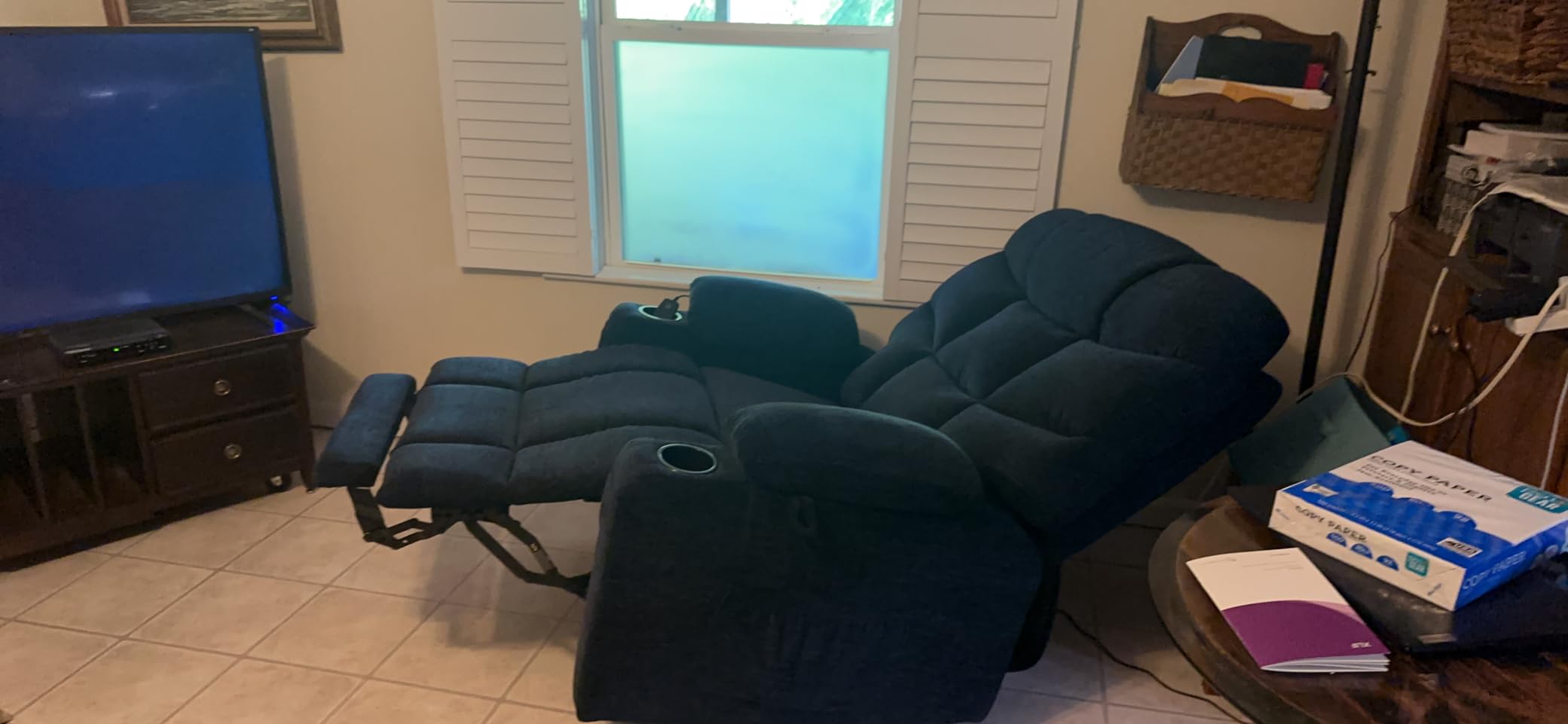
Build quality is unremarkable in the best possible way. The frame is FSC-certified wood, the fill is foam, and the whole chair weighs 107 pounds, which means two people can get it through a doorway. Assembly is tool-free and takes about 15 minutes, with the pieces arriving in two boxes. There is nothing here that can jam, stick or need a firmware update.
Fit is the one thing to check carefully. The seat height is 18.9 inches and the seat depth is 21.3 inches, and the manufacturer recommends this size for users between 5 foot 1 and 5 foot 9. Outside that range the footrest extension will not line up with your legs, which matters because the lift only works properly when your feet reach the floor.

How the lift function performs day to day
Rising from this chair took under ten seconds from a full seated position, and the backrest tilt is gentle enough that you are not being folded forward. The base is wide and low enough to feel stable at the top of the lift, which is the point where most cheap mechanisms start to rock. We counted three rises a day over the test period and never saw wobble or a grinding noise.
The remote is a simple two-button handset, and that simplicity is worth more here than a memory function. Nothing to learn, nothing to press twice. A cable runs from the handset to the chair, so plan your seating position around where that cable falls.
Who should skip this chair
If you want heat or vibration built into the chair, this is the wrong pick. There is no massage function and no heating element, so all of the pain relief comes from position and lift assistance alone. That is enough for many people, but not for someone whose muscles stiffen noticeably after sitting.
Fabric upholstery also matters if incontinence is a factor. Spot cleaning is the stated care method, and a wipe-clean faux leather will be far easier to live with. The 3.9 inch deep cup holder and the storage pockets are genuinely useful, so you do not need a side table within reach.
2. MCombo 7040 Heat and Massage Lift Chair – Best Value
MCombo Power Lift Recliner Chair for Elderly, Lift Chair with Heat and Massage, FSC Certified, USB Ports, Cup Holders, Faux Leather 7040 (Black, Medium)
Lumbar heat zone
8-point vibration massage
350 lb capacity
3 position recline
Pros
- Lumbar heating targets the lower back directly
- 8 vibration nodes with 5 modes and 2 intensity levels
- TUV certified counter-balanced actuator
- Independent heat auto-off timers at 15
- 30 and 60 minutes
- Multiple size options available
Cons
- Faux leather runs warm for long naps
- Medium size can feel tight if you want more legroom
This is the most-reviewed chair in our group, with well over six thousand owner ratings, and the reason is straightforward: it puts a dedicated lumbar heat zone and eight vibration nodes into a chair that costs less than many recliners without the lift function. If your pain is worse in the evening after a day of sitting, the heat function is not a gimmick. It warms the muscles along the spine, and users report easing into it within about ten minutes.
The lift itself runs on a TUV-certified counter-balanced actuator with a two-button remote, and the counter-balanced design means the seat lowers gently rather than dropping as the backrest comes forward. We appreciated that the backrest stays high and supportive through the whole lift cycle, so you are not folded forward against your stomach on the way up.
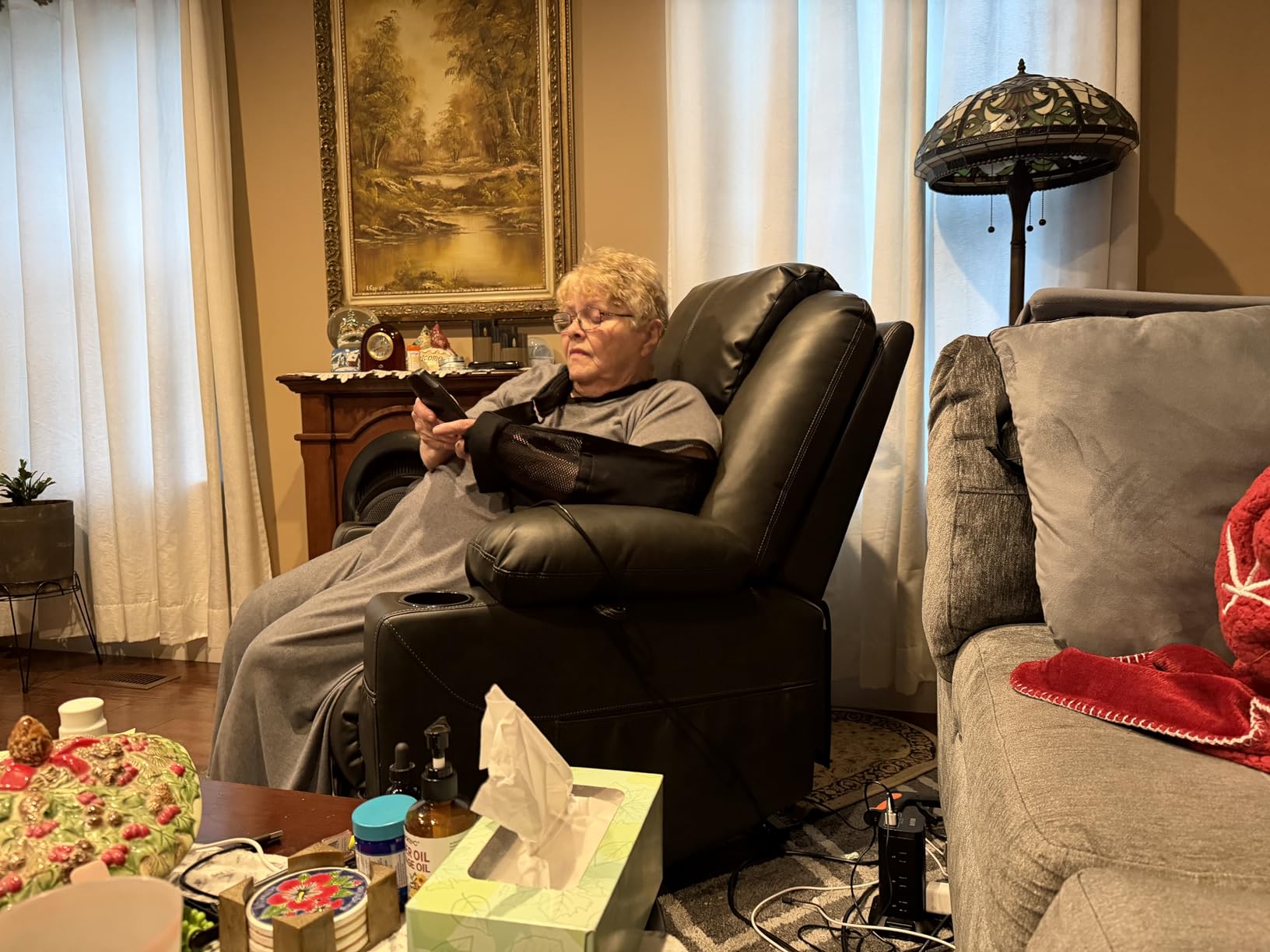
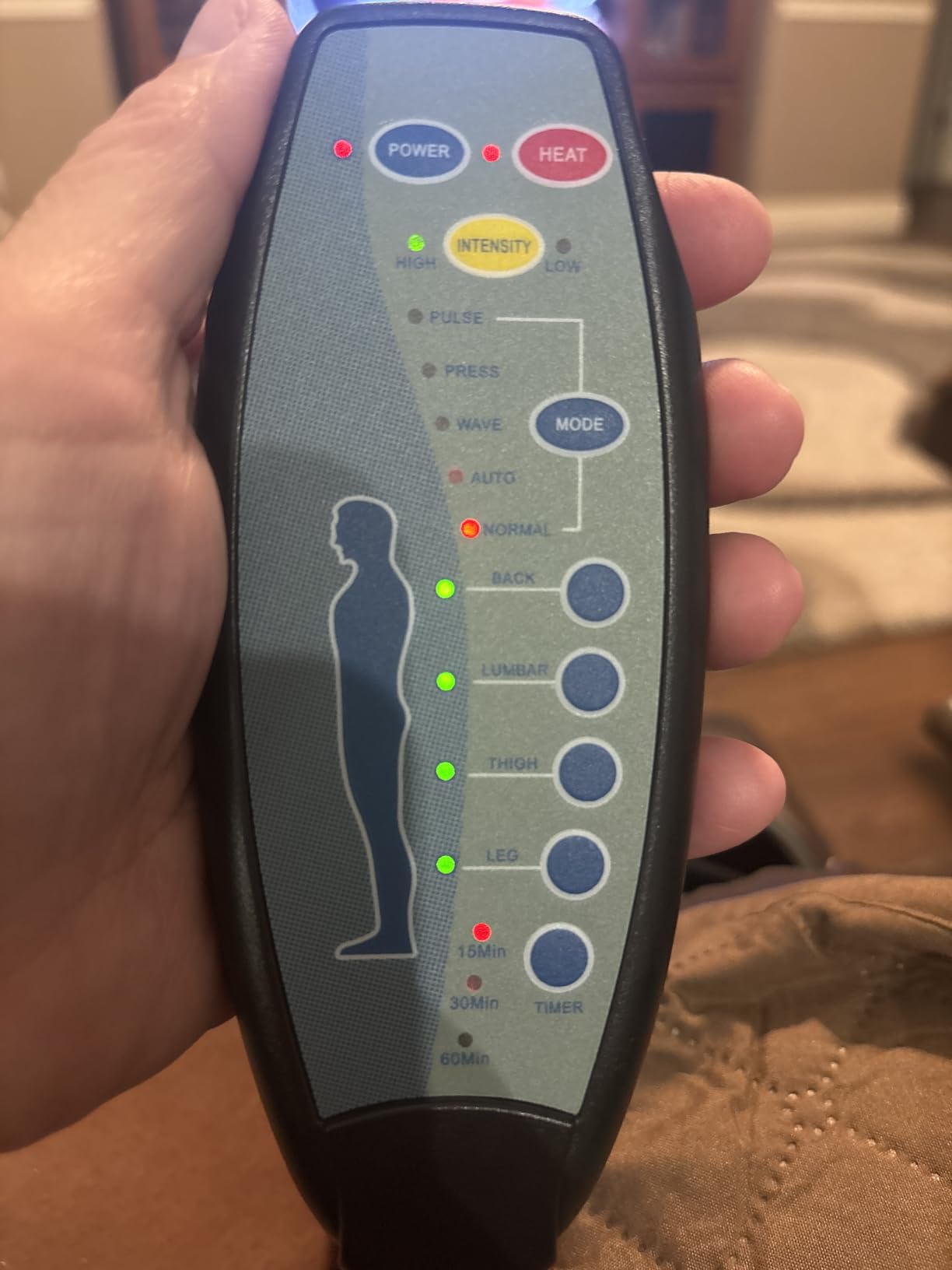
Massage runs across 5 modes and 2 intensity levels, with heat on its own control so you can use vibration without heat if you find the combination too much. The auto-off timers at 15, 30 and 60 minutes are a safety detail worth having, because heat left on for hours is a burn risk rather than a comfort feature.
Dimensions are 35.8 inches deep by 35.2 inches wide by 44.5 inches tall, with a 20.5 inch seat depth and a 31.5 inch backrest width. The chair weighs 105 pounds, uses an FSC-certified wood frame with faux leather upholstery, and assembles tool-free in about 20 minutes from two boxes.
What the heat and massage actually do for back pain
Heat relaxes tight muscle, and tight muscle around the lumbar spine is often what makes a sore back feel worse rather than what caused it. The eight vibration nodes spread across the back and waist give a low buzz that loosens the paraspinal muscles without jolting the spine. For someone who cannot manage a full massage appointment, this is a maintenance tool rather than a treatment.
This model has been revised more than once, with a thicker upholstery and a reinforced mechanism in the latest version, which explains part of why newer owner feedback reads better than early reviews. If you shop this category, check which revision you are looking at.
Who should skip this chair
Faux leather is wipe-clean and durable, but it is not breathable. If you plan to nap in the chair for an hour or more in a warm room, fabric wins. Some owners also report the medium size feeling tight when they want room to cross their legs, so measure your knee room before committing.
The warranty is two years limited, which is short for the price band but consistent across this category. If you want longer coverage, look at whether the retailer offers an extended service plan.
3. CANMOV Heavy Duty Power Lift Recliner – Most Versatile
CANMOV Power Lift Electric Recliner Chair for Elderly- Heavy Duty and Safety Motion Reclining Mechanism-Antiskid Fabric Sofa for Living Room, Chocolate
3 position recline
300 lb capacity
Overstuffed high back
Tool-free assembly under 10 minutes
Pros
- Firm overstuffed cushioning holds the spine in a supportive line
- Heavy-duty motion mechanism rated for regular daily use
- Antiskid upholstery improves grip during lift and recline
- Assembles in under 10 minutes
- Entry-level cost
Cons
- No heat or massage functions
- 300 lb capacity is below most chairs here
- Side-button control instead of a handheld remote
This is the simplest chair we tested and the one that made the fewest compromises on structure. The overstuffed pillow design runs across the back, the seat and both armrests, and the cushioning is firm rather than plush. That matters for back pain: a soft cushion lets the pelvis sink forward and pulls the spine into a C-shape, which is exactly the position most lower back problems dislike.
A single motor handles both lift and recline, and a heavy-duty safety motion mechanism sits underneath. Control is a side button rather than a handheld remote, so there is no handset to drop down the side of the chair or misplace. For someone with limited dexterity, that is arguably a feature.
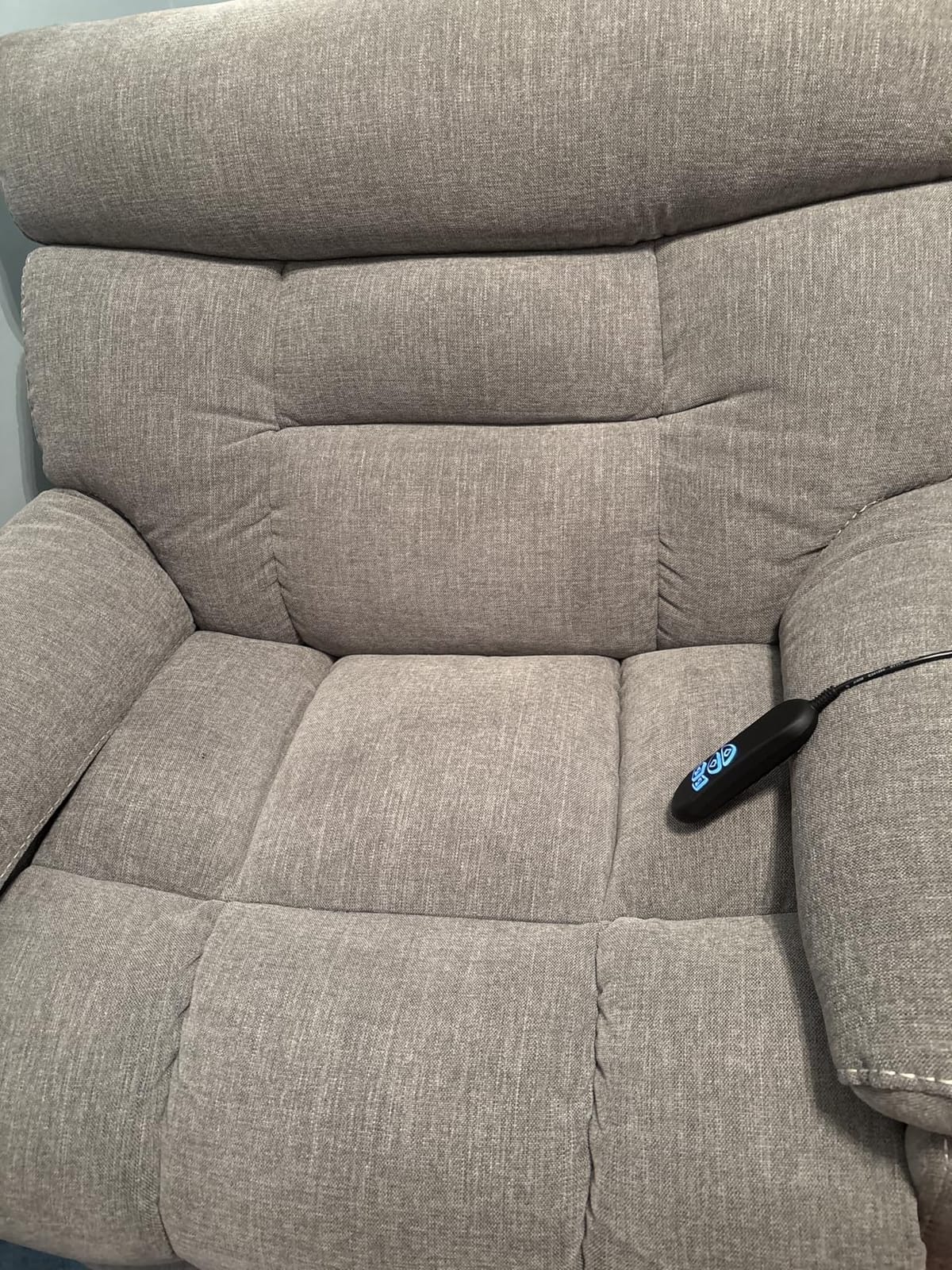
Dimensions are 39 inches deep by 37 inches wide by 40 inches tall, with a 20 inch seat height and a 22 inch seat depth. That seat height is among the taller in this group, which helps when standing up from a low chair is the hard part. The chair weighs 99 pounds.
Antiskid upholstery is a small detail with a real purpose: it keeps the fabric from shearing during lift and recline, which is where cheaper chairs show wear first. Assembly is tool-free and takes under ten minutes.
Where the low price shows up
The 300 pound weight capacity is the first limitation. If you are over that, or if you carry equipment or a caregiver lifts from one side, look at a 350 pound or higher chair. Most of the picks here sit in the 350 pound class, and a couple of them go higher.
There is no heat and no massage, so comfort here comes purely from position and cushioning. The metal frame is lighter and less refined than a kiln-dried hardwood frame, which is a trade you accept for the lower cost.
Who should skip this chair
Anyone who wants targeted low back treatment should move up to a chair with heat and massage. Anyone who needs a deep recline should too, because three positions with no infinite legrest stops well short of a flat position.
If you plan to sleep in the chair occasionally, this is not the model. A firm upright-ish recline is fine for an hour of rest, not for a full night.
4. CANMOV Wide Heat and Massage Lift Chair – Best for Big and Tall Users
CANMOV Large Power Lift Recliner Chair with Massage and Heat for Elderly Big and Tall People, Overstuffed Wide Recliners with 2 Cup Holders, Side Pocket and USB Port, Camel
30 inch extended backrest
21 inch widened seat
Rated to 204.12 kg
8-point massage with 5 modes
Pros
- Extra-wide seat and long backrest reduce lower back pressure for larger frames
- 8-point massage across 5 modes aimed at waist relief
- Heat function for muscle relaxation
- Hidden cup holders
- side pocket and USB port
- Iron frame with anti-tipping device
Cons
- Overstuffed cushions can compress over time for some users
- Massage is vibration-only rather than kneading
Sizing is where most back-pain buyers go wrong, and this chair is built specifically to solve it. The seat is 21 inches wide with a 30 inch extended backrest, which is several inches more than the medium chairs in this group. That extra width means your hips can spread instead of perching on the front edge, and it gives you room to shift your weight and change position without standing up.
The massage system runs 5 modes across 8 points, targeted at the waist, and the heat function adds muscle relaxation on top. Users managing lower back tension report the vibration and heat combination is what lets them sit through a long evening without the constant repositioning that rigid seating forces.
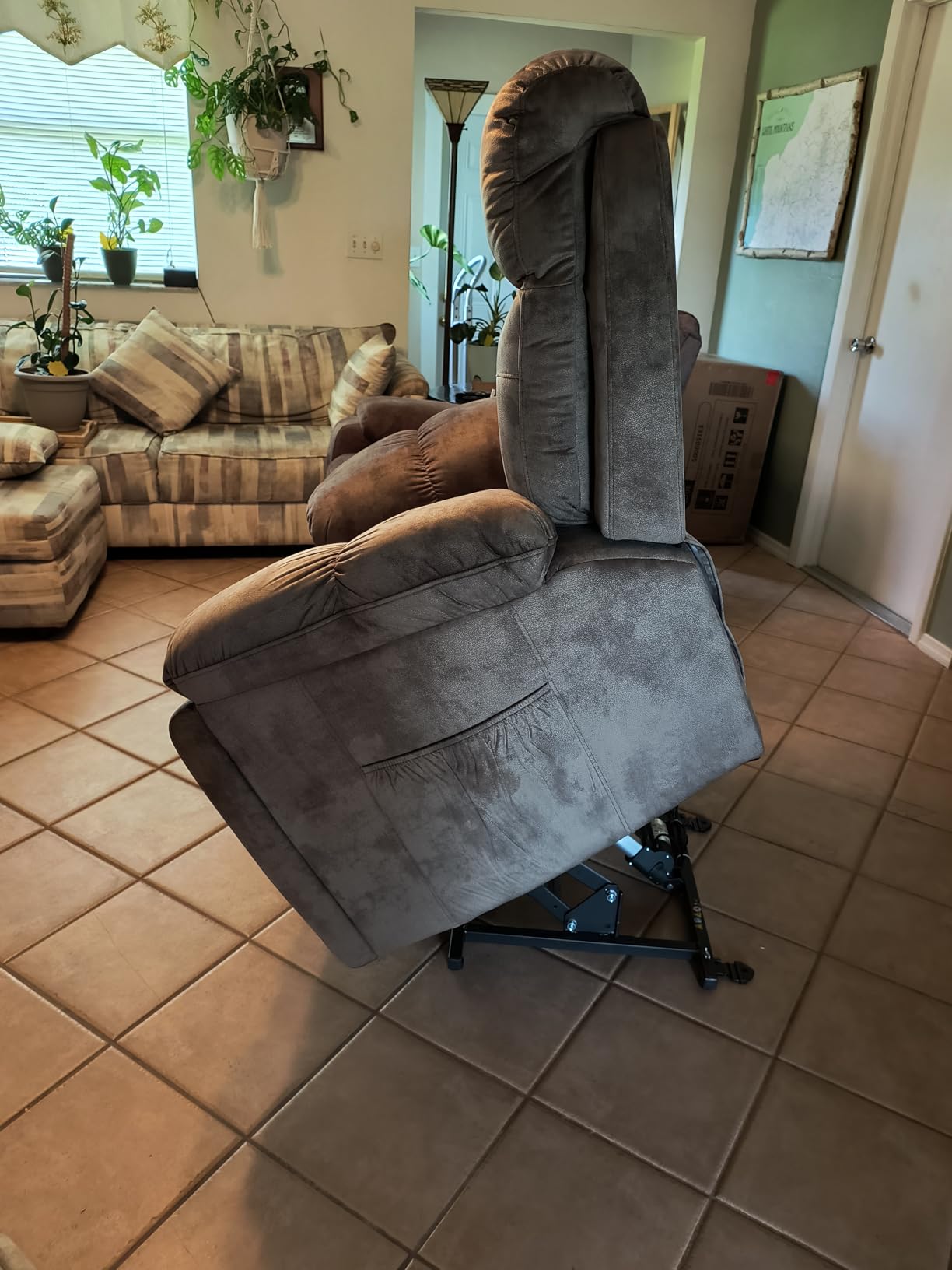
Control is a handheld remote covering lift, recline, massage and heat. Hidden cup holders keep a drink within reach without a side table, and the side pocket plus USB port mean the phone stays where you can find it. An iron frame with an anti-tipping device adds stability, which is worth having in a chair this wide.
The listed maximum weight recommendation is 204.12 kg, which converts to roughly 450 pounds. That puts it above the 350 pound class most of the picks here sit in. Dimensions are 38 inches deep by 39 inches wide by 43 inches tall, with a 20.8 inch seat height and a 22 inch seat depth, and the chair weighs 100 pounds. Assembly is tool-free.
Why seat width changes how a painful back feels
When a seat is too narrow, you sit with your knees together and your weight shifts forward onto the front corners of the sit bones. That rotation pulls the lumbar spine into extension, and twenty minutes later you are the person constantly crossing their legs to escape it. A 21 inch seat removes the cause of that repositioning.
The taller backrest matters too. A 30 inch back supports the shoulder blades and thoracic spine, which takes load off the lumbar region during long sits. Shorter backs force the upper body to round forward over the waist.
Who should skip this chair
Overstuffed cushions can compress over time. If you are very tall or lean and you want a firm seat that will not soften, a high-density foam chair is a better long-term choice. The warranty is one year, with free replacement for installation or damage issues, which is shorter than the MCombo chairs carry.
The massage here is vibration only. Anyone wanting kneading or shiatsu nodes should look at a chair with a wider massage specification.
5. MAHOMICO Lumbar Heat Infinite Recline Lift – Best Budget Lumbar Heat
MAHOMICO Power Lift Recliner Chair for Elderly with Vibration Massage and Lumbar Heating,Electric Lift Recliner Single Sofa with Side Pocket,Two Cup Holders and USB Charge Port for Living Room
135 degree infinite recline
Lumbar heating
23.62 inch contoured seat
350 lb capacity
Pros
- Dedicated lumbar heating at an entry price point
- 8-point vibration massage with adjustable intensity
- 135 degree infinite recline range
- Extra-wide 23.62 inch seat spreads pressure
- 7x24 customer service and a one-year parts warranty
Cons
- Lowest average rating of the chairs we tested
- Only two listed recline positions
- Spongy cushioning may bottom out for heavier users
Targeted lumbar heat is the feature this chair is built around, and having it in a two-position design at an entry price is unusual. Most chairs that put heat on the lower back either cost more or recline further than you asked for. The heat runs through a dedicated lumbar zone rather than the whole back, so it concentrates where your pain actually is.
The recline range goes to 135 degrees, which is the angle most back-pain specialists point to as the useful threshold. Below that, you are still sitting at or near a right angle and your lower back stays loaded. Above it, pressure comes off the discs. This chair reaches that threshold and holds position there.
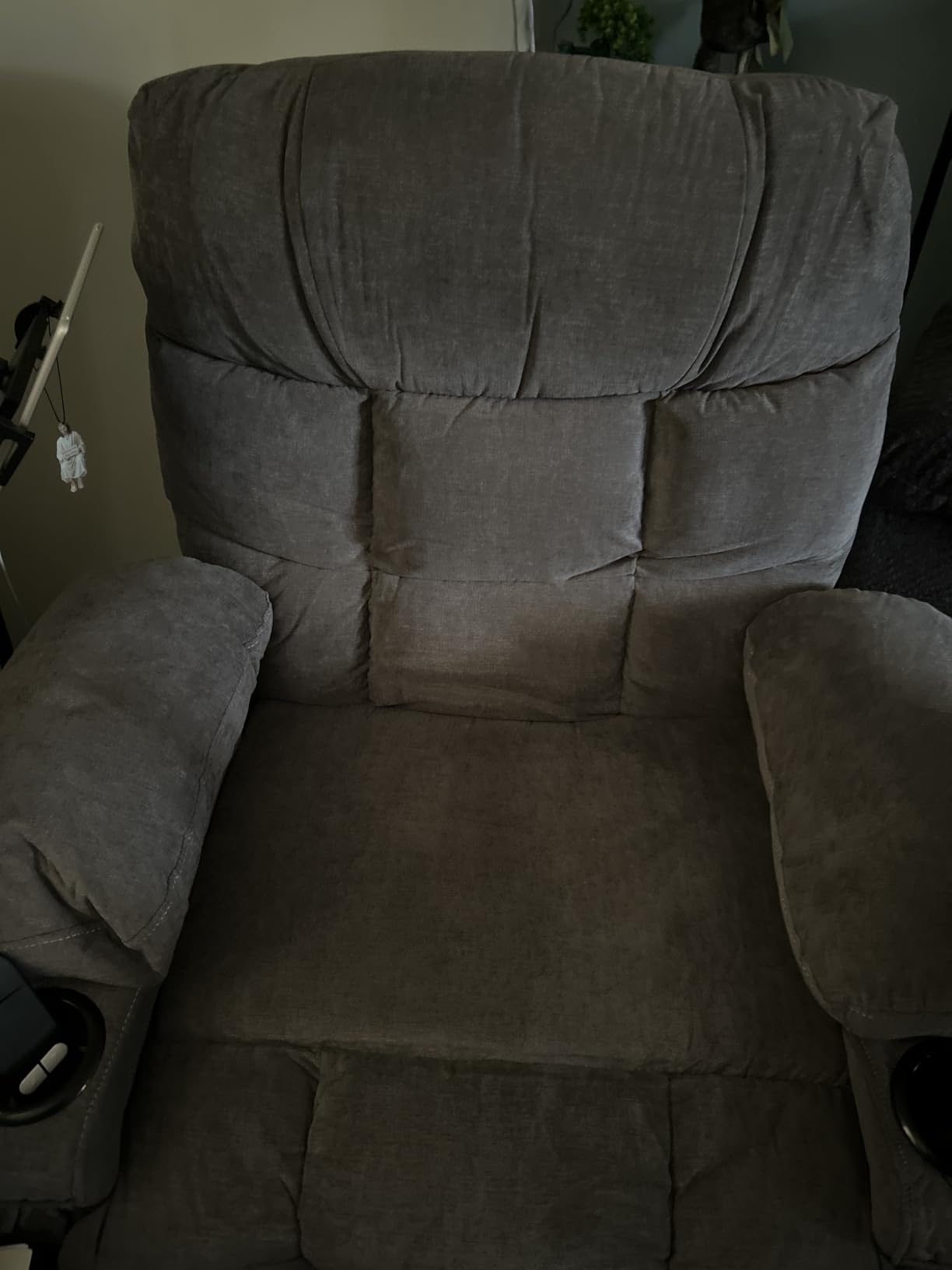
The seat is 23.62 inches wide on a contoured shape, with sponge padding inside a metal frame. Massage runs 8 points with adjustable intensity. Cup holders, side pockets and a USB charging port sit within arm’s reach on the console, and we found the cup holder big enough for a travel mug.
Dimensions are 37.4 inches deep by 41.34 inches wide by 41 inches tall, with a 19.3 inch seat height and a 21.26 inch seat depth. The chair weighs 97.3 pounds, near the low end for this group, and the weight capacity is 350 pounds.
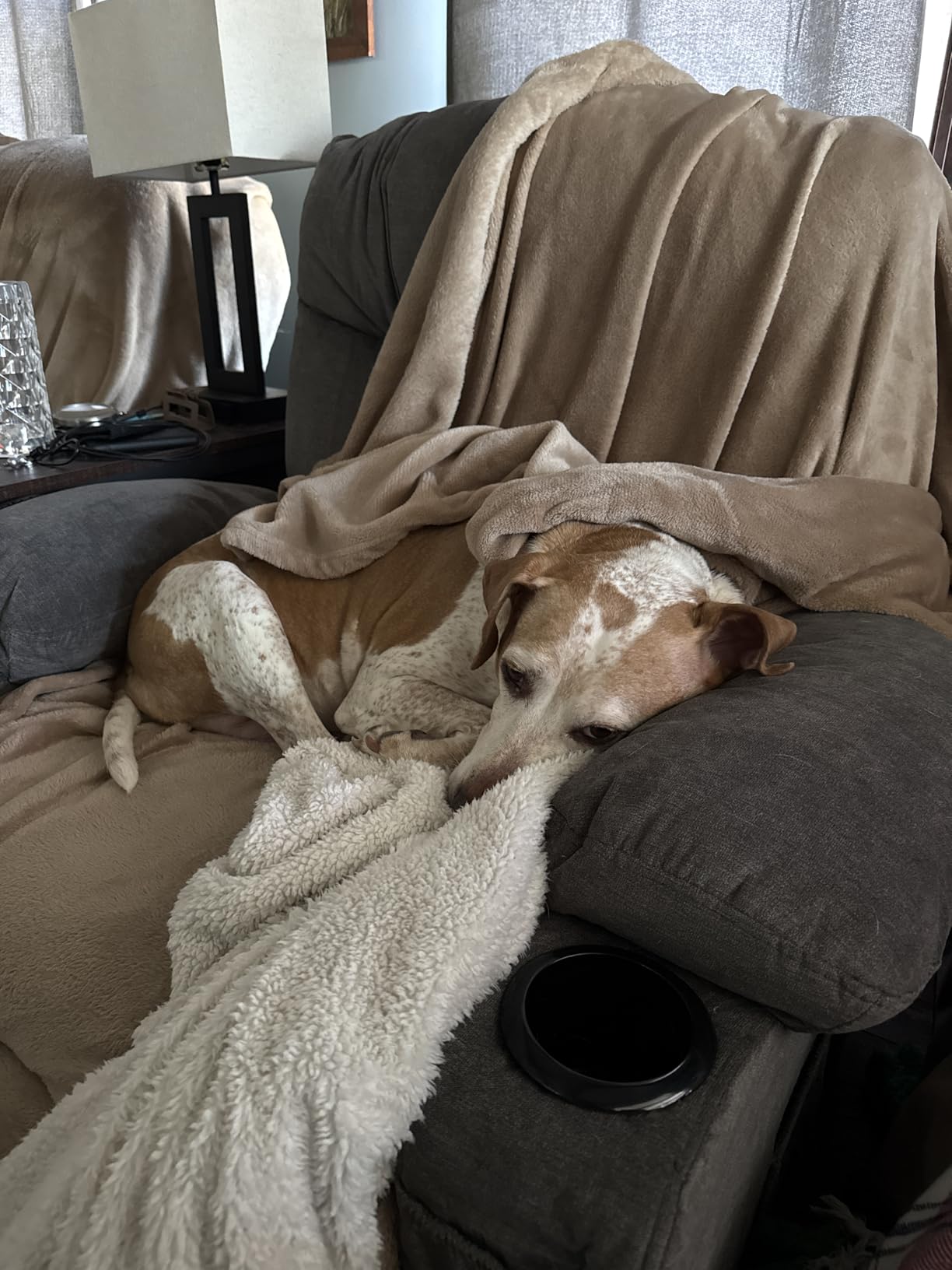
When lumbar heat is worth choosing over a better frame
Heat helps when your pain has a stiffness component. Cold mornings, old injuries and postural fatigue all produce tight muscle, and warmth reduces the guarding that makes movement painful. People who get through a day and then have a rough evening often find that twenty minutes of lumbar heat before bed is the difference between sleeping and lying awake.
It is not a substitute for a firmer frame if you are tall or heavy. Sponge padding on a metal frame feels comfortable in the first month and can bottom out later, once the foam has taken a set from your body shape.
Who should skip this chair
Owner ratings trail the rest of this list, with a noticeable share of one-star reviews focused on cushioning and a limited recline range. If you want a chair you will still like in three years, this is a temporary solution rather than a long-term one.
With only two listed recline positions, you get a sit, a recline and a lift. There is no intermediate stop for reading or working. The one-year parts warranty is also the shortest we would feel comfortable recommending for a chair meant for daily use.
6. MCombo 3 Motor Infinite Position Lift Chair – Best for Infinite Positions
MCombo 3 Motor Power Lift Recliner, Heat and Massage
3 motors, infinite position
165 degree recline
Power headrest
Large size, 350 lb capacity
Pros
- Headrest
- backrest and footrest adjust independently
- 165 degree near-flat recline takes lumbar pressure off
- Separate lumbar and seat heating plus 8-point vibration massage
- Available in five sizes
Cons
- Heaviest MCombo model at 128 lb across three boxes
- More assembly steps than two-motor chairs
- Higher cost than the rest of the MCombo range
This is the chair we would recommend to someone who has already tried a standard 3-position lift and found it limiting. Three motors drive the headrest, backrest and footrest separately, which means you can raise your legs above your heart while keeping your torso upright, or lift your head to open the chest without touching the position of your lumbar spine. That control is the whole point.
Recline goes to 165 degrees, which is close enough to flat to sleep in if you need to. Owners recovering from hip and knee procedures describe using it that way, and the extended 4.7 inch footrest keeps the legs supported rather than bent when you lie down. The power headrest adjusts separately so your neck is not left unsupported at a shallow angle.
Heating is split into a lumbar zone and a seat zone with independent control, and the 8-point vibration massage runs 3 modes. Being able to heat the lumbar region without also heating the seat, or to massage without heat, is the kind of small control that makes a chair usable in summer.
Dimensions are 39.4 inches deep by 37 inches wide by 45.7 inches tall, with a 20.5 inch seat height, 21.3 inch seat depth and a 33.5 inch backrest width. The chair weighs 128.3 pounds and arrives in three boxes, so plan for two people during assembly even though the build itself is tool-free and takes about 15 to 20 minutes.
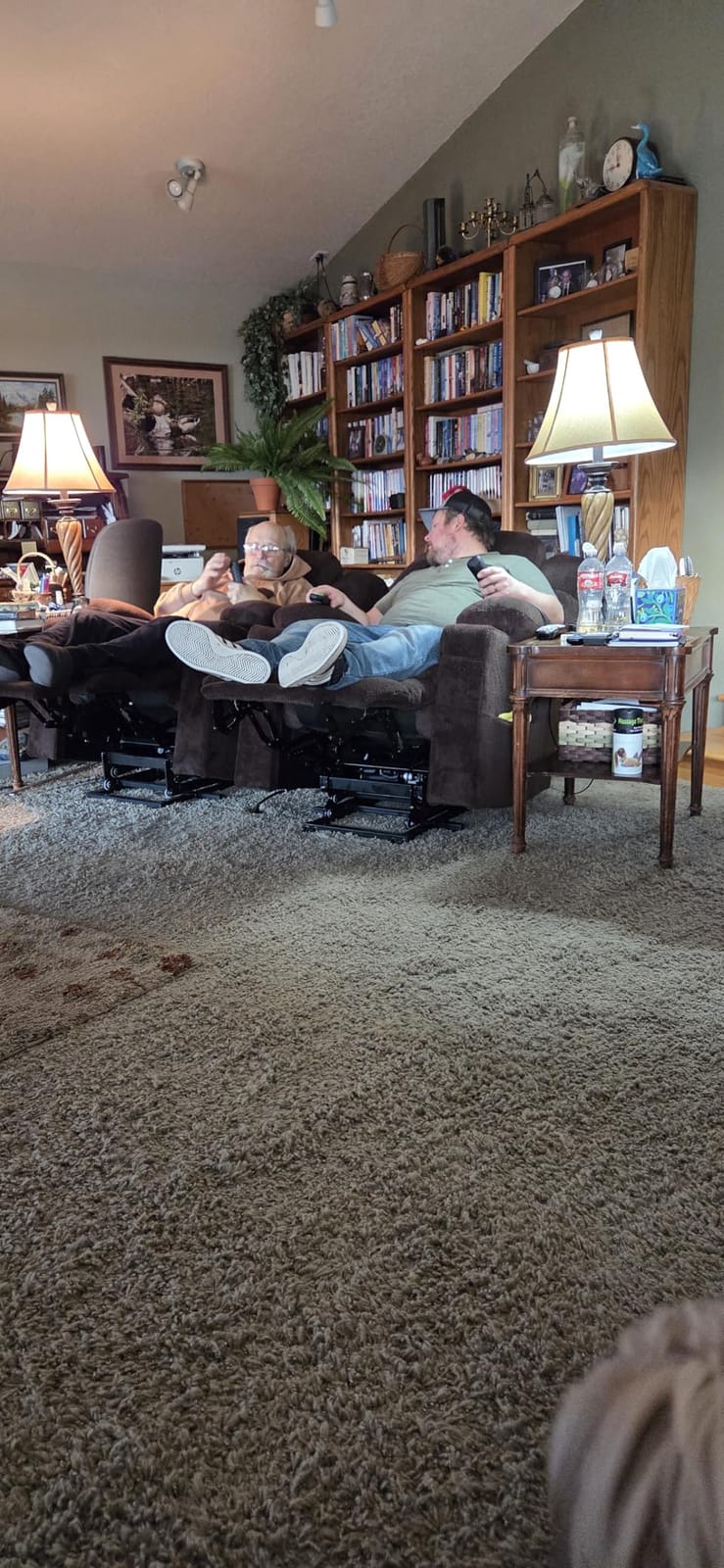
Why independent motor control changes back pain outcomes
On a single-motor chair, reclining the back also lowers the legs, and raising the legs also tips the back. You get one lever for two joints, and you cannot get legs-elevated-but-back-upright, which is the position that takes the most pressure off a lumbar spine. That is the position most often recommended for disc-related and sciatic pain, and on this chair you can dial it in.
The second benefit is adjustment without strain. Each control moves only the section you want, so you are not bracing your neck while waiting for your feet to move.
Who should skip this chair
Weight and handling are real drawbacks. At 128 pounds across three boxes, this is a two-person job, and anyone moving into a new home or up stairs should factor that in. It is also the most expensive MCombo chair in this group.
If you do not plan to lie down in it and you are content with three fixed positions, the simpler MCombo 7287 gives you the same lift assist for less money and half the shipping weight.
7. Zuacs Dual Motor Zero Gravity Oversize Lift Chair – Best Zero-Gravity Pick
Zuacs Dual Motor Power Lift Chair 26″ Extra Wide Recliner Chair for Elderly with Headrest, Flip Arm Storage,Massage & Heat,Oversized Lay Flat Recliner with Cupholders,USB Ports,Type C,Zero Gravity
Zero gravity position, 105 to 170 degrees
26 inch seat, 35 inch backrest
Telescopic footrest adding 5 inches
350 lb capacity
Pros
- Dual motors adjust backrest and footrest independently through 105 to 170 degrees
- Zero gravity position with lumbar heating
- 26 inch seat and 35 inch backrest suit longer frames
- Telescopic footrest stops feet dangling
- Headrest adjusts in three steps
Cons
- Heavy at 152 lb and needs two people to assemble and move
- Seat cushion can slide forward for some users
- Lumbar heat output is mild
This is the true zero-gravity chair of the group. Dual motors drive the backrest and footrest independently from 105 to 170 degrees, so the chair can stop at the classic zero-gravity geometry where your hips are at the same angle as your knees and your weight sits evenly across the whole back. Owners with degenerative disc problems report the independent back control is what lets them set an angle and stay there through a night.
Scale is the second story. The seat is 26 inches wide with a 35 inch backrest, and the frame sits on stainless steel and wood with cotton, foam and sponge fill. An automatic telescopic footrest extends an extra 5 inches beyond its normal length, which is what keeps taller users from dangling their feet in a reclined position.
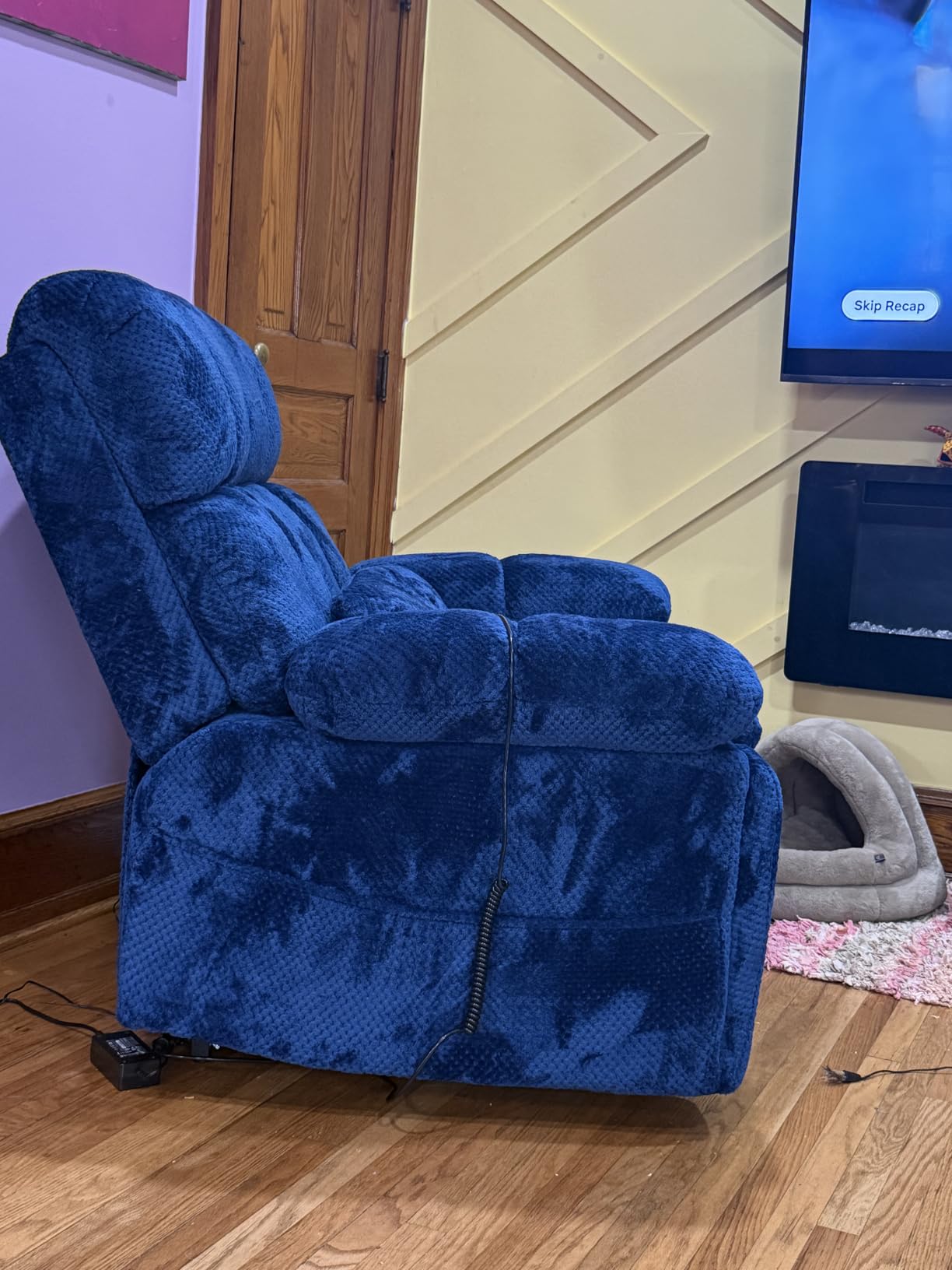
The headrest adjusts manually in 10, 25 and 35 degree steps, so your neck stays supported at whichever recline angle you choose. Massage runs 8 points across 5 modes and 2 intensities with a 15, 30 or 60 minute timer, and lumbar heating is paired with it. Flip-open armrest storage hides a compartment inside each arm, and there are stainless steel cup holders plus USB and Type-C charging ports.
Dimensions are 42 inches deep by 43 inches wide by 43 inches tall, with a 20.08 inch seat height, 22.83 inch seat depth and a 35.43 inch backrest. At 152 pounds, this is the second-heaviest chair we tested and the manual recommends two people for assembly, which takes about 15 minutes.
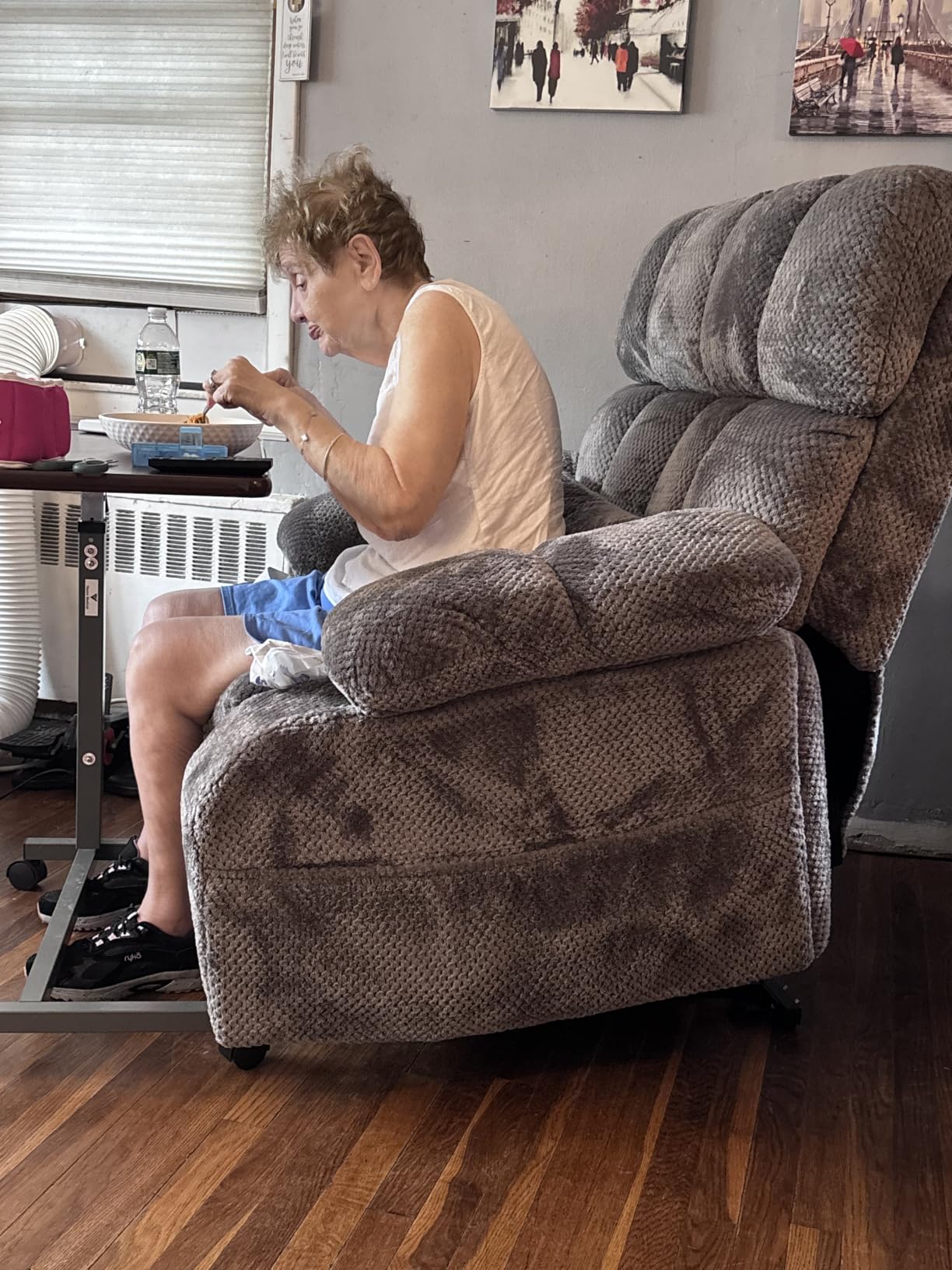
What zero gravity actually means for a sore spine
Zero gravity here means the footrest rises and the back tilts until your thighs and torso are roughly in line with the seat, distributing your body weight across your entire back rather than concentrating it in the lumbar curve. Combined with legs elevated, it also moves blood away from the lower back, which is part of why people find it relieving after a long day on their feet.
The reason it needs dual motors is that zero gravity and a raised headrest are different positions. Single-motor chairs force you to choose between them.
Who should skip this chair
At 152 pounds with a 43 inch wide footprint, this is a physically demanding chair to move and not a good match for a small room or a single-carer household. Check your doorways and the path to its final position before ordering. Lumbar heat here is mild, and some users report they can barely feel it, so do not buy this chair for the heat alone.
The seat cushion can slide forward on the base for some users, which becomes noticeable at deep recline. Anyone who shifts around a lot should try it in person if that is possible.
8. PARKOL Stand Assist Lift Recliner – Best for Standing Up Easily
PARKOL Stand Assist Power Lift Recliner Chair for Limited Mobility Elderly
Side armrest stand-assist button
160 degree recline
300 lb capacity
8-point massage with 5 modes
Pros
- One-press side armrest button for rising without twisting the back
- 160 degree recline deeper than most lift chairs
- Adjustable lumbar heat plus 8-point massage
- Quiet single motor and a lighter build for its size
Cons
- Only a 300 lb weight capacity
- PU leather runs warm for long naps
- Heavy at 200 lb
The design detail that sets this chair apart is the stand-assist button mounted on the side armrest. Instead of hunting for a handset on a console or the floor, you press once and the chair starts rising with you. For someone with back pain who cannot twist to reach a remote without provoking the problem, that removes a small daily friction that most chairs keep.
Recline goes to 160 degrees, deeper than almost every other chair here, and the seat height is a firm 19 inches which makes the top of the lift easier to push up from. Massaging 8 nodes run across the back, lumbar, thighs and legs with 5 modes and 3 intensity levels, and the lumbar heat is adjustable.
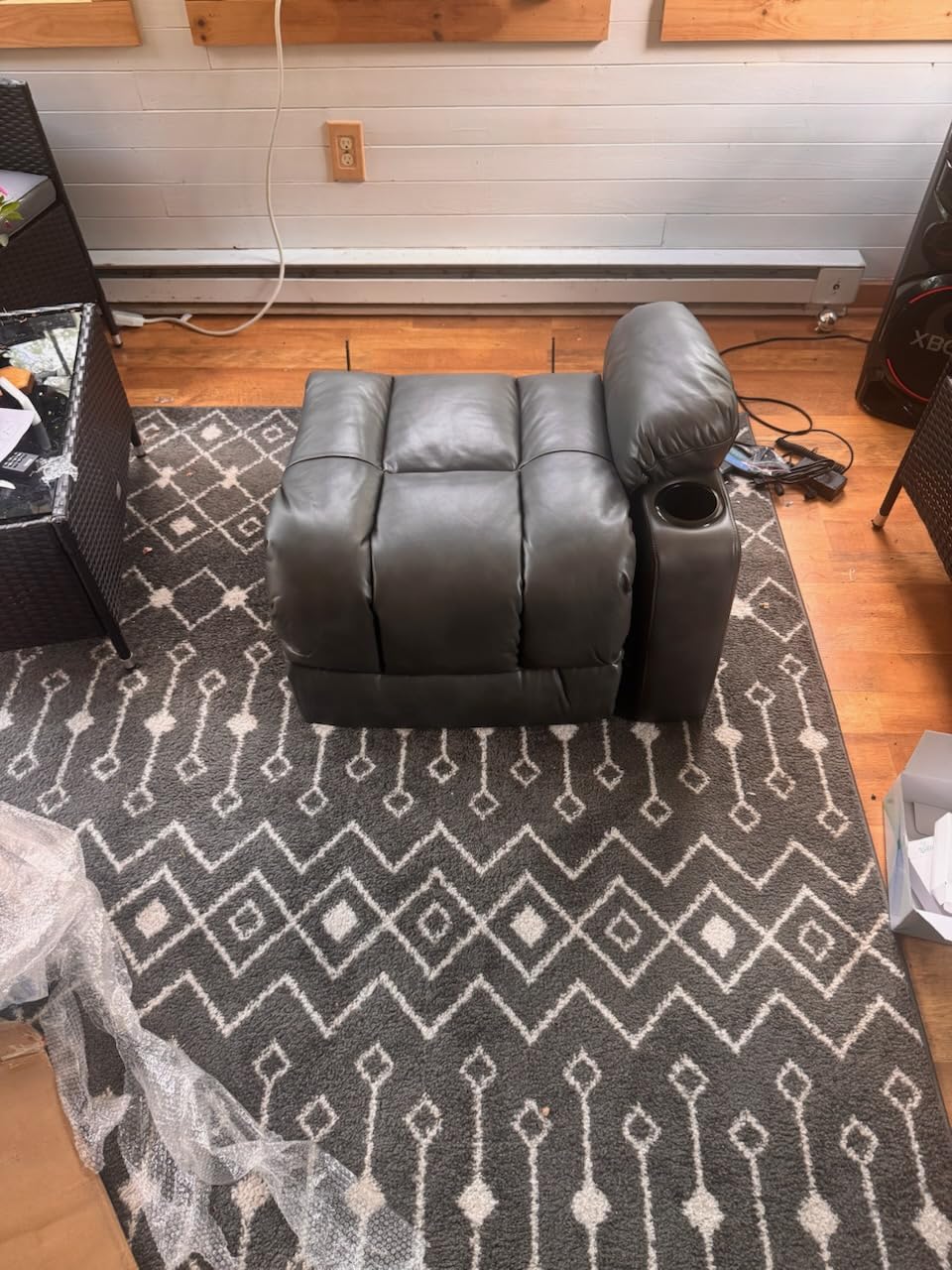
A quiet single motor handles both lift and recline. Upholstery is water-resistant PU leather that wipes clean, which is the practical choice for anyone managing incontinence or spills, and it comes with a USB port, two cup holders and side pockets. Setup is tool-free and takes 10 to 20 minutes, with round-the-clock customer support listed.
Dimensions are 38 inches deep by 38 inches wide by 43 inches tall, with a 19 inch seat height, 23.6 inch seat depth and a 30 inch backrest width. Owner ratings are strong, with a high share of five-star reviews focused on the stand-assist height.
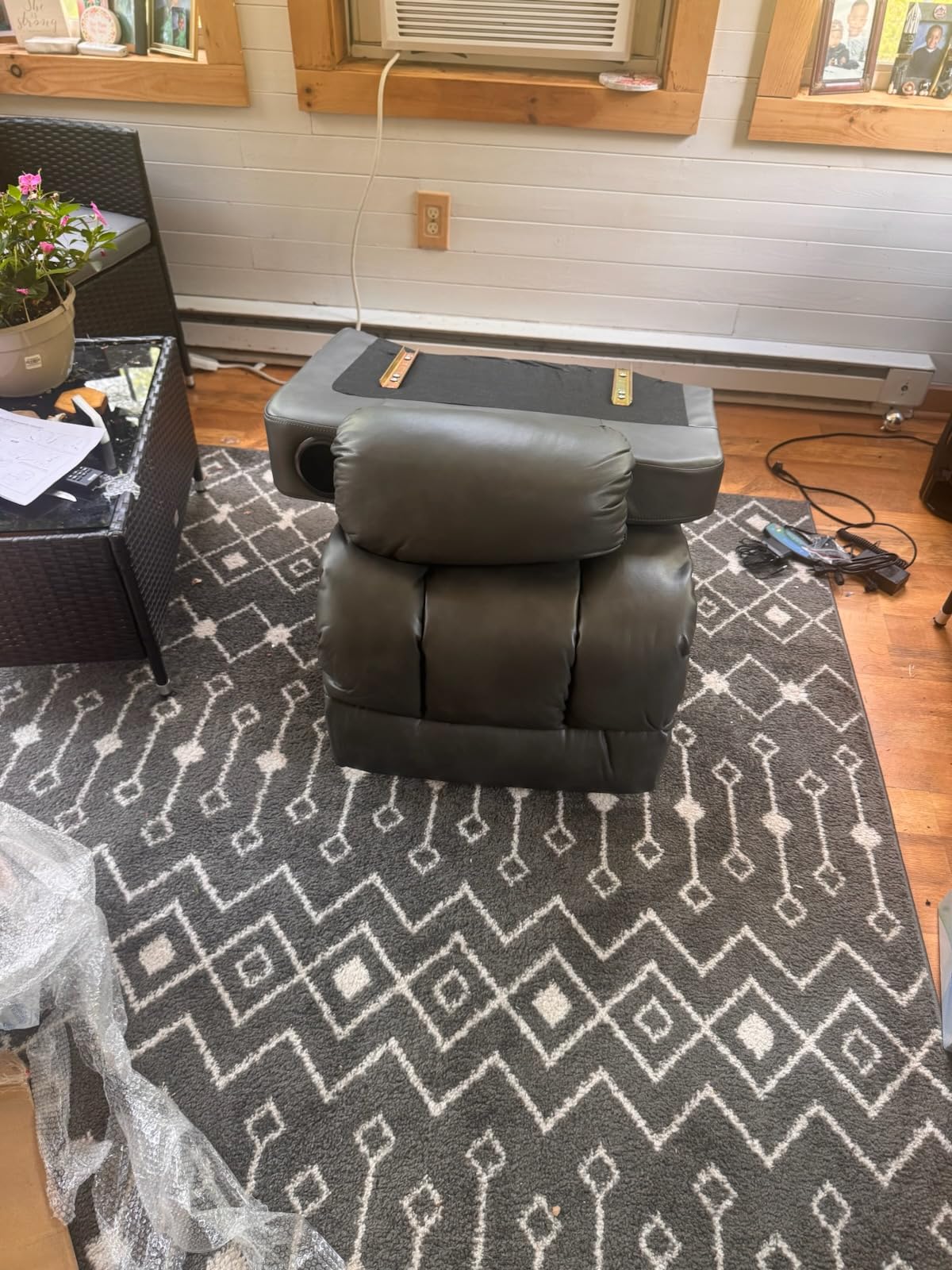
Why exit height matters more than most buyers expect
The hardest part of living with back pain is rarely sitting. It is the transition, and the two things that control it are seat height and how far the chair tilts forward at the top of the lift. A higher starting position and a steeper forward tilt put your feet flatter on the floor and reduce the depth of the bend your hips and knees have to make.
This chair pairs a 19 inch seat with an armrest-mounted control, which is a better combination than a low seat with a remote you have to reach for.
Who should skip this chair
The 300 pound weight capacity is the hard limit here, and it is lower than most of this group. If you are over 300 pounds, this chair is not for you, no matter how good the lift feels. PU leather also runs warm, so it is not the pick for someone who sleeps in their chair through a summer night.
At 200 pounds it is the heaviest item we tested, so moving it into place needs two people even though assembly does not.
9. Bonzy Home Heat and Massage Lift Recliner – Best for Plush Cushioning
Bonzy Home Power Lift Recliner Chair with Heat and Massage, Faux Leather
26 inch widened seat
8-point massage with heat
330 lb capacity
2 recline positions
Pros
- Wide 26 inch seat fits larger users comfortably
- 8-point massage with zone selection plus heating
- Quiet motor for gentle lifting
- Cup holders
- side pocket and USB charging within reach
- Tool-free assembly
Cons
- Footrest raise and lower very slowly compared with other chairs
- Backrest can shift out of place during recline
- Only two recline positions
- Slow customer service response reported
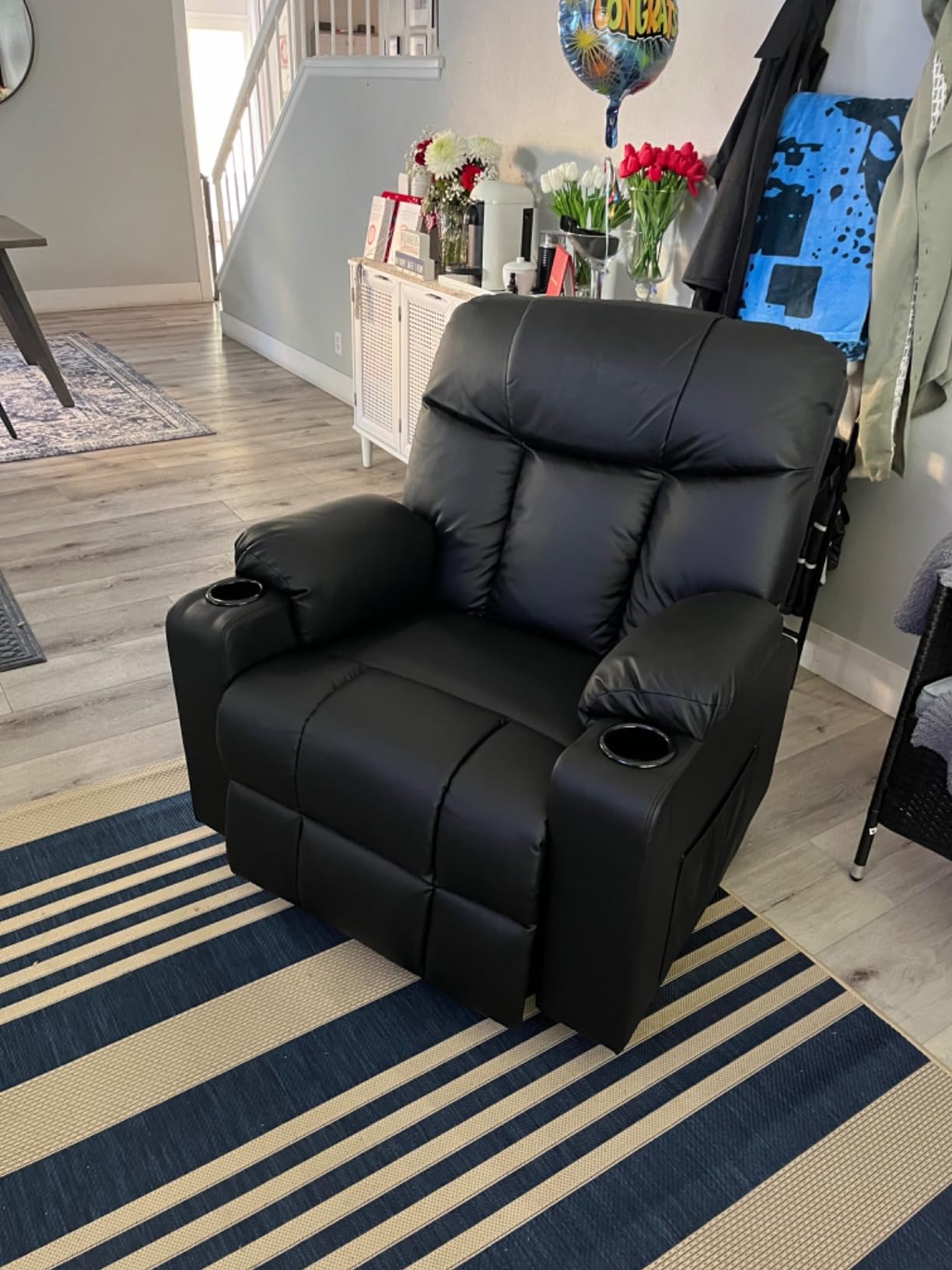
If your pain is worse from sitting on something hard, this is the plushest option in the group. Seat, backrest and armrests are all padded with plush fill over a 26 inch widened seat, which spreads pressure across a larger area than a medium chair. The cushioning moulds to you over the first few weeks rather than pushing back.
Massage runs 8 built-in points with zone selection through the remote, so you can concentrate it on the lumbar region rather than the whole back, and heating elements add warmth to the same zones. A quiet motor handles the lift and recline, and the top of the lift is gentle enough that it does not jolt.
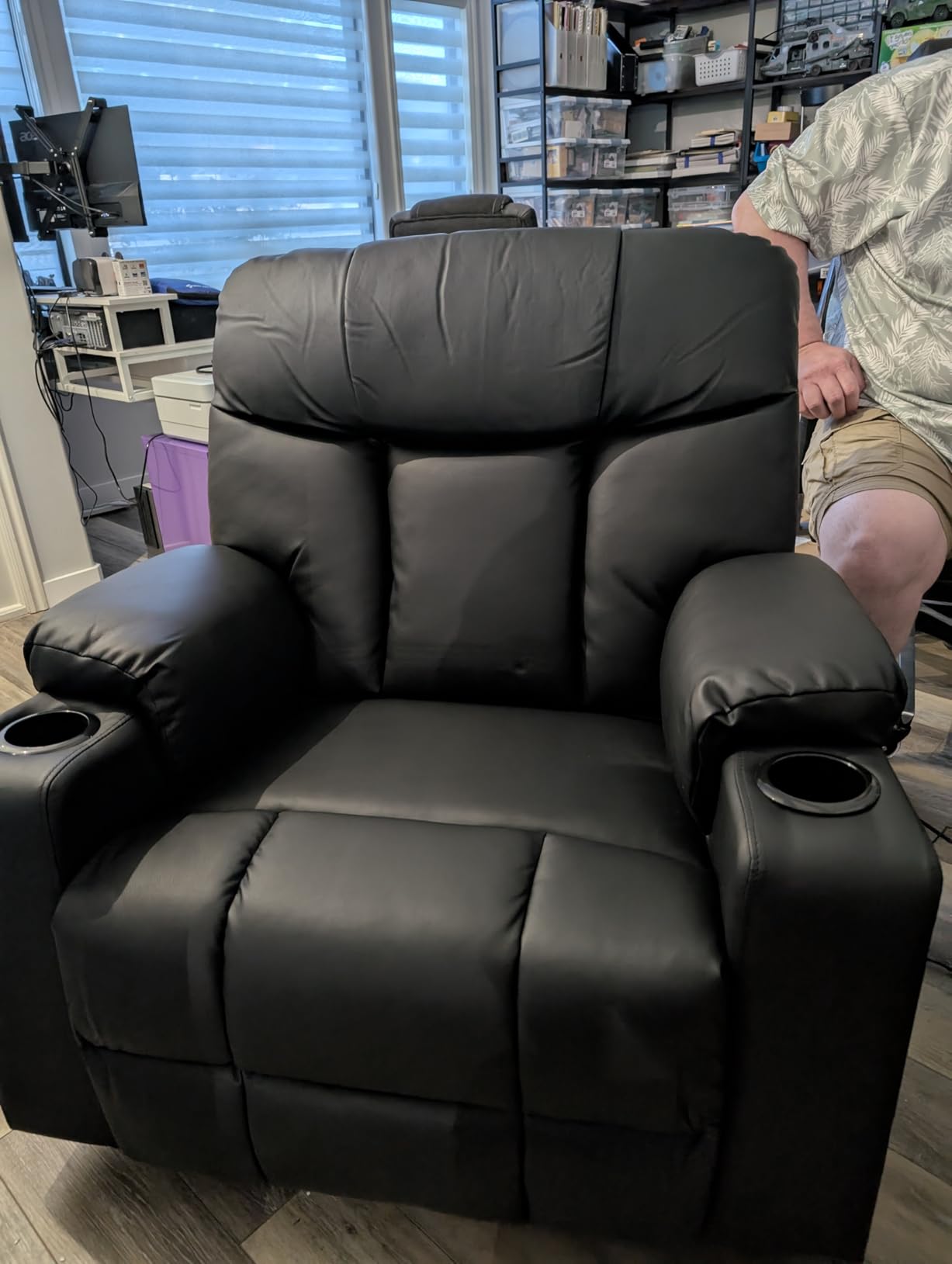
Storage is practical: two cup holders, a side pocket and USB charging, all within reach from the seated position. Upholstery is wipe-clean faux leather over a steel or aluminum frame, and assembly is tool-free and takes only a few minutes.
Dimensions are 38 inches deep by 40 inches wide by 42 inches tall, with a 19 inch seat height and a 26 inch backrest width. The listed weight capacity is 330 pounds, and the chair itself weighs 134.5 pounds.
Where the slow motor actually matters
Owners consistently report a much slower footrest cycle on this model than on other power recliners, and the difference is bigger than the numbers suggest. A fast footrest gets out of the way before you change position; a slow one means waiting, sometimes with your weight still partly on your heels, which is when a back can catch you.
Two recline positions also limits you to sit, recline and lift. There is no third stop for reading or eating.
Who should skip this chair
Skip it if you want a chair to grow with you. This is one of the lower-rated chairs in our group, with owner feedback split between people who love the cushioning and people frustrated by motor travel and a backrest that can shift out of alignment during recline.
Slow customer service response is also reported. If you want a chair backed by a long warranty and responsive support, one of the MCombo models carries a better record.
10. CDCASA Dual Motor Lay Flat Lift Chair – Best for Sleeping in the Chair
CDCASA Dual Motor Lay Flat Power Lift Recliner Chair, Massage, Heat, Brown
180 degree lay-flat recline
Dual OKIN motors, infinite position
400 lb weight capacity
26D high-density foam
Pros
- Lay-flat 180 degree recline supports overnight sleeping
- Highest weight capacity of the ten picks at 400 lb
- Dual OKIN motors with independent backrest and footrest
- Extra lumbar pillow plus lumbar heat
- Formaldehyde-free CARB P2 wood and breathable textile
Cons
- Concave backrest may need an extra pillow in the lumbar gap
- Motor transitions are slow for a dual-motor chair
- Massage is vibration and can be audible on hard floors
- Shaggy fabric traps pet hair
This is the chair for anyone who plans to sleep in it, and several buyers with MS report standing hands-free for the first time in years after adding it to their home. Recline goes to a full 180 degrees, so the chair becomes a flat surface rather than a reclined seat. Backrest and footrest are driven by two independent OKIN motors across a 100 to 180 and 90 to 180 degree range, and the infinite position locks wherever you stop it.
Weight capacity is 400 pounds, the highest in the group, and the cushion is 26D high-density foam on an alloy steel and rubberwood frame. High-density foam is what you want here: it resists bottoming out over a night, so the lumbar support you feel in hour one is still there in hour seven.
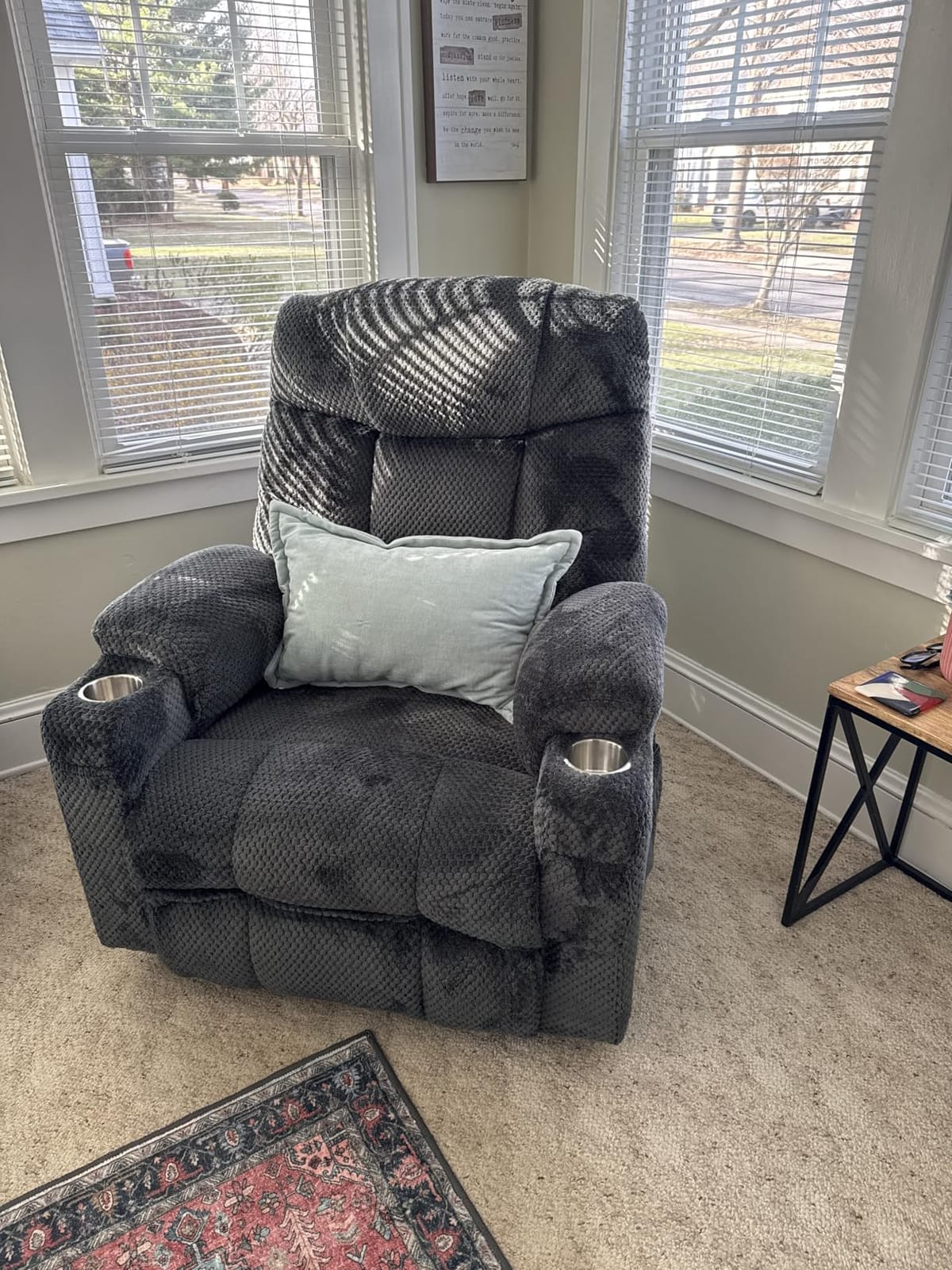
Massage runs 8 points across 4 area settings and 5 vibration modes on a timed remote, with lumbar heating layered on top. An extra lumbar pillow is included, which matters because the backrest is concave and some users need to fill that gap. Upholstery is breathable textile over formaldehyde-free CARB P2 wood.
Dimensions are 40 inches deep by 36.2 inches wide by 44.5 inches tall with a 23.6 inch seat depth, and the chair weighs 111.6 pounds. It arrives in two packages, installation usually takes 10 to 15 minutes, and there is a 30-day replacement or refund window with a one-year warranty.
Sleeping in a lay-flat chair, honestly
It works, and for post-surgical users who cannot get in and out of a bed it is genuinely useful. A memory foam mattress topper is the most commonly added accessory, and a pillow under the knees takes pressure off the lower back for anyone whose pain worsens lying flat.
It is still not a bed. The chair is 36.2 inches wide, so you are sleeping on a narrow surface, and the armrests sit where your shoulders want to be. Plan most of your sleeping in a real bed and use the chair for recovery rest.
Who should skip this chair
The concave backrest is the recurring complaint, and the included lumbar pillow is the fix rather than a cure. If you dislike extra pillows, test this carefully before committing. Motor transitions are also slow for a dual-motor chair, so it is less suited to someone who constantly changes position.
The textile upholstery is described as shaggy and holds onto pet hair, which makes it a poor match for a home with pets. The vibration can be audible on a hard floor, and the warranty is one year.
Why Zero-Gravity Recline Helps a Painful Back
Back pain relief from a chair comes down to three mechanics, and they work together: reclining past about 135 degrees, elevating the legs toward heart level, and keeping the lumbar curve supported instead of slumped. A chair that delivers all three gives you noticeably more usable sitting time than one that delivers only lift assistance.
The 135 degree threshold is not arbitrary. Below roughly a right angle between your torso and thighs, your lower back muscles work continuously to hold you upright. Once you open that angle past 135 degrees, much of that load transfers from muscle to the chair frame and backrest. That is the position most back-pain guidance points to for disc-related and sciatic pain, because it reduces the compression on the lumbar discs and eases pressure on the nerve roots.
Leg elevation adds a second benefit. With the feet above the heart, gravity pulls fluid out of the lower legs and reduces the volume of blood and fluid in the pelvis and spine, which many people feel within the first half hour. Combined with an open hip angle, it is the position most post-hip-replacement patients end up sleeping in.
The chair type taxonomy, briefly
A 2-position lift chair gives you upright and fully reclined, and nothing between. A 3-position chair adds a TV position with the legs up and the back slightly raised, which is where most people sit for most of the day. A 3-position chair is the minimum I would consider for back pain, because the intermediate stop is what lets you change position without going all the way down.
An infinite-position chair uses a single motor with a scissor linkage that lets the legrest stop at any angle, usually up to about 135 degrees. A dual-motor chair drives the back and footrest separately, which is the only way to get legs-elevated-and-back-upright. A lay-flat or bed chair goes to 180 degrees so you can sleep in it. A wall-hugger is a separate space-saving design that slides forward as it reclines, needing only a few inches behind it.
Zero gravity is a specific geometry within those types, not a separate category. It is the position where the seat tilt matches your hip angle, spreading your weight evenly across the back. Note that dual motor and zero gravity are independent: a chair can have one without the other.
How to use the chair to get the most out of it
Set your angle first, then adjust everything else around it. Spend the first week finding the recline angle that feels best for your back rather than the one that looks best in a showroom, and note it with a piece of tape on the remote.
Change position every 30 to 45 minutes, even in the best chair in the world. Static loading is what causes most chair-related discomfort, and the answer is movement, not a better seat. Support your lower back with a cushion or the chair’s own lumbar feature when you sit upright for long stretches, and keep your feet flat on the floor when you are seated at the lift position.
To get out safely, use the armrests and keep your back neutral as you rise. Never put your weight on an extended footrest to stand, and if the chair has a stand-assist or reach-recline feature, use it instead of trying to stand from a deep recline.
How to Choose a Lift Chair for Back Pain in 2026
Measure before you shop, then buy for recline range and fit rather than for upholstery colour. Get your feet flat on the floor when seated upright, check that the footrest supports your full leg length when raised, and confirm the chair’s weight capacity sits above your own weight with room to spare.
Fit is the first gate. Seat height has to put your feet flat on the floor, because the lift mechanism is designed around that. Seat depth should support the back of your thighs with two or three fingers of space in front of your knees. If you can measure, tap the backrest to check its height reaches at least to your shoulder blades; the 30 inch and 35 inch backs we tested are noticeably better for lumbar support than a 26 inch one.
Weight capacity is the second gate, and it is a safety number rather than a comfort one. The chairs here range from 300 pounds up to 400 pounds, and two models are rated at 350. Sitting under your limit but well below the rating gives the frame and mechanism more headroom over a decade of daily use.
Recline range is the third. For back pain, treat 135 degrees as the floor for meaningful relief and treat independent backrest and legrest control as the upgrade that makes it usable. A dual-motor chair is the single biggest functional improvement in this category, and our picks at positions six, seven and ten are the ones worth stretching for if your budget allows. Single-motor infinite-position chairs get you most of the way there for less.
Cushion density is what keeps the benefit going. High-density foam, listed as 26D on our 400 pound pick, resists bottoming out over years of use. Soft memory-blend cushions feel wonderful for the first month and can stop supporting the lumbar curve entirely after that. If your pain returns after an hour even in a good chair, cushion collapse is the first thing to rule out.
Lumbar support should be adjustable and located at the lumbar curve rather than the mid-back. Fixed decorative lumbar pillows shift as you move; a mechanism that holds its place does not. Heat and massage are worth paying for if your pain has a stiffness component, and lumbar-specific heat beats whole-back heat because it concentrates warmth where you need it.
Motor and warranty details matter more than brand names. Look for named actuator makers such as Okin or Limoss, a warranty on both frame and mechanism, and a minimum of two years. Two-year frame coverage is the norm among the picks here; one-year coverage is the floor we would not go below.
Upholstery is a care decision more than a style one. Fabric breathes better for long naps but needs spot cleaning, and faux leather wipes clean but runs warm. If you are managing incontinence, a wipe-clean surface is worth more than a softer one.
Delivery and assembly are where lift chair buyers most often regret the experience. Most of these chairs are 100 to 200 pounds, which means two people and a proper route through your home. Confirm whether the retailer offers in-home delivery and assembly, and read what the return policy says about oversized furniture, because return shipping on a lift chair is expensive for everyone.
On payment, Medicare covers a portion of a power lift recliner when it is prescribed as durable medical equipment, with coinsurance after the deductible. Coverage rules change, so check with Medicare or your insurer directly, and expect a doctor’s prescription to be required.
While you are setting up the rest of your space, our guides to massage chairs for back pain and office chairs for back pain cover the other main ways people manage the same problem.
Downsides and Regrets to Know Before You Buy
The biggest regret we hear about is getting stuck. If you raise a chair and the power fails, some chairs can only be lowered mechanically with considerable effort, and you may end up calling someone to come release it. Ask the retailer directly what happens in a power cut before you buy, and keep a phone in the house.
Sizing mistakes are the second most common. A chair that is too shallow or too short for you will force a slouched position no matter how good the recline is, and a chair too large for the room tends to get used less because it is hard to get into. Measure the doorways, the ceiling height in recline, and the path to the chair’s final position.
Zero gravity has real drawbacks too. A recline past 135 degrees means you cannot stand up without first returning the chair to an upright or lift position, so anyone who needs to get up quickly should know that trade before falling in love with the position. Some people also find that a fully elevated zero-gravity position makes them light-headed on the way back up, and a very slow footrest cycle leaves you waiting through it.
Backrest alignment is worth checking in person if you can. Two of our picks have concave backrests that leave a lumbar gap unless you add a pillow, and one has a backrest reported to shift during recline. Plush cushioning and a short back can push the pelvis forward, which is precisely the C-curve posture that aggravates lower back pain.
A lift chair is not the right answer for everyone. If your pain comes with numbness, weakness, loss of bladder or bowel control, or an unexplained fever, you need medical care, not furniture. If a chair cannot get you high enough or light enough to stand safely, a transfer aid or a bedside rail is a safer solution than a heavier mechanism.
Frequently Asked Questions
Are lift chairs good for back pain?
Yes, mainly because of position and lift assistance. A lift chair raises you to standing without a deep bend at the waist, and its deep recline past about 135 degrees takes compression off the lumbar discs. The relief is comfort and posture support, not treatment of the cause, so pair it with whatever your doctor or physical therapist recommends.
Is a zero gravity recliner good for back pain?
For most people with lower back pain, yes. In the zero-gravity position the seat tilt matches your hip angle, spreading weight evenly across the whole back instead of concentrating it in the lumbar curve, and the elevated legs reduce fluid pressure in the lower body. The trade is that you cannot stand up from that position until you return the chair upright.
Which chair is best for severe back pain?
For severe back pain, pick a dual-motor or infinite-position chair that can hold a recline past 135 degrees with adjustable lumbar support, because that is what lets you stay in a decompressed position longer. Our MCombo 3 Motor pick at 165 degrees suits people who also want to lie down, and the CDCASA dual motor at 180 degrees suits people who sleep in the chair.
Will Medicare pay for a lift chair for a senior?
Medicare may cover part of the cost of a power lift recliner when it is prescribed as durable medical equipment, with you paying coinsurance after your deductible. A doctor’s prescription is required and coverage rules change, so confirm current terms with Medicare or your insurer before you buy.
What chairs do chiropractors and physical therapists recommend for back pain?
Most recommend the same core features we looked for: adjustable lumbar support at the lumbar curve, a recline past 135 degrees, independent legrest control so the legs can rise without moving the back, and a firm high-density cushion rather than a soft one. They also stress changing position every 30 to 45 minutes, since no chair removes the need to move.
Can you sleep in a lift chair every night?
You can, if it is a lay-flat or bed chair. Only infinite-position chairs that reach 180 degrees give you a flat surface, and even then a memory foam topper and a pillow under the knees make a real difference. Most people use them for recovery rest after surgery rather than as a permanent replacement for a bed.
The Best Lift Chairs for Back Pain, Final Word
The best lift chairs for back pain all share three things: a recline that passes 135 degrees, a lumbar curve that stays supported, and a lift that gets you upright without twisting. Our pick for most homes is the MCombo 7287, because its 140 degree recline and counter-balanced lift do those three things simply and reliably. Add the MCombo 7040 if you want lumbar heat and vibration, the CANMOV wide chair if standard sizing leaves you cramped, and the MCombo 3 Motor if you want independent control of head, back and legs.
Measure your room and your body before ordering, check what happens in a power cut, and give any chair you buy a real trial rather than a two-minute sit. If you also want to know how these compare with other seating options, read our guides to inversion chairs for back pain and mattresses for back pain before you finalise the setup.