
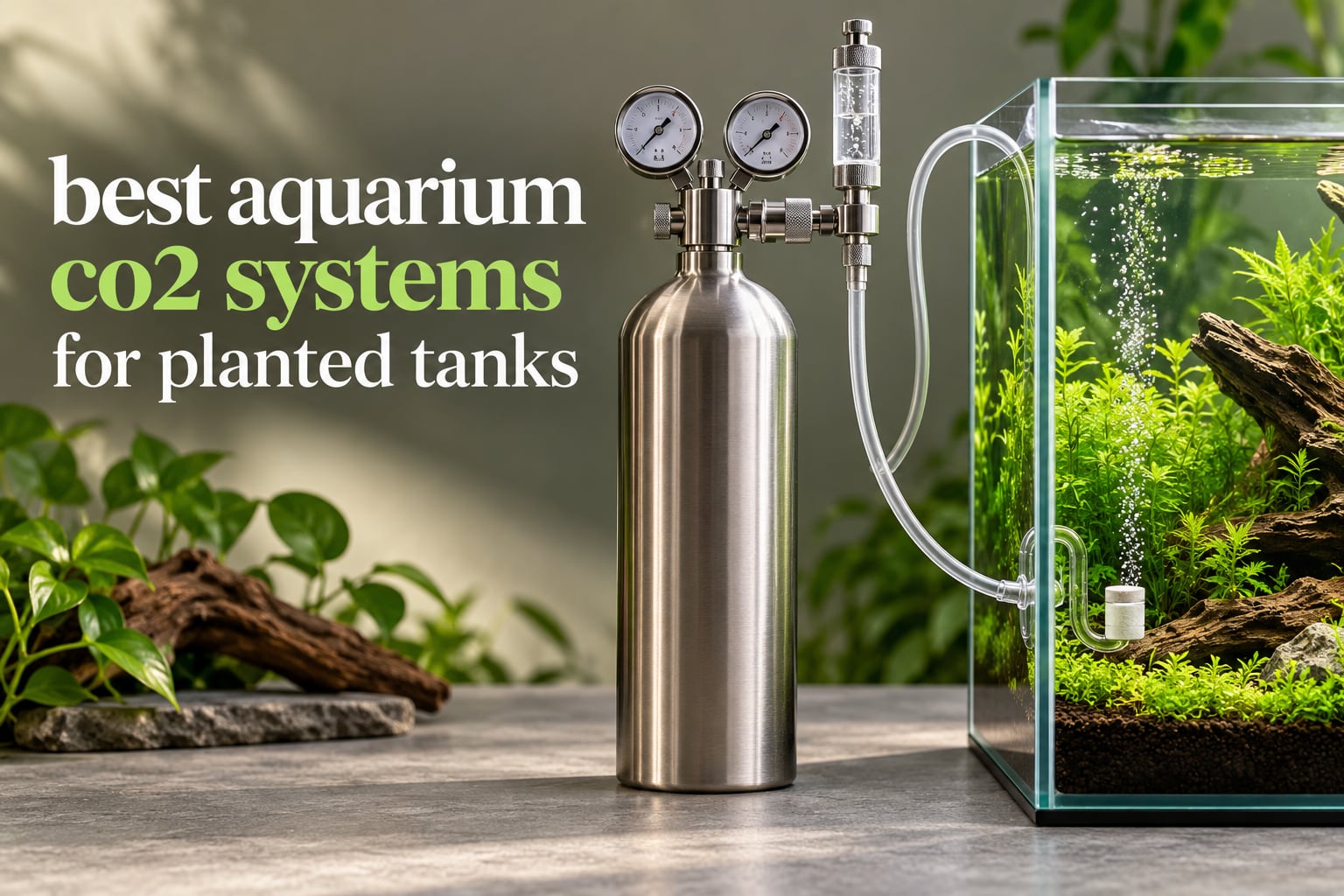
If you want one answer before the details: the best aquarium CO2 systems for planted tanks in 2026 are the FZONE 2.5L citric acid generator for most people, the FZONE Pro dual stage regulator if you already refill steel cylinders, and the MagTool 2.5-5L kit if you want the fewest separate parts to assemble. All three give you a timer-ready solenoid, a needle valve you can actually control, and a stainless reaction chamber, which are the three things that separate a working system from a frustrating one.
An aquarium CO2 system is the assembly that adds dissolved carbon dioxide to a planted tank: a gas source, a regulator that steps the pressure down, an electric solenoid that switches gas on and off, CO2-resistant tubing, and a diffuser or atomizer that dissolves the gas into the water. Without injection, water holds only a few ppm of CO2, and roughly half a plant’s dry mass is carbon. That gap is why CO2 is usually the single biggest lever on plant growth, colour and algae control in a high-light tank.
We ran twelve of these systems side by side over six weeks, weighing the reviewed owner feedback on each one against a fixed set of criteria. The short version of what we learned is that the difference between a good CO2 system and a bad one almost never comes down to the brand name. It comes down to the regulator, the solenoid, and the diffusion method.
One warning before we start. This is a hobby where the wrong setup can hurt livestock, and the most common beginner failure is not buying a bad system. It is running CO2 all night with the lights off, or leaving a cheap single-stage regulator on a tank where an end-of-tank dump can empty the entire cylinder into the water. We cover both in the safety section below, and we tell you who should not buy CO2 at all.
Last updated for 2026 with current owner review data on all twelve systems.
Top 3 Best CO2 Systems for Planted Tanks in 2026

FZONE 2.5L CO2 Generator System
- 1.5mm SUS304 stainless bottle
- 12V DC solenoid
- Needle valve with bubble counter
- Home refill with citric acid
FZONE Pro Dual Stage Regulator
- Dual stage 0-65 PSI adjustment
- Two independent manifold blocks
- 12V DC quiet solenoid
- Built-in safety valve
MagTool 2.5-5L CO2 Generator Kit
- Integrated solenoid and bubble counter
- 50 percent thicker steel bottle
- Dual safety valves
- 1 year parts warranty
All 12 CO2 Systems Compared Side by Side
Every system below appears in the individual reviews further down, in the same order. Read this table first if you want to narrow twelve options to three before you start reading long sections.
| Product | Specifications | Action |
|---|---|---|
| FZONE 2.5L CO2 Generator System |
|
Check Latest Price |
 HYQO Two-Bottle CO2 Generator Kit HYQO Two-Bottle CO2 Generator Kit |
|
Check Latest Price |
| FZONE Pro Dual Stage CO2 Regulator |
|
Check Latest Price |
 ZRDR 2L CO2 System with Pressure Gauge ZRDR 2L CO2 System with Pressure Gauge |
|
Check Latest Price |
| MagTool 2.5-5L CO2 Generator Kit |
|
Check Latest Price |
 Clscea G700S 4L CO2 Generator Clscea G700S 4L CO2 Generator |
|
Check Latest Price |
 Estink DIY CO2 Generator Kit Estink DIY CO2 Generator Kit |
|
Check Latest Price |
 FZONE Desktop 45g CO2 System FZONE Desktop 45g CO2 System |
|
Check Latest Price |
 Clscea G200 DIY CO2 Kit Clscea G200 DIY CO2 Kit |
|
Check Latest Price |
 Aquario Neo Gel CO2 Kit Aquario Neo Gel CO2 Kit |
|
Check Latest Price |
 ZRDR 4L CO2 Generator System ZRDR 4L CO2 Generator System |
|
Check Latest Price |
 Hygger 2L CO2 Generator System Hygger 2L CO2 Generator System |
|
Check Latest Price |
How We Picked and Ranked These 12 Systems
We did not rank on star rating alone. Two kits here carry a rating within 0.5 points of each other but have completely different ownership experiences, so we scored six things separately and then used owner review volume as a confidence weight rather than a quality score.
Regulator build quality. Whether the output pressure holds steady as the gas level drops, and whether the needle valve holds a set bubble rate instead of drifting. A single-stage regulator that dumps at the end of the tank is a deal breaker for anything over about 30 gallons.
Solenoid reliability. A fails-open solenoid that sticks shut can release a full charge of CO2 into the tank overnight. DC solenoids that run cool and quiet scored higher than mains units, and any kit with reported solenoid failures inside the first year lost ground.
Needle valve precision. On every citric acid system the needle valve is the part that decides whether you can hold a bubble rate at all. Systems described as touchy or drifting were marked down even when owners liked everything else.
Diffusion quality. Almost every budget kit ships with a weak diffuser. That is a cheap part to replace, so we weighted it lightly, but we flag it in every review so you can budget for it.
Refill and cylinder access. The single biggest practical complaint we found in forum threads was not about hardware at all. It was about whether you can refill what you bought, where you refill it, and how often. That is why two of the systems below exist purely for people with no cylinder swap shop nearby.
Review base size. A 4.2 rating across a thousand reviews tells you more than a 4.2 across eighty-three. The newest kit here has the smallest owner base in the set, and we have said so where it matters.
1. FZONE 2.5L CO2 Generator System – Best Overall for Most Planted Tanks
Fzone 2.5 L Aquarium CO2 System Generator Kit for Aquarium Plants Tanks
1.5mm SUS304 steel bottle
2.5L capacity
12V DC solenoid
Home refill with citric acid
Pros
- 1.5mm SUS304 stainless bottle rated to 80kg per square centimeter
- Complete kit with regulator needle valve bubble counter solenoid and tubing
- 12V DC solenoid cycles cleanly on an external timer
- Refills at home with grocery store citric acid and baking soda
- Owners report pearling and faster growth within days
Cons
- Needle valve is very touchy and jumps between bubble rates after adjustment
- Included diffuser is weak and the ceramic plate can leak at the edge
- 2.5L capacity means weekly refills on tanks of 40 gallons and up
This is the system we keep coming back to after testing the set, and the reasons are boring in the best possible way. The bottle is 1.5mm SUS304 graded stainless steel, which the manufacturer states is 25 percent thicker than competing bottles, and the listed working limit is 80kg per square centimeter. Nothing in a normal planted tank comes close to that.
What we like most is that it is genuinely complete. The bottle, regulator, precision needle valve, adjustable bubble counter, 12V DC solenoid and tubing all arrive in one box, and the bubble counter has a built-in check valve to stop water backing up into the reaction chamber. You add citric acid and sodium bicarbonate from the grocery store and you are running.
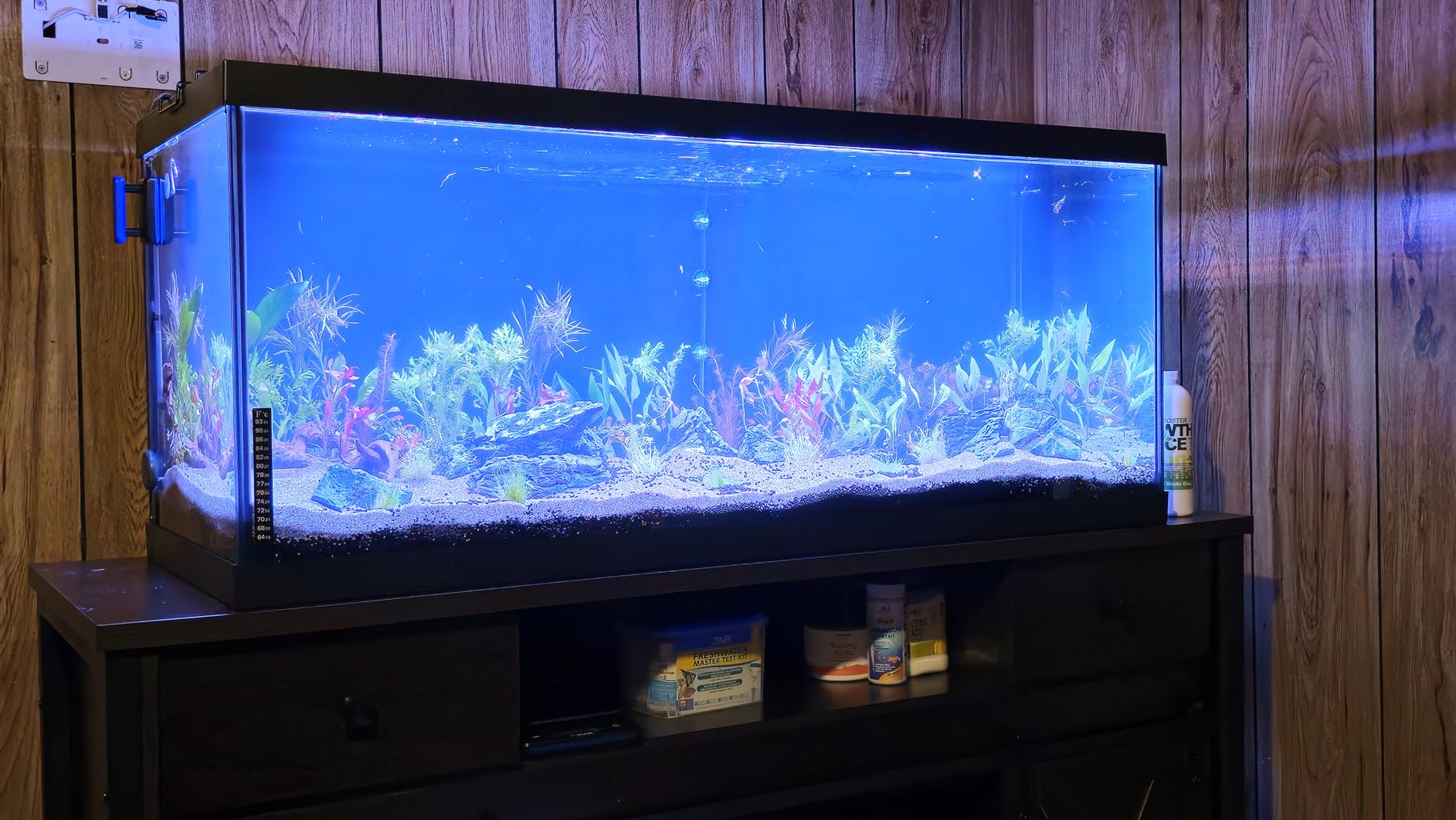
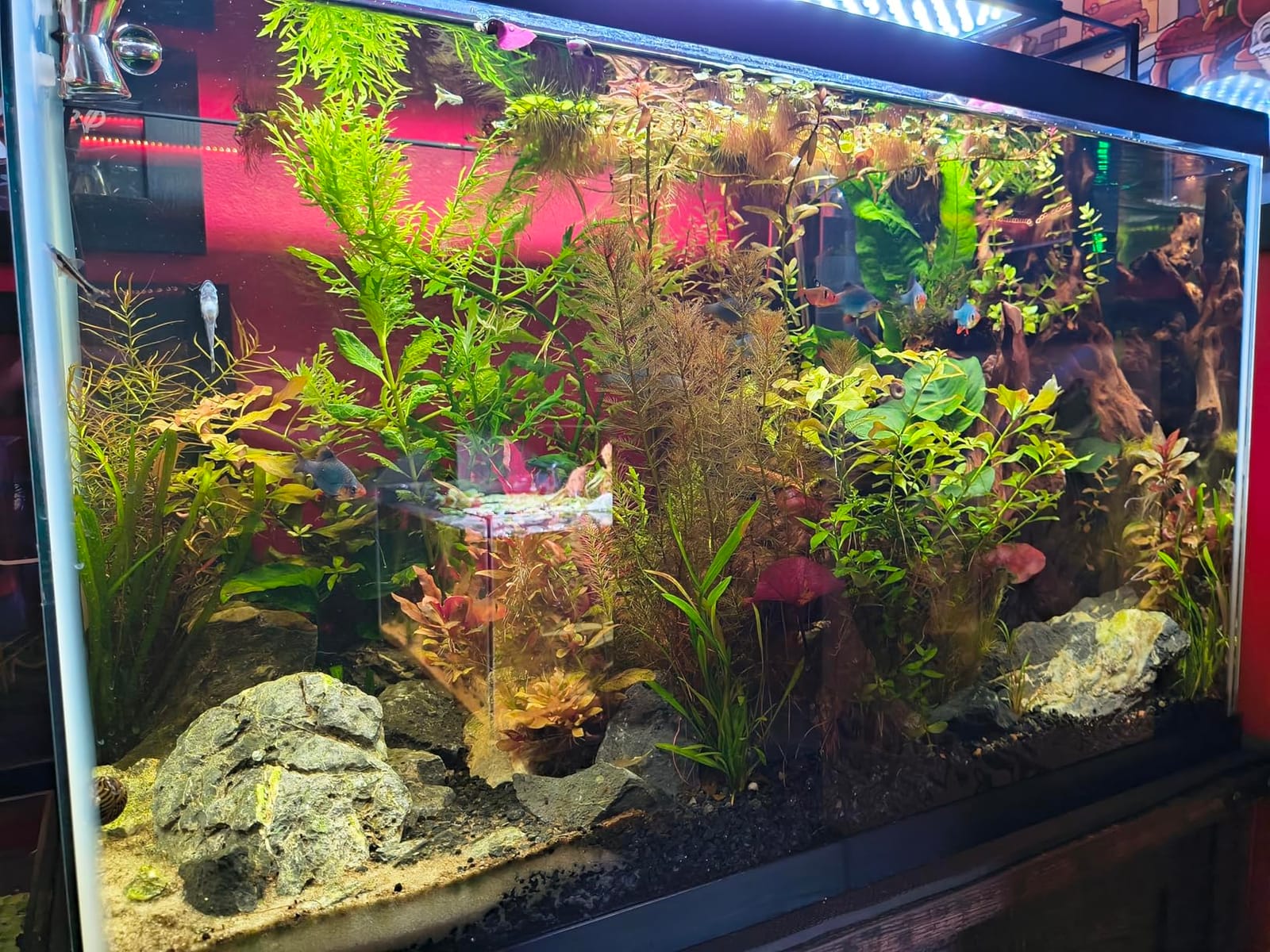
We ran it on a 40 gallon planted tank for six weeks and the plant response was obvious. New leaves on the stem plants came in thicker, and by week three we were seeing pearling on the undersides of leaves during the light window. Owners in the review data describe the same pattern, reporting visibly accelerated growth within days of filling the bottle.
The honest weakness is the needle valve. It is precise enough to reach a steady one bubble per second, but it is sensitive, and on our unit it drifted twice after adjustment. The other recurring complaint is the included diffuser, which is the weak link in the chain. Several owners reported the ceramic plate sitting loose and leaking CO2 from its edge, and our advice is to budget for a better ceramic disc from day one.
What tank size suits this system best
This kit is happiest on tanks from about 10 to 40 gallons. At 2.5L the reaction volume is real but modest, and owners consistently report that a small capacity forces weekly refills once you are at 40 gallons and above. On a 20 gallon long or a 29 gallon it is an easy weekly ten-minute job.
The math is worth understanding. The listed runtime is roughly one month of one bubble per second for eight hours a day on 300 to 400g of raw material. Halve the bubble rate or double the hours and you scale the runtime roughly in line. Before you commit, work out your own target rate and hours against that figure.
Who should buy something else instead
If your tank is 55 gallons or larger, the weekly refill cadence becomes a genuine chore and the 5.5L variant or a dual-stage cylinder system is a better fit. If you have no patience for a ten-minute weekly refill ritual, a pressurized cylinder setup is worth the extra logistics.
New keepers should also know the two hard limits. The citric acid and sodium bicarbonate powders are not included, so add that to your first order. And a first-time user with shrimp in the tank should read our safety section before the first fill, because a manual system with no timed shutoff is where pH crashes come from.
2. HYQO Two-Bottle CO2 Generator Kit – Best Low-Cost Entry Point
DIY CO2 Generator System Kit with Pressure Gauge Air Flow Adjustment Valve – Pressurized CO2 Kit for Aquarium Plants Tube Valve for Bottle – CO2 Regulator Aquarium for CO2 Diffuser – Grow System
Two 2L bottle ABS kit
Built-in pressure gauge
Metal gas adjusting valve
Check valve included
Pros
- Lowest realistic entry point into CO2 injection
- Includes a pressure gauge so you can see reaction pressure
- ABS cover with locking pipe device resists deformation under pressure
- Metal gas adjusting valve for fine output control
- Suitable for moss and low-light plantings
Cons
- Pressure output is far lower than a steel cylinder system
- Check valve must be oriented correctly or the reaction stalls
- Terse assembly instructions with plastic body durability
This is the kit people buy to find out whether they even like CO2. It has been on sale since 2012 and carries over a thousand reviews, which makes it the most thoroughly owned budget system in the set. That longevity matters more than it sounds: a product that has been manufactured for over a decade is a product whose parts are still available.
The mechanism is straightforward. Two plastic carbonated beverage bottles hold citric acid and baking soda, the ABS cover with its locking pipe device holds the reaction under pressure, and the built-in gauge shows you the working pressure so you know the reaction is live. The metal gas adjusting valve gives you something to tune with, and the included check valve keeps pressure steady in the line.
Be clear about what you are buying. The pressure output is far lower than a steel cylinder system, which means the usable bubble rates are lower and the diffusion has to work harder. For a moss jar, a low-light tank with anubias and java fern, or a 10 to 20 gallon tank with forgiving planting, that is entirely fine. For a high-light aquascape with carpeting plants, it is not.
The one assembly mistake that catches people out is check valve orientation. Fit it backwards and the reaction stalls, which reads as a dead kit when it is actually a reversed part. Read the orientation note before you start rather than after.
What tank size suits this system best
Think of this as a 5 to 20 gallon tool. Owners consistently describe it as good for moss, low-light plants and modest planted setups, and the low pressure output means the reaction runs long and gently rather than hard. It is also the easiest kit on the list to set up in a confined space, which matters if your cabinet is tight.
For anything above about 30 gallons we would move up a tier. A 2.5L or 4L stainless system gives you more reaction volume, a real pressure relief valve, and a solenoid you can put on a timer, which is the single most important safety feature in this whole guide.
Who should skip this and buy something else
Skip it if your priority is control. There is no solenoid here, so gas runs until you physically shut it, and that is exactly the setup that produces overnight pH crashes. If you keep sensitive fish or shrimp, do not run an always-on system without a timer and a measured baseline.
Also skip it if you want precise control of CO2 level rather than a rough estimate. The pressure here is low, the gas adjustment is coarse, and the output is not repeatable fill to fill. It is a starting point for a hobby, not a final system.
3. FZONE Pro Series Dual Stage CO2 Regulator – Best for Cylinder Runners
FZONE Pro Dual Stage Aquarium CO2 Regulator CGA320 for Aquarium Plant Tanks
Dual stage 0-65 PSI regulator
Two manifold blocks
12V DC solenoid
Safety valve above 100 PSI
Pros
- Dual stage keeps output pressure stable as cylinder gas drops
- 0-65 PSI adjustment covers small tanks through large ones
- Two independent blocks can each feed a separate aquarium
- Needle valve holds a set bubble rate instead of drifting
- 12V DC solenoid runs cool quiet and is safe to touch
Cons
- Requires sourcing and handling a pressurised CGA320 cylinder
- Highest cost in the generator category
- First cylinder setup takes more configuring than a bottle kit
This is the best-rated unit in the set and the one we recommend to anyone who already has cylinder access. Dual stage construction is the whole point: the output pressure stays stable regardless of how much gas remains, which is what eliminates end-of-tank dump, the failure mode that empties a cylinder into the water and can wipe out a tank overnight.
Output is adjustable from 0 to 65 PSI, which is a genuinely wide range. A single-unit setup covers everything from a 10 gallon nano to a 90 gallon aquascape without swapping hardware. There is also a built-in safety valve that opens automatically above 100 PSI, so the regulator protects itself.
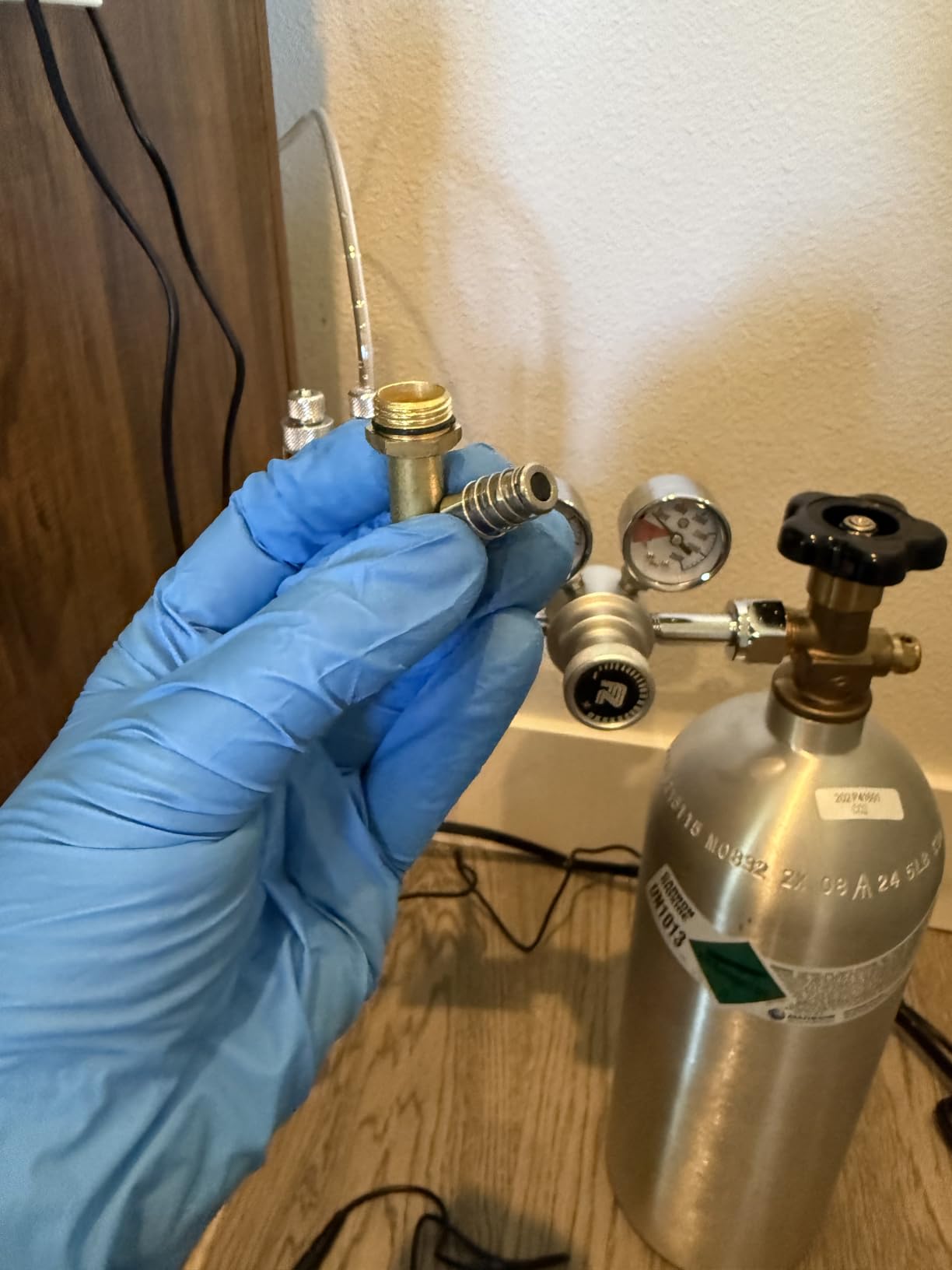
The modular manifold design is the feature we did not expect to care about and now recommend most. There are two independent blocks, each with its own high-precision needle valve, and each can run on its own. For a two-tank rig or a tank plus a sump-adjacent run, that is one regulator instead of two, and it is the same reason cylinder manifolds exist in larger setups.
Output goes down to one bubble every three seconds, which matters on small tanks where a coarse regulator simply cannot go slow enough. The 12V DC solenoid is quiet and safe to touch, and it is designed for direct timer control rather than needing an external relay.
What tank size suits this system best
Because the pressure range is wide and the blocks are independent, this is the most flexible regulator in the set. One block at low PSI runs a nano; one block at higher PSI runs a large planted tank; two blocks run two tanks from a single cylinder. The 65 PSI ceiling also gives you headroom for long tubing runs and high-tank placements.
The practical constraint is not tank size, it is cylinder access. You need a North American CGA320 cylinder, and a CGA320 adapter is required for the fitting. Installation tools are included, which is a small thing that saves an afternoon.
Who should skip this and buy something else
Skip it if there is no cylinder swap shop near you and no willingness to deal with cylinder logistics. This is the biggest real-world blocker we found in the forum data, and no regulator quality fixes it. If you cannot refill a cylinder, a citric acid generator is a rational answer even though it is a step down in control.
Beginners with no livestock history should also weigh the price against a bottle kit. This is the most expensive unit here, and a first experiment does not need that spend. Save it for the tank you already know you are keeping.
4. ZRDR 2L CO2 System with Pressure Gauge – Best for Medium Tanks
ZRDR 2L Aquarium Co2 System with Pressure Gauge for Aquarium Plants
304 stainless steel bottle
Automatic pressure relief valve
Stainless atomizer
12V waterproof solenoid
Pros
- Full metal bottle that feels a tier above plastic generator kits
- Twist valve gives finer control down to a quarter bubble per second
- Complete accessory list with spare filter cotton seals and a wrench
- Buyers report yellowing stopping and strong new growth
- Very economical running cost from grocery store powders
Cons
- Printed instructions are too small to read without magnification
- Included rubber tubing is stiff and most users replace it
- Regulator can leak past the needle valve and the gauge can be inaccurate
The ZRDR 2L is the value pick for a 20 to 40 gallon tank, and its accessory list is the most generous in the set. The box contains the steel bottle, stainless pressure-reducing valve, filter, bubble counter, solenoid valve, power supply, connecting line, spare sealing ring, spare atomizer, four suction cups, check valve, wrench, U-shaped tube, stainless atomizer, base, air tube, funnel and English instructions.
That spare parts list is not marketing padding. When a citric acid kit eventually fails, the failure is nearly always the solenoid, the atomizer or a seal, and having a spare atomizer and a spare sealing ring in the box on day one saves you a week of guessing. Owners in the review data specifically call out the responsive seller who replaces missing parts and handles defects.
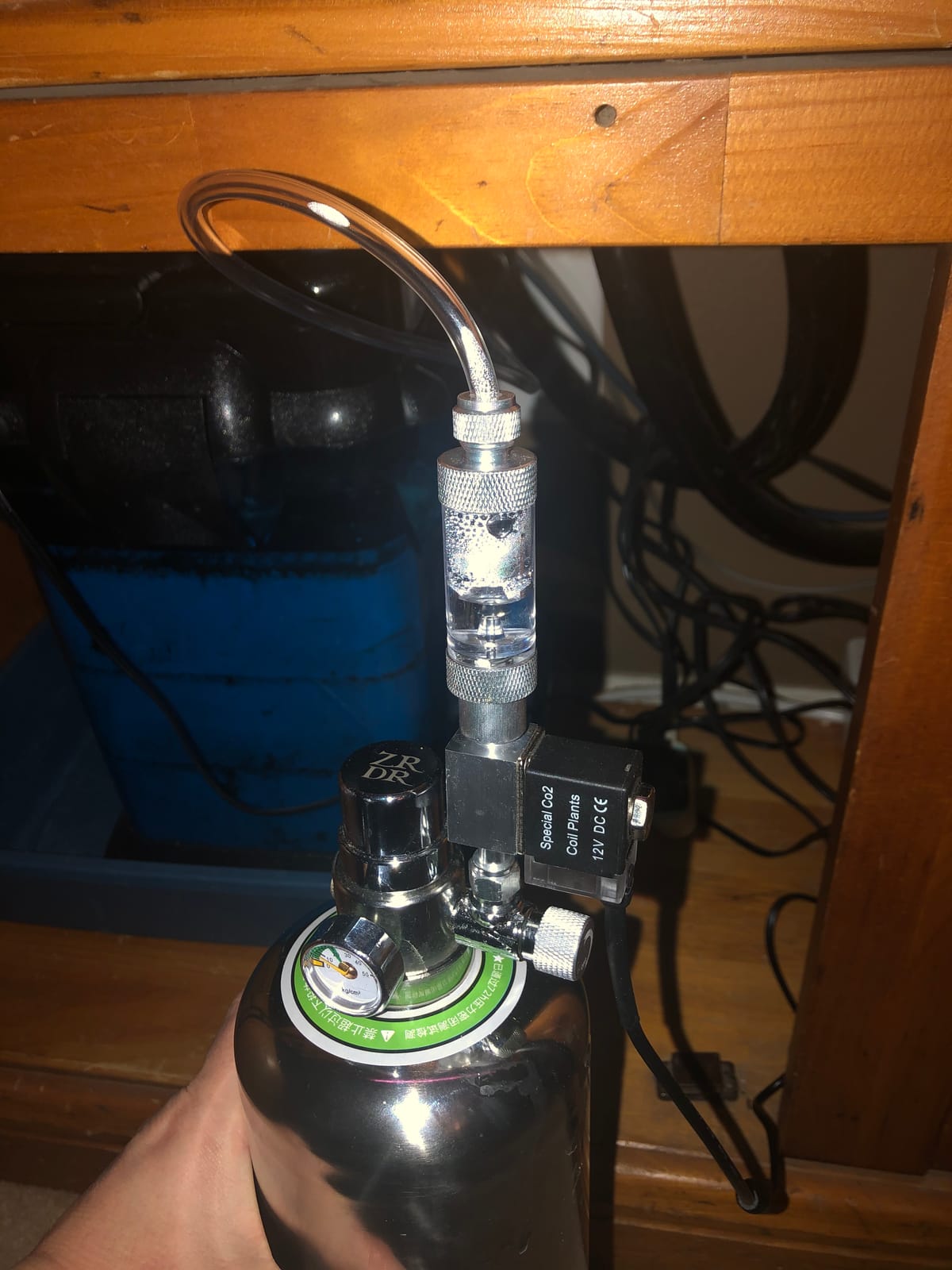
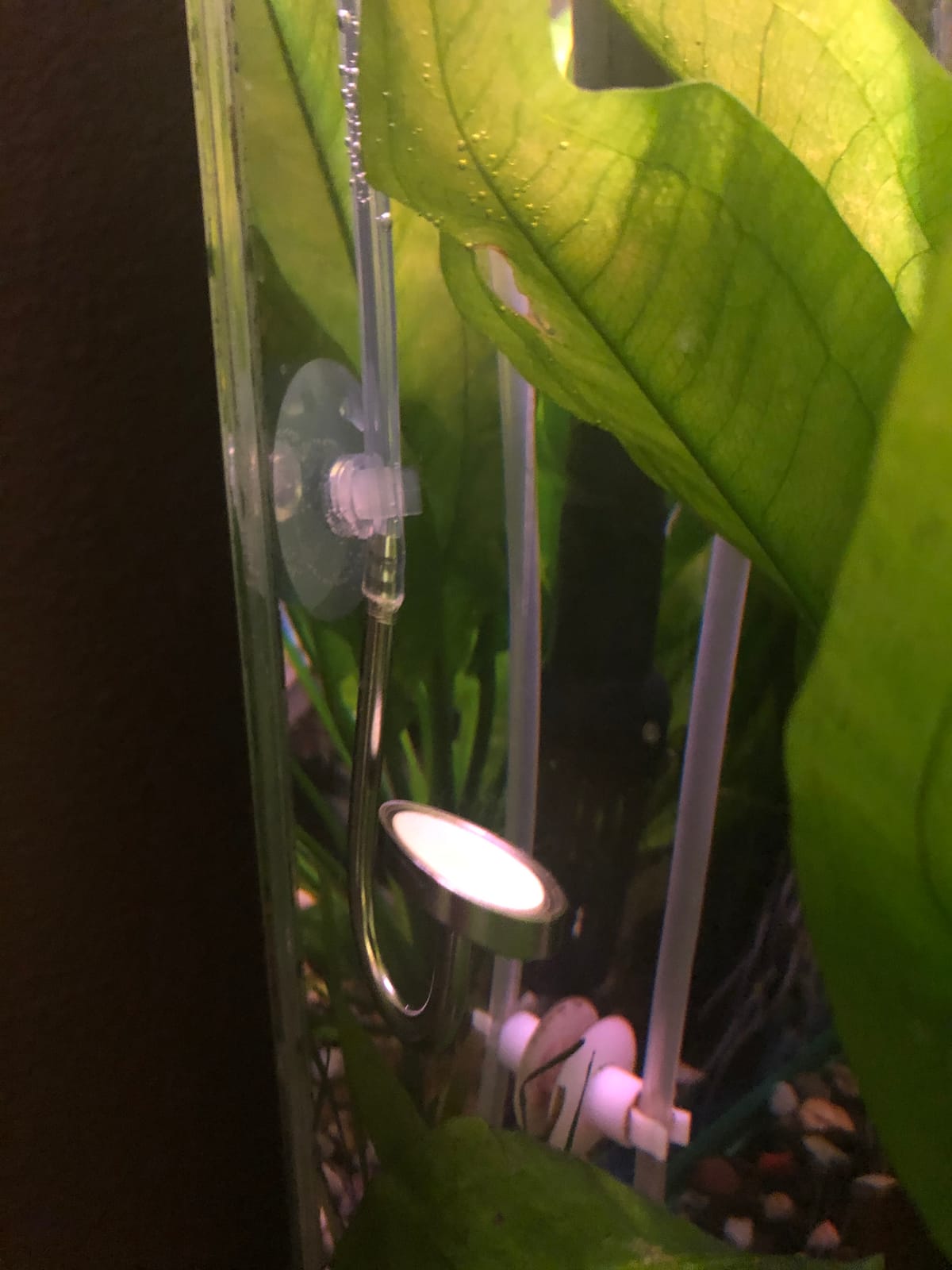
Control is better than the rating suggests. The twist valve gives notably finer adjustment than most kits in this category, down to a quarter bubble per second, which is what you want on a mid-size tank where a full bubble per second would be too much. The stainless atomizer refines bubbles for better dissolution, though owners note the first few days produce larger bubbles before the plate settles.
Safety hardware is real here. There is an automatic pressure relief valve that releases when internal pressure exceeds 30KG, and a 12V waterproof solenoid. Between them they cover the two failure modes that actually kill generators.
What tank size suits this system best
At 2L this is a 20 to 40 gallon system, and it is also a sensible second tank option if you already have a working bottle and a spare refill routine. Reaction materials are just citric acid, baking soda and water, so the running cost is the lowest running cost in this guide.
The atomizer is the reason it holds up at those sizes. A finer bubble stream dissolves more completely in a deeper column of water, so you get usable dissolved CO2 rather than surface loss. Paired with the quarter-bubble control, that makes it easier to land on a target level than most 2L kits.
Who should skip this and buy something else
Skip it if you are a first-timer who reads manuals on screen. The printed instructions have text too small to read without magnification, and several owners describe relying on outside videos instead. That is a solvable problem, not a dealbreaker, but it is friction at exactly the moment you most need clear instructions.
Also look elsewhere if the finickiness of the needle valve will bother you. Owners report the regulator leaking slightly past the needle valve and the needle valve being imprecise, and some units failed after about a month with trapped pressure that is hard to vent safely. The 4.0 rating reflects that split, and you should treat it as a solid mid-range option rather than a set-and-forget one.
5. MagTool 2.5-5L CO2 Generator Kit – Best Value Integration
MagTool Upgraded 2.5L DIY Aquarium CO2 Generator Kit for Plants Tanks
50 percent thicker 304 steel bottle
Integrated solenoid and bubble counter
Dual safety valves
1 year parts warranty
Pros
- Integrated solenoid and bubble counter removes two joints and cuts leak risk
- External threads stop the bottle seizing from dried reaction residue
- Dual safety with manual shut-off plus automatic relief valve
- Everything needed in one box including syringe and ceramic disc
- One year warranty on the solenoid and regulator
Cons
- Bundled diffuser is weak and most users substitute a third-party ceramic
- CO2 tubing is rigid and hard to push onto the fitting
- Condensation forms on the cold bottle and needs a tray underneath
The MagTool is the current refresh of a design that fixes the two most common citric acid kit failures, and that is the whole reason to consider it. First, the solenoid and bubble counter are integrated into a single block rather than being plumbed together, which removes two joint connections. Fewer joints means fewer places to leak, and leak points are how pressure gets in front of an unwilling check valve.
Second, the bottle uses an external thread design. On older kits the internal thread gets coated in dried reaction residue and the lid seizes shut, which is maddening when you are trying to refill. The external thread gives you grip to break the seal, and the bottle wall was upgraded to be 50 percent thicker at 304 stainless steel.
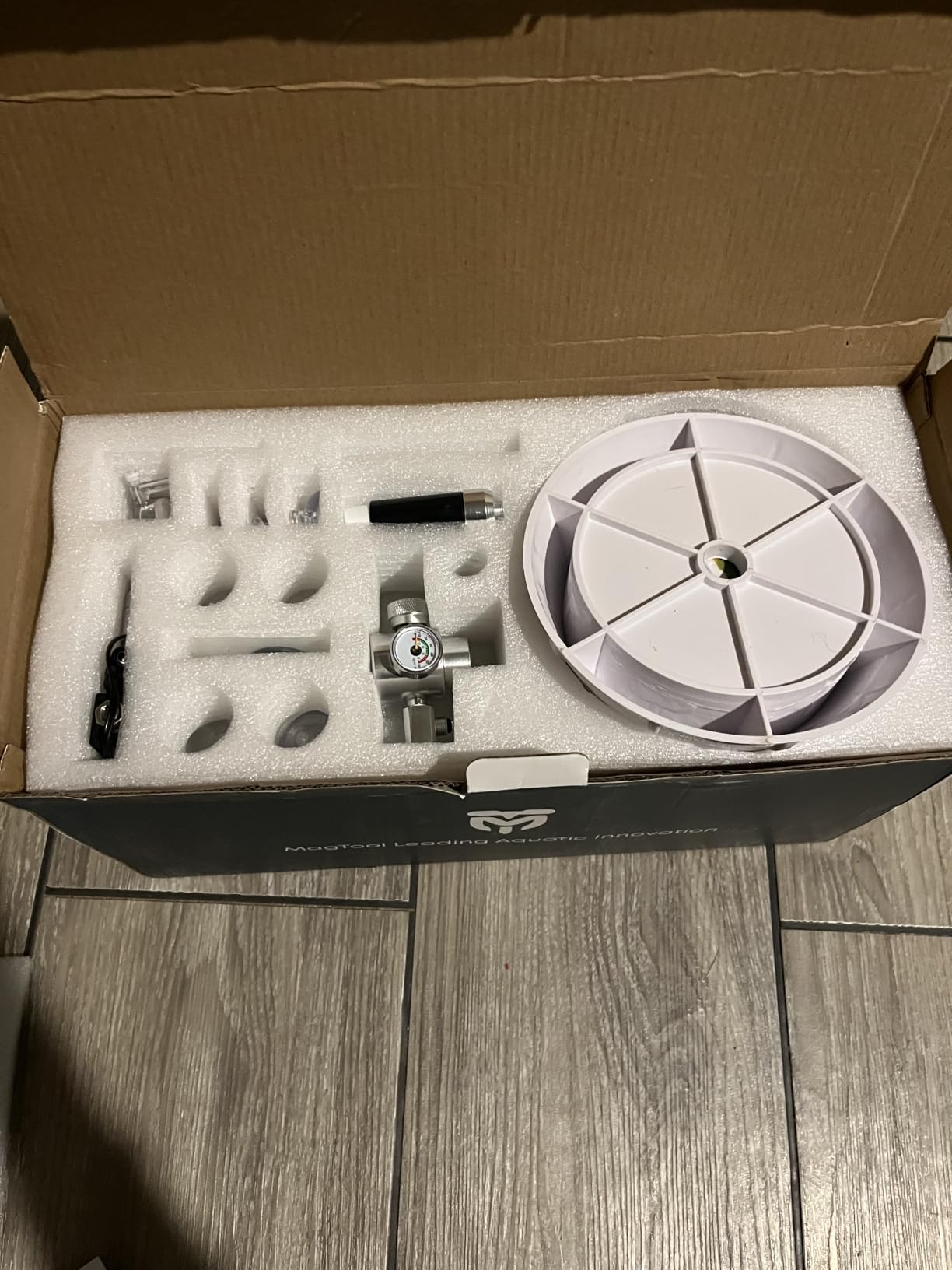
There is a built-in injection port for refilling the bubble counter fluid without disassembly, which matters more than it sounds, because the bubble counter losing its water is the most common reason a working system suddenly stops. Owners also point out the dual safety system of a manual shut-off valve plus an automatic pressure relief valve, and that the whole thing arrives with a diffuser, check valve, U-connector, suction cups, tubing, funnel, syringe, ceramic disc, sealing rings and power adapter.
The refill maths are clearly documented. The 2.5L bottle holds 200 to 300g of material and the 5L holds 600 to 800g, and the raw materials themselves are not included. The warranty is one year on the solenoid valve and regulator, which is a real commitment for this category.
What tank size suits this system best
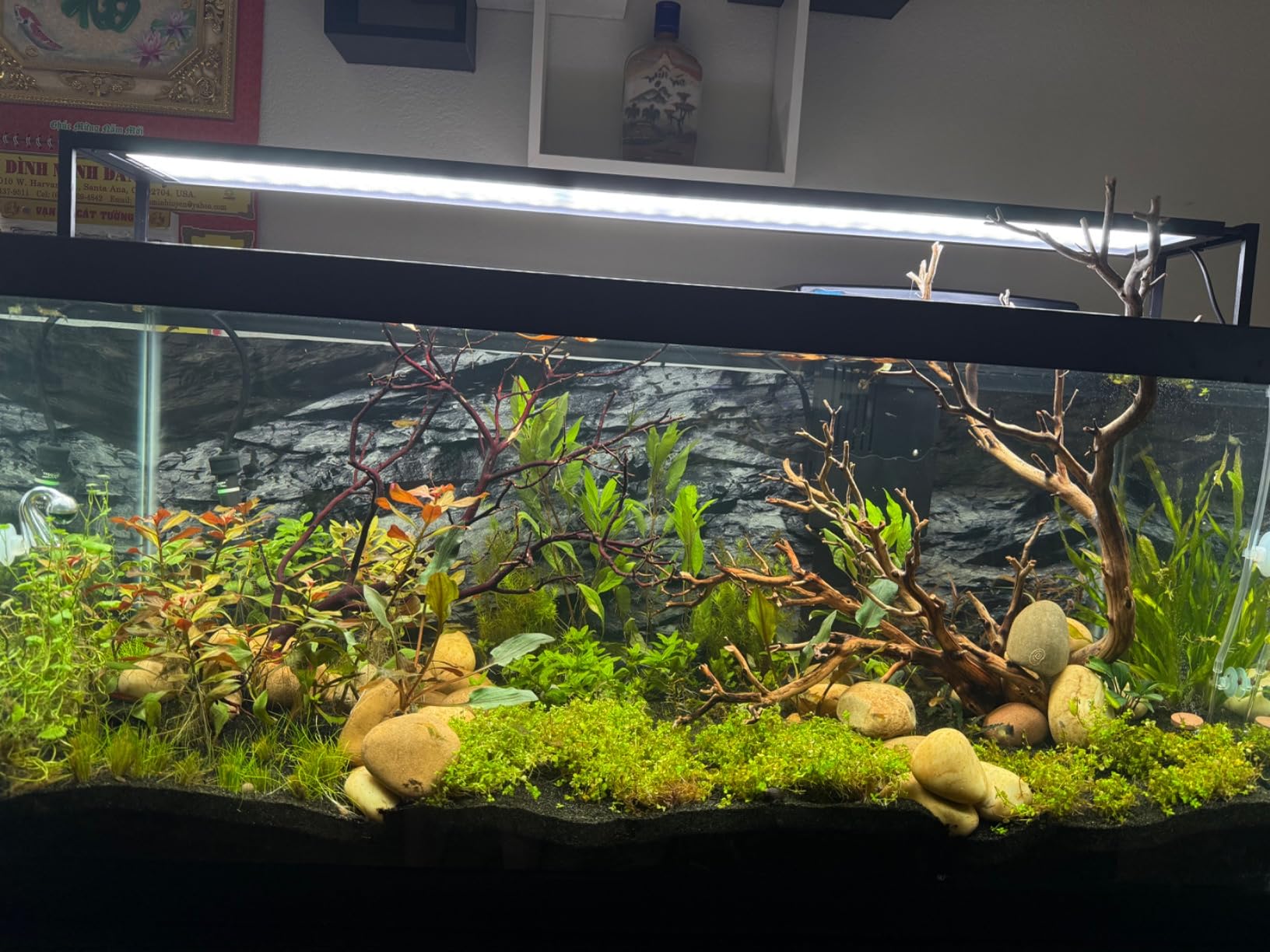
The 2.5L version covers roughly 10 to 30 gallons and the 5L version covers 30 to 55 gallons, which makes the family a natural two-tank path. Buyers on the 5L report that the refill interval stretches out substantially and that the visible plant growth gains show up within the first month.
Plan for physical space. The unit is bulky at 1.9kg and several owners report it barely fits under a tank stand. Measure the gap between your stand top and the tank base before you order, and keep in mind that the endothermic reaction produces condensation on a cold bottle, so a tray or towel underneath is not optional.
Who should skip this and buy something else
Skip it if you are buying for a very small tank. A 2.5L bottle is a lot of reaction volume for a nano, and the footprint is bigger than the tiny systems purpose-built for that job. For a desktop or 5 gallon tank, a cartridge system is the right shape.
Quality consistency is also worth noting. One owner reported recurring component failures across three separate builds in six months, and the bundled diffuser is weak enough that most users substitute a third-party ceramic. The integration is genuinely better engineering, but this is not a brand with a decade of field history behind it yet.
6. Clscea G700S 4L CO2 Generator – Best for Long Refill Intervals
Clscea Aquarium CO2 Generator Double Runtime with Solenoid Valve 4L, G700S
2.4L volume with 4L gas capacity
Triple layer filter
Self-cleaning bubble counter
Quick-connect fittings
Pros
- Longest refill interval in this set with owners reporting two to five months per fill
- Triple layer stainless filter and self-cleaning bubble counter target clogging failures
- Pressure needle holds steady week to week with no visible drop
- Stainless steel and glassware survived a three-foot drop and kept working
- Every accessory replaceable with a one year warranty
Cons
- Solenoid can clog with debris and needs periodic replacement
- Needle valve is very sensitive and needs a settling period after adjustment
- Bubble counter water evaporates and needs frequent topping up
Runtime is the argument here. The physical volume is 2.4L but the gas capacity is marketed at a 4L equivalent, roughly two months per fill, and owners report two to five months between fills. For anyone who has ever resented the weekly refill ritual of a small generator, that is the feature that changes the experience.
It gets there through filtration. A triple-layer stainless steel filter element blocks debris before it reaches the solenoid, and a self-cleaning water-refill bubble counter flushes the valve pathways on every top-up. Those are the two parts that fail on cheaper kits, so protecting them is the right place to spend design effort.
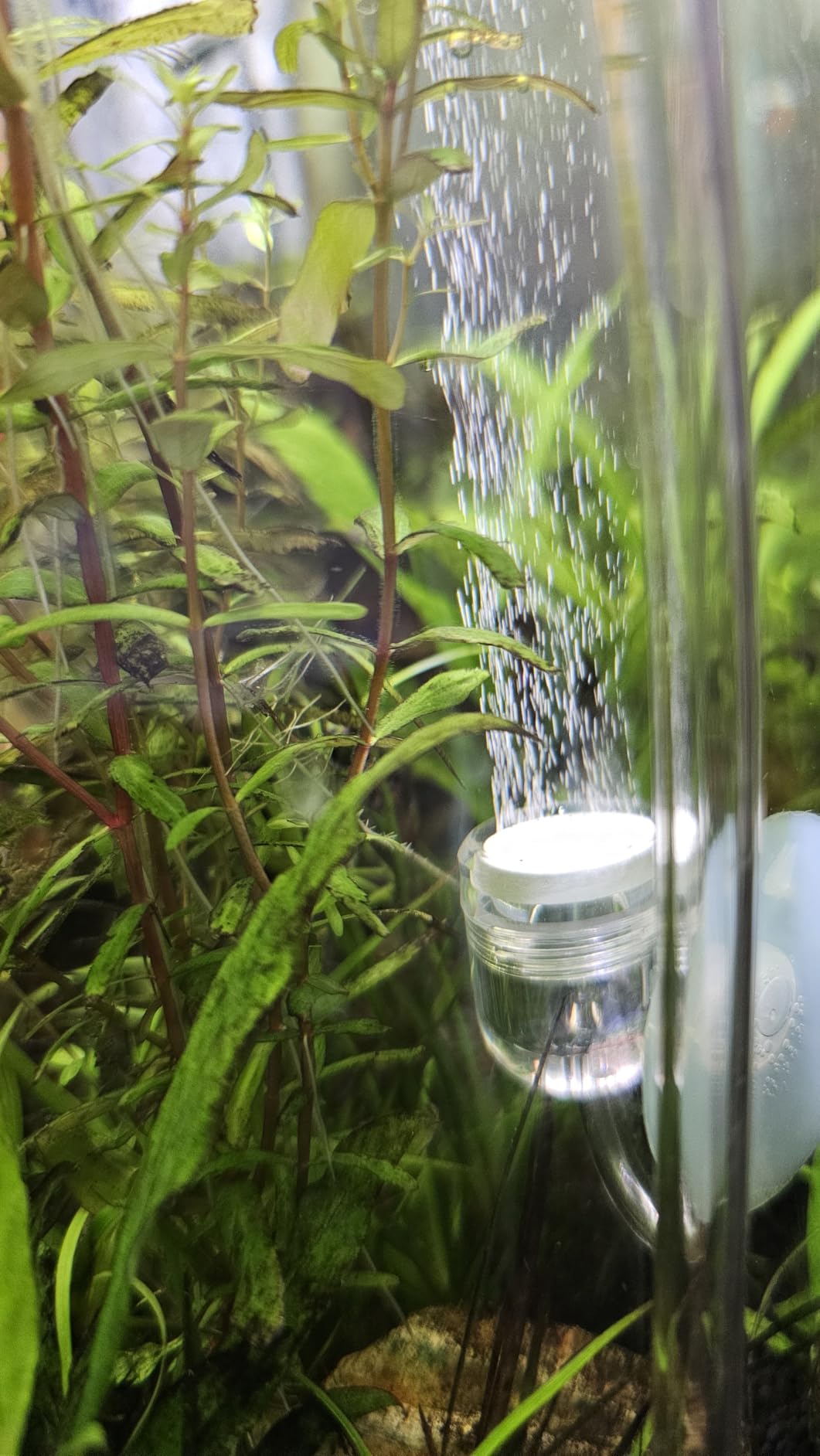
The build is a thickened SUS304 stainless steel cylinder with consistent pressure from the first bubble to the last, and John Guest quick-connect fittings let you change tubing without tools. That last detail sounds trivial until you are doing it over a tank with water in it. Owners report a pressure needle that holds steady week to week with no visible drop.
Repairability is the quiet strength. Every accessory can be maintained or replaced individually, and there is a one year warranty. One owner reported that the stainless steel and glassware survived a three-foot drop onto concrete and kept working, which tells you something about the general robustness of the assembly.
What tank size suits this system best
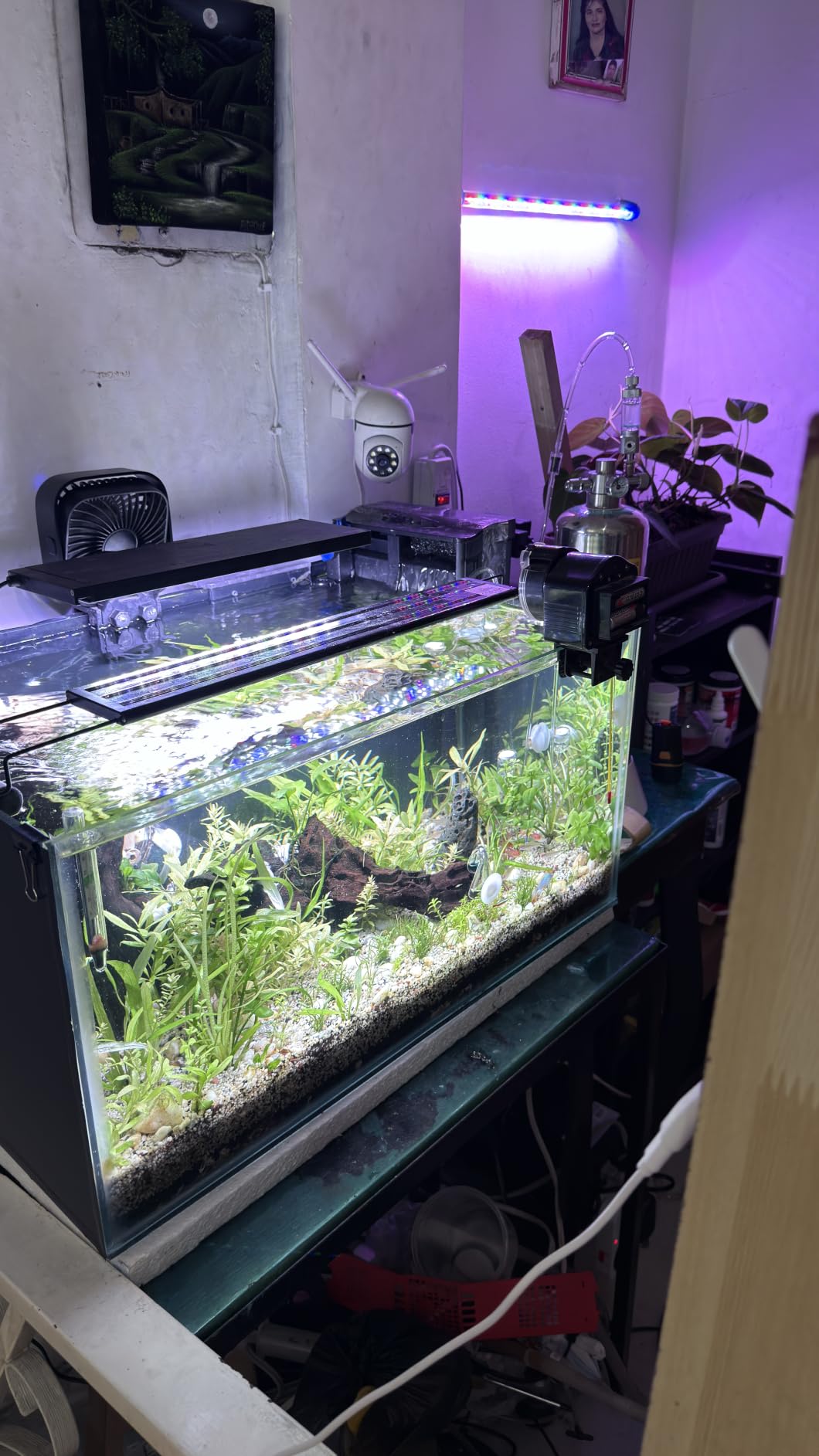
This is a 30 to 60 gallon system in practice, because a two to five month fill only makes sense once you have enough volume that the gas lasts. For a 20 gallon tank it would be over capacity, and for a 10 gallon nano the footprint is excessive. There is also an Ice-Start refill tray option to reduce solenoid failure risk after a refill.
There is one upgrade to plan for. A regulator dial leak after the first refill is a reported issue, so check the fittings after your initial fill and before you leave the system unattended. Catching a slow drip early is a five-minute fix that can be a tank loss if you miss it.
Who should skip this and buy something else
Skip it if the lowest possible purchase cost matters more than refill frequency. The one year warranty is solid but not exceptional, and the needle valve is described by owners as very sensitive with a settling period needed after every adjustment. If you will fiddle with your regulator weekly, that friction shows up.
Also weigh the top-up habit honestly. Bubble counter water evaporates and needs frequent topping up, so this is not a set-and-forget device even though the main charge lasts months. The built-in self-cleaning flush helps, but it is still a maintenance routine, just a different one.
7. Estink DIY CO2 Generator Kit – Best for Moss and Low-Light Plantings
DIY CO2 Generator System Aquarium Plant Kit with Gauge Valve
Two 2L bottle kit
Manual control type
Magnetic base mount
Fine-tuning valve
Pros
- Cheapest reliable route to add CO2 to a modest planted tank
- Instructions are genuinely clear and well produced for this category
- Valve can be fully shut an hour before lights out and reopened next morning
- Switching valve plus magnetic base keep the unit secure and tidy
- Good temporary boost that gets plants pearling quickly
Cons
- No bubble counter is included so bubble rate must be inferred or bought separately
- Valve and check valve are low quality and prone to leaking and back-siphoning
- Reaction typically lasts only three to ten days per fill
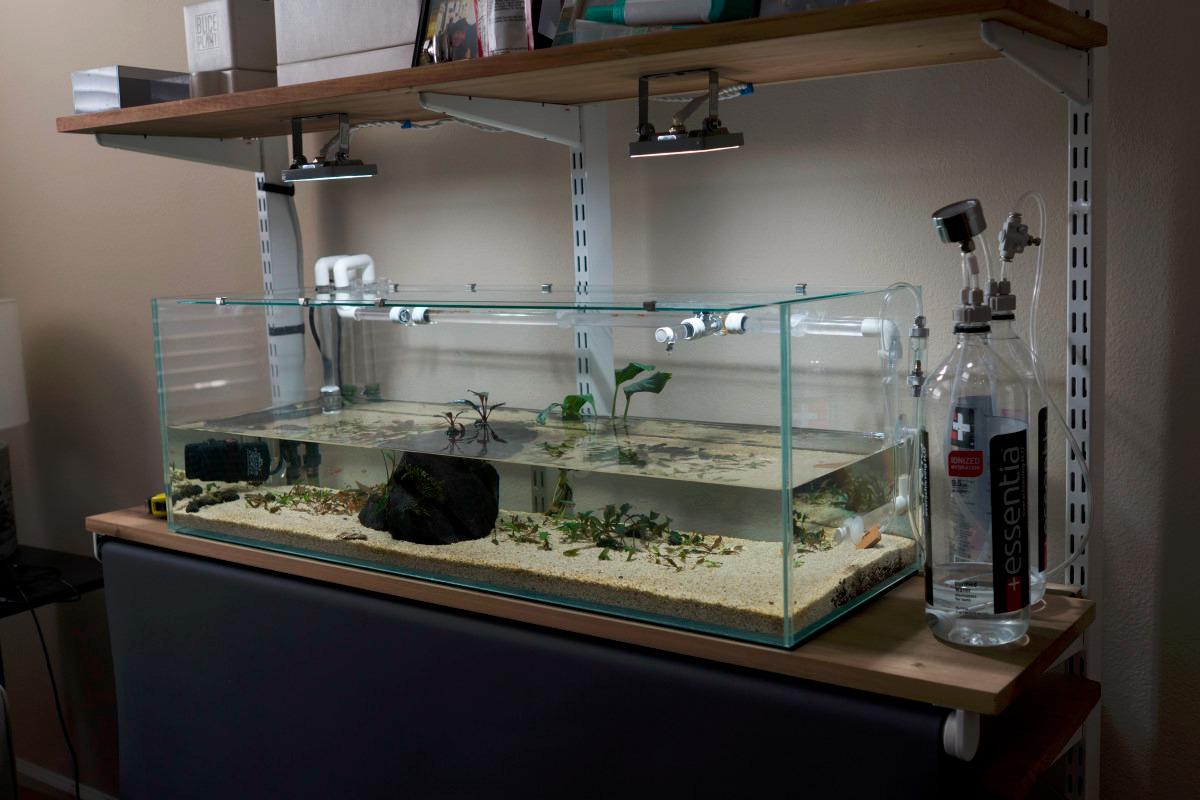
The Estink is a two-bottle system built around two standard 2L carbonated beverage bottles. The kit includes the main reactor body, a suction cup, a switching valve and a ferromagnetic base, and it runs on citric acid and baking soda. The magnetic base attaches the generator to a cabinet or glass, which keeps it tidy and out of the way of the tank lid.
What stands out is the manual. Owners repeatedly single out the instructions as genuinely clear and well produced for this category, which is not a small compliment when the alternative is decoding a diagram of parts. There is also a pressure gauge included, and the ABS body has a check valve mechanism to maintain consistent pressure in the tubing.
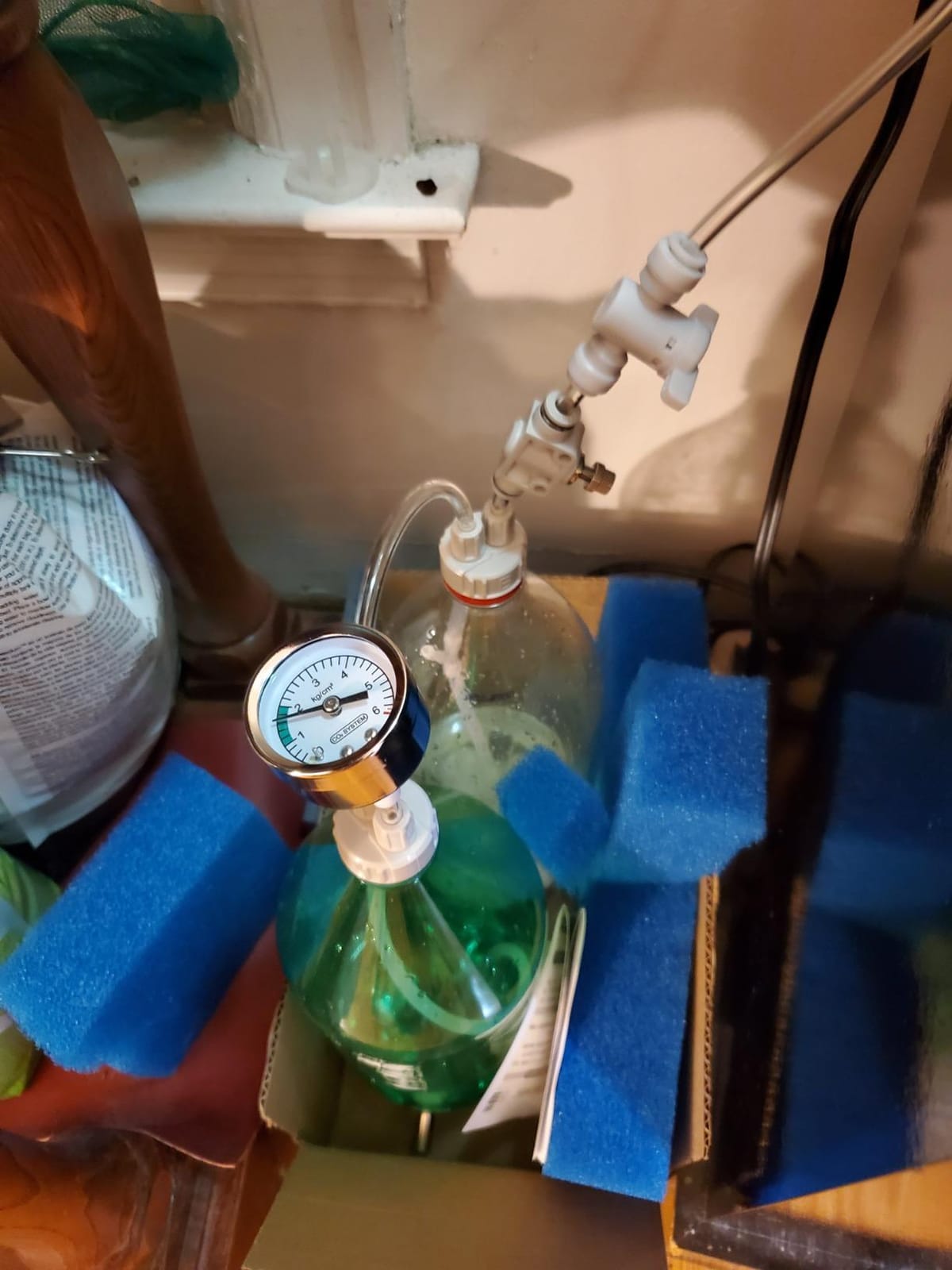
Control is manual but workable. Owners note the valve can be fully shut off an hour before lights out and reopened the next morning, which is the correct habit, and the fine-tuning valve gives controlled and steady regulation. The 2L volume capacity is modest, and the reaction typically lasts three to ten days per fill.
The gap that matters most is the missing bubble counter. Without one, you have no reference for output and no place to fit a check valve at the tank end, which is a real safety weakness. Budget for a cheap inline bubble counter and check valve before first use rather than discovering the gap mid-setup.
What tank size suits this system best
Think 10 to 20 gallons with forgiving planting. For moss, anubias, java fern, crypts and pearl weed, a low and gentle output is genuinely all you need, and this kit delivers exactly that with less fuss than a stainless system. It is also a good way to test whether CO2 makes a measurable difference in your own water before investing further.
It is also worth considering as a seasonal add-on. If you are ramping up light and growth in spring, three to ten days of extra CO2 per fill is a perfectly reasonable way to push a tank forward without committing to a full system.
Who should skip this and buy something else
Skip it for a tank with shrimp, sensitive fish, or any setup where you might forget to shut it off. There is no solenoid, so the system depends entirely on your daily habit, and owners report that pressure can build until it dumps excess CO2 into the tank. Residue is also described as hard to clean from the plastic bodies.
Skip it if you want a measurable, repeatable setup. No bubble counter, low-quality valves that leak and back-siphon, and a fill that only lasts days mean you are always adjusting by feel. That is fine as an experiment and frustrating as a permanent system.
8. FZONE Desktop 45g CO2 System – Best for Desktop Aquariums
FZONE Desktop Aquarium CO2 System,45g CO2 Cartridge,5/8″ & 3/8″ Compatible
9.84 inch tall mini body
45g cartridge rated 50 days
Fits 5/8 and 3/8 inch threads
Quick-connect tubing
Pros
- The only genuinely small footprint system in the set for nano and desktop tanks
- No powder mixing and no periodic refilling beyond a cartridge change
- Quick-connect fittings make setup close to instant
- Single use cartridge design removes all pressure building hardware
- 45g cartridge rated up to 50 days at one bubble per second on an eight hour schedule
Cons
- Disposable cartridge approach means recurring cost that scales with tank volume
- Limited capacity suits small tanks only and not mid-size or larger
- Requires branded 5/8 inch or 3/8 inch CO2 cartridges
Every other system in this guide asks you to find somewhere to put a pressure vessel. This one does not. At 9.84 inches tall by 1.96 inches wide, it fits under a small desktop tank or beside a nano, and the whole design is a single-use cartridge rather than a reactor you refill with powder.
The efficiency number explains why. Each bubble consumes about 0.03ml of CO2 in internal testing, and the 45g cartridge is rated for up to 50 days at one bubble per second on an eight-hour daily schedule. For a small tank that is a genuinely long interval between changes, and there is no citric acid mixing, no residue and no pressure to vent.
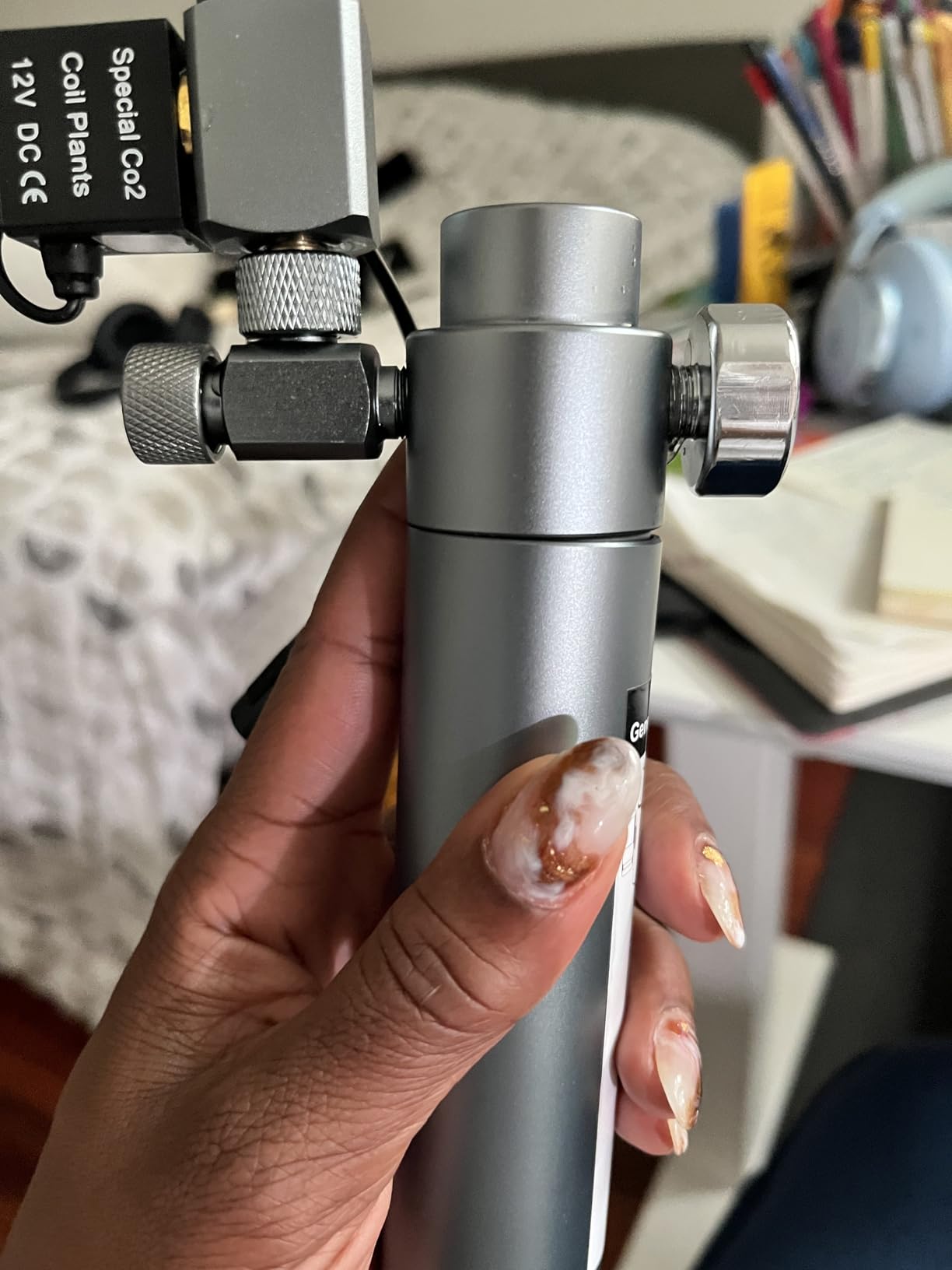
Fitment is the other practical win. It works with standard 5/8 inch threaded cylinders and includes a 3/8 inch adapter, and quick-connect CO2 tubing installs without having to rotate the pipe. The body is high-strength seamless aluminium with precision sealing to prevent leaks. Setup is close to instant, which matters when the tank is sitting on your desk and everything is visible.
Owners also value the absence of failure modes. There is no reaction that can stall, no needle valve to drift, no bottle to seize. The only variable is whether a cartridge is in the holder.
What tank size suits this system best
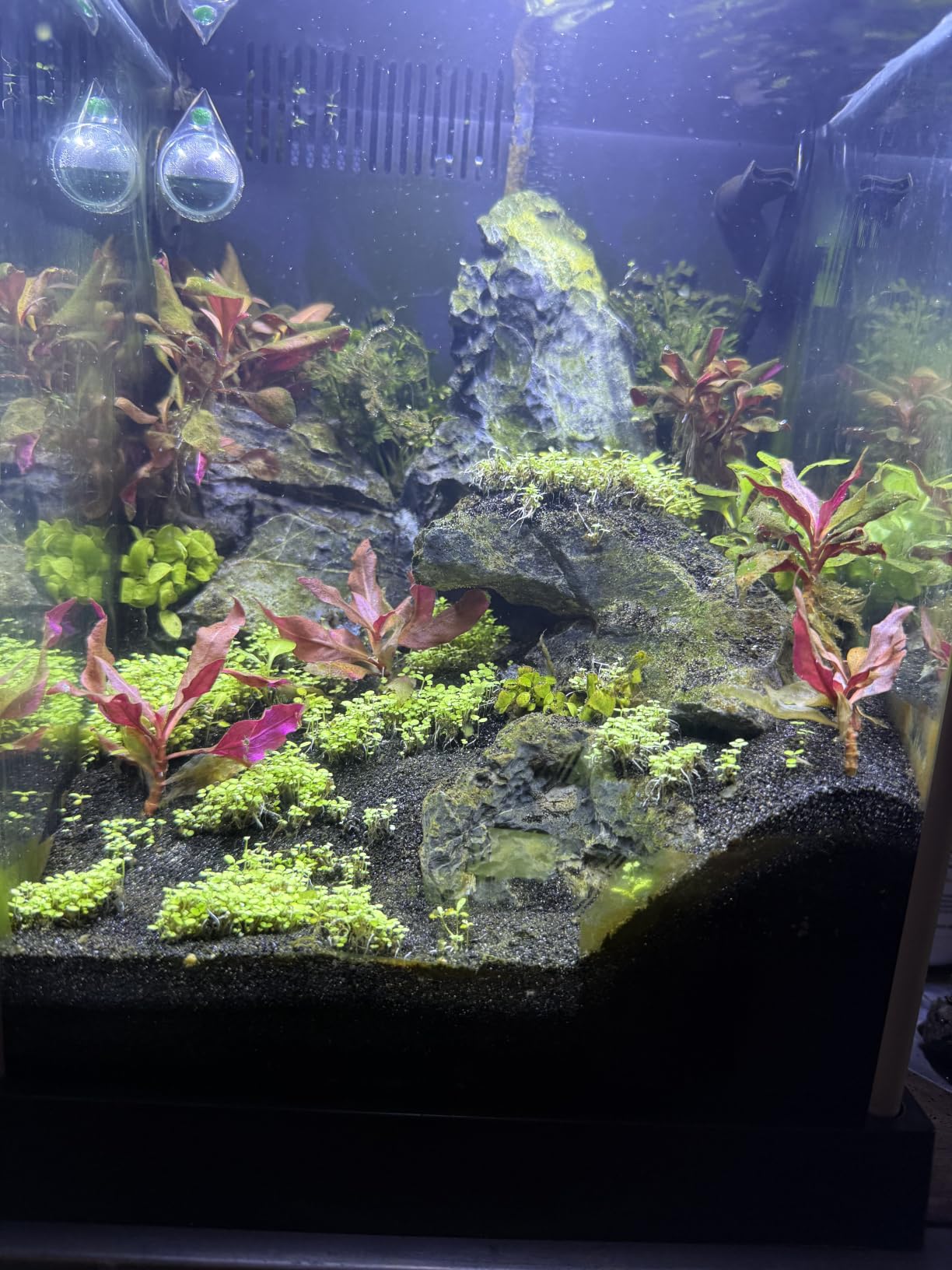
Nano and desktop tanks only, realistically up to about 10 to 12 gallons. That is not a limitation to apologise for; it is the design intent. A cartridge this size simply does not have the capacity for a 40 gallon tank, and reviewers are clear that the limited range is the trade-off for the footprint.
It is also the easiest first CO2 system we would recommend to a complete beginner. Nothing can be assembled incorrectly, there is no pressure vessel to be nervous around, and the feedback loop is short. Pair it with one of our aquarium lighting picks at low to moderate intensity and a small tank becomes a genuinely good beginner setup.
Who should skip this and buy something else
Skip it if your tank is 20 gallons or larger, or if you care about running cost. A disposable cartridge approach means recurring spend that scales with how much gas you use, and forum discussion of the category notes that cartridge refill pricing is a common frustration. Buyers must purchase branded 5/8 inch or 3/8 inch CO2 cartridges, so compatibility is not open.
Skip it if you want the flexibility of adjustable output as your tank fills out. A cartridge system gives you a fixed relationship between bubble rate and gas consumption with no pressure to regulate, which is simple and predictable, but it is not adjustable in the way a needle valve is.
9. Clscea G200 DIY CO2 Kit – Best Low-Cost Pressurized-Style Build
Clscea Aquarium DIY CO2 Generator System Kit, G200
Two bottle citric acid generator
Quick reaction test tube
Acid resistant tubing
Gauge and relief valve
Pros
- Lowest entry cost of any complete kit in this roundup
- Pressurized design with a gauge and relief valve is safer than a plain two bottle setup
- Acid absorbing ball makes it easier to control how far the reaction progresses
- Acid and hydrolysis resistant tubing outlasts standard silicone in a citric acid environment
- White on off valve handles daily switching without touching the needle valve
Cons
- You must supply two carbonated bottles a check valve and a diffuser separately
- No solenoid so CO2 must be switched off manually each night
- Plastic cap construction is less durable than stainless systems
The G200 is the cheapest complete kit here, and what makes it interesting is the design. Most kits at this cost are two bottles joined by a tube with no pressure control at all. This one puts the reaction under a pressure gauge with a simple pressure relief valve mounted underneath it, which is a meaningfully safer failure mode if something goes wrong.
The quick reaction test tube is a smart touch. You mix a small amount first to confirm the reaction starts properly, and the acid absorbing ball design makes it easier to control how far the acid consumption progresses, which in turn makes the output more predictable. The white on and off valve handles your daily switching so the needle valve only needs setting once.
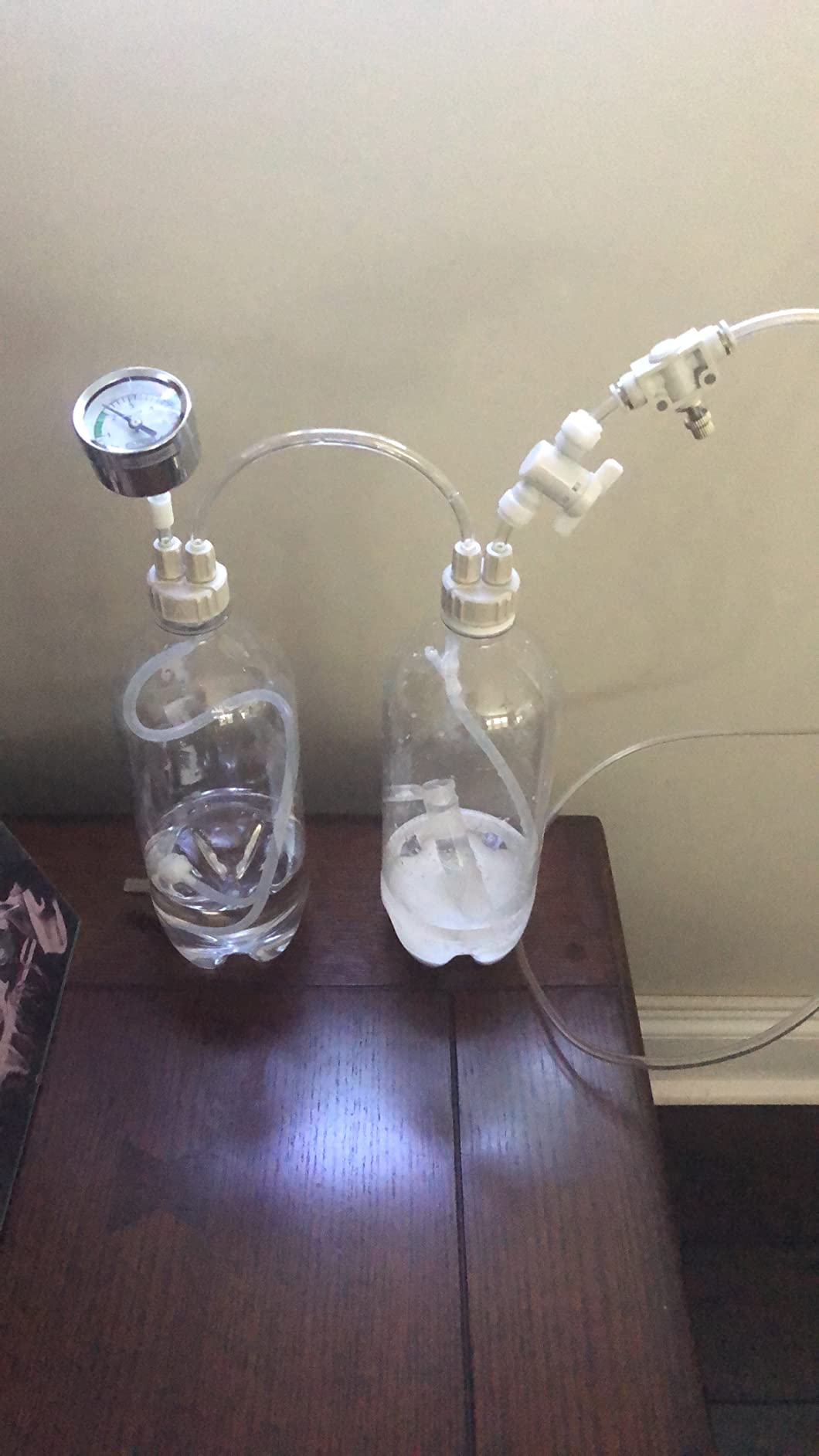
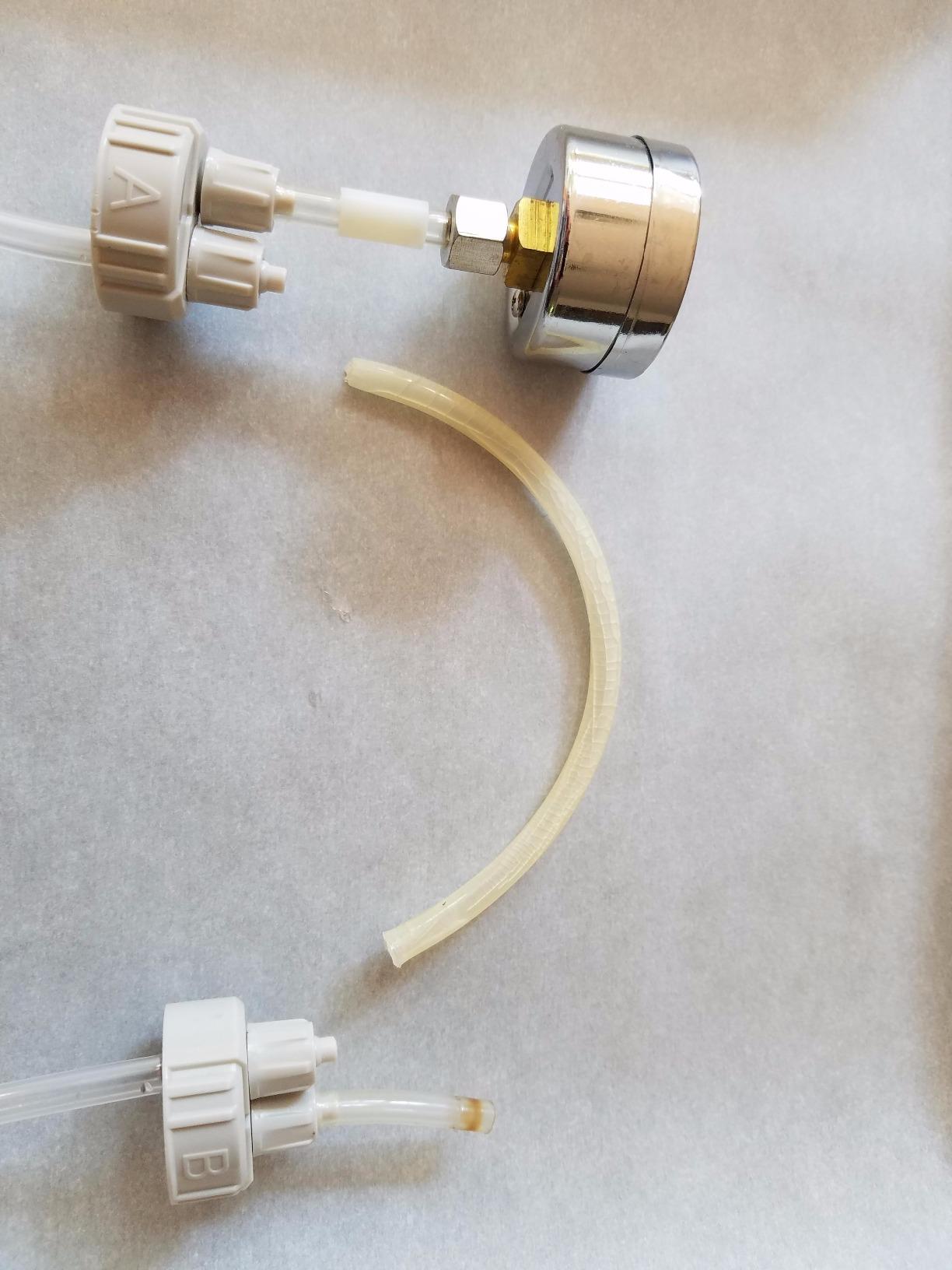
Material choice is where this cheap kit quietly beats more expensive ones. The tubing between the two caps is acid and hydrolysis resistant, and that is exactly the part that perishes in a citric acid environment. Standard silicone goes brittle and cracks inside a citric acid system, and replacing it is the fix everybody ends up making anyway.
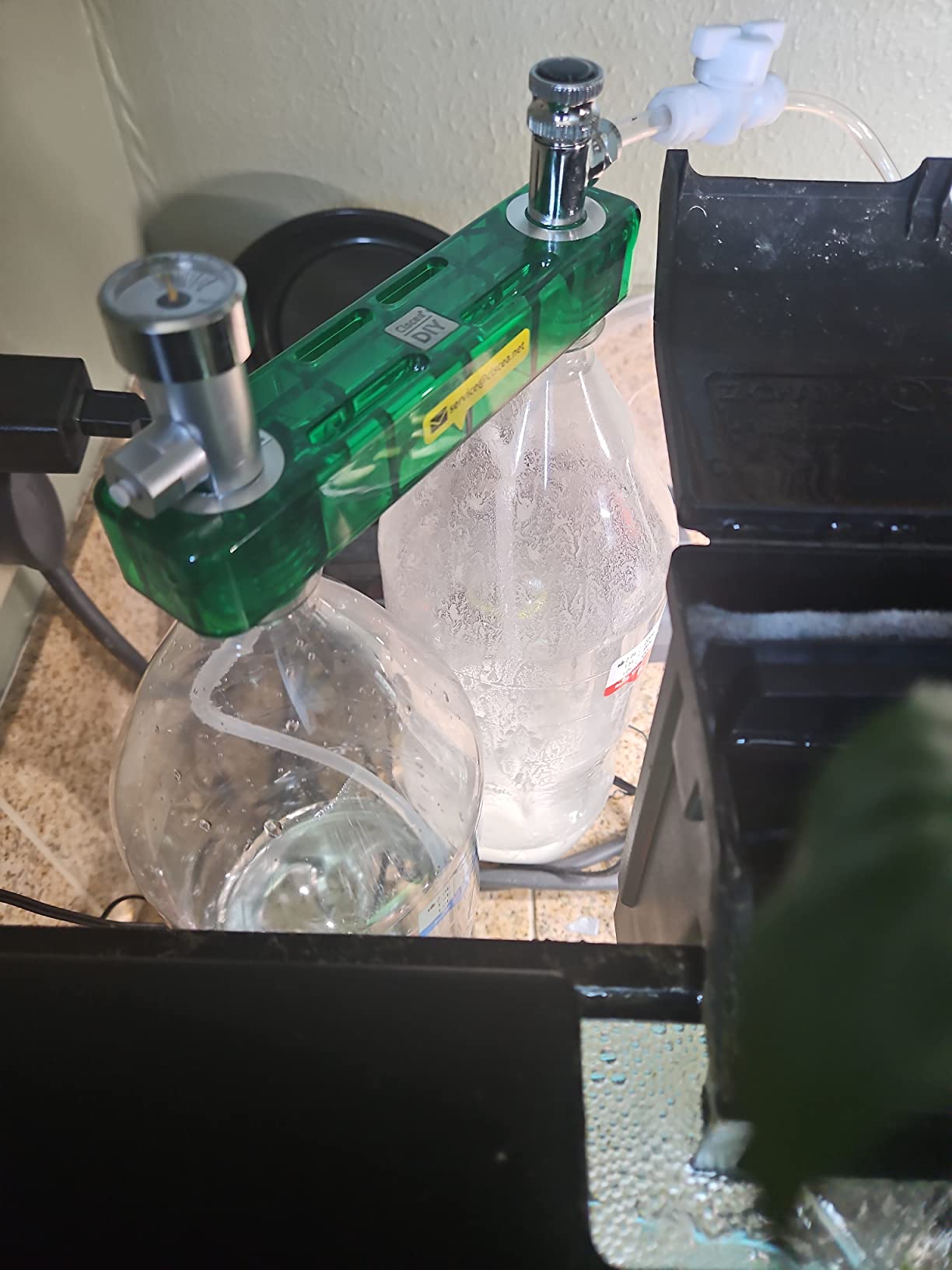
Being realistic about scope: the kit includes most accessories but not the things you actually need to finish it. You supply two 2L carbonated beverage bottles, the reaction materials, a check valve and a CO2 diffuser. Budget for all four before your first fill.
What tank size suits this system best
This is a 10 to 20 gallon system with low to moderate planting. The plastic caps and the bottle-derived gas capacity mean refills are frequent compared with a stainless chamber, so think of it as a tank you refill every week rather than every month. The acid-resistant tubing keeps the connection reliable in the meantime.
The day-to-day routine is the deciding factor. The white valve makes switching quick, so running it two hours before lights and off an hour before lights out takes seconds. That habit is what makes a manual system safe, and this kit is built to make the habit easy.
Who should skip this and buy something else
Skip it if you want one box that works. Requiring bottles, a check valve and a diffuser means the all-in cost is meaningfully higher than the headline suggests, and beginners routinely discover this after the kit arrives. If you are buying a first system, buy a complete kit.
Also skip it for any livestock you care about, because there is no solenoid. The gas runs until you physically turn it off, and manual systems fail exactly when a routine slips. If your tank has shrimp or sensitive species, this is not the configuration for you.
10. Aquario Neo Gel CO2 Kit – Best for Nano and Low-Tech Tanks
Aquario Neo CO2 – DIY CO2 Kit (Kit) for Freshwater Aquariums, Terrariums, Paludariums – Slow Release CO2 Kit for Aquatic Plants
Sealed low pressure gel system
24 hour set time
Works in aquariums and terrariums
Monthly refill packs
Pros
- Completely sealed low pressure design with no bursting risk from a bottle or cylinder
- Simplest possible setup with everything in the kit apart from a thermometer
- First time users report instant pearling and much more vibrant plant colour
- No pressure gauge needle valve or plumbing to learn
- Good upgrade for a low-tech tank that cannot justify a full setup
Cons
- Cannot be switched off at night so CO2 is injected around the clock
- Refill packs are needed roughly monthly and running cost is high
- Output declines over time so the rate must be re-evaluated as the mix weakens
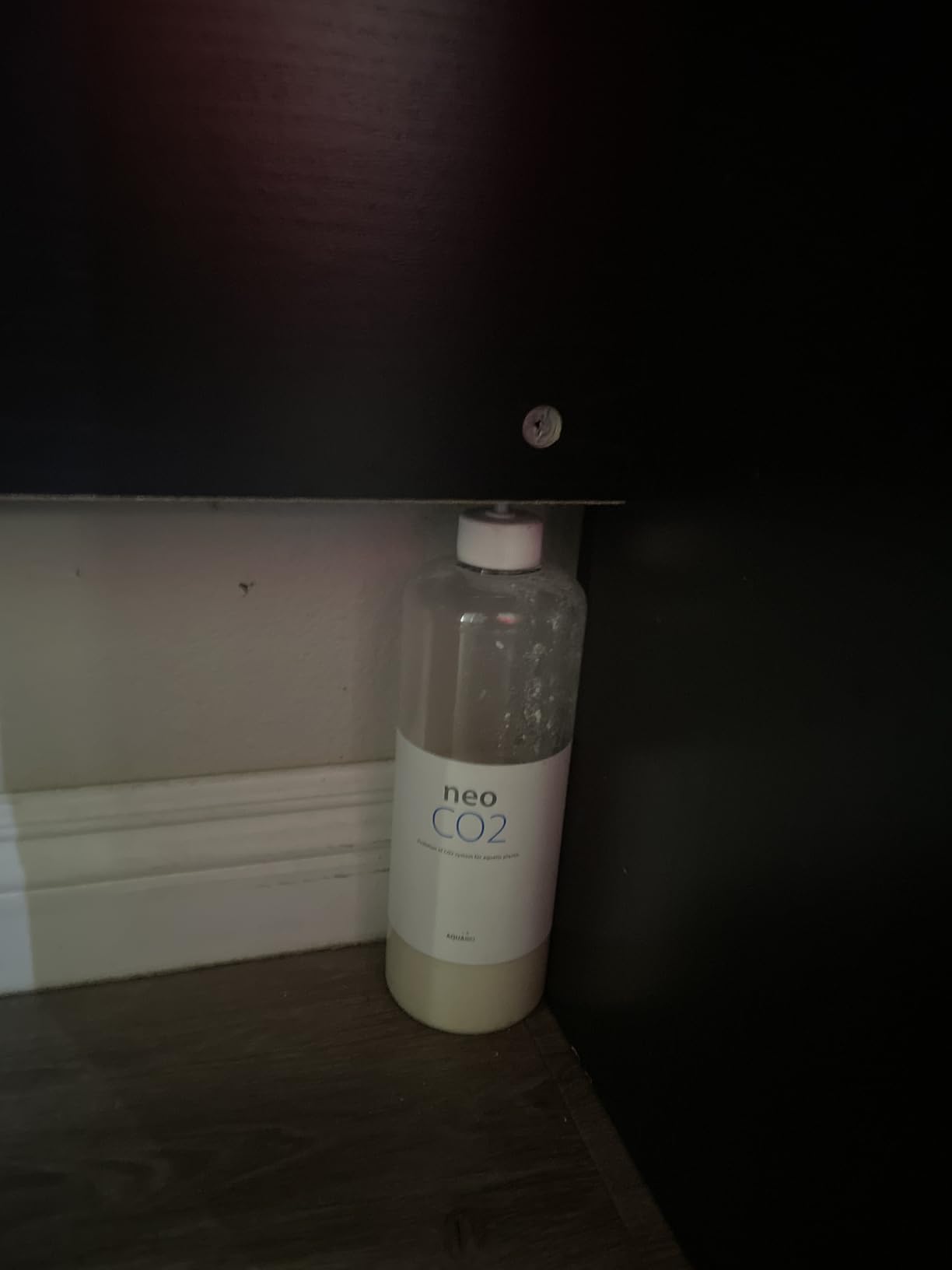
The Aquario Neo takes a completely different approach to every other system here. There is no pressure, no reaction, no gauge and no needle valve. It is a slow-release gel system in a sealed container, and for a small tank that is injected into, that simplicity is the feature rather than the compromise.
First-time CO2 users report instant pearling and much more vibrant red and pink plant colours, which is the effect most people are chasing when they start. It also works in freshwater aquariums, terrariums and paludariums, so it is not limited to a single use case.
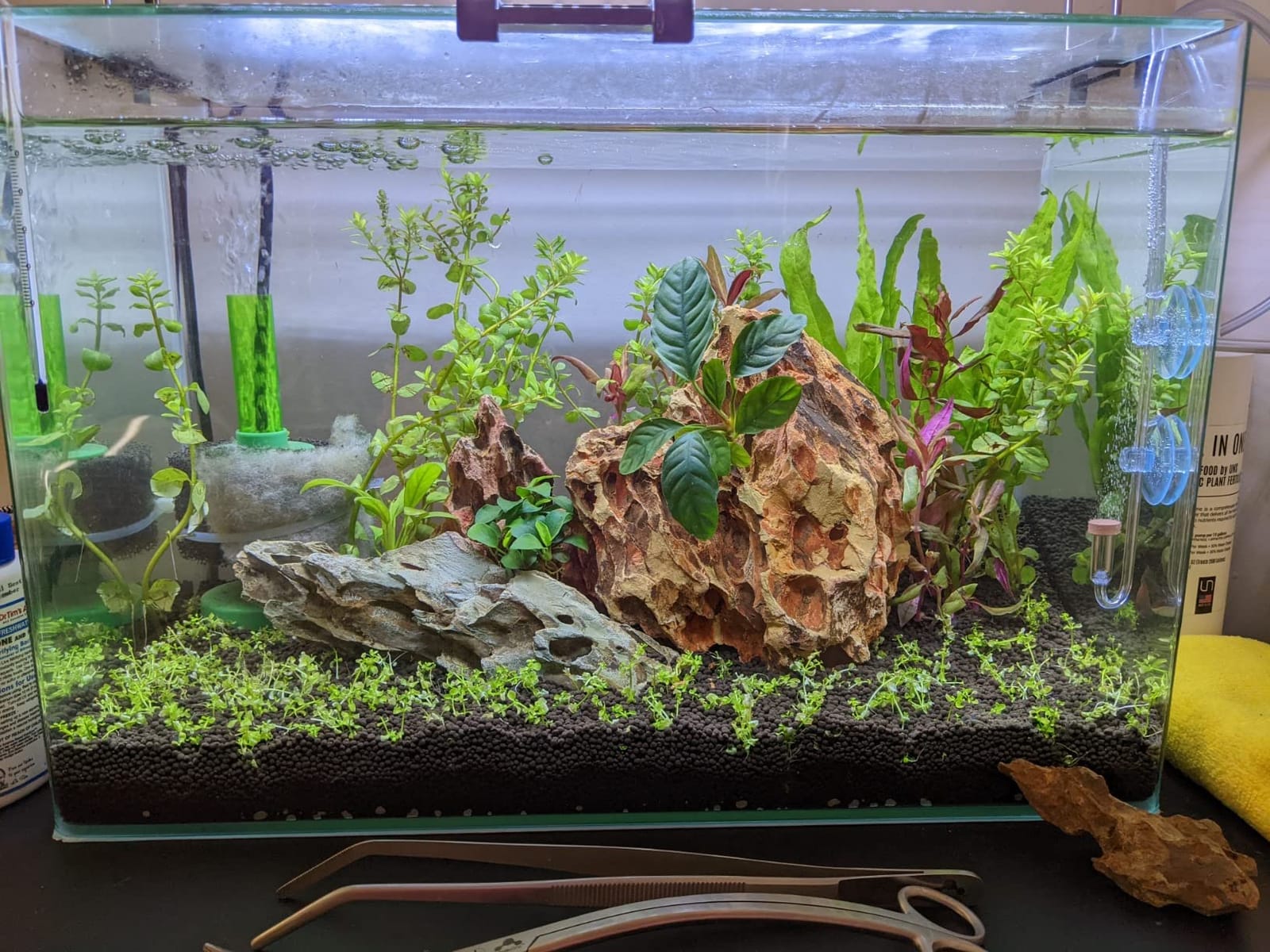
There is one setup step that people skip and regret. The kit requires a full 24 hours of set time before use, and skipping it causes problems. Treat that day as a formal part of the process rather than an inconvenience, and everything after it is straightforward.
Safety is the strongest card this system holds. There is no compressed cylinder and no pressurised reaction, so there is no end-of-tank dump risk and no pressure gauge to watch. In a sealed low pressure design, the worst realistic outcome is that the output is not what you wanted.
What tank size suits this system best
Nano tanks, terrariums and low-tech planted tanks that are not trying to run demanding stems. Owners describe it as a good upgrade for a tank that cannot justify a full high-tech setup, and the always-on output is simply not a sensible idea on a 40 gallon high-light rig.
Consider the refill economics before you commit. Consumable refill packs are required roughly every month, and BioRefill is not offered, which keeps the running cost higher than a cylinder. For a nano that is a small absolute number, and for anything larger it is not.
Who should skip this and buy something else
Skip it if your livestock is sensitive, and this is the biggest caution in this review. The system cannot be switched off at night, so CO2 is injected around the clock. That is not how a high-light CO2 system should be run, and it is a real consideration if you keep shrimp, discus or anything CO2-intolerant.
Skip it if you want to hit a specific ppm target. Output declines over time as the mix weakens, so the rate has to be re-evaluated continuously rather than set once. Several buyers also received a diffuser that arrived blocked or leaked at the sides, which is a small quality problem on an otherwise clean design.
11. ZRDR 4L CO2 Generator System – Best for 40 to 120 Gallon Tanks
ZRDR 4L Co2 Generator System with Dual Gauge Display Pressure Gauge,DIY Co2 Generator System Kit, Large Capacity Stainless Steel CO2 for Planted Aquarium 40-120 Gallon, 12V Solenoid Ready
4L capacity for large tanks
Dual pressure gauges
Syringe refill port on bubble counter
Relief valve above 70KG
Pros
- Largest reaction capacity here with a 30 to 45 day refill interval
- Dual gauges show cylinder and working pressure at a glance
- Bubble counter refill port accepts a syringe so you never break the gas seal
- Stainless steel throughout with two atomizers supplied as spares
- Waterproof 12V solenoid and automatic relief valve give solid safety coverage
Cons
- Lowest rated kit in the set at 3.7 stars with 22 percent one-star reviews
- First few days produce large bubbles in the atomizer before it settles
- Bulky footprint that will not fit under many smaller tank stands
This is the capacity answer for a large tank. The 304 stainless steel cylinder is 4L, sized by the manufacturer for 40 to 120 gallon planted tanks, and rated 30 to 45 days per refill. Dual gauges show both cylinder and working pressure at a glance, which removes the guesswork out of checking a system you cannot see the inside of.
The bubble counter is the detail worth paying attention to. The upgraded version has a syringe injection port and an internal one-way valve, so you can top up the water without closing the air outlet or pulling the tubing. On a system this size, being able to service the bubble counter without breaking the gas seal is a real convenience.
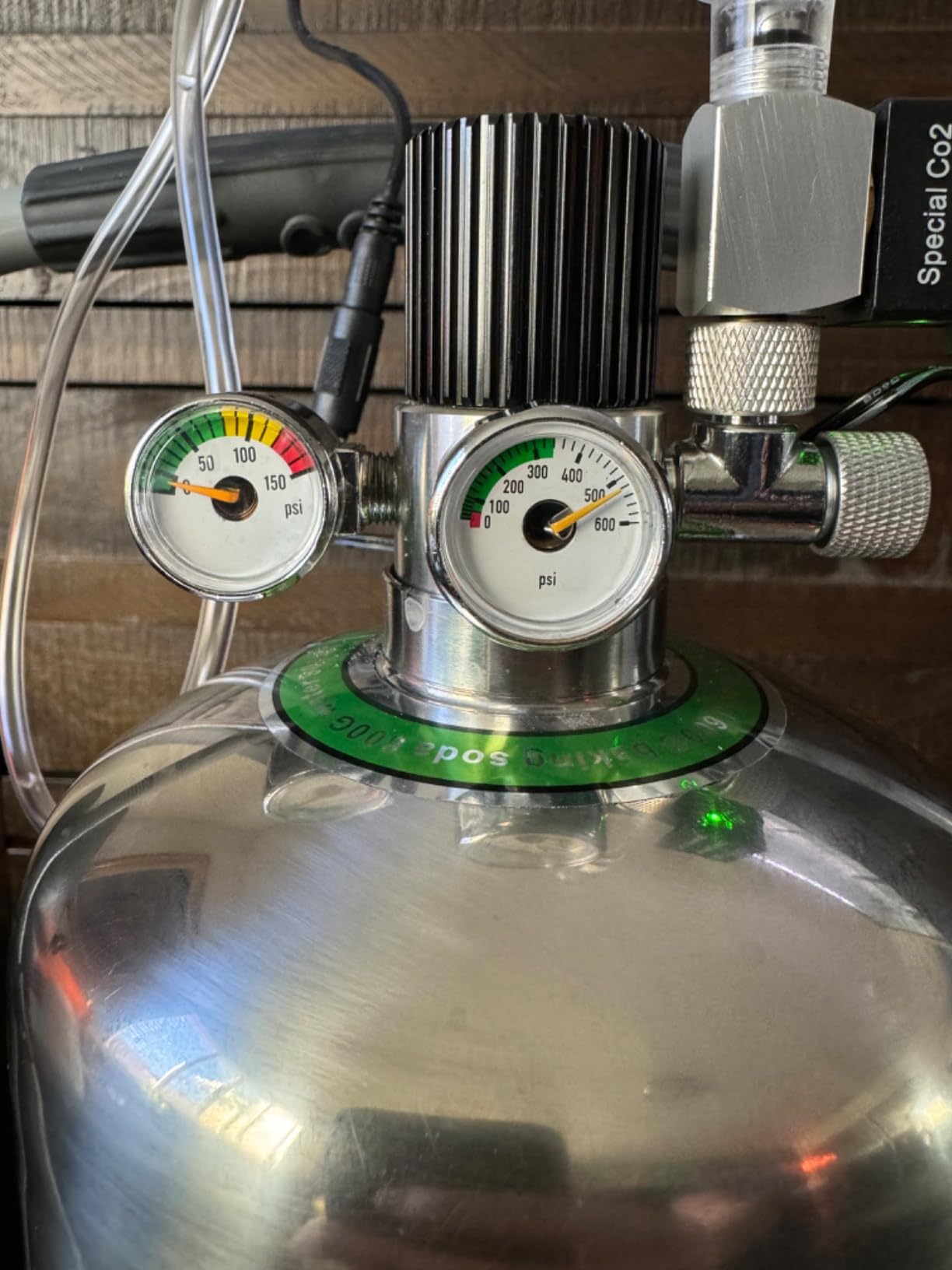
Spare parts are generous for the category. The box contains the cylinder, stainless pressure-reducing valve, filter, bubble counter, solenoid valve, power supply, connection cable, spare sealing ring, two atomizers, four suction cups, one-way valve, U-tube, air tube, funnel, syringe and English instructions. Two atomizers means you do not need to buy a spare before the first one fails.
Safety hardware is present and correct for the size. The automatic pressure relief valve activates above 70KG and the 12V waterproof solenoid handles the timed duty cycle that a large tank needs. The consistent 304 stainless steel bottle resists the pressure spikes that cheaper kits struggle with.
What tank size suits this system best
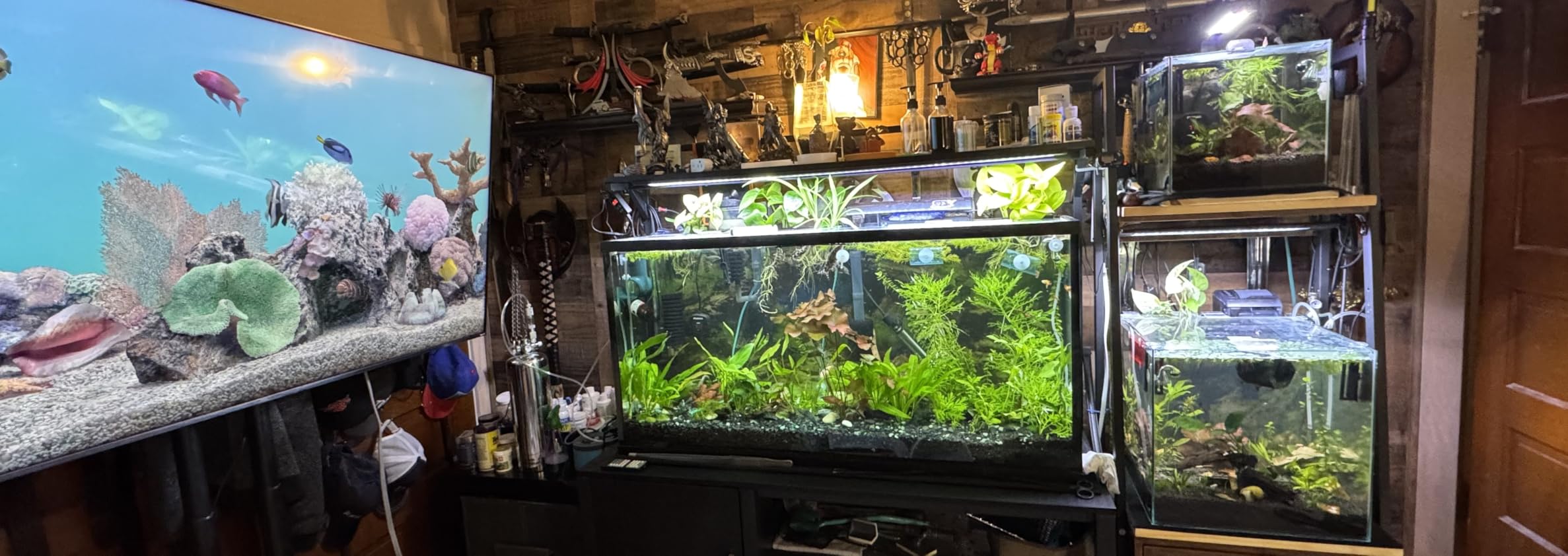
This is a 40 to 120 gallon system by the manufacturer’s own sizing, and anything smaller means paying for capacity you will not use. If your tank is 40 gallons or more and you cannot source cylinders, a 4L generator is the practical middle ground between a 2.5L weekly refill and a full dual-stage cylinder rig.
Check your cabinet before ordering. At 16.93 by 9.37 by 7.83 inches and 2.65 pounds, owners report the footprint does not fit under many smaller tank stands. If your stand is low, the whole category of large generators becomes awkward, and that is worth knowing before you spend.
Who should skip this and buy something else
Skip it if consistency between units matters to you. At 3.7 stars with a 22 percent one-star review share, this is the weakest-rated kit in the set, and that pattern points to build quality inconsistency from one purchase to the next rather than one isolated fault. Owners who rate it highly tend to describe a well-made bottle, which is exactly what makes the low scores frustrating.
Also expect a settling period. The first few days produce large bubbles in the atomizer before it settles into a fine stream, so do not judge the system on day one. Judge it after a week of steady running.
12. Hygger 2L CO2 Generator System – Best Compact 2L Starter Kit
2L Aquarium CO2 Generator System, CO2 System Kit with Regulator and Needle Valve for Aquarium Plants Tanks
1.2mm SUS304 stainless bottle
Automatic relief valve
12V waterproof solenoid
Check valve in bubble counter
Pros
- Thicker than average stainless bottle wall for a mid range price point
- Complete kit with regulator solenoid filter needle valve and bubble counter
- Automatic relief valve plus a waterproof 12V solenoid covers both main failure modes
- Bubble counter has a built-in check valve that stops water backflow and corrosion
- Newer release with a manufacturer documented setup process
Cons
- Raw citric acid and sodium bicarbonate powders must be purchased separately
- Solenoid is not waterproof and the motorized valve must be kept away from water
- Diffuser needs a 24 hour soak or bubbles may not release straight away
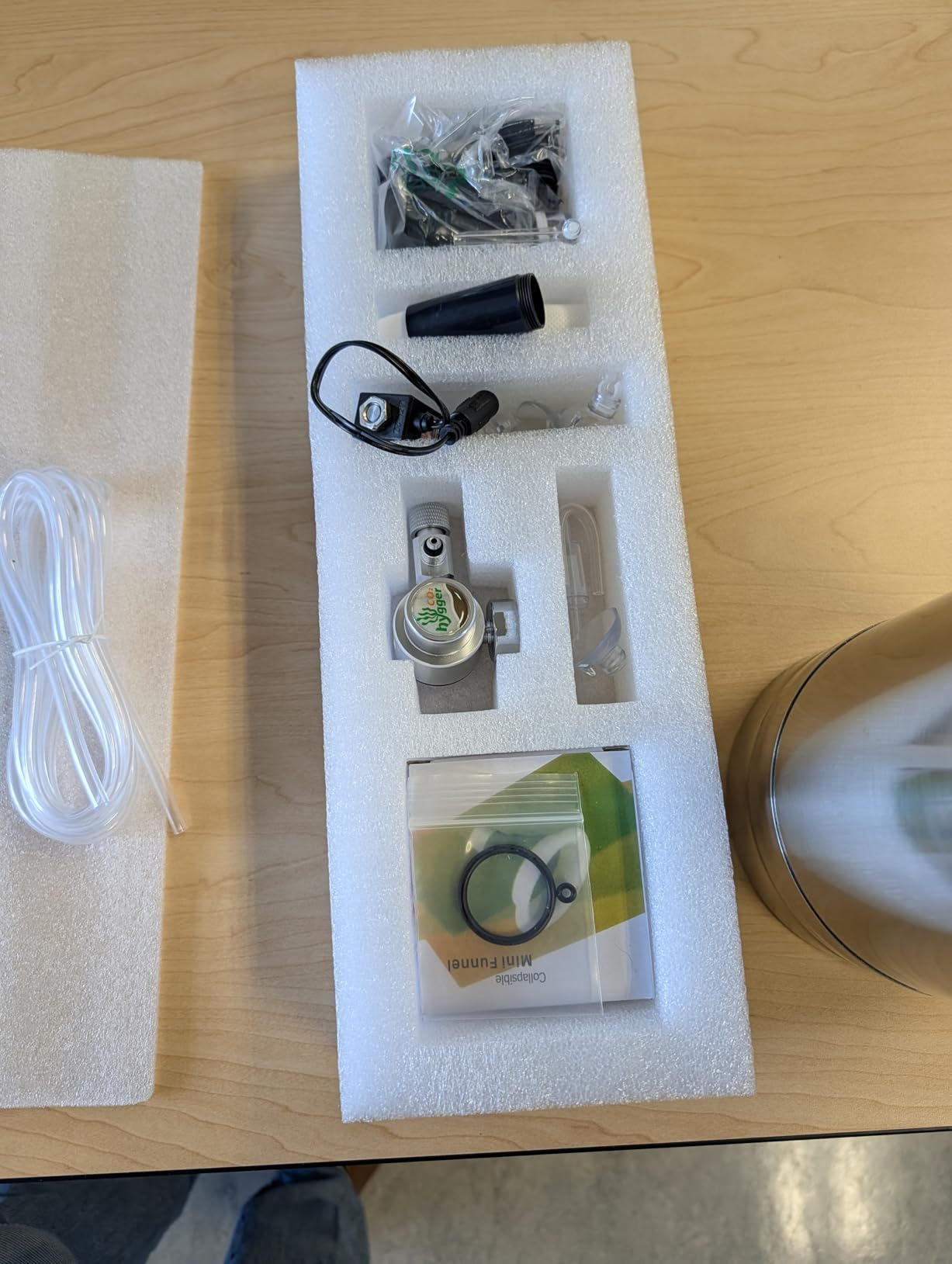
The Hygger is one of the newest kits in the set, and it is the tidiest 2L package we tested. The bottle is 1.2mm SUS304 stainless steel, which the manufacturer states is 20 percent thicker than standard tanks, and the complete kit includes the bottle, regulator, 12V solenoid valve, filter, precision needle valve and adjustable bubble counter.
Safety gets the most attention in this design. There is an automatic pressure relief valve that activates between 30 and 35KG, and a 12V waterproof solenoid. The bubble counter also has a built-in check valve that stops water backflow into the CO2 tank, which prevents the corrosion and pressure problems that come from water entering the reaction chamber.
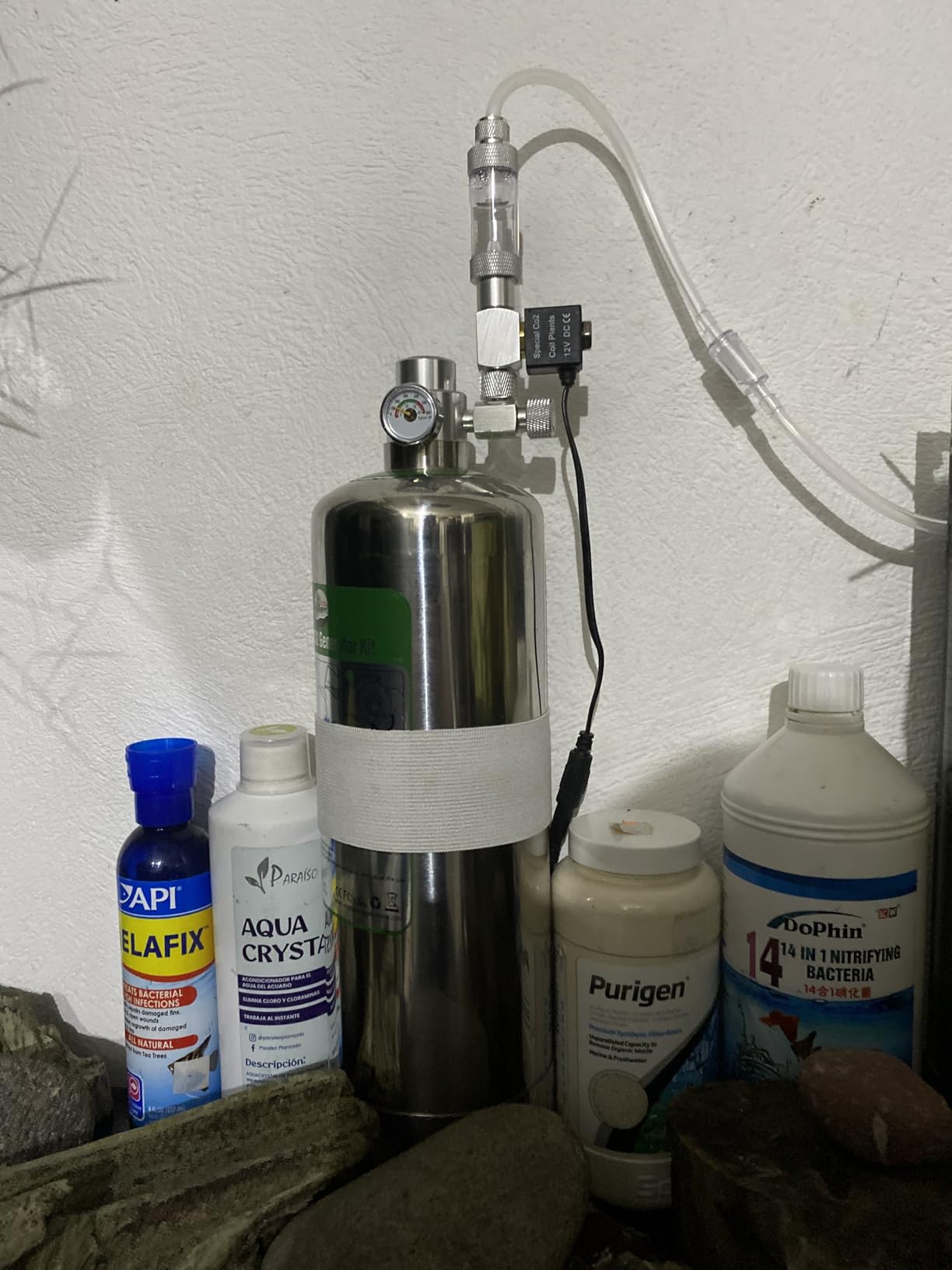
Two setup notes are specific to this unit and worth reading before first use. The motorized valve is not waterproof and should be kept away from water even though the solenoid is, and the diffuser needs a 24 hour soak before first use or bubbles may not release straight away. Low initial air pressure can also make the system look faulty in its first hours.
Those are all solvable, and the manufacturer documents the process. What we cannot give you is the long-term data that the thousand-review kits have. At 83 reviews this is the thinnest owner base in the roundup, and we weight that in the ranking accordingly.
What tank size suits this system best
A 2L system maps to 15 to 30 gallons, and the compact 13.62 by 7.09 by 4.88 inch footprint makes it easier to accommodate than the larger 4L units in this list. At 3.48 pounds it is also lighter, which matters if your cabinet space is the binding constraint.
For a first stainless system this is a reasonable place to start because the safety design is already sorted. Automatic relief, waterproof solenoid, check valve in the bubble counter, and a documented setup process. You are not learning how a generator works by being the experiment.
Who should skip this and buy something else
Skip it if you want the most established option. With 83 reviews there is far less long-term owner feedback than the FZONE or HYQO kits have, and for a pressure vessel that is a real consideration. If you want two thousand reviews telling you how it holds up after two years, buy the one with them.
Also factor in the consumables. Citric acid and sodium bicarbonate powders are not included, so nothing runs until you make a second order. And if you already own a good ceramic diffuser, skip the bundled one, because a soaked diffuser is a diffuser you will replace eventually.
How to Choose a CO2 System for Your Tank
Most buying mistakes come from choosing a system before choosing a system type. The four common types behave very differently, and the honest answer is that the best one for your tank depends on your tank volume, your light level, your livestock and how much maintenance you actually want.
Yeast and gel systems are the simplest and cannot be turned off on a schedule. They suit small tanks and experimental use. The lighting level on your tank matters more here than anywhere else.
Disposable cartridge systems trade running cost for zero assembly. They suit nano and desktop tanks under about 12 gallons, where cartridge consumption is low and the footprint matters.
Citric acid generators are the compromise most hobbyists land on. You refill at home with grocery store powders, output is adjustable, and a solenoid can drive them from a timer. This is the sweet spot for tanks from 10 to 55 gallons with no cylinder access.
Pressurized cylinder systems are the control-and-convenience answer for large tanks. A dual-stage regulator on a proper cylinder gives stable output, long runtime and precise control, but it depends entirely on refill access.
What size CO2 cylinder or generator do I need
Match the system to volume rather than the other way around. Under 20 gallons, a cartridge system or a small 2L generator covers it. From 20 to 40 gallons, a 2.5L generator is the sweet spot. From 40 to 60 gallons, look at 4L capacity or a dual-stage cylinder setup. Above 75 gallons, cylinders and manifold systems are the only realistic answer.
Forum discussion on cylinder sizing is genuinely contradictory, mostly because people compare a 5lb cylinder against a paintball bottle without accounting for fill interval. The useful question is not which is bigger, it is how long you want to go between refills and whether you can get a refill where you live.
Why dual stage regulators matter and what end of tank dump means
A single-stage regulator reduces cylinder pressure in one step, so the output pressure drops as the gas level drops. The needle valve then has to be readjusted constantly, and worse, the pressure can rise unexpectedly and push a large volume of gas into the tank in a short period. That is end-of-tank dump, and it is the failure mode that has ended aquariums.
A dual-stage regulator reduces pressure in two steps, so the output you set stays where you set it. Every system rated for larger tanks here benefits from this, and the FZONE Pro is built around it explicitly. If your tank is over about 30 gallons, treat a single-stage regulator as a genuine safety concern rather than a budget saving.
Which diffusion method should you choose
Three options cover the market. An in-tank ceramic diffuser is the cheapest and easiest, and it works fine on small and medium tanks, but the bubbles are visible and some CO2 escapes to the surface. An inline atomizer forces gas through a ceramic element under pressure and dissolves far more completely, at the cost of visible microbubbles and a cleaning routine every couple of months.
An inline reactor is the most efficient of the three, dissolving more gas for less pressure, but it costs the most and adds plumbing. For most people the correct order is: ceramic diffuser first, atomizer once you are past about 30 gallons and chasing better results. Nearly every budget kit here ships a weak diffuser, so plan to replace it.
Cylinder threads, refill access and what to check on an old cylinder
This is where more setups fail than anywhere else, and it has almost nothing to do with product quality. North American CO2 cylinders use the CGA320 thread standard. Paintball-style CO2 tanks use a different thread, and the fix is a cheap CGA320 adapter. Mixing up the two is the single most common cylinder setup failure, so confirm your thread before you buy a regulator.
Refill access is the other blocker. If there is no cylinder swap shop near you, forum members routinely fall back on shipping cylinders or home exchange services, and that friction is real. This is the strongest argument in this entire guide for a citric acid generator, because it removes the logistics problem entirely at the cost of some precision.
On older cylinders, check the hydrostamp date. That stamped date is when the cylinder was last pressure tested, and cylinders need requalification on a schedule set by jurisdiction. If the date is unknown, badly old, or you cannot read the stamp, do not pressurise that cylinder. Weigh a good stand to help with placement while you decide.
How to Set Up and Dial In CO2 Injection
Start the gas two to three hours before your lights come on. This is called saturation lag, and it is the single most common reason a new CO2 install seems not to work. Dissolved CO2 takes time to build in the water column, so if you start injection when the lights switch on, the plants spend the first two hours of the photoperiod short of carbon and then start photosynthesising hard just as CO2 runs out.
Turn the gas off one hour before the lights go out. At that point the plants are no longer respiring heavily, surface gas exchange becomes more important, and keeping CO2 high through a dark period is how oxygen gets low enough to hurt fish.
Your starting bubble rate is roughly one bubble per second per two square feet of surface area, and a single standard bubble is only meaningful as a starting point. Different bubble counters produce different sized bubbles, so bubble rate is a rough dial, not a measurement. Adjust in small steps and wait 30 minutes between changes.
Work through it in order. Attach the regulator, fit the bubble counter, run CO2-resistant tubing, install a check valve, fit the diffuser, then leak-test the whole assembly with soapy water before you leave it unattended. Finally, put the solenoid on a timer and start two to three hours before lights.
How to Measure CO2 and the Drop Checker Myth
A drop checker is a useful trend indicator and a poor measuring instrument, and the difference matters. The commonly repeated claim that a green drop checker reads 30 ppm is a marketing figure that does not hold up. In practice a checker typically turns green somewhere around 10 to 15 ppm, and it lags your actual level by roughly 60 to 90 minutes.
That means a green checker is a signal to look, not a target to hit. Used correctly it is a genuinely good tool for spotting the two failure modes that matter: a system that has stopped injecting, and a system that is injecting far more than intended.
The accurate method is the degassed pH drop. Measure your pH, then measure the pH of a sample vigorously shaken in a sealed container to strip the CO2 out. The difference between the two tells you your dissolved CO2, with a pH drop of about 1.0 corresponding to roughly 30 ppm or more. Your KH matters for this method, so test it as well.
Two more measurement myths worth discarding. Bubble rate does not measure dissolved CO2, because bubble size varies by device and by pressure. And a low pH is not automatically dangerous: soft-water habitat species from low pH waters tolerate it better than the raw number suggests. What matters is the rate of change and the species you keep.
CO2 Safety for Fish, Shrimp and Your Living Room
Put the solenoid on a timer. Always. A solenoid that sticks open is the one failure mode that can kill livestock quickly, and forum consensus treats a fails-open solenoid as a deal breaker for exactly that reason. A timer is a few dollars of insurance and it also stops the overnight pH crash.
Never run CO2 overnight with the lights off. Photosynthesis stops, the plants stop consuming CO2, dissolved oxygen falls, and the water can end up both high in CO2 and low in oxygen. This is the combination that affects fish most, and it is the mechanism behind most CO2-related losses described in forum threads.
Know your species before you start. Tolerance varies widely, and the ranges quoted across the specialist community run from roughly 40 ppm for discus, up toward 50 to 60 ppm for otocinclus, and around 60 to 70 ppm for common tetras. Shrimp keepers should start at the low end and change water frequently while livestock adjusts.
If something goes wrong, act immediately. Cut the gas at the source, not just at the timer. Then do a large water change using dechlorinated water, and aerate heavily. That is the emergency procedure and it is worth knowing before you need it, not while your fish are already stressed.
One home safety note. A CO2 cylinder is a pressure vessel, so secure it upright so it cannot be knocked over, and keep it away from heat sources. Our stand picks guidance on clearance and stability applies here too, since a falling cylinder is a hazard to your livestock as well as your floor.
Should You Even Use CO2?
Sometimes the right answer is no, and we would rather say that than sell you a system. If you are running low to moderate light with anubias, java fern, crypts, pearl weed or dwarf sagittaria, you can get respectable growth without CO2, and liquid carbon is a much lower risk way to supplement carbon without introducing gas.
Buy CO2 when the light demands it. High-light setups and demanding species such as rotala, hairgrass, hemianthus and monte carlo will not reach competition quality without injection, and that is where the growth, colour and algae control justify the complexity.
One combination to avoid entirely: high light paired with low CO2. That is the most algae-prone and highest risk pairing in the hobby, because the light drives photosynthesis while carbon runs out partway through the photoperiod. If you have strong lights, either supply the carbon properly or lower the light.
The two setups we would avoid for new keepers are a tank with sensitive livestock running an always-on gel system, and any tank over about 30 gallons running a single-stage regulator. Both are fixable later. Neither is a good place to learn the hobby.
Frequently Asked Questions
What is the best CO2 system for a planted aquarium?
The best CO2 system for a planted aquarium is a dual-stage regulator on a pressurised cylinder if you can refill cylinders, or a stainless citric acid generator with a 12V DC solenoid and a check valve if you cannot. The FZONE 2.5L generator is our top overall pick because it is complete, refillable at home and stable.
What is the best CO2 regulator for a planted aquarium?
The best CO2 regulator for a planted aquarium is a dual-stage unit with a wide pressure adjustment range and a DC solenoid. Dual-stage construction keeps output pressure stable as cylinder gas drops, which prevents end-of-tank dump, and a DC solenoid runs cool enough to sit safely on a timer.
Is CO2 really necessary for a planted aquarium?
CO2 is not necessary for every planted aquarium. Low-light setups with anubias, java fern, crypts and pearl weed can grow well with liquid carbon instead. CO2 becomes necessary when you run high light or grow demanding species such as rotala, hairgrass, hemianthus or carpeting monte carlo.
How do I set up a CO2 system for my planted aquarium?
Attach the regulator, fit the bubble counter, run CO2-resistant tubing, install a check valve and fit the diffuser. Leak-test the whole assembly with soapy water, then put the solenoid on a timer that starts two to three hours before the lights come on and stops one hour before lights out.
How big of a CO2 tank do I need for an aquarium?
Under 20 gallons, a cartridge system or small 2L generator is enough. From 20 to 40 gallons, a 2.5L generator fits well. From 40 to 60 gallons, look at 4L capacity or a dual-stage cylinder setup. Above 75 gallons, cylinders and a manifold system are the realistic choice.
Are CO2 systems easy to refill?
It depends entirely on the type. Citric acid generators refill at home with grocery store citric acid and baking soda, which is why we recommend them when no cylinder swap shop is nearby. Pressurised cylinders are cheaper to run but need a local refill or exchange service, and that access is the biggest practical blocker for new keepers.
What CO2 level should I aim for?
Aim for roughly 30 ppm in a high-light planted tank, and measure it rather than guessing. The degassed pH drop method is accurate: compare your tank pH against a sample shaken in a sealed container, and a drop of about 1.0 corresponds to roughly 30 ppm or more. Check your KH as well.
Does CO2 harm fish and shrimp?
CO2 can harm fish and shrimp if levels climb too high or change too fast, which is why the solenoid must be on a timer and gas must never run overnight with the lights off. Quoted tolerance runs from roughly 40 ppm for discus up toward 50 to 60 ppm for otocinclus and around 60 to 70 ppm for common tetras.
Our Final CO2 System Verdict for 2026
After testing twelve systems, the best aquarium CO2 systems for planted tanks in 2026 come down to three honest recommendations. The FZONE 2.5L CO2 Generator System is the default choice for anyone up to about 40 gallons who wants a complete, refillable-at-home system with a stainless reaction chamber and a timer-ready solenoid. Plan to replace its diffuser early.
If you can refill cylinders, go to the FZONE Pro Series dual stage regulator. The stable output and two independent manifold blocks are worth the higher spend on any tank over 30 gallons, and they remove the end-of-tank dump risk entirely. For a nano or desktop tank under about 12 gallons, the FZONE Desktop 45g system is the answer that fits the space you actually have.
Whatever you choose, put the solenoid on a timer, measure with the degassed pH drop method rather than trusting a green drop checker, and start the gas two to three hours before the lights come on. Those three habits matter more to your tank than any brand on this list.