
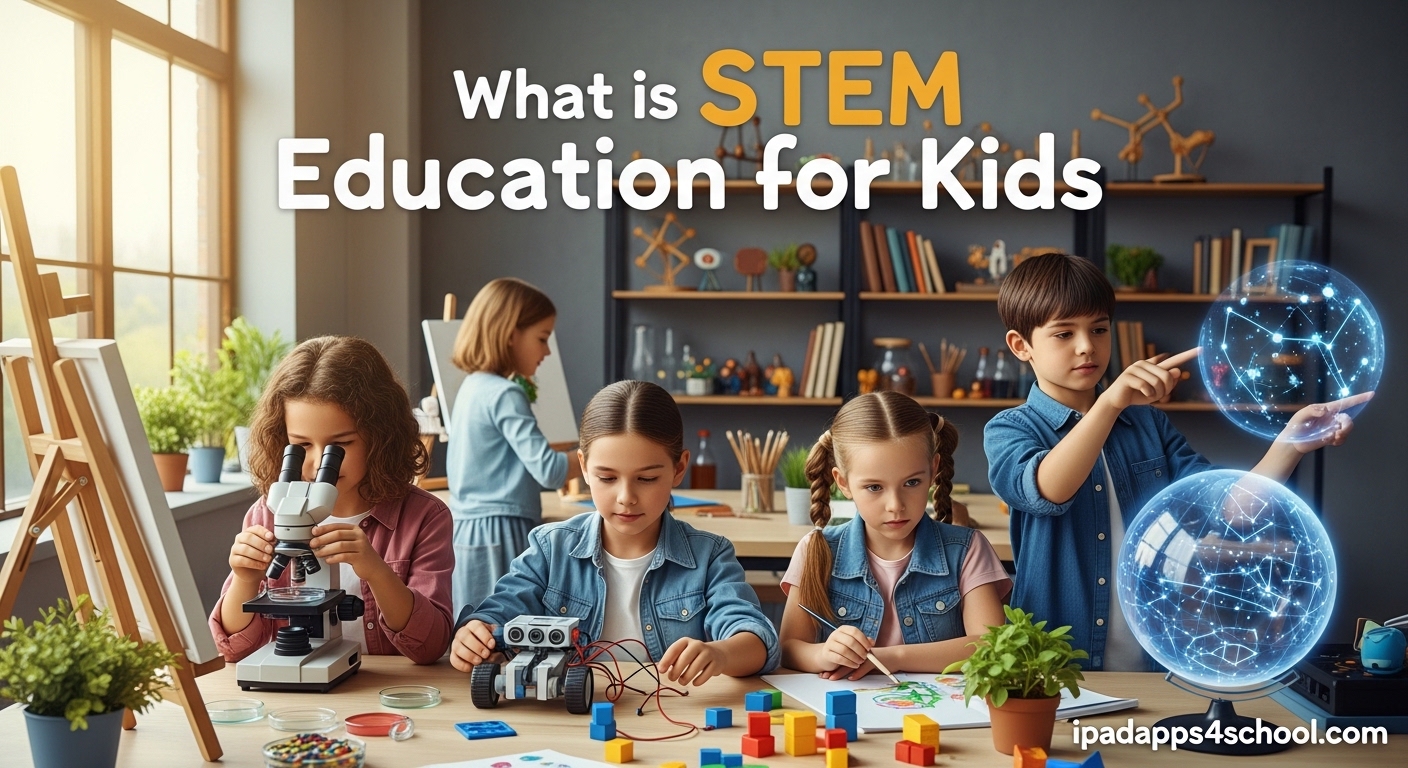
STEM education for kids has become one of the most talked-about approaches to learning in 2026. Parents, teachers, and caregivers keep hearing that STEM matters, but many wonder what it actually means and how to introduce it to children. This guide breaks down everything you need to know about STEM education, from the basic definition to practical activities you can start using today with tools like iPad apps and simple household items.
By the end of this article, you will understand what STEM stands for, why each component matters, and how to make STEM learning fun and accessible for children of any age. Whether you are a parent looking to supplement school learning or a teacher building your curriculum, this guide gives you concrete strategies that work.
Table of Contents
What is STEM Education for Kids
STEM education for kids is an interdisciplinary teaching approach that combines Science, Technology, Engineering, and Mathematics into connected learning experiences rather than teaching each subject in isolation. The National Science Foundation first promoted this integrated approach to prepare students for the demands of the modern workforce.
Unlike traditional education that treats science, math, and technology as separate classes, STEM weaves these subjects together through hands-on projects and real-world problem solving. Kids do not just memorize multiplication tables or science facts. They build, experiment, design, and discover how these disciplines connect to solve actual problems.
The STEM acronym breaks down into four essential components:
- Science – Exploring the natural world through observation, questioning, and experimentation
- Technology – Using tools, including digital devices and coding platforms, to create and solve problems
- Engineering – Designing, building, and testing solutions to challenges
- Mathematics – Using numbers, patterns, measurement, and logic to understand relationships
When children engage with STEM education, they develop what educators call “21st century skills” – critical thinking, creativity, collaboration, and communication. These skills prepare kids not just for future careers in tech or science fields, but for any path they choose.
The Science Component: Building Curiosity Through Exploration
Science in STEM education focuses on developing inquiry skills that help kids ask questions, make observations, and test ideas. Young scientists learn to look closely at the world, wonder why things happen, and design simple experiments to find answers.
For young children, science starts with nature exploration and sensory experiences. A preschooler digging in the garden discovers soil, worms, and plant roots. An elementary student watching ice melt learns about states of matter. These hands-on experiences build the foundation for more complex scientific thinking later.
Effective STEM science activities for kids include:
- Planting seeds and tracking growth over weeks
- Mixing baking soda and vinegar to observe chemical reactions
- Collecting and sorting rocks, leaves, or shells by properties
- Stargazing and tracking moon phases
- Observing weather patterns and recording data
The goal is not memorizing scientific facts but developing scientific thinking. Kids learn to form hypotheses, test them, observe results, and draw conclusions. This process builds logical reasoning and evidence-based thinking that serves them across all subjects.
The Technology Component: Beyond Screen Time to Creation
Technology in STEM education means much more than passive screen consumption. It encompasses all tools humans create to solve problems, from simple levers to complex computer programs. For kids, technology education focuses on understanding how tools work and using them to create, communicate, and build.
iPad apps and educational technology play a powerful role in making technology concepts accessible to young learners. Well-designed apps turn abstract coding concepts into visual, interactive experiences that children can manipulate directly. Our team has seen kids as young as four grasp basic programming logic through drag-and-drop coding games.
Here is how technology fits into STEM learning for different ages:
Preschool (ages 3-5): Simple cause-and-effect apps, basic drawing tools, voice recording for storytelling, sorting and categorization games
Elementary (ages 6-10): Block-based coding platforms, digital storytelling apps, animation tools, basic robotics simulations
Middle School (ages 11-14): Text-based coding introduction, 3D design tools, video editing, app creation platforms, data visualization
The key distinction is creation versus consumption. Quality STEM technology experiences have kids making things, not just watching or playing pre-programmed games. When a child codes a simple animation, designs a 3D model, or records and edits a science explanation video, they are engaging with technology as a creative tool.
Parents often ask our team whether screen-based STEM activities count as “real” learning. The answer depends on engagement level. Apps that require problem-solving, decision-making, and creation support STEM goals. Passive video watching does not. The best STEM technology experiences combine digital and physical elements – like coding a robot that then moves through a physical maze.
The Engineering Component: Design Thinking for Kids
Engineering in STEM education introduces children to the design process – identifying problems, brainstorming solutions, building prototypes, testing, and improving. Young engineers learn that failure is part of the process and that iteration leads to better solutions.
This component often surprises parents who think engineering is too advanced for young children. In reality, kids are natural engineers. Every time a child builds a taller block tower, creates a LEGO machine, or figures out how to reach a cookie jar, they are engineering.
Formal STEM engineering activities for kids include:
- Building bridges from popsicle sticks and testing weight limits
- Creating simple machines like levers and pulleys
- Designing marble runs or Rube Goldberg machines
- Constructing shelters for toy animals with specific constraints
- Building boats from aluminum foil and testing buoyancy
The engineering design process follows a consistent pattern children can learn: Ask (what is the problem?), Imagine (what could work?), Plan (draw your design), Create (build it), Improve (what works and what doesn’t?). This structured approach to problem-solving transfers to challenges across all areas of life.
Forum discussions from homeschooling parents reveal that open-ended building challenges with recycled materials often engage kids more than expensive kits. A cardboard box, tape, and markers can become a rocket ship, a pet house, or a musical instrument through engineering imagination.
The Math Component: Patterns, Logic, and Real-World Connections
Mathematics in STEM education goes far beyond worksheets and memorization. STEM math focuses on mathematical thinking – recognizing patterns, understanding relationships, measuring, estimating, and using logic to solve problems. The goal is helping kids see math as a useful tool rather than a dreaded subject.
When math connects to real activities children enjoy, it becomes engaging and meaningful. Cooking together teaches fractions and measurement. Building with blocks develops spatial reasoning and geometry. Sorting collections by attributes builds classification skills that lead to algebraic thinking.
STEM math activities for kids include:
- Following recipes and doubling or halving ingredients
- Creating patterns with beads, blocks, or natural objects
- Measuring and comparing heights of plants or buildings
- Playing strategy games that require logical thinking
- Tracking sports statistics or weather temperatures
- Estimating quantities and then counting to check
One common concern from parents in education forums involves children who say they “are not math people.” STEM education counters this mindset by showing math as a tool for exploring interesting questions rather than a performance subject. When kids use math to build something cool or solve a mystery, they discover mathematical thinking serves their goals.
iPad apps can support STEM math through interactive visualization tools that let kids manipulate numbers and shapes directly. Virtual manipulatives help children see mathematical relationships that abstract symbols might obscure at young ages.
Why STEM Education Matters for Kids
STEM education develops capabilities that extend far beyond future career preparation, though that alone makes it valuable. The skills children build through STEM learning serve them throughout school and life, regardless of whether they become scientists or artists.
Here is what STEM education does for children:
- Builds critical thinking skills – Kids learn to analyze problems, evaluate evidence, and make reasoned decisions rather than accepting information at face value
- Develops problem-solving confidence – Through repeated cycles of trying, failing, and improving, children learn that difficult challenges can be solved with persistence
- Encourages creativity and innovation – STEM projects rarely have single correct answers, allowing kids to generate unique solutions and think outside conventional patterns
- Promotes collaboration – Complex STEM challenges require teamwork, communication, and learning from diverse perspectives
- Fosters resilience – When experiments fail or designs collapse, kids learn that setbacks are information, not endpoints
- Connects learning to real life – STEM shows kids why school subjects matter by applying them to tangible outcomes they care about
Research consistently shows that early exposure to STEM concepts correlates with later academic confidence and career interest in technical fields. More importantly, STEM education builds transferable thinking skills that benefit children in any domain. A child who learns to break complex problems into manageable steps can apply that approach to writing essays, resolving conflicts, or planning projects.
STEM vs STEAM: Adding the Arts to Create a Fuller Picture
STEAM education has emerged as a popular variation that intentionally includes Arts alongside Science, Technology, Engineering, and Math. This addition recognizes that creativity, design, and human expression are essential parts of innovation and problem-solving.
The STEAM movement responds to a valid criticism of pure STEM – that it can become overly technical and analytical without considering aesthetics, user experience, and cultural context. When engineers design products, they need to understand how people will interact with them. When scientists communicate findings, they need storytelling and visual design skills.
STEAM activities blend technical and artistic elements:
- Designing and building kinetic sculptures that demonstrate physics principles
- Creating digital art that incorporates mathematical patterns
- Building musical instruments and exploring sound waves
- Photographing nature and editing images to highlight scientific features
- Coding animations that tell stories
For most parents and educators, the STEM versus STEAM distinction matters less than ensuring children engage with both analytical and creative thinking. Whether you call it STEM or STEAM, effective education develops the whole child – logical and imaginative, technical and expressive.
Many iPad apps for education now explicitly combine STEM and arts elements. Coding platforms let kids create art and music. Design apps teach geometry through digital drawing. This integration mirrors how real-world innovation works.
STEM Learning with iPad Apps and Educational Technology
Digital tools have transformed how families and schools approach STEM education. iPad apps and educational technology make sophisticated STEM concepts accessible to younger children while providing interactive experiences that paper and pencil cannot match.
The best educational technology for STEM learning shares common characteristics. It engages kids actively rather than passively, provides immediate feedback that supports learning, allows experimentation without permanent consequences, and adapts to individual learning paces.
Here is how technology supports each STEM component:
Science apps offer virtual labs where kids conduct experiments impossible in most homes, like exploring cell structures or simulating chemical reactions safely. Interactive field guides help children identify plants, animals, and constellations during outdoor exploration.
Technology and coding apps use visual programming languages that let children create animations, games, and interactive stories while learning computational thinking. Platforms designed for kids introduce programming concepts through puzzles and challenges rather than syntax memorization.
Engineering apps provide design tools for 3D modeling, simple machines simulation, and structural testing. Kids can prototype inventions digitally before building with physical materials, saving time and supplies while encouraging iteration.
Mathematics apps turn abstract concepts into manipulable visual representations. Fractions become sliceable pizzas. Algebraic relationships appear as adjustable graphs. Geometry transforms into shape puzzles and tessellation design.
Forum discussions reveal parents appreciate apps that combine digital and physical play. Coding apps that control real robots, design apps that output to 3D printers, or nature apps that encourage outdoor observation create healthier technology relationships than pure screen experiences.
When selecting STEM apps, look for those that require active problem-solving rather than passive consumption. The best apps have no single right answer. Instead, they provide tools for kids to explore, create, and discover at their own pace.
Age-Appropriate STEM Activities for Every Stage
STEM education works at any age when activities match developmental readiness. The key is starting simple and building complexity as children grow. Parents in education forums consistently emphasize that beginning early with playful exploration prevents the anxiety many adults feel about STEM subjects.
Preschool STEM (Ages 3-5)
At this stage, STEM looks like play because play is how young children learn. Simple activities build foundational thinking skills that later support complex STEM learning.
- Building with blocks, LEGOs, or cardboard boxes
- Water play with cups, funnels, and containers
- Nature walks collecting and sorting natural objects
- Simple cooking activities measuring and mixing
- Puzzle solving and matching games
- iPad apps focused on cause-and-effect and simple sorting
The goal is developing curiosity, comfort with exploration, and basic concepts like more/less, bigger/smaller, and cause and effect.
Elementary STEM (Ages 6-10)
Elementary children can handle more structured projects while still learning through hands-on experiences. They can follow multi-step processes, record observations, and work collaboratively.
- Simple science experiments with hypothesis and observation
- Block-based coding on iPad apps
- Building challenges with constraints (build a bridge with only 20 sticks)
- Gardening projects tracking growth and conditions
- Basic robotics kits
- Math games involving strategy and logic
Kids at this age can begin connecting their activities to real STEM careers and understanding how scientists and engineers contribute to society.
Middle School STEM (Ages 11-14)
Pre-teens and young teens can handle abstract concepts, complex projects, and independent research. STEM activities at this level build sophistication while maintaining engagement through real-world relevance.
- Text-based coding and app development
- Science fair projects with controlled variables
- 3D design and printing projects
- Citizen science participation in real research projects
- Engineering competitions and challenges
- Data collection and analysis using spreadsheets or apps
What is the best age to start STEM? The answer is as early as possible through playful exploration. Formal STEM instruction can begin in preschool with age-appropriate activities. There is no such thing as starting too early when the approach matches the child’s developmental stage.
FAQ
What is a STEM program for kids?
A STEM program for kids is a structured learning experience that integrates science, technology, engineering, and math concepts through hands-on activities and projects. These programs can take place in schools, after-school clubs, summer camps, museums, or at home. Quality STEM programs emphasize inquiry-based learning where children ask questions, experiment, build, and solve problems rather than simply memorizing facts. Programs range from formal curriculum-based classes to informal workshops focused on specific projects like robotics, coding, or nature exploration.
What does STEM do for children?
STEM education helps children develop critical thinking, problem-solving, creativity, and collaboration skills that serve them throughout life. It builds confidence in tackling challenging problems by teaching kids that failure is part of learning. STEM connects school subjects to real-world applications, making learning more relevant and engaging. Children in STEM programs often show improved persistence, logical reasoning, and comfort with technology. These benefits extend beyond future technical careers to any field requiring analytical thinking and innovation.
What are the pros and cons of STEM?
Pros of STEM education include building critical thinking skills, preparing children for 21st century careers, fostering creativity through hands-on projects, increasing engagement through real-world relevance, and developing problem-solving confidence. Cons can include limited access to resources and technology for some families, potential for increased screen time if technology use is not balanced, risk of neglecting arts and humanities if STEM is overemphasized, and pressure on children who may develop anxiety about technical subjects. The key is balanced integration that develops the whole child while making STEM accessible and playful rather than stressful.
Are STEM schools good for autistic students?
STEM education can be particularly beneficial for many autistic students because of its structured, logical approach and emphasis on hands-on learning. The clear processes in engineering design, the concrete nature of experiments, and the visual-spatial aspects of technology often align with strengths common in autistic learners. STEM activities can provide predictable routines while allowing for special interests in technical areas. However, success depends on individual needs, sensory considerations, and social support during collaborative projects. Some autistic students thrive in STEM-focused environments while others need additional accommodations for group work or sensory sensitivities in lab settings.
Getting Started with STEM Education for Kids
STEM education for kids does not require expensive equipment, specialized training, or extensive preparation. The most effective STEM learning happens through everyday exploration guided by curious adults. Start with your child’s natural interests. If they love animals, explore wildlife science. If they enjoy building, introduce engineering challenges. If they are fascinated by tablets, use coding apps that teach computational thinking.
The resources you need are probably already available. Kitchens become chemistry labs. Backyards transform into biology field stations. Recycled materials become engineering supplies. iPad apps provide interactive tools that make abstract concepts concrete. The essential ingredient is not money or special curriculum. It is creating space for kids to ask questions, experiment, fail, try again, and discover how the world works.
Begin this week with one simple activity. Build something together. Ask what would happen if. Test a hypothesis. Celebrate the process regardless of the outcome. That is STEM education in action.