

Most kayaks sold for lake weekends are short, wide and stable, which is exactly right until you want to reach the island camp two miles downwind. The best touring kayaks for lakes sit in the middle: long enough to hold a line, narrow enough to glide, and light or packed small enough that one person can still get them to the water. I compared 12 sit-inside and convertible boats across length, beam, hull weight, real load capacity, storage and how each one behaves when the wind comes off the far shore.
This roundup is built for paddlers who want distance, not laps around a boat ramp. Whether you are planning a day tour to a shoreline campsite, a three night loop across an island chain, or open water crossings on a lake wide enough to develop real chop, the decisions are the same: hull length, beam, skeg or rudder, and how much dry storage you actually need. Our team logged time in these boats on flat lakes, in wind, and with camping gear loaded amidships, and we leaned hard on owner review data for the details that only show up after a season of use.
A quick note on how we evaluated. Every boat here was scored on six things: tracking and straight-line efficiency, primary and secondary stability, storage for real gear loads, cockpit comfort over a full day, portability for a solo paddler, and build quality. We also read the complaints, not just the praise, because the difference between a boat that is excellent and a boat that is excellent for you usually shows up in the one-star reviews. If you are still narrowing the field, our guides to the best kayaks for beginners and the best inflatable kayaks for rivers cover the entry points well.
Table of Contents
Top 3 Picks: Best Touring Kayaks for Lakes

Wilderness Systems Pungo 120
- 12 foot 2 inch length
- Sealed bulkhead rear hatch
- Phase 3 Air Pro seat
- 49 lb

Pelican Sprint 120XR
- 41 lb hull
- Keel extension for tracking
- ERGOFLEX G2 seat
- 300 lb capacity

OCEANBROAD 13.7 ft Inflatable
- Drop-stitch floor
- 36 inch beam
- Removable directional fin
- Packs to one bag
The Pungo 120 wins the overall slot because it does the three things that matter on a lake day equally well: it moves with real glide, it holds a line in a crosswind, and it has a sealed bulkhead hatch plus a dashboard dry box so gear stays dry without a separate dry bag. The Pelican Sprint 120XR takes the value slot because at 41 lb it is the hardest-working hard shell here for the money, and it is the boat a paddler who has to solo the whole operation from car to water will thank us for. The OCEANBROAD inflatable is the widest, most forgiving boat in the group, the highest rated of the three, and the easiest of the inflatables to actually sit inside for a full day.
Best Touring Kayaks for Lakes in 2026: Quick Overview
| Product | Specifications | Action |
|---|---|---|
| Wilderness Systems Pungo 120 |
|
Check Latest Price |
| Pelican Sprint 120XR |
|
Check Latest Price |
| OCEANBROAD 13.7 ft Inflatable |
|
Check Latest Price |
 Perception Expression 11.5 Perception Expression 11.5 |
|
Check Latest Price |
 Wilderness Systems Pungo 125 Wilderness Systems Pungo 125 |
|
Check Latest Price |
 Wilderness Systems Pamlico 135 Wilderness Systems Pamlico 135 |
|
Check Latest Price |
 Aqua Marina Tomahawk AIR-K Aqua Marina Tomahawk AIR-K |
|
Check Latest Price |
 BEYOND MARINA Adventurer 12.5 BEYOND MARINA Adventurer 12.5 |
|
Check Latest Price |
 Advanced Elements Island Voyage 2 Advanced Elements Island Voyage 2 |
|
Check Latest Price |
 Perception Rambler 13.5 Perception Rambler 13.5 |
|
Check Latest Price |
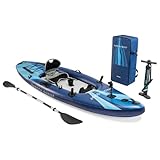 Intex Dakota Quest Intex Dakota Quest |
|
Check Latest Price |
 Intex Challenger K1 Intex Challenger K1 |
|
Check Latest Price |
Read that table as a set of trade-offs rather than a ranking. Beam is the column that decides whether you feel safe on day one, and hull weight is the column that decides whether you ever leave the house. The three narrowest boats here are the fastest, and they are also the three that make beginners nervous. The three widest are the most stable and the slowest, and two of them are tandems.
1. Wilderness Systems Pungo 120 – Best All-Rounder for Lake Touring
Wilderness Systems Pungo 120 Recreational Kayak – Sit Inside – Phase 3 Air Pro Comfort Seating – 12.2 ft – Mango
12 ft 2 in long
29 in beam
49 lb hull
325 lb capacity
Polyethylene with sealed bulkhead
Pros
- Best-in-class speed and glide for a 12 foot hull
- Sealed bulkhead rear hatch keeps gear dry
- Pungo dashboard with removable dry box and two cup holders
- Phase 3 Air Pro seat adjusts on the water
Cons
- Snug cockpit for larger paddlers than the rating suggests
- 49 lb still needs a roof rack or cart for solo carry
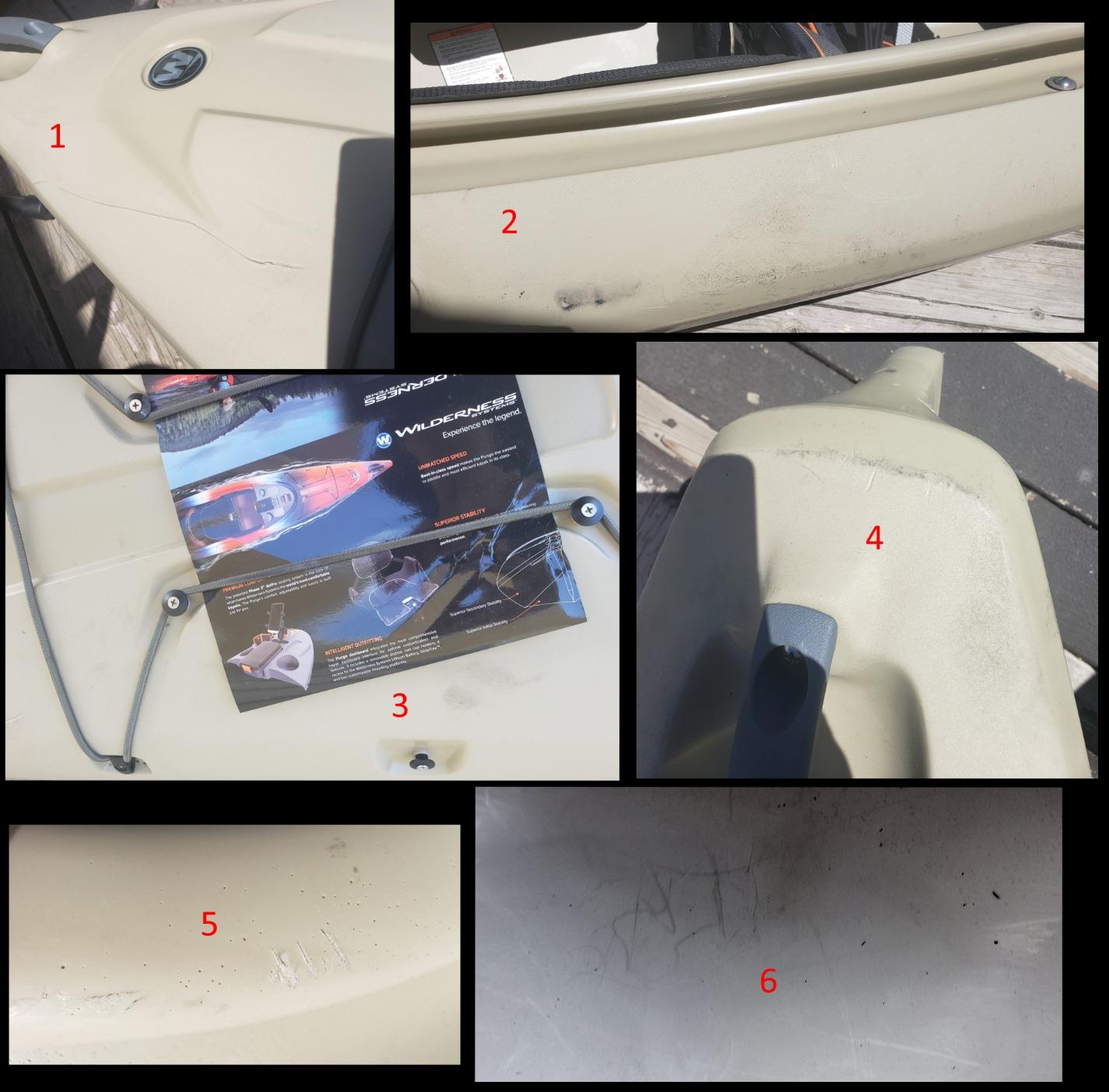
- Arrives in thin packaging that scuffs easily
This is the boat I keep coming back to. The 12 foot 2 inch hull is not the fastest thing on the list, but it is fast enough that a 15 mile day does not feel like a punishment, and it is wide and stable enough that you can stop worrying about trim while you look at the map. Owners use it for 100 mile lake and river trips, and that is the honest ceiling of what a polyethylene boat this size does well.
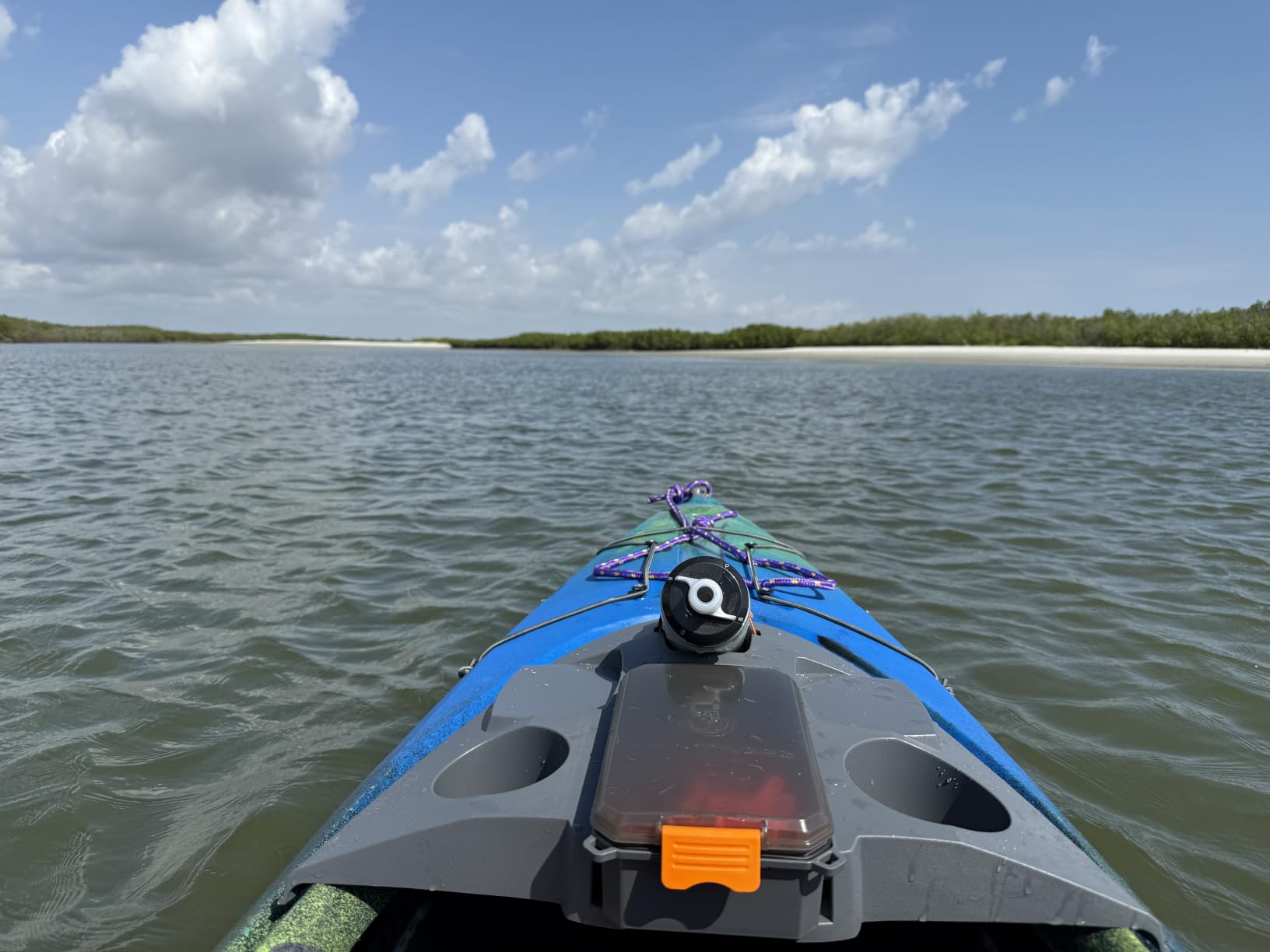
The Pungo dashboard in front of your knees is the feature that changes daily use more than the marketing suggests. The removable dry box swallows a phone, a sandwich, a first aid kit and a spare layer, and the two cup holders sit within reach rather than at your feet. Behind you, the Orbit hatch with its sealed bulkhead is the difference between a day tour and a camping trip, because it is genuinely dry rather than nominally dry.
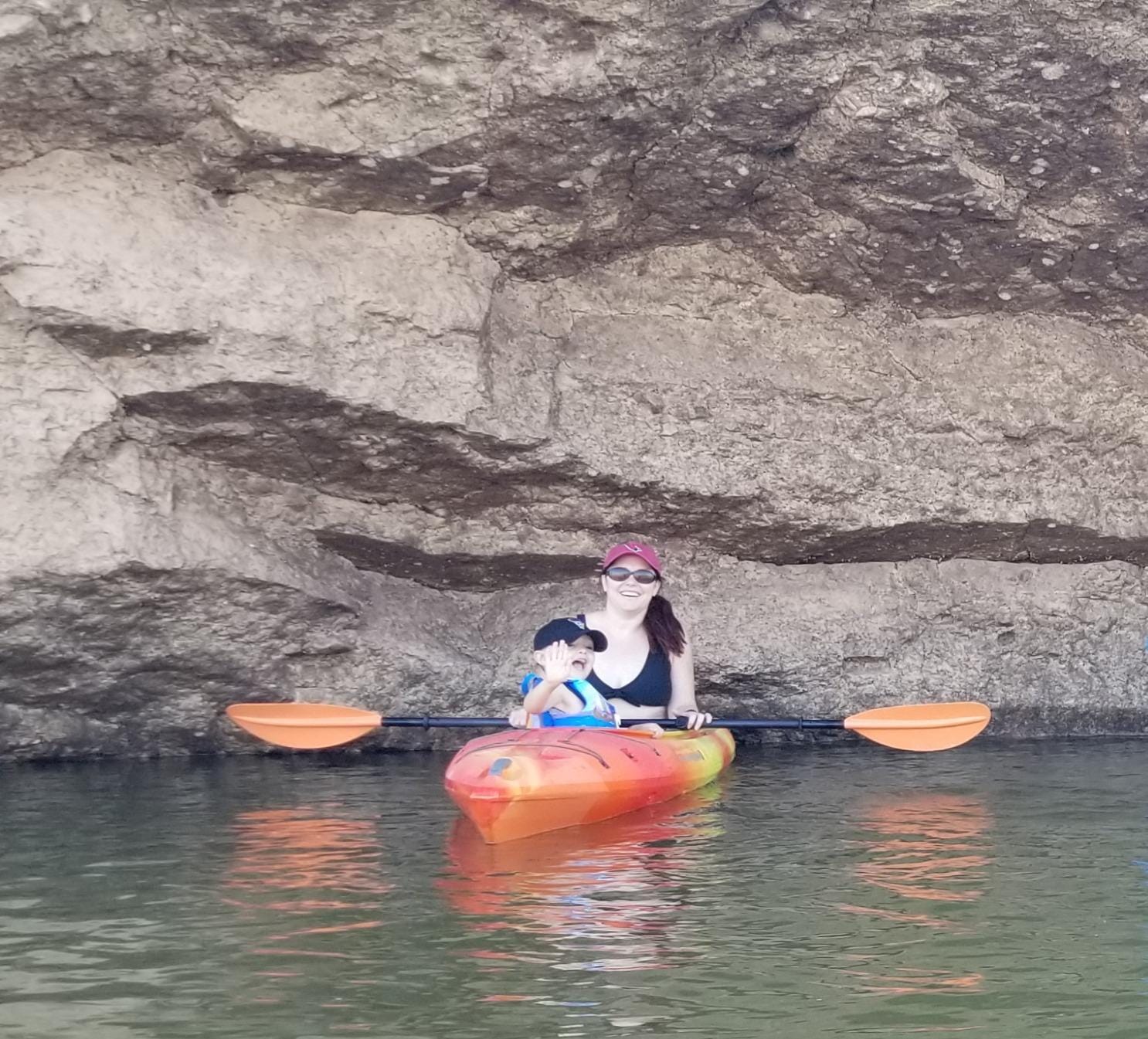
What I did not expect was how much the seat matters over a six hour day. The Phase 3 Air Pro uses mesh over honeycomb vented foam, so it breathes and it adjusts without tools. It is also the single most common complaint magnet in reverse: paddlers above six feet and around 200 lb describe the cockpit as snug, and the fit is tightest once you have thick spray-skirt clothing on.
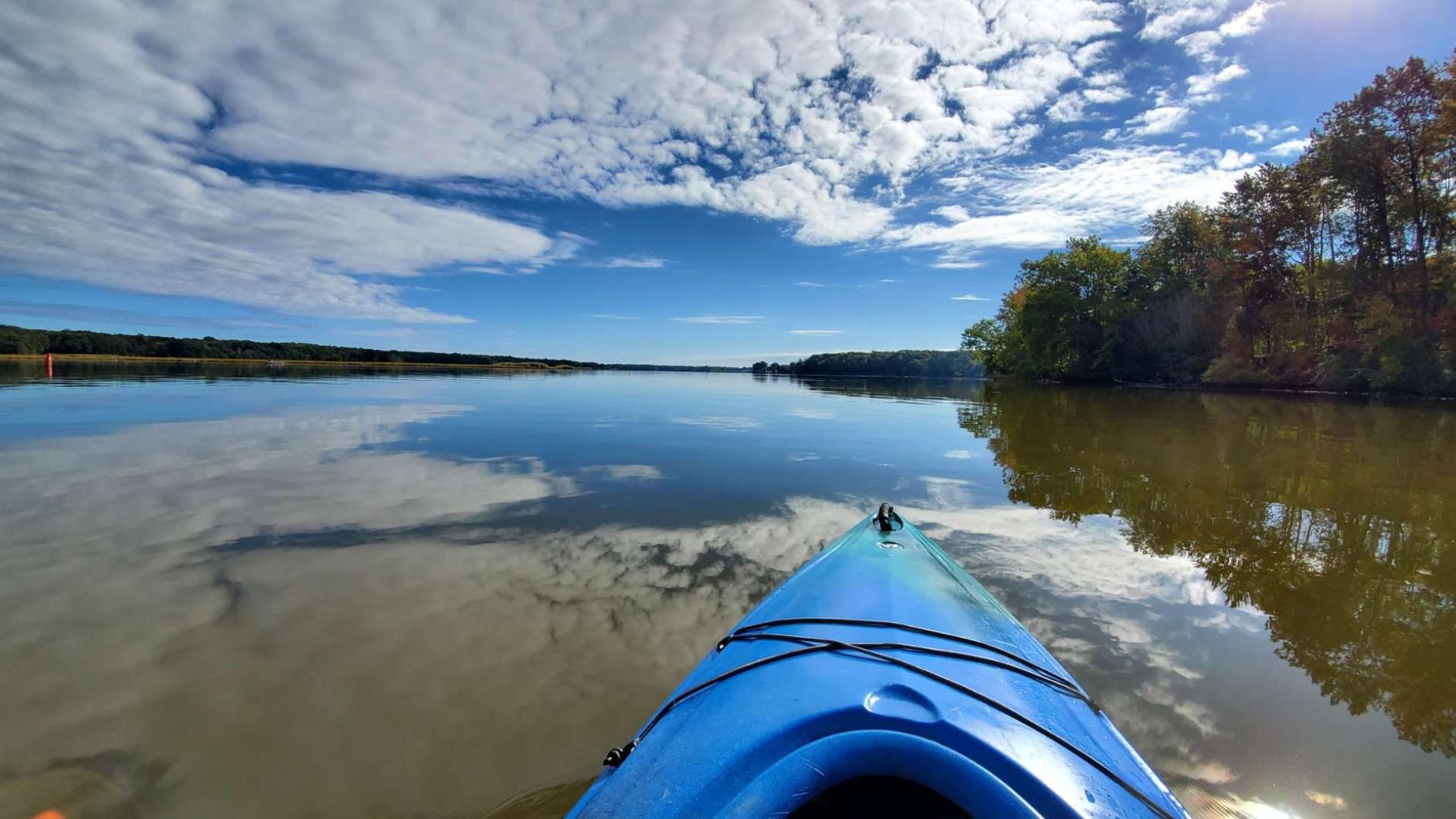
On the lake, the hull tracks cleanly. When a wind band comes across an open bay, the boat holds its line rather than slewing, and the secondary stability from the hull shape keeps you upright in short chop. It is not a boat for big wind and whitecaps, and I would not take it there, but for the sheltered-to-moderate water that makes up most lake paddling, it is unfussy.
The 49 lb hull weight is the real constraint. One person can shoulder it across a short parking lot, but a soft-shoulder cart is near mandatory for anything longer, and I would budget for one. Owners commonly mention thin protective packaging, so inspect the hull and the seat hardware carefully in the first ten minutes.
Who this boat suits
Buy the Pungo 120 if you are a small to medium paddler, you want one boat for both day tours and one or two night camping trips, and you can rig a roof rack or own a cart. The sealed bulkhead hatch and the dry box mean you can carry real food and clothing rather than a dry bag full of dry bags.
If your lake is small and calm and you mostly want to wander, this boat will feel like more than you need, and something lighter or inflatable will be easier to justify.
Who this boat is wrong for
Skip it if you are a larger paddler who found a 12 foot cockpit restrictive, or if you have no way to transport 49 lb. Heavy paddlers will also find the usable load figure well under the 325 lb rating once the hull weight is subtracted, so treat that number as a paddler-plus-gear ceiling rather than a paddler rating.
2. Pelican Sprint 120XR – Best Light Carry and Best Small Lake Boat
Pelican Sprint XR – Sit-in Kayak – Lightweight one Person Kayak – 10.75 ft – Blue
10 foot length
28 inch beam
41 lb hull
300 lb capacity
Deep V-chine with keel extension
Pros
- Lightest hard shell here at 41 lb
- Keel extension gives straight tracking for a 10 foot boat
- ERGOFLEX G2 seat is adjustable and supportive
- Rear hatch plus bungee platform plus stern bulkhead
Cons
- Narrow beam feels tippy on entry and exit
- Threaded day hatch lid is awkward to open
- Sharp-edged plastic footrests can hurt bare feet
With 287 reviews, this is among the most thoroughly owner-tested hard shells in the roundup, and the pattern is consistent: fast, light, well tracking and well equipped for what it costs. At 41 lb it straps to a roof rack without a trailer and one person can genuinely shoulder it from the car to a launch, which solves the single complaint that shows up under every heavier touring kayak on this list.
The deep V-chine hull is the surprise. On a 10 foot recreational boat you would normally expect twitchy handling, but the keel extension gives it a genuinely straight line, and the chine resists the side-to-side push that makes short boats wander across a big lake. It is more responsive than typical 10 footers and it covers ground faster than the length suggests.
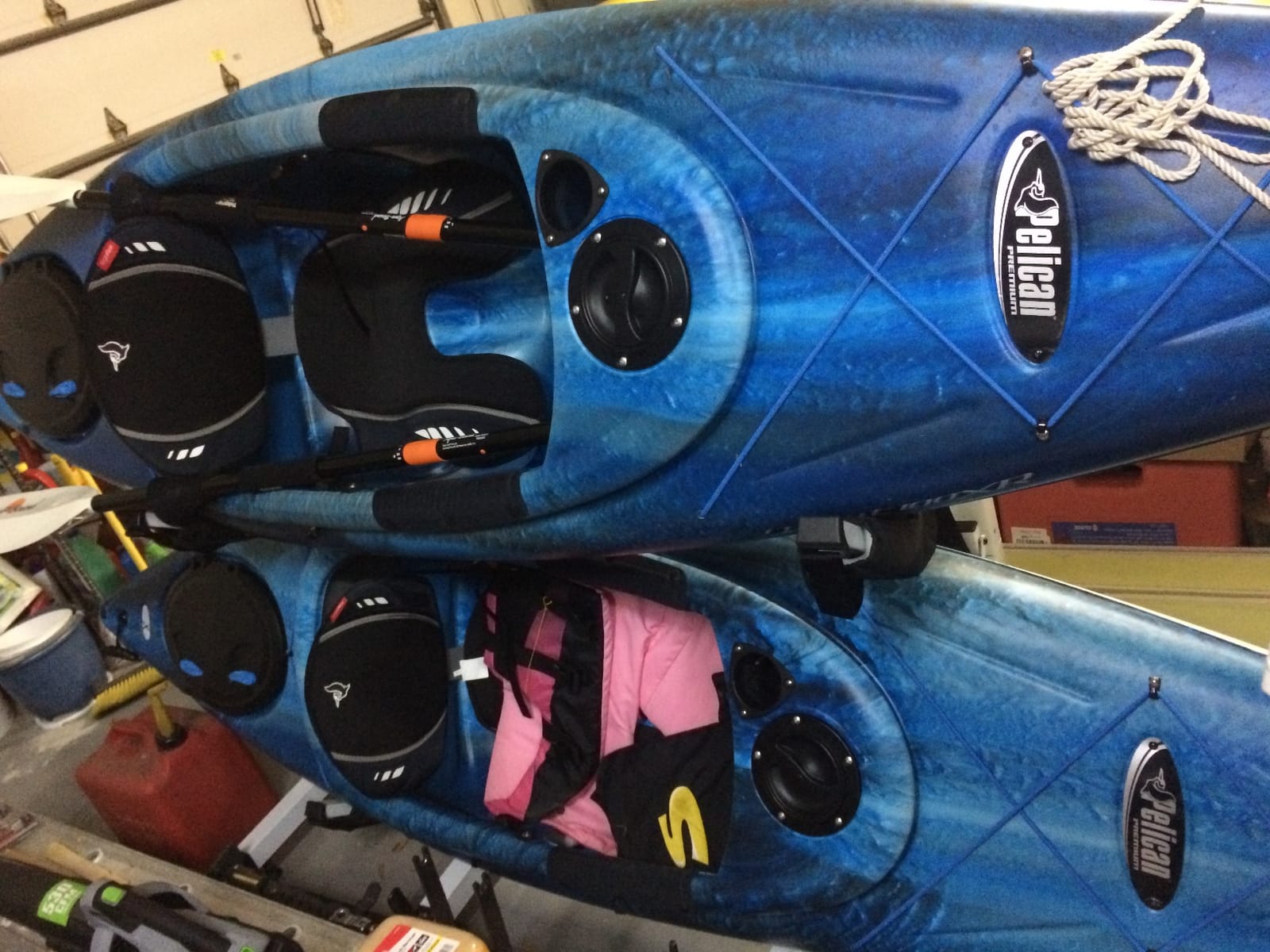
Storage is the other reason this boat keeps appearing on lake lists. The rear quick-lock hatch, the front bungee platform and a four inch day hatch cover day gear, water and a jacket, and the stern bulkhead with side foam blocks adds flotation if you do have to swim. That is more than most 10 foot recreational boats offer, and it means you can do an overnight with a small dry bag rather than a full expedition setup.
Where it earns its criticism is ergonomics and edge cases. The 28 inch beam is narrow, so entry and exit feel less stable than the 300 lb rating implies, and heavier paddlers report feeling top-heavy once the 41 lb hull weight comes out of the rating. The threaded day hatch lid is genuinely fiddly, the front cubby is not a dry compartment and sits between your legs, and the footrests are sharp-edged plastic that you will feel at a shoreline launch.
Who this boat suits
This is the pick for a paddler on a small to mid-size lake who wants real tracking and a dry hatch without a roof rack, a trailer or a second person. It also works well as a fishing boat given the bungee platform and bottle holders, and it fits inside most small garages. Our guide to the best kayaks for fishing covers the gear side of that use case.
If you are under five foot six or so, the seat height and foot brace range will probably suit you well. This is one of the few boats here that reviewers consistently call comfortable right out of the box.
Who this boat is wrong for
It is the wrong choice for an open-water crossing on a wide lake in wind, because ten feet is simply not enough hull to push against a steep chop. Paddlers over roughly 250 lb should also look at a boat with more reserve capacity, since the 300 lb rating includes a 41 lb boat.
3. OCEANBROAD 13.7 ft Inflatable – Best Wide and Forgiving Inflatable
OCEANBROAD Inflatable Sit-in Kayak(NO HIN), 1 Person/2 Person Touring Kayak
13.7 foot length
36 inch beam
51.7 lb hull
308 lb capacity
Drop-stitch floor with removable fin
Pros
- High-density drop-stitch floor paddles like a hard shell
- 36 inch beam is very stable for novice and larger paddlers
- Packs into one bag with pump paddles and seats
- Tracking improves sharply once the fin is fitted
Cons
- Included seat back will not stay zipped upright
- Tracking drops off badly without the fin in wind
- Vinyl wears quickly against jagged rocks
This is the inflatable that stops behaving like an inflatable. The drop-stitch floor gives it a flat, rigid sitting surface and enough stiffness that it holds a course the way a hard shell does, and at 36 inches of beam it sits among the widest and most forgiving hulls here, which is what makes it reassuring for a nervous beginner or a larger paddler. Inflating takes about five to ten minutes and the whole package folds into the supplied bag.
At 13.7 feet it is long enough to glide for a genuine day tour, and the removable directional fin is what makes that possible. Fit it and the boat tracks straight and stops wandering when you pause. Take it off in a sustained breeze and the bow pushes around, and reviewers are clear that this is a relaxed-lake boat rather than an open-water crossing boat.
The recurring complaint is the seat. Buyers report that the included seat back will not stay zipped upright, and a significant number replaced it with a third-party seat straight away. The foam footrest is thin and most owners stopped using it. Both are cheap fixes, but you should plan for them rather than discover them on a launch.
Who this boat suits
It suits a first touring kayak purchase where the priority is confidence, a paddler who wants one boat that works solo or with a partner, and anyone who needs the whole rig to fit in a closet or a small car boot. The three chamber build with Halkey-Roberts valves gives you redundancy if one chamber goes down on a multi-day trip.
It also handles fresh and salt water without complaint, so a coastal lake or an estuary trip is within reach.
Who this boat is wrong for
It is not the right tool for open water in wind, for rocky whitewater where vinyl will abrade, or for anyone who wants a fast boat. Performance drops once the wind is up or the fin is off, and the cockpit can pool water in waves because of the scupper and skirt layout.
4. Perception Expression 11.5 – Best Light Touring and Solo Shoulder Carry
Perception Expression 11.5 – Sit Inside Kayak – Light Touring Kayak with Adjustable Zone Seating – 11.6 ft – Mystic
11 ft 6 in long
25.75 inch beam
44 lb hull
250 lb capacity
One-piece rotomolded polyethylene
Pros
- Fast efficient hull that glides well for a short touring boat
- Zone deluxe seat has extra padding and adjusts on the water
- One-piece rotomolded shell shrugs off rocks and transport scrapes
- 44 lb is manageable for a solo shoulder carry
Cons
- Narrow 25.75 inch beam feels tippy for beginners
- Few deck tie-down points for ratchet straps
- No cup holder
The Expression 11.5 is the most efficient hard hull in this roundup, and if you have done your stroke work it shows immediately. One-piece rotomolded polyethylene means there is no seam to catch and no bulkhead to fail, and the 11 foot 6 inch length glides for a boat you can pick up and carry on one shoulder. Owners describe it as the best short day touring hull they have paddled.
The Zone deluxe seating system is the other story here. It is generously padded, the back is supportive without being intrusive, and the important part is that it adjusts while you are sitting in the boat. On a narrow touring hull that is not a small thing, because a fixed seat in a narrow cockpit is the fastest way to ruin a day.
The trade-offs are all about narrowness. At 25.75 inches of beam this is the tightest boat here, and experienced paddlers rate it as lively and responsive while beginners report needing a few sessions before the tippiness stops bothering them. Secondary stability is good in calm water and fair in small chop. If your lake is a sheltered pond or an inside corner of a bay, that matters very little.
There is a skeg, and it does its job, holding a straight line in crosswind and current. For deck rigging there is not much: a few tie-down points, which owners who car-top flag as the one place they wish Perception had added more, and no cup holder at all. The rotomolded finish is genuinely durable and shrugs off the scrapes that come with carting a boat to a launch.
Who this boat suits
It suits an experienced or athletic paddler who wants speed and a light boat more than forgiveness, and who is under about 250 lb including gear. The 44 lb weight is one of the more genuinely solo-friendly figures here, and the hull is easy to slide onto a shoulder cart.
It is a strong choice for a paddler who covers distance in short bursts and enjoys a responsive boat, and for smaller or sheltered lakes where tracking matters more than stability.
Who this boat is wrong for
A first-time kayaker should look elsewhere. The same 25.75 inch beam that makes it efficient is what produces the tippiness that reviewers flag for new paddlers, and a narrow slalom on an unfamiliar lake is not a confidence builder. It is also a single-seat boat with a 250 lb ceiling, which leaves little margin for a partner or a heavy gear load.
5. Wilderness Systems Pungo 125 – Best for Larger Paddlers and Long Days
Wilderness Systems Pungo 125 | Sit Inside Recreational Kayak | Features Phase 3 Air Pro Comfort Seating | 12′ 6″ | Mango
12 ft 6 in long
29 inch beam
53 lb hull
325 lb capacity
Sealed bulkhead rear Orbit hatch
Pros
- Best-in-class speed and tracking in its class
- Sealed bulkhead Orbit hatch gives real dry storage
- Roomy cockpit fits a 6 foot 1 inch 205 lb paddler
- Balanced stability without giving up performance
Cons
- 53 lb is a hard solo lift
- Thin packaging leads to scuffs in transit
- Dashboard plastics feel cheap
The Pungo 125 is the boat to buy if you are a bigger paddler than the average shopper and you have been disappointed by the fit in a 12 foot cockpit. Owners report that a 6 foot 1 inch, 205 lb paddler fits it properly, with real legroom and a Phase 3 Air Pro seat that stays comfortable over a full day. That is the single most common reason this hull gets recommended to a friend.
It is also the highest rated hard shell here, and for the same reason the Pungo 120 is the top pick: the hull glides and tracks. At 12 foot 6 inches with a 29 inch beam, the compromise is close to ideal on flat water. It holds a line in a crosswind without feeling locked up in flat water, and the extra four inches over the Pungo 120 buys noticeable glide on longer crossings.
Storage is the same well-judged layout as the smaller Pungo. The Pungo dashboard with its removable dry box, two cup holders, Slidetrax rail and battery recess sits within reach, and the rear Orbit hatch with a sealed bulkhead keeps a change of clothes dry on a two or three night trip. For a lake loop with campsites that is enough; you would add a dry bag for anything longer.
Who this boat suits
It suits mid to larger paddlers who want one boat for day touring and short camping trips and who can get 53 lb onto a roof rack or into a cart. The cockpit volume is the differentiator, and taller paddlers who felt cramped in a 12 foot boat tend to feel the difference immediately.
It is also a strong first serious kayak. Owners recommend it to beginners who intend to keep paddling, because it is stable enough to learn on and good enough that you never outgrow it.
Who this boat is wrong for
If you cannot manage 53 lb solo, this is the wrong boat, and there is no version of that problem you can solve with technique. It is also more than most paddlers need on a small pond, where the extra length mostly means more boat to drag across a parking lot. A few owners report a missing skid plate screw on arrival, so check the packaging and hardware before the first paddle.
6. Wilderness Systems Pamlico 135 – Best Tandem That Converts to Solo
Wilderness Systems Pamlico 135 | Sit Inside Recreational Kayak | Tandem Kayak | 13′ 6″ | Mango
13 ft 6 in long
31 inch beam
75 lb hull
500 lb capacity
Tandem convertible with rear dry hatch
Pros
- Glides effortlessly and holds a straight line with no pull
- Phase 3 AirPro seats are comfortable enough to forget
- Converts from tandem to solo quickly
- Rear dry hatch and bulkhead foam add storage and buoyancy
Cons
- 75 lb needs a cart or a second person at the launch
- Cup holders only reliably hold cans
- Occasional packaging and assembly quality complaints
One boat that does two jobs is the idea here, and the Pamlico 135 executes it well. The center seat converts in seconds from a full tandem to a solo boat with adjustable footrests set forward, and the 13 foot 6 inch hull is long enough that a solo paddler is not wasting a wide empty cockpit. That combination makes it a favourite for households where one partner paddles and the other does not, or for a boat that gets loaned out.
The rounded hull is the reason it feels fast for a tandem. It accelerates quickly and glides on long strokes, and owners repeatedly say it holds a straight line without pulling to either side, which is the specific complaint that ruins big-lake days in shorter boats. With two people and a loaded centre compartment it is stable enough that a nervous passenger settles quickly.
Comfort is genuinely good. The Phase 3 AirPro ventilated mesh seats with thigh and knee pads and large padded footrests are described by some owners as seats they stop noticing. A 90 inch by 24 inch cockpit fits a six foot paddler comfortably, which is another reason it works as a solo boat.
Who this boat suits
It suits mixed ability crews, families with one confident paddler, and anyone who wants a single boat that can be a tandem on a social weekend and an efficient solo boat on a distance day. The rear dry hatch and stern bulkhead foam make short camping trips realistic, and the 500 lb rating covers two adults with gear.
It is a good fit for a paddler with a roof rack and a helper at the launch, since the weight is the limiting factor rather than the handling.
Who this boat is wrong for
A solo paddler who has to carry the boat to the water alone should rule it out. At 72 to 75 lb it is not a shoulder carry, and a full-size kayak cart becomes essential rather than optional. It is also overkill for small sheltered water where you would be dragging more boat than you need, and the small cup holders will frustrate anyone carrying a large bottle.
7. Aqua Marina Tomahawk AIR-K – Best Inflatable for Longer Trips
Aqua Marina Tomahawk Air-K Inflatable Touring Kayak, 2 Person, 14 Ft 5 In
14 ft 5 in long
31 inch beam
44.8 lb hull
462 lb capacity
Full drop-stitch build rated to 10 PSI
Pros
- Genuinely stiff drop-stitch feel for an inflatable
- Sets up in about 10 minutes and packs into a backpack
- Three air chambers add redundancy
- High backrest seats with storage pockets
Cons
- Seam bulging and occasional hull seam leaks reported on some units
- More affected by wind than a rigid kayak
- Paddles not included
At 14 foot 5 inches this is the longest boat in the roundup, and among inflatables that length buys real glide. The full drop-stitch build rated to 10 PSI feels solid under the paddle rather than springy, and the result is an inflatable that covers ground at a pace most inflatables cannot. If your lake is big enough that a shorter inflatable would have you paddling all day, this is the one that changes that.
Setup takes about ten minutes with the double action pump, and the whole thing packs into the included backpack, which means a solo paddler can carry the whole rig to a remote launch over one shoulder. Three air chambers mean one puncture is an inconvenience rather than the end of a trip, and the deck shield splash guards at bow and stern keep water off your face when the wind is up.
Build quality consistency is the weak point and reviewers are honest about it. European buyers report seam bulging at the valve joins, leaks at the hull-to-tube joins, and visible glue along the bow and stern seams. If you buy it, inflate it fully at home before you trust it on a trip, and check the seams under pressure.
Who this boat suits
It suits a paddler who wants touring speed in a packable format, is happy setting up at the shore, and is likely to use it solo given the space it takes up with two adults aboard. The high backrest seats with storage pockets make it a comfortable boat for long sitting days, and the adjustable footrest helps with that.
It is a good two-person boat for relaxed trips with light gear rather than loaded multi-day touring, where the wind sensitivity of a soft hull becomes a problem.
Who this boat is wrong for
It is the wrong pick for anyone on an exposed lake who paddles in wind above a light breeze, because a soft hull with a lot of beam is exactly the combination that gets pushed around. It is also the wrong choice for a person who wants a turn-key boat with no assembly, and for rocky shorelines where the seams are exposed to abrasion.
8. BEYOND MARINA Adventurer 12.5 – Best Fast Setup and Solo Carry
Beyond Marina Inflatable Kayak 2 Person – Drop Stitch Floor Touring Kayak
12.5 foot length
36.5 inch beam
27.5 lb hull
440 lb capacity
Drop-stitch floor with tri-chamber build
Pros
- Very light at 27.5 lb so it is easy to solo carry
- Inflates in under five minutes with the included pump
- Complete kit with paddles seats footrests fin pump and repair kit
- Double-layered PVC resists punctures
Cons
- Single center fin gives weaker tracking than twin-fin designs
- Shorter 12.5 ft length means less glide than a 14 ft tandem
- Aluminum paddles are heavy over long sessions
This is the most complete package in the roundup and one of the easiest boats to solo. At 27.5 lb it is genuinely carryable on a shoulder for a short walk to a launch, and it inflates in under five minutes with the supplied high pressure hand pump. Everything you need comes in the bag: two adjustable paddles, two EVA padded seats, two footrests, a fin, a pump, a repair kit and the carry bag.
The drop-stitch bottom gives it a rigid feel, and at 36.5 inches of beam the tandem footprint is wide and stable on both calm water and short chop. The tri-chamber construction with reinforced double-layered PVC means a puncture in one section does not end the day. For an inflatable under 28 lb, that combination of rigidity, width and redundancy is unusual.
The limitation is directional control, and it is a design choice rather than a flaw. A single center fin turns the boat well but does not hold a long straight line the way twin fins or a keel do, so on an open lake you will steer more than you would in a rigid 13 foot hull. The 12.5 foot length is also short for touring, which is the other half of the same trade: you turn easily, and you cover ground more slowly.
Who this boat suits
It suits a couple or two families who want one boat, a paddler who wants zero shopping after the purchase, and anyone who wants a tandem they can carry to a launch without a cart. The 440 lb rating covers two adults and a day of gear comfortably, and the included paddles save a real cost at the start.
It is a strong choice for families with a beginner who wants a wide, stable platform and a partner who wants to steer rather than fight the boat.
Who this boat is wrong for
It is the wrong boat for a distance-focused paddler. Anyone covering more than about eight miles a day, or crossing open water where holding a line matters, will find the single fin and short length fighting them. The included aluminum paddles are also heavier than a paddler covering that distance should be carrying.
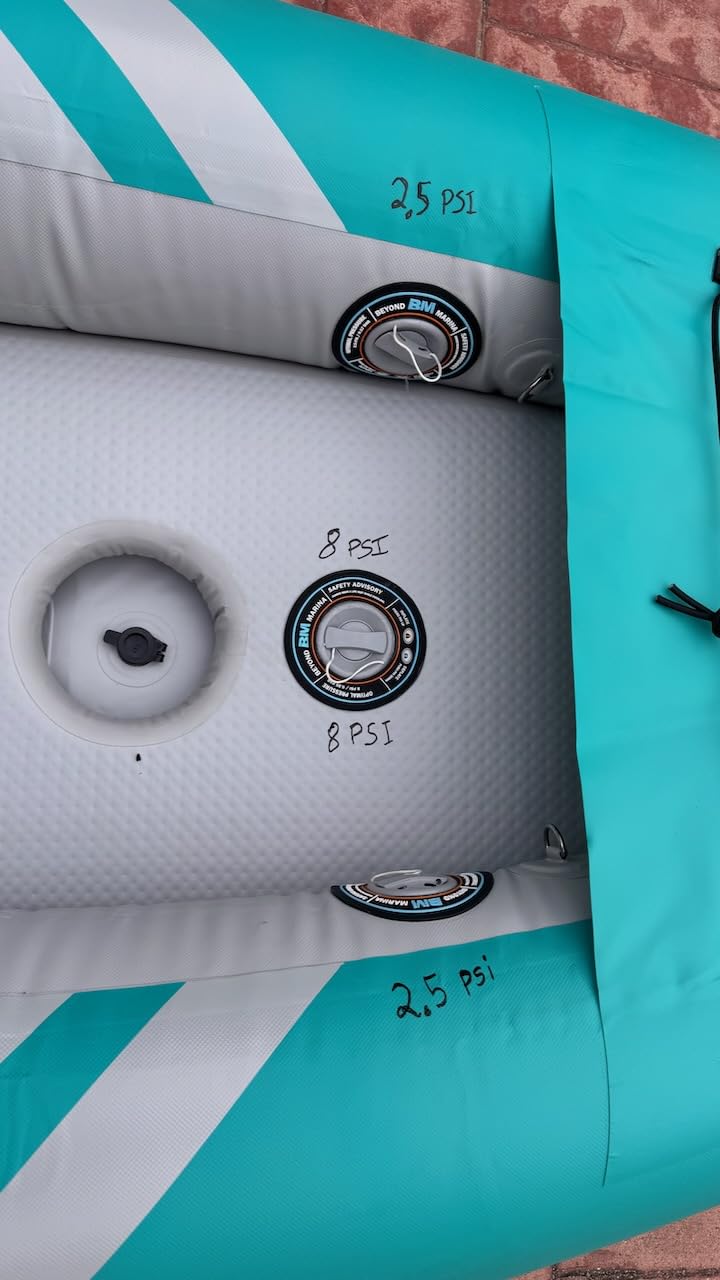
9. Advanced Elements Island Voyage 2 – Best Compact Storage
Advanced Elements Island Voyage 2 Inflatable Kayak, Yellow
11 foot length
37 inch beam
31.5 lb hull
400 lb capacity
Convertible one or two person inflatable
Pros
- 31.5 lb and packs small enough for a car boot or back seat
- 37 inch beam gives a very stable confident platform
- Convertible so it works solo or as a tandem
- 400 lb rating covers two adults plus gear
Cons
- Inflatable rigidity means slower speed and less glide
- Soft floor reduces tracking without the fin
- Wind and chop push the bow around more than a hard shell
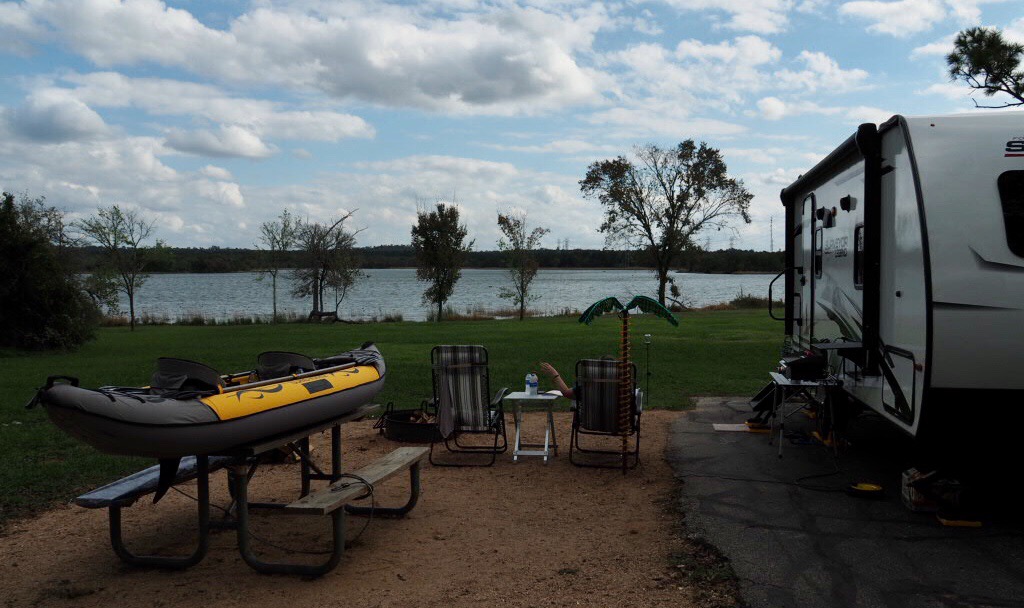
Portability is the entire argument for this boat, and the argument is strong. At 31.5 lb and 11 feet long it fits in a car boot or a back seat, and it can be carried one-handed to a launch. If you live in an apartment, have no garage, or want a boat that lives in a cupboard between trips, that solves the problem that stops most people paddling more than a few times a year.
It is also among the widest boats in the roundup at 37 inches, and owners consistently describe it as confidence-inspiring for beginners. The convertible layout means one person can paddle it alone with the deck adjusted, and two adults plus gear sits inside the 400 lb rating comfortably. It is also a capable fishing platform given the size and buoyancy.
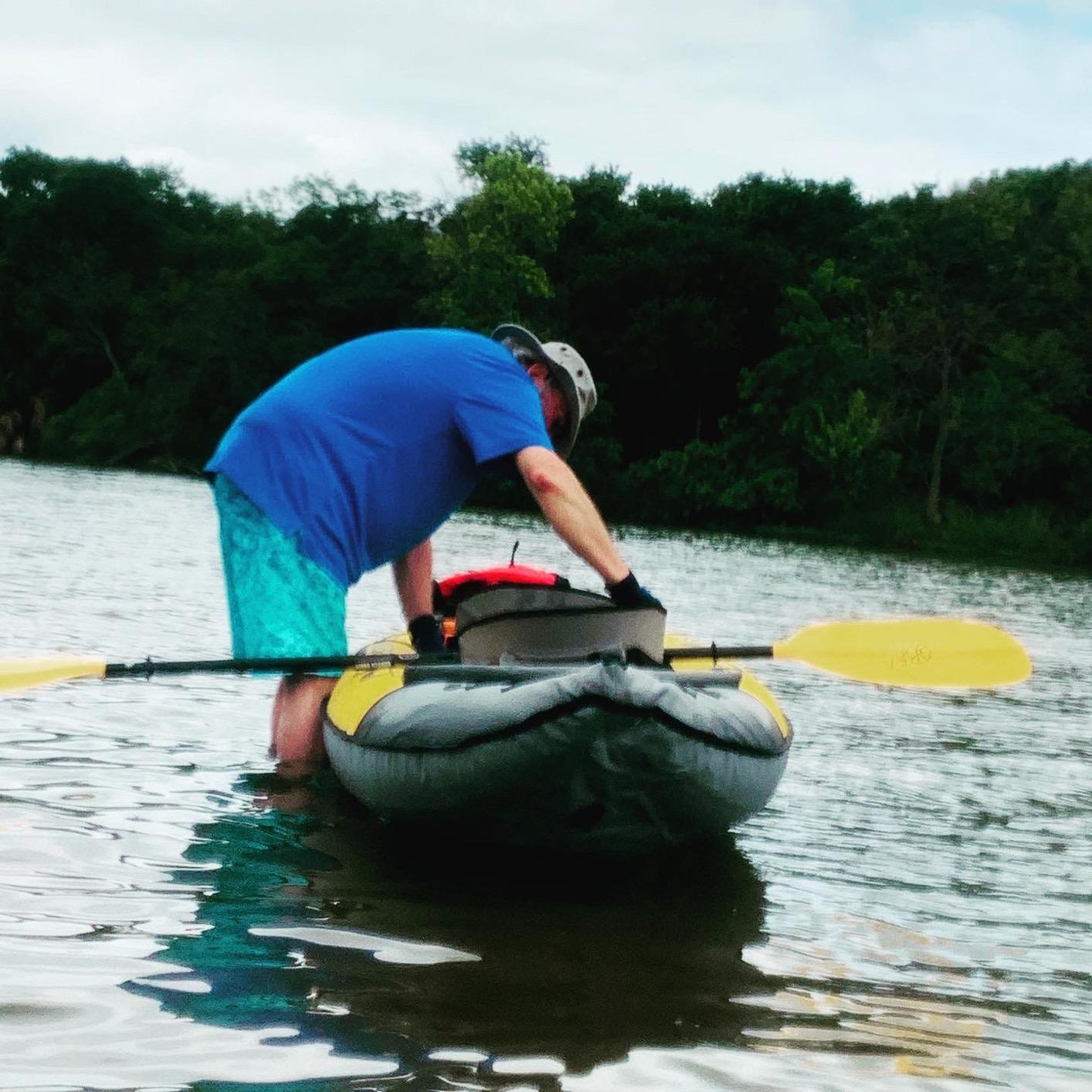
What you give up is performance, and owners accept it knowingly. The soft floor means less glide and slower speed than a hard shell of the same length, the bow moves around more in wind and chop, and tracking depends heavily on the fin being fitted. For relaxed lake outings, casual touring and family days it is entirely adequate, and for covering distance it is not.
Who this boat suits
It suits apartment paddlers, beginners, families, and anyone whose real obstacle is carrying and storing a boat rather than paddling skill. It also works well as a second boat for a household where one person already owns a fast touring hull and the other partner does not.
If you want to test whether you like paddling before committing, this is a low-consequence way to find out, and the multi-year manufacturer warranty on current kayaks reduces the risk further.
Who this boat is wrong for
It is the wrong choice if your lake is large and you want to reach the far shore efficiently, because an 11 foot inflatable will take roughly twice the effort of a 13 foot hard shell for the same distance. It is also the wrong pick for exposed open water, and for anyone who wants gear to stay dry, since there is no enclosed dry storage.
10. Perception Rambler 13.5 – Best for Families, Kids or a Dog
Perception – Rambler 13.5 Recreational Kayak – Sit on Top Tandem Kayak – Storage with Tie Downs – 13.6 ft – Dapper
13 ft 6 in long
34 inch beam
78 lb hull
550 lb capacity
Sit-on-top tandem with center seat
Pros
- Very easy to get in and out of with an open sit-on-top deck
- Stable and forgiving for all skill levels
- Center mold-in seat for a child or dog
- 550 lb capacity takes two adults plus gear
Cons
- 78 lb is the heaviest hull here and needs a cart or two people
- Open deck catches wind and spray
- Open rear storage is not dry and fills in waves
The Rambler solves a problem no other boat here does: getting children or a dog into a kayak without a wrestling match. The sit-on-top deck is wide and open, the entry is a step up rather than a leg over, and there is a molded-in center seat that a child or a dog can use. The 550 lb rating and 34 inch beam make it the most stable tandem in the roundup.
It is also comfortable for long outings. The removable padded seat and backrest with adjustable support means the adults are not sitting on bare plastic all afternoon, and multiple footrest options let two adults of different sizes both get comfortable. Owners describe it as usable on lakes, bays, light surf and slow rivers, and it is made in the USA.
There is a real price for that stability. At 78 lb it is the heaviest boat here, and the open rear storage with tie-downs is genuinely not dry, so it fills in waves or chop. The open deck also catches wind and spray in a way a sit-inside does not, and there are fewer tracking and storage features than a comparable 13 or 14 foot sit-inside.
Who this boat suits
It suits families with children, mixed ability crews, and anyone bringing a dog, because the wide open deck and center seat make it the easiest boat here to load a passenger into. It also works for anglers who want a stable platform and a large open cargo area for a cooler and tackle, the same use case covered in our best kayaks for fishing picks.
It is a good choice for a paddler who has a cart or a second person at the launch and wants a boat that will not tip when a kid stands up in it.
Who this boat is wrong for
Rule it out if you are paddling solo and far from a road, because carrying 78 lb alone is not realistic. It is also the wrong boat for multi-day camping trips where dry storage matters, and for anyone who cares about covering distance efficiently, since the open hull is a drag compared with a long sit-inside.
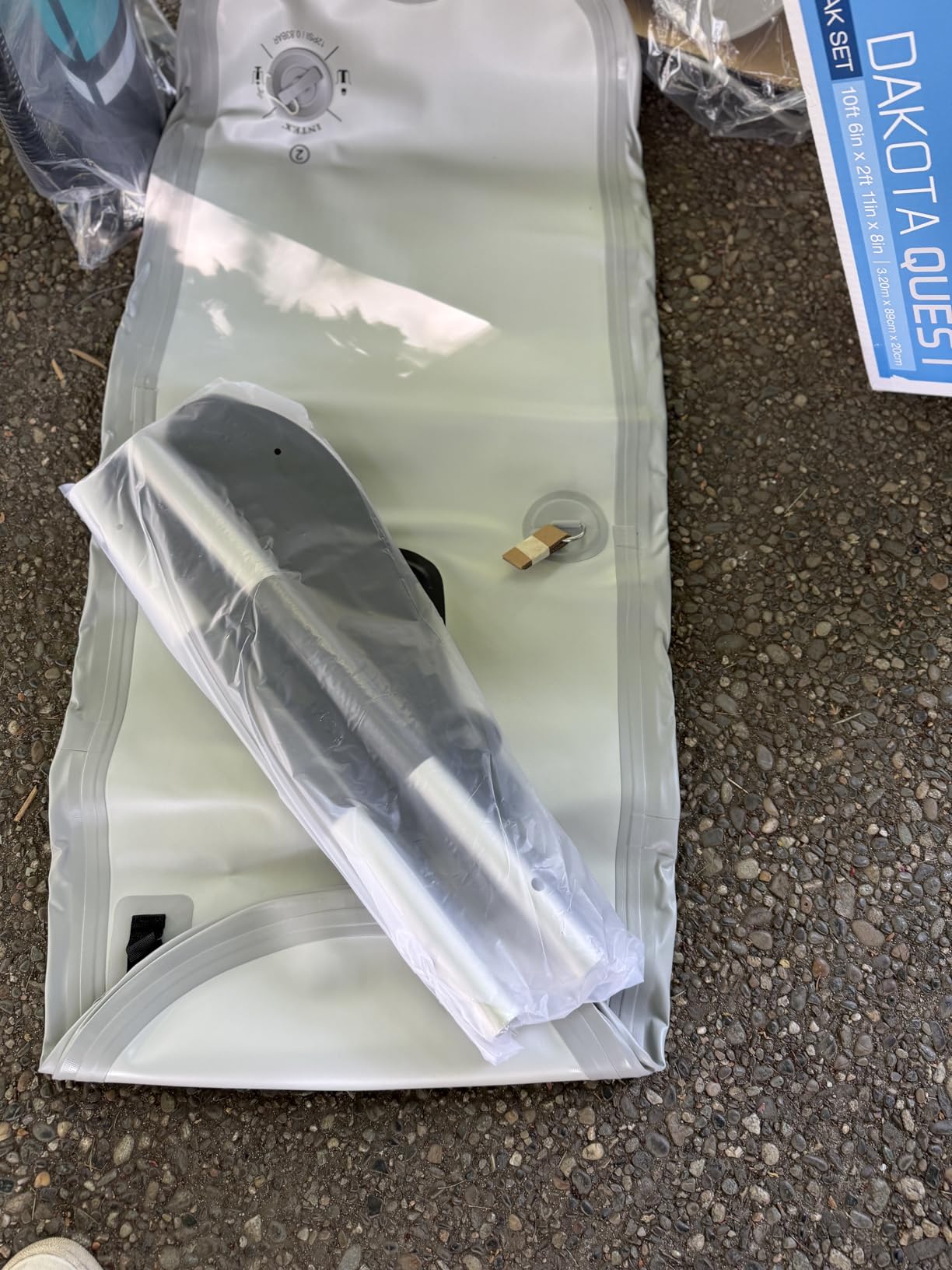
11. Intex Dakota Quest – Best for Fishing From an Inflatable
INTEX 68245EP 10.5ft Dakota Quest Sit-On-Top Inflatable Kayak, Kayak Folds into Backpack, 352lbs Capacity, Hand Air Pump, Paddle, Phone/Action Camera Holder Included
10 ft 6 in long
2 ft 11 in wide
352 lb capacity
Inflates to 12 PSI with large detachable skeg
Pros
- At 12 PSI it feels nearly rigid with no creases or give
- Folds into the included backpack for one person carry
- Large detachable skeg tracks straight for an inflatable
- Rod holders and camera mount are within reach
Cons
- Included pump has a hard to read gauge and unclear instructions
- Rod and camera mounts sit too far forward for taller paddlers
- One experienced paddler found tracking poor even with the skeg
The Dakota Quest is the newest boat in the group and it solves a specific problem well: hard-shell feel without hard-shell weight. Inflating to 12 PSI gives a rigid, crease-free hull that most inflatables at this level cannot match, and the large detachable single-fin skeg gives it straight tracking that reviewers specifically call unusual for an inflatable. Wide deck and safe leaning are also noted by owners.
It folds into the included backpack, so a solo paddler can carry the whole rig to a remote launch. The accessory layout is unusually complete for a mid-range inflatable: two detachable rod holders, a phone and action camera mount, tie-down bungee cords, an elevated back-support seat and a three position footrest, all in an eight piece kit.
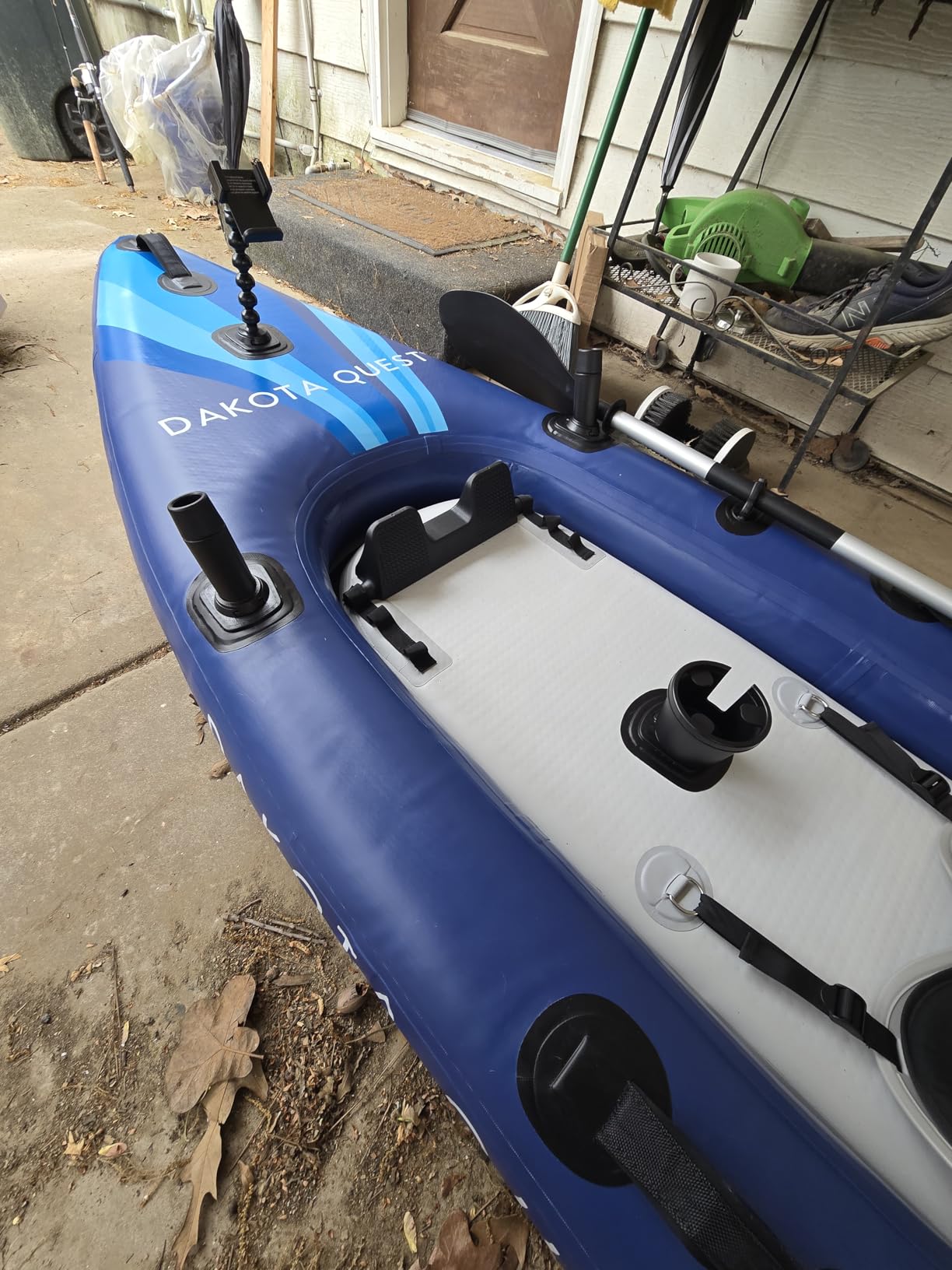
Most of the criticism lands on the included equipment rather than the hull. The high-output pump has a hard to read gauge and unclear instructions, and some owners had to buy a separate inflator. The rod and camera mounts sit too far forward for taller paddlers, the paddle retaining clips are too stiff, and the included aluminum paddle is heavy for a full day. There is also a report of poor tracking even with the skeg fitted.
Who this boat suits
It suits a solo paddler who wants a backpack-portable boat with a genuinely rigid feel, and an angler who wants rod holders and a stable wide deck without carrying a hard shell to the water. The elevated back-support seat is comfortable enough for multi-hour sessions, and the rod holders are genuinely useful rather than decorative.
It is a good day-trip and casual touring boat, and the 352 lb rating gives real headroom for gear and a dog if you outfit it.
Who this boat is wrong for
It is the wrong pick for anyone planning long distances, since ten foot six inches is a short waterline and the boat is more affected by wind than a hard shell. Taller paddlers should be aware that the footrest position has to be chosen before inflating and that the mounts may be out of reach, and you should budget for a better pump and paddle straight away.
12. Intex Challenger K1 – Budget Pick and Best Starter Boat
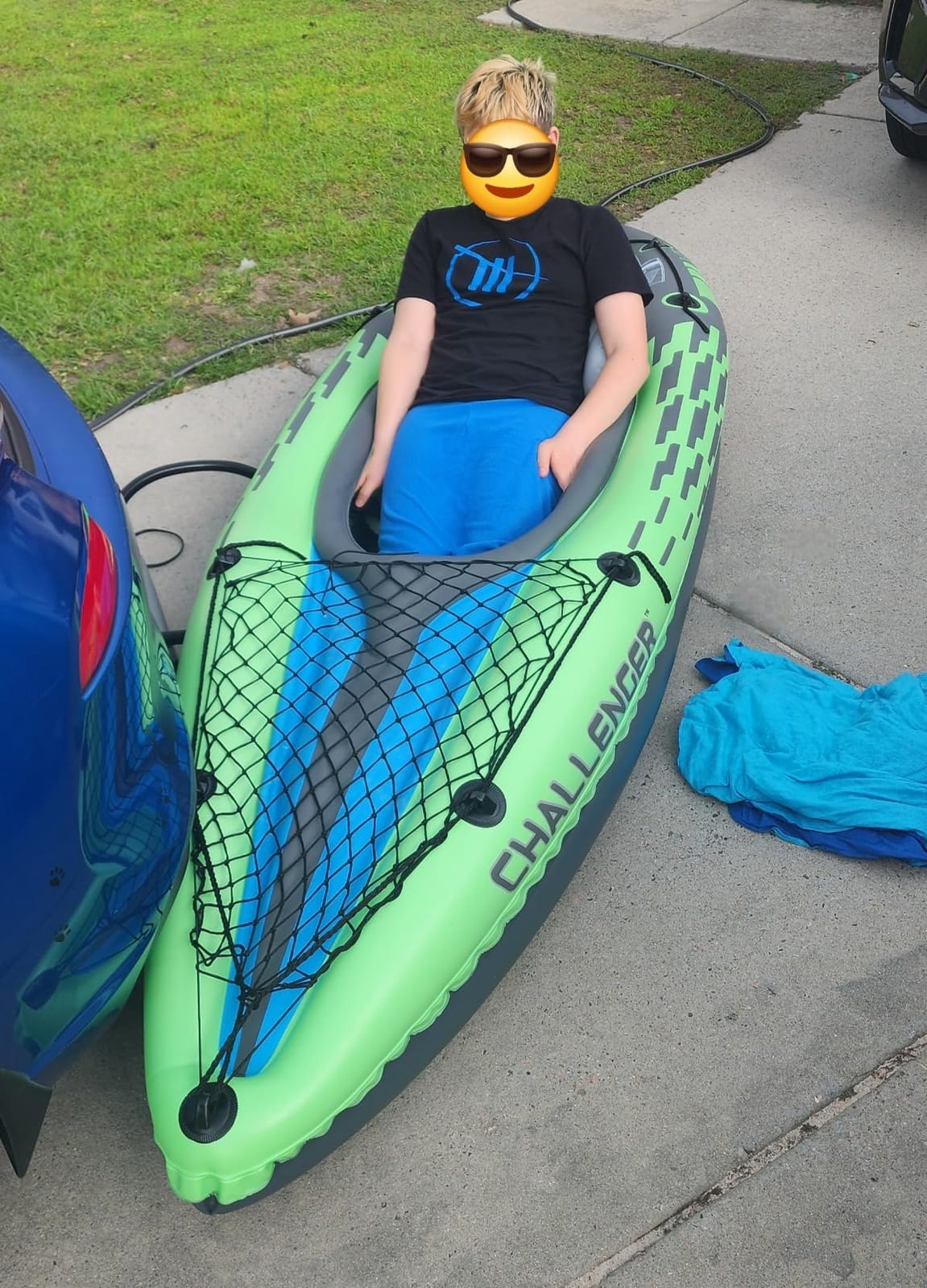
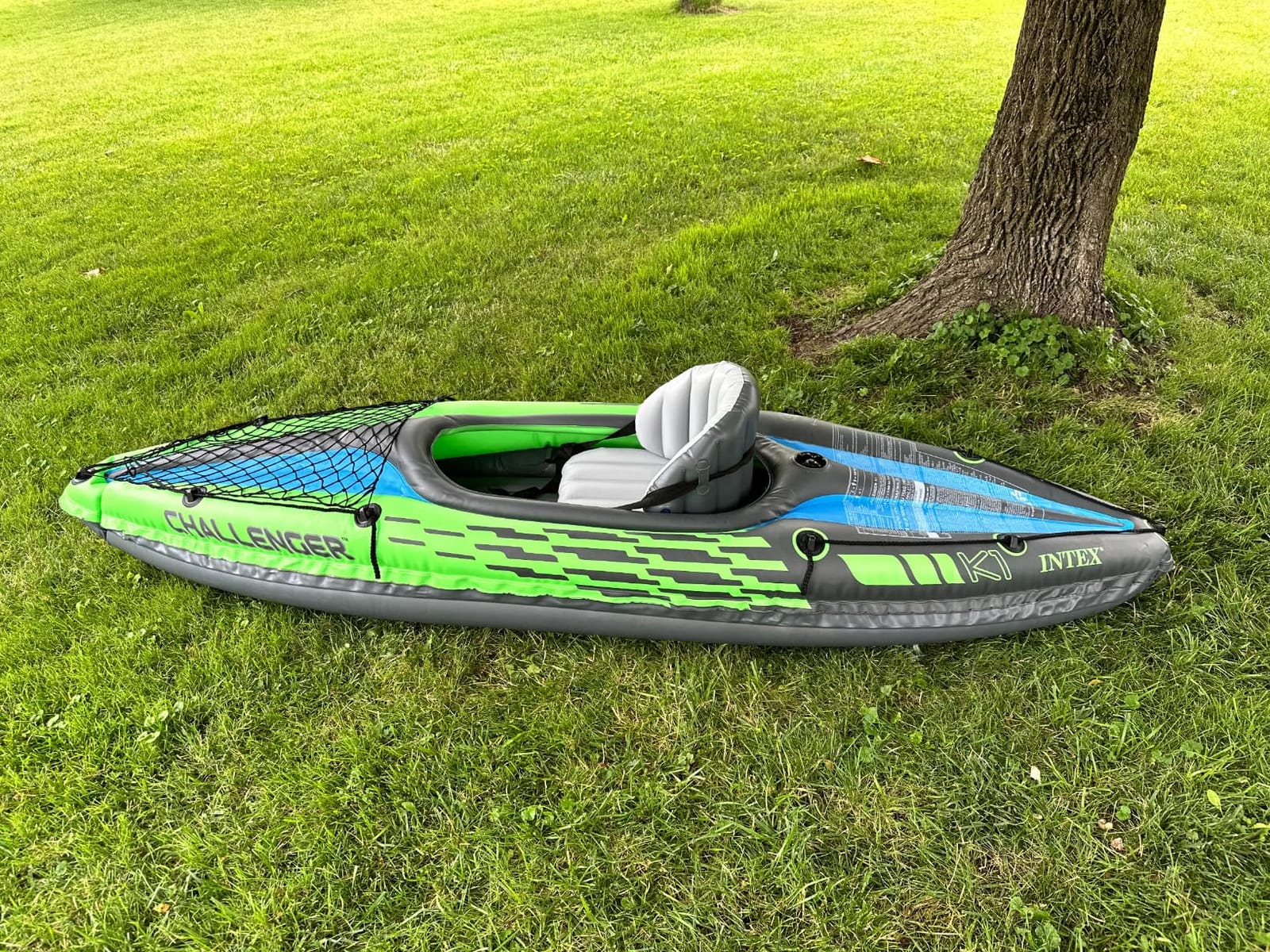
INTEX 68305EP Challenger K1 Inflatable Kayak Set: Includes Deluxe 86in Kayak Paddles and High-Output Pump – Adjustable Seat with Backrest – Removable Skeg – 1-Person – 220lb Weight Capacity
9 foot length
30 inch beam
26 lb hull
220 lb capacity
PVC with removable skeg and cargo net
Pros
- The most extensively reviewed boat here with decades of owner reports
- Genuinely tough for an inflatable and repeatedly survives rocks and abuse
- Light at 26 lb and folds small for storage
- Removable skeg gives reasonable straight line tracking
Cons
- Slow with noticeably more effort per stroke than a hard shell
- Loses track badly without the skeg fitted
- Difficult to fully dry and folds with trapped water
With close to 20,000 ratings, the Challenger has more owner history than every other boat in this roundup combined, and that history is remarkably consistent. It is exceptionally tough for a low-cost inflatable. Owners report years of creek trips, tree jams, dragging across gravel and full seasons of sun exposure without a single puncture, which is not something you can say about most inflatables at any price.
The selling point is not performance, it is consequence. At 26 lb it carries solo, folds to closet size, and gives you a low-risk way to find out whether you like paddling before you spend real money. The removable skeg provides better straight-line tracking than a nine foot inflatable has any right to, and the adjustable seat with a backrest is genuinely usable for a couple of hours.
What you accept is speed. It is slow, it needs noticeably more effort per stroke than a hard shell, and it turns with every stroke, which produces a wandering line unless the skeg is fitted. The dry and fold ritual is tiresome, creases trap water and can smell musty, there is no drink holder, and the seat backrest deflates easily where the valve sits against it.
Who this boat suits
It suits a complete beginner who wants to try paddling for almost nothing, an angler fishing quiet water, and anyone who needs a boat that fits in a closet. It also works as a durable back-up boat for a household that already owns a proper touring hull, because it will not be the boat that fails you.
If you are solo, under 220 lb, and paddling calm lakes or mild rivers, it will do what you need for a couple of hours at a time.
Who this boat is wrong for
It is the wrong boat for touring in any real sense. At nine feet with a soft hull, a 15 mile day becomes a long grind, and the wandering line makes open water uncomfortable. It is also a single-person boat with a low capacity, so it does not work as a tandem, and you will want to add a proper paddle and a dry bag for anything past a couple of hours.
Lake Touring Buying Guide: How to Choose Before You Buy
Boat shopping gets easier once you stop reading feature lists and start answering four questions about your own water: how big is the lake, how far do you want to go in a day, what is the worst wind you actually paddle in, and can you get the boat to the water alone. Everything else in this guide hangs off those four answers.
What a touring kayak actually is
A touring kayak is a sit-inside boat, usually 12 to 17 feet long, with a narrower beam than a recreational hull, sealed bulkhead hatches and deck rigging so it can carry multi-day gear and hold a straight line efficiently across open water. The long, narrow hull cuts through water with less drag and better tracking, so you cover more distance per stroke with less fatigue while sealed hatches keep gear dry and add buoyancy. On a lake, that combination is what lets you reach campsites and islands a short recreational hull cannot reach in a day.
Three terms get mixed up constantly. Tracking is how straight a boat goes when you stop correcting. Primary stability is how much the boat rocks when you lean, which is what beginners feel. Secondary stability is what keeps you upright once you are tilted, which is what matters in chop. Rocker is the curve in the hull, and more of it means the boat handles rough water better but is slower and less stable flat.
Touring vs sea kayak vs recreational
The difference between a sea kayak and a touring kayak is mostly a matter of intended water and hull volume. Sea kayaks are built for open ocean with more volume, more rocker, a larger cockpit, spray skirts as standard and bulkheads designed to float a capsized boat. Touring kayaks are built for rivers, lakes and protected coastal water, with a tighter cockpit, slightly less rocker and a setup that works just as well on a campsite launch as on a beach.
Recreational kayaks sit at the other end. They are short, wide and very stable, which makes them easy and safe but slow, and most have open cockpits or limited dry storage. For a lake weekend a recreational hull is often enough. For reaching campsites and crossing open water, the touring hull earns its extra length.
Choosing hull length for a lake
Length is the easiest lever to understand and the hardest to get right. A longer hull glides further per stroke and tracks straighter, but it turns more slowly, weighs more and is harder to carry. A shorter hull is agile and light but wanders across a big lake and fights a headwind.
As a rough guide, ten to eleven feet suits small lakes and short trips where you can paddle across in under an hour. Twelve to thirteen feet is the sweet spot for most day touring and is where the balance between glide, turning and weight sits. Fourteen feet and up earns its length when you are covering eight miles or more in a day, running an open water crossing, or carrying loaded camping gear where efficiency beats agility.
Most paddlers in this roundup cover three to four miles an hour on flat water in a hard shell and closer to two in an inflatable. Multiply that by the hours you actually want to paddle and you have a trip range to check against your lake.
What type of kayak is best for lakes?
For most lakes the answer is a sit-inside touring hull between 12 and 14 feet long with a beam of roughly 25 to 31 inches, a skeg or keel for tracking, and at least one dry hatch. That combination tracks straight, holds up in short chop, stores a night of gear and remains light enough to handle. A wider beam of 34 inches or more gives more initial stability at the cost of speed, and a narrower beam under 24 inches feels twitchy to new paddlers.
Wind, fetch and open-water crossings
This is where lake paddling separates from river and pond paddling, and it is the part most buying guides skip. Fetch is the distance open water between you and the shore you launched from, and it is what turns a gentle breeze into steep chop. A two mile fetch in a light wind builds a short confused sea; the same wind on a narrow river barely moves the surface.
Longer hulls and narrower beams are the answer because they have more waterline to resist side push. A skeg or keel adds directional stability without slowing you down the way a rudder does, and a boat with a skeg holds a line in crosswind where the same boat without one gets pushed sideways. Paddlers report weathercocking as their single biggest frustration on large lakes, and that is what it is.
The practical rule is to know your lake’s exposure before you buy for it, and to treat a boat with a skeg as the minimum for anything wider than a mile. If you plan genuine crossings, look for a boat in the 14 foot range or above, and be honest with yourself about your skills before committing.
Skeg or rudder on flat water
A skeg is a small fin that slides down into the hull. It does nothing while you paddle straight and drops in when you need it, so it costs you nothing on flat water and rescues you in a crosswind. A rudder is a larger blade mounted on the stern, usually controlled by foot pedals, and it steers like a rudder on a boat, which means constant small corrections and more drag.
On a lake, a skeg is almost always the better answer because you do not need active steering, you need resistance to being pushed sideways. A rudder earns its place on a fast sea kayak where you cover distance in a following wind and want instant heading control. The removable fin on an inflatable is a skeg in all but name, and the difference in tracking with and without it is dramatic.
Storage for a three day lake trip
For two nights you need somewhere dry for a change of clothes, a sleeping bag and food. A sealed bulkhead hatch in the stern plus a dashboard dry box usually covers that for one person. For a longer trip, or for two people, you are adding dry bags regardless of what the boat offers, because boat storage is for soft, light, bulky gear and dry bags are for everything else.
Two rules keep a boat tracking straight under load. Keep the heaviest gear amidships and low, and keep your daypack and any water forward or aft rather than at your feet. A touring hull with a dry hatch beats a recreational boat with bungee cords, but a badly packed hull beats neither.
Cockpit fit and sizing
Fit matters more than any feature list, and this is the most consistent piece of advice across every paddling forum we read. A cockpit that is too small gives you numb legs and a poor connection to the boat; too large and you slide around and lose control. Cockpit volume matters as much as width, so a taller paddler needs more volume, not just more leg length.
The most common community heuristic is worth repeating because it resolves a contradiction people run into constantly. Boats under about 12 inches of beam feel twitchy, while around 14 inches is widely regarded as a good balance of tracking and stability for beginners on flat water. The narrow end of the range rewards an experienced paddler with speed, and the wide end rewards a nervous one with confidence. Try before you commit if you can, and demo days are the cheapest way to do it.
Materials, weight and solo transport
Rotomolded polyethylene is heavy, tough, cheap and essentially indestructible, which is why most of the hard shells here use it. Thermoformed composite and ABS laminate boats are lighter and more efficient, and they reward careful handling. Inflatables trade all of that for portability, and the drop-stitch models here come closest to a hard-shell feel.
The forum complaint that appears most often is weight, and it deserves a real answer. Under about 45 lb you can shoulder-carry a kayak to a launch. Between 45 and 60 lb you want a shoulder strap or a kayak cart. Above 60 lb you need a full-size cart and a helper. A cart costs less than most owners expect and it changes how often you go, so treat it as part of the boat rather than an accessory. If you are buying over 60 lb with no cart, be honest about whether you will actually launch it solo.
Safety kit and the 120 rule
Every paddler on a lake should carry a personal flotation device they are willing to wear, a whistle on a lanyard, a bailer or bilge pump, a throw bag, a spare paddle, a paddle float if you are far from shore, and a means of communication. Dress for the water temperature rather than the air temperature, because immersion in cold water is what actually kills paddlers in the field.
The 120 rule is the working practice that follows from that. If the water is 50 to 60 degrees Fahrenheit, treat it as if it is 50 degrees if you are wearing a wetsuit, and 60 degrees if you are not. In practical terms it means dressing for the coldest plausible water rather than the weather forecast, because a paddler in an unexpected capsize has minutes, not the time it takes to walk back to the car.
Who should skip each category
Skip a long narrow touring hull if you are new to paddling, because you will be fighting secondary stability on day one. Skip a wide tandem if you are a fast solo paddler covering distance, because the extra beam is drag. Skip any boat over 60 lb if you have no cart and no second person. Skip a hard shell entirely if storage at home is the problem, because a boat you cannot keep indoors is a boat you will not use. And skip any of these if your lake is a sheltered pond and you only ever paddle two miles from the ramp, because a simpler boat will serve you better.
Frequently Asked Questions
What type of kayak is best for lakes?
For most lakes the best choice is a sit-inside touring hull between 12 and 14 feet with a beam of roughly 25 to 31 inches, a skeg or keel, and at least one dry storage hatch. That combination tracks a straight line, handles short chop, stores a night of gear, and stays light enough to launch. A wider recreational hull is easier to learn in but slower, and a narrower hull is faster but twitchy.
What is the 120 rule for kayaking and how does it work?
The 120 rule says that if the water temperature is between 50 and 60 degrees Fahrenheit, you should treat it as 50 degrees if you are wearing a wetsuit and 60 degrees if you are not. It exists because cold water shock can impair your movement and decision making within minutes of an unexpected capsize. Practically, it means dressing for the water temperature rather than the air temperature on the shore.
What is the difference between a sea kayak and a touring kayak?
Sea kayaks are built for open ocean, with more hull volume, more rocker, a larger cockpit, a spray skirt as standard, and bulkheads designed to float a capsized boat. Touring kayaks are built for rivers, lakes and protected coastal water, with a tighter cockpit, slightly less rocker, and a setup that works equally well on a campsite launch as on a beach. On a lake the touring hull is usually the more comfortable and more efficient choice.
What are the best touring kayaks?
The best touring kayaks for lakes in this roundup are the Wilderness Systems Pungo 120 as the all-rounder, the Pelican Sprint 120XR for light solo carry, the Wilderness Systems Pungo 125 for larger paddlers and long days, the Wilderness Systems Pamlico 135 for a tandem that converts to solo, and the OCEANBROAD drop-stitch inflatable for a wide and forgiving platform. Each was picked for tracking, stability, storage, comfort and portability rather than price.
How long should a touring kayak be for lake touring?
Ten to eleven feet suits small lakes and short trips. Twelve to thirteen feet is the sweet spot for most day touring and balances glide, turning and weight. Fourteen feet and above earns its length when you cover eight miles or more in a day, run an open water crossing, or carry loaded camping gear. Most paddlers cover three to four miles an hour in a hard shell, so match the length to the distance you actually want to cover.
Do I need a skeg or a rudder on a lake touring kayak?
On a lake, a skeg is usually the better choice. It stays retracted while you paddle straight, so it adds no drag, and it drops in when a crosswind tries to push you sideways. A rudder gives constant active heading control, which is useful on a fast sea kayak running in a following wind, but on flat water it means constant small corrections. Inflatable fins act as skegs and the difference in tracking with and without one is dramatic.
How much storage do I need for a 3 day lake trip?
For two nights you need a dry place for a change of clothes, a sleeping bag and food. A sealed bulkhead stern hatch plus a dashboard dry box covers that for one person. Beyond two nights, or for two paddlers, add dry bags regardless of the boat, because built-in storage suits soft light bulky gear while dry bags protect everything else. Keep heavy gear amidships and low to protect tracking.
What size touring kayak fits a 6 foot paddler?
For a 6 foot paddler, look for a boat with a cockpit of roughly 90 inches and enough cockpit volume, which usually means a mid-size touring hull such as the Wilderness Systems Pamlico 135 or a Pungo 120. Very narrow low-volume hulls suit smaller and lower framed paddlers, and taller or heavier paddlers should step up to a roomier cockpit rather than fighting a snug one.
Are inflatable touring kayaks good for lakes?
Yes, for relaxed lake touring and for anyone whose real constraint is carrying and storing a boat. Drop-stitch models such as the OCEANBROAD and the Aqua Marina Tomahawk AIR-K feel close to a hard shell and cover ground far better than an entry-level inflatable. The trade-offs are wind sensitivity, slower speed, and the assembly and drying routine. Avoid them for open water in wind or for covering long distances quickly.
How heavy should a touring kayak be for solo car-topping?
Under about 45 lb you can shoulder-carry the boat to a launch. Between 45 and 60 lb you want a shoulder strap or a kayak cart, and above 60 lb you need a full-size cart and a helper at the launch. The community complaint about heavy touring kayaks is really a complaint about carrying, so budget for a cart as part of the boat. If you cannot manage the weight solo, choose a lighter hull or an inflatable that packs into a bag.
Final Verdict: Best Touring Kayaks for Lakes in 2026
The Wilderness Systems Pungo 120 is the pick. It glides, it tracks, it holds a line in a crosswind, and the sealed bulkhead hatch plus the Pungo dashboard mean it works for a day tour and a two night camping trip without modification. The runner-up is the Pelican Sprint 120XR, which gives up some length and some capacity and gets you a 41 lb hull that one person can genuinely get to the water alone.
If your lake is sheltered and you want forgiveness over speed, the OCEANBROAD inflatable gives you a 36 inch beam and a drop-stitch floor in a bag. If you are a bigger paddler, step up to the Pungo 125 rather than squeezing into a narrow cockpit. And if you carry kids or a dog, the Perception Rambler is the easiest boat here to load a second passenger into, provided you have a cart.
Whichever one you choose, take a cart if the boat is over 45 lb, dress for the water temperature rather than the weather, and match the hull length to the distance you want to cover each day. Those three decisions matter more than any feature on the spec list, and they are the difference between a boat in a garage and a boat on the water all season.