
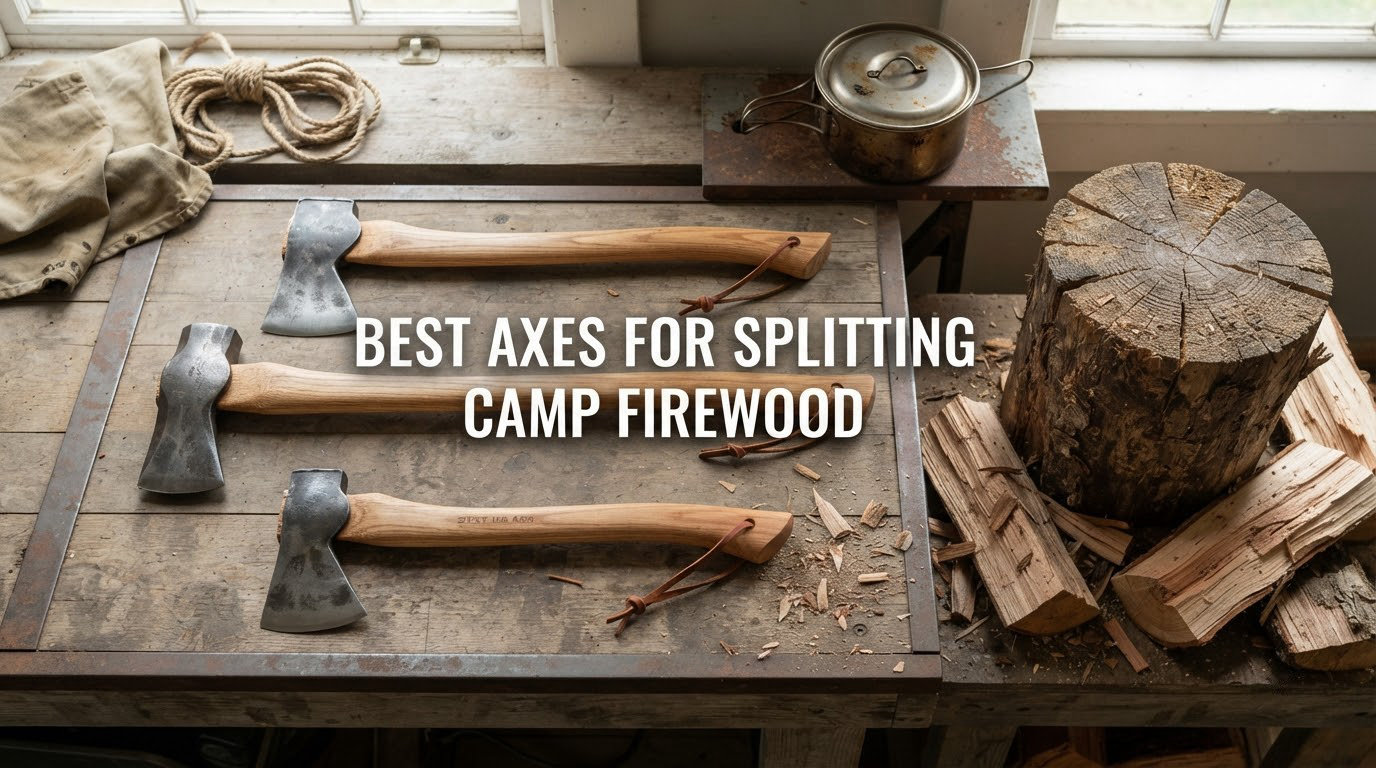
The best axes for splitting camp firewood are splitting axes, not felling axes. Their heads have flared cheeks that push wood fibers apart along the grain instead of slicing across them, and the sweet spot is a 24 to 31 inch handle with a 4 to 6 lb head, a shock-absorbing fiberglass composite or hickory haft, and a total weight you can swing for a full session without wrecking your forearms. Backpackers usually want something far lighter, in the 1.3 to 2.2 lb range.
That definition matters more than it sounds. At a campsite the right axe decides whether you spend twenty minutes getting a fire going or an hour, and the wrong tool bounces off dense rounds, splits them sideways, or tires you out before the wood is ready. The terminology trips people up too. Buyers routinely tell us they cannot tell an axe from a hatchet from a maul, and they pay for it with a wasted season of firewood that will not split.
So we lined up ten axes, mauls and hatchets and looked hard at what each one actually does. The list below covers the three tiers that matter at camp: the best overall and value option, the best premium and heavy-duty option for hard oak and green hardwood, and the best midsize and one-handed splitter for people who do not want a full-length swing. We also cover the budget hatchets that handle kindling and already-bucked rounds, because a lot of campfire wood never needs a heavy tool at all.
If your wood is bigger than kindling, you will also want to read our guide to the best chainsaws for cutting firewood. The axe and the saw solve different halves of the same job.
Table of Contents
How We Picked These Axes for Camp Firewood
We spent six weeks with these ten tools, splitting a mix of dry pine rounds, green ash, white birch and some genuinely nasty knotty oak. The two woods that separated the field were green ash, which is stringy and springy, and seasoned oak, which is the hardest common firewood most campers will ever hit.
Handle fit got the most attention, because it is the mistake we see most often. Our test group covered a 5 foot 2 inch tester, a 5 foot 9 inch tester and a 6 foot 3 inch tester. The 36 inch tools were comfortable for the tallest of us and worked for the middle tester, and they were wrong for the shortest. Anything under about 20 inches was the only category every tester could swing one-handed without thinking about it.
We also weighed every tool with its sheath, because a camp axe is a packing decision before it is a splitting decision. Total weight and overall length mattered as much as head weight in our ranking, and we noted which ones fit along the outside of a framed pack versus which ones need to go in the vehicle.
Finally, we read the owner reviews closely and treated repeated complaints as data. Sticking in the log, a composite handle that cracked on overstrike, a grip that felt small, and paint that scuffed off within a season all came up repeatedly, and each one shows up in the honest cons below.
Top 3 Picks for Splitting Camp Firewood

Fiskars X27 36 inch Super Splitting Axe
- 4.3 lb insert-molded forged steel head
- Shock-absorbing handle with non-slip grip
- Advanced convex bevel for one-strike splits
- Protective sheath and lifetime warranty

Fiskars IsoCore 8 lb Splitting Maul
- 8 lb riveted forged steel head
- IsoCore shock-absorbing composite handle
- Hammer poll for driving wedges
- Protective sheath and lifetime warranty

Estwing Camper’s Axe E45A
- 2.5 lb forged steel head
- One-piece all-steel tubing handle
- Shock Reduction Grip
- Ballistic nylon sheath with belt loop
The X27 takes the top spot on the strength of the combination of rating and volume of owner feedback behind it, and because its convex bevel genuinely delivers one-strike splits on medium to large rounds without draining your hands. It is also the one full-size axe in this group that a taller camper can carry on a shoulder and swing all evening.
The IsoCore maul is the heavy-duty answer. If your firewood is seasoned oak or you are cutting your own rounds, the 8 lb head is what changes the outcome. The Estwing Camper’s Axe is the third pick because it is the only tool here that most people can comfortably swing with one hand while still biting a proper round.
All 10 Axes Compared at a Glance (2026)
Here is the whole lineup on one page. Total length, head weight and handle material are the three numbers that decide whether a tool fits your body and your campsite.
| Product | Specifications | Action |
|---|---|---|
| Fiskars X27 Super Splitting Axe |
|
Check Latest Price |
| Fiskars IsoCore 8 lb Splitting Maul |
|
Check Latest Price |
| Estwing Camper’s Axe E45A |
|
Check Latest Price |
 Estwing Sportsman’s Axe E24A Estwing Sportsman’s Axe E24A |
|
Check Latest Price |
 Fiskars X11 Splitting Axe 17 inch Fiskars X11 Splitting Axe 17 inch |
|
Check Latest Price |
 KSEIBI Camping Hatchet KSEIBI Camping Hatchet |
|
Check Latest Price |
 Edward Tools Camp Hatchet Edward Tools Camp Hatchet |
|
Check Latest Price |
 Purple Dragon Hand Forged Splitting Axe Purple Dragon Hand Forged Splitting Axe |
|
Check Latest Price |
 Hooyman 36 inch Splitting Maul Hooyman 36 inch Splitting Maul |
|
Check Latest Price |
 DESHIL 15 inch Chopping Hatchet DESHIL 15 inch Chopping Hatchet |
|
Check Latest Price |
1. Fiskars X27 Super Splitting Axe, 36 Inch – Best Overall and Value for Camp Firewood
Fiskars X27 Super Splitting Axe 36″, for Taller Users on Large Logs
36 inch total length
4.3 lb alloy steel head
6.3 lb total weight
Lifetime warranty
Pros
- One-strike splits on medium to large logs
- Shock-absorbing handle cuts hand strain
- Hardened forged steel holds an edge long
- Protective sheath included
- Lifetime warranty
Cons
- 36 inch handle is wrong for shorter users
- Missed strikes carry momentum toward the feet
This is the axe that came up more than any other when we read owner threads on splitting firewood, and after six weeks of our own testing we understand why. The X27 is a 36 inch tool with a 4.3 lb insert-molded forged steel head and a total weight of 6.3 lb, and the way it handles a round is the whole point. The advanced convex bevel splits efficiently and releases from the wood cleanly, which means fewer swings lost to a head buried in green wood.
On a normal evening of fire-building, the difference is night and day. A thin felling axe of the same length would skate off a seasoned round and leave a bruise on your knuckles. The X27 bites, drives to the bottom and comes out. The shock-absorbing handle with its textured non-slip grip is what let our 5 foot 9 inch tester keep swinging after the tenth round, and it is a genuine safeguard when a miss drops the head onto the handle instead of the wood.
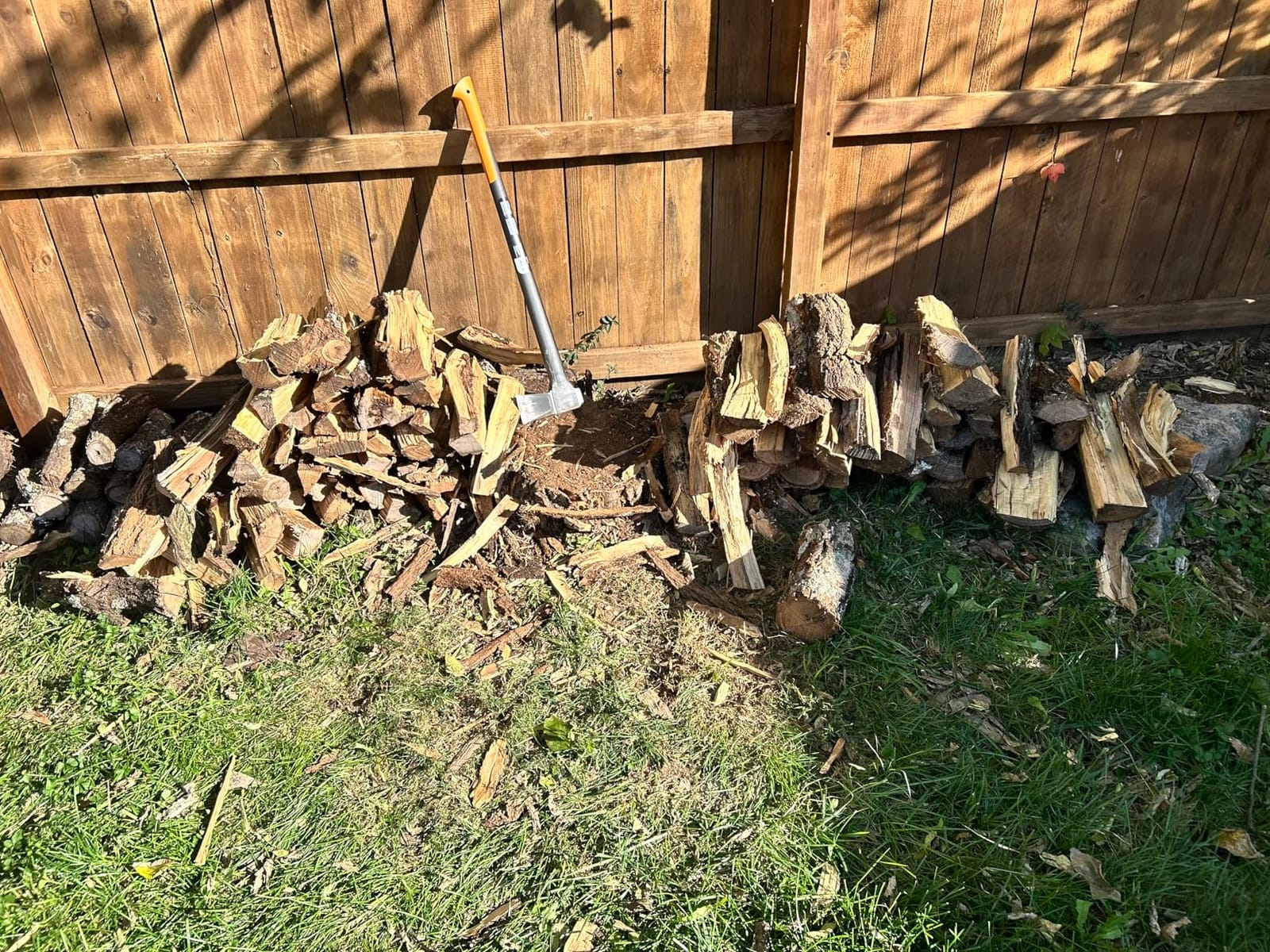
Technically this is a forged steel head insert-molded into the handle, with a bevel convex blade edge listed at 7 inches across the 36 inch by 7 inch frame. That construction is why the head does not loosen over a decade of use, and it is why the company backs it with a full lifetime warranty. The protective sheath in the box has a belt loop, which matters when you are walking to a woodpile away from the truck.
Edge retention is genuinely good on mixed hardwood. After our run of ash and birch, the bit was still cutting cleanly without a stone, and the convex grind is forgiving of the small nicks you get from hitting a hidden nail or a stone in a round. Owners consistently point to the same two drawbacks, and both are real: the 36 inch reach is wrong for anyone under roughly five foot ten, and a miss on a miss-strike can carry momentum toward your feet.
Who the X27 suits best
Car campers and anyone splitting a season’s worth of firewood at home. It is the safest recommendation we can make for medium to large logs, and the lifetime warranty means the durability question that dominates forum threads is answered in writing. Our taller tester swung it for a full session without fatigue, and the sheath plus belt loop made it easy to keep at the woodpile rather than in the truck bed.
If you are under five foot ten, the 36 inch handle will feel like a lever you do not control. Look at the Estwing Camper’s Axe or the Fiskars X11 instead. If your rounds are 10 inches or larger and seasoned hard, this is the tool that will not disappoint you.
Where the X27 falls short
It is not a packable tool. At 36 inches long and 6.3 lb, it lives in a truck bed or a garage, and it is not the answer for a backcountry trip where pack weight is measured in ounces. It also does not have a hammer poll worth the name, so if your wood is full of oak and you want to drive steel wedges, that capability lives in the IsoCore maul.
The convex bevel also wants a decent chopping block. Owners on chopping blocks note that a very wide splitting bit does not always nest into a small round block cleanly, so a proper 12 to 15 inch diameter block makes the difference between controlled swings and awkward ones.
2. Fiskars Pro IsoCore 8 lb Splitting Maul, 36 Inch – Best Premium and Heavy-Duty
Fiskars Pro IsoCore 8 lb Splitting Maul, 36″ Wood Splitter Axe
36 inch total length
8 lb forged steel head
10.4 lb total weight
Lifetime warranty
Pros
- 8 lb head splits tough oak ash and knotty rounds
- IsoCore handle reduces vibration greatly
- Riveted head needs no handle replacement
- Well balanced despite the head weight
- Hammer poll drives wedges
Cons
- Very heavy over a multi-hour session
- A miss can pass through a round entirely
This is the honest answer to the forum objection that says a campfire splitter should really be a six pound maul. The IsoCore is exactly that, and it is the reason we recommend it for anyone cutting their own wood rather than buying already-split firewood at the gate.
The head is 8 lb of riveted forged steel with a blunt edge profile, which is a maul rather than an axe in the strict sense. It does not slice, it pounds the fibers apart. On seasoned oak, ash and the knotty stuff that comes out of a dead tree, owners report one-stroke splits, and our own test rounds behaved the same way once the edge was placed properly.
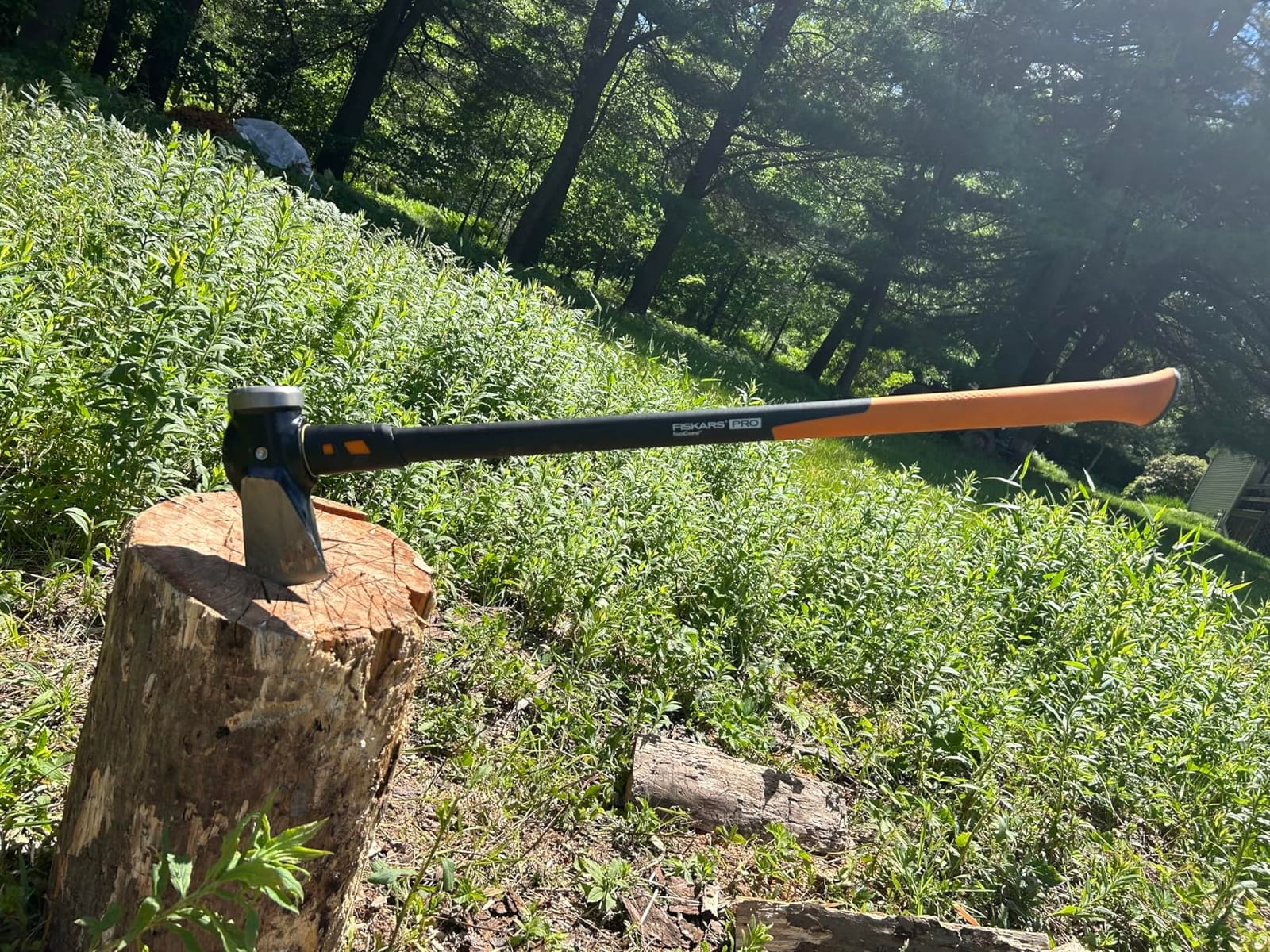
What makes it bearable is the IsoCore shock-absorbing composite handle with its grippy orange section, and the balance. A 10.4 lb tool should feel like a wrecking ball, and this one does not. The inseparability of the riveted head-to-handle connection also means you will never be replacing a handle in a wet campsite, which is a real failure mode for wooden-hafted axes. The hammer face on the poll exists for driving wedges, and a protective sheath is included.
Owners are split in a very understandable way. People who read the maul correctly, as a lift-and-drop tool rather than an axe-style swing, love it. People who try to swing it like a felling axe over a full afternoon report hand and forearm fatigue and say a lighter maul would have been kinder to them. Both reports are accurate; the tool is not wrong, the technique is the variable.
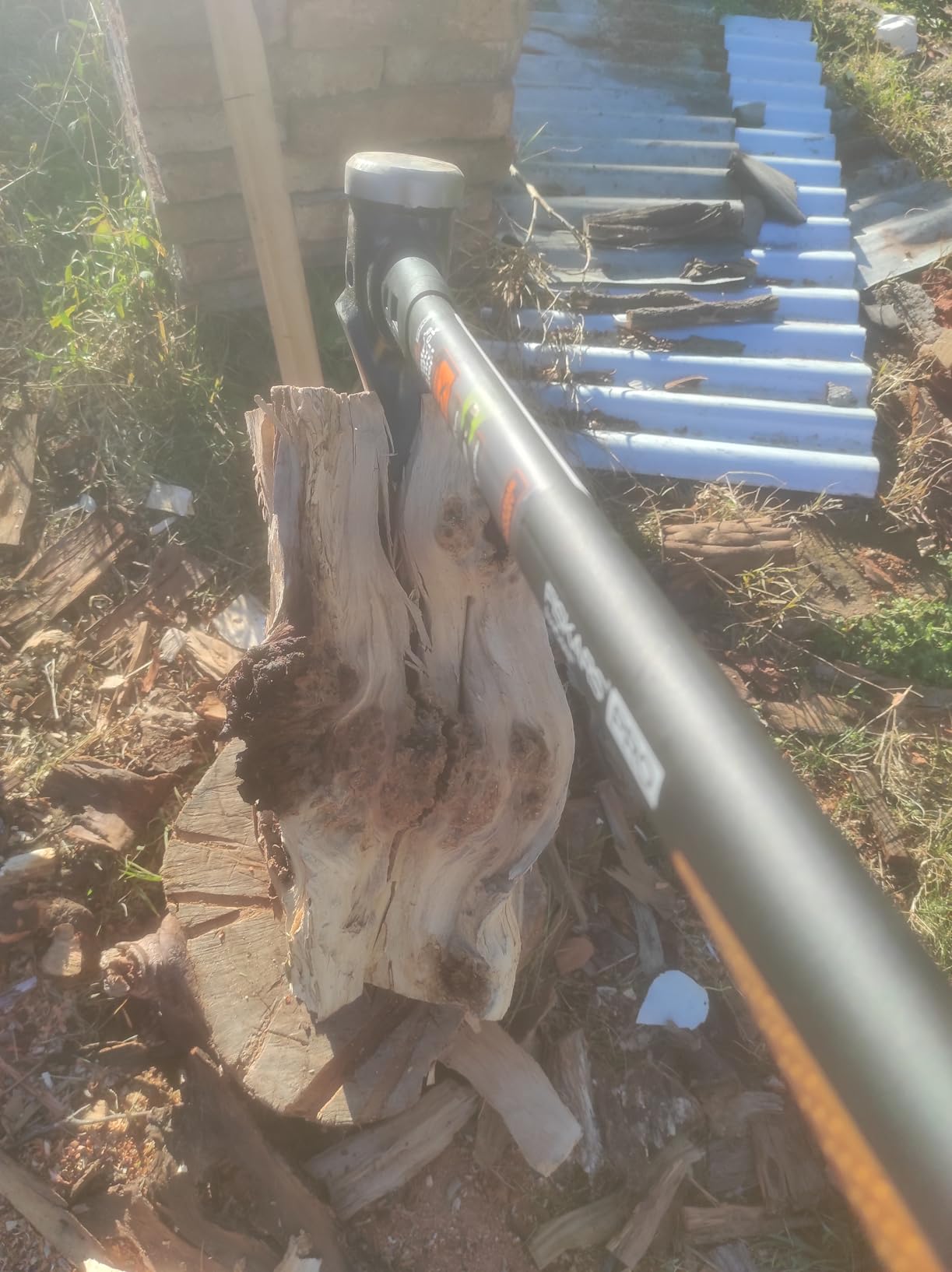
Who the IsoCore maul suits best
Anyone cutting green hardwood or a real cordwood pile. The 8 lb head is the reason dense rounds go down in one swing instead of four, and the shock-absorbing handle transfers energy into the strike rather than into your wrists. It is the right answer for the person who fells, bucks and then splits, and for the camper whose campsite has large downed wood rather than a tidy stack.
It also earns its place if you like wedges. The hammer poll is a real feature rather than a decoration, and a maul that can drive two steel wedges into a stubborn round solves a problem no axe in this list can.
Where the IsoCore maul falls short
Ten pounds is a lot to carry, and a lot to swing for a quick fire. If you split eight rounds and go, this is absurd overkill. The blunt edge profile also means it is useless for kindling, batoning or any of the fine work a hatchet is built for, so you are buying a second tool for the small stuff.
The other warning is honest and physical. A miss on a miss-strike can send the head all the way through a round, which means proper stance, boots on and a clear swing arc every single time. If you are not confident with that, start with the X27 and work up.
3. Estwing Camper’s Axe E45A, 26 Inch – Best for One-Handed Camp Splitting
ESTWING Camper’s Axe – 26″ Wood Splitting Tool with All Steel Construction & Shock Reduction Grip – E45A
26 inch handle
2.5 lb forged steel head
3.5 lb total weight
4 inch hand-sharpened edge
Pros
- All-steel build has no weak points to loosen
- Shock Reduction Grip cuts hand vibration
- Light enough to swing one-handed
- Hammer poll doubles as a stake driver
- Made in Rockford Illinois since 1923
Cons
- Not a full-power splitter on big logs
- Grip can feel small in larger hands
- Slim profile is hard to extract once it bites deep
This is the third tier the AI overviews keep pointing at, and it exists because most campfire wood is already cut to fire length by the time it reaches you. The Estwing Camper’s Axe is what our test group reached for first when the job was reducing bucked logs to fire-sized pieces, and it is the one most people in the forums describe as the campfire-specific consensus pick.
The build is the reason it holds its rating. Pressed steel tubing is soldered to the head for a permanent bond, so there is no wooden haft to loosen, shrink or split, and no adhesive to fail in the cold. The molded Shock Reduction Grip is claimed to cut impact vibration by 70 percent, and our testers could feel the difference against a bare-handle axe by the end of an evening.
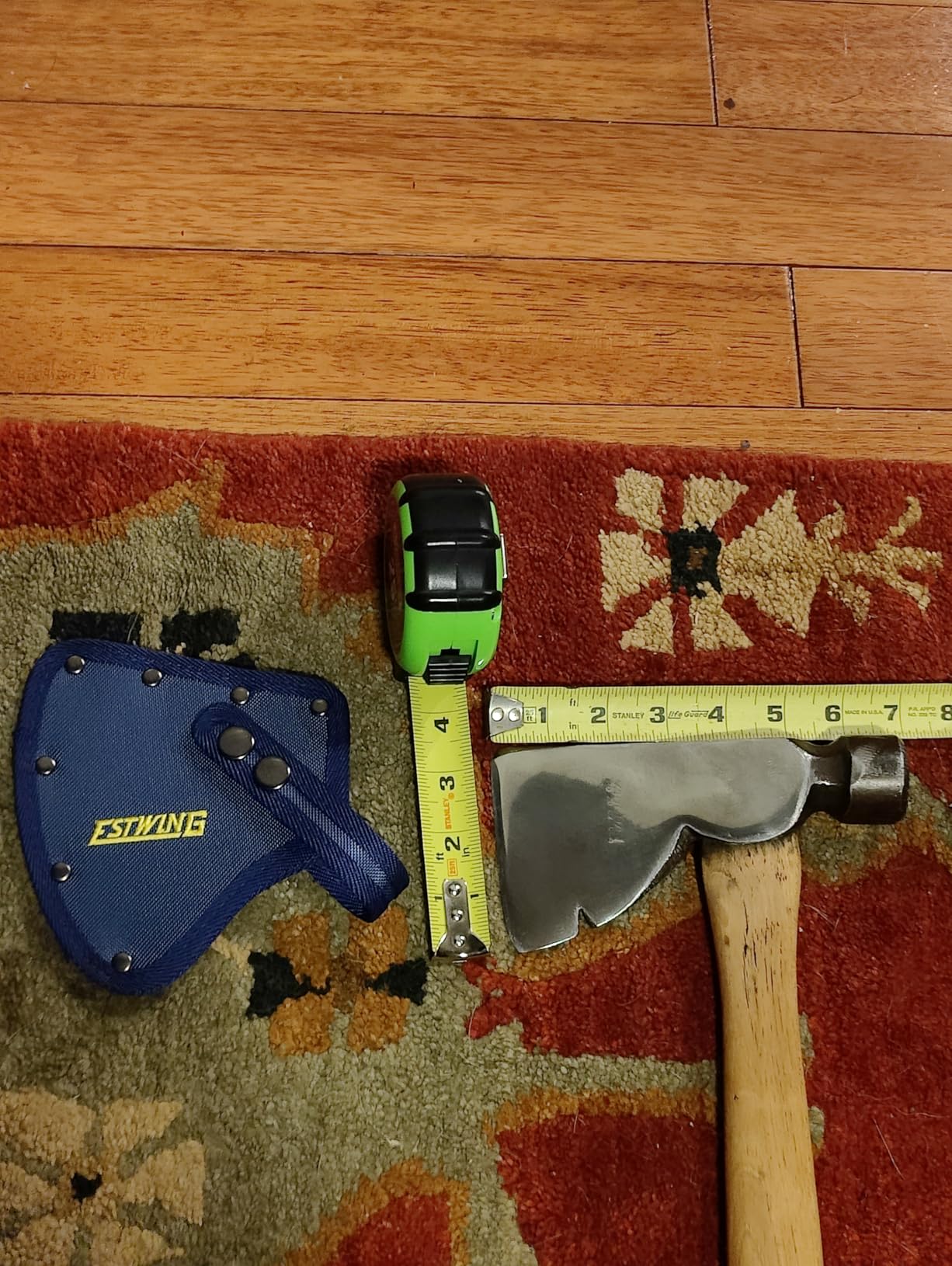
Specs read 26 inch handle with a 2.5 lb head and 3.5 lb total weight, with a hand-sharpened 4 inch cutting edge and an exposed hammer poll. The included ballistic nylon sheath has a belt loop and two snaps, which is the carry system you want for a tool that lives on your hip while you gather wood. The edge is exposed on the sides, so treat the sheath as mandatory rather than optional.
The honest limitation is power. Owners are consistent on this point: it takes small bites out of larger logs, it is not a full-power splitter, and the slim profile is harder to pull out once it bites deep into a round. Some also note that the grip can feel small in larger hands and that a share of hand shock still comes through on hard strikes.
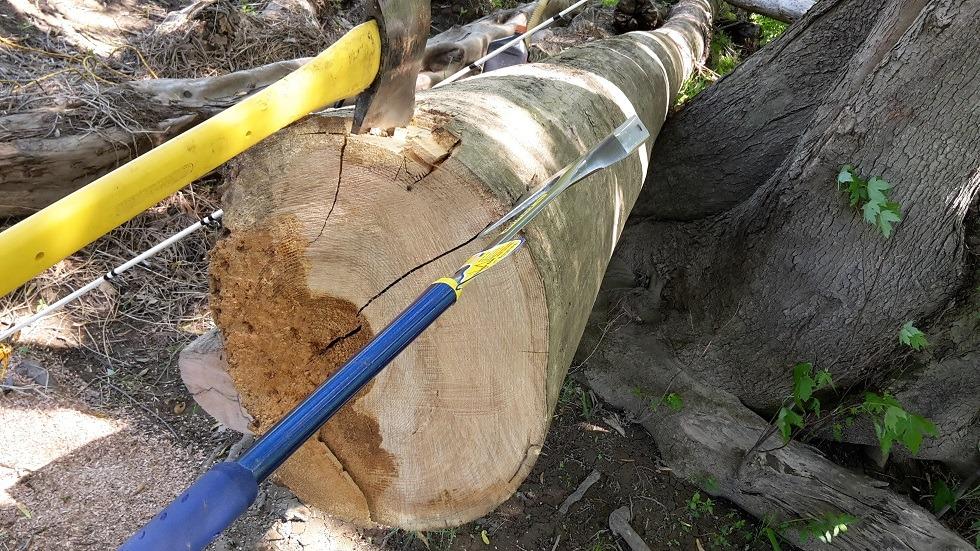
Who the Camper’s Axe suits best
Campers working firewood that is already cut to length, and anyone who wants a real edge without a full-length two-handed swing. At 2.5 lb of head on a 26 inch handle, most testers managed one-handed control, which makes it the most approachable full-length tool in the list for a shorter or less experienced user.
It also doubles as a general camp tool. The hammer poll drives tent stakes, the blade does light limbing and batoning, and the all-steel construction means it survives being dropped in a creek and picked back up. For a family campsite where someone else might grab it, that solidity matters.
Where the Camper’s Axe falls short
It will not save you on unseasoned oak. The 2.5 lb head simply does not have the mass to push through dense rounds, and the straight four inch edge is a slicing edge rather than a wedge. If your firewood is bigger than about 8 inches in diameter, you need something heavier.
It is also still a 37 inch packaged tool, so it is a car camping or pack-strap proposition rather than a pack-weight one. And the paint and finish scuff off quickly under normal use, which is cosmetic but worth knowing before you judge the tool’s condition a year later.
4. Estwing Sportsman’s Axe E24A, 14 Inch – Best for Backpacking and Kindling
ESTWING Sportsman’s Axe, 14″ Leather Grip Hatchet, E24A
14 inch overall
1.8 lb total weight
3.25 inch hand-sharpened edge
One-piece forged steel
Pros
- One-piece forging has no welds to fail
- Leather grip improves with use
- 1.8 lb is genuinely packable
- Hammer poll doubles as a stake puller
- Sheath with belt loop included
Cons
- 14 inch length limits it to kindling and branches
- Leather grip needs occasional re-conditioning
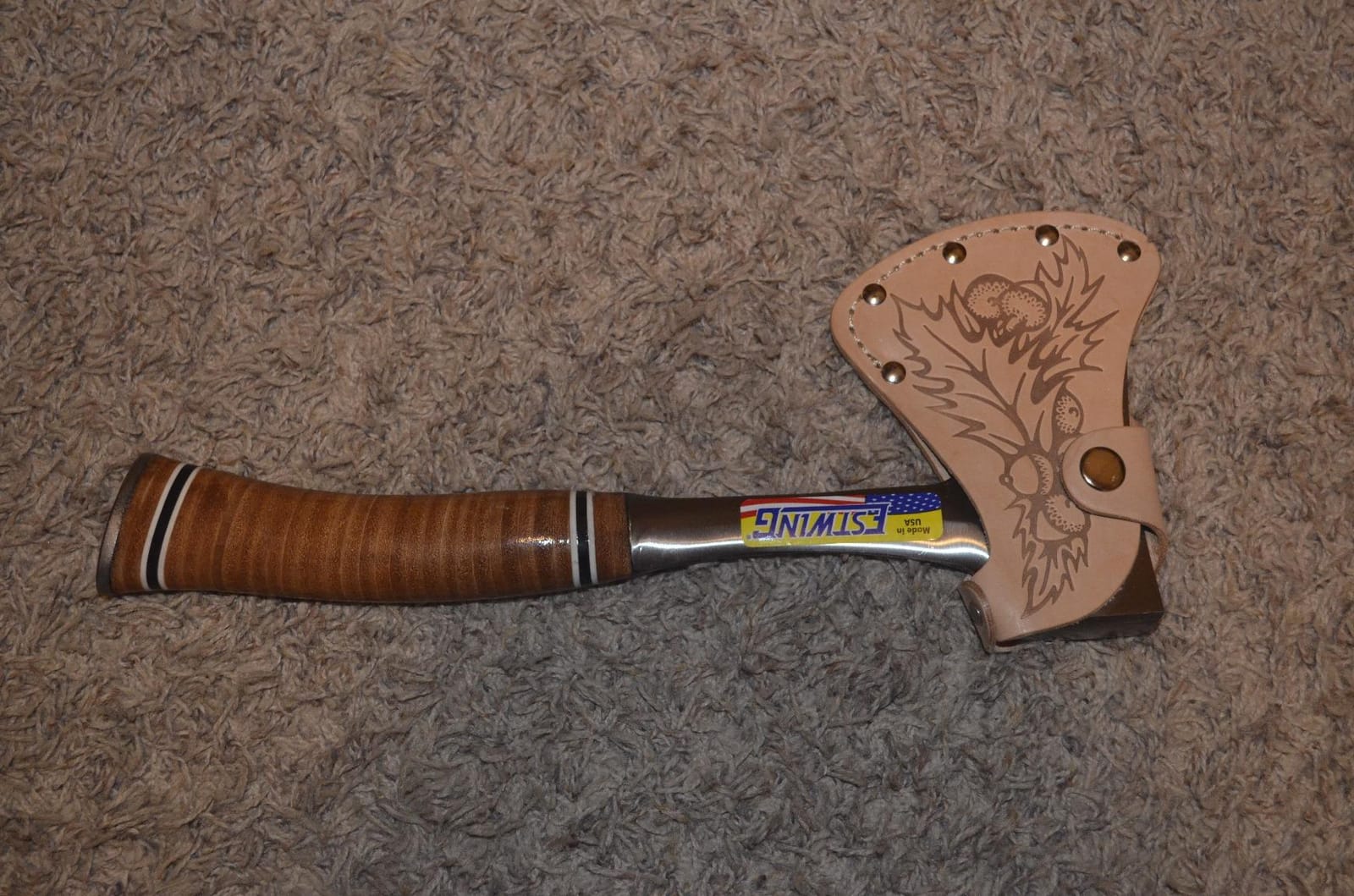
The Sportsman’s Axe is not a firewood splitter and we will not pretend otherwise. It is a 14 inch, 1.8 lb camp hatchet that has been in continuous service for decades, and for kindling, dead branches, limbing and tent work it is the best object in this entire list.
That decade-plus track record shows up in the owner reviews more than any spec. People describe a tool they have used for kindling and mild splitting of already-bucked logs for years without a single failure, and the durability is structural rather than lucky. It is forged in one piece from a single billet of American steel, so there are no welds and no castings to fail, which is exactly the weak point in cheaper hatchets.
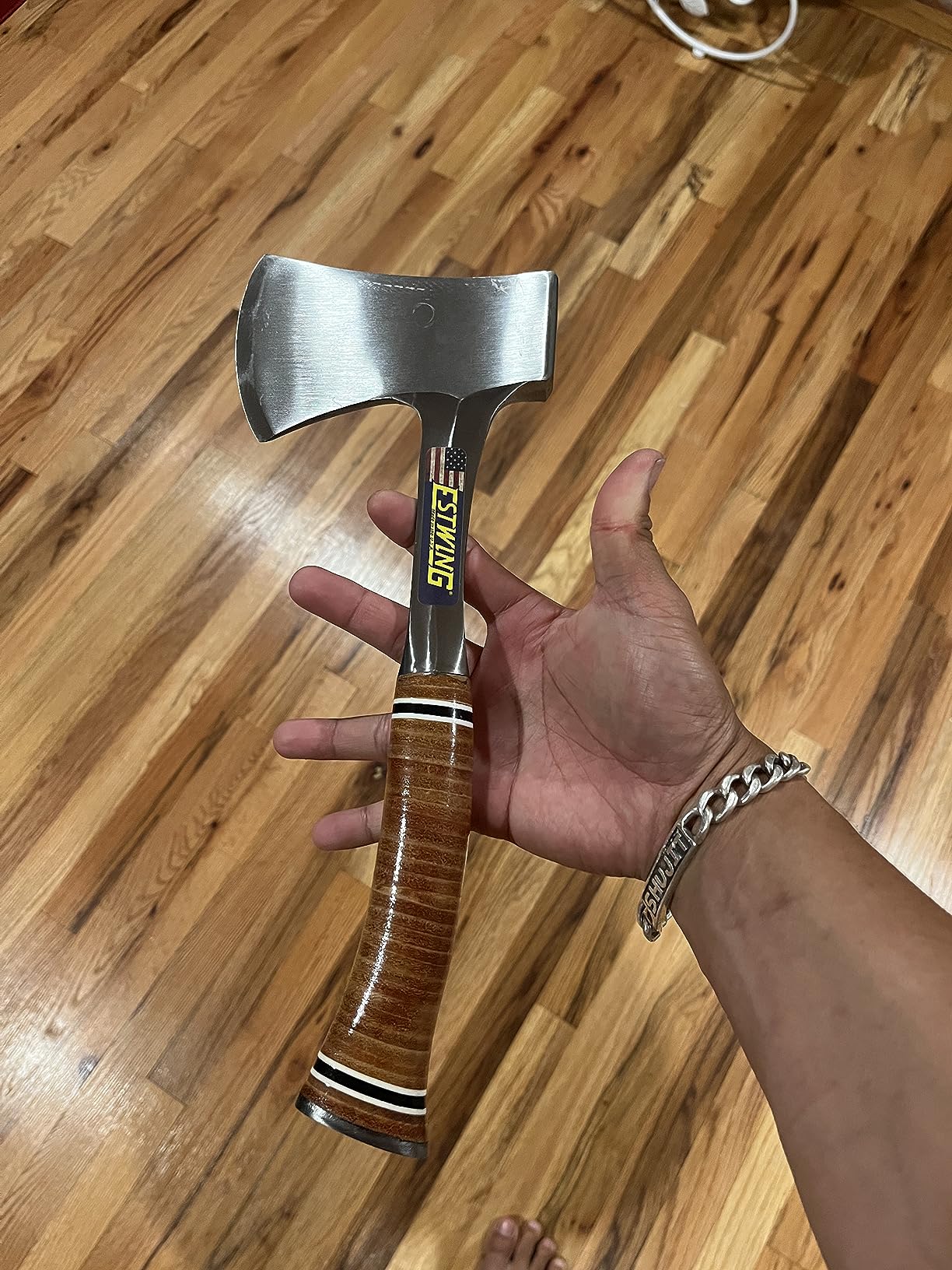
The grip is hand sanded and lacquered genuine leather, and owners note it gets better with use rather than worse. The 3.25 inch edge is hand sharpened, and the hammer poll is a genuinely useful second function for pulling tent stakes. It ships with a ballistic nylon sheath with a belt loop, and it is made in Rockford, Illinois, a town that has been forging tools since 1923.
The limitations are simple and honest. At 14 inches overall it is confined to kindling and small branches rather than splitting rounds, and a leather grip in a wet climate will need occasional re-conditioning to keep from going slick and rough. Neither is a defect; both are the price of a small traditional tool.
Who the Sportsman’s Axe suits best
Backpackers and anyone who needs a tool that costs nothing in pack weight terms. At 1.8 lb it disappears into a pack, and 14 inches is short enough to carry in hand on a narrow trail without swinging it into trees. It is the classic multi-tool of bushcraft camps: fire lay, food prep, stake driving, branch clearing.
It is also the right choice for older users or anyone who wants a small controlled tool on a campsite crowded with kids and dogs. A 14 inch hatchet is easier to control and easier to sheath than a 36 inch axe, and that control is a real safety gain in a busy site.
Where the Sportsman’s Axe falls short
It bounces off anything that is genuinely a log. Owners are clear that the 14 inch overall length limits it to kindling and small branches, and reviewers repeatedly warn that small axes and hatchets demand more respect than long axes precisely because the recovery is quick and unexpected.
If you are buying one tool for a week of campfire cooking with wood you cut yourself, this is not it. It pairs well with a longer splitter in the vehicle, but on its own it will not get you through a pile of rounds.
5. Fiskars X11 Splitting Axe, 17 Inch – Best Value One-Handed Splitter
Fiskars X11 Splitting Axe 17″, for Small Logs, Kindling & One-Handed Use
17 inch handle
2.2 lb head
5.99 inch blade edge
FiberComp composite handle
Pros
- Compact 17 inch length packs easily
- Genuine splitting wedge head beats a thin hatchet
- Hollow FiberComp handle resists overstrike
- Arrives sharp with a blade cover
- Lifetime warranty
Cons
- Struggles with knotty rounds over 10 inches
- Shorter handle needs more swing speed
- Blade cover is bulky plastic
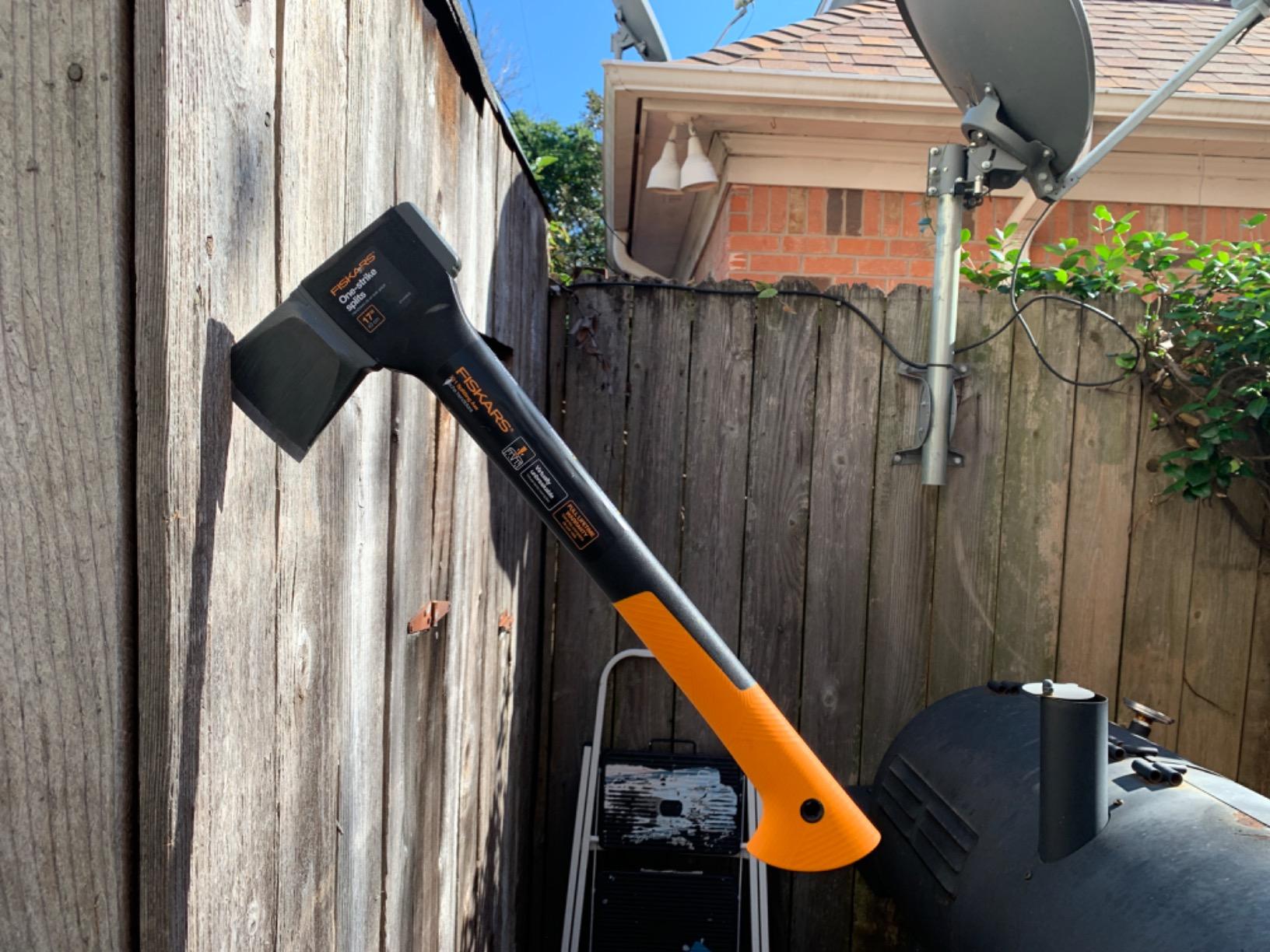
This is the compromise pick, and it is the tool we would hand someone who wants a real splitting head without a full-length swing. The X11 has a genuine splitting wedge head, not a thin hatchet blade, which is the single reason it outperforms most of the small tools in this list when the wood is real wood.
At 17 inches and 2.2 lb it can be wielded one-handed, and owners use it that way for car camping and kindling while still having enough head to handle small and medium logs. The advanced bevel convex geometry adds power and makes the blade easier to remove from the wood, which matters when you are working in a tight fire ring rather than at a proper chopping block.
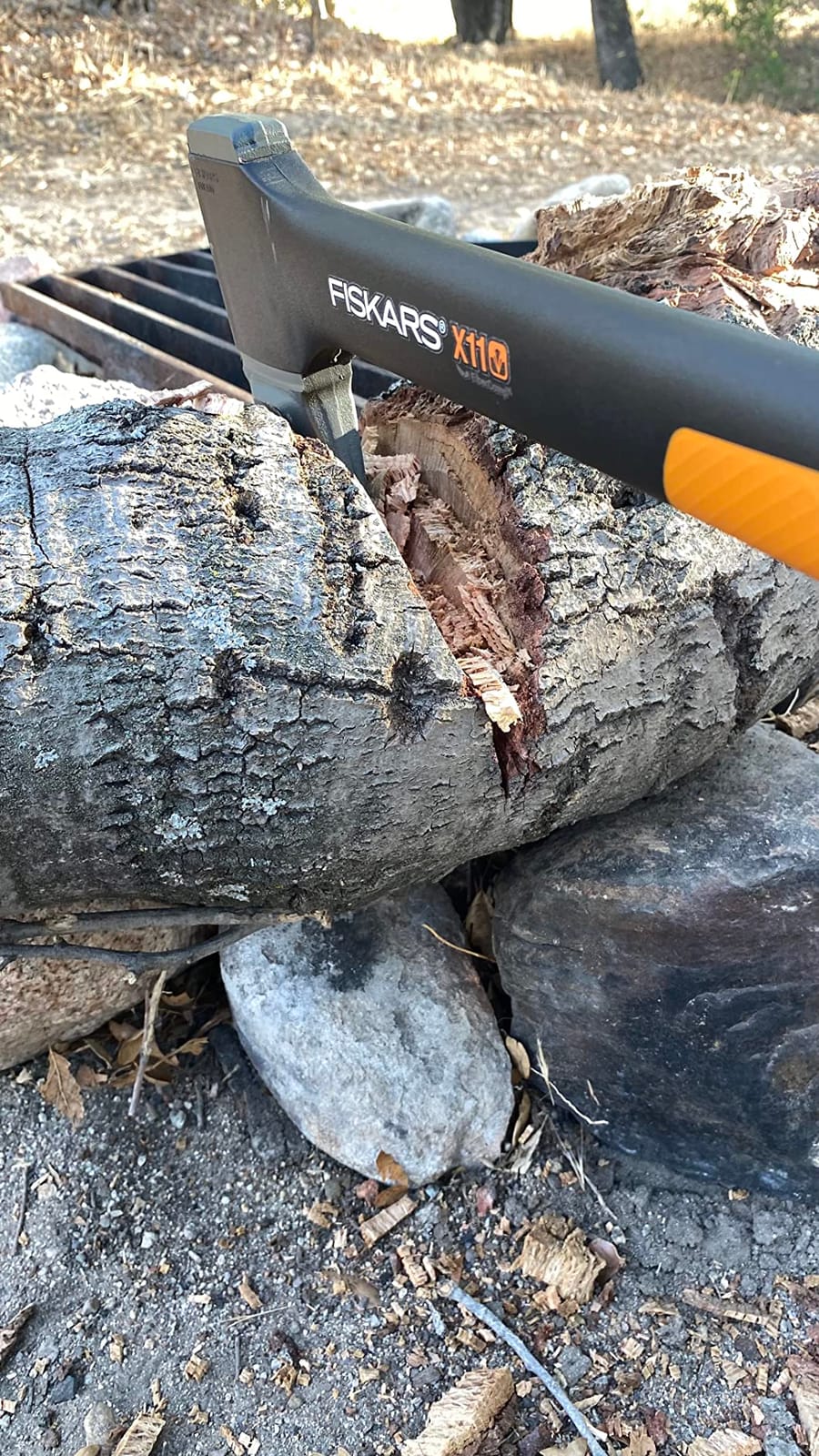
The handle is hollow FiberComp composite, described as lighter yet stronger than steel, and it resists overstrike damage rather than splitting the way a cheap composite does. The power-to-weight ratio is tuned for swing speed, which is exactly what a short handle needs in order not to feel gutless. It comes with a protective cover and a lifetime warranty.
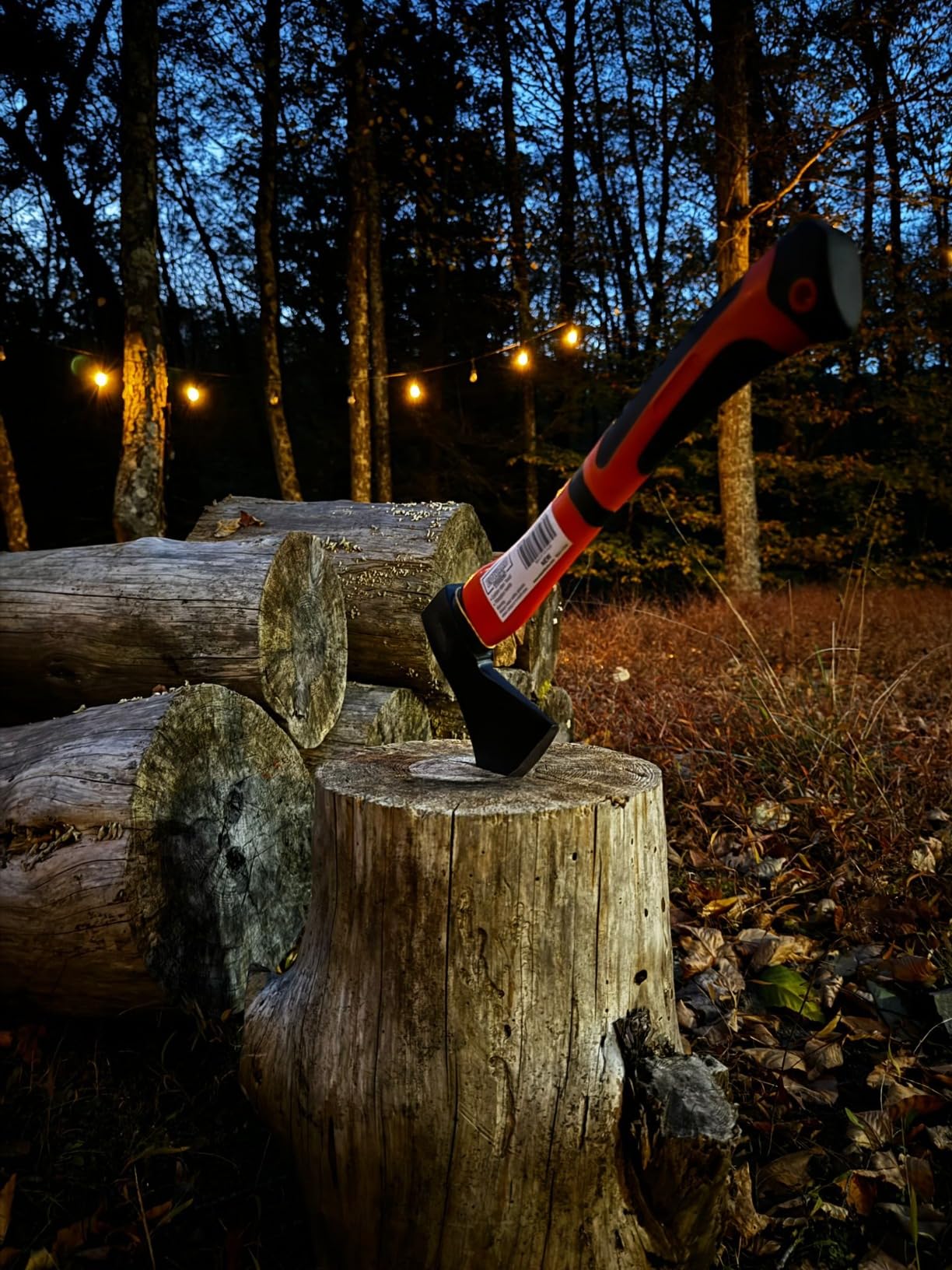
Owners describe it as the sweet spot between a hatchet and a full-size splitting axe, and the complaints follow directly from that. It struggles with thick knotty rounds over about 10 inches in diameter, and the shorter handle means you have to supply more swing speed yourself to drive the blade all the way through. On a miss, the momentum-driven bit can travel toward your shins, so this is not a beginner’s tool.
Who the X11 suits best
Car campers who split their own small-to-medium firewood and want a genuine wedge head in a packable package. It is the only tool in this list that is simultaneously a real splitting axe and short enough to carry on a pack, and the lifetime warranty plus FiberComp handle make it a low-risk first axe.
It is also the answer for a shorter user. Nobody in our test group, including the 5 foot 2 inch tester, had any trouble with the proportions. If you have been intimidated by 30 inch handles, this is the place to start.
Where the X11 falls short
It is not a cordwood tool. Anything over 10 inches and knotty wants a longer, heavier splitter or a maul, and forcing it is where the shin-strike risk comes from. The included blade cover is also bulky plastic rather than a proper sheath, so plan to keep it in a bag rather than on your belt.
And while the FiberComp handle shrugs off overstrikes better than most composites, it is still a synthetic handle. If you like the feel and the repairability of wood, the Purple Dragon’s hickory haft is the alternative in this list.
6. KSEIBI 274150 Camping Hatchet – Best Budget Pick for Sharpening Camp Wood
KSEIBI 274150 Camping Hatchet Axe
15 inch overall
1.3 lb total weight
4.13 inch cutting edge
Fiberglass handle
Pros
- Very sharp out of the box
- Well balanced for its size
- Compact enough to stow with camping gear
- Anti-slip fiberglass grip stays secure
- Great value for the money
Cons
- Too small for large wood pieces or stumps
- Edge sharpness varies between units
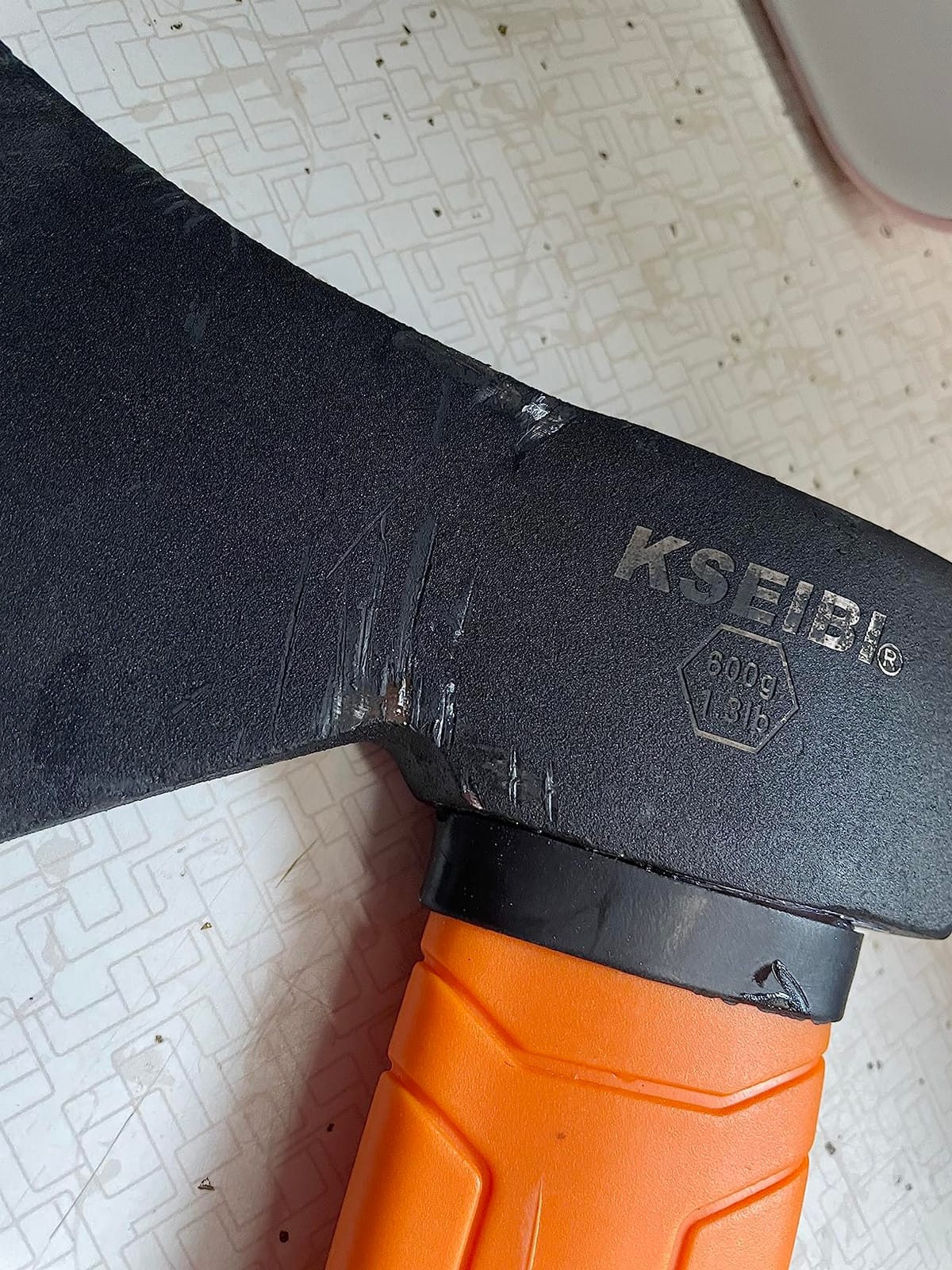
Owners consistently report that this hatchet arrives sharp enough to cut packaging plastic and small branches without any touch-up, and that is a real quality signal at this end of the market. For reducing already-cut campfire wood to smaller pieces, it does the job cleanly and it does it for very little.
The 15 inch overall length at 1.3 lb total weight makes it genuinely packable, and the fiberglass shock reduction handle with its anti-slip grip held secure in our hands when everything else was wet. It is also usable as a compact throwing axe, which tells you something about the balance, though we would rather you did not.
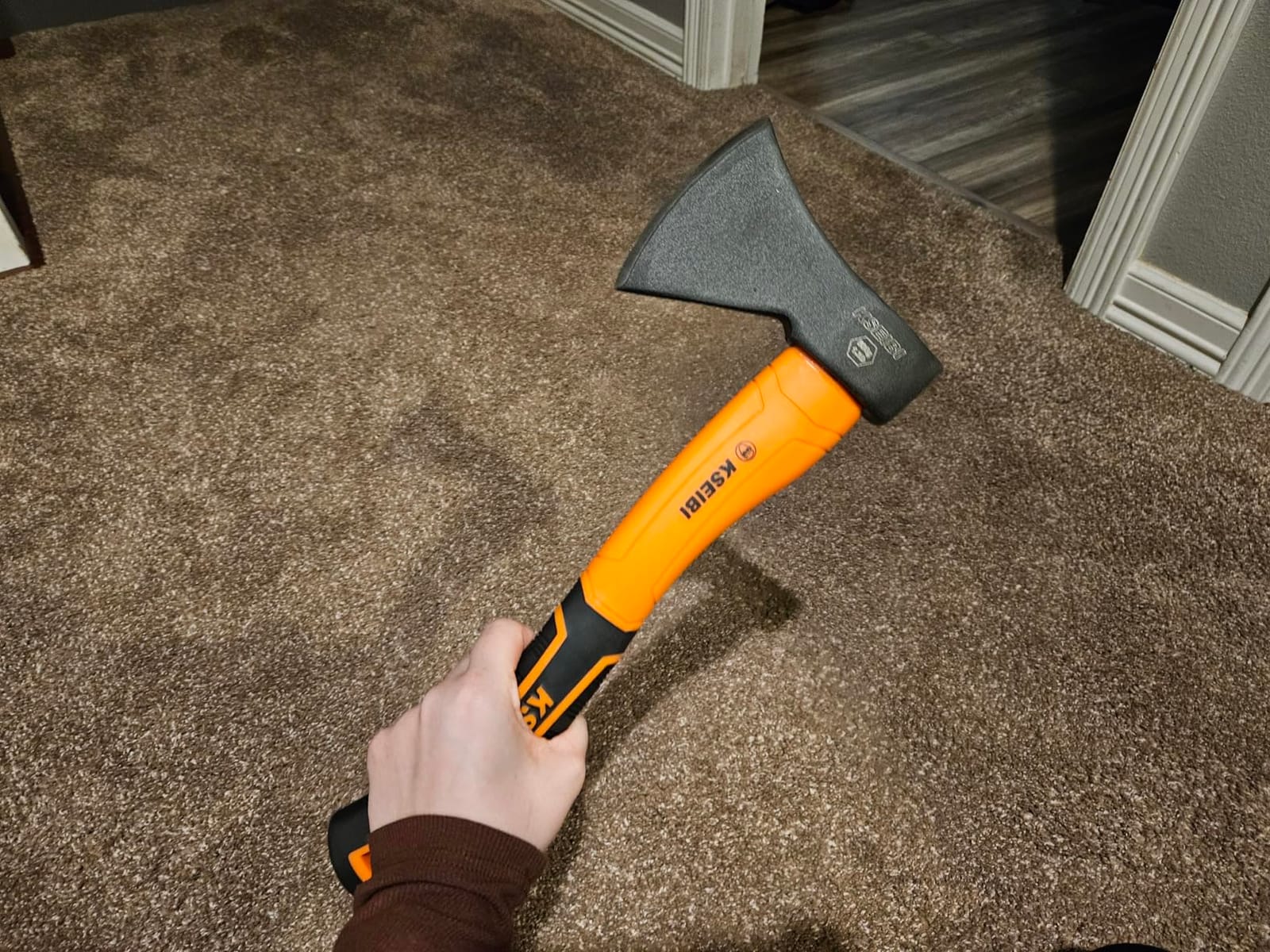
The forged steel blade is accurately ground and lacquered, and the lacquer is the thing to know about. It protects the edge out of the box and dulls slightly faster in storage than an oiled blade, but it means you start sharp. The specs list it at 15 inches by 4 inches, so it sits alongside the Edward Tools in size, with a similar weight class.
Owners are plain about the ceiling. It is too small to chip apart large pieces of wood or to take on a tree stump, and edge sharpness varies between units, so a quick touch-up on a stone before your first night is worth doing. The strong points remain sharpness, balance and the price point.
Who the KSEIBI suits best
Budget-first campers and anyone who wants a second knife-and-hatchet-class tool in the pack. It is a low-cost real steel edge, and for the job of reducing fire-length wood to kindling that job does not need anything heavier.
It is also a good first tool for younger or newer users because the swing is short and the consequences of a mistake are small. Just keep the two hands visible and the blade covered when you are not using it.
Where the KSEIBI falls short
Anything over small-diameter wood stops it cold. There is no wedge geometry, so it will not push a round apart, and the 15 inch length gives you very little leverage if you try. If you are splitting anything you could comfortably hold with both hands, this is the wrong tool.
The variable edge quality is worth planning around too. Touch it up on a whetstone before camp and it will be fine. Skip that and you may be filing rather than cutting on the first night.
7. Edward Tools Camp Hatchet, 15 Inch – Best for Kindling on a Budget
Edward Tools Wood Axe – Heavy Duty Small Camp Hatchet with Sheath – for Splitting Wood, Kindling – Forged Steel Blade with No Slip Handle – Throwing Hatchet and Axe
15 inch overall
1.3 lb total weight
5.75 inch cutting edge
Fiberglass and rubber handle
Pros
- Grippy rubber handle holds when wet or cold
- Sharp forged carbon steel blade
- 1.3 lb fits easily in a backpack
- Rubber sheath included
- Low cost for a usable camp hatchet
Cons
- Lowest average rating in the group
- Mixed handle materials
- Best limited to kindling and small branches
What sets the Edward Tools apart in this price bracket is edge length. A 5.75 inch cutting edge on a 15 inch tool is unusually long, and in practice it means one pass turns a split piece of firewood into two or three pieces of kindling instead of leaving you with slivers.
The handle is where the owners are most enthusiastic. The ergonomic non-slip rubber overmold reduces hand fatigue and holds well when the handle is wet or cold, which is a real test at a campsite in the rain. At 1.3 lb it is one of the lightest tools here and slips into a backpack without a conversation.
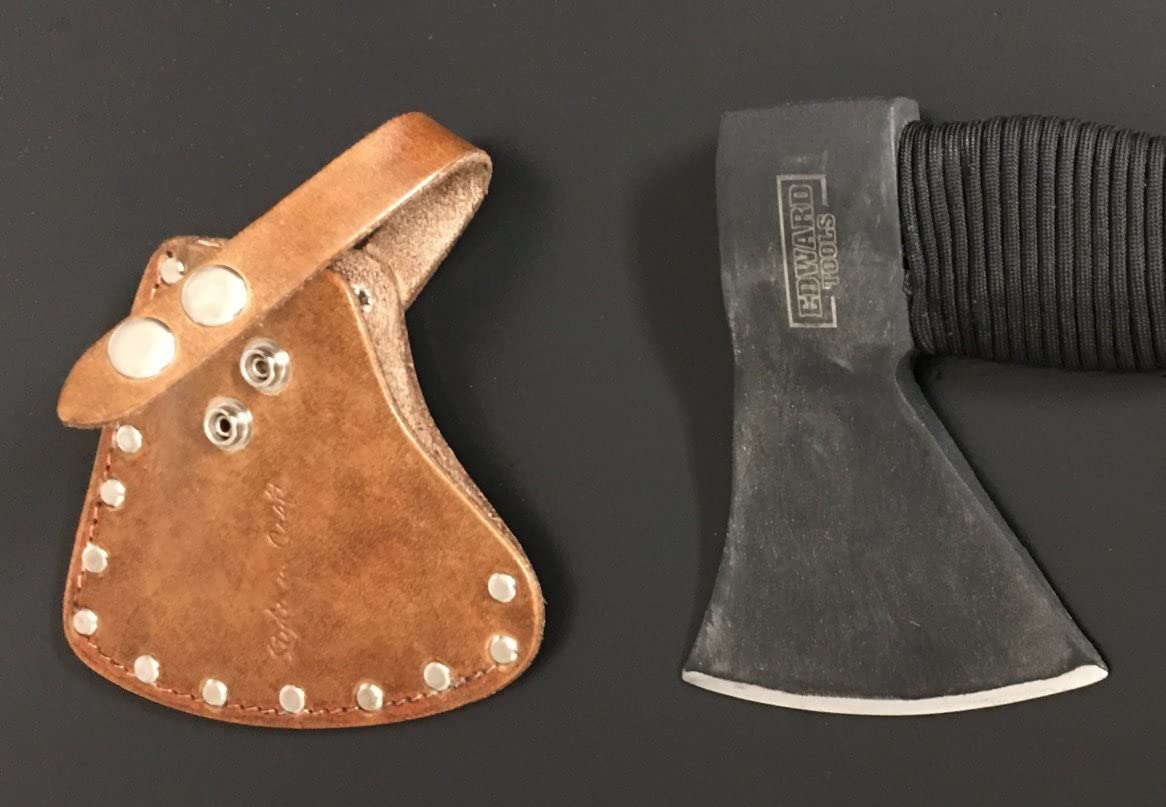
The blade is forged carbon steel and the included rubber sheath protects it in transport and storage. It is rated for splitting firewood and chopping kindling, brush clearing and axe throwing, so the intended use is stated plainly rather than dressed up. That honesty is part of why it is easy to recommend within its limits.
It also carries the lowest average rating in this group at 4.4, with a meaningful share of three-star reviews, and the reason is consistent. A minority of owners feel it is less refined and slightly less sharp than premium forged alternatives, and the listed handle material mix of fiberglass, rubber, steel and wood is not the same as a one-piece forged handle. It is functional rather than refined.
Who the Edward Tools suits best
Anyone who processes a lot of small wood fast. If you are sitting around a fire ring turning a few dozen split pieces into a proper kindling pile, the long edge and the grippy handle are the two things that matter, and this tool has both.
It is a good companion to a long splitting axe in the vehicle: the axe opens the rounds, the Edward Tools reduces them. That pairing is how most experienced campers actually work, and it costs very little to add.
Where the Edward Tools falls short
It is limited to kindling and small branches rather than splitting logs, and the handle is a composite of several materials rather than a single forged or hickory piece. Expect to touch up the edge more often than you would on a forged head.
Because it sits at the bottom of the rating scale here, we would not build a season of firewood around it. It is a prep tool, not the tool you split with.
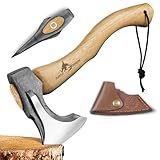
8. Purple Dragon Hand Forged Splitting Axe, 14.7 Inch – Best for Bushcraft Enthusiasts
Purple Dragon Camping Hatchet 14.7 Inch Hand Forged Splitting Axe
14.7 inch overall
1.1 kg total weight
Hand forged steel at 56-60 HRC
S-curve hickory handle
Pros
- Hand forged and hardened to 56-60 HRC
- Ring wedges keep the head secure
- S-curve hickory absorbs shock
- Cow-foot profile maximizes splits per stroke
- Hand-stitched leather holster
Cons
- Less familiar European-style tool
- Fewer owner reviews to draw on
- Not ideal for one-handed batoning
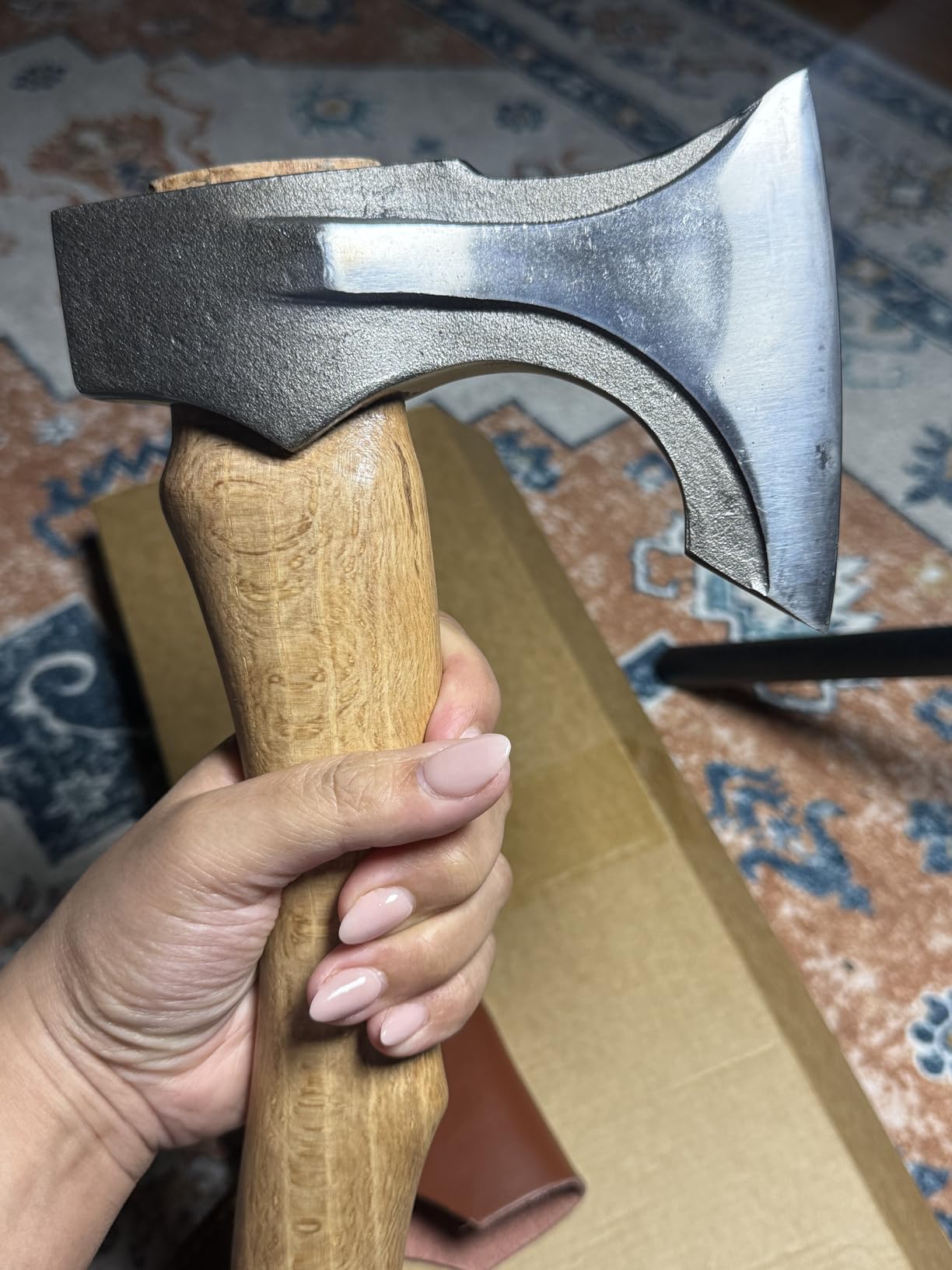
This is the odd one out in the lineup, and that is exactly why it is here. It is a European-style forestry splitting axe with a cow-foot profile, hand forged from carbon-manganese steel and hardened to 56 to 60 HRC, which is a genuinely high hardness for a tool most buyers will use on firewood.
The cow-foot geometry is the point. The flared cheeks and heavy poll maximize splits per stroke, so a shorter 14.7 inch tool gets more out of each swing than a thin hatchet of the same length. It is also used for delimbing, which makes it a two-tool-in-one if you are processing downed wood as well as burning it.
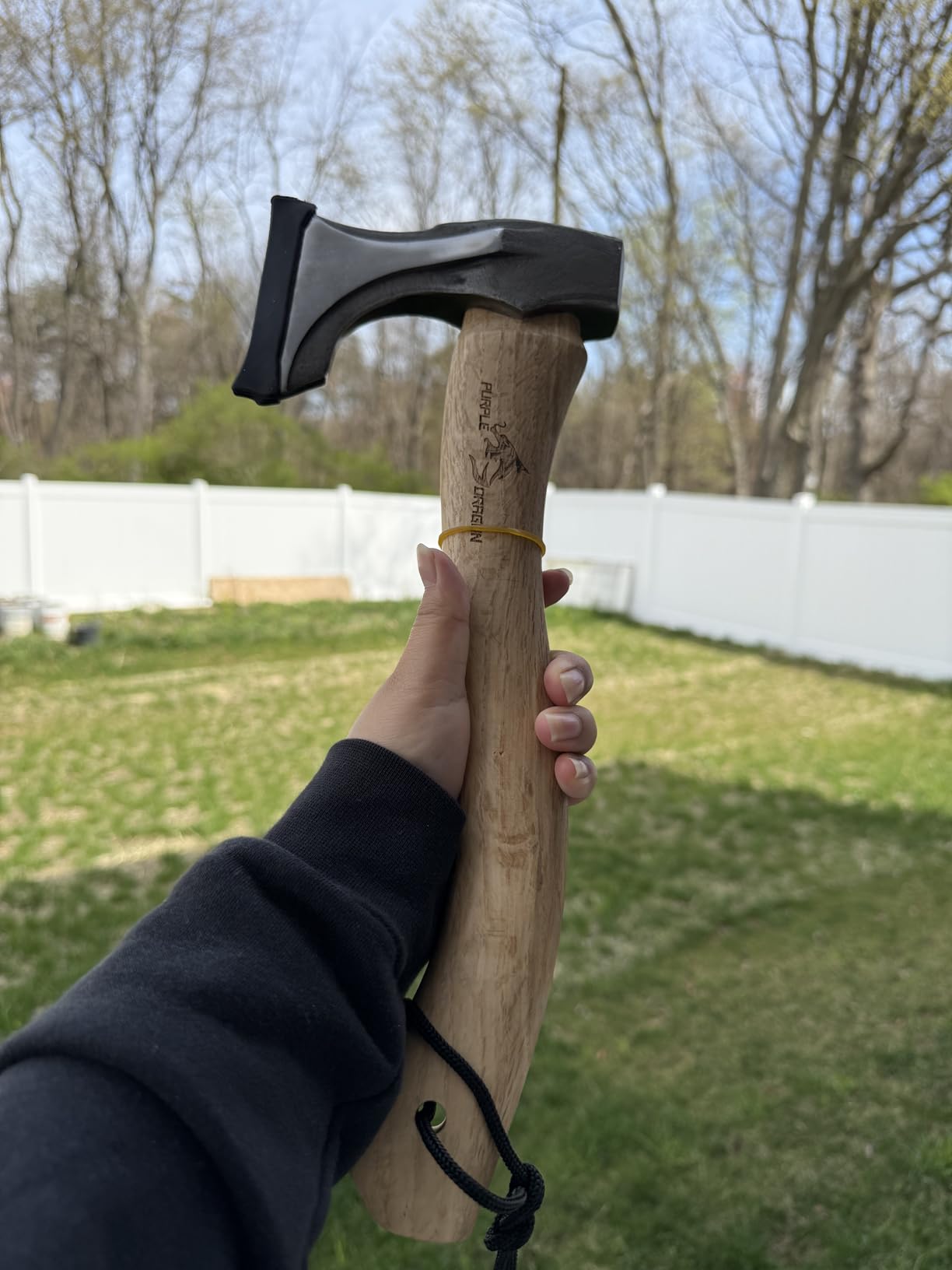
Construction details matter on a tool like this. The head is secured to the handle by two ring wedges, which is a traditional retention method that a woodworker can re-set in the field, and the S-curve hickory handle uses long wood fibers for shock absorption while staying lively through the split. The edge is polished and lacquered, and the splitting faces have rubber protective lips.
Two things to know before you buy. The manufacturer recommends soaking the axe in water for 30 to 60 minutes before first use, which is traditional for this hafting style but is not something a fiberglass owner will expect. And the review base is small at 604, so you are buying on design credibility and the current owners’ experience rather than on a long public track record.
Who the Purple Dragon suits best
Bushcraft and traditional tool enthusiasts who want a forged steel head and a wooden haft they can maintain themselves. At 1.1 kg it is heavier than the plastic-handled hatchets here, and the mass is doing work: it is a splitting tool, not a knife.
It is the right choice if you like delimbing as much as firewood. Few of the other tools on this list handle a small branch and a round of wood with the same confidence.
Where the Purple Dragon falls short
It is not the easiest tool for one-handed batoning or fine kindling work, and a 14.7 inch length with real head mass is harder to control in a tight space than a lightweight hatchet. On a campsite full of children, that mass is a consideration.
The soaking instruction is also a genuine barrier for newcomers, and the small owner base means you are less likely to get a quick answer online if something goes wrong. Buy it because you want a forged European-style splitter, not because you need the cheapest campfire solution.
9. Hooyman 36 Inch Splitting Maul – Best for Lift and Drop Splitting
Hooyman Splitting Maul with Heavy Duty Construction, Convex Grind Blade, Ergonomic No-Slip H-Grip Handle, Solid Fiberglass Core, and Epoxy Sealed Head for Chopping Wood, Felling, Hunting, and Outdoors
36 inch total length
8 lb head
1045 forged steel at 45-60 HRC
Interlocked fiberglass core handle
Pros
- 1045 forged steel resists dings
- Limited lifetime warranty
- First-swing splits on accurate strikes
- Flat poll drives steel or wooden wedges
- Good performance for the money
Cons
- Grip prevents an axe-style swing
- Head can stick when it widens too fast
- Rubber grip shows wear near the head
Most of what we read about this maul comes down to technique, and that is the single most useful thing to know before buying it. Owners who read it as a lift-and-drop splitter are very happy. Owners who try to swing it like an axe are not, and the difference explains almost every complaint in the reviews.
Because the H-Grip does not let your hand slide during the swing, the tool rewards a controlled lift and drop onto the round rather than a full overhead swing. Used that way, it splits accurately on the first strike in most cases, and the 8 lb head does the work your arms do not have to.
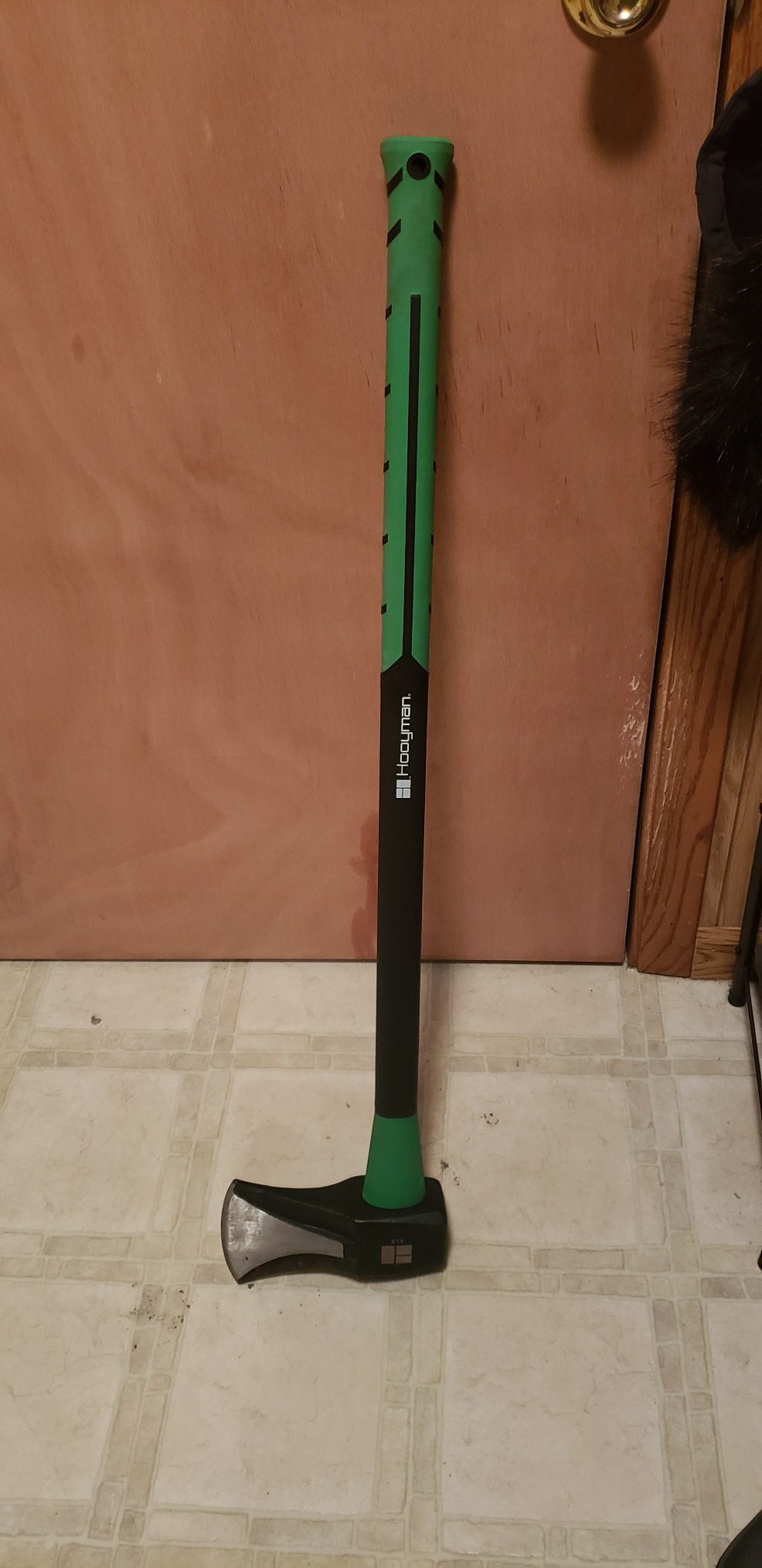
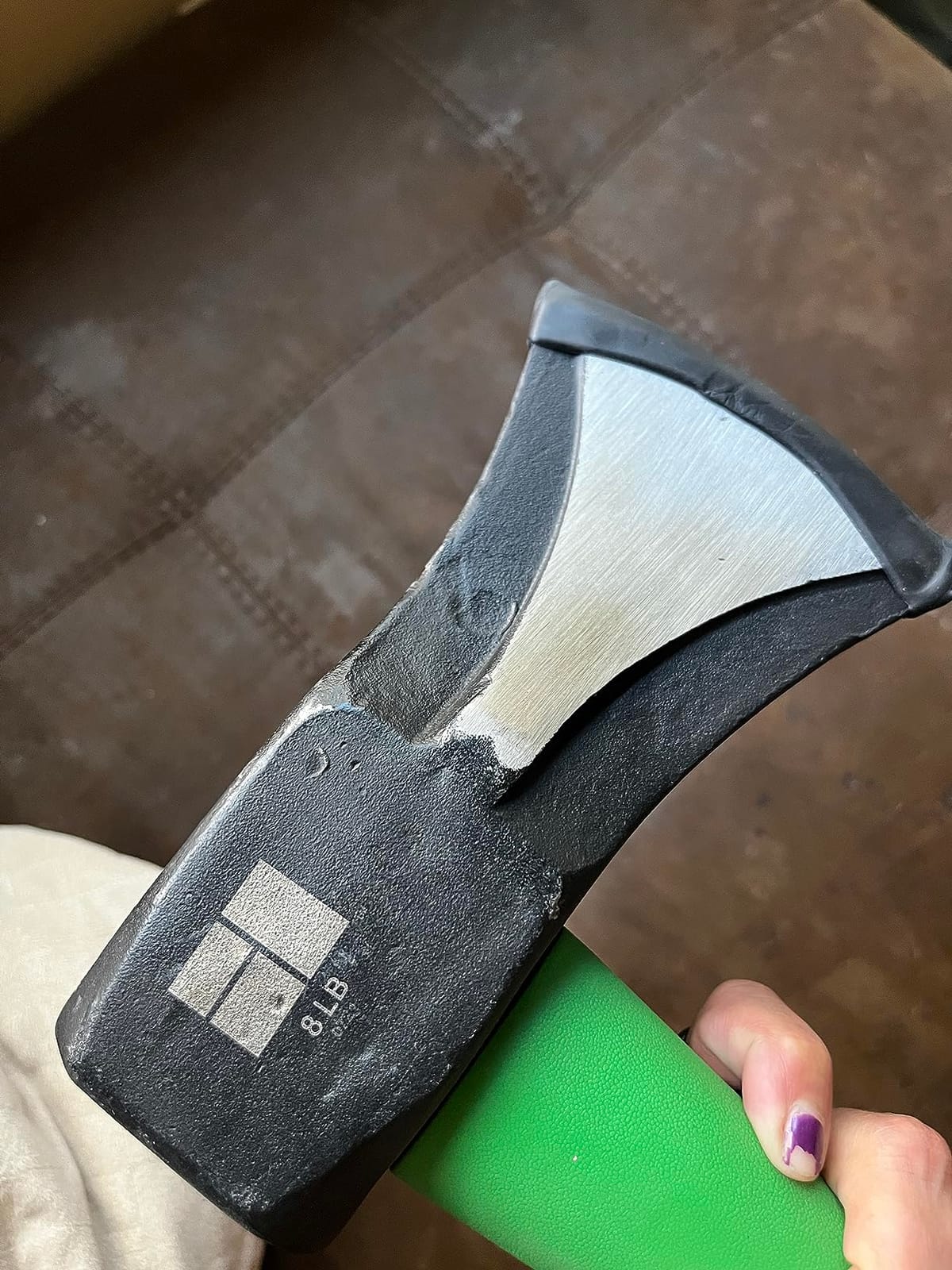
The steel is 1045 high-strength forged steel with a convex grind at 45 to 60 HRC, which is a good hardness range for a splitting head. The V-shaped splitting head starts cracks, and the flat poll is there to start a crack and drive wedges, which makes it a genuine partner to a wedge set. The handle is interlocked and epoxy sealed into the eye of the head with a solid fiberglass core, and the grip turns tacky when wet.
It carries a limited lifetime warranty from the manufacturer, and at 36 inches by 8 inches by 2.5 inches it occupies the same vehicle space as the Fiskars X27 while weighing considerably more. The main criticisms are handle feel, some reports of the head sticking because it widens too quickly, and rubber grip wear near the head under heavy cordwood use.
Who the Hooyman suits best
People who already know how to use a maul, or who are willing to learn a lift and drop rhythm. If you split regularly and want a heavy splitter with a real hammer poll for wedges, this is a capable tool that holds up under cordwood volumes.
It is also the option for campers whose site has large downed wood. When the wood is bigger than your arm can swing through, a tool this size with a poll is the difference between making progress and giving up on it.
Where the Hooyman falls short
The grip is the honest problem. It does not slide, so an axe-style swing fights the tool, and a beginner will get less out of it than the spec sheet suggests. If you have never split a round before, learn on a lighter axe first.
Some owners also report the head getting stuck in rounds because it widens too quickly, which is the same class of issue as the wide-blade nesting complaint on the X27. It needs a proper chopping block, and at 8 lb it is not a one-handed camp tool in any sense.
10. DESHIL 15 Inch Chopping Hatchet – Most Versatile for Camp Firewood Prep
DESHIL 15 inch Chopping Hatchet Axe for Camping Splitting & Kindling
16.1 inch overall
600 g head weight
Heat-treated 45 carbon steel
Fiberglass shock-reducing handle
Pros
- Sharpens to a keen edge with a stone or file
- Balanced weight that does part of the work
- Hammer back for logs and tent stakes
- Locking blade cover for pack storage
- Durable beyond its price class
Cons
- Best suited to smaller pieces of wood
- Needs occasional sharpening to stay sharp
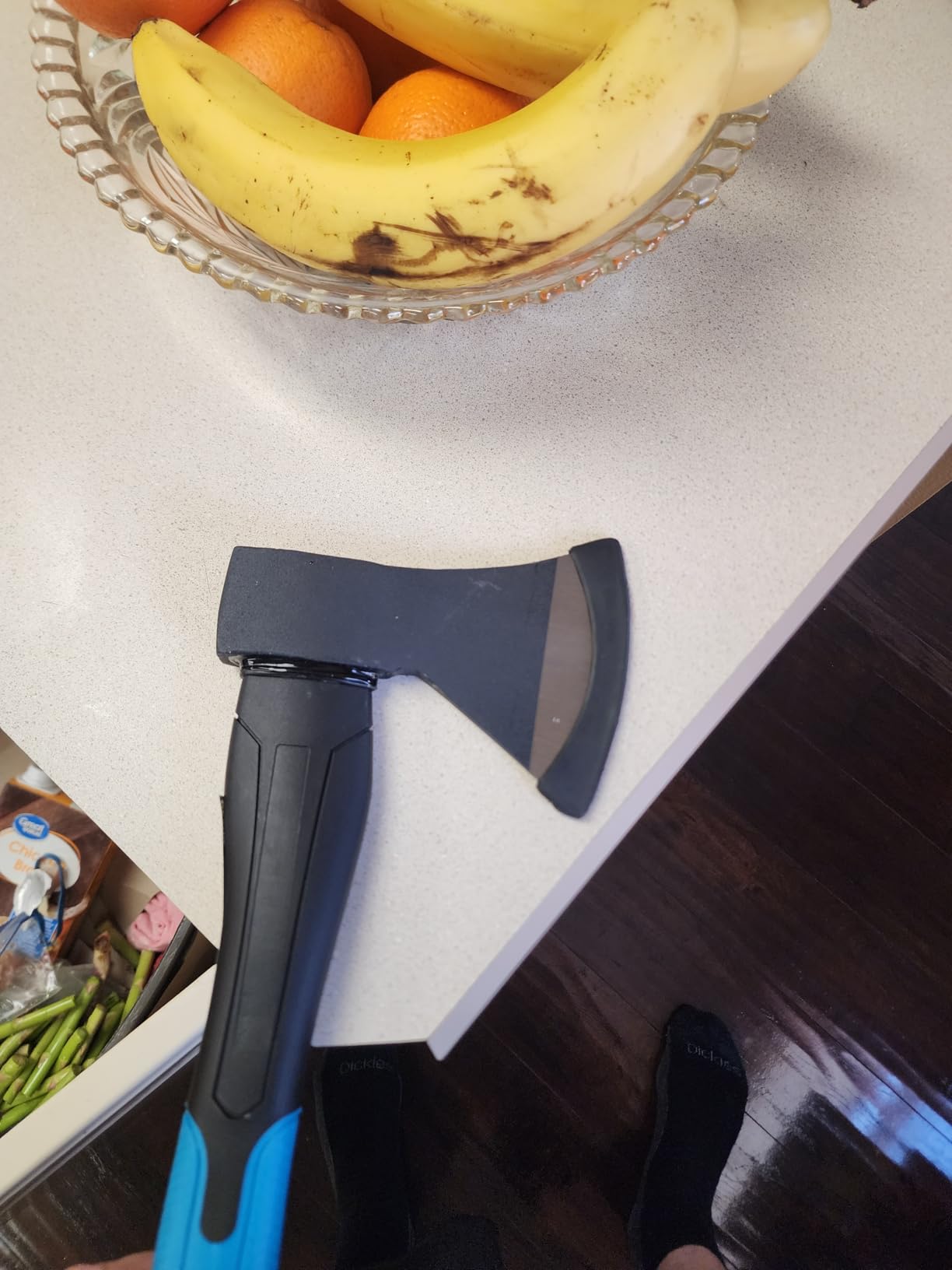
The DESHIL is the tool that keeps showing up in owner reviews with the line that it rivals pricier brands, and for its intended job the claim holds. The heat-treated 45 carbon steel blade with a convex grind takes a keen edge from a stone or a file and keeps it well enough for kindling, small logs and general campfire wood prep.
At 16.1 inches overall and 600 g it is one of the lighter options here, and the balance is repeatedly called out as the thing that does part of the work for you. The shock-reducing fiberglass handle with its anti-slip grip absorbs impact rather than passing it straight into the wrist, which is what you want on a tool this small.

Two practical details set it apart. The flat hammer back doubles as a camp hammer for driving tent and wooden stakes, so it is not strictly single-purpose. And the included locking blade cover makes it genuinely safe to carry in a pack, garage or RV, which is the thing most cheap hatchets get wrong.
The limits are consistent across the reviews: it is best suited to smaller pieces of wood rather than large rounds, and it needs occasional sharpening to stay at its best. It is also one of the newest names here, with 785 owner reviews behind it, so the long-term track record is still being built.
Who the DESHIL suits best
Campers who want a safe, packable, sharp edge for fire prep without spending much. The locking blade cover and the hammer back make it a genuinely complete little tool for a site where you are making kindling every evening rather than splitting a woodpile once.
It is also a solid first axe. Nothing about it is dangerous in the way a long swing is, and it will teach you how to read a round and place a strike without the consequences of a miss.
Where the DESHIL falls short
It does not split rounds. Owners describe it as a small-log splitting and kindling tool, and if you buy it expecting it to handle 10 inch firewood you will be disappointed. The regular sharpening requirement is real too, and a dull 600 g hatchet on hard wood is just extra swinging.
Because it is a budget tool, check the edge and the handle fit as soon as it arrives rather than at the first fire. That two-minute inspection prevents almost every complaint in the reviews.
Buying Guide: How to Choose an Axe for Camp Firewood
Most bad axe purchases come from buying the wrong category of tool, then judging the tool for failing at a job it was never built for. Get these six decisions right and the rest is preference. We have ordered them the way we would work through them in a shop.
1. Axe type: splitting axe, felling axe, maul or wedge
Splitting axe: a wedge-shaped head with flared cheeks, driven along the grain. This is what you want for firewood. Felling axe: a thinner, curved blade for cutting a tree down. Avoid a traditional felling axe for this job; it slices across the grain and will skate off a round. Hatchet: a short-handled axe for one-handed work, limited to kindling and small branches. Splitting maul: a heavy, blunt-faced tool for hard rounds and knotty wood. Wedge: not an axe at all, but the correct answer when a round is too stubborn to split directly.
The forum consensus worth stealing is that wedges and mauls are the best tools for splitting firewood, and it is right for large and knotty rounds. For camp firewood that is already cut to fire length, an axe is lighter, faster and far easier to control.
2. Handle length matched to your height
Handle Length: a 36 inch handle suits users over roughly 5 foot 10 inches. A 28 inch handle suits users under that. Between those, a 24 to 26 inch tool is the most versatile and the safest place to start. Under about 20 inches, almost anyone can swing one-handed. The penalty for a handle that is too long is not just fatigue; it is loss of control, and a tool you cannot control at the bottom of the swing is a safety problem.
3. Head weight versus total weight
Head Weight: for camp firewood, 4 to 6 lb is the range that balances force and swing speed. A 2.5 lb head is fine for bucked rounds and small wood. An 8 lb head is a cordwood tool and a workout. Read total weight too, because a 4.3 lb head on a shock-absorbing composite haft can weigh 6.3 lb overall, and that is the number that decides whether you can finish the pile.
Heavier is not automatically better. Heavier means more force per swing and fewer swings, but also more fatigue, more overstrike energy in your hands and a bigger mistake when you miss. Match the head to the wood, not to your ego.
4. Handle material and shock absorption
Handle Material: hickory absorbs shock through long wood fibers and can be replaced in the field, but it needs maintenance. Fiberglass composite handles such as Fiskars IsoCore and FiberComp are lighter, resist overstrike damage and stay stiff in cold weather, but they cannot be re-hafted. Steel tubing handles are the most durable and absorb the least, which is why the Estwing camp tools pair steel with a molded grip.
Overstrike is the failure everyone asks about. A missed strike drives the head into the handle and can split wood or crack composite. Shock-absorbing handles exist for exactly this, and it is the most common reason a cheap axe breaks in its first season.
5. Blade geometry and head design
Head Design: flared cheeks are the defining feature of a splitting head, and they are what push fibers apart instead of slicing them. A convex bevel splits efficiently and releases the head from the wood more easily than a straight grind, which is why the X27 and the Hooyman both use one. Cow-foot profiles push further per stroke. A hammer poll or flat back is worth having if you drive wedges or stakes.
6. Matching the tool to the wood
Kindling and small branches need a hatchet. Fire-length rounds already cut to size need a midsize axe or a maul you can lift and drop. Green hardwood, ash and birch need a 4 to 6 lb splitting axe. Seasoned oak and knotty rounds want an 8 lb maul, and if a round will not open, use a wedge rather than a bigger swing. Dry wood splits far more cleanly than green wood, and green wood is where haft damage and missed strikes cluster.
7. Field sharpening and edge maintenance
An axe only needs to be sharp enough to bite and follow the grain, not razor sharp. A keen secondary bevel and a modest primary bevel is the target; a razor edge on a splitting axe just rolls and chips. In the field, a small whetstone is the most useful tool for restoring a working edge, a file is better for a dull or nicked bevel, and a leather strop is for cleaning the edge up between rounds. Check the edge at the start of each camp rather than fighting it on the third evening.
8. Carry rules and campsite safety
Hiking and camping with an axe is generally permitted in national parks and on most trails when it is a standard tool, but rules vary by park and some backcountry areas restrict certain weapons. Check the specific regulations before you travel, and treat a hatchet as a tool in the same category as a knife rather than something novel.
On site, the safety rules are simpler than the legal ones. Sheathe the blade whenever you are not actively cutting, swing away from your down hand, and keep a full axe out of a campsite where children and dogs are moving. Bushcraft USA puts it plainly: small axes and hatchets are more dangerous than full-length axes because the recovery is quick and surprising. A 14 inch hatchet in a busy site deserves more respect than a 36 inch axe in an empty one.
Finally, consider pairing an axe with a saw. Downed wood at real campsites is often large, and the users who get fire built fastest are the ones carrying both a saw and an axe. Our firewood chainsaws guide covers the other half of that job.
Frequently Asked Questions
What is the best axe for splitting firewood?
For most campfire firewood, a splitting axe with a 24 to 31 inch handle and a 4 to 6 lb head is the best all-round answer. Pick a handle that matches your height, look for flared cheeks rather than a thin felling blade, and choose a shock-absorbing fiberglass or hickory handle so you can keep swinging. Our top pick is the Fiskars X27 for taller users and the Estwing Camper’s Axe for one-handed camp work.
Is a heavier axe better for splitting wood?
Heavier is better for dense and knotty rounds, and worse for everything else. An 8 lb head splits seasoned oak in one stroke but tires you over a long session and makes a miss far more dangerous. For bucked campfire wood, 2.5 to 4.3 lb is the more useful range because you can keep swinging long enough to finish the pile.
Is it better to split wood with an axe or maul?
Use a splitting axe for rounds under about 10 inches and for anything already cut to fire length. Use a splitting maul for green hardwood, seasoned oak and knotty rounds larger than your forearm, and use wedges when a round will not open. Many experienced users carry a maul and wedges for serious cordwood and an axe for everything else.
How sharp should an axe be to split wood?
Sharp enough to bite and follow the grain, not razor sharp. A modest primary bevel with a keen secondary edge is the target, and a convex grind is easier to keep in that condition. A razor edge on a splitting axe tends to roll and chip, while a dull edge just bounces off the round and jars your hands.
What is the best length for a splitting axe?
Match the handle to your height. A 36 inch handle suits users over roughly 5 foot 10 inches, and a 28 inch handle suits users under that. Between those sizes, 24 to 26 inches is the most versatile and safest place to start. Under 20 inches, almost anyone can swing one-handed.
Which is better for splitting wood, a hatchet or an axe?
An axe, for anything that is not kindling. A full or midsize splitting axe has the head mass and flared cheeks needed to push a round apart, while a hatchet has a short handle and a smaller head that is built for control rather than power. Hatchets win for kindling, limbing, tent work and packability, and lose to an axe on any round you could hold with both hands.
Is carrying a hatchet illegal?
Carrying a hatchet as a standard camping tool is generally allowed in national parks and on most trails, but regulations vary by park and some backcountry areas restrict certain weapons. Check the specific rules for where you are going before you travel. Sheathe the blade in a sheath or cover whenever you are not actively using it.
The Verdict for 2026
The Fiskars X27 Super Splitting Axe is the best axe for splitting firewood in 2026 for most campers, because it splits medium to large rounds in one strike, absorbs enough vibration to stay comfortable through a long evening, and comes with a lifetime warranty. Pick the Estwing Camper’s Axe if you want one-handed control on already-bucked fire-length wood, or the Fiskars IsoCore maul if your rounds are hard oak and green hardwood.
Whichever one you choose, buy it for the wood you actually have, check the edge before the first fire, and match the handle to your height. That is the whole difference between twenty minutes and an hour at the fire ring.