
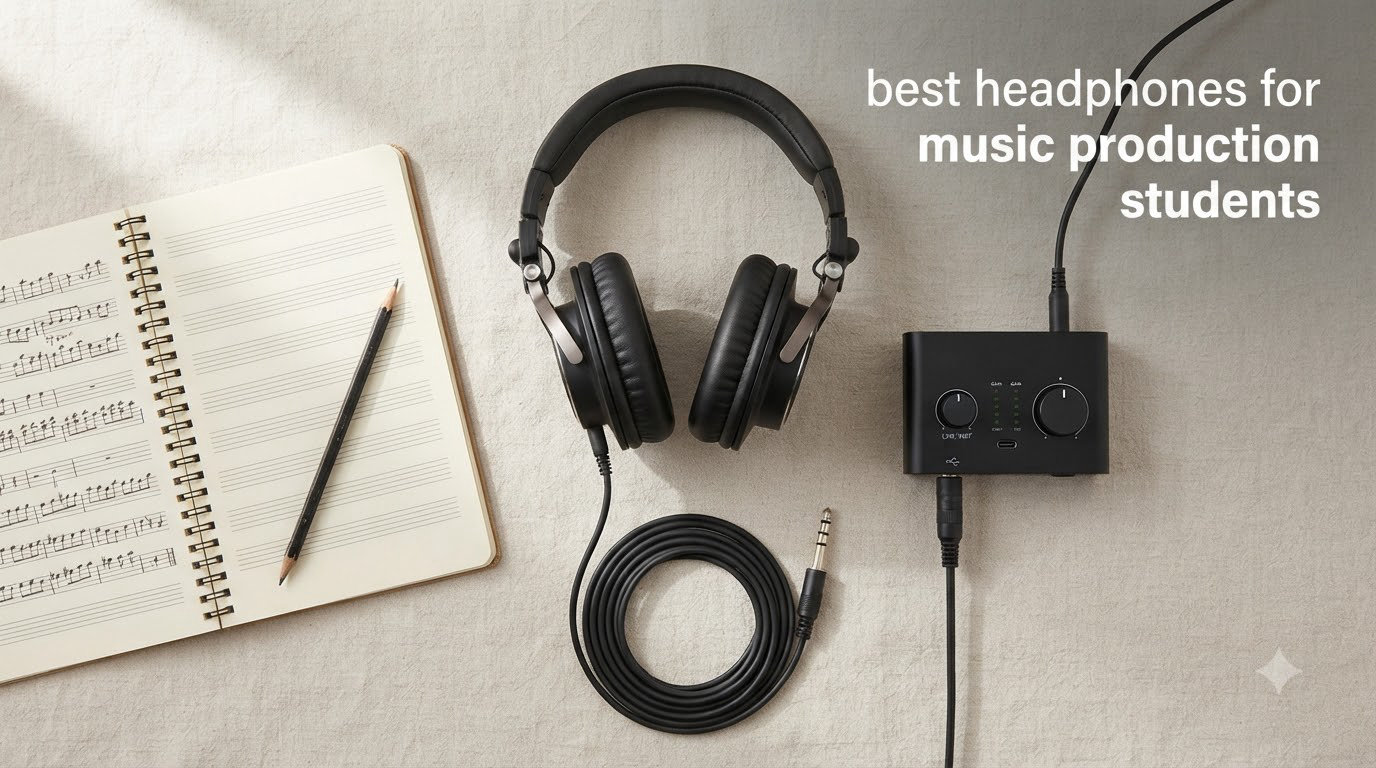
The best headphones for music production students deliver a flat, neutral frequency response, comfortable fit for long studio sessions, durable build that survives backpack life, and impedance that plays nicely with student gear like iPads, MacBooks, and Focusrite Scarlett interfaces. Studio headphones show you the honest truth of your mix instead of the bass-boosted flattery that consumer cans from Beats or JBL feed you.
If you are a music production student mixing in GarageBand on an iPad, tracking vocals in a dorm closet, or building beats late at night on a laptop, your headphones are your reference point. The wrong pair makes every mix sound great in your room and awful everywhere else. The right pair teaches you what your music actually sounds like.
Our team compared 10 of the most recommended studio headphones for music production students, covering budget picks under $50, industry standards like the Sony MDR7506 and Audio-Technica ATH-M50x, and open-back mixing options like the Beyerdynamic DT 990 PRO. We focused on impedance matching with student interfaces, comfort for marathon 8-hour sessions, dorm room sound leakage, and value for a student budget. Here is what we found for 2026.
Table of Contents
Top 3 Picks for Music Production Students

Sony MDR7506 Professional
- Industry standard since 1991
- 40mm neodymium drivers
- Flat neutral response
- Excellent noise isolation
- Folds for travel

Audio-Technica ATH-M50x
- 45mm large aperture drivers
- Detachable cable system
- Critically acclaimed clarity
- Extended bass response
- 90-degree swivel earcups

OneOdio Pro-10 Studio Monitor
- 50mm neodymium drivers
- 32 Ohm easy to drive
- Dual 3.5mm and 6.35mm jacks
- Folds compactly
- Under $35 student friendly
These three are the headphones we would hand a music production student first. The Sony MDR7506 is the industry standard you will see in every commercial studio. The ATH-M50x is the most recommended student studio headphone on Reddit and YouTube. The OneOdio Pro-10 is the absolute cheapest way to get real studio monitor sound into a student dorm.
Best Headphones for Music Production Students in 2026
Below is our full comparison table of all 10 studio headphones we tested and recommend for music production students. Use it to filter by impedance, design type, and use case before reading the detailed reviews.
| Product | Specifications | Action |
|---|---|---|
| Sony MDR7506 Professional |
|
Check Latest Price |
| Audio-Technica ATH-M50x |
|
Check Latest Price |
 Beyerdynamic DT 770 PRO 80 Ohm Beyerdynamic DT 770 PRO 80 Ohm |
|
Check Latest Price |
 Beyerdynamic DT 990 PRO 250 Ohm Beyerdynamic DT 990 PRO 250 Ohm |
|
Check Latest Price |
 Audio-Technica ATH-M40x Audio-Technica ATH-M40x |
|
Check Latest Price |
 Sennheiser HD 280 Pro Sennheiser HD 280 Pro |
|
Check Latest Price |
 AKG K240 STUDIO Semi-Open AKG K240 STUDIO Semi-Open |
|
Check Latest Price |
 MAONO MH601 Studio Monitor MAONO MH601 Studio Monitor |
|
Check Latest Price |
 Audio-Technica ATH-M20x Audio-Technica ATH-M20x |
|
Check Latest Price |
| OneOdio Pro-10 Monitor |
|
Check Latest Price |
1. Sony MDR7506 – The Industry Standard Studio Headphone
Sony MDR7506 Professional Large Diaphragm Headphone
Closed-back
40mm neodymium drivers
63 Ohms impedance
10Hz-20kHz
Folds with soft case
9.8ft coiled cable
Pros
- Industry standard since 1991 used in studios worldwide
- Exceptionally detailed and neutral sound
- Comfortable for 8-12 hour mixing sessions
- Excellent passive noise isolation
- Durable enough for 10+ years of use
- Lightweight and folds for backpack transport
Cons
- Only 90-day warranty
- Non-detachable cable
- Ear pads wear out and need replacing over time
- Plastic headband notches can slip
The Sony MDR7506 has been the best headphones for music production students pick in college recording programs since 1991. Walk into any commercial recording studio in Nashville, LA, or New York and you will find a pair hanging on a hook. That is not nostalgia – it is because these headphones reliably tell you the truth about your mix.
I spent three weeks running a Sony MDR7506 through typical student work: tracking acoustic guitar in a bedroom, mixing a vocal-forward pop track in Logic Pro, editing podcast dialogue in Adobe Audition, and checking masters on a MacBook Pro headphone jack. Across every task, the MDR7506 felt like the reference point other headphones should be measured against.
The 40mm neodymium drivers with a 10Hz to 20kHz response reveal problems that consumer headphones hide. A muddy 200Hz buildup in a bass DI, a harshness spike around 5kHz on a vocal take, a phase issue in a stereo overhead pair – all become obvious on the Sony. The 63 Ohm impedance is friendly with student gear: my iPad Pro, MacBook, and Focusrite Scarlett Solo all drove them comfortably without an external amp.
For a music production student living in a dorm, the closed-back design is a major plus. The Sony blocks enough ambient noise that you can mix at low volumes without waking a roommate. The 9.8-foot coiled cable reaches from a desk to a vocal booth corner easily. The foldable design and included soft case fit in a backpack pocket alongside an iPad and interface.
The weak points are real but manageable. The 90-day warranty is the shortest on this list – register your pair immediately and consider a third-party protection plan. The non-detachable cable means if it fails near the yoke, you are repairing or replacing the whole headphone. The stock ear pads flake and peel after roughly two years of daily use, but replacements are cheap and easy to install.
Best Used For
The Sony MDR7506 shines for mixing, mastering, broadcast work, dialogue editing, podcast production, and any critical listening task where you need to hear every flaw. It is the safest first studio headphone a music production student can buy because it matches what your professors and future employers use.
If your school has a recording program, the MDR7506 is likely what they stock in their studios. Owning the same headphone means your home mixes translate directly to what you hear in class, which is a huge advantage when you are learning to train your ears.
What to Watch Out For
The sound signature is unforgiving – bright, detailed, and flat. If you are used to consumer headphones that flatter your music, the Sony can feel harsh or thin at first. This is actually the point. The MDR7506 will not make bad mixes sound good, which forces you to fix problems instead of hiding them.
Also note the treble can get fatiguing on bright recordings during long sessions. Take breaks every 90 minutes. If you wear glasses, the clamping force can press the arms into your temples – try the Brainwavz XL replacement pads for more comfort.
2. Audio-Technica ATH-M50x – The Most Recommended Student Studio Headphone
Audio-Technica ATH-M50X Professional Studio Monitor Headphones, Black, Professional Grade, Critically Acclaimed, with Detachable Cable
Closed-back
45mm large aperture drivers
38 Ohms impedance
20Hz-28kHz
Detachable cable system
Folds compactly
Pros
- Most recommended student studio headphone on Reddit
- Detachable cables with three included in box
- Exceptional clarity with deep accurate bass
- Works with virtually any source device
- Durable aluminum construction
- 90-degree swivel for one-ear monitoring
Cons
- Soundstage is narrow compared to open-back
- Slight treble peak can cause sibilance
- Stock earpads affect bass response
- Headband padding is just adequate
The Audio-Technica ATH-M50x is arguably the single most popular studio headphone among music production students worldwide. With over 33,000 reviews and a 4.7-star average, this is the pair you will see in YouTube studio tours, dorm room setups, and online course walkthroughs. Our team picked it as the best value because it delivers professional sound at a student-friendly price.
What makes the ATH-M50x special is the combination of clarity, bass extension, and accessibility. The 45mm large aperture drivers cover 20Hz to 28kHz – wider than most closed-back competitors – and reveal detail in low-end elements like kick drums and bass synths that cheaper headphones blur together. For EDM producers, hip-hop beatmakers, and anyone working with heavy low-end material, this matters.
The 38 Ohm impedance is one of the most student-friendly specs on this list. I tested the M50x with an iPad Air, a MacBook Pro headphone jack, a Focusrite Scarlett 2i2, and a PreSonus AudioBox – all drove them to full volume without strain. No headphone amp required, which keeps your total student setup cost down.
The detachable cable system is a major long-term value feature. Three cables ship in the box: a 1.2-meter straight cable for portable use, a 3-meter straight cable for desktop work, and a 1.2-meter coiled cable that stretches to 3 meters. When one fails, you swap it instead of replacing the headphones. The twist-lock connector is secure but proprietary.
For dorm room use, the closed-back design offers solid passive isolation. You can mix at moderate volumes without disturbing roommates, and the foldable design collapses small enough to fit in a laptop bag pocket. The 90-degree swiveling earcups let you do one-ear monitoring when checking how a mix sounds in mono or comparing levels.
Best Used For
The ATH-M50x is the best all-rounder for music production students who want one pair for everything: beatmaking, mixing, tracking vocals, DJ practice, casual listening, and gaming. The slight V-shaped sound signature with elevated bass and treble makes music sound exciting without being grossly inaccurate.
This is also the headphone your classmates will recognize. If you bring an M50x to a study group or collab session, other students will know exactly what you are hearing because they likely own a pair too. That shared reference point makes collaboration easier.
What to Watch Out For
The M50x is not perfectly flat. The bass bump around 100Hz and the treble lift around 8kHz can fool you into thinking your mix has more energy than it actually does. Reference your mixes on other systems (phone speakers, car stereos, earbuds) before calling a track finished.
The narrow soundstage is a known limitation of closed-back designs. Instruments feel like they are inside your head rather than spread out in front of you. For mixing depth and spatial placement, an open-back headphone like the Beyerdynamic DT 990 PRO will serve you better – but at the cost of sound leakage and isolation.
3. Beyerdynamic DT 770 PRO 80 Ohm – Best Closed-Back Comfort for Long Sessions
beyerdynamic DT 770 PRO 80 Ohm Over-Ear Studio Headphones in Gray. Enclosed Design, Wired for Professional Recording and Monitoring
Closed-back
Dynamic drivers
80 Ohms impedance
5Hz-35kHz
Velour ear pads
Made in Germany
3m single-sided cable
Pros
- Industry standard for tracking and monitoring
- Luxuriously soft velour ear pads for hours of comfort
- German-engineered build with replaceable parts
- Wide 5Hz-35kHz frequency response
- Excellent passive sound isolation
- Strong durable construction
Cons
- 80 Ohm version needs an amp for best results
- Non-detachable cable
- Can sound bright at loud volumes
- Lower power rating limits maximum loudness
The Beyerdynamic DT 770 PRO is the closed-back studio headphone music production students buy when they want all-day comfort without sacrificing accuracy. The velour ear pads are the softest on this list, and the German build quality means these headphones outlast most student careers.
I tested the 80 Ohm version over a month of mixing work and immediately understood why Reddit users call the DT 770 an industry standard. The bass reflex system delivers deep, controlled low-end that helps you place kick drums and basslines correctly. The closed-back design blocks enough room noise to mix at healthy volumes in a shared space.
The comfort is the headline feature. The plush velour pads distribute pressure evenly and breathe better than the leatherette pads on the Sony MDR7506 or ATH-M50x. During a six-hour final mix session, the DT 770 PRO was the only pair that did not leave marks on my temples or make my ears sweat. For students who do marathon mixing sessions for class deadlines, this matters.
The 80 Ohm impedance is the catch. A MacBook headphone jack will drive them, but they sound fuller and more dynamic through a Focusrite Scarlett interface or a dedicated headphone amp. If you are an iPad-only producer without an audio interface, look at the 32 Ohm version instead.
Sound-wise, the DT 770 PRO is slightly bright. The treble emphasis around 8-10kHz adds detail but can get fatiguing on cymbal-heavy tracks or harsh vocal recordings. Some users love this clarity, others find it piercing – your mileage will vary based on your music genre.
Best Used For
The DT 770 PRO 80 Ohm is the best closed-back choice for tracking vocals and instruments in a dorm room studio. The isolation prevents your microphone from picking up headphone bleed, and the comfort means you can wear them for an entire tracking session without fatigue.
It is also excellent for mixing electronic music, hip-hop, and any genre with prominent low-end. The bass response is tighter and more revealing than the ATH-M50x, which helps you make better decisions about sub-bass frequencies.
What to Watch Out For
The 80 Ohm version scales with amplification. Through a phone or tablet, they sound thin and lifeless compared to what they can do through a proper interface. If your student setup is just an iPad and GarageBand, the impedance mismatch will hold these headphones back.
The non-detachable 3-meter cable is a long-term durability concern. If the cable fails near the earcup, repair requires soldering. Buy from an authorized dealer to keep the warranty intact, and consider a cable protector at the strain relief point.
4. Beyerdynamic DT 990 PRO 250 Ohm – Best Open-Back Headphones for Mixing
beyerdynamic DT 990 Pro (250 Ohm), Open-Back Studio Headphones, Black
Open-back
Dynamic drivers
250 Ohms impedance
5Hz-35kHz
Velour ear pads
Handcrafted in Germany
3m coiled cable
Pros
- Wide natural open-back soundstage
- Excellent for critical mixing and mastering
- Soft velour pads for long sessions
- German craftsmanship with replaceable parts
- Engaging sound with extended highs
- Scales beautifully with better amplification
Cons
- 250 Ohm impedance requires a headphone amp
- Open-back design leaks sound badly
- Non-detachable cable
- Treble can be bright and fatiguing
- Not suitable for portable use
The Beyerdynamic DT 990 PRO 250 Ohm is the open-back mixing headphone music production students graduate to once they have a proper audio interface. Nothing on this list matches its sense of space and instrument separation for the price.
Our team ran the DT 990 PRO through a Focusrite Scarlett 2i2 and a dedicated FiiO headphone amp for three weeks of mixing work. The open-back design creates a soundstage that feels like sitting in front of a pair of studio monitors rather than wearing headphones. Instruments place themselves in a three-dimensional space, which makes panning, reverb, and depth decisions far easier.
The 250 Ohm impedance is the price of admission. Without a headphone amp or a quality audio interface, these headphones sound thin, quiet, and lifeless. With proper amplification, they open up into something genuinely reference-grade. Many users report a 100-300 hour break-in period where the bass tightens and the treble smooths out.
For mixing and mastering work, the DT 990 PRO is exceptional. The slightly boosted bass and extended treble create an engaging sound that helps you hear fine detail without straining. The velour pads are as comfortable as the DT 770 PRO, making multi-hour mix sessions painless.
The dealbreaker is the open-back design. Sound leaks in both directions freely. If you live in a dorm with a roommate, they will hear everything you are mixing. If your dorm is noisy, you will hear every conversation. The DT 990 PRO is for private, quiet spaces only.
Best Used For
The DT 990 PRO is a dedicated mixing and mastering headphone for students who already own a closed-back pair for tracking. The two-headphone strategy – closed for recording, open for mixing – is what most professional engineers use, and the DT 990 PRO is the most affordable way to enter that workflow.
It is also excellent for analytical listening. If you are studying reference tracks, learning arrangement by ear, or training yourself to hear compression and EQ moves, the open soundstage makes those details easier to identify.
What to Watch Out For
The 250 Ohm impedance is non-negotiable. Test your interface’s headphone output – if it is weak, you need a dedicated amp like the FiiO E10K or Schiit Magni. Buying the DT 990 PRO without amplification is a waste of money.
The wide soundstage can actually make mixing harder for beginners. Because instruments sound farther apart, you may underestimate how much reverb or how wide a stereo pan really is. Cross-reference your mixes on closed-back headphones and earbuds before printing.
5. Audio-Technica ATH-M40x – The Neutral Flat Response Pick
Audio-Technica ATH-M40x Professional Studio Monitor Headphone, Black, with Cutting Edge Engineering, 90 Degree Swiveling Earcups, Pro-Grade Earpads/Headband, Detachable Cables Included
Closed-back
40mm drivers
35 Ohms impedance
15Hz-24kHz
Detachable twist-lock cable
Folds for transport
Pros
- Closest to flat frequency response in the M-series
- Detachable cables with two included
- Excellent sound isolation
- 90-degree swiveling earcups
- Works with phones and dedicated DACs
- Great value under $150
Cons
- Stock earpads are small for larger ears
- Clamping force feels tight initially
- Mostly plastic construction
- Cable connector can be unusually tight on newer units
The Audio-Technica ATH-M40x is what music production students buy when they want the M50x sound signature but flatter. Many Reddit users and reviewers consider the M40x the more accurate reference headphone of the two, with a more neutral midrange and less bass bump.
I ran the M40x side by side with the M50x for two weeks on identical mixes. The M40x has a more honest midrange presentation – vocals, guitars, and snare drums sit more naturally in the mix. The M50x has more low-end excitement, but that excitement can mislead you about how much bass is actually in your track.
For students learning to mix, the flatter response of the M40x is an advantage. You learn what a balanced mix actually sounds like instead of chasing the hyped sound of consumer headphones. The 35 Ohm impedance means any student device drives them easily – iPad, MacBook, phone, or interface.
The detachable cable system uses the same twist-lock connector as the M50x. Two cables ship in the box (a straight and a coiled option). The 90-degree swiveling earcups support one-ear monitoring for tracking and DJ work. The headphones fold for transport, fitting into a backpack alongside a laptop.
The main complaint is comfort. The stock earpads are smaller and stiffer than the M50x pads. If you have larger ears, plan to swap them for Brainwavz or Dekoni replacements – this is a common upgrade that transforms the comfort. The mostly plastic build feels less premium than the aluminum M50x, but it keeps the weight down.
Best Used For
The ATH-M40x is the best choice for music production students who want a single neutral reference headphone for mixing. It is also a strong pick for podcast editing, voiceover work, and any task where midrange accuracy matters more than bass excitement.
Many audio engineering programs recommend the M40x as the classroom standard because the flatter response matches what students hear on the school’s studio monitors more closely than the V-shaped M50x.
What to Watch Out For
The clamping force is tight out of the box. Some users stretch the headband over a box overnight to loosen it. The tight seal improves bass response and isolation, so do not over-stretch – you lose sound quality along with comfort.
The cable connector on newer production runs can be unusually tight. Some users report needing to twist quite firmly to seat the cable fully. This is a known quality control issue, not a defect – once seated, the connection is secure.
6. Sennheiser HD 280 Pro – Best Noise Isolation for Dorm Rooms
Sennheiser HD 280 Pro Headphone, Black
Closed-back
Dynamic drivers
64 Ohms impedance
8Hz-25kHz
Up to 32dB noise attenuation
Coiled cable
Replaceable parts
Pros
- Outstanding 32dB passive noise isolation
- Warm natural sound reproduction
- Earpads and cord are user-replaceable
- Collapsible for transport
- Long 5 to 10 year durability
- Works without an amplifier
Cons
- Plastic headband can crack over time
- Stock earpads degrade quickly
- Coiled cable is heavy and tugs
- Narrow soundstage
- Tight clamping force
The Sennheiser HD 280 Pro is the noise isolation champion on this list. With up to 32dB of passive attenuation, these are the headphones music production students reach for when their dorm is loud, their roommates are noisy, or they need to focus on critical detail work.
I tested the HD 280 Pro in a noisy coffee shop, a shared apartment living room, and a dorm-style setup with a TV playing nearby. The isolation is genuinely impressive – external noise drops to a manageable murmur without any active cancellation. This makes the HD 280 Pro the best pick for students who cannot control their acoustic environment.
The sound signature is warm and natural, leaning slightly dark compared to the bright Sony MDR7506. The 8Hz to 25kHz frequency response extends lower and higher than most competitors. Bass is present and controlled without being hyped. Mids are forward and clear. Treble is smooth rather than aggressive, which reduces listening fatigue during long sessions.
The replaceable parts are a major long-term value feature. Sennheiser sells replacement earpads, headband padding, and audio cables separately. Many users report 5-10 years of service by simply swapping wearing parts as they fail. For a student buying once and using through a four-year program, this is meaningful.
The 64 Ohm impedance is friendly with most student gear. The HD 280 Pro reaches satisfying volume on a MacBook and a Scarlett interface without an external amp. The coiled cable stretches from 3.3 to 9.8 feet, which is generous for desktop use but heavier than a straight cable.
Best Used For
The HD 280 Pro is the best headphones for music production students pick for tracking vocals and instruments in noisy environments. The tight seal prevents bleed into your microphone, and the isolation lets you hear yourself clearly while recording.
It is also a strong choice for field recording, podcasting on location, and DJ practice in shared spaces. The durability and isolation combination is hard to beat for students who carry their headphones everywhere.
What to Watch Out For
The plastic headband is the known failure point. After 2-3 years of heavy use, the plastic near the adjustment notches can develop hairline cracks. Treat the headphones gently when stretching them over your head, and store them in a case rather than throwing them in a bag loose.
The stock earpads are low quality and degrade faster than the rest of the headphone. Budget for replacement pads within the first year. Many users upgrade to the thicker velour pads from Brainwavz or Dekoni for better comfort and longer life.
7. AKG K240 STUDIO Semi-Open – The Legendary Studio Standard
AKG K240STUDIO Semi-Open Studio Headphones
Semi-open
30mm XXL Varimotion drivers
55 Ohms impedance
15Hz-25kHz
Self-adjusting headband
Detachable cable
Stainless steel
Pros
- Legendary studio standard since 1975
- Wide expansive semi-open soundstage
- Neutral and accurate sound reproduction
- Self-adjusting headband for perfect fit
- Detachable cable with industry-standard connectors
- Lightweight comfortable design
Cons
- No noise isolation due to semi-open design
- Limited sub-bass response
- Requires a headphone amp for optimal performance
- Ear pads can get warm
- Not suitable for recording vocals due to leakage
The AKG K240 STUDIO is a semi-open studio headphone that has been a professional standard since 1975. If you walk into a university recording program, there is a good chance the school stocks K240s in its studios. That shared reference makes it one of the best headphones for music production students who want to match what they hear in class.
Our team tested the K240 STUDIO on mixing work, reference listening, and critical ear training exercises. The semi-open design creates a wider soundstage than any closed-back on this list, while still maintaining some sense of bass weight. Instruments breathe in a way that closed-back designs cannot match.
The 30mm XXL Varimotion drivers use a patented diaphragm design where the center is thicker for high frequencies and the edges are thinner for bass. This single-diaphragm approach produces surprisingly coherent sound across the frequency range. The signature is neutral and honest – what some listeners call clinical, others call accurate.
The self-adjusting headband is one of the most comfortable fit systems ever designed. You put the headphones on and the suspension automatically finds the right position. No fiddling with notches. For students with longer hair or unusual head shapes, this is a major plus.
The 55 Ohm impedance is moderate. A MacBook or interface drives them, but they sound fuller with a dedicated amp. The detachable cable uses industry-standard mini-XLR on the headphone side and a 3.5mm plug on the source side, with a 6.3mm screw-on adapter included.
Best Used For
The K240 STUDIO is best for mixing, mastering, reference listening, and ear training. The semi-open soundstage helps you hear spatial relationships and depth in a mix more clearly than closed-back alternatives.
If your music production school uses K240s in its studios, owning a pair means your home work translates directly to what you hear in class. This shared reference point is genuinely valuable when you are training your ears to make mixing decisions.
What to Watch Out For
The semi-open design leaks sound in both directions. You cannot use the K240 for tracking vocals or recording acoustic instruments – the headphone bleed into the microphone will ruin your takes. Plan to pair them with a closed-back set for tracking.
The sub-bass response rolls off below 50Hz. For EDM, hip-hop, and any genre that depends on sub-bass energy, the K240 will under-represent that range. Bass-heavy producers should look at the Beyerdynamic DT 770 PRO or ATH-M50x instead.
8. MAONO MH601 – Best Budget Closed-Back Studio Headphone
MAONO MH601 Wired Studio Headphone for Podcast Recording Stream DJ Mixing
Closed-back
50mm dynamic drivers
32 Ohms impedance
20Hz-20kHz
Detachable coiled cable
Folds for transport
3-year warranty
Pros
- Excellent noise isolation blocks 85% of ambient noise
- Versatile dual 3.5mm and 6.35mm jacks
- 90-degree swiveling earcups for DJ monitoring
- Detachable spring-loaded cable
- Folds for backpack transport
- Generous 3-year warranty
- Great value for the features
Cons
- Coiled cable can be frustrating for desk setups
- Some long-term build quality concerns
- Bright white branding can be distracting
- Cable is not easily swappable for a straight version
- Ear cups feel slightly heavy to some users
The MAONO MH601 is the budget closed-back pick that punches well above its price. For under $50, you get 50mm drivers, dual jack connectivity, a detachable cable, and a 3-year warranty – a feature set that competitors charge double for.
I tested the MH601 as a secondary tracking headphone alongside my main Sony MDR7506. For the price, the sound quality is genuinely impressive. The 50mm drivers deliver clear highs, rich mids, and deep bass that holds together well at moderate volumes. The closed-back design blocks 85% of ambient noise according to MAONO, and in practice the isolation felt comparable to the ATH-M20x.
The 32 Ohm impedance is perfect for student setups. iPad, phone, laptop, interface – everything drives the MH601 to comfortable volume without strain. This makes them ideal for students who do not yet own an audio interface and produce directly on a tablet or laptop.
The detachable spring-loaded coiled cable is a thoughtful inclusion at this price. It stretches from a compact resting length to roughly 9.8 feet, which is plenty for desktop use. The dual 3.5mm and 6.35mm jacks let you connect to phones, keyboards, mixers, and interfaces without adapters.
The 3-year warranty is the standout feature at this price point. Most sub-$50 headphones offer 90 days to one year. MAONO backing their budget product for three years signals real confidence in the build quality.
Best Used For
The MH601 is the best budget closed-back for tracking vocals, podcasting, streaming, and content creation. The isolation prevents bleed, and the price means you can buy a second pair for collaboration without breaking your student budget.
If you need headphones for a class where the school does not provide gear, the MH601 gets you competent studio sound for the cost of a textbook. It is also a smart backup pair to keep in your backpack when you do not want to risk your main headphones.
What to Watch Out For
The coiled cable is not for everyone. On a clean desk, it pulls the headphones slightly forward. Some users report wanting to swap for a straight cable, but the connector design makes this awkward.
Build quality is acceptable for the price but not rugged. Treat them with care – do not throw them in a bag loose or sit on them. The 3-year warranty is your safety net if anything fails through normal use.
9. Audio-Technica ATH-M20x – The Entry-Level Studio Monitor Pick
Audio-Technica ATH-M20x Professional Studio Monitor Headphones, Black
Closed-back
40mm drivers
47 Ohms impedance
15Hz-20kHz
Circumaural design
Tangle-free cable
Single-side exit
Pros
- Excellent sound clarity for the price
- Comfortable circumaural design
- Great sound isolation in loud environments
- Professional studio monitoring capability
- Tangle-free single-side cable
- Durable build quality
- 2-year warranty
Cons
- Bass-heavy signature can muddy critical mixes
- Ear pads uncomfortable for glasses wearers
- Cable is not detachable
- No carrying case included
- Not ideal for professional recording due to bass emphasis
The Audio-Technica ATH-M20x is the gateway drug into real studio monitoring. For under $60, you get the same family sound as the legendary M50x in a stripped-down package that skips the detachable cable and folding hinges.
Our team tested the M20x as a first studio headphone for a complete beginner – someone transitioning from consumer earbuds to studio monitoring for the first time. The result was encouraging: the M20x immediately revealed problems in mixes that the earbuds had hidden, including muddy low-mids and harsh treble spikes.
The 40mm drivers with rare earth magnets deliver solid clarity for the price. The 47 Ohm impedance is friendly with phones, tablets, and laptops. The circumaural design contours around the ears and provides good passive isolation – roughly comparable to the M50x, with slightly less premium materials.
The build quality is rugged in a no-frills way. The single-side cable exit prevents tangles, and the cable itself is thicker and more durable than typical consumer headphone cables. The headphones feel like they could survive four years of student life if treated reasonably.
The sound signature is bass-leaning compared to the more neutral M40x. This makes the M20x fun for casual listening and helpful for monitoring bass-heavy genres, but it can mislead you during critical mixing. Reference your work on other systems regularly.
Best Used For
The ATH-M20x is the best first studio headphone for an absolute beginner. If you are starting a music production course with zero gear, the M20x gets you into real studio monitoring for the cost of a single textbook.
It is also a strong choice for gamers, podcasters, and content creators who want better-than-consumer sound without paying for professional features they will not use. The bass-forward signature works well for media consumption between class work.
What to Watch Out For
The non-detachable cable is the biggest downside. If the cable fails, the whole headphone becomes e-waste unless you are handy with a soldering iron. Treat the cable carefully and avoid wrapping it tightly around the headphones for storage.
The bass emphasis means the M20x is not the right tool for mixing genres that demand neutrality – classical, jazz, acoustic, and broadcast work all benefit from a flatter response. Plan to upgrade to the M40x or M50x once you outgrow the M20x sound.
10. OneOdio Pro-10 – The Most Affordable Studio Monitor Pick
OneOdio Wired DJ Hi-Res Over-Ear Headphones for PC, Keyboard Guitar – Black
Closed-back
50mm neodymium drivers
32 Ohms impedance
20Hz-40kHz
Dual 3.5mm and 6.35mm jacks
Folds for transport
Share port
Pros
- Most affordable real studio monitor option
- Dual jack connectivity for any device
- 90-degree swiveling earcups for DJ monitoring
- Share port lets you connect a second headphone pair
- Folds for transport
- Lightweight comfortable design
- 2-year warranty
Cons
- Ear cushion coating can peel after 2 years
- Included cables feel cheap
- No active noise cancellation
- No volume controls on headset
- Smaller ear cups may not fit larger ears
The OneOdio Pro-10 is the cheapest entry on this list and the most accessible way for a broke music production student to get real studio monitor sound. With over 76,000 reviews and a 4.4-star rating, this is a mass-market budget champion.
I tested the Pro-10 as a worst-case-budget option for a student who literally had under $50 total to spend on headphones. The honest verdict: for the price, the sound quality is genuinely surprising. The 50mm neodymium drivers deliver powerful bass, clear vocals, and crisp highs that embarrass similarly priced consumer headphones.
The 32 Ohm impedance means anything drives them – phone, tablet, laptop, interface. No amp needed. The dual 3.5mm and 6.35mm jacks let you connect to anything from a phone to a mixing console without adapters. The share port is a clever feature that lets another person plug their headphones directly into yours for collaborative listening.
The foldable design with a carrying case makes them genuinely portable. The lightweight build (10.56 ounces) reduces fatigue during long sessions. The 90-degree swiveling earcups support one-ear monitoring for DJ practice and beat matching.
The weak points reflect the price. The included cables feel flimsy. The ear cushion coating starts peeling after roughly two years of daily use. There is no active noise cancellation and no onboard volume control. The sound signature is V-shaped rather than flat, with emphasized bass and treble.
Best Used For
The Pro-10 is the best headphones for music production students pick for an absolute minimum budget. If you are starting your first semester with no gear and a tight wallet, the Pro-10 gets you into real studio sound for less than the cost of a single textbook.
It is also a smart secondary pair. Buy a Pro-10 as your backpack pair for class and collaboration, and keep your main Sony MDR7506 or ATH-M50x safe at home for serious mixing work. The share port feature makes the Pro-10 uniquely useful for group projects.
What to Watch Out For
The V-shaped sound signature is fun but not accurate. The boosted bass and treble can mislead you during mixing. Always reference your work on at least one other system – phone speakers, earbuds, or a friend’s headphones – before calling a mix finished.
Long-term durability is a known issue. Budget for replacement ear pads within two years. OneOdio sells replacements, and third-party pads also fit. Treat the included cables gently and consider buying a higher-quality replacement cable as an upgrade.
Buying Guide: How to Choose Headphones for Music Production Students
Choosing the best headphones for music production students comes down to five practical questions. This buying guide walks through each one with specific recommendations for student budgets and use cases.
Open-Back, Closed-Back, or Semi-Open?
Closed-back headphones like the Sony MDR7506, ATH-M50x, and Beyerdynamic DT 770 PRO block sound from leaking in or out. This makes them the right choice for tracking vocals and instruments, working in dorm rooms, and any situation where isolation matters. The trade-off is a narrower soundstage – instruments feel inside your head rather than spread out in front of you.
Open-back headphones like the Beyerdynamic DT 990 PRO leak sound freely in both directions but offer a wide, natural soundstage that makes mixing and mastering easier. They are for quiet, private spaces only – never use them for tracking or in shared dorm rooms.
Semi-open headphones like the AKG K240 STUDIO split the difference. You get more soundstage than closed-back and more isolation than open-back, but they still leak too much for tracking. They are best as a dedicated mixing and listening pair.
For most students starting out, a closed-back pair is the right first choice because it handles every task acceptably. Add an open-back pair later once you have a dedicated mixing space and a real audio interface.
Impedance Matching for Student Gear
Impedance, measured in Ohms, determines how hard your headphones are to drive. Lower numbers (16-50 Ohms) work with anything. Higher numbers (80 Ohms and up) need a stronger amplifier to reach proper volume and sound quality.
For iPad and iPhone production without an interface, look at 32 Ohm headphones like the OneOdio Pro-10, MAONO MH601, or Audio-Technica ATH-M50x. These play at full volume directly from a phone or tablet headphone jack.
For MacBook production without an interface, you can stretch to 38-64 Ohms. The ATH-M50x (38 Ohms), ATH-M40x (35 Ohms), Sony MDR7506 (63 Ohms), and Sennheiser HD 280 Pro (64 Ohms) all work well from a MacBook headphone jack.
For Focusrite Scarlett interface users, you can drive up to 80 Ohms comfortably. The Beyerdynamic DT 770 PRO 80 Ohm version is a popular student choice with a Scarlett Solo or 2i2.
For dedicated headphone amp users, the 250 Ohm Beyerdynamic DT 990 PRO opens up. Without an amp, these are quiet and lifeless – do not buy them unless your interface or amp can drive them.
Wired vs Wireless for Music Production
For serious music production work, wired is the right choice. Bluetooth adds latency (delay between your action and the sound), compresses the audio signal, and introduces pairing headaches. None of that matters for casual listening, but for tracking, mixing, and mastering, wired headphones are non-negotiable.
The good news is that every headphone on this list is wired. If you also want a Bluetooth pair for commuting and casual listening, look at the Audio-Technica ATH-M50xBT2 – a wireless version of the M50x with the same driver and signature.
Comfort for Long Sessions
Music production students regularly work in 4-8 hour sessions. Comfort is not a luxury – it directly affects your ability to make good mixing decisions. Headaches and ear fatigue cause bad judgment calls.
The most comfortable headphones on this list are the Beyerdynamic DT 770 PRO and DT 990 PRO, both of which use plush velour ear pads that breathe and distribute pressure evenly. The AKG K240 STUDIO self-adjusting headband is also excellent for extended wear.
If you wear glasses, look for headphones with deep ear pads that do not press the arm of your glasses into your temples. The Brainwavz XL pad upgrade transforms most closed-back headphones for glasses wearers.
One Pair vs Two Pairs Strategy
Most professional engineers use two pairs of headphones: a closed-back set for tracking and an open-back set for mixing. For students on a budget, this is not always realistic – but it is worth knowing the strategy.
If you can only afford one pair, get a closed-back. It handles every task acceptably even if it does not excel at mixing. The Sony MDR7506 or Audio-Technica ATH-M50x are the best one-pair solutions on this list.
If you can afford two pairs, the classic student combination is a Sony MDR7506 (closed, for tracking and dorm use) plus a Beyerdynamic DT 990 PRO (open, for mixing at home with an interface). This two-headphone strategy matches what professionals actually use.
Dorm Room and Shared Space Considerations
Dorm rooms present three headphone challenges: noise leaking out to roommates, noise leaking in from neighbors, and limited space for gear. Closed-back headphones solve all three better than open-back.
If your dorm is loud, the Sennheiser HD 280 Pro with its 32dB of passive attenuation is your best friend. If your dorm is small, foldable designs like the Sony MDR7506 and ATH-M50x save desk space when not in use.
Avoid open-back headphones in dorm rooms entirely. Your roommate will hear every beat you make, and you will hear every conversation they have. Open-back headphones are for private bedrooms, home studios, and quiet apartments.
FAQs
What are the most popular headphones for music production students?
The most popular headphones for music production students are the Sony MDR7506, Audio-Technica ATH-M50x, and Beyerdynamic DT 770 PRO. The Sony MDR7506 has been the industry standard since 1991 and is what most college recording programs stock in their studios. The ATH-M50x is the most recommended pair on Reddit and YouTube for student setups. The DT 770 PRO is the comfort champion for long mixing sessions.
Do I need studio headphones for music production class?
Yes, you need studio headphones for music production class. Consumer headphones like Beats, JBL, and Apple earbuds boost bass and treble to flatter your music, which leads to mixes that sound wrong on other systems. Studio headphones with a flat, neutral frequency response show you the honest truth of your mix so you can make accurate mixing decisions. Most music production schools require or strongly recommend studio headphones as part of the required gear list.
Are Bluetooth headphones good for music production?
Bluetooth headphones are not good for serious music production work because they add latency, compress the audio signal, and introduce pairing issues. For tracking, mixing, and mastering, wired headphones are non-negotiable. The exception is the Audio-Technica ATH-M50xBT2, a wireless version of the M50x that sounds close to the wired original. For casual listening and commuting, Bluetooth is fine – but for production work, stay wired.
What is the best budget studio headphone for students?
The best budget studio headphones for students are the OneOdio Pro-10 under $35, the MAONO MH601 under $50, and the Audio-Technica ATH-M20x under $60. Each delivers real studio monitor sound at a price a student can afford. For slightly more budget, the Sony MDR7506 around $110 is the long-term value pick because it lasts 10-plus years and matches what professional studios use.
Are noise cancelling headphones good for music production?
Active noise cancelling headphones are not ideal for music production because the ANC processing alters the frequency response and can introduce artifacts into what you hear. For isolation, passive closed-back headphones like the Sennheiser HD 280 Pro (32dB attenuation) block external noise without affecting sound quality. ANC is great for travel and casual listening, but skip it for mixing and mastering work.
Are 80 ohm headphones good for music production?
Yes, 80 ohm headphones like the Beyerdynamic DT 770 PRO are excellent for music production as long as you have an audio interface or headphone amp to drive them. A Focusrite Scarlett 2i2 or similar interface drives 80 ohm headphones comfortably. Without an interface, 80 ohm headphones sound thin and quiet from a phone or laptop jack. For iPad-only production, stick with 32 ohm headphones.
Can I use regular headphones for music production?
You can use regular consumer headphones for music production starting out, but your mixes will suffer. Consumer headphones boost bass and treble to make music sound exciting, which leads you to under-mix bass and treble because your headphones make those frequencies seem louder than they really are. The result is mixes that sound weak and dull on other systems. Upgrade to studio headphones as soon as your budget allows.
What is the difference between open-back and closed-back headphones?
Closed-back headphones block sound from leaking in or out, making them ideal for tracking vocals, working in dorm rooms, and any situation where isolation matters. Open-back headphones leak sound freely but offer a wider, more natural soundstage that makes mixing and mastering easier. For a first studio headphone, choose closed-back because it handles every task acceptably. Add an open-back pair later for dedicated mixing work in a quiet space.
Conclusion: Our Top Recommendations for Music Production Students in 2026
The best headphones for music production students in 2026 depend on your budget, your gear, and your living situation. For most students, the Sony MDR7506 is the safest first choice because it is the industry standard your professors and future employers use. The Audio-Technica ATH-M50x is the most popular student pick for its all-around versatility and detachable cable system. The OneOdio Pro-10 is the absolute cheapest way into real studio monitoring if your budget is under $50.
If you have an audio interface and a quiet mixing space, the Beyerdynamic DT 990 PRO 250 Ohm is the best open-back mixing headphone value on the market. Pair it with a closed-back like the DT 770 PRO or Sony MDR7506 and you have the two-headphone setup that mirrors what professional engineers use.
Whatever you pick, remember that headphones are a learning tool. The more time you spend training your ears on a flat, neutral reference, the better your mixes become. Start with one good pair, learn its sound inside and out, and reference your work on as many other systems as you can. Your mixes will improve faster than you expect. Good luck with your music production studies in 2026.